After 6 Months of Stagnation, India Resumes Silver Imports: Can Silver Prices Achieve a Breakthrough?

Publicado a 2026-08-24Actualizado a 2026-08-24

Resumen

India's resumption of silver imports signals restocking demand. Combined with the approaching peak season and eased foreign exchange pressure, the improvement in physical supply and demand supports silver prices.

Summary: India's resumption of silver imports releases restocking demand. Combined with the approaching peak season and eased foreign exchange pressure, improved physical supply and demand supports silver prices.

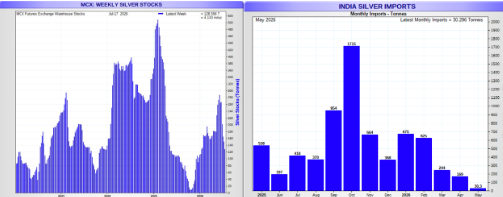
In August, India restarted permitting silver imports, with approximately 89.81 tons of silver entering through the India International Bullion Exchange (IIBX), ending a six-month import standstill. Concurrently, import licenses for about 400 tons of silver have been approved. Although the import volume is still far from a full recovery, the policy direction has shifted from comprehensive tightening to gradual permission, indicating that the most severe administrative restriction phase for Indian silver imports has passed.
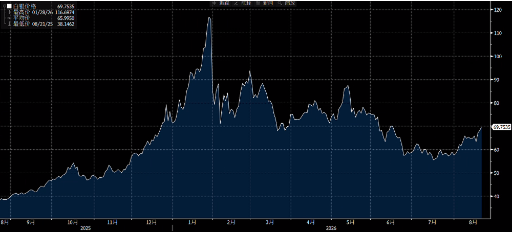
In May this year, due to tight foreign exchange liquidity and the depreciation of the rupee, the Indian government significantly increased the import duty on silver from 6% to 15%, requiring importers to obtain government permits for import. This immediately blocked silver import channels, tightened domestic silver supply, and caused a sharp decline in import volume. India's silver imports fell drastically from 747 tons in January to about 29 tons in June, rapidly depleting domestic inventories and causing the local premium relative to international prices to soar. The 30-day average premium once reached its highest level since at least 2019.
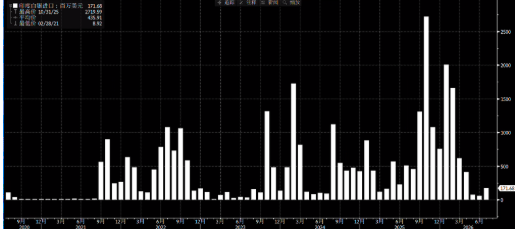
With the marginal easing of import restrictions, India's domestic silver premium has begun to narrow, with the 30-day average premium falling to $4 per ounce (approximately a 7% premium level). However, new licenses still require certificates of origin issued by official agencies, and traders also need to go through transportation, customs, and refining processes. Cumbersome approval procedures and logistics clearance delays continue to constrain the actual arrival pace. In the short term, market supply still relies on existing inventories and depleting replenishments. The domestic physical shortage situation in India has not fundamentally reversed.
Nevertheless, this premium level provides continuous arbitrage incentives for global traders. Although administrative barriers have not been fundamentally removed, traders are actively attempting to ship physical silver to the Indian market through various channels, positioning themselves in advance for further easing of restriction policies.
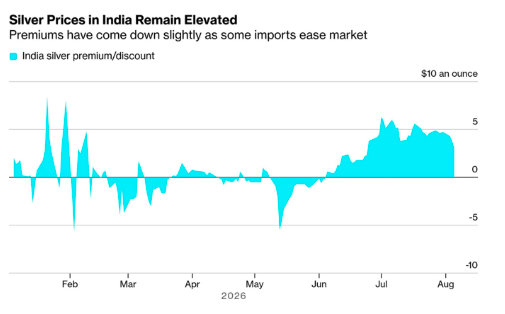
The chart shows India's silver premium surged significantly after May, reaching a historical high, before slightly retreating in August.

Article Conclusion

Indian Physical Demand and Restocking Cycle Initiation Provide a Bottom for Silver Prices

As one of the world's most important silver consumer markets, India accounts for 9% of global silverware demand in all forms (with its silverware demand alone constituting 63% of the global total). However, its domestic silver supply is highly dependent on imports. Therefore, changes in India's import policies are not merely regional adjustments but a crucial variable in the global silver supply and demand equation.

The six-month import standstill severely depleted India's domestic inventories, with the physical shortage situation providing solid bottom support for silver prices. As import restrictions ease marginally and restocking demand gradually releases, coupled with the approaching traditional consumption peak season in the second half of the year, the physical silver supply-demand structure is shifting from "extreme tightness" to "gradual improvement." Silver prices are expected to gain new upward momentum driven by the replenishment of physical demand.


Lecturas Relacionadas

Arthur Hayes Ten Thousand Words Interview: ETH to $30,000; FLOP Will Surpass ETH

Arthur Hayes Interview Summary: In a wide-ranging interview, Arthur Hayes discusses macroeconomic drivers for crypto, bullish predictions for ETH and BTC, and details his new project, Flop Network. On Macroeconomics & Market Outlook: Hayes argues that unsustainable US debt and potential Yield Curve Control (YCC) will drive massive liquidity into hard assets like Bitcoin. He views recent Treasury bond回购 operations as a key signal, comparing the current environment to the 2008 financial crisis that birthed Bitcoin. He predicts Bitcoin will break its all-time high, reaching around $126,000 by year-end, and could soar to $500,000 if the Fed removes limits on its FEMA repo facility. On Ethereum & Altcoins: Hayes is particularly bullish on ETH, calling it his top large-cap altcoin pick. He believes it will significantly outperform in this cycle, potentially reaching $20,000-$30,000, as it hasn't yet broken its 2021 high unlike other major assets. He values ETH for its established developer community and Lindy effect. On Regulation: He dismisses the US Clarity Act as irrelevant for crypto's core value proposition, stating that macroeconomic liquidity, not regulation, is the primary driver. On Flop Network: Hayes unveils his new project, Flop Network, designed to be a native currency for the AI Agent economy. The core thesis is that AI Agents need a货币 that can be directly converted into compute power (measured in FLOPs - Floating Point Operations). The network will use a "Proof of Useful Inference" consensus where miners earn FLOP tokens for processing AI推理 tasks. It will also provide decentralized storage for AI memory/context. The token will be distributed via a massive airdrop (targeting 20% of the 10-year supply) to early testnet participants and users, with no VC预售 or public sale. Mainnet is slated for Q1 2025. Hayes believes FLOP has a "binary" outcome: it could become the base money for the AI economy and rival Bitcoin, or it could fail.

Odaily星球日报Hace 18 min(s)

Arthur Hayes Ten Thousand Words Interview: ETH to $30,000; FLOP Will Surpass ETH

Odaily星球日报Hace 18 min(s)

Goldman Sachs Research Report Analysis: Samsung Electronics' Shareholder Returns Fall Short of Expectations, FCF Expansion Supports Valuation Recovery

Gold Sachs research report analysis indicates Samsung Electronics' announced shareholder return pool for 2026 (projected 90-110 trillion KRW) fell short of market expectations for a larger one-time payout. However, Goldman emphasizes that sustained Free Cash Flow (FCF) expansion and a stable, phased return mechanism are the true drivers for valuation repair, not a single event. The report maintains a Buy rating on Samsung ordinary shares with a 740,000 KRW target price, implying 74% upside. Samsung plans a ~30 trillion KRW dividend in Q3 2024, with the remaining returns from the 2026 pool executed post-January 2027 earnings via dividends and share buybacks/cancellations. Goldman estimates 2024-2026 cumulative FCF at ~270 trillion KRW. Assuming a 50% return ratio, total shareholder returns would be ~135 trillion KRW. After accounting for 2024-2025 payouts, the 2026 return is estimated near 106 trillion KRW, at the high end of guidance. While Samsung's short-term return scale lags peers like SK Hynix, its future return capacity is underpinned by robust FCF growth from memory and HBM businesses. Goldman forecasts FCF will significantly rise in 2027-2028, potentially boosting annual return pools to 179 trillion and 232 trillion KRW respectively under the existing policy, potentially matching or exceeding peers. Samsung's current valuation (1.7x P/B for 2027) is seen as attractive given high ROE projections (40%-50%). The core thesis is that Samsung's shareholder return story represents a structural improvement based on durable cash flow generation, not a one-time event.

marsbitHace 24 min(s)

Goldman Sachs Research Report Analysis: Samsung Electronics' Shareholder Returns Fall Short of Expectations, FCF Expansion Supports Valuation Recovery

marsbitHace 24 min(s)

Trading

Spot
活动图片