After Privacy Coins Surge, Does It Mean a Bear Market Is Coming?

marsbitPublicado a 2026-01-31Actualizado a 2026-01-31

Resumen

The article explores the sharp rise in privacy coins like ZEC and XMR as a potential signal of an impending bear market in the crypto cycle. Historically, privacy tokens tend to surge when other narratives—such as DeFi or NFTs—lose momentum, often marking a final speculative push before a downturn. In 2017, coins like ZEC and XMR gained attention as "better Bitcoin" alternatives, fueled by technological appeal and hype. By late 2021 and early 2022, privacy projects like Aleo attracted massive investments, though they ultimately failed to deliver practical, mainstream adoption. The recent surge in late 2025, with ZEC rising 20x in three months, lacked clear catalysts but may reflect growing unease with increasing regulatory scrutiny and reduced financial privacy in crypto. While figures like Arthur Hayes and firms like a16z promoted "privacy-as-a-service," the author suggests this may have been a tactic to facilitate sell-offs rather than genuine growth. The piece argues that extreme privacy features—such as Monero’s fully anonymous transactions—often cater to illicit use cases rather than mainstream needs, making them a target for regulators and exchanges. Most users and regulators seek balanced privacy—protection without complete anonymity—which current privacy tokens fail to provide. Without addressing real-world utility and acceptable levels of privacy, these coins may remain the last resort in cyclical market pumps, often leaving investors at a loss.

Author: Eric, Foresight News

Every bull market has its signs of ending. Looking back, among these signs, the sudden explosion of privacy tokens has never been absent.

This recurring phenomenon has the same reason each time: there's nothing left to hype. After all concepts and narratives have been exhausted, the final dance of capital usually chooses "privacy," a topic that has persisted since 2014.

Hype around privacy at the end of a bull market has logical rationality. After experiencing the noise, many people often suddenly realize, in the void of the bull-to-bear transition, what the original intention of Web3 was, then shout about making privacy and decentralization great again—but the result is just another round of speculation.

Although the process is the same, the triggers each time are not entirely identical.

2017 was the heyday of privacy tokens because there were no impressive DApps, and the sector was still in a phase of finding direction. Back then, ZEC, XMR, and DASH were absolute "hot stars," with discussion levels even surpassing Bitcoin. ZEC and XMR were launched with the "technological innovations" of zero-knowledge proofs and ring signatures, respectively, while DASH combined PoW and PoS.
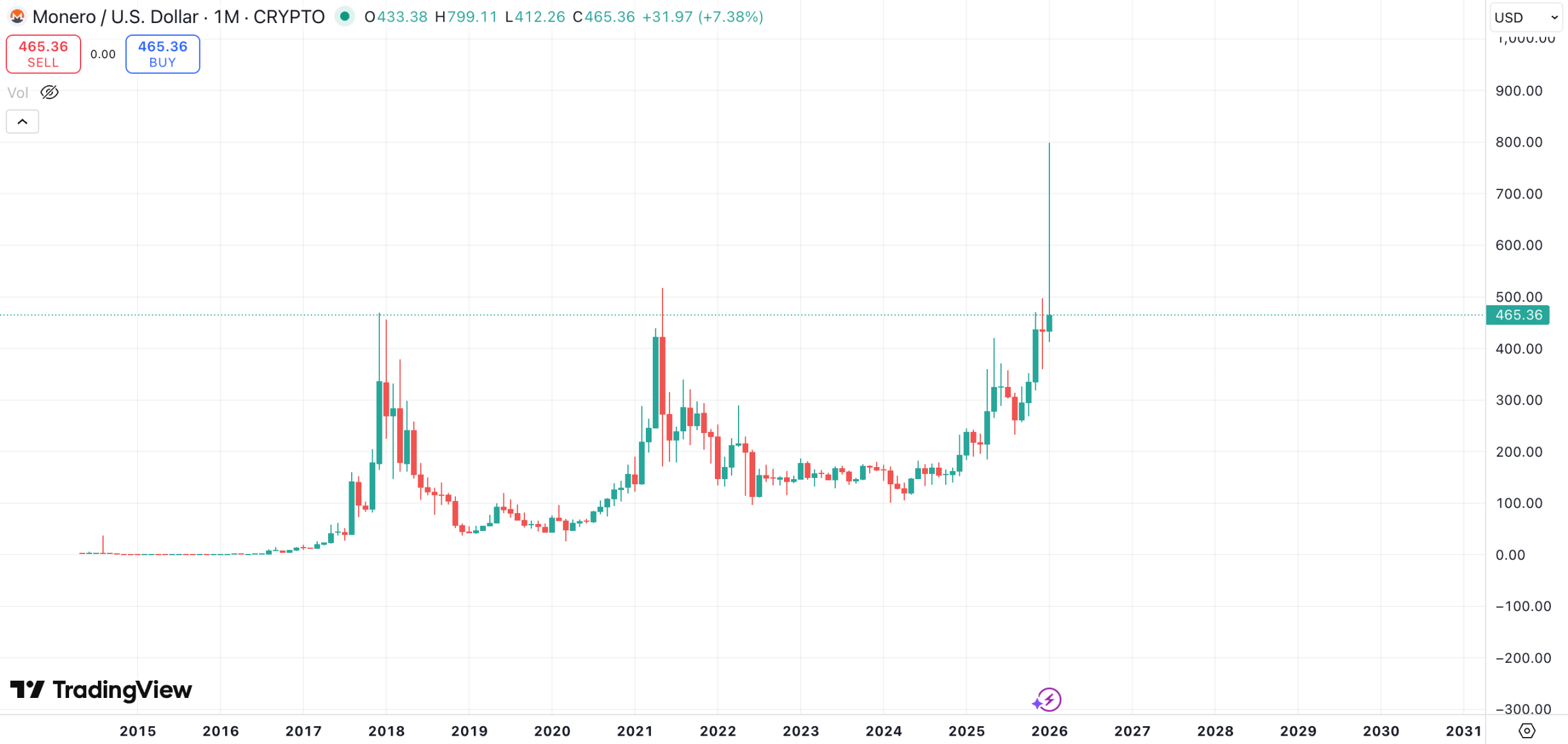
Readers who didn't experience that period might not understand the market's fervor for such tokens at the time. Back then, whether Bitcoin was the absolute core of cryptocurrency was controversial; many such tokens charged ahead under the banner of "better Bitcoin." ZEC's price once surged to $30,000 in early 2018, while Bitcoin's peak price in that cycle was less than $20,000.

Late 2021 and early 2022 were purely about forcing the privacy concept. After experiencing DeFi, NFT, and the metaverse, projects including Aleo received hundreds of millions in funding, with SoftBank, a16z, and Tiger Fund among the investors. The market at that time briefly believed that after the application explosion, privacy could finally move from concept to practical implementation.

Perhaps because everyone was making money and was euphoric, no one truly cared whether privacy was a mass need, or even if there was demand, whether demanders were willing to bear significant costs just to ensure privacy. The result was that it landed—but face-first.

In this cycle, the rise of privacy tokens represented by ZEC began in September 2025. Looking back, it's hard to pinpoint any specific reason at that time to explain why it rose 20 times in three months. If we must find a reason, it might be because it was "not so compliant."
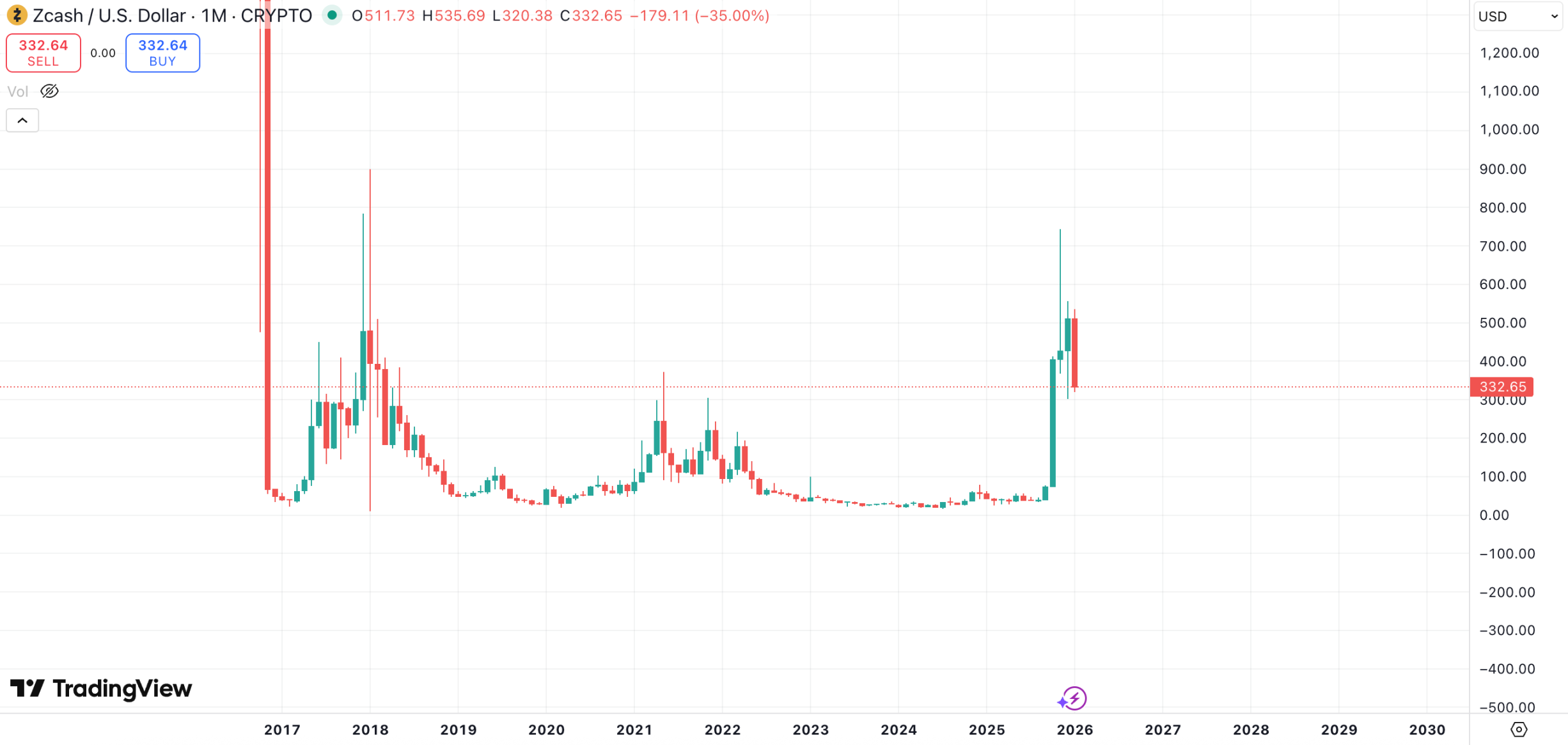
2025 can be said to be the year cryptocurrency was fully legitimized. Multiple countries in Europe and America successively introduced regulatory laws. Even supporting cryptocurrency development couldn't escape scrutiny under regulations like identity verification and anti-money laundering—DeFi was no exception. Thus, although cryptocurrency was no longer considered a security, it essentially wasn't much different from trading securities. Government scrutiny of individuals didn't relax at all; it only temporarily eased regulations on projects and institutions to avoid hindering innovation.

Additionally, the arrest of fraudster Qian Zhimin in the UK, and later the exposure of Chen Zhi whose Bitcoin was confiscated, revealed an open secret: although only you hold the private key, it's not difficult for law enforcement to make you hand it over. When this fact is laid bare again, it might trigger some investors to switch to privacy tokens.

But including BitMEX co-founder Arthur Hayes's shilling and a16z's mention of "privacy as a service" all happened after November. Judging from the price trend, this seems more like cover for dumping rather than driving the rise. XMR might have held on for two more months due to reasons like Iranian officials fleeing with funds or hackers who stole hundreds of millions in Bitcoin converting it to XMR, but it also peaked and fell rapidly.

Although we can't definitively say the bull market is over now, at least at the end of the last bull market, there were no shortage of well-known figures and institutions shilling privacy. The extremely similar plot should at least make us more vigilant.

The privacy concept has persisted from 2014 to today without dying out because it genuinely meets some gray demands, but it conflicts with actual "privacy" needs. In reality, what most people recognize as privacy protection isn't making data completely untraceable, but more about not being easily exposed. In financial transactions, dark pools exist to prevent large capital actions from affecting the market or being targeted by other funds, but this doesn't mean the transaction information itself can't be verified.

The privacy concept in Web3 is sometimes overly extreme. Zcash's privacy transactions are optional, while XMR is private by default—sender, receiver, and amount can't be verified on-chain, which is also the core reason XMR was delisted by over 70 global cryptocurrency exchanges in 2025. For most people, there seems to be insufficient reason to use XMR to hide traces. Moreover, the process of buying XMR itself is traceable; when you buy XMR, you might be suspected of engaging in illegal activities.

Simply put, most people just want their behavioral records protected and respected, not completely hidden; regulatory agencies especially cannot accept channels almost tailor-made for money laundering. With current technology, anonymous on-chain transfers of USDT are also achievable, so there's really not much reason to use a targeted asset just for privacy.

Web3 has been talking about privacy for over 10 years but seems to always avoid the question: "What level of privacy do we actually need?" Without finding real scenarios, privacy tokens may forever be the last bagholders in sector rotation.


Preguntas relacionadas

QAccording to the article, what is a common sign that a bull market in cryptocurrency might be ending?

AThe article states that a sudden surge in privacy coins is a common sign that a bull market might be ending, as it often represents the 'last dance' for capital when other narratives have been exhausted.

QWhat was the primary reason given for the rise of privacy coins like ZEC in September 2025?

AThe article suggests the main reason was that privacy coins were 'less compliant' with the increasing regulatory scrutiny on mainstream cryptocurrencies, which led some investors to seek assets that offered more anonymity.

QWhy does the author believe the 'privacy' narrative in Web3 is problematic?

AThe author argues that the Web3 privacy narrative is often too extreme, focusing on complete anonymity which is at odds with what most people and regulators actually want—protection and respect for data, not complete untraceability, which is often associated with illicit activities.

QWhat historical example does the article use to show the market's past enthusiasm for privacy coins?

AThe article cites the 2017 bull market where ZEC's price briefly reached $30,000, surpassing Bitcoin's price at the time, due to intense market speculation and the belief that these coins were 'better versions of Bitcoin'.

QWhat fundamental question does the article claim the Web3 privacy space has avoided for over a decade?

AThe article states that the space has avoided the crucial question: 'What degree of privacy do we actually need?', leading to a lack of real-world use cases and making privacy coins the last resort in market cycles.

Lecturas Relacionadas

$292 Million KelpDAO Cross-Chain Bridge Hack: Who Should Foot the Bill?

On April 18, 2026, an attacker stole 116,500 rsETH (worth ~$292M) from KelpDAO’s cross-chain bridge in 46 minutes—the largest DeFi exploit of 2026. The stolen assets were deposited into Aave V3 as collateral, causing $177–200M in bad debt and triggering a cascade of losses across nine DeFi protocols. Aave’s TVL dropped by ~$6B overnight. This legal analysis argues that KelpDAO and LayerZero Labs share concurrent liability, with fault apportioned 60%/40%. KelpDAO negligently configured its bridge with a 1-of-1 decentralized verifier network (DVN)—a single point of failure—despite LayerZero’s explicit recommendation of a 2-of-3 setup. LayerZero, which operated the compromised DVN, failed to secure its RPC infrastructure against a known poisoning attack vector. Both protocols’ terms of service cap liability at $200 (KelpDAO) or $50 (LayerZero), but these limits are likely unenforceable due to unconscionability, gross negligence exceptions, and potential securities law invalidation (if rsETH is deemed a security under the Howey test). Aave’s governance also faces fiduciary duty claims for raising rsETH’s loan-to-value ratio to 93%—far above competitors’ 72–75%—without adequately assessing bridge risks, amplifying the systemic fallout. Practical recovery targets include LayerZero Labs (a registered Canadian entity), KelpDAO’s founders, auditors, and identifiable Aave governance delegates. The incident underscores escalating legal risks for DeFi protocols, infrastructure providers, and governance participants.

marsbitHace 1 hora(s)

$292 Million KelpDAO Cross-Chain Bridge Hack: Who Should Foot the Bill?

marsbitHace 1 hora(s)

Insider Trading in War: 5 People Involved, the Highest Earner Was Arrested

On April 24, the U.S. Department of Justice arrested U.S. Army Special Forces Staff Sergeant Gannon Ken Van Dyke for insider trading related to the capture of Venezuelan President Nicolás Maduro on January 3. Van Dyke allegedly profited over $400,000 by placing bets on a prediction market, Polymarket, using insider knowledge of the covert operation. According to the indictment, Van Dyke registered an account (0x31a5) on December 26 and made a series of bets predicting Maduro’s capture and U.S. military involvement in Venezuela. He withdrew most of his funds on the day of the operation and attempted to obscure his tracks by transferring assets through crypto and brokerage accounts. This case marks the first time the DOJ has prosecuted insider trading on Polymarket. PolyBeats had previously identified five suspicious accounts, including Van Dyke’s—the highest earner—in January. The other accounts, with profits ranging from $34,000 to $145,000, remain under unofficial scrutiny but have not been charged. Their lower profits, indirect access to information, and unclear legal boundaries may complicate prosecution. Polymarket has since strengthened its market integrity rules, explicitly prohibiting trading based on confidential or insider information. Van Dyke’s arrest, nearly four months after his trades, signals increased regulatory attention and the persistent traceability of blockchain-based transactions.

marsbitHace 1 hora(s)

Insider Trading in War: 5 People Involved, the Highest Earner Was Arrested

marsbitHace 1 hora(s)

Bitwise: Bullish on Bitcoin's Performance in the Second Half of the Year, AI and Regulation Will Spark a New Altcoin Season

Bitwise CIO Matt Hougan and Research Lead Ryan Rasmussen express strong bullish sentiment on Bitcoin's long-term prospects, suggesting that its $1 million price target may be too conservative. They argue Bitcoin serves a dual role: as digital gold and a potential global settlement asset, especially amid declining trust in traditional monetary systems. Despite a weak Q1 2026 where nearly all crypto assets and prices saw double-digit declines, the analysts remain optimistic due to strong forward-looking catalysts, including institutional adoption via Bitcoin ETFs from major firms like Morgan Stanley and Goldman Sachs. Geopolitical instability, such as Iran’s mention of using Bitcoin for international payments, increases the value of Bitcoin’s “out-of-the-money call option” as a non-political, global settlement currency. This enhances its appeal beyond a mere store of value. . Additionally, Hougan highlights that a clearer regulatory token framework under current SEC leadership, combined with AI efficiency gains and high-performance blockchains, could fuel a new “altseason” by late 2026. This may lead to a wave of legitimate, value-capturing token projects, unlike the earlier ICO boom. . Bitwise also announced an Avalanche ETF, citing its unique architecture and rapid growth in real-world asset (RWA) tokenization, which has surged 10x to nearly $30 billion in two years. The firm believes Layer 1 blockchains are still early in their growth cycle, with significant potential ahead.

marsbitHace 1 hora(s)

Bitwise: Bullish on Bitcoin's Performance in the Second Half of the Year, AI and Regulation Will Spark a New Altcoin Season

marsbitHace 1 hora(s)

Trading

Spot
Futuros
活动图片




