After Premium Reset, Is It Time to Enter MSTR?

marsbitPublicado a 2026-01-28Actualizado a 2026-01-28

Resumen

MicroStrategy (MSTR), the world's largest corporate Bitcoin holder, aggressively purchased over 40,000 BTC in January 2026, investing $3.7 billion despite Bitcoin's 30% price correction from its all-time high. While MSTR’s stock price fell 65% from its peak, its premium to net asset value (mNAV) reset from 2.4x to a more rational 1.07x, suggesting reduced speculative泡沫. However, the broader market shows structural weakness. Bitcoin ETFs have seen three consecutive months of net outflows, and corporate Bitcoin buying (aside from MicroStrategy) remains sparse. The company also faces financial pressures from its $8.36 billion in perpetual preferred equity and convertible debt, with significant cash obligations due in 2027. Three potential scenarios are outlined: 1) Sideways Bitcoin movement ($85K-$100K) could keep MSTR range-bound; 2) A Bitcoin surge above $100K could reignite MSTR's leveraged upside; 3) A drop below $80K could trigger a severe financial stress cycle. The decision to invest hinges on risk appetite—viewing MSTR as a leveraged Bitcoin bet or awaiting broader institutional reinvestment.

Author: Chloe, ChainCatcher

When the price of Bitcoin retreated 30% from its all-time high and spot ETFs faced three consecutive months of net outflows, MicroStrategy, the world's largest Bitcoin strategic reserve company, defied the trend by aggressively increasing its holdings by over $3.7 billion in a single month. Meanwhile, its stock MSTR experienced a sharp correction of over 60%, and its mNAV dropped from 2.4 to a more rational range of 1.07. This article will analyze MicroStrategy's three potential future scenarios under different market conditions based on macroeconomic data and institutional weaknesses. With the premium bubble now gone, is this the best time to enter MSTR?

MicroStrategy Defies Trend, Buys Over $3.7 Billion Worth of BTC in a Single Month

After Bitcoin hit a new all-time high of $126,000 in October 2025, it experienced a sharp pullback, now trading around $88,000, a drop of 30%. However, this correction did not shake the resolve of MicroStrategy, the world's largest Bitcoin reserve company. In early 2026, the company continued to buy at an even more aggressive pace, demonstrating its strong confidence in Bitcoin to the global market.

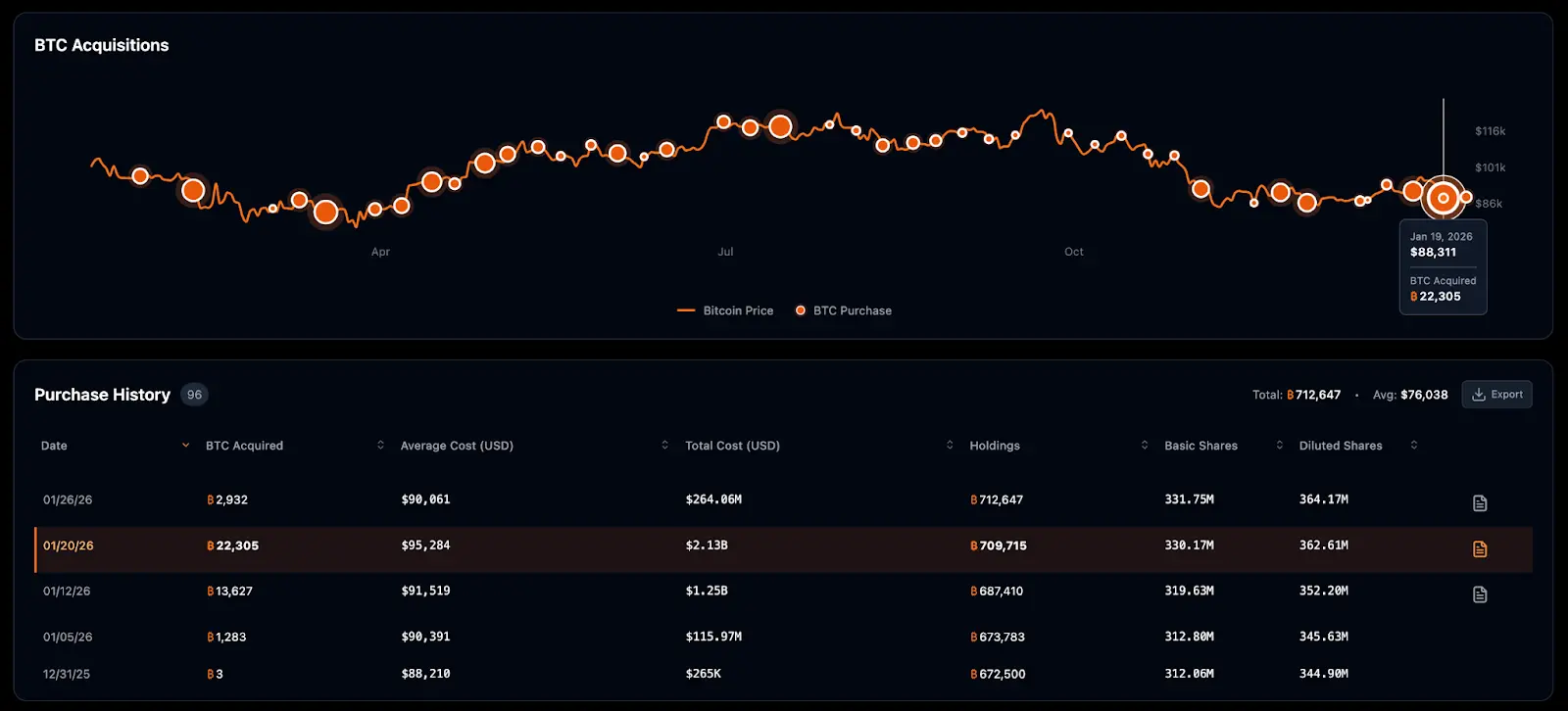
According to data from Bitcoin Strategy Tracker, MicroStrategy purchased over 40,000 Bitcoins in January 2026 alone. Particularly, between January 6 and January 20, it bought 35,932 Bitcoins in two batches, with an average purchase price ranging from $91,500 to $95,300. Statistics show that MicroStrategy's total investment in January reached $3.7 billion; as of January 27, its balance sheet held 712,647 Bitcoins, with an overall average purchase cost of $76,038.

In addition to aggressively buying in the spot market, MicroStrategy is also expanding its influence into the European market. Several financial institutions have launched leveraged products linked to MicroStrategy (MSTR) on major European exchanges, aiming to attract traditional capital from across the Atlantic. Meanwhile, interest from top global financial institutions in holding MSTR has also grown significantly. Investment management giant Vanguard Group's funds recently disclosed holdings of MicroStrategy stock; the Louisiana State Employees' Retirement Fund and Japan's financial giant Sumitomo Mitsui Trust Holdings have also included MSTR in their investment portfolios according to recent reports.
Bitcoin's Structural Weakness and Institutional Wait-and-See

However, MicroStrategy's enthusiastic buying and numerous positive news have not dispelled the overall market chill. For investors, current macroeconomic data shows a clear demand gap:

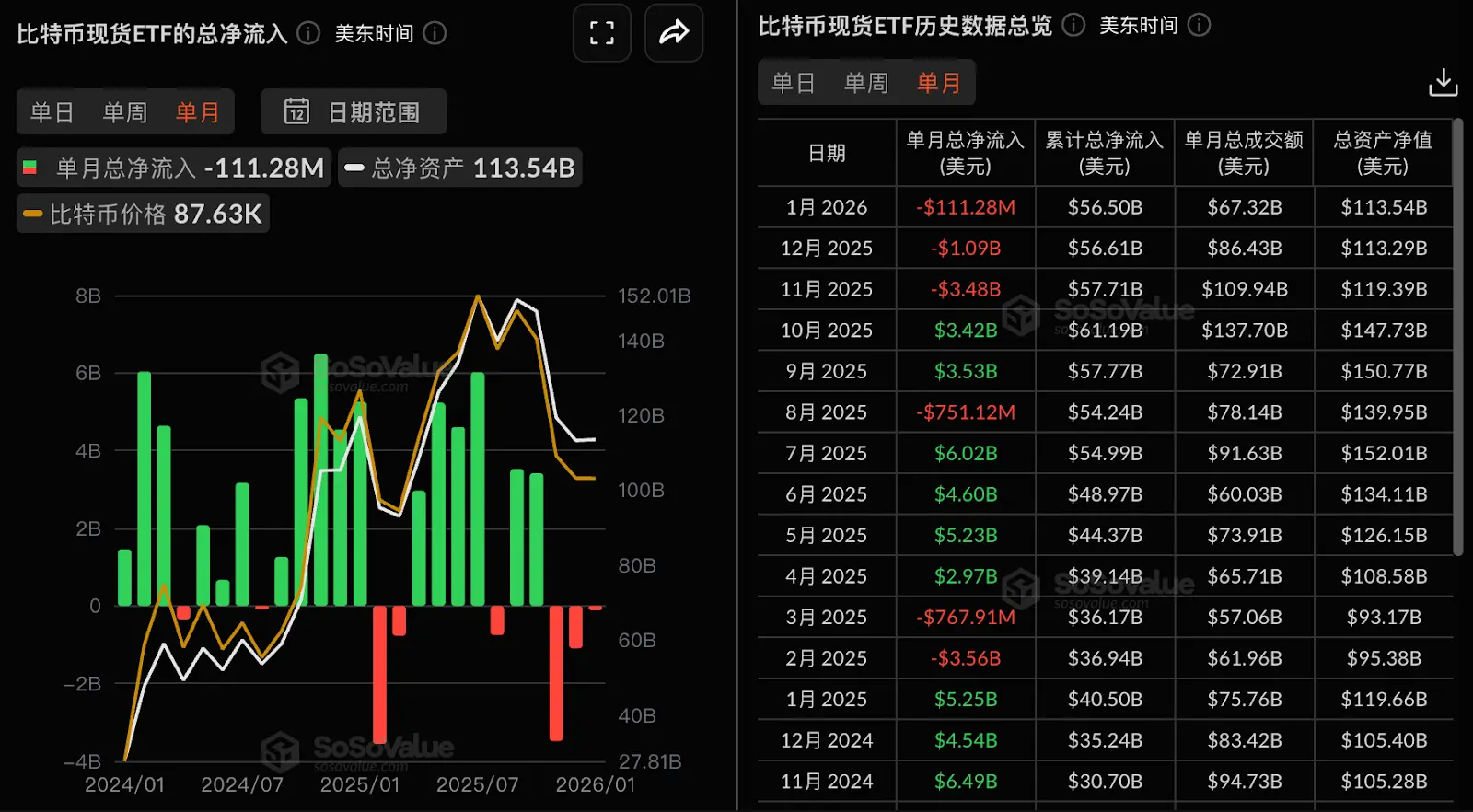
Bitcoin spot ETFs have seen three consecutive months of net outflows: Since November 2025, U.S. Bitcoin spot ETFs have been stuck in a three-month streak of net outflows, including a net outflow of $3.48 billion in November, $1.09 billion in December, and although the outflow slowed to $111 million in January 2026, the trend has not ended. This shows that mainstream Wall Street funds have been withdrawing during this period, in stark contrast to MicroStrategy's counter-trend accumulation.
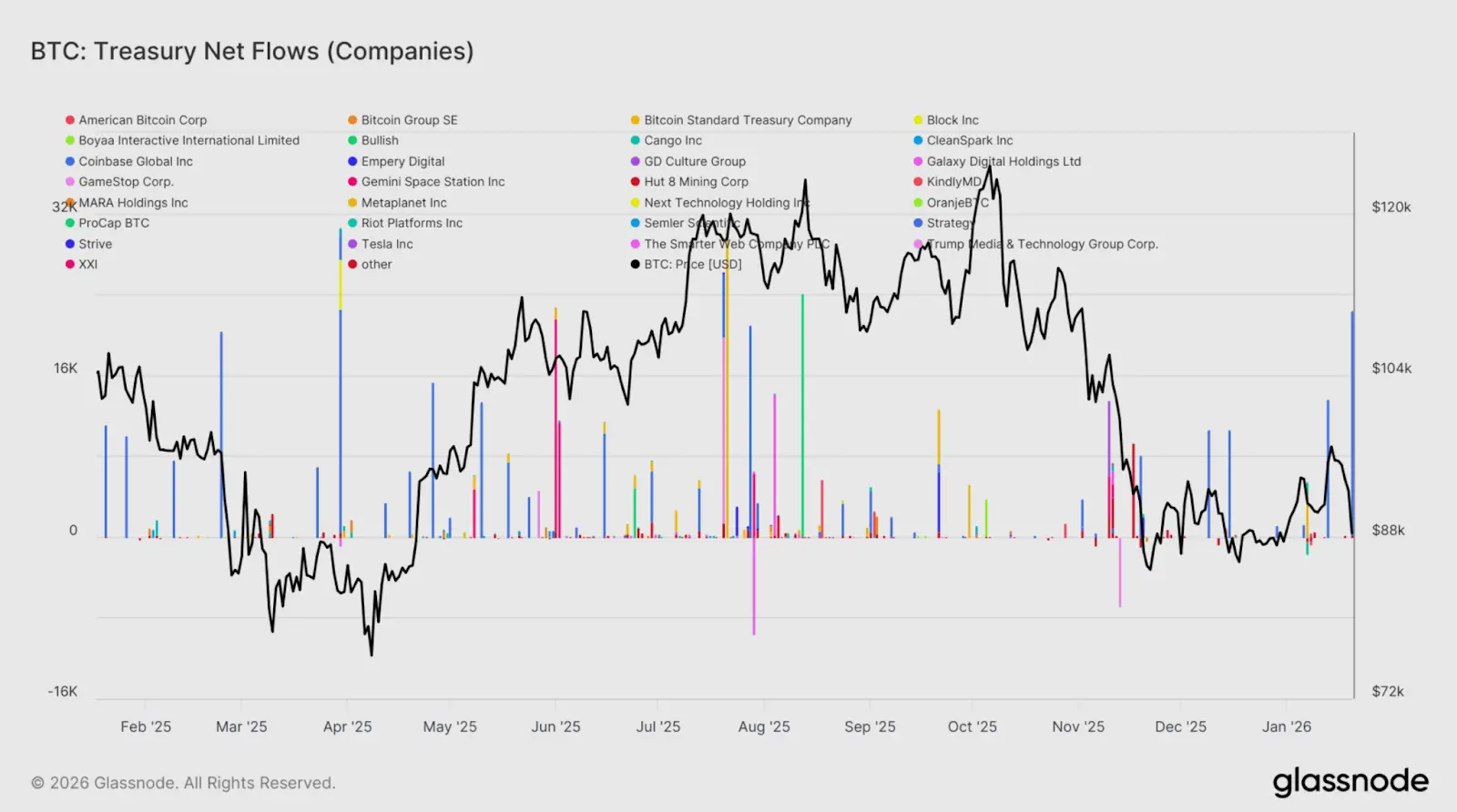
Sporadic and Uneven Inflows into Bitcoin Treasuries: A Glassnode report points out that recent corporate inflows have been concentrated in individual event-driven trades rather than widespread accumulation. The chart below shows that the buying is primarily driven by MicroStrategy, while other Bitcoin treasury companies have not made further purchases recently, contrasting sharply with the boom from May to August 2025 when multiple treasury companies bought collaboratively, accelerating the trend.
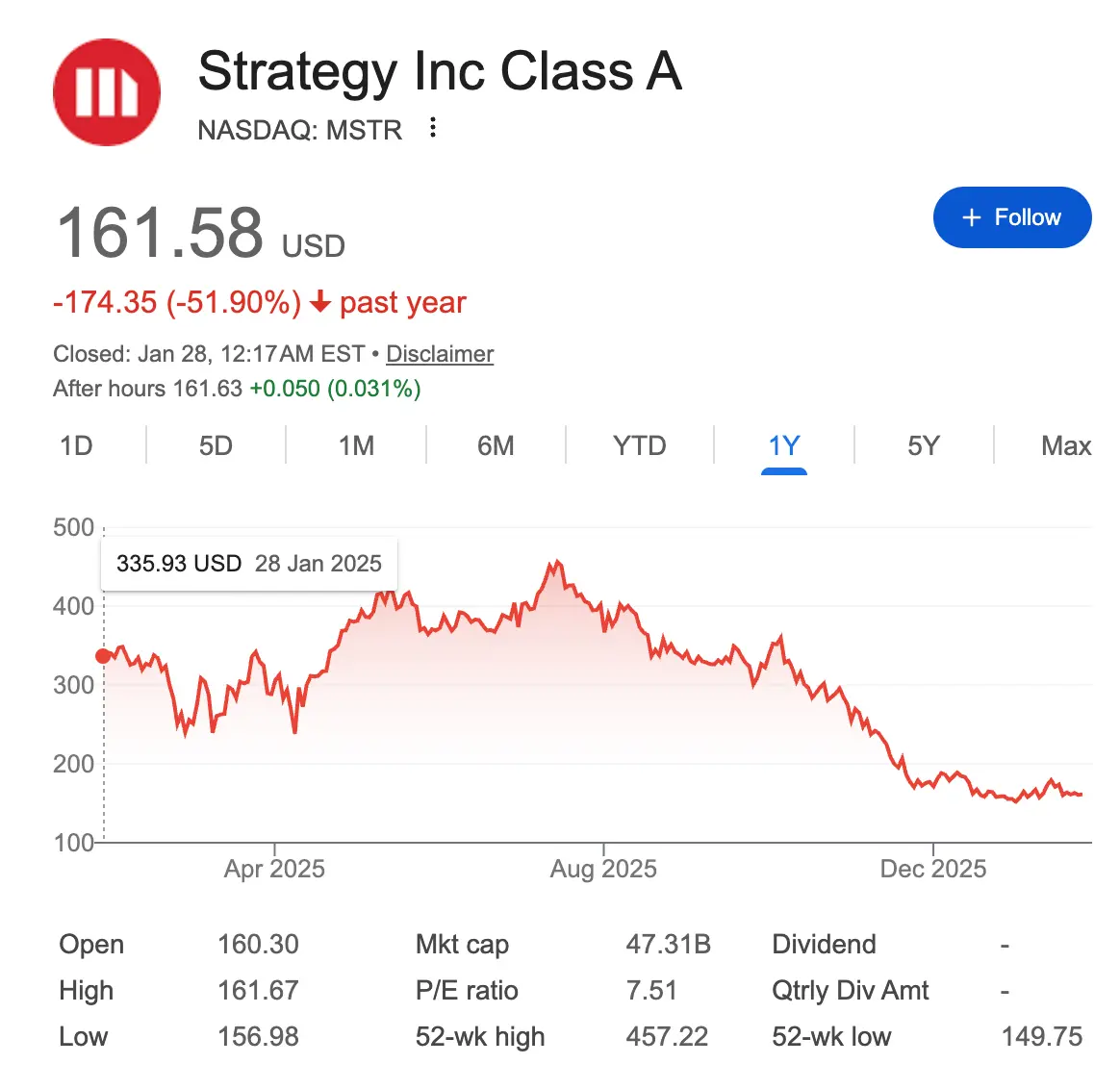
Another brutal reality can be observed: Bitcoin fell from its high of $126,000 to the current $88,000, a drop of about 30%; however, MicroStrategy's (MSTR) stock price plummeted from its high of $457 last July to around $160 currently, a drop of 65%, meaning MicroStrategy's decline was almost twice that of Bitcoin. The leveraged tool that amplified gains on the way up has become an "accelerator" for the stock price plunge during the downturn.
MSTR's Premium Reset and Three Potential Future Outcomes

After experiencing a dual correction in stock price and premium, the core question facing investors is: Is the current MSTR stock price of $160 an entry opportunity or the beginning of another crash?

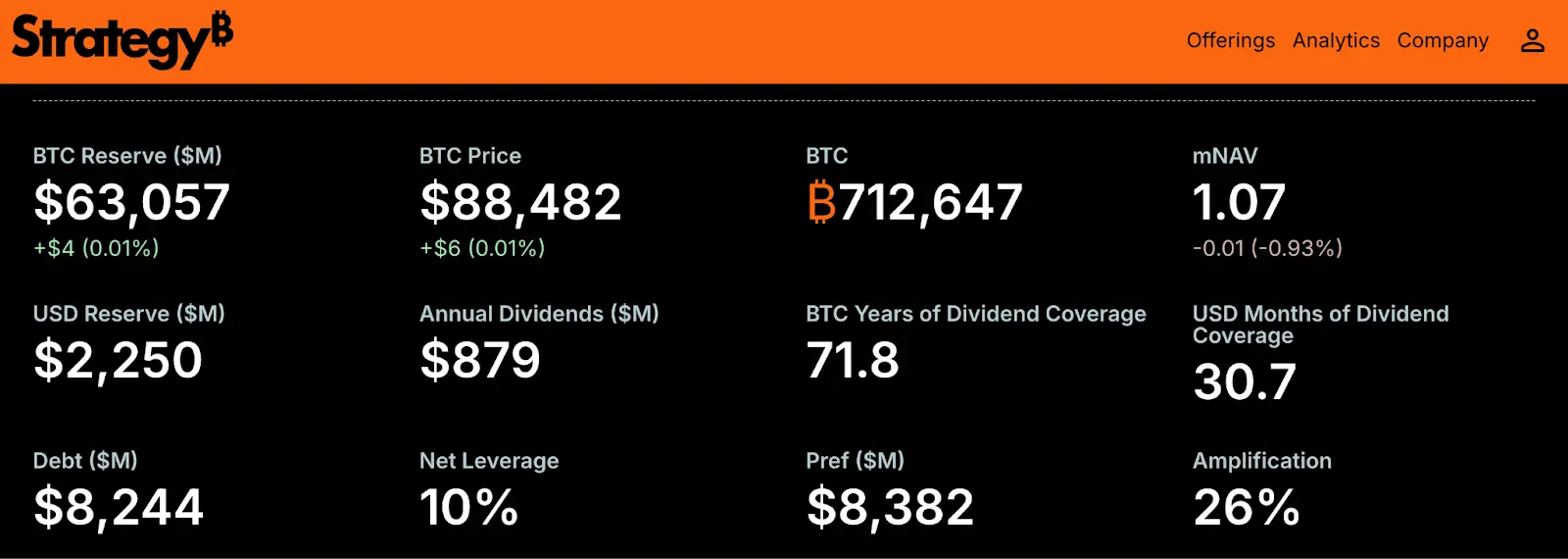
A key metric is: MicroStrategy's mNAV performance relative to its Bitcoin holdings. At the end of 2024, the market was willing to pay a premium of up to 2.4 times to hold MSTR; with the recent stock price drop of over 60%, this premium has significantly contracted to 1.07 times. From a valuation perspective, this means the emotional泡沫 in the market has been largely squeezed out, and the current stock price is highly close to its asset bottom price, providing a more cost-effective entry point for long-term Bitcoin bulls.

However, MicroStrategy's debt risk cannot be ignored. As of early 2026, the company's perpetual preferred equity reached $8.36 billion, surpassing its $8.21 billion in convertible debt. While this shift eliminates refinancing pressure from debt maturity, it also brings持续性 cash outflows. MicroStrategy currently holds approximately $2.25 billion in cash reserves, with annual dividend and interest obligations around $876 million.

At the current spending rate, the company has about two and a half years of financial buffer. A more critical test will come in September 2027, when the $1.01 billion "put option" on its 2028 notes may require cash payment, depending on the stock price performance at that time.
Simultaneously, based on Forbes' perspective, the following three scenarios can be summarized for the future market:

Scenario 1 (Base Case): If Bitcoin consolidates within the range of $85,000 to $100,000, the market will enter a period of testing patience. Limited by macroeconomic policy uncertainty, geopolitical turmoil, and the lack of new large institutional groups buying collaboratively, MicroStrategy's premium is expected to remain low, and the stock price is预计 to fluctuate between $150 and $250.

Scenario 2 (Optimistic Outlook): If Bitcoin breaks through the $100,000 mark and charges towards $150,000, MicroStrategy is expected to restart its "leveraged long" engine. According to analysis from Canaccord Genuity and Bernstein, the target price could return to above $450. For investors seeking excess returns, MicroStrategy remains the most powerful leveraged Bitcoin investment vehicle in the capital market.

Scenario 3 (Pessimistic Outlook): This is the situation most feared by critics like Peter Schiff. If the Bitcoin price falls below $80,000,甚至 approaching the average cost line of $76,000, the company will find it difficult to maintain its buying through low-cost financing tools; more严峻的是, the accumulated dividends on perpetual preferred stock will also face huge financial pressure, potentially triggering a vicious cycle of asset value and financing capacity trampling each other.

Market "Consensus" is in a Fragile Period, Going Long Depends on Investor Risk Appetite

Should you go long on MicroStrategy (MSTR) now? The argument for going long is that the premium has been reset (mNAV has dropped from a high of 2.4 to 1.07), and the risk release is relatively sufficient. If you believe Bitcoin below $100,000 is a serious "mispricing," then MicroStrategy is your best lever to放大 profits.

The conservative view is that macroeconomic policy uncertainty, geopolitical turmoil,持续 ETF outflows, and corporate treasury wait-and-see attitudes show the market "consensus" is in a fragile period. If MicroStrategy fights alone, it will be difficult to resist the overall macro gravity, perhaps only providing a bottoming effect.

The answer ultimately depends on the investor's risk appetite. For those who believe digital gold will ultimately prevail, this is an entry opportunity after the premium has shrunk; but for funds seeking stability, remaining neutral might be a more rational choice until Wall Street institutions show a turn towards net inflows again.


Preguntas relacionadas

QWhat is the current mNAV (market Net Asset Value) premium for MSTR after the recent price correction, and what does it indicate?

AThe mNAV premium for MSTR has been reset from a high of 2.4x down to 1.07x. This indicates that the previous emotional bubble and speculative premium have been significantly squeezed out, making the stock price much closer to its underlying asset value (the value of its Bitcoin holdings). It suggests a more rational and potentially attractive entry point for investors who are bullish on Bitcoin long-term.

QDespite a 30% Bitcoin price drop, why did MicroStrategy aggressively purchase more BTC in January 2026?

AMicroStrategy aggressively purchased over 40,000 BTC (worth over $3.7 billion) in January 2026 because the company maintains a strong, long-term conviction in Bitcoin's value. They viewed the price drop as an opportunity to accumulate more assets at lower prices, with their average purchase price ranging between $91,500 and $95,300. This demonstrates their strategy of using market downturns to increase their Bitcoin reserves significantly.

QWhat are the three potential future scenarios for MicroStrategy (MSTR) as outlined in the article, based on Bitcoin's price movement?

AThe three potential future scenarios for MSTR are: 1. Base Case: Bitcoin trades sideways between $85,000 and $100,000. MSTR's premium remains low, and its stock price fluctuates between $150 and $250. 2. Bull Case: Bitcoin breaks above $100,000 and rallies towards $150,000. MSTR's 'leveraged long' effect would re-engage, with price targets potentially returning above $450. 3. Bear Case: Bitcoin falls below $80,000, nearing MicroStrategy's average cost basis of ~$76,038. This would strain the company's ability to fund further purchases and meet its perpetual preferred stock dividend obligations, potentially triggering a vicious cycle.

QWhat key financial risk does MicroStrategy face related to its capital structure, and what is its financial buffer timeline?

AA key financial risk for MicroStrategy is its significant debt and preferred equity obligations. The company's perpetual preferred stock has reached $8.36 billion, exceeding its $8.21 billion in convertible debt. While this structure eliminates near-term debt maturity pressure, it creates a continuous cash outflow for dividend and interest payments, which total approximately $876 million annually. With about $2.25 billion in cash reserves, the company has a financial buffer of roughly two and a half years at the current spending rate. A major test will come in September 2027 with a $1.01 billion 'put option' on its 2028 notes.

QHow does the performance of Bitcoin ETF flows contrast with MicroStrategy's recent buying activity, and what does this signal about broader institutional demand?

AThe performance starkly contrasts. U.S. Bitcoin spot ETFs have experienced net outflows for three consecutive months (November 2025 to January 2026), indicating a withdrawal of mainstream Wall Street capital. Conversely, MicroStrategy has been the dominant, and often solitary, large-scale corporate buyer during this period. This signals a significant demand断层 (demand断层) or fracture in broader institutional appetite, with most entities adopting a wait-and-see approach, leaving MicroStrategy to largely 'go it alone' in its accumulation strategy.

Lecturas Relacionadas

Conversation with Arthur Hayes: AI Has Drained Market Liquidity, BTC Will Be Below 100k by Year-End

In this June 2026 podcast interview, BitMEX co-founder Arthur Hayes explains his decision to sell his major crypto holdings (HYPE, NEAR, Worldcoin, Zcash). His rationale is based on a macro view linking oil prices, the Iran conflict, US politics, and an impending AI bubble burst. Hayes argues that high oil prices, driven by the ongoing war, will pressure domestic US inflation. To salvage the Republican Party's chances in the midterm elections, he believes Donald Trump may pivot to a populist, anti-AI stance—advocating for taxes and regulation—which would deflate the AI investment narrative. He sees the AI sector, particularly massive capital expenditure on data centers, as having absorbed nearly all excess market liquidity (around $1.5 trillion in debt issuance since 2025), starving other assets like Bitcoin. He highlights the upcoming SpaceX IPO at a ~$1.8 trillion valuation and 100x price-to-sales ratio as a potential tipping point. If these hyped IPOs underperform, it could shatter market confidence in AI. In such a scenario, all risk assets, including crypto, would fall together as correlations converge to 1 during a broad correction. Hayes has moved his portfolio into Treasuries and energy stocks (like ExxonMobil), predicting Bitcoin will be below $100k by year-end. He sees a potential crypto bull market only after the AI frenzy cools, liquidity stops flowing exclusively into AI, and possibly after a significant market downturn prompts new monetary stimulus.

marsbitHace 4 min(s)

Conversation with Arthur Hayes: AI Has Drained Market Liquidity, BTC Will Be Below 100k by Year-End

marsbitHace 4 min(s)

Fed's Internal Doves Flock to Hawkish Stance, Warsh's Debut "Between a Rock and a Hard Place"

U.S. Federal Reserve officials who previously advocated for rate cuts, including Governor Christopher Waller, have recently shifted their stance, with many now not ruling out the possibility of future rate hikes. This sets a challenging stage for new Fed Chair Kevin Warsh's first policy meeting. Appointed by President Trump based on his dovish views, Warsh now faces a committee where the debate has pivoted from "when to cut" to "whether to hike," driven by persistent inflation above 3%, a strong labor market, and supply-side pressures from AI infrastructure demands and geopolitical tensions. Key figures illustrate the shift. Governor Waller, once concerned about employment, now says data has pushed him toward considering rate increases. Even moderate voices like Governor Lisa Cook, while expecting inflation to ease, have indicated readiness to hike if it fails to do so. Long-time hawks such as regional Fed presidents Beth Hammack, Lorie Logan, and Neel Kashkari have grown more vocal, arguing that the real policy rate is effectively falling and that action may soon be needed. The upcoming Fed meeting is expected to keep rates steady but will likely remove the "easing bias" from its statement, signaling a neutral stance between cuts and hikes. The quarterly "dot plot" is anticipated to show most officials projecting no cuts this year, with some potentially indicating hikes. Chair Warsh, a critic of the Fed's reliance on forward guidance like the dot plot, must navigate communicating this pivot using tools he has questioned, all while steering policy in a direction counter to the preferences of the president who appointed him. The consensus suggests the Fed's next move could well be a rate increase.

marsbitHace 1 hora(s)

Fed's Internal Doves Flock to Hawkish Stance, Warsh's Debut "Between a Rock and a Hard Place"

marsbitHace 1 hora(s)

The Trillion-Yuan Market Cap 'Yi Zhong Tian': Who is the True Value King?

The article analyzes the three leading Chinese optical module companies, collectively nicknamed "Yi Zhong Tian": Xinyisheng, Zhongji Innolight, and TFC Optical Communication. It evaluates their "cost-performance" not by current stock price, but through three lenses: PEG ratio (growth vs. valuation), earnings quality, and premium/discount for certainty. Xinyisheng shows the most attractive PEG ratio and high profitability, but its valuation reflects discounts for risks like high customer concentration and reliance on overseas markets. Zhongji Innolight, the most expensive, commands a premium for its market leadership, dominant share in key products like 800G/1.6T modules, and higher earnings certainty, though it faces geopolitical risks. TFC Optical, as an upstream component supplier ("water seller"), has the highest gross margin and bets on the long-term CPO/NPO architecture trend, but trades at a high valuation with more stable, less explosive growth. The core argument is that while these companies dominate module assembly, the true profit pool and technological moat lie upstream in laser and switch chips, currently controlled by U.S. firms like Lumentum and Coherent. The long-term "cost-performance" for these Chinese leaders hinges on whether the domestic industry, exemplified by companies like Yuanjie Technology, can successfully move up the value chain into high-power laser chips. Otherwise, their high growth may remain confined to the lower-margin assembly segment.

marsbitHace 1 hora(s)

The Trillion-Yuan Market Cap 'Yi Zhong Tian': Who is the True Value King?

marsbitHace 1 hora(s)

Has the Crypto Market Bottomed? Here's What Institutions Think

The crypto market is in a period of significant debate, with leading institutions offering differing views on whether a bottom has been reached. Three prominent firms have published detailed analyses: * **Galaxy Digital** argues Bitcoin has **not yet bottomed**. Their analysis of 13 historical indicators across six dimensions (valuation, profit-taking, miner pressure, etc.) shows only four are fully met. They project a potential bottom range between $30k and $54k. * **NYDIG** states a bottom is **possible but not likely**. While metrics are close to historic bear market extremes, they note the absence of a classic panic-selling event. They also suggest increased institutional adoption may have structurally altered the market cycle, potentially leading to a shallower downturn. * **Standard Chartered Bank** asserts the **bottom has already occurred** at around $59k. They cite two key factors: potential US-Iran diplomatic progress and the anticipated SpaceX IPO, which they believe absorbed capital and caused ETF selling pressure that is now subsiding. They forecast a year-end price target of $100k. Despite the surface-level disagreement, the reports share critical common ground more valuable for long-term investors: 1. All three believe the market bottom will form **within this year**. 2. All agree the current price is **closer to the bottom than to previous highs**. 3. All maintain a **bullish long-term outlook** for Bitcoin and a new cycle. The core takeaway is that while the exact bottom price ($40k, $50k, or $60k) is debated, the consensus is that a bottom is imminent. For long-term holders, the primary focus should not be pinpointing the absolute low, but on the future potential for prices to reach $100k, $200k, or higher. The fundamental thesis for Bitcoin—sovereign debt accumulation, inflation, declining trust in centralized institutions, global digitization, and improved accessibility—remains intact and is arguably strengthening. The overall landscape is viewed as more favorable than in previous crypto winters.

marsbitHace 1 hora(s)

Has the Crypto Market Bottomed? Here's What Institutions Think

marsbitHace 1 hora(s)

Trading

Spot
Futuros

Artículos destacados

Qué es BITCOIN

Entendiendo HarryPotterObamaSonic10Inu (ERC-20) y Su Posición en el Espacio Cripto En los últimos años, el mercado de criptomonedas ha sido testigo de un aumento en la popularidad de las monedas meme, capturando el interés no solo de los comerciantes, sino también de aquellos que buscan compromiso comunitario y valor de entretenimiento. Entre estos tokens únicos se encuentra HarryPotterObamaSonic10Inu (ERC-20), un proyecto intrigante que mezcla referencias culturales en el tejido de las criptomonedas. Este artículo profundiza en los aspectos clave de HarryPotterObamaSonic10Inu, explorando sus mecanismos, ethos impulsado por la comunidad y su relación con el paisaje cripto más amplio. ¿Qué es HarryPotterObamaSonic10Inu (ERC-20)? Como su nombre sugiere, HarryPotterObamaSonic10Inu es una moneda meme construida sobre la blockchain de Ethereum, clasificada bajo el estándar ERC-20. A diferencia de las criptomonedas tradicionales que pueden enfatizar la utilidad práctica o el potencial de inversión, este token prospera en el valor de entretenimiento y la fuerza de su comunidad. El proyecto tiene como objetivo fomentar un entorno donde los usuarios comprometidos puedan reunirse, compartir ideas y participar en actividades inspiradas por diversos fenómenos culturales. Una característica notable de HarryPotterObamaSonic10Inu es su cero impuestos en las transacciones. Este atractivo elemento tiene como objetivo incentivar el comercio y la participación comunitaria, sin cargos adicionales que puedan disuadir a los comerciantes de pequeña escala. El suministro total de la moneda está establecido en mil millones de tokens, una cifra que marca su intención de mantener una circulación sustancial dentro de la comunidad. Creador de HarryPotterObamaSonic10Inu (ERC-20) Los orígenes de HarryPotterObamaSonic10Inu están algo envueltos en misterio; los detalles sobre el creador siguen siendo desconocidos. El desarrollo de este token carece de un equipo identificable o de un plan explícito, lo cual no es inusual dentro del sector de monedas meme. En cambio, el proyecto ha surgido de manera orgánica, con su progreso muy dependiente del entusiasmo y la participación de su comunidad. Inversores de HarryPotterObamaSonic10Inu (ERC-20) En cuanto a inversiones externas y respaldo, HarryPotterObamaSonic10Inu también sigue siendo ambiguo. El token no lista ninguna fundación de inversión conocida o apoyo organizacional significativo. En cambio, la savia del proyecto es su comunidad de base, que informa su crecimiento y sostenibilidad a través de la acción colectiva y el compromiso en el espacio cripto. ¿Cómo Funciona HarryPotterObamaSonic10Inu (ERC-20)? Como una moneda meme, HarryPotterObamaSonic10Inu opera principalmente fuera de los marcos tradicionales que a menudo rigen el valor de los activos. Hay varios aspectos distintivos que definen cómo funciona el proyecto: Transacciones Sin Impuestos: Sin tarifas impositivas en las transacciones, los usuarios pueden comprar y vender el token libremente sin preocuparse por costos ocultos. Compromiso Comunitario: El proyecto prospera en la interacción comunitaria, aprovechando plataformas de redes sociales para crear entusiasmo y facilitar la participación. Las discusiones, el intercambio de contenido y el compromiso son elementos cruciales que ayudan a expandir su alcance y fomentar la lealtad entre los seguidores. Sin Utilidad Práctica: Cabe señalar que HarryPotterObamaSonic10Inu no ofrece utilidad concreta dentro del ecosistema financiero. Más bien, se clasifica como un token principalmente para actividades de entretenimiento y comunitarias. Referencia Cultural: El token incorpora astutamente elementos de la cultura popular para atraer interés, conectando con entusiastas de los memes y seguidores de las criptomonedas por igual. HarryPotterObamaSonic10Inu ejemplifica cómo las monedas meme operan de manera diferente a los proyectos de criptomonedas más tradicionales, ingresando al mercado como construcciones sociales innovadoras en lugar de activos utilitarios. Cronología de HarryPotterObamaSonic10Inu (ERC-20) La historia de HarryPotterObamaSonic10Inu está marcada por varios hitos notables: Creación: El token surgió de un meme viral, capturando la imaginación de muchos entusiastas de las criptomonedas. Las fechas específicas de creación no están disponibles, subrayando su ascenso orgánico. Listado en Exchanges: HarryPotterObamaSonic10Inu ha llegado a varios exchanges, permitiendo un acceso y comercio más fácil por parte de la comunidad. Iniciativas de Compromiso Comunitario: Actividades continuas destinadas a mejorar la interacción comunitaria, incluyendo concursos, campañas en redes sociales y generación de contenido por parte de fanáticos y defensores. Planes de Expansión Futuros: La hoja de ruta del proyecto incluye el lanzamiento de una colección de NFT, mercancía y un sitio de comercio electrónico relacionado con sus temas culturales, involucrando aún más a la comunidad e intentando añadir más dimensiones a su ecosistema. Puntos Clave Sobre HarryPotterObamaSonic10Inu (ERC-20) Naturaleza Impulsada por la Comunidad: El proyecto prioriza la participación colectiva y la creatividad, asegurando que la involucración de los usuarios esté a la vanguardia de su desarrollo. Clasificación como Moneda Meme: Representa la epítome de las criptomonedas basadas en el entretenimiento, diferenciándose de los vehículos de inversión tradicionales. Sin Afiliación Directa con Bitcoin: A pesar de la similitud en el nombre del ticker, HarryPotterObamaSonic10Inu es distinto y no tiene relación con Bitcoin u otras criptomonedas establecidas. Enfoque en la Colaboración: HarryPotterObamaSonic10Inu está diseñado para crear un espacio para la colaboración y el intercambio de historias entre sus poseedores, proporcionando una vía para la creatividad y el vínculo comunitario. Perspectivas Futuras: La ambición de expandirse más allá de su premisa inicial hacia NFTs y mercancías describe un camino para que el proyecto potencialmente ingrese a avenidas más tradicionales dentro de la cultura digital. A medida que las monedas meme continúan capturando la imaginación de la comunidad de criptomonedas, HarryPotterObamaSonic10Inu (ERC-20) se destaca debido a sus lazos culturales y su enfoque centrado en la comunidad. Si bien puede no encajar en el molde típico de un token impulsado por la utilidad, su esencia radica en la alegría y la camaradería fomentadas entre sus seguidores, destacando la naturaleza en evolución de las criptomonedas en una era cada vez más digital. A medida que el proyecto continúa desarrollándose, será importante observar cómo las dinámicas comunitarias influyen en su trayectoria en el cambiante paisaje de la tecnología blockchain.

1.8k Vistas totalesPublicado en 2024.04.01Actualizado en 2024.12.03

Qué es BITCOIN

Cómo comprar BTC

¡Bienvenido a HTX.com! Hemos hecho que comprar Bitcoin (BTC) sea simple y conveniente. Sigue nuestra guía paso a paso para iniciar tu viaje de criptos.Paso 1: crea tu cuenta HTXUtiliza tu correo electrónico o número de teléfono para registrarte y obtener una cuenta gratuita en HTX. Experimenta un proceso de registro sin complicaciones y desbloquea todas las funciones.Obtener mi cuentaPaso 2: ve a Comprar cripto y elige tu método de pagoTarjeta de crédito/débito: usa tu Visa o Mastercard para comprar Bitcoin (BTC) al instante.Saldo: utiliza fondos del saldo de tu cuenta HTX para tradear sin problemas.Terceros: hemos agregado métodos de pago populares como Google Pay y Apple Pay para mejorar la comodidad.P2P: tradear directamente con otros usuarios en HTX.Over-the-Counter (OTC): ofrecemos servicios personalizados y tipos de cambio competitivos para los traders.Paso 3: guarda tu Bitcoin (BTC)Después de comprar tu Bitcoin (BTC), guárdalo en tu cuenta HTX. Alternativamente, puedes enviarlo a otro lugar mediante transferencia blockchain o utilizarlo para tradear otras criptomonedas.Paso 4: tradear Bitcoin (BTC)Tradear fácilmente con Bitcoin (BTC) en HTX's mercado spot. Simplemente accede a tu cuenta, selecciona tu par de trading, ejecuta tus trades y monitorea en tiempo real. Ofrecemos una experiencia fácil de usar tanto para principiantes como para traders experimentados.

5.2k Vistas totalesPublicado en 2024.12.12Actualizado en 2026.06.02

Cómo comprar BTC

Qué es $BITCOIN

ORO DIGITAL ($BITCOIN): Un Análisis Integral Introducción al ORO DIGITAL ($BITCOIN) ORO DIGITAL ($BITCOIN) es un proyecto basado en blockchain que opera en la red Solana, cuyo objetivo es combinar las características de los metales preciosos tradicionales con la innovación de las tecnologías descentralizadas. Aunque comparte un nombre con Bitcoin, a menudo referido como “oro digital” debido a su percepción como un refugio de valor, ORO DIGITAL es un token separado diseñado para crear un ecosistema único dentro del paisaje Web3. Su meta es posicionarse como un activo digital alternativo viable, aunque los detalles sobre sus aplicaciones y funcionalidades aún están en desarrollo. ¿Qué es ORO DIGITAL ($BITCOIN)? ORO DIGITAL ($BITCOIN) es un token de criptomoneda diseñado explícitamente para su uso en la blockchain de Solana. A diferencia de Bitcoin, que proporciona un papel de almacenamiento de valor ampliamente reconocido, este token parece centrarse en aplicaciones y características más amplias. Aspectos notables incluyen: Infraestructura Blockchain: El token está construido sobre la blockchain de Solana, conocida por su capacidad para manejar transacciones de alta velocidad y bajo costo. Dinámicas de Suministro: ORO DIGITAL tiene un suministro máximo limitado a 100 cuatrillones de tokens (100P $BITCOIN), aunque los detalles sobre su suministro circulante no se han divulgado actualmente. Utilidad: Si bien las funcionalidades precisas no están delineadas explícitamente, hay indicios de que el token podría ser utilizado para diversas aplicaciones, potencialmente involucrando aplicaciones descentralizadas (dApps) o estrategias de tokenización de activos. ¿Quién es el Creador de ORO DIGITAL ($BITCOIN)? En la actualidad, la identidad de los creadores y el equipo de desarrollo detrás de ORO DIGITAL ($BITCOIN) sigue siendo desconocida. Esta situación es típica entre muchos proyectos innovadores dentro del espacio blockchain, particularmente aquellos alineados con las finanzas descentralizadas y fenómenos de monedas meme. Si bien tal anonimato puede fomentar una cultura impulsada por la comunidad, intensifica las preocupaciones sobre la gobernanza y la responsabilidad. ¿Quiénes son los Inversores de ORO DIGITAL ($BITCOIN)? La información disponible indica que ORO DIGITAL ($BITCOIN) no tiene patrocinadores institucionales conocidos ni inversiones destacadas de capital de riesgo. El proyecto parece operar en un modelo de peer-to-peer centrado en el apoyo y la adopción de la comunidad en lugar de rutas de financiamiento tradicionales. Su actividad y liquidez se sitúan principalmente en intercambios descentralizados (DEX), como PumpSwap, en lugar de plataformas de trading centralizadas establecidas, lo que resalta aún más su enfoque de base. Cómo Funciona ORO DIGITAL ($BITCOIN) Los mecanismos operativos de ORO DIGITAL ($BITCOIN) pueden elaborarse en función de su diseño blockchain y atributos de red: Mecanismo de Consenso: Al aprovechar el único proof-of-history (PoH) de Solana combinado con un modelo de proof-of-stake (PoS), el proyecto asegura una validación de transacciones eficiente que contribuye al alto rendimiento de la red. Tokenómica: Si bien los mecanismos deflacionarios específicos no se han detallado extensamente, el vasto suministro máximo de tokens implica que podría atender microtransacciones o casos de uso nicho que aún están por definirse. Interoperabilidad: Existe el potencial de integración con el ecosistema más amplio de Solana, incluyendo varias plataformas de finanzas descentralizadas (DeFi). Sin embargo, los detalles sobre integraciones específicas permanecen no especificados. Cronología de Eventos Clave Aquí hay una cronología que destaca hitos significativos relacionados con ORO DIGITAL ($BITCOIN): 2023: El despliegue inicial del token ocurre en la blockchain de Solana, marcado por su dirección de contrato. 2024: ORO DIGITAL gana visibilidad al estar disponible para trading en intercambios descentralizados como PumpSwap, permitiendo a los usuarios comerciar contra SOL. 2025: El proyecto presencia actividad de trading esporádica y potencial interés en compromisos liderados por la comunidad, aunque no se han documentado asociaciones notables o avances técnicos hasta el momento. Análisis Crítico Fortalezas Escalabilidad: La infraestructura subyacente de Solana soporta altos volúmenes de transacciones, lo que podría mejorar la utilidad de $BITCOIN en varios escenarios de transacción. Accesibilidad: El potencial bajo precio de trading por token podría atraer a inversores minoristas, facilitando una participación más amplia debido a oportunidades de propiedad fraccionada. Riesgos Falta de Transparencia: La ausencia de patrocinadores, desarrolladores o un proceso de auditoría conocidos públicamente puede generar escepticismo sobre la sostenibilidad y confiabilidad del proyecto. Volatilidad del Mercado: La actividad de trading depende en gran medida del comportamiento especulativo, lo que puede resultar en una volatilidad de precios significativa y en incertidumbre para los inversores. Conclusión ORO DIGITAL ($BITCOIN) surge como un proyecto intrigante pero ambiguo dentro del ecosistema de Solana en rápida evolución. Si bien intenta aprovechar la narrativa del “oro digital”, su alejamiento del papel establecido de Bitcoin como refugio de valor subraya la necesidad de una diferenciación más clara de su utilidad y estructura de gobernanza previstas. La aceptación y adopción futura dependerán probablemente de abordar la actual opacidad y de definir sus estrategias operativas y económicas de manera más explícita. Nota: Este informe abarca información sintetizada disponible hasta octubre de 2023, y pueden haber ocurrido desarrollos más allá del período de investigación.

87 Vistas totalesPublicado en 2025.05.13Actualizado en 2025.05.13

Qué es $BITCOIN

Discusiones

Bienvenido a la comunidad de HTX. Aquí puedes mantenerte informado sobre los últimos desarrollos de la plataforma y acceder a análisis profesionales del mercado. A continuación se presentan las opiniones de los usuarios sobre el precio de BTC (BTC).

活动图片