Original|Odaily Planet Daily(@OdailyChina)
Author|Wenser(@wenser 2010)
On October 7th, Abstract, the L2 project under Igloo, the parent company of Pudgy Penguins, officially announced it will shut down on December 15th of this year. This "consumer-grade L2 public chain," once placed with high hopes by the Pudgy Penguins team and numerous NFT players, is concluding its nearly two-year operation, ending in a somewhat regrettable manner.
After the announcement, market opinions diverged sharply. One faction believes that the Pudgy Penguins team did not choose to "conduct a final round of token distribution (TGE) and cash out" as some other L2 teams have, showing integrity from start to finish. However, another faction strongly disagrees. They argue that the tens of millions of dollars in operational losses mentioned by Pudgy Penguins CEO Luca Netz in his lengthy announcement, as well as Abstract's previous operational activities like the badge system which were somewhat "PUA-style," were largely paid for by users. Many had pinned their hopes on Abstract's potential token launch to recoup losses, a hope now completely dashed.
Behind Abstract's shutdown, the hype surrounding Robinhood Chain's launch has cooled, and Blast has also announced its shutdown. Following the wave of some CEX closures, perhaps more unsustainable L2s will face a wave of shutdowns.
"Consumer-Grade Blockchain Network" Finds No Takers: DeFi, Meme, and Institutional Capital All Fail to Gain Traction
Looking back at Abstract's development, its positioning as a "consumer-grade encrypted blockchain network" might not have been a good business idea from the start.
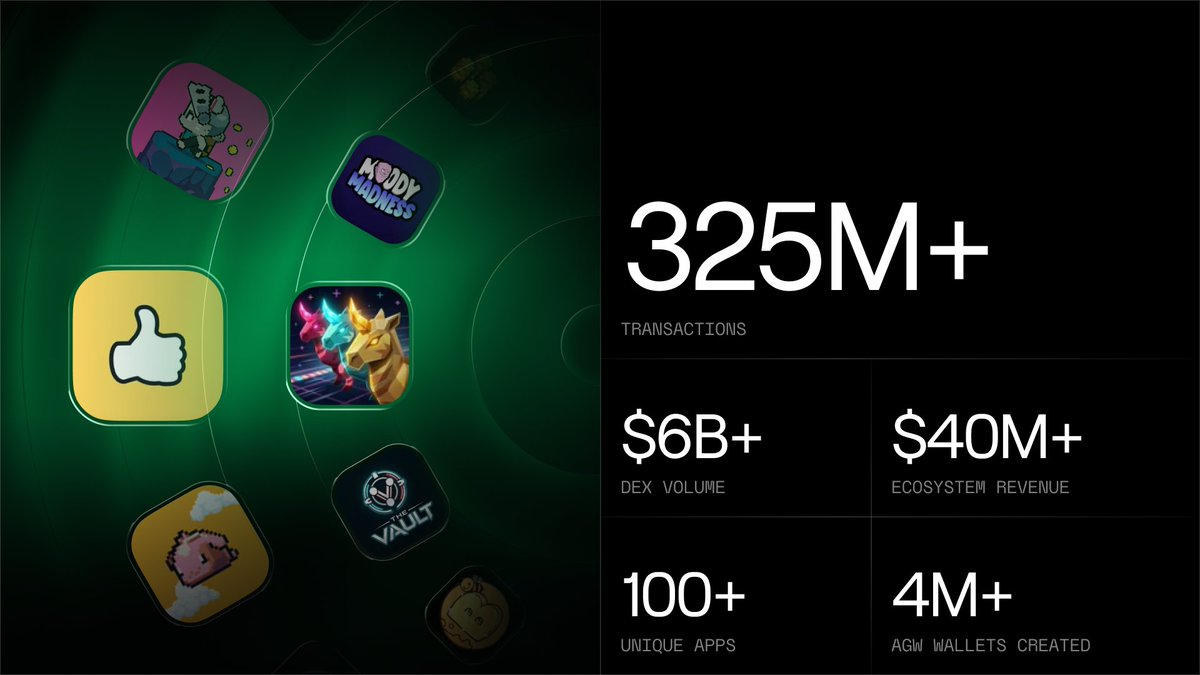
According to Abstract's official statements, the L2 network had attracted over 400,000 cumulative users and deployed more than 144 applications. Pudgy Penguins CEO Luca Netz also stated that Abstract had processed over 325 million on-chain transactions, launched Portal and AGW, and attracted global brands like Disney and Red Bull. On the surface, Abstract's performance seemed decent. However, what ultimately led it into an "operational dead end" might be similar to a strategic miscalculation made by Base in recent years regarding "crypto-social + on-chain consumption"—it neither followed the grassroots route like Solana and Robinhood Chain to develop its own Meme ecosystem, nor did it deeply cultivate DeFi around institutional and large investor needs to attract liquidity and complete its business self-sufficiency loop.
Main Reasons for Shutdown: Insufficient DeFi Ecosystem, Lack of Institutional Involvement, High Operational Costs, and Unclear PMF
Based on official announcements from Abstract and posts by Pudgy Penguins CEO Luca Netz, we can glimpse the "main causes of death" for this L2 network:
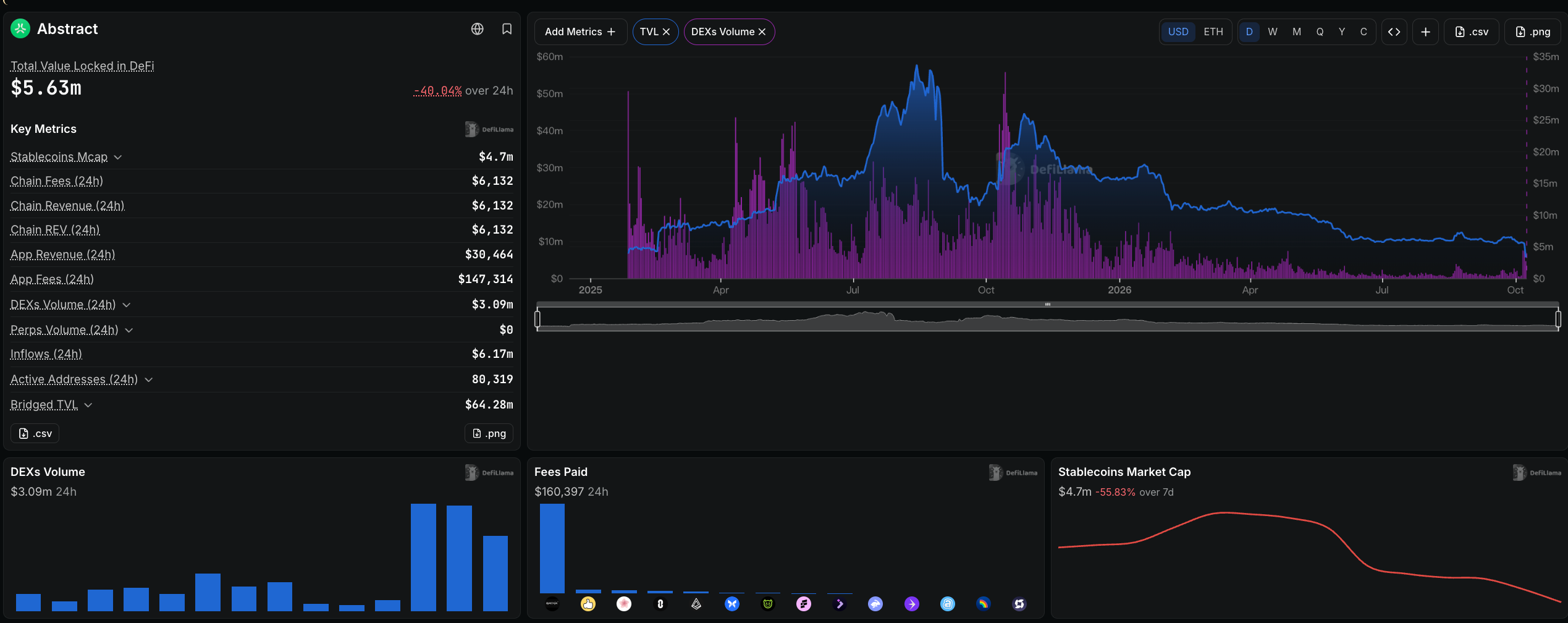
First, insufficient DeFi ecosystem; Although Abstract claimed its DEX trading volume reached $6 billion, considering its nearly two-year operational period, this is hardly an impressive figure. According to Defilama data, Abstract's DeFi TVL is currently around $5.6 million, ranking 90th among major L1 and L2 networks, with a 24-hour drop of about 40%. While heavily impacted by the shutdown news, its DEX trading volume had long fluctuated between $300k-$1 million; its stablecoin market cap saw a nearly 60% drop over 7 days, now standing at only $4.7 million.
For an L2 network, a failed DeFi ecosystem development almost inevitably means limited ecological activity, limited real user base, and difficulty in generating revenue and achieving self-sufficiency through fees.
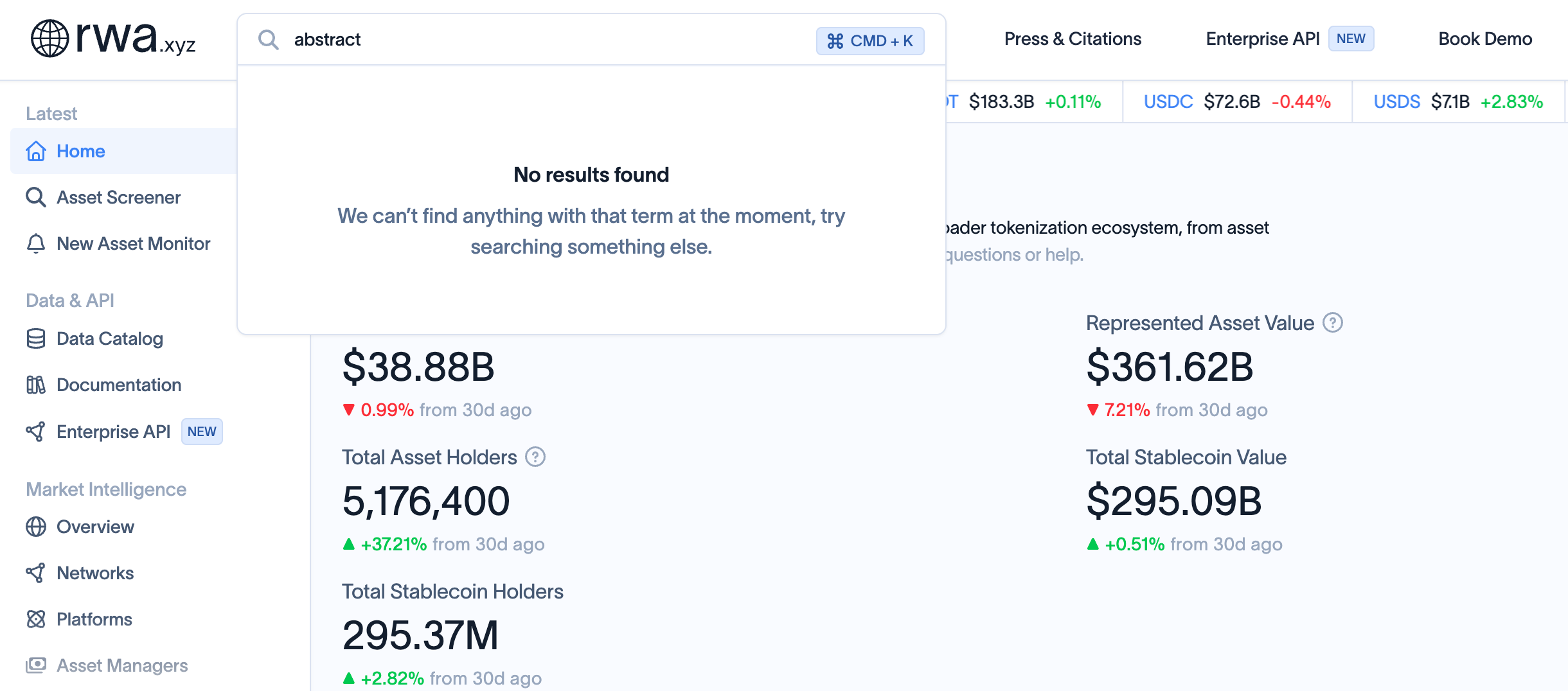
Second, low institutional participation and limited liquidity. This is one of the important reasons for Abstract's shutdown. Taking RWA asset data as an example, Abstract is essentially "absent" on RWA asset TVL network rankings. It also largely missed out on the major crypto and traditional finance trends of the past two years, such as institutional investment channels, the RWA asset wave, and stock tokenization trading. From this perspective, it represents an extremely serious strategic misjudgment.
Third, excessively high operational costs. Beyond the fixed operating expenses of an L2 (Odaily Planet Daily Note: including sequencer operations, ZK-related data availability and proof costs, bridging and front-end maintenance, infrastructure development, team operational costs, ecosystem incentives/developer support, etc.), Abstract's collaborations with traditional brands, partnerships, and offline events also required significant spending. The seemingly glamorous L2 path is not as low-cost as many imagine. Early technical development, mid-term growth operations, and long-term ecosystem building all require continuous capital investment. Abstract's shutdown also carries a sense of cutting losses in time.
Fourth, declining demand for related products and unclear PMF. Unlike the favorable situation Pudgy Penguins previously enjoyed due to its NFT community, physical toy IP, PENGU token launch, and a favorable crypto bull market, the current crypto market's demands on L2 networks, and even L1 public chains, are no longer limited to small-scale project prosperity. Instead, it requires "ecosystem-level hubs" like Hyperliquid and Robinhood Chain, which enable pre-pricing of traditional financial assets and introduce liquidity and institutional capital from traditional financial markets, thereby reaping the benefits of "fee harvesting." This is precisely the market that Abstract and numerous other L2 networks have been unable to tap into.
Beyond these reasons, homogeneous competition among L2 networks and the rapid alternation of crypto market bull and bear cycles are also contributing factors to Abstract's reluctant shutdown. And following Abstract's closure, heated debates have emerged in the market.
Praise vs. Criticism: No Intent to Cash Out or "PUA to the End"?
After Abstract's official shutdown announcement, the crypto community engaged in fierce debate. Here are some representative viewpoints:
Yuga Labs VP 0xQuit posted: "Abstract did a decent thing. They could have followed Blast's model and directly launched a token (TGE) to raise a massive amount of money. Instead, they admitted failure, choosing to wind down the project without a TGE. Sure, people still lost money, but it could have been much worse. Respect."
Community member Loki agreed: "Abstract could have done a TGE at any point before shutting down, like countless L2 projects with no users, but they didn't. Pudgy Penguins co-founder and CCO @chefgoyardi and CEO @LucaNetz bought the project with their own money and never cashed out from the community. Now, with Abstract, they've shown their integrity again. The best news: refocusing on the Pudgy Penguins project." His words express continued confidence in the Pudgy Penguins team.
However, others expressed extreme dissatisfaction, particularly users who invested real money, time, and effort into Abstract's ecosystem and network interactions.
Abstract power user Micka posted on X: "I participated in @AbstractChain during the testnet in July 2024. I built the French community, posted thousands of tweets about Abstract, and streamed over 1500 hours of Abstract mainnet content in 2025. I spent thousands of dollars over one year and ten months, accumulating 4 million Abstract interaction XP." Now, Abstract has fallen even before completing the first phase of its three-stage roadmap. He is "speechless" and "will no longer trust Luca."
Another community member, Chris, criticized sharply: "I sold all my PENGU tokens. That Space they used to announce the shutdown of Abstract services was awful, like they hadn't discussed it beforehand and hastily threw it together last minute. I somewhat understand their move because they didn't want to shut down after launching the ABS token via TGE. But what I really dislike is the overall narrative framework. Their response was a cold 'badges are useless anyway' and 'you supported our startup project.' The worst blow was when someone asked Luca if any Abstract users would receive any rewards from the Pudgy Penguins ecosystem, he immediately said no without hesitation, basically stating that what users can currently access in the ecosystem is it. This went on for far too long, completely unnecessarily. As a streamer, someone who diamond-handed tokens to zero for engagement, who invested massive time and effort weekly for six months, creating content series around this vision, I'm deeply disappointed in how this turned out."
Others even dug up an interview video of Luca from last year's Paris NFT conference, where he expressed full confidence in Abstract's future, claiming "Abstract will become the biggest L2 network in the future," and asked everyone to wait and see. Now, many received the official notice of Abstract's shutdown.
The brutal reality checks in the crypto market seem to keep happening. Often, you can't foresee that the project you invest heavily in will definitely be the winner at the table, just as you can't guarantee you'll reach the South Pole as long as you keep walking.
Conclusion: After the CEX Shutdown Wave, the L2 Shutdown Wave Has Arrived
After years in the space, I've seen too many failures—in sectors like NFT, GameFi, SocialFi, and the recent wave of CEX closures. Earlier, I even interviewed Luca Netz around January 2025. Back then, similar to his state at the NFT Paris conference, he was full of grand ambitions for the future of Abstract, Pudgy Penguins, and the Igloo group, placing high hopes on PENGU's prospects.
However, the development of things often doesn't follow individual will. The success or failure of a crypto project depends on numerous factors: beyond the usual track, strategy, and direction, there's also funding, business model, ecosystem building. It relies on the participation of institutions, market makers, and retail investors, and sometimes requires a bit of time and luck.
Just as I wrote numerous articles last year discussing "L2 is a detour for Ethereum," the shutdowns of Abstract and Blast are not the end of the exodus for these "ghost town" L2s. In the current climate where various models and projects are being proven unviable, projects unable to connect with traditional financial markets may need to reconsider their future direction and path forward.