Actually, the Crypto Winter Began in January 2025

marsbitPublicado a 2026-02-03Actualizado a 2026-02-03

Resumen

The crypto winter began in January 2025, though many only recently acknowledged it. Bitcoin and Ethereum have fallen 39% and 53% from their October 2025 peaks, with steeper declines for other assets. This is a full bear market, not a correction, driven by over-leverage and profit-taking. Positive developments like regulatory progress and institutional adoption have been ignored amid the downturn, typical of crypto winters where good news fails to lift prices. Historically, crypto winters last around 13 months. However, this one may be closer to ending than it appears, as it effectively started in January 2025. ETF and digital asset trust (DAT) inflows masked the reality for some assets. Bitcoin, Ethereum, and XRP saw milder declines (10–20%) due to institutional support, while assets like ADA, AVAX, SUI, and DOT fell 62–75% without such backing. Without $75 billion in ETF/DAT buying, Bitcoin’s drop would have been closer to 60%. The retail crypto market has been in winter since January 2025. Despite the gloom, fundamental strengths remain: regulatory clarity, institutional adoption, stablecoins, tokenization, and Wall Street embrace. These positive factors are stored energy that will fuel the next rally when sentiment shifts. Triggers could include strong economic growth, pro-crypto regulatory surprises, sovereign adoption of Bitcoin, or simply time. As with past winters, the end feels near—despair and frustration are common precursors to recovery. Spring is likely coming s...

Author:Matt Hougan, Chief Investment Officer of Bitwise

Compiled by: Hu Tao, ChainCatcher

We have been in a crypto winter since January 2025. It's likely that we are closer to the end of this winter than to its beginning.

We are in the midst of a full-blown crypto winter.

Crypto Twitter has only recently begun to realize this, but it is undeniable. Bitcoin is down 39% from its all-time high in October 2025, Ethereum is down 53%, and many other crypto assets have fallen even more.

This is not a "bull market correction" or a "slight dip." This is a full-blown, Leonardo DiCaprio-in-The-Revenant-(2012)-level crypto winter—caused by factors such as excessive leverage and widespread profit-taking by seasoned players.

Recognizing and accepting this is enlightening.

Why are crypto prices still falling despite positive news about adoption, regulation, and other areas? Because we are in the depths of a crypto winter.

Why is the new Fed Chair a Bitcoin supporter, yet the Crypto Fear & Greed Index is near historic highs? Because we are in a crypto winter.

Crypto investors who have lived through past winters (be it 2018 or 2022) should remember that at the deepest points of the winter, good news meant nothing. Wall Street hiring aggressively or Morgan Stanley increasing its crypto investments did not drive a crypto market rally. These factors might matter in the long run, but not now. The end of a crypto winter is not exciting; it is exhausting.

So, when will the winter end?

The good news is: We are closer to the end than you think.

The History of Crypto Winters

Crypto winters typically last about 13 months. For example, Bitcoin peaked in December 2017 and bottomed in December 2018. It peaked again in October 2021 and bottomed in November 2022.

By that measure, we are in for a tough time. After all, Bitcoin's peak was in October 2025. Are we really going to have to wait until next November to get back in?

I don't think so.

The more time I spend analyzing the current "winter," the more I realize it actually began in January 2025. It's just that ETF and Digital Asset Trust (DAT) flows masked the truth, preventing us from seeing it.

ETF and DAT Flows Masked the 2025 Winter

Take a closer look at this chart of the components of the Bitwise 10 Large Cap Crypto Index since January 1, 2025.
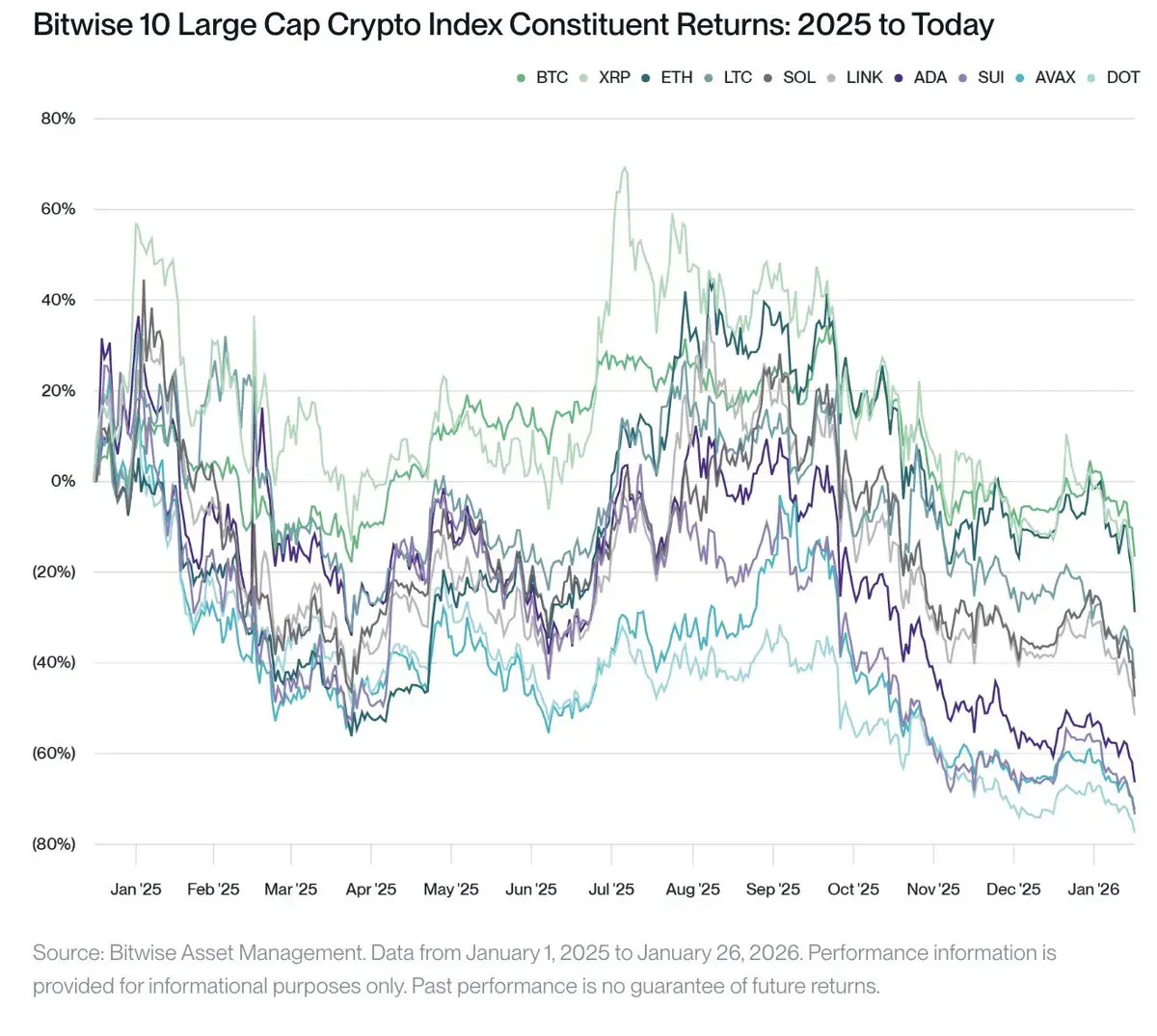
It is divided into three clear groups. The first group of assets (BTC, ETH, XRP) performed okay, down 10.3% to 19.9%. The second group (SOL, LTC, LINK) experienced a standard bear market, down 36.9% to 46.2%. But the third group (ADA, AVAX, SUI, DOT) was hit hard, with declines as high as 61.9% to 74.7%.

The fundamental difference between these three groups lies in the ability of institutional investors to invest in them. The first group benefited from strong ETF/DAT support throughout the year (or, in the case of XRP, from winning its lawsuit against the SEC); the second group had ETFs expected to be approved in 20251; and the third group never received such support.

Look at what happened to the third group, which relied solely on crypto-native channels for support!

The institutional support received by the first group was unprecedented. For example, during the period shown in the chart, ETFs and DATs bought 744,417 bitcoins, worth approximately $75 billion. Imagine where Bitcoin would be without that $75 billion in support? I estimate it would be down about 60%.

The retail crypto market has been in a severe winter since January 2025. Institutional investors merely masked this fact for certain assets.

The Darkest Hour Is Just Before the Dawn

What needs to be remembered now is that there is indeed a lot of good news in the crypto space. Regulatory progress is real. Institutional adoption is real. Stablecoins and tokenization are real. Wall Street's acceptance is real.

Good news tends to be ignored in bear markets, but it doesn't disappear. It is stored as potential energy. When the gloom lifts and market sentiment returns to normal, this stored energy will return with a vengeance.

What can lift the gloom? Strong economic growth triggering a wave of aggressive risk-on sentiment, positive surprises from the Clarity Act, signs of Bitcoin recognition by sovereign nations, or simply the passage of time.

As a veteran of multiple crypto winters, I can tell you that the feeling at the end of those winters felt very much like it does now: despair, frustration, and listlessness. But the current market correction has not fundamentally changed anything about crypto.

I believe we will bounce back strongly soon. After all, if it has felt like winter from January 2025 until now, spring must surely be just around the corner.

Preguntas relacionadas

QAccording to the article, when did the crypto winter actually begin?

AThe crypto winter actually began in January 2025.

QWhat was the primary factor that masked the true start of the crypto winter in 2025?

AThe massive inflows into ETFs and Digital Asset Trusts (DATs) masked the true start of the crypto winter.

QHow are the assets in the article's 'third group' characterized, and what was their performance?

AThe third group (ADA, AVAX, SUI, DOT) consists of assets that never received institutional support like ETFs. They were hit the hardest, with declines ranging from 61.9% to 74.7%.

QWhat does the author suggest is the typical duration of a crypto winter, and why does he believe the current one might be different?

AThe typical duration is about 13 months. The author believes the current winter is different because it effectively started in January 2025, not October 2025 (the peak), meaning we are likely closer to its end than the 13-month timeline from the peak would suggest.

QWhat does the author say happens to positive news and developments during a crypto winter?

APositive news is ignored during a crypto winter, but it doesn't disappear. It gets stored as potential energy and is then released powerfully when market sentiment returns to normal.

Lecturas Relacionadas

380,000 Apps Exposed, 2,000+ Apps Leaked Secrets: AI Programming Turns 'Intranet' into Public Internet

Israeli cybersecurity firm RedAccess uncovered a severe data exposure trend linked to "vibe coding" or AI-powered software development tools. Their research found approximately 38,000 publicly accessible web applications built with platforms like Lovable, Base44, Netlify, and Replit. Of these, an estimated 2,000 apps exposed sensitive corporate and personal data, including medical records, financial information, internal strategic documents, and customer chat logs. In some cases, access even granted administrative privileges. The core issue stems from default privacy settings that make applications public by default, combined with a lack of built-in security controls (like authentication) in the AI-generated code. This allows employees without security expertise—"citizen developers"—to easily create and deploy applications that bypass standard corporate security reviews. The exposed apps, often indexed by search engines, are trivially discoverable. While some platform providers (Replit, Lovable, Wix/Base44) argue that security configuration is the user's responsibility and question the validity of some findings, security researchers confirm the widespread reality of such exposures. This pattern, also noted in prior studies, highlights a critical security gap as AI democratizes app creation, potentially leading to massive, unintentional data leaks.

marsbitHace 51 min(s)

380,000 Apps Exposed, 2,000+ Apps Leaked Secrets: AI Programming Turns 'Intranet' into Public Internet

marsbitHace 51 min(s)

Attracting Global Capital, Asia's New 'Super Cycle' Is Unfolding

Investors are turning to Asia as the next frontier for global equity growth, with a new "super cycle" unfolding across the region. Driven by the AI revolution, Asian markets, particularly South Korea, have seen significant rallies. According to Morgan Stanley analysis, the underlying drivers of Asia's industrial cycle are shifting from traditional sectors like real estate and manufacturing to massive investments in AI infrastructure, energy security and transition, and supply chain resilience. Fixed asset investment in Asia is projected to grow from around $11 trillion in 2025 to $16 trillion by 2030, with a 7% annual growth rate from 2026-2030. The AI wave is a primary catalyst, driving immense capital expenditure for chips, servers, data centers, and power systems. Asia is central to this hardware supply chain. In China, AI investment is focused on building a full-system domestic capability, with the local AI chip market potentially reaching $86 billion by 2030. Beyond AI, China's export story is expanding from EVs and batteries to robotics. The country already captures about half of new global industrial robot demand and over 90% of humanoid robot shipments. This growth phase mirrors the early stages of China's EV export boom. Simultaneously, energy security investments, spurred by AI's massive power needs, are rising, with China benefiting from its leadership in solar, batteries, and EVs. Regional defense spending is also increasing structurally, supporting demand for advanced manufacturing. The main beneficiaries are China, South Korea, and Japan, positioned in core supply chain areas. However, risks remain, including potential overcapacity, profit margin pressures from competition, persistent technological restrictions, geopolitical friction, and workforce displacement due to AI-driven automation. Market volatility is also expected to increase as investor expectations diverge on the realization of these capital investment and export themes.

marsbitHace 52 min(s)

Attracting Global Capital, Asia's New 'Super Cycle' Is Unfolding

marsbitHace 52 min(s)

Funding Weekly Report | 14 Public Funding Events, Kalshi Completes $10B New Funding Round at $220B Valuation Led by Coatue Management

Weekly Funding Roundup: 14 Deals and $10.49B+ in Total Funding, Led by Kalshi's $1B Round Last week (5.4-5.10) saw 14 notable funding events in the global blockchain ecosystem, raising over $10.49 billion in total. Key highlights include Kalshi, a prediction market platform, securing a $1 billion round led by Coatue Management, reaching a $22 billion valuation. The platform now boasts ~2 million MAUs and $178B in annualized trading volume. In DeFi, regulated on-chain reinsurer OnRe raised $5 million in Series A funding, and Bitcoin-backed credit protocol Saturn Credit completed a $2 million seed round. For Infrastructure & Tools, OpenTrade raised $17 million to expand its stablecoin yield infrastructure, and RWA platform Balcony secured $12.7 million to deploy its property settlement service in the US. Centralized Finance saw one deal: AI-driven trading platform Stockcoin.ai completed a seed round led by Amber Group. In the prediction market sector alongside Kalshi, AI-powered platform Elastics raised $2 million. Other notable deals include SC Ventures' strategic investment in crypto market maker GSR and Centrifuge securing a "seven-figure" investment from Coinbase to become a core RWA partner for Base. On the investor side, Haun Ventures raised a new $1 billion fund targeting crypto and AI, and Multi Investment raised ~$616 million to focus on blockchain and Web3 investments.

marsbitHace 1 hora(s)

Funding Weekly Report | 14 Public Funding Events, Kalshi Completes $10B New Funding Round at $220B Valuation Led by Coatue Management

marsbitHace 1 hora(s)

Trading

Spot
Futuros
活动图片

