Actually, the Crypto Winter Began in January 2025

marsbitPublicado a 2026-02-03Actualizado a 2026-02-03

Resumen

The crypto winter began in January 2025, though many only recently acknowledged it. Bitcoin and Ethereum have fallen 39% and 53% from their October 2025 peaks, with steeper declines for other assets. This is a full bear market, not a correction, driven by over-leverage and profit-taking. Positive developments like regulatory progress and institutional adoption have been ignored amid the downturn, typical of crypto winters where good news fails to lift prices. Historically, crypto winters last around 13 months. However, this one may be closer to ending than it appears, as it effectively started in January 2025. ETF and digital asset trust (DAT) inflows masked the reality for some assets. Bitcoin, Ethereum, and XRP saw milder declines (10–20%) due to institutional support, while assets like ADA, AVAX, SUI, and DOT fell 62–75% without such backing. Without $75 billion in ETF/DAT buying, Bitcoin’s drop would have been closer to 60%. The retail crypto market has been in winter since January 2025. Despite the gloom, fundamental strengths remain: regulatory clarity, institutional adoption, stablecoins, tokenization, and Wall Street embrace. These positive factors are stored energy that will fuel the next rally when sentiment shifts. Triggers could include strong economic growth, pro-crypto regulatory surprises, sovereign adoption of Bitcoin, or simply time. As with past winters, the end feels near—despair and frustration are common precursors to recovery. Spring is likely coming s...

Author:Matt Hougan, Chief Investment Officer of Bitwise

Compiled by: Hu Tao, ChainCatcher

We have been in a crypto winter since January 2025. It's likely that we are closer to the end of this winter than to its beginning.

We are in the midst of a full-blown crypto winter.

Crypto Twitter has only recently begun to realize this, but it is undeniable. Bitcoin is down 39% from its all-time high in October 2025, Ethereum is down 53%, and many other crypto assets have fallen even more.

This is not a "bull market correction" or a "slight dip." This is a full-blown, Leonardo DiCaprio-in-The-Revenant-(2012)-level crypto winter—caused by factors such as excessive leverage and widespread profit-taking by seasoned players.

Recognizing and accepting this is enlightening.

Why are crypto prices still falling despite positive news about adoption, regulation, and other areas? Because we are in the depths of a crypto winter.

Why is the new Fed Chair a Bitcoin supporter, yet the Crypto Fear & Greed Index is near historic highs? Because we are in a crypto winter.

Crypto investors who have lived through past winters (be it 2018 or 2022) should remember that at the deepest points of the winter, good news meant nothing. Wall Street hiring aggressively or Morgan Stanley increasing its crypto investments did not drive a crypto market rally. These factors might matter in the long run, but not now. The end of a crypto winter is not exciting; it is exhausting.

So, when will the winter end?

The good news is: We are closer to the end than you think.

The History of Crypto Winters

Crypto winters typically last about 13 months. For example, Bitcoin peaked in December 2017 and bottomed in December 2018. It peaked again in October 2021 and bottomed in November 2022.

By that measure, we are in for a tough time. After all, Bitcoin's peak was in October 2025. Are we really going to have to wait until next November to get back in?

I don't think so.

The more time I spend analyzing the current "winter," the more I realize it actually began in January 2025. It's just that ETF and Digital Asset Trust (DAT) flows masked the truth, preventing us from seeing it.

ETF and DAT Flows Masked the 2025 Winter

Take a closer look at this chart of the components of the Bitwise 10 Large Cap Crypto Index since January 1, 2025.
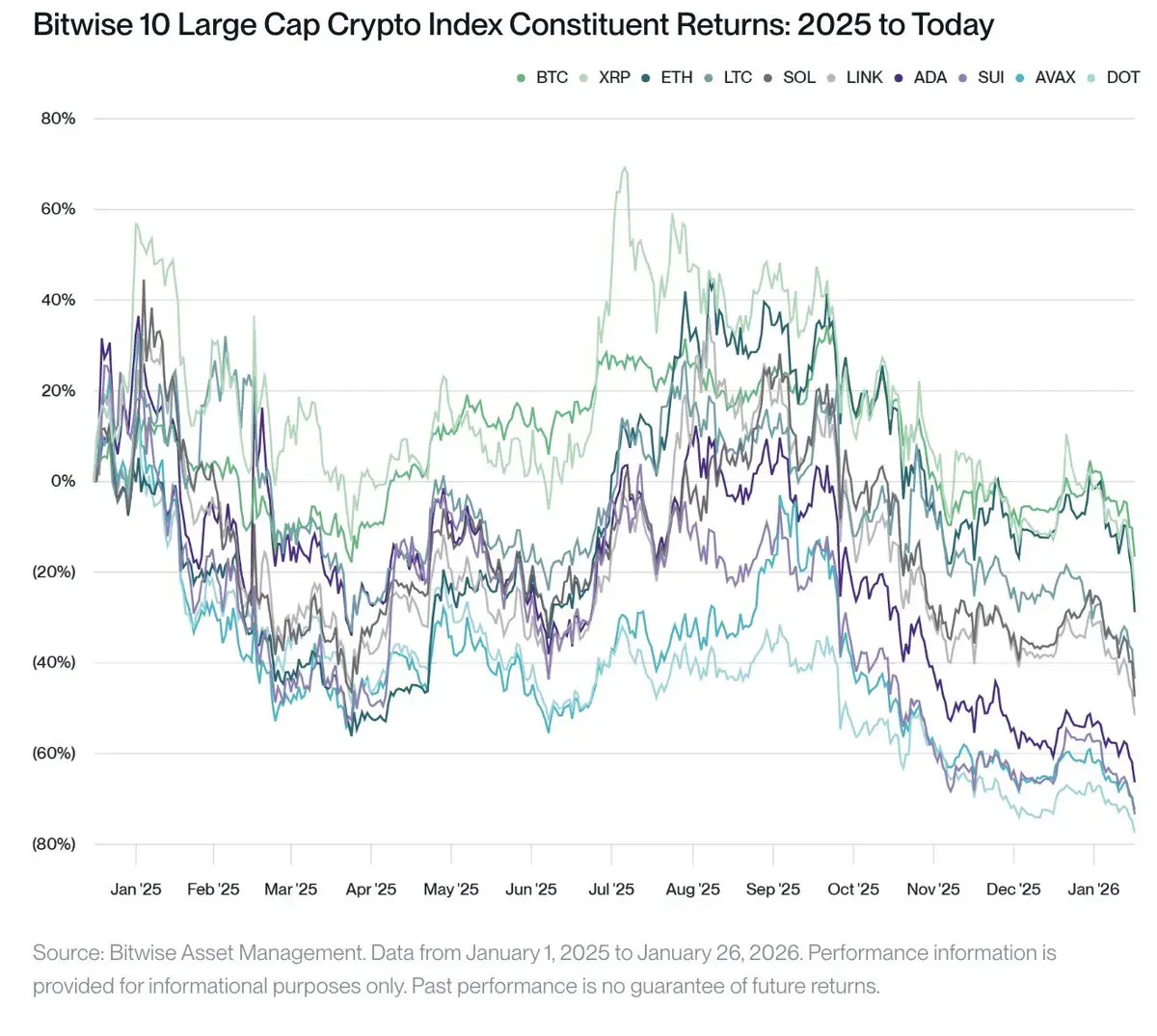
It is divided into three clear groups. The first group of assets (BTC, ETH, XRP) performed okay, down 10.3% to 19.9%. The second group (SOL, LTC, LINK) experienced a standard bear market, down 36.9% to 46.2%. But the third group (ADA, AVAX, SUI, DOT) was hit hard, with declines as high as 61.9% to 74.7%.

The fundamental difference between these three groups lies in the ability of institutional investors to invest in them. The first group benefited from strong ETF/DAT support throughout the year (or, in the case of XRP, from winning its lawsuit against the SEC); the second group had ETFs expected to be approved in 20251; and the third group never received such support.

Look at what happened to the third group, which relied solely on crypto-native channels for support!

The institutional support received by the first group was unprecedented. For example, during the period shown in the chart, ETFs and DATs bought 744,417 bitcoins, worth approximately $75 billion. Imagine where Bitcoin would be without that $75 billion in support? I estimate it would be down about 60%.

The retail crypto market has been in a severe winter since January 2025. Institutional investors merely masked this fact for certain assets.

The Darkest Hour Is Just Before the Dawn

What needs to be remembered now is that there is indeed a lot of good news in the crypto space. Regulatory progress is real. Institutional adoption is real. Stablecoins and tokenization are real. Wall Street's acceptance is real.

Good news tends to be ignored in bear markets, but it doesn't disappear. It is stored as potential energy. When the gloom lifts and market sentiment returns to normal, this stored energy will return with a vengeance.

What can lift the gloom? Strong economic growth triggering a wave of aggressive risk-on sentiment, positive surprises from the Clarity Act, signs of Bitcoin recognition by sovereign nations, or simply the passage of time.

As a veteran of multiple crypto winters, I can tell you that the feeling at the end of those winters felt very much like it does now: despair, frustration, and listlessness. But the current market correction has not fundamentally changed anything about crypto.

I believe we will bounce back strongly soon. After all, if it has felt like winter from January 2025 until now, spring must surely be just around the corner.


Preguntas relacionadas

QAccording to the article, when did the crypto winter actually begin?

AThe crypto winter actually began in January 2025.

QWhat was the primary factor that masked the true start of the crypto winter in 2025?

AThe massive inflows into ETFs and Digital Asset Trusts (DATs) masked the true start of the crypto winter.

QHow are the assets in the article's 'third group' characterized, and what was their performance?

AThe third group (ADA, AVAX, SUI, DOT) consists of assets that never received institutional support like ETFs. They were hit the hardest, with declines ranging from 61.9% to 74.7%.

QWhat does the author suggest is the typical duration of a crypto winter, and why does he believe the current one might be different?

AThe typical duration is about 13 months. The author believes the current winter is different because it effectively started in January 2025, not October 2025 (the peak), meaning we are likely closer to its end than the 13-month timeline from the peak would suggest.

QWhat does the author say happens to positive news and developments during a crypto winter?

APositive news is ignored during a crypto winter, but it doesn't disappear. It gets stored as potential energy and is then released powerfully when market sentiment returns to normal.

Lecturas Relacionadas

In Jinjiang, Fujian, a Storage Super Unicorn Lies Quiet

In Fujian's Jinjiang, a city known for sportswear, lies a quiet semiconductor giant: Fujian Jinhua Integrated Circuit Co. (JHICC). Once a promising domestic DRAM manufacturer alongside Yangtze Memory and ChangXin Memory Technologies (CXMT), its journey was derailed in 2018 when the U.S. placed it on an Entity List and filed criminal charges for alleged trade secret theft. This halted production for years. A turning point came in February 2024 when a U.S. federal court found JHICC not guilty. However, it had lost crucial time. While CXMT soared to become a top-valued A-share company in 2024, JHICC, with an estimated valuation of 80 billion RMB, was just restarting. Its current output is primarily customized DDR4 chips, not the advanced DDR5/HBM demanded for AI, but it still benefits from the broader memory chip upcycle. JHICC's story is tied to Chen Zhengkun, a veteran engineer who left Micron to lead the venture. Founded in 2016 with state-backed funding, JHICC partnered with Taiwan's UMC to develop DRAM technology. Rapid progress was cut short by the U.S. actions, which Micron initiated, partly due to its heavy reliance on the Chinese market. Post-sanctions, Chen's team worked to rebuild the production line with reduced reliance on U.S. technology. According to its records, JHICC achieved small-scale production and revenue growth under immense pressure. It now focuses on the stable "niche" DRAM market (e.g., TVs, routers) with a monthly capacity of ~40,000 wafers, aiming for 60,000 by 2026. It holds over 1,000 patents but remains on the Entity List. For Jinjiang, investing in JHICC was a bold industrial leap. The local government provided unwavering financial and logistical support during the crisis, helping the company survive. JHICC has become the anchor for a growing local semiconductor cluster. Though its scale lags behind domestic peers, JHICC's persistence symbolizes a hard-won foothold in a global market long dominated by Samsung, SK Hynix, and Micron. Having missed one boom, it seeks a place in the new AI-driven memory supercycle.

marsbitHace 32 min(s)

In Jinjiang, Fujian, a Storage Super Unicorn Lies Quiet

marsbitHace 32 min(s)

Must-Watch Events Next Week|CLARITY Act Could Face Senate Vote; SpaceX, Circle to Report Earnings (8.3-8.9)

**Summary: Key Events and Developments to Watch (August 3-9)** The upcoming week is marked by significant financial disclosures, key legislative deadlines, and notable product updates. **Major Financial Events:** Several companies are scheduled to release their Q2 2026 earnings. American Bitcoin (ABTC) will report on August 3, followed by SpaceX and Hut 8 Mining Corp. on August 4, and Circle on August 5. Notably, a significant portion of SpaceX shares (up to 12% of total shares) will be unlocked on August 6 following their earnings release. **Key Legislative Deadline:** The U.S. Senate faces an August 7 deadline to secure 60 votes for the CLARITY Act, a bipartisan bill aiming to establish a federal regulatory framework for cryptocurrencies. The Senate may hold a full vote on the bill during the week. **Economic Data:** The U.S. July Non-Farm Payrolls report will be released on August 7, providing crucial labor market data. **Technology & Product Updates:** * **Shutdowns:** DeFi portfolio tracker Zapper and wallet app Ctrl Wallet will cease operations on August 3. * **Upgrades:** LayerZero will deprecate its v1 relayers on August 3. XRP Ledger's new version 3.3.0, featuring five new functions, is expected next week. * **AI:** Elon Musk announced that the advanced Grok 4.6 AI model is set for release around August 7. * **Bitcoin:** The BIP-110 forced signaling for a potential Bitcoin network change is scheduled to begin around August 8. **Other Notable Events:** Chinese robotics firm Unitree Tech has set its preliminary price inquiry for its IPO for August 5. South Korean exchange Upbit will delist AQT and AERGO tokens on August 3.

marsbitHace 2 hora(s)

Must-Watch Events Next Week|CLARITY Act Could Face Senate Vote; SpaceX, Circle to Report Earnings (8.3-8.9)

marsbitHace 2 hora(s)

Trading

Spot
活动图片




