Acquiring 800MHz Spectrum Nationwide in One Go, Is Starlink Challenging the Big Three US Carriers Head-On?

Published on 2026-10-12Last updated on 2026-10-12

Abstract

SpaceX will acquire up to 14MHz of nationwide 800MHz low-band spectrum from Grain Management to enhance the indoor coverage capabilities of Starlink Mobile. Combined with the previous $17 billion mid-band spectrum acquisition and the license for 15,000 next-generation satellites, this deal moves SpaceX a step closer to evolving from a satellite backup solution to a complete mobile network.

Deal Overview

Spectrum: Purchase nationwide low-band licenses for up to 14MHz in the 800MHz band, covering approximately 100% of the US population.

Existing Resources: Additionally, 65MHz of nationwide mid-band spectrum acquired from EchoStar in a $17 billion transaction.

Satellites: 650 direct-to-device satellites already launched, with approval to launch up to 15,000 next-generation satellites.

Risk: The deal still requires FCC approval and may face opposition from smaller carriers.

Low-Band Spectrum Fills Indoor Coverage Gap

SpaceX has reached an agreement to purchase nationwide low-band spectrum licenses for its planned terrestrial mobile network, complementing the satellite-based Starlink cellular service. The company will acquire spectrum licenses for up to 14MHz in the 800MHz band from Grain Management; Grain obtained these licenses from T-Mobile earlier this year.

The FCC states that these 800MHz licenses cover approximately 100% of the US population. The available spectrum per county ranges from 4.85MHz to 14MHz and can be used for terrestrial mobile service, direct-to-phone satellite service, or both simultaneously.

SpaceX's Cumulative Spectrum Portfolio Continues to Expand

Beyond this low-band acquisition, SpaceX will also purchase 65MHz of nationwide mid-band spectrum from EchoStar. The FCC approved this $17 billion transaction in May 2026.

SpaceX stated that the global 2GHz mid-band spectrum will provide high-bandwidth capacity for the US market, while the new low-band spectrum can penetrate obstacles like walls, allowing users to access the service indoors. Most existing mobile phones already support this low-frequency band.

From Carrier Collaboration to Direct Competition

SpaceX has primarily collaborated with carriers to provide satellite coverage for areas lacking terrestrial network coverage. The company now indicates that Starlink Mobile will eventually offer a more complete mobile service. Following the announcement of the spectrum deal, share prices of major US telecom carriers and AST SpaceMobile declined noticeably.

SpaceX's mobile service partner in the US is T-Mobile, and their agreement includes leasing 10MHz of nationwide mid-band spectrum. The new deal signifies SpaceX is purchasing spectrum originally belonging to T-Mobile, moving a step closer to direct competition.

Next-Generation Satellites to Increase Bandwidth by Over 100 Times

SpaceX has already launched 650 direct-to-device satellites for its existing mobile service and plans to launch up to 15,000 more powerful next-generation satellites. The FCC has approved this application. The company claims that the V2 Starlink Mobile satellites will offer over 100 times the bandwidth of the current generation and can deliver high-speed service directly to unmodified terminals.

The deal is expected to receive FCC approval but may face opposition from smaller carriers. The Rural Wireless Association previously stated that the continued concentration of spectrum among a few major players weakens the competitiveness of rural carriers.
Related Reads

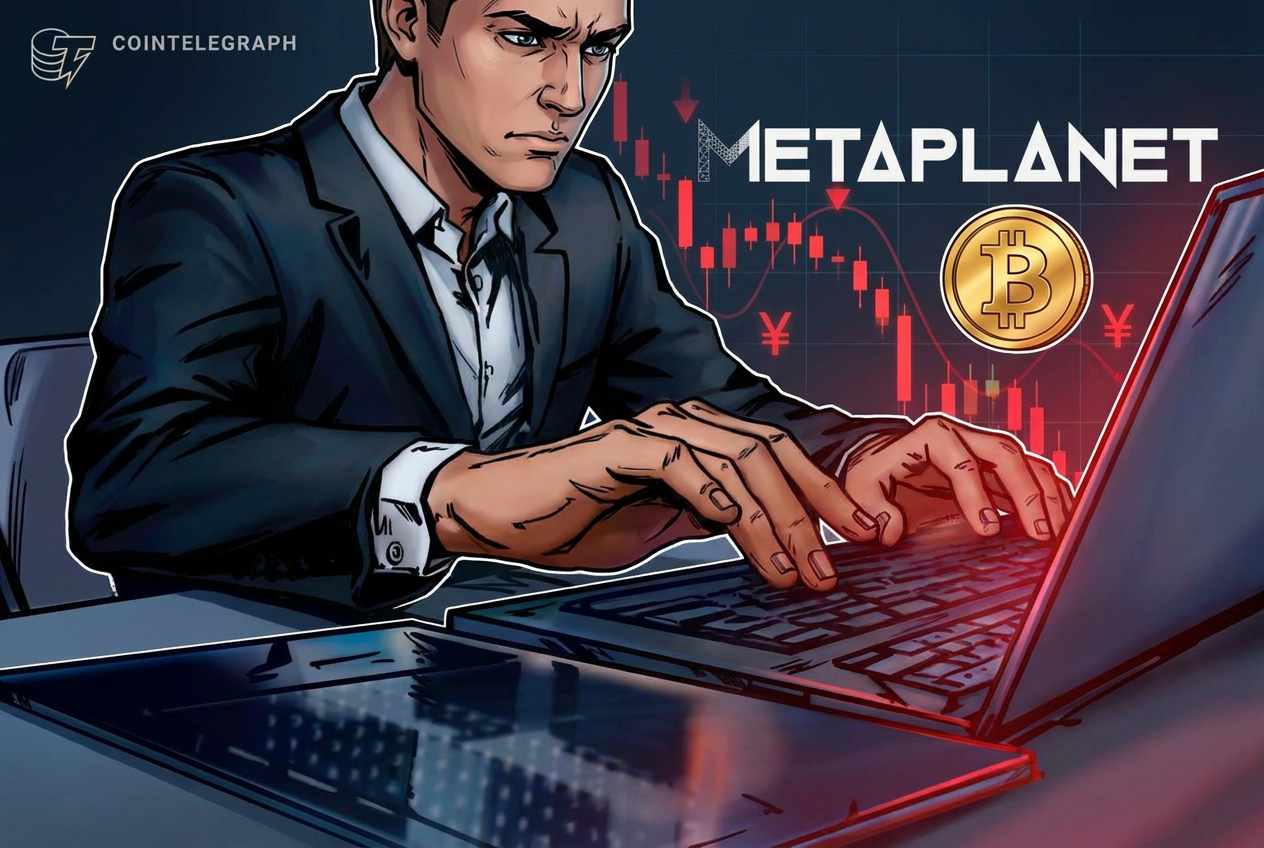
Metaplanet swings to $170M loss as Bitcoin sale hits earnings

Metaplanet, the world's second-largest publicly traded corporate Bitcoin holder, reported a net loss of 27.16 billion yen (about $170 million) in the first nine months of 2026, compared with a profit of 13.53 billion yen ($84.6 million) a year earlier. The loss was driven by a 19.17 billion yen ($119.8 million) loss on the sale of 10,000 BTC and an 8.04 billion yen ($50.3 million) loss from a decline in the value of its Bitcoin holdings, which outweighed gains in its operating business. During the quarter, Metaplanet sold 10,000 BTC for 124.7 billion yen, temporarily held the proceeds in cash, stablecoins and other liquid assets, then spent 149.9 billion yen to buy 11,000 BTC at an average price 9.3% higher per coin. The company said the sale was intended to demonstrate to rating agencies and bond investors that it could convert Bitcoin into cash to meet financing obligations. Holdings ended September at 44,000 BTC, a net increase of 1,000 coins. Metaplanet borrowed against its Bitcoin during the quarter, raising its credit line debt to $649.5 million at the end of September from $414 million at the end of June. It funded purchases from the second quarter onward with borrowed funds, bond proceeds, exercised stock acquisition rights and revenue from its Bitcoin options business. Interest expense rose 56% quarter over quarter to 1.36 billion yen ($8.5 million), and short-term borrowings and bonds payable totaled 110.5 billion yen ($691 million). For the nine months through September, revenue rose 30.5% to 5.9 billion yen ($36.9 million) and operating profit increased 26.5% to 3.48 billion yen ($21.8 million). The company cut its full-year revenue forecast to 6.5 billion yen ($40.6 million) from 16 billion yen ($100 million). The results come as Bitcoin treasury companies face pressure from falling prices and index removals; MSCI confirmed Strategy, Metaplanet and Upexi will be removed from its equity indexes at the Nov. 30 market close. Bitcoin fell below $70,000 on Friday, trading around $68,600, down about 9% over the previous week.

cointelegraph2h ago

Metaplanet swings to $170M loss as Bitcoin sale hits earnings

cointelegraph2h ago

From Near Bankruptcy to Five Trillion: Jensen Huang and His Thirty-Three Years at NVIDIA

In November, at NVIDIA's Santa Clara headquarters, a two-page press release announced CEO Jensen Huang's immediate resignation as president, CEO, and director, following his admission of marital infidelity and a board investigation into related conduct. CFO Colette Kress became interim CEO, and Harvey Jones was named board chairman. Huang, who had just overseen NVIDIA's rise to become the first company worth $5 trillion, retained only his roughly 3% stake and no operational role. The article traces NVIDIA's 33-year history from its 1993 founding at a Denny's in East San Jose, where Huang and two engineers bet on making graphics chips for PCs. Their first chip, NV1, failed, but a pivotal meeting with Sega's Shoichiro Irimajiri converted a $5 million contract payment into an investment, saving the company. After layoffs and self-teaching from Silicon Graphics textbooks, NVIDIA's RIVA 128 succeeded in 1997. The company went public in 1999 and weathered crises including defects, financial downturns, and industry consolidation. Huang's long-term bet on CUDA, initially met with silence and skepticism, positioned NVIDIA for the AI boom. After AlexNet in 2012, he committed the company to deep learning, personally delivering the first DGX-1 to OpenAI in 2016. ChatGPT's 2022 launch triggered explosive growth, with revenue reaching $215.9 billion. Despite surviving decades of near-collapse, it was personal scandal—not business failure—that ended his tenure. As the article notes, for 33 years he woke believing the company was 30 days from collapse; this time, the 30th day was his own.

marsbit4h ago

From Near Bankruptcy to Five Trillion: Jensen Huang and His Thirty-Three Years at NVIDIA

marsbit4h ago

Solo brings human verification to Venmo co-founder’s JellyJelly app as AI agents beat CAPTCHA

Solo, a privacy-preserving proof-of-humanity company, is bringing its human verification SDK to JellyJelly, a Solana-based social video app co-founded by Venmo co-founder Iqram Magdon-Ismail. The integration confirms every account belongs to a real, unique person without government ID or puzzles. The move comes as AI agents learn to beat CAPTCHA: in a Solo experiment, an AI agent named Gary joined over 50 Discord servers overnight and sent 500+ messages without being detected, passing every CAPTCHA through ordinary browsing and clicking. Solo CEO Edison Siu says CAPTCHA's assumption that humans can do what bots cannot is increasingly hard to sustain, and that platforms should verify the human directly rather than adding friction or requiring identity documents. JellyJelly lets users share short videos and send crypto payments, and rising AI-generated video and automated accounts make it harder to know who is behind each account; Solo's SDK distinguishes genuine users from automated ones and prevents one person from registering multiple verified identities. The process uses a facial scan from a standard smartphone camera, converted into a biometric representation encrypted on-device with fully homomorphic encryption (FHE), allowing comparison against existing records without decrypting data. No special hardware or ID is needed, raw facial images are not stored, and apps receive only a verification result. The SDK can also serve gaming platforms and payment services. Solo is backed by Draper Associates, which led a $1 million round in March 2025, and was selected for Solana Incubator cohort 5. Solo is now building tools letting verified users authorize their own AI agents and enabling AI companies to pay verified people for human-only work. Magdon-Ismail, advising Solo, says the next step after Venmo is your AI agent paying on your behalf, with recipients needing to know a real person authorized it.

cointelegraph4h ago

Solo brings human verification to Venmo co-founder’s JellyJelly app as AI agents beat CAPTCHA

cointelegraph4h ago

Arthur Hayes ‘flattered’ as Coinbase backs US stock perps

Arthur Hayes, co-founder of BitMEX, said he was "flattered" by Coinbase's support for the CFTC in a US legal dispute over stock perpetual futures. Hayes noted that when BitMEX launched the perpetual swap in 2016, Washington's reaction was "less than warm," and remarked that "imitation is the sincerest form of regulation." Coinbase and five other companies submitted a brief opposing the Capital Markets Alliance Association's (CMAA) request to block trading in perpetual futures tied to individual stocks. The CMAA argues these contracts should be treated as security-based swaps, which face tighter retail trading restrictions. The SEC reportedly submitted a proposed brief opposing the alliance's request to temporarily halt trading, saying it is reviewing the exchanges' rules for listing the contracts. The CMAA said the CFTC approved the contracts without adequately explaining its decision or addressing unresolved regulatory questions, citing about $375 million in reported 24-hour notional trading volume for Kalshi's stock perpetuals shortly after launch. US District Judge Valerie Caproni denied the group's request for a temporary restraining order, finding the alliance was likely to succeed on its claim that the CFTC exceeded its authority. Stock perpetuals let traders speculate on share prices without owning the underlying stocks and have no fixed expiration date. Wojciech Kaszycki, strategy adviser to BTCS SA, said the lack of a fixed expiration or delivery date could complicate treating perpetual contracts as futures, but warned that a ruling against the CFTC could push trading toward offshore and decentralized platforms: "The product doesn't die; it just changes address."

cointelegraph6h ago

Arthur Hayes ‘flattered’ as Coinbase backs US stock perps

cointelegraph6h ago

Trading

Spot
活动图片