Aave founder under scrutiny for $10M token purchase amid governance drama

cointelegraphPublicado a 2025-12-24Actualizado a 2025-12-24

Resumen

Aave founder Stani Kulechov faces criticism for purchasing $10 million worth of AAVE tokens, with allegations that the move was intended to increase his voting power in a key governance proposal. Critics, including DeFi strategist Robert Mullins, claim the purchase could be used to vote against token holders' interests, highlighting concerns about governance attacks and the concentration of voting power. The controversy arises amid a heated vote on reclaiming control of Aave's brand assets through a DAO structure. Critics argue the proposal was rushed and note that a small group of large holders controls over 58% of the voting power, raising questions about the fairness of token-based governance.

Aave founder Stani Kulechov is facing scrutiny over his recent $10 million purchase of AAVE tokens, with some in the crypto community claiming it was used to boost his voting power in a key governance proposal.

In a Wednesday post on X, Robert Mullins, a decentralized finance (DeFi) strategist and liquidity specialist, argued that the purchase was meant to increase Kulechov’s “voting power in anticipation to vote for a proposal directly against the token holders best interests.”

He added: “This is a clear example of tokens not being equipped to adequately disincentivize governance attacks.”

Prominent crypto user Sisyphus echoed those concerns, claiming that Kulechov might have sold “millions of dollars” worth of Aave (AAVE) tokens between 2021 and 2025, questioning the economic rationale behind the move.

The controversy comes as Aave token holders debate how governance power is exercised within one of DeFi’s largest protocols, with critics arguing that large token purchases can materially influence voting outcomes on high-stakes proposals. The dispute has reignited concerns about whether token-based governance adequately protects minority holders when founders or early insiders retain significant economic leverage.
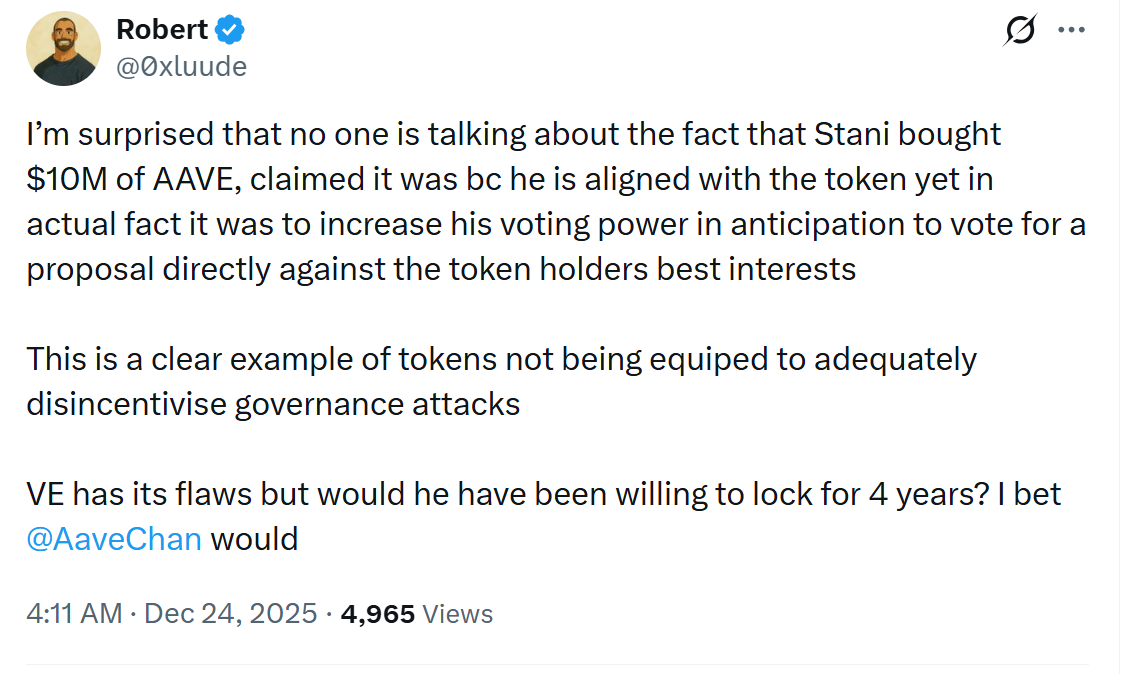
Robert Mullins questions Kulechov’s motive behind recent purchase. Source: Robert Mullins

Aave governance vote sparks backlash

As Cointelegraph reported, Aave’s governance vote has triggered a backlash after a proposal on reclaiming control of the protocol’s brand assets was pushed to a snapshot vote despite ongoing debate.

The proposal asks whether AAVE token holders should regain ownership of domains, social accounts and intellectual property through a DAO-controlled legal structure.

Several stakeholders disputed that decision, arguing that the proposal was escalated prematurely.

Former Aave Labs CTO Ernesto Boado, listed as the proposal’s author, said the vote escalated without his consent and broke community trust.

Related: Aave founder outlines 2026 ‘master plan’ after end to SEC probe

Voting power concentration in Aave DAO

Samuel McCulloch of USD.ai pointed out the concentration of voting power. In an X post, he described the Aave vote as “silly,” adding that a small group of large holders accounted for about half of the total voting weight.

Snapshot data from the Aave DAO shows that the top three voters alone control more than 58% of the entire vote. The top voter, 0xEA0C...6B5A, holds 27.06% of the voting power (333k AAVE), while the second-largest voter, aci.eth, controls 18.53% (228k AAVE).

Cointelegraph reached out to Kulechov for comment, but did not receive a response by publication.

Magazine: Bitcoin whale Metaplanet ‘underwater’ but eyeing more BTC: Asia Express

Criptos en tendencia

Preguntas relacionadas

QWhy is Aave founder Stani Kulechov facing scrutiny for his recent token purchase?

AStani Kulechov is facing scrutiny because some in the crypto community claim his $10 million purchase of AAVE tokens was used to boost his voting power in a key governance proposal, potentially acting against token holders' best interests.

QWhat specific governance proposal has caused controversy in the Aave community?

AThe controversial proposal asks whether AAVE token holders should regain ownership of the protocol's brand assets, including domains, social accounts, and intellectual property, through a DAO-controlled legal structure.

QHow concentrated is the voting power in the Aave DAO according to the article?

AVoting power in Aave DAO is highly concentrated, with the top three voters controlling more than 58% of the total voting weight, and the top single voter holding 27.06% of the voting power.

QWhat criticism did Robert Mullins raise about Kulechov's token purchase?

ARobert Mullins argued that Kulechov's purchase was meant to increase his voting power to vote for a proposal that goes against token holders' best interests, calling it a clear example of tokens not being equipped to disincentivize governance attacks.

QWhat concern has this controversy reignited about token-based governance systems?

AThe controversy has reignited concerns about whether token-based governance adequately protects minority holders when founders or early insiders retain significant economic leverage and can influence voting outcomes through large token purchases.

Lecturas Relacionadas

From South Korea to the United States: Blue-Collar Jobs Are Becoming Increasingly Popular, Thanks to AI

AI is reshaping the labor market's value proposition. The traditional four-year college degree is losing its appeal as a guaranteed career path, while skilled blue-collar trades like electricians, welders, and plumbers are experiencing historic demand and wage premiums. This shift is driven by dual pressures: AI's displacement of certain white-collar roles and a booming need for physical infrastructure and data center construction. Data confirms the trend. In the U.S., vocational school revenue surged, and a significant portion of recent layoffs are AI-related. Surveys show a majority of Gen Z adults plan to pursue blue-collar work, citing better job security against AI automation. Vocational education interest has exploded recently. Experts cite a psychological shift as younger generations seek tangible, AI-resistant careers and avoid high student debt. In many cases, salaries for skilled trades now match or exceed those requiring a bachelor's degree. In South Korea, semiconductor vocational high schools boast near-total employment, with graduates securing high-paying roles at companies like Samsung. The shortage is structural, exacerbated by a retiring baby boomer workforce and massive infrastructure projects. Companies like JPMorgan Chase, Meta, and Lowe's are investing heavily in training programs. However, overcoming historical stigma and a "perception gap" around trade careers remains a key challenge to closing the talent gap.

marsbitHace 1 hora(s)

From South Korea to the United States: Blue-Collar Jobs Are Becoming Increasingly Popular, Thanks to AI

marsbitHace 1 hora(s)

Qualcomm: AI Hype Subsides, When Will Smartphones Emerge from the Gloom?

Qualcomm reported its Q3 FY2026 results (ending June 2026), with revenue of $9.95B, down 4% YoY but above expectations. Gross margin declined to 53.1%, pressured by rising costs across manufacturing and memory. Key business segments showed mixed performance: Handset revenue fell 19.6% YoY to $5.09B, dragged by an 11% decline in non-Apple Android shipments and weaker high-end mix. Conversely, Automotive revenue surged 61% to $1.59B, and IoT grew 9% to $1.83B. Core operating profit dropped 41% YoY due to margin compression and higher expenses. Management's Q4 FY2026 guidance projects revenue of $9.7B-$10.5B, in line with consensus, but Non-GAAP EPS guidance of $2.05-$2.25 fell short of expectations. Amidst persistent weakness in its core handset market, Qualcomm is pursuing growth in AI, focusing on Edge AI (smartphones, PCs, automotive) and Data Center AI. Its data center strategy includes four pillars: AI accelerators (e.g., AI200), commercial CPUs (Dragonfly C1000), custom silicon, and connectivity solutions. While these initiatives initially boosted its stock, concerns over AI capital expenditure sustainability have since erased those gains. The company targets $5B in data center revenue for FY2027 and $15B for FY2029. The report concludes that with the traditional handset business still under pressure, the data center opportunity is currently viewed as a longer-term option, and a more conservative valuation based on core operations may be warranted until AI contributions materialize.

marsbitHace 1 hora(s)

Qualcomm: AI Hype Subsides, When Will Smartphones Emerge from the Gloom?

marsbitHace 1 hora(s)

From TPU to Self-Evolving Agents: How Jeff Dean Predicts the Next Step in AI

At the 2026 YC Startup School, Jeff Dean outlined his vision for AI's next phase, shifting focus from simply scaling models to building intelligent, autonomous systems. He believes AI's progress is no longer just about creating smarter models, but about integrating them into systems capable of long-term, iterative work, automated experimentation, and continuous learning. This evolution moves the competition from "who has the bigger model" to "who can best organize intelligence." Dean suggests AI capabilities are now comparable to a junior engineer, enabling the automation of complex workflows. However, the true challenge and opportunity lie in managing these AI "workers" at scale. He emphasizes the importance of **context engineering**—structuring tools, memory, and feedback loops—over raw model power. For startups, this means building deep expertise in niche domains where general models currently fail (near 0-1% success rates), leveraging proprietary data, specialized tools, and domain-specific evaluators. A recurring theme is re-examining fundamental constraints. Dean's past work, like moving Google's search index to memory or creating the TPU, stemmed from questioning outdated assumptions about hardware and cost. He sees similar inflection points today, particularly in **specialized inference hardware** to drastically reduce latency and energy consumption for real-time Agent operation. Notably, he points out that in modern AI systems, the dominant cost is often not computation but **data movement**. Reliable, long-running Agents require robust system design, borrowing concepts from distributed computing like checkpointing, state management, and parallel exploration to handle failures and maintain progress over days or weeks. As AI automates execution, the scarcest human skills will shift to **defining clear specifications**, **judging what problems are worth solving** (taste), and designing effective feedback loops. Ultimately, Dean's framework prioritizes understanding the problem deeply, identifying the true bottlenecks, and systematically building closed-loop systems where AI can not only perform tasks but also improve AI itself.

marsbitHace 1 hora(s)

From TPU to Self-Evolving Agents: How Jeff Dean Predicts the Next Step in AI

marsbitHace 1 hora(s)

Trading

Spot

Artículos destacados

Cómo comprar AAVE

¡Bienvenido a HTX.com! Hemos hecho que comprar Aave Protocol (AAVE) sea simple y conveniente. Sigue nuestra guía paso a paso para iniciar tu viaje de criptos.Paso 1: crea tu cuenta HTXUtiliza tu correo electrónico o número de teléfono para registrarte y obtener una cuenta gratuita en HTX. Experimenta un proceso de registro sin complicaciones y desbloquea todas las funciones.Obtener mi cuentaPaso 2: ve a Comprar cripto y elige tu método de pagoTarjeta de crédito/débito: usa tu Visa o Mastercard para comprar Aave Protocol (AAVE) al instante.Saldo: utiliza fondos del saldo de tu cuenta HTX para tradear sin problemas.Terceros: hemos agregado métodos de pago populares como Google Pay y Apple Pay para mejorar la comodidad.P2P: tradear directamente con otros usuarios en HTX.Over-the-Counter (OTC): ofrecemos servicios personalizados y tipos de cambio competitivos para los traders.Paso 3: guarda tu Aave Protocol (AAVE)Después de comprar tu Aave Protocol (AAVE), guárdalo en tu cuenta HTX. Alternativamente, puedes enviarlo a otro lugar mediante transferencia blockchain o utilizarlo para tradear otras criptomonedas.Paso 4: tradear Aave Protocol (AAVE)Tradear fácilmente con Aave Protocol (AAVE) en HTX's mercado spot. Simplemente accede a tu cuenta, selecciona tu par de trading, ejecuta tus trades y monitorea en tiempo real. Ofrecemos una experiencia fácil de usar tanto para principiantes como para traders experimentados.

377 Vistas totalesPublicado en 2024.12.11Actualizado en 2026.06.02

Cómo comprar AAVE

Discusiones

Bienvenido a la comunidad de HTX. Aquí puedes mantenerte informado sobre los últimos desarrollos de la plataforma y acceder a análisis profesionales del mercado. A continuación se presentan las opiniones de los usuarios sobre el precio de AAVE (AAVE).

活动图片













