a16z: Without Relying on Interest Spreads or Burning Cash, How Does Revolut Become Europe's Most Profitable Neobank?

marsbitPublicado a 2026-03-25Actualizado a 2026-03-25

Resumen

Revolut has emerged as Europe's most profitable neobank, achieving exceptional growth and efficiency without relying heavily on net interest income. In 2025, Revolut reported £4.5 billion in revenue (46% growth) and £1.7 billion in pre-tax profit (57% growth), with a remarkable 38% profit margin. Its user base grew by 30% to 68 million, while maintaining a diversified revenue stream across six business lines, none exceeding 22% of total income. Key to its success is a fee-based model (76% of revenue), contrasting traditional banks that depend on interest income. Revolut’s rule of 75% (revenue growth + profit margin) and 35% ROE far exceed industry averages. The company’s growth is driven by rapid customer acquisition, high user satisfaction (NPS double the industry average), and efficient operations enhanced by AI. With significant room to expand both its user base and average revenue per user (ARPU), particularly through primary account adoption and lending, Revolut is positioned to become a global banking leader. It has applied for a U.S. bank charter, underscoring its ambitious growth trajectory beyond Europe.

Author: Alex Immerman & Santiago Rodriguez

Compiled by: Deep Tide TechFlow

Deep Tide Introduction: a16z uses Revolut's 2025 annual report to dissect how a company achieved a 76% CAGR in a mature financial market. The numbers themselves are astonishing, but what's even more worth reading is the underlying growth logic: not relying on interest spreads for profit, an ROE 3-4 times that of traditional banks, and user NPS more than double the industry average. Put together, this is no longer just a challenger bank story.

Full Text Below:

As growth investors, we often say that great companies speak through their numbers. Revolut, as a UK company, is required to disclose annual financial data mandatorily. Its numbers are outliers, and that's an understatement:

Revenue grew 46% to £4.5 billion

Pre-tax profit grew 57% to £1.7 billion, with a 38% margin

Retail customers grew 30%, adding 16 million in 2025

Revolut has penetration across Europe, with no single country accounting for more than 25% of fee income

Revenue is distributed across 6 business segments, with no single category exceeding 22%

11 product lines each generated over £100 million in revenue

Return on Equity (ROE) reached 35%, a record-breaking level among peers (despite being over-capitalized)

Revolut continues to grow rapidly and efficiently—its "Rule of 75%" (revenue growth rate + net profit margin) places it in the highest tier among modern and mature financial institutions.

More importantly, we believe Revolut still has ample room for both customer growth and monetization in its existing markets. Not to mention potential new markets it hasn't even touched yet—Revolut just applied for a US banking license, showing true global ambition.

This is not your grandmother's neobank. Revolut has the potential to become one of the largest banks globally. There's still a long way to go to get there, but we believe the foundation is laid.

Enough said, let's get started.

I. One of the World's Fastest-Growing Financial Institutions

Let's start with revenue. Revolut's revenue growth is astounding.

Alongside NU (Nubank), they stand in a league of their own compared to other companies in the consumer fintech industry (see chart below). Since breaking the $1 billion revenue mark in 2022, Revolut has compounded at an astonishing 76% CAGR (70% in GBP terms) over the subsequent four years, making it one of the fastest-growing companies post the $1 billion revenue milestone. This growth is particularly notable given that Europe's consumer banking market is highly mature (unlike NU's emerging market).
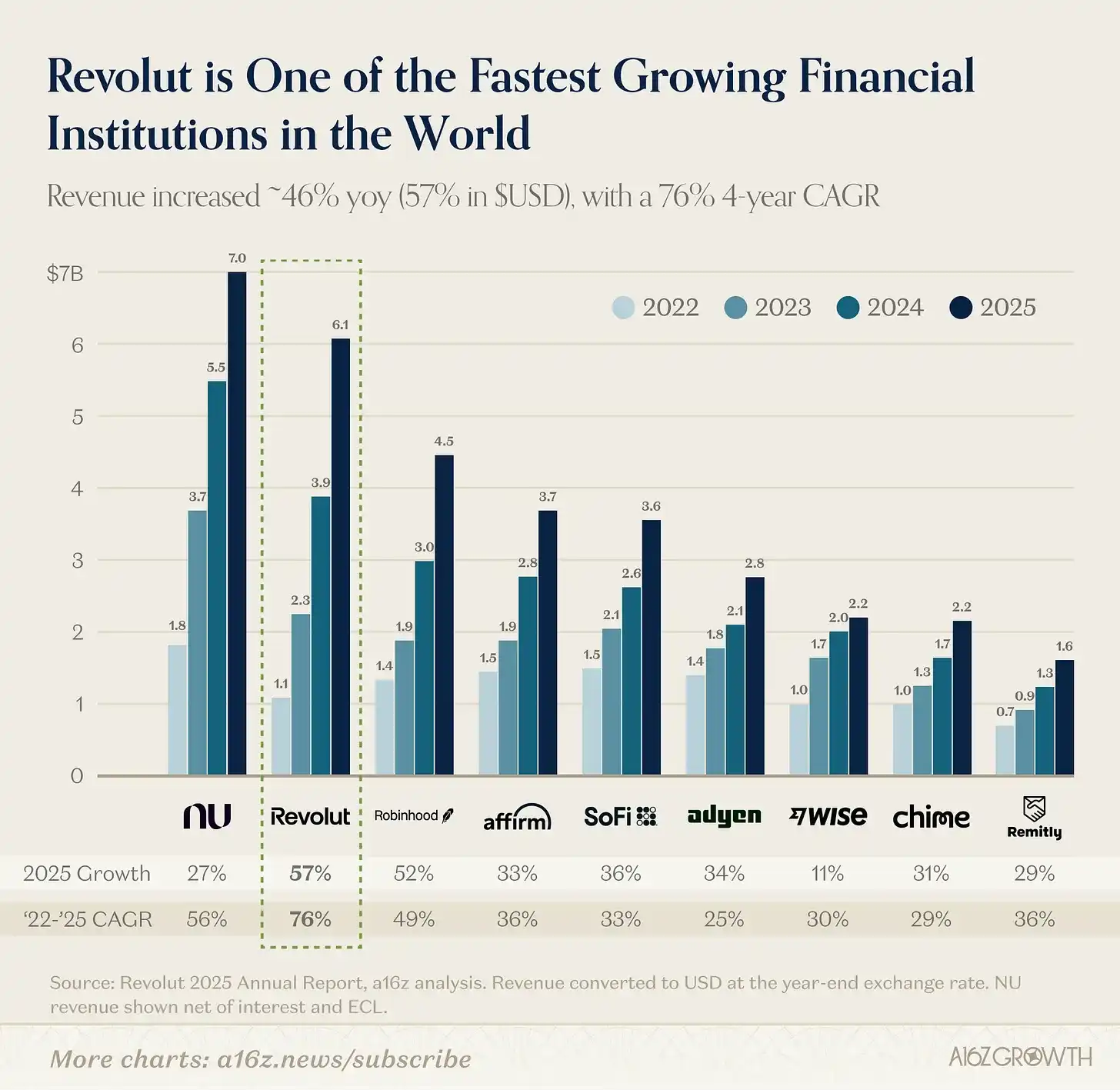
Chart: Revenue converted to USD at year-end exchange rates. NU revenue is net of interest and expected credit losses (ECL).

Source: Revolut 2025 Annual Report

For perspective: In 2022, Revolut's revenue was either less than or similar to that of Robinhood, Affirm, Sofi, Adyen, Wise, or Chime. Now, its revenue is 33% to nearly 3 times greater than any of these well-known consumer fintech companies.

II. Deconstructing Revolut's Growth Algorithm: Six Horses Running Simultaneously

A key differentiator for Revolut is that it is no longer a one-trick pony. It has multiple revenue drivers firing at once.

Revolut started by addressing a real pain point for Europeans: foreign exchange fees. With Revolut, Europeans traveling within or outside the Eurozone, or sending money overseas, no longer had to face payment delays or the 5% fees charged by banks.

From a once single-product, geographically concentrated painkiller, Revolut has grown into a fully-featured personal and business bank. Now, approximately 1 in 3 new accounts opened in Europe (Revolut's primary operating region) chooses Revolut:
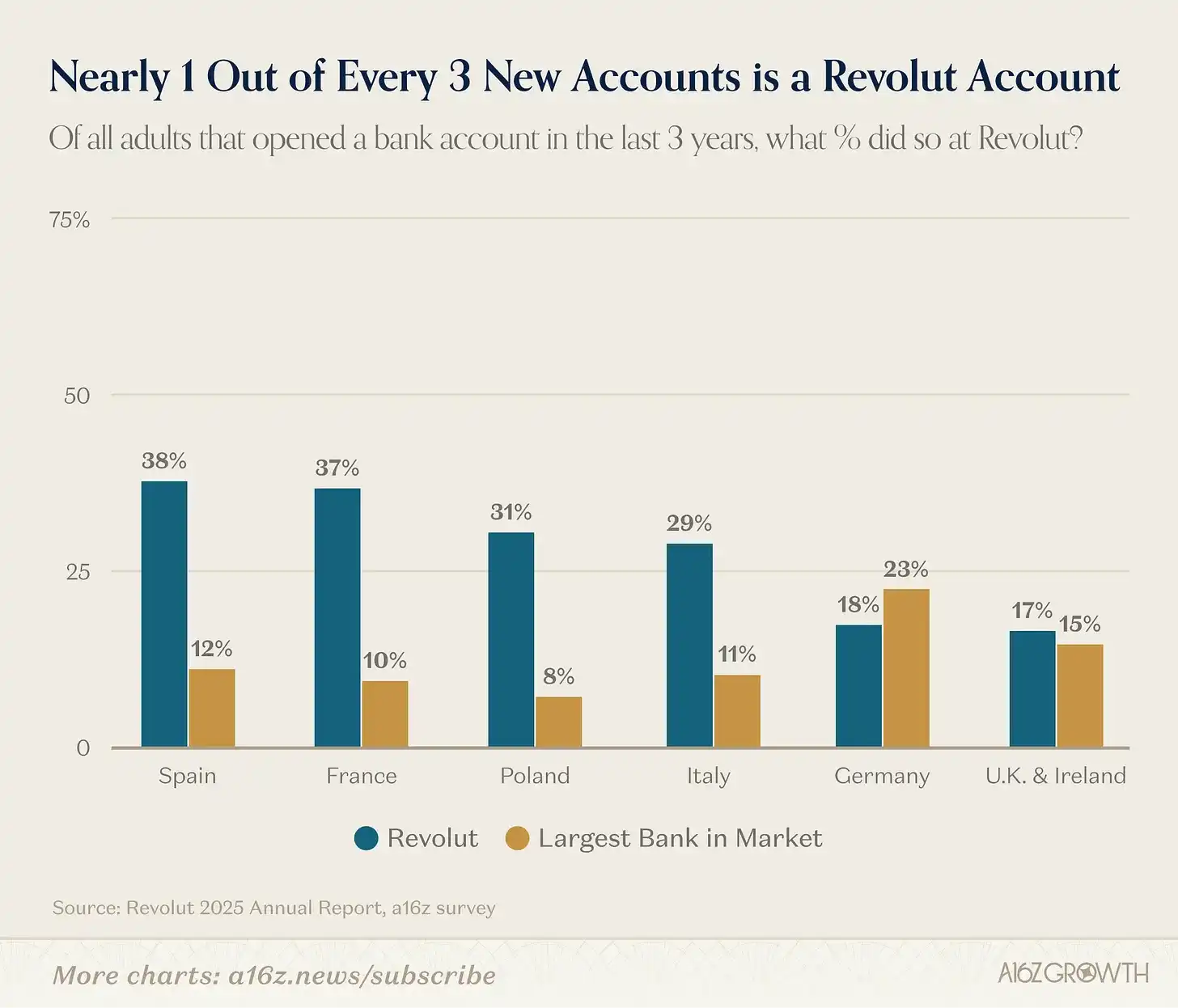
Chart: Survey conducted in key markets using a sample of the general adult population. Respondents indicated where they opened accounts and the timing of each account opening.

Source: a16z European Banking Survey, July 2025 (N = 3500)

1 in 5 working-age people in Europe use Revolut. Revolut's appeal across the diverse Eurozone markets demonstrates the company's exceptional product iteration speed and execution.

Revolut has launched a complete suite of personal and business banking features, driving growth across diverse European markets. Importantly, Revolut's product suite is increasingly attracting users within the Eurozone who are indifferent to the initial FX value proposition. We might say Revolut's platform is "feature complete," though that might be an understatement as Revolut keeps launching new features.

It's not just the quantity of features and products, but the quality of execution. Users love it. The company reported in 2024 that 65% of new users came through organic acquisition or referrals from existing users. Our research also shows that Revolut's user NPS is more than double the industry average.

Overall, the user base continues to grow at a 30% CAGR, reaching 68 million by the end of 2025.
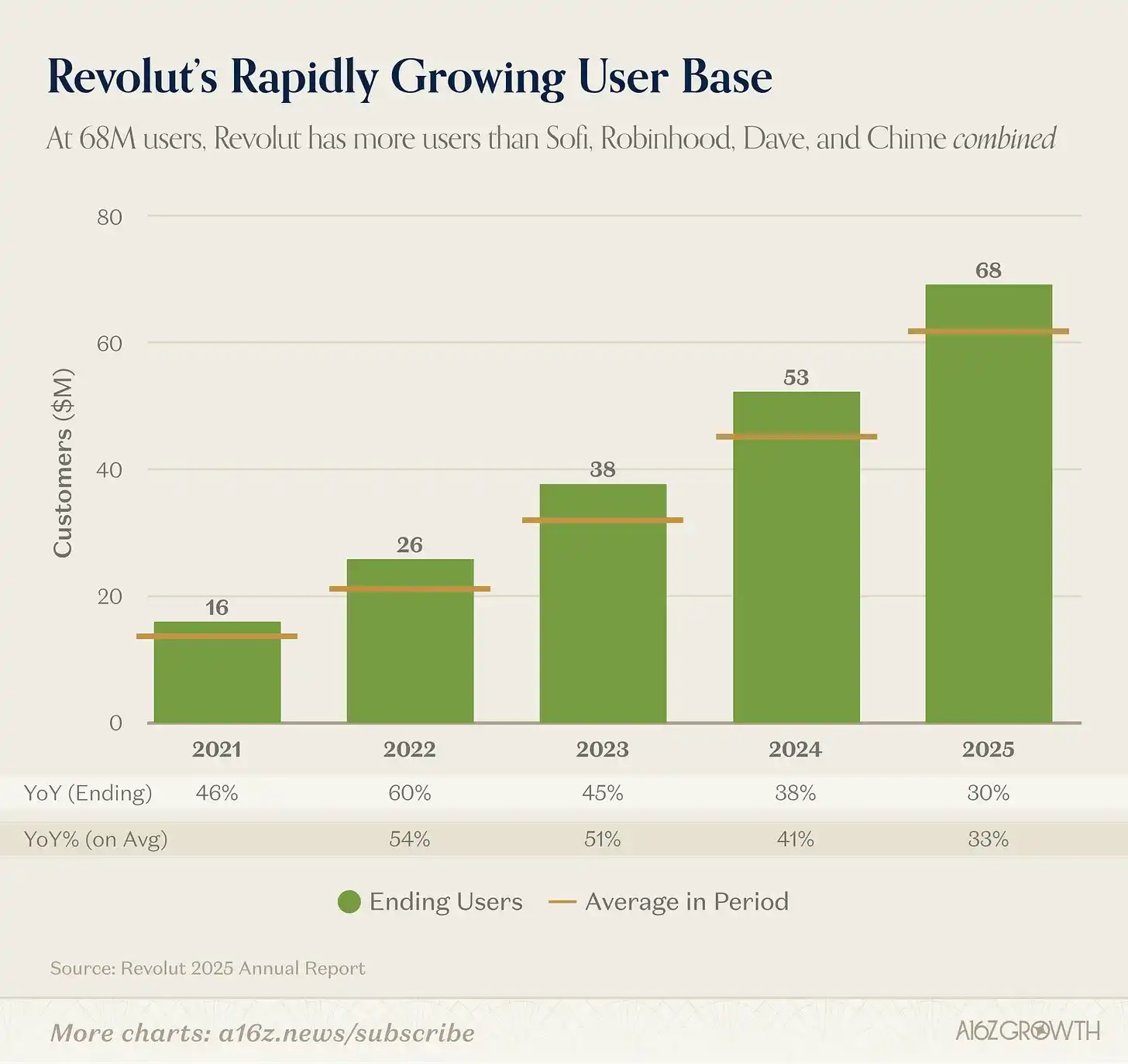
Source: Revolut Annual Report

To put 68 million users into perspective: JPMorgan Chase—the world's largest bank outside China—has about 85 million consumer customers (over 70 million of whom are considered "digitally active").

Admittedly, JPMorgan's total AUM makes its scale far exceed Revolut's, but from a pure user coverage perspective, Revolut is no longer just a "challenger"; it's a real competitor. Revolut has more users than Sofi, Robinhood, Dave, and Chime combined.

The complete product suite not only continues to attract more customers but also creates an increasingly diversified revenue structure:
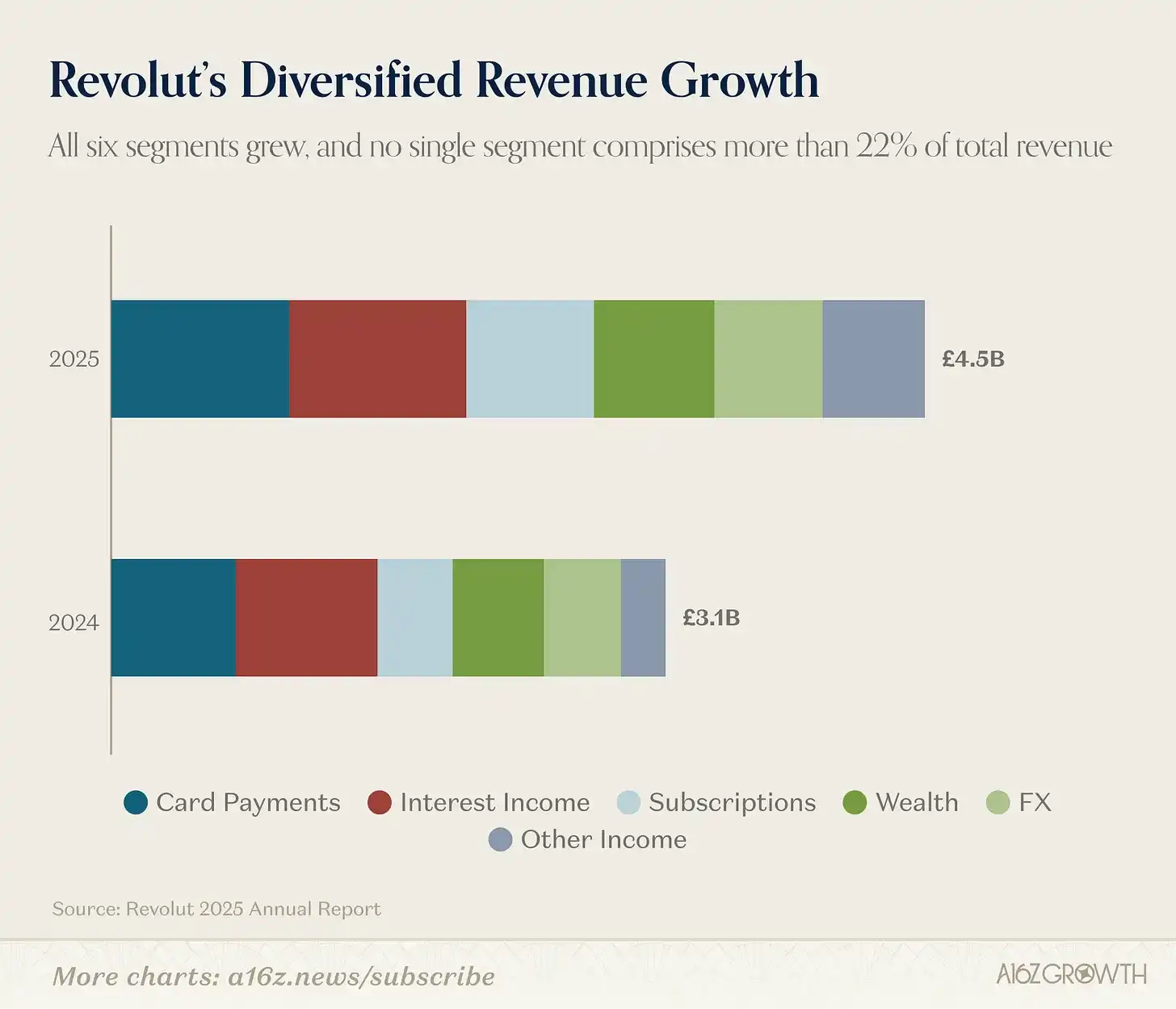
Source: Revolut Annual Report

The company publicly discloses 6 main revenue sources:

Interest Income

Card Payments

Subscriptions

Other Income

All six segments grew year-over-year, with no single segment exceeding 22%.

The business is even more diversified than this disclosure suggests, as each revenue stream likely contains multiple sub-products (e.g., the Wealth segment includes both public stocks and crypto assets). In 2025, 11 product lines each generated over £100 million in revenue.

Importantly, 76% of revenue came from fees, up over 4 percentage points from 2024, while interest income accounted for just under 22%. This is the opposite of mature banks, which derive over 70% of their income from interest, and is one reason Revolut can achieve high ROE (more on this later).

Unsurprisingly, the diversified revenue structure has also led to diversified ARPU growth.
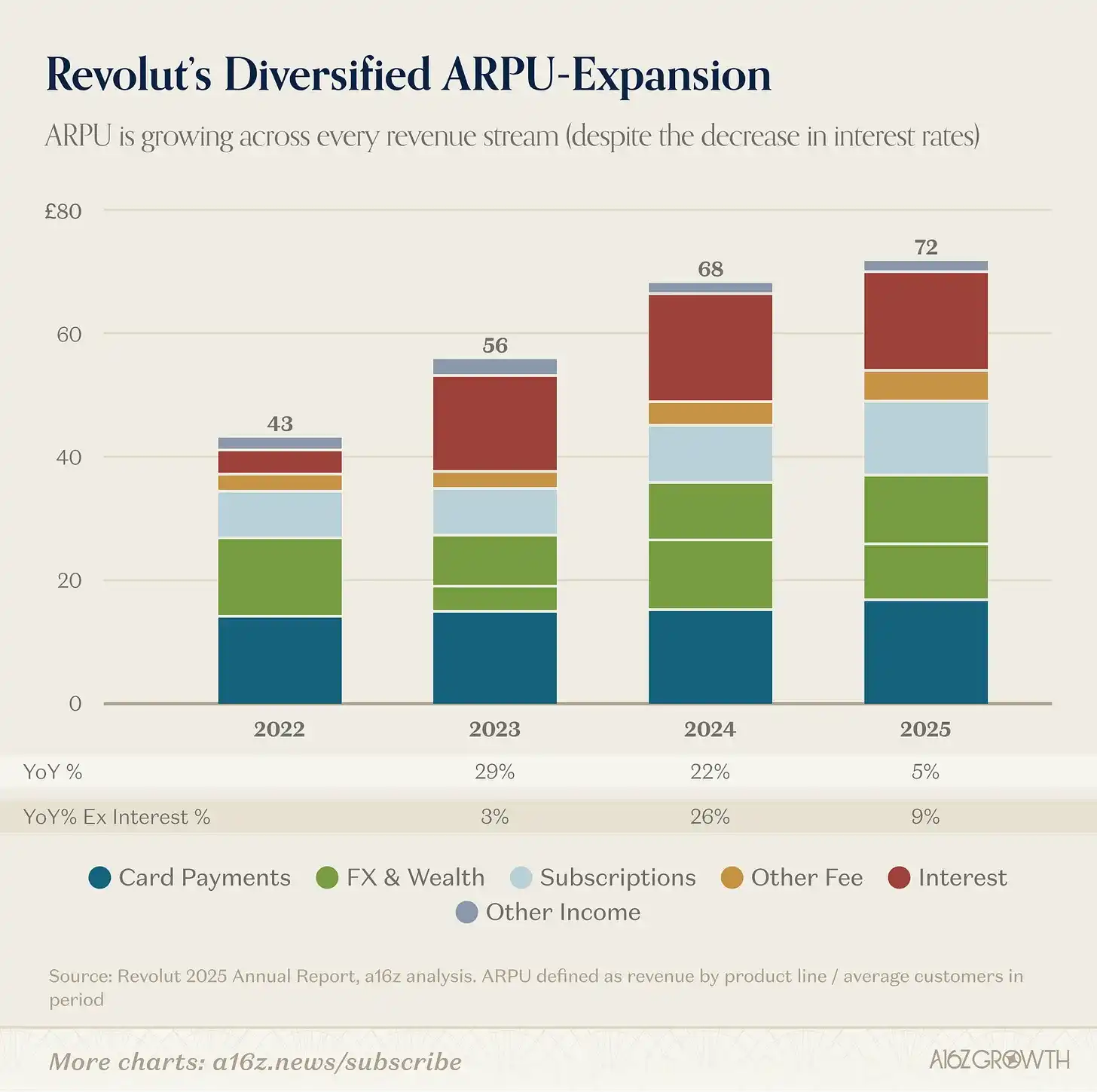
Chart: ARPU defined as segment revenue / average number of customers during the period.

Source: Revolut Annual Report

Since 2022, each disclosed revenue stream has grown, and overall ARPU has increased by approximately 65%, representing an 18% annualized CAGR.

The importance of diversification is that it supports sustained compounding and builds resilience. In any given year, some product lines may boom while others face headwinds (like last year's rate decreases). But overall, strong ARPU growth can still be driven by new product additions and continued wallet share gains in core businesses.

III. Top-Tier Efficiency

Revolut demonstrates rapid user growth,极强的 product iteration speed, and diversified revenue. The efficiency we promised is also delivered.

In 2025, Revolut achieved 46% revenue growth and a 29% net profit margin, resulting in a "Rule of X" (growth + profit margin) of 75%. The "Rule of 40" is no longer sufficient!
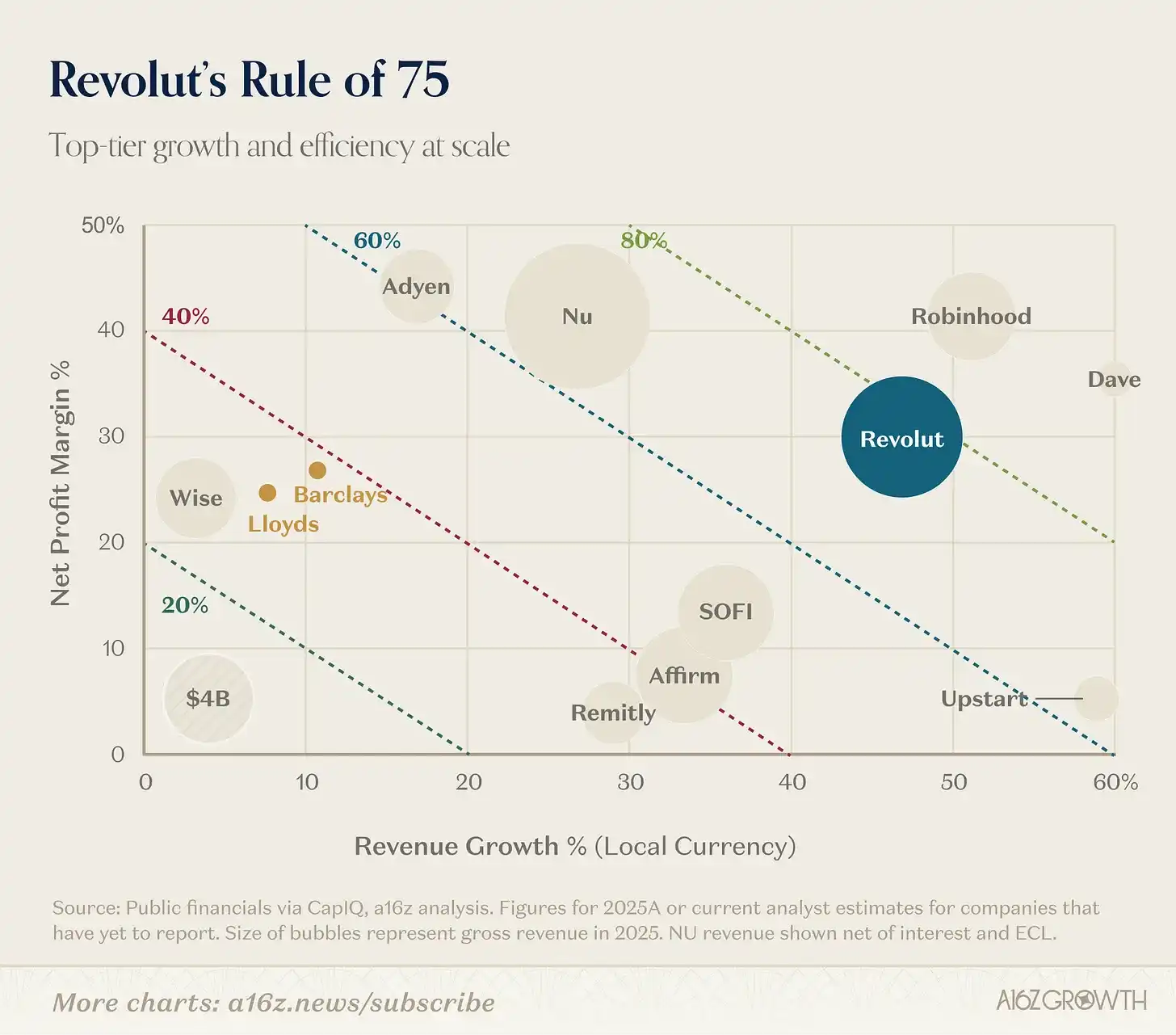
Chart: 2025A data or current analyst forecasts for companies yet to report. Bubble size represents total revenue in 2025. NU revenue is net of interest and ECL.

Source: Public financial data via CapIQ, a16z analysis

This combination of growth and efficiency places Revolut in an extremely rare position—companies achieving a Rule of 75% at over $1 billion in revenue are few and far between in history.

In fact, given that consensus growth expectations for Robinhood and Dave next year are both below 30%, Revolut might soon stand alone at the top of the podium.

Efficiency is ingrained in Revolut's DNA. Building its own banking infrastructure, highly organic growth, and strict cost control combine to achieve a 29% net profit margin. Coupled with minimal physical branches, Revolut now has a meaningful cost advantage over traditional banks, an advantage that will compound as scale continues to grow.

AI is further enhancing operational leverage. Take customer service as an example:

In 2024, Revolut's smart assistant chatbot reduced issue resolution time by 80%. In 2025, this improvement continued—resolution time decreased by over 40% for retail and over 50% for business, while user NPS increased by nearly 12 percentage points year-over-year. Revolut's smart assistant now resolves over 75% of customer inquiries.

This efficiency enables Revolut to achieve the highest ROE we've seen among scaled fintech companies (and it's still improving). We've written before about the importance of ROE for bank valuation; Revolut is a paradigm of scale efficiency.
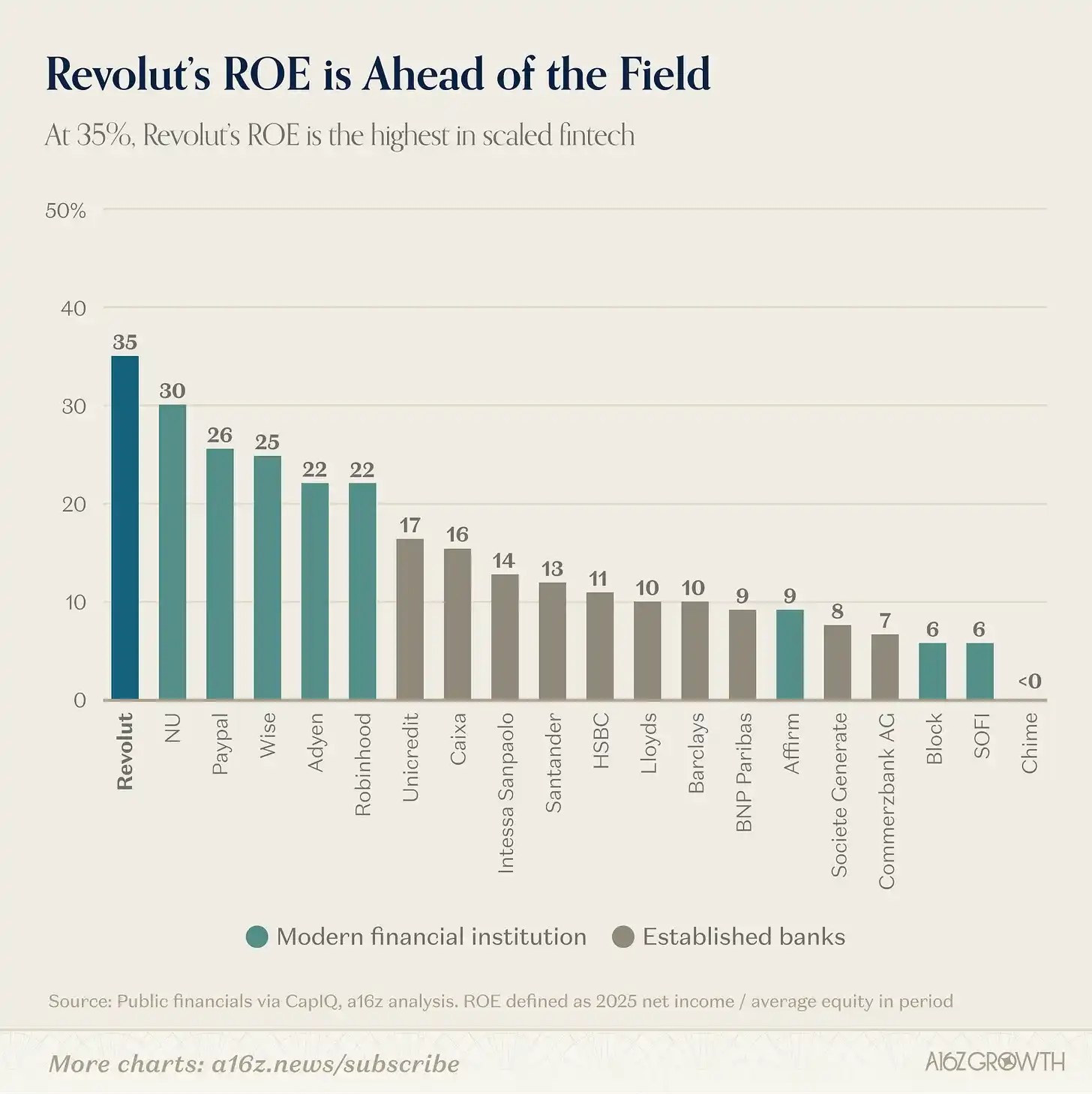
Chart: ROE defined as 2025 net income / average equity during the period.

Source: Public financial data via CapIQ

Revolut's 35% ROE is significantly higher than other leading consumer fintech companies and about 3-4 times that of mature banks. Note that Revolut is in an "over-capitalized" state (i.e., reported equity is higher than required by banking capital requirements), meaning its "true" ROE might be even higher.

It's rare to see growth being so capital efficient.

IV. Ample Room for Growth: ARPU × Number of Users

Despite Revolut's impressive 2025 performance, we believe there is still a significant runway ahead. Returning to the company's core revenue growth algorithm (Number of Users × ARPU), both variables still have considerable room for expansion.

More Users to Acquire

The company reported 68 million users at the end of 2025. As mentioned, this is a significant number, but it represents less than 15% of Europe's (excluding Russia) approximately 450-500 million adult population. This doesn't even include Australia and Singapore (existing markets), Mexico and Brazil (newly entered markets), the US (just applied for a banking license), and more regions yet to be explored.

Revolut has many more potential users to acquire.

Moreover, the current user composition suggests the future won't be like the present. Unsurprisingly, Revolut's users skew younger and are more digitally native—we believe these users represent the future demands of the majority of the population.
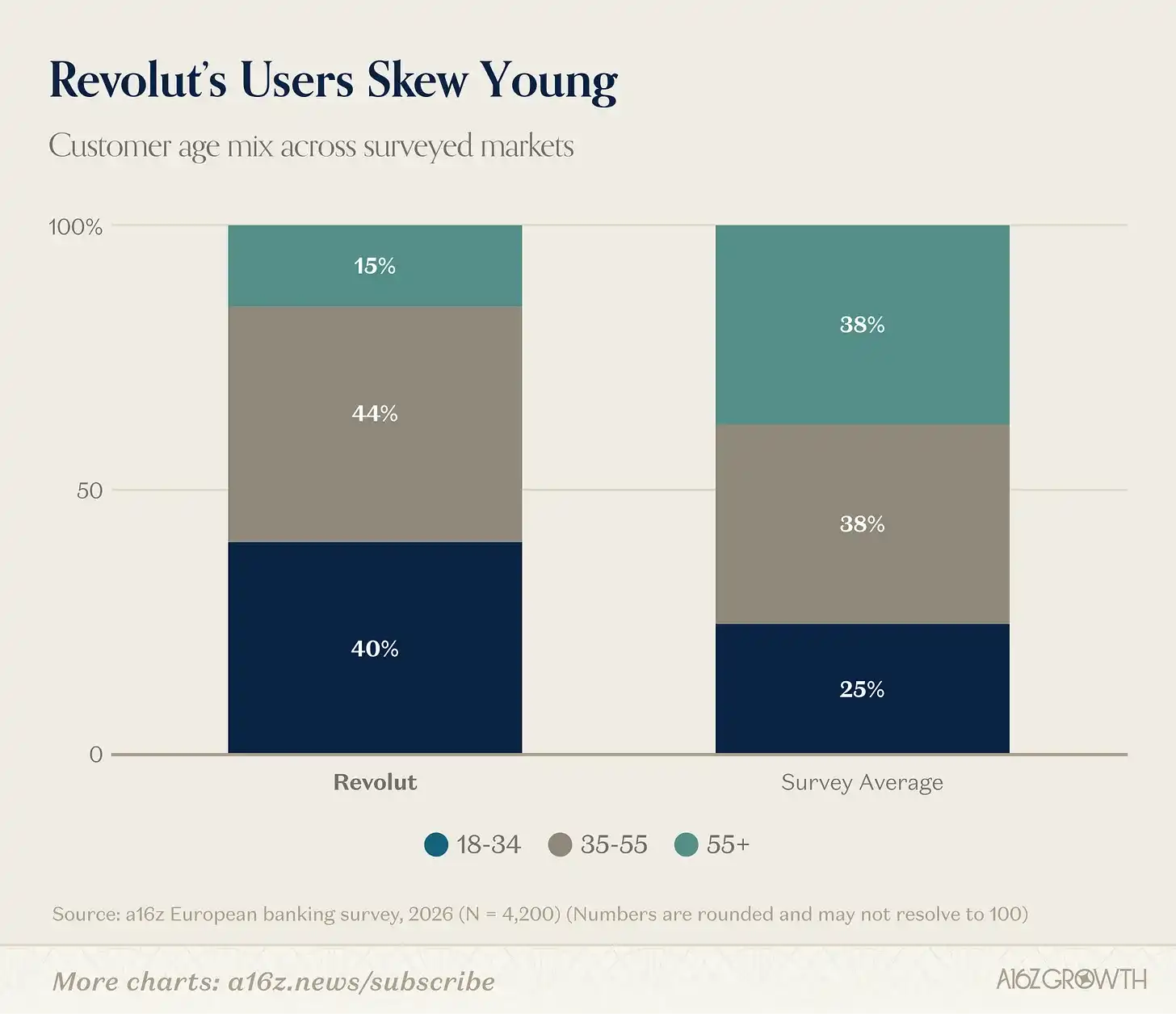
Chart: Surveyed markets include UK, Ireland, France, Spain, Italy, Germany, and Poland.

Source: a16z European Banking Survey, February 2026 (N = 4200)

As Revolut continues to capture a large share of first-time account openers (and convinces older demographics that banking can be enjoyable), its market share should continue to grow.

Importantly, our research shows that about 25% of Revolut users under 35 use Revolut as their primary account. This alone will have a profound impact on future bank market shares in Europe as this user base ages.

More Room for ARPU Expansion

The other growth dimension, ARPU, has even more room.

Wallet share shifts in financial services typically happen over decades, not years. Revolut continues to win user trust: primary account users (per company definition) grew 45%, exceeding the overall user growth rate of 30%.

The rapid growth of primary account users is crucial because, in terms of ARPU, the "primary account" user is the grand prize:

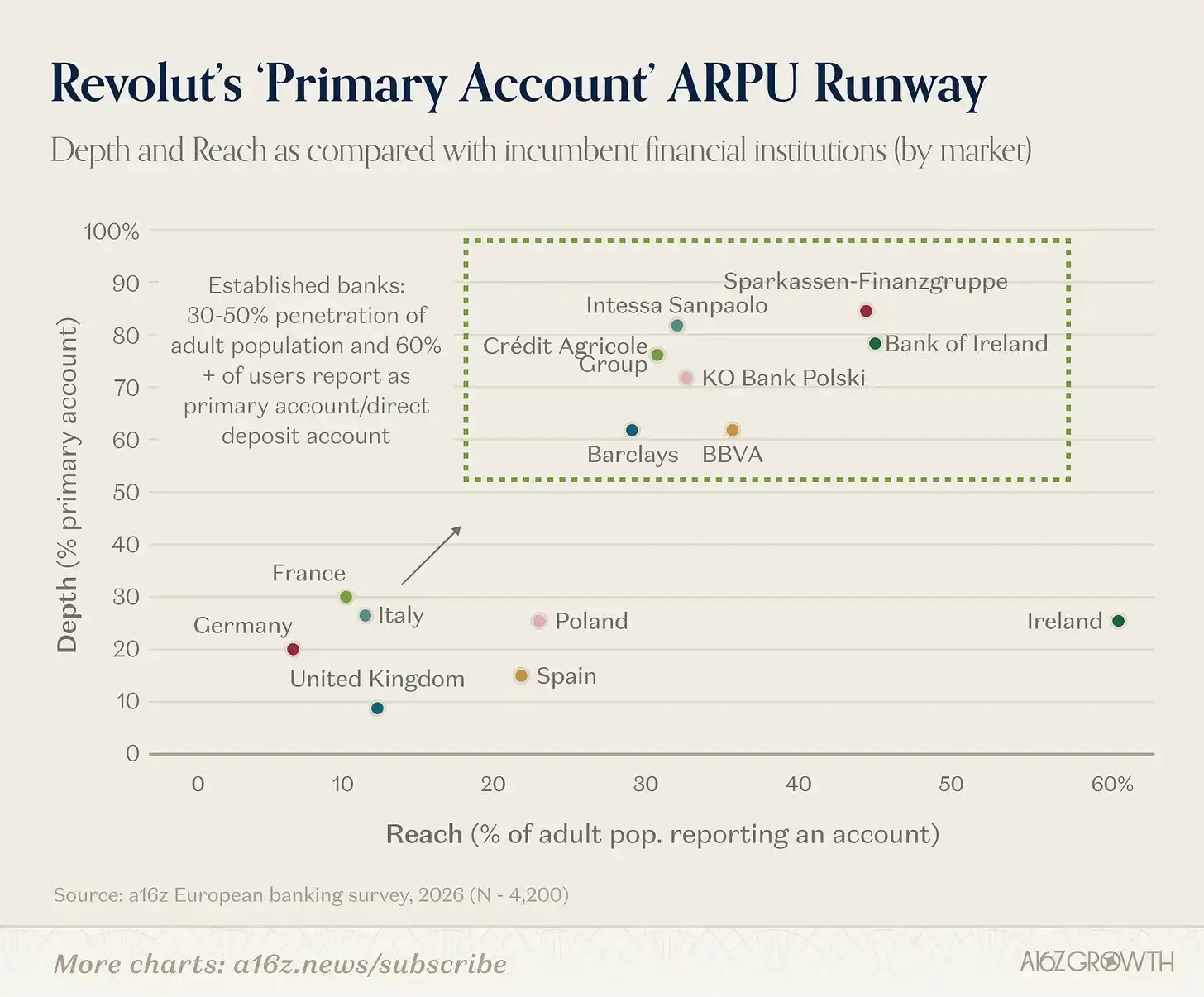
Our research shows that mature customer relationships in traditional banking institutions can push their "primary account" share to over 60%.

Revolut primary account users self-report spending and saving about twice as much on their primary account compared to any other account they use—and spending amounts increase with age.

In short, more (and increasingly mature) primary account users can translate into higher ARPU, and if traditional banking ceilings are any guide, Revolut's rising "primary account share"上限 is quite high.

Another aspect of primary relationship growth is the lending revenue opportunity that Revolut has yet to fully tap:

As mentioned, 76% of Revolut's current revenue comes from fees, while the typical proportion for mature banking institutions is about 30%;

At the end of 2025, Revolut's Loan-to-Deposit Ratio (LDR) was only about 6%, compared to 70-90%+ for mature banks (or about 4% if calculated on total customer balances). Loan balances grew about 2x in 2025 and can continue to compound for many years.

Of course,稳健的 loan growth takes time. But if traditional banking ceilings are any reference, Revolut has ample opportunity to significantly expand ARPU by utilizing its balance sheet and offering better loan products to customers. For comparison, a simple estimate puts Barclays UK Consumer and Business Banking segment ARPU at around £435, about 6 times Revolut's current level.

Here is where Revolut currently stands in terms of breadth (penetration) and depth (primary account share) of coverage:
Source: a16z European Banking Survey, February 2026 (N = 4200)

Revolut has ample runway to continue moving up and to the right (Ireland's case is mainly upward), both by expanding its user base and by deepening more relationships into "primary accounts." The latter should happen organically as the younger user base matures.

V. Conclusion: More Than Just a Challenger

Revolut's 2025 numbers are important not only because they are impressive but also because they paint a complete picture of a financial institution, not just a "challenger" bank.

User growth remains excellent, monetization continues to broaden, primary account adoption is rising, and profitability is strengthening even as the company continues to invest and expand rapidly. This combination is extremely rare in financial services (or any industry).

Execution challenges remain ahead—especially in lending, regulation, and entering new markets—but after reading this annual report, we feel the focus has shifted from "Can Revolut become a scaled banking platform?" to "How big can this platform become?"

The company's publicly stated long-term goal is "100 million daily active users in 100 countries." This journey is already underway.


Preguntas relacionadas

QWhat makes Revolut's revenue growth rate so outstanding compared to other consumer fintech companies?

ARevolut achieved a 76% compound annual growth rate (CAGR) in USD terms (70% in GBP) after surpassing $1 billion in revenue in 2022, making it one of the fastest-growing companies at that scale. This is particularly notable because it operates in the highly mature European consumer banking market, unlike Nubank which operates in a developing market.

QHow does Revolut's revenue structure differ from traditional banks, and why is this significant for its high ROE?

A76% of Revolut's revenue comes from fees (non-interest income), while interest income accounts for just under 22%. This is the opposite of traditional banks, which typically derive over 70% of their revenue from interest. This fee-heavy, capital-light model is a key reason why Revolut achieves a high Return on Equity (ROE) of 35%, which is 3-4 times that of mature banks.

QWhat are the six main disclosed revenue streams for Revolut, and how do they contribute to its business resilience?

ARevolut's six main revenue streams are: Interest Income, Card Payments, Subscriptions, Wealth, FX & Remittance, and Other. No single stream contributes more than 22% of total revenue. This diversification across multiple products and geographies provides resilience, as growth in some areas can offset headwinds in others, ensuring consistent overall growth.

QWhat is Revolut's 'Rule of X' (growth + profit margin) and how does it compare to its peers?

ARevolut's 'Rule of X' is 75%, calculated by adding its 46% revenue growth and 29% net profit margin in 2025. This places it in the highest echelon of modern financial institutions for growth efficiency, far surpassing the standard 'Rule of 40' benchmark and outperforming peers like Robinhood, SoFi, and Chime.

QAccording to the article, what are the two main drivers for Revolut's future growth potential?

AThe two main growth drivers are: 1) User Growth: Revolut has captured less than 15% of the adult population in its core European markets, with significant expansion potential in new regions like the US, Mexico, and Brazil. 2) ARPU Expansion: Revolut can significantly increase Average Revenue Per User by deepening relationships (converting more users to 'primary account' holders) and expanding into lending, where its Loan-to-Deposit Ratio (LDR) is only 6% compared to 70-90%+ for traditional banks.

Lecturas Relacionadas

Understanding CPO (Co-Packaged Optics) in One Article: Why Nvidia Is Willing to Spend $3.2 Billion on a Fiber?

NVIDIA and Corning announced a multi-year strategic partnership on May 6, 2026, with NVIDIA committing up to $3.2 billion to support Corning's U.S. expansion. This investment will triple Corning's manufacturing plants and significantly boost its optical fiber and communications production capacity. The core driver behind this massive investment is the fundamental shift from copper to optical interconnect technology within AI data centers. As GPU clusters scale, copper wires face critical limitations: severe signal attenuation over distance, high energy consumption for signal integrity, and excessive heat generation. Optical fiber, transmitting light instead of electrical signals, solves these issues with minimal loss, near-light speed, and lower power needs. The article outlines a three-stage evolution of data center interconnect: 1. **Traditional Copper Interconnects:** The mainstream solution of the 2010s, now being phased out due to scaling bottlenecks. 2. **Pluggable Optical Modules:** The current mainstream, where modules convert electrical signals to light externally. This process still introduces energy loss and latency. 3. **CPO (Co-Packaged Optics):** The next-generation technology where the optical engine is integrated directly with the GPU chip package. This drastically reduces the electrical signal travel distance to mere millimeters, slashing power consumption and latency while boosting data density. NVIDIA CEO Jensen Huang has identified CPO as an essential core technology for AI infrastructure. NVIDIA's investment signifies a strategic shift from being a buyer to actively controlling its supply chain for critical components. With demand for specialized optical fiber far outstripping supply—evidenced by soaring prices—securing long-term manufacturing capacity has become a competitive necessity. While Corning's expansion may pressure some suppliers, a projected global fiber supply gap of 5-15% over the next few years creates a significant opportunity window, particularly for Chinese manufacturers competitive in optical preforms, chips, and modules. Ultimately, NVIDIA's move is not about chasing a trend but an engineering imperative. The transition to light-based interconnects like CPO is driven by the physical limits of copper, marking a definitive step in the ongoing AI computing revolution.

marsbitHace 3 min(s)

Understanding CPO (Co-Packaged Optics) in One Article: Why Nvidia Is Willing to Spend $3.2 Billion on a Fiber?

marsbitHace 3 min(s)

KOL's Perspective: Why Is SOL Set to Rise from This Point?

**Summary: Why SOL is Positioned for Growth at This Level** The article argues that SOL is poised for an upward move from its current price point, citing several key factors. Primarily, SOL has just broken out of a 4-month consolidation phase. This breakout signals a return of risk appetite to the broader crypto market, as SOL is seen as a key indicator of overall crypto health. The token's ownership has reportedly shifted from short-term traders and tourists to long-term accumulators, leading to low volume. Any meaningful increase in trading activity could thus trigger significant upward momentum. Fundamental strengths include strong institutional adoption, integration with DeFi and RWAs (Real-World Assets), and the potential benefits from the Clarity Act. Despite its high volatility—having dropped 70% from its all-time high but still up 12x from its bear market low—SOL is highlighted as one of the few tokens from the last cycle to reach new highs. It boasts a robust ecosystem of applications, users, and protocols. Future catalysts include the expected influx of AI developers following the Miami Accelerate conference, which focused on AI on Solana. Furthermore, Solana is positioned as the premier chain for memecoin activity, a trend expected to continue and drive network usage and fees. The article concludes that recent price action reflects a healthy transfer to long-term holders, setting the stage for growth.

marsbitHace 53 min(s)

KOL's Perspective: Why Is SOL Set to Rise from This Point?

marsbitHace 53 min(s)

Those Pre-Bitcoin PoW Protocols Have Recently Been Reimplemented

This article details a recent surge in replicating pre-Bitcoin Proof-of-Work (PoW) protocols, specifically focusing on Hal Finney's 2004 RPOW (Reusable Proofs of Work). Within five days in May 2026, multiple independent builders in the Bitcoin/cypherpunk community launched projects inspired by this early electronic cash proposal. The initiative began with Fred Krueger's `rpow2.com`, a centralized but auditable system that replaced RPOW's original IBM 4758 hardware with Ed25519 signatures. Initially a faithful replica, it later adopted Bitcoin-like features (21M supply cap, difficulty adjustment) and a controversial 5.24% founder allocation. This sparked rapid forks, including `rpow4.com` which incorporated full Bitcoin parameters, a prediction market (`rpowmarket.com`), and a DEX (`rpow2swap.com`). Concurrently, Mike In Space created a prototype of Wei Dai's 1998 b-money proposal (`b-money.replit.app`), pushing the historical exploration even further back. The article contrasts these centralized, server-dependent experiments with Bitcoin's core innovation of decentralized, trustless consensus. It also highlights a parallel development: the `HASH` project on Ethereum, which uses smart contract hooks to enable a purely fair-launch, browser-mineable PoW token with 0% allocations to team or VCs. The collective activity is framed as a meme-driven, educational exploration of cypherpunk history rather than a serious financial movement, with all projects heavily disclaiming any investment value.

marsbitHace 58 min(s)

Those Pre-Bitcoin PoW Protocols Have Recently Been Reimplemented

marsbitHace 58 min(s)

South Korean Exchanges 'Battle' Regulators, Challenging the Boundaries of Enforcement and Legislation

South Korea's cryptocurrency industry is engaged in a rare, direct confrontation with regulators. The Financial Intelligence Unit (FIU), the primary anti-money laundering (AML) watchdog, has recently imposed heavy penalties on major exchanges like Upbit and Bithumb for alleged violations involving unregistered overseas VASPs and AML procedures. However, exchanges are now actively challenging these actions in court and through industry associations. In a significant shift, the Seoul Administrative Court ruled in favor of Upbit's operator, Dunamu, overturning part of an FIU-ordered business suspension. The court found the FIU's penalty criteria and justification insufficiently clear. Similarly, the court suspended the enforcement of a six-month business suspension against Bithumb pending a final ruling, citing potential irreversible harm to the exchange. Beyond legal battles, the industry is contesting proposed legislative amendments. The Digital Asset eXchange Alliance (DAXA) strongly opposes a draft rule that would mandate Suspicious Transaction Reports (STRs) for all crypto transfers over 10 million KRW (~$6,800). DAXA argues this "poison pill" clause violates legal principles and would overwhelm the STR system, increasing reports from 63,000 to an estimated 5.45 million annually for major exchanges, thereby crippling effective AML monitoring. This conflict highlights a structural tension in South Korea's crypto governance: comprehensive digital asset laws are still developing, while regulators rely heavily on AML enforcement. The industry's move from passive compliance to active legal and legislative challenges signifies a new phase, pressing for clearer rules and more proportionate enforcement. While short-term disputes may intensify, this clash could ultimately lead to a more mature and sustainable regulatory framework for South Korea's vibrant crypto market.

marsbitHace 1 hora(s)

South Korean Exchanges 'Battle' Regulators, Challenging the Boundaries of Enforcement and Legislation

marsbitHace 1 hora(s)

Trading

Spot
Futuros

Artículos destacados

Qué es $S$

Entendiendo SPERO: Una Visión General Completa Introducción a SPERO A medida que el panorama de la innovación continúa evolucionando, la aparición de tecnologías web3 y proyectos de criptomonedas juega un papel fundamental en la configuración del futuro digital. Un proyecto que ha atraído la atención en este campo dinámico es SPERO, denotado como SPERO,$$s$. Este artículo tiene como objetivo reunir y presentar información detallada sobre SPERO, para ayudar a entusiastas e inversores a comprender sus fundamentos, objetivos e innovaciones dentro de los dominios web3 y cripto. ¿Qué es SPERO,$$s$? SPERO,$$s$ es un proyecto único dentro del espacio cripto que busca aprovechar los principios de descentralización y tecnología blockchain para crear un ecosistema que promueva la participación, la utilidad y la inclusión financiera. El proyecto está diseñado para facilitar interacciones de igual a igual de nuevas maneras, proporcionando a los usuarios soluciones y servicios financieros innovadores. En su esencia, SPERO,$$s$ tiene como objetivo empoderar a los individuos al proporcionar herramientas y plataformas que mejoren la experiencia del usuario en el espacio de las criptomonedas. Esto incluye habilitar métodos de transacción más flexibles, fomentar iniciativas impulsadas por la comunidad y crear caminos para oportunidades financieras a través de aplicaciones descentralizadas (dApps). La visión subyacente de SPERO,$$s$ gira en torno a la inclusividad, buscando cerrar brechas dentro de las finanzas tradicionales mientras aprovecha los beneficios de la tecnología blockchain. ¿Quién es el Creador de SPERO,$$s$? La identidad del creador de SPERO,$$s$ sigue siendo algo oscura, ya que hay recursos públicos limitados que proporcionan información de fondo detallada sobre su(s) fundador(es). Esta falta de transparencia puede derivarse del compromiso del proyecto con la descentralización, una ética que muchos proyectos web3 comparten, priorizando las contribuciones colectivas sobre el reconocimiento individual. Al centrar las discusiones en torno a la comunidad y sus objetivos colectivos, SPERO,$$s$ encarna la esencia del empoderamiento sin señalar a individuos específicos. Como tal, comprender la ética y la misión de SPERO sigue siendo más importante que identificar a un creador singular. ¿Quiénes son los Inversores de SPERO,$$s$? SPERO,$$s$ cuenta con el apoyo de una diversa gama de inversores que van desde capitalistas de riesgo hasta inversores ángeles dedicados a fomentar la innovación en el sector cripto. El enfoque de estos inversores generalmente se alinea con la misión de SPERO, priorizando proyectos que prometen avances tecnológicos sociales, inclusión financiera y gobernanza descentralizada. Estas fundaciones de inversores suelen estar interesadas en proyectos que no solo ofrecen productos innovadores, sino que también contribuyen positivamente a la comunidad blockchain y sus ecosistemas. El respaldo de estos inversores refuerza a SPERO,$$s$ como un contendiente notable en el dominio de proyectos cripto que evoluciona rápidamente. ¿Cómo Funciona SPERO,$$s$? SPERO,$$s$ emplea un marco multifacético que lo distingue de los proyectos de criptomonedas convencionales. Aquí hay algunas de las características clave que subrayan su singularidad e innovación: Gobernanza Descentralizada: SPERO,$$s$ integra modelos de gobernanza descentralizada, empoderando a los usuarios para participar activamente en los procesos de toma de decisiones sobre el futuro del proyecto. Este enfoque fomenta un sentido de propiedad y responsabilidad entre los miembros de la comunidad. Utilidad del Token: SPERO,$$s$ utiliza su propio token de criptomoneda, diseñado para servir diversas funciones dentro del ecosistema. Estos tokens permiten transacciones, recompensas y la facilitación de servicios ofrecidos en la plataforma, mejorando la participación y la utilidad general. Arquitectura en Capas: La arquitectura técnica de SPERO,$$s$ apoya la modularidad y escalabilidad, permitiendo la integración fluida de características y aplicaciones adicionales a medida que el proyecto evoluciona. Esta adaptabilidad es fundamental para mantener la relevancia en el cambiante paisaje cripto. Participación de la Comunidad: El proyecto enfatiza iniciativas impulsadas por la comunidad, empleando mecanismos que incentivan la colaboración y la retroalimentación. Al nutrir una comunidad sólida, SPERO,$$s$ puede abordar mejor las necesidades de los usuarios y adaptarse a las tendencias del mercado. Enfoque en la Inclusión: Al ofrecer tarifas de transacción bajas e interfaces amigables para el usuario, SPERO,$$s$ busca atraer a una base de usuarios diversa, incluyendo a individuos que anteriormente pueden no haber participado en el espacio cripto. Este compromiso con la inclusión se alinea con su misión general de empoderamiento a través de la accesibilidad. Cronología de SPERO,$$s$ Entender la historia de un proyecto proporciona información crucial sobre su trayectoria de desarrollo y hitos. A continuación se presenta una cronología sugerida que mapea eventos significativos en la evolución de SPERO,$$s$: Fase de Conceptualización e Ideación: Las ideas iniciales que forman la base de SPERO,$$s$ fueron concebidas, alineándose estrechamente con los principios de descentralización y enfoque comunitario dentro de la industria blockchain. Lanzamiento del Whitepaper del Proyecto: Tras la fase conceptual, se lanzó un whitepaper completo que detalla la visión, los objetivos y la infraestructura tecnológica de SPERO,$$s$ para generar interés y retroalimentación de la comunidad. Construcción de Comunidad y Primeras Interacciones: Se realizaron esfuerzos de divulgación activa para construir una comunidad de primeros adoptantes y posibles inversores, facilitando discusiones en torno a los objetivos del proyecto y obteniendo apoyo. Evento de Generación de Tokens: SPERO,$$s$ llevó a cabo un evento de generación de tokens (TGE) para distribuir sus tokens nativos a los primeros seguidores y establecer liquidez inicial dentro del ecosistema. Lanzamiento de la dApp Inicial: La primera aplicación descentralizada (dApp) asociada con SPERO,$$s$ se puso en marcha, permitiendo a los usuarios interactuar con las funcionalidades centrales de la plataforma. Desarrollo Continuo y Alianzas: Actualizaciones y mejoras continuas a las ofertas del proyecto, incluyendo alianzas estratégicas con otros actores en el espacio blockchain, han moldeado a SPERO,$$s$ en un jugador competitivo y en evolución en el mercado cripto. Conclusión SPERO,$$s$ se erige como un testimonio del potencial de web3 y las criptomonedas para revolucionar los sistemas financieros y empoderar a los individuos. Con un compromiso con la gobernanza descentralizada, la participación comunitaria y funcionalidades diseñadas de manera innovadora, allana el camino hacia un paisaje financiero más inclusivo. Como con cualquier inversión en el espacio cripto que evoluciona rápidamente, se anima a los posibles inversores y usuarios a investigar a fondo y participar de manera reflexiva con los desarrollos en curso dentro de SPERO,$$s$. El proyecto muestra el espíritu innovador de la industria cripto, invitando a una mayor exploración de sus innumerables posibilidades. Mientras el viaje de SPERO,$$s$ aún se desarrolla, sus principios fundamentales pueden, de hecho, influir en el futuro de cómo interactuamos con la tecnología, las finanzas y entre nosotros en ecosistemas digitales interconectados.

72 Vistas totalesPublicado en 2024.12.17Actualizado en 2024.12.17

Qué es $S$

Qué es AGENT S

Agent S: El Futuro de la Interacción Autónoma en Web3 Introducción En el paisaje en constante evolución de Web3 y las criptomonedas, las innovaciones están redefiniendo constantemente cómo los individuos interactúan con las plataformas digitales. Uno de estos proyectos pioneros, Agent S, promete revolucionar la interacción humano-computadora a través de su marco agente abierto. Al allanar el camino para interacciones autónomas, Agent S busca simplificar tareas complejas, ofreciendo aplicaciones transformadoras en inteligencia artificial (IA). Esta exploración detallada profundizará en las complejidades del proyecto, sus características únicas y las implicaciones para el dominio de las criptomonedas. ¿Qué es Agent S? Agent S se presenta como un marco agente abierto innovador, diseñado específicamente para abordar tres desafíos fundamentales en la automatización de tareas informáticas: Adquisición de Conocimiento Específico del Dominio: El marco aprende inteligentemente de diversas fuentes de conocimiento externas y experiencias internas. Este enfoque dual le permite construir un rico repositorio de conocimiento específico del dominio, mejorando su rendimiento en la ejecución de tareas. Planificación a Largo Plazo de Tareas: Agent S emplea planificación jerárquica aumentada por la experiencia, un enfoque estratégico que facilita la descomposición y ejecución eficiente de tareas complejas. Esta característica mejora significativamente su capacidad para gestionar múltiples subtareas de manera eficiente y efectiva. Manejo de Interfaces Dinámicas y No Uniformes: El proyecto introduce la Interfaz Agente-Computadora (ACI), una solución innovadora que mejora la interacción entre agentes y usuarios. Utilizando Modelos de Lenguaje Multimodal de Gran Escala (MLLMs), Agent S puede navegar y manipular diversas interfaces gráficas de usuario sin problemas. A través de estas características pioneras, Agent S proporciona un marco robusto que aborda las complejidades involucradas en la automatización de la interacción humana con las máquinas, preparando el terreno para una multitud de aplicaciones en IA y más allá. ¿Quién es el Creador de Agent S? Si bien el concepto de Agent S es fundamentalmente innovador, la información específica sobre su creador sigue siendo elusiva. El creador es actualmente desconocido, lo que resalta ya sea la etapa incipiente del proyecto o la elección estratégica de mantener a los miembros fundadores en el anonimato. Independientemente de la anonimidad, el enfoque sigue siendo en las capacidades y el potencial del marco. ¿Quiénes son los Inversores de Agent S? Dado que Agent S es relativamente nuevo en el ecosistema criptográfico, la información detallada sobre sus inversores y patrocinadores financieros no está documentada explícitamente. La falta de información disponible públicamente sobre las bases de inversión u organizaciones que apoyan el proyecto plantea preguntas sobre su estructura de financiamiento y hoja de ruta de desarrollo. Comprender el respaldo es crucial para evaluar la sostenibilidad del proyecto y su posible impacto en el mercado. ¿Cómo Funciona Agent S? En el núcleo de Agent S se encuentra una tecnología de vanguardia que le permite funcionar de manera efectiva en diversos entornos. Su modelo operativo se basa en varias características clave: Interacción Humano-Computadora Similar a la Humana: El marco ofrece planificación avanzada de IA, esforzándose por hacer que las interacciones con las computadoras sean más intuitivas. Al imitar el comportamiento humano en la ejecución de tareas, promete elevar las experiencias de los usuarios. Memoria Narrativa: Empleada para aprovechar experiencias de alto nivel, Agent S utiliza memoria narrativa para hacer un seguimiento de las historias de tareas, mejorando así sus procesos de toma de decisiones. Memoria Episódica: Esta característica proporciona a los usuarios una guía paso a paso, permitiendo que el marco ofrezca apoyo contextual a medida que se desarrollan las tareas. Soporte para OpenACI: Con la capacidad de ejecutarse localmente, Agent S permite a los usuarios mantener el control sobre sus interacciones y flujos de trabajo, alineándose con la ética descentralizada de Web3. Fácil Integración con APIs Externas: Su versatilidad y compatibilidad con varias plataformas de IA aseguran que Agent S pueda encajar sin problemas en ecosistemas tecnológicos existentes, convirtiéndolo en una opción atractiva para desarrolladores y organizaciones. Estas funcionalidades contribuyen colectivamente a la posición única de Agent S dentro del espacio cripto, ya que automatiza tareas complejas y de múltiples pasos con una intervención humana mínima. A medida que el proyecto evoluciona, sus posibles aplicaciones en Web3 podrían redefinir cómo se desarrollan las interacciones digitales. Cronología de Agent S El desarrollo y los hitos de Agent S pueden encapsularse en una cronología que resalta sus eventos significativos: 27 de septiembre de 2024: El concepto de Agent S fue lanzado en un documento de investigación integral titulado “Un Marco Agente Abierto que Usa Computadoras Como un Humano”, mostrando las bases del proyecto. 10 de octubre de 2024: El documento de investigación fue puesto a disposición del público en arXiv, ofreciendo una exploración profunda del marco y su evaluación de rendimiento basada en el benchmark OSWorld. 12 de octubre de 2024: Se lanzó una presentación en video, proporcionando una visión visual de las capacidades y características de Agent S, involucrando aún más a posibles usuarios e inversores. Estos marcadores en la cronología no solo ilustran el progreso de Agent S, sino que también indican su compromiso con la transparencia y la participación comunitaria. Puntos Clave Sobre Agent S A medida que el marco Agent S continúa evolucionando, varios atributos clave destacan, subrayando su naturaleza innovadora y potencial: Marco Innovador: Diseñado para proporcionar un uso intuitivo de las computadoras similar a la interacción humana, Agent S aporta un enfoque novedoso a la automatización de tareas. Interacción Autónoma: La capacidad de interactuar de manera autónoma con las computadoras a través de GUI significa un salto hacia soluciones informáticas más inteligentes y eficientes. Automatización de Tareas Complejas: Con su metodología robusta, puede automatizar tareas complejas y de múltiples pasos, haciendo que los procesos sean más rápidos y menos propensos a errores. Mejora Continua: Los mecanismos de aprendizaje permiten a Agent S mejorar a partir de experiencias pasadas, mejorando continuamente su rendimiento y eficacia. Versatilidad: Su adaptabilidad en diferentes entornos operativos como OSWorld y WindowsAgentArena asegura que pueda servir a una amplia gama de aplicaciones. A medida que Agent S se posiciona en el paisaje de Web3 y criptomonedas, su potencial para mejorar las capacidades de interacción y automatizar procesos significa un avance significativo en las tecnologías de IA. A través de su marco innovador, Agent S ejemplifica el futuro de las interacciones digitales, prometiendo una experiencia más fluida y eficiente para los usuarios en diversas industrias. Conclusión Agent S representa un audaz avance en la unión de la IA y Web3, con la capacidad de redefinir cómo interactuamos con la tecnología. Aunque aún se encuentra en sus primeras etapas, las posibilidades para su aplicación son vastas y atractivas. A través de su marco integral que aborda desafíos críticos, Agent S busca llevar las interacciones autónomas al primer plano de la experiencia digital. A medida que nos adentramos más en los reinos de las criptomonedas y la descentralización, proyectos como Agent S sin duda desempeñarán un papel crucial en la configuración del futuro de la tecnología y la colaboración humano-computadora.

429 Vistas totalesPublicado en 2025.01.14Actualizado en 2025.01.14

Qué es AGENT S

Cómo comprar S

¡Bienvenido a HTX.com! Hemos hecho que comprar Sonic (S) sea simple y conveniente. Sigue nuestra guía paso a paso para iniciar tu viaje de criptos.Paso 1: crea tu cuenta HTXUtiliza tu correo electrónico o número de teléfono para registrarte y obtener una cuenta gratuita en HTX. Experimenta un proceso de registro sin complicaciones y desbloquea todas las funciones.Obtener mi cuentaPaso 2: ve a Comprar cripto y elige tu método de pagoTarjeta de crédito/débito: usa tu Visa o Mastercard para comprar Sonic (S) al instante.Saldo: utiliza fondos del saldo de tu cuenta HTX para tradear sin problemas.Terceros: hemos agregado métodos de pago populares como Google Pay y Apple Pay para mejorar la comodidad.P2P: tradear directamente con otros usuarios en HTX.Over-the-Counter (OTC): ofrecemos servicios personalizados y tipos de cambio competitivos para los traders.Paso 3: guarda tu Sonic (S)Después de comprar tu Sonic (S), guárdalo en tu cuenta HTX. Alternativamente, puedes enviarlo a otro lugar mediante transferencia blockchain o utilizarlo para tradear otras criptomonedas.Paso 4: tradear Sonic (S)Tradear fácilmente con Sonic (S) en HTX's mercado spot. Simplemente accede a tu cuenta, selecciona tu par de trading, ejecuta tus trades y monitorea en tiempo real. Ofrecemos una experiencia fácil de usar tanto para principiantes como para traders experimentados.

847 Vistas totalesPublicado en 2025.01.15Actualizado en 2025.03.21

Cómo comprar S

Discusiones

Bienvenido a la comunidad de HTX. Aquí puedes mantenerte informado sobre los últimos desarrollos de la plataforma y acceder a análisis profesionales del mercado. A continuación se presentan las opiniones de los usuarios sobre el precio de S (S).

活动图片