a16z: Two Suggestions for Crypto Industry Builders in 2026

marsbitPublicado a 2026-01-15Actualizado a 2026-01-15

Resumen

In their 2026 outlook, a16z crypto partners offer two key recommendations for builders in the crypto space. First, Arianna Simpson argues that while many successful crypto companies are pivoting to trading platforms, this short-term strategy may dilute market focus and limit long-term competitiveness. Trading, though important, should be a transit point rather than the end goal. Founders are encouraged to focus on building substantive products rather than seeking immediate product-market fit through speculative token dynamics. Second, Miles Jennings highlights that regulatory clarity in the U.S. could resolve long-standing legal uncertainties that have hindered blockchain development. Historically, ambiguous securities laws forced projects to prioritize legal risk over product strategy, leading to non-transparent practices and distorted incentives. The anticipated passage of crypto market structure legislation may establish clear standards for token issuance, governance, and decentralization, enabling networks to operate as truly open, autonomous, and decentralized systems. Together, these insights urge builders to prioritize sustainable product development over short-term gains and welcome regulatory clarity as a catalyst for genuine innovation.

Author:a16z crypto

Compiled by: Deep Tide TechFlow

1. Transactions Can Be a Transit Point, Not the End Goal of Crypto Business

Today, aside from stablecoins and some core infrastructure, almost all well-performing crypto companies are transitioning or have already transitioned into trading platforms. But if "every crypto company becomes a trading platform," where does that leave everyone else? When so many players are doing the same thing, market attention becomes fragmented, ultimately leaving only a few big winners. This also means that companies that pivot to trading too early may miss the opportunity to build more competitive and enduring businesses.

I fully understand the efforts of all entrepreneurs to get their finances in order, but pursuing short-term product-market fit also comes at a cost. This is particularly true in the crypto industry, where the unique dynamics of tokens and speculation can lead founders down the path of instant gratification while searching for product-market fit... one might call it a "marshmallow test" (an experiment testing patience and self-control).

There's nothing wrong with trading itself—it's an important function in market operations—but it doesn't have to be the end goal. Founders who focus on the "product" aspect rather than merely chasing product-market fit may ultimately become bigger winners.

—Arianna Simpson (@AriannaSimpson), Partner at a16z Crypto Fund

2. This Year, Regulation Will Help Eliminate Industry Distortions

Over the past decade, one of the biggest obstacles to building blockchain networks in the United States has been legal uncertainty. Securities laws were stretched and selectively enforced, forcing founders into a regulatory framework designed for companies, not networks. For years, reducing legal risk replaced product strategy; the role of engineers was taken over by lawyers.

This dynamic led to many anomalies: founders were advised to avoid transparency; token distributions became legally arbitrary; governance became superficial; organizational structures were optimized for legal cover; and tokens were designed to avoid economic value or lacked a business model. Worse, crypto projects that circumvented the rules often developed faster than conscientious builders who followed them.

However, this year, the government is closer than ever to passing crypto market structure regulation, which could eliminate all these distortions. If legislation passes, it will incentivize transparency, establish clear standards, and replace "enforcement roulette" (random enforcement) with a clearer, structured path for fundraising, token issuance, and decentralization. After GENIUS (note: likely referring to a policy or event), the explosive growth of stablecoins has already become evident; and legislation on crypto market structure will bring even greater change, but this time for networks.

In other words, such regulation will enable blockchain networks to truly operate as networks—open, autonomous, composable, credibly neutral, and decentralized.

—Miles Jennings (@milesjennings), Head of a16z Crypto Policy Team and General Counsel

Preguntas relacionadas

QAccording to Arianna Simpson, why might crypto companies that pivot to trading too early miss out on building more competitive and lasting businesses?

ABecause when many players are doing the same thing, market attention becomes fragmented, leaving only a few big winners, and the pursuit of short-term product-market fit can lead to immediate gratification at the expense of long-term competitiveness.

QWhat does Arianna Simpson suggest as an alternative focus for crypto founders instead of just pursuing product-market fit through trading?

AShe suggests that founders should focus on the 'product' part itself, rather than just pursuing product-market fit, which could lead to becoming bigger winners in the long run.

QWhat has been the biggest obstacle for blockchain network builders in the U.S. over the past decade, according to Miles Jennings?

AThe biggest obstacle has been legal uncertainty, where securities laws were stretched and selectively enforced, forcing founders into a regulatory framework designed for companies, not networks.

QHow did the legal uncertainty in the U.S. crypto space lead to 'weird distortions,' as described by Miles Jennings?

AIt led to founders being advised to avoid transparency, token distributions becoming legally arbitrary, governance becoming superficial, organizational structures being optimized for legal cover, and tokens being designed to avoid economic value or business models.

QWhat potential positive impact does Miles Jennings believe crypto market structure legislation could have if passed?

AIt could eliminate distortions by incentivizing transparency, establishing clear standards, and providing a clearer, structured path for fundraising, token issuance, and decentralization, allowing blockchain networks to operate as truly open, autonomous, composable, credibly neutral, and decentralized networks.

Lecturas Relacionadas

Goldman Sachs: July Smashes Through Crowded Trades, U.S. Stock Bull Market Not Broken but Harder to Navigate

Goldman Sachs: July Sees Crowded Trades Unwound, U.S. Bull Market Intact but Getting Tougher. The U.S. stock market in July did not see an index-level crash, but rather a significant unwinding of speculative positions. While the S&P 500 remained stable—trading within a narrow 3.5% range and staying within 2% of its high—underlying market dynamics were volatile. Heavily crowded trades, particularly in high-momentum tech, AI-linked stocks, and Asian strategies, faced severe pressure and forced deleveraging. Data indicates this was a meaningful cleanse, not a minor adjustment. Global tech exposure saw its largest sell-off in over five years, leverage in Korean equity ETFs plummeted, and Goldman's prime brokerage recorded the largest gross exposure reduction since late 2022. Leverage on momentum factors among fundamental long/short clients fell to the 28th percentile of its one-year range. The AI trade narrative shifted from pure potential to a focus on tangible returns. While Meta failed to show clear AI monetization, Microsoft and Amazon provided evidence that massive capital expenditure is translating into scalable revenue and product growth, preventing a blanket sell-off of the AI sector. The Federal Reserve's more opaque communication style and volatility in long-end Treasury yields have introduced new friction, particularly for rate-sensitive growth and tech stocks. The broader outlook for U.S. equities remains favorable, supported by a strong economy, robust earnings, and substantial AI capital expenditure. However, risk/reward is no longer cheap, and the market's upward elasticity has weakened. The Nasdaq 100's trajectory—up 12% year-to-date despite significant pullbacks—illustrates that the bull trend persists but the path is becoming more difficult. The key lesson from July is that the market no longer rewards crowded, highly leveraged trades, requiring more disciplined and liquid portfolio approaches.

marsbitHace 2 hora(s)

Goldman Sachs: July Smashes Through Crowded Trades, U.S. Stock Bull Market Not Broken but Harder to Navigate

marsbitHace 2 hora(s)

Interview with Robinhood Executive: Meme + Tokenized US Stocks as "Barbell" Customer Acquisition Strategy, All Business Lines Achieve Hundreds of Millions in Revenue

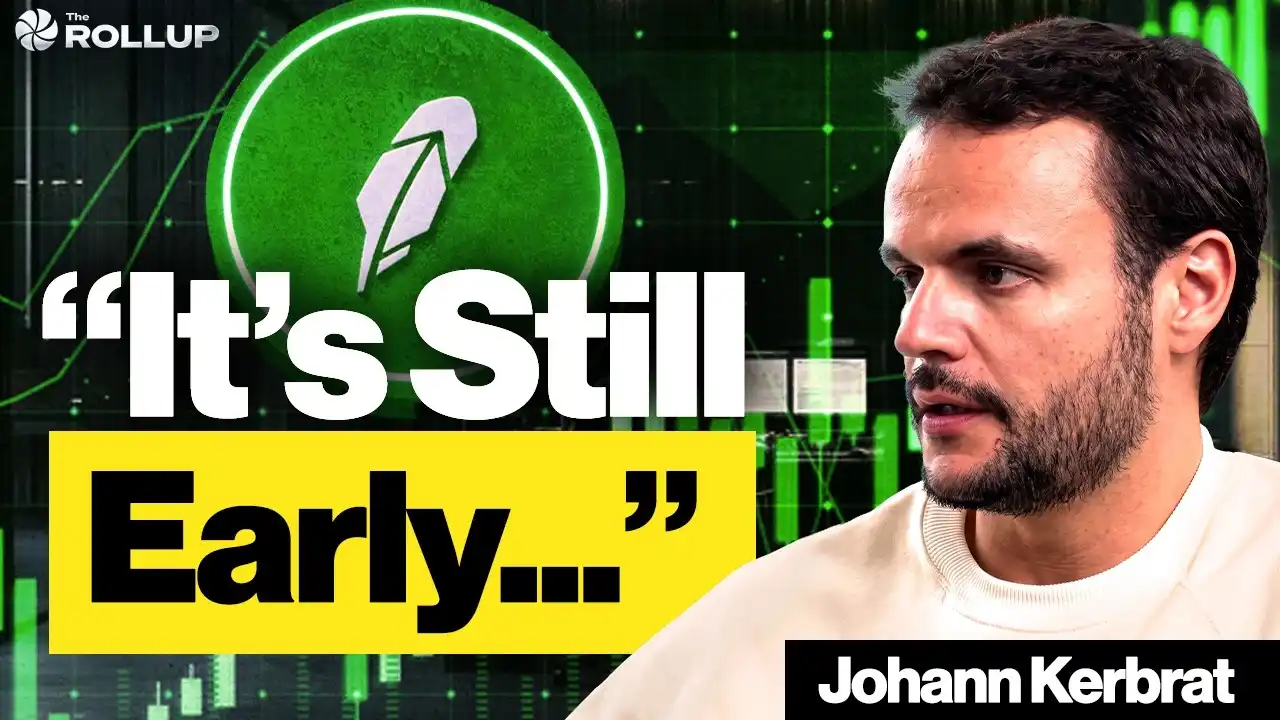
Interview with Robinhood executive Johann Kerbrat reveals the company's "barbell" customer acquisition strategy for its new Robinhood Chain, combining meme tokens with tokenized stocks. Three weeks after mainnet launch, the chain has seen over $3B in weekly DEX volume and 105M transactions. Kerbrat explains the logic behind the permissionless chain: meme tokens attract DeFi users, while tokenized real-world assets (RWA), currently over 90 US stocks and ETFs accessible in 120+ countries, serve global users. The goal is to bring Robinhood's 27 million funded accounts on-chain by simplifying DeFi with a user-friendly interface, exemplified by features like Robinhood Earn which offers yield without requiring wallet management. Built on Arbitrum's technology stack for its speed, low cost, and Ethereum's security, the chain focuses on financial products like Earn, spot trading, and perpetuals. Kerbrat downplays direct competition with platforms like Base, emphasizing the goal of expanding the overall market for on-chain assets. He details selective partnerships (e.g., Morpho, Lighter) based on compliance, unique UX, and differentiation. While regulatory clarity is pending for US perpetuals, the expansion continues via Bitstamp in Europe. Finally, Kerbrat positions Robinhood as a "super app" integrating stocks, options, crypto, banking, and AI trading, with all major business lines generating hundreds of millions in revenue. For the chain, current priority is driving adoption over maximizing gas fee revenue.

marsbitHace 4 hora(s)

Interview with Robinhood Executive: Meme + Tokenized US Stocks as "Barbell" Customer Acquisition Strategy, All Business Lines Achieve Hundreds of Millions in Revenue

marsbitHace 4 hora(s)

Trading

Spot
活动图片