a16z: PR as BD, How to Break Through the 'Noise' in the Crypto Industry?

marsbitPublicado a 2026-01-20Actualizado a 2026-01-20

Resumen

In the article "a16z: PR as BD – How to Break Through the Noise in Crypto," the author argues that "communications" is a broad term encompassing strategies for engaging various stakeholders, including employees, media, and investors. It involves owned content, social media, community building, speaking opportunities, and media relations (PR). No single tactic is superior; the optimal strategy depends on answering three core questions: What are your business goals? Who is your target audience? What is the best way to reach them? A consistent core narrative is paramount. The piece particularly defends the enduring value of media relations (PR), which, despite its controversial reputation in tech, remains a crucial tool. Media coverage provides third-party validation, expands reach to new audiences (potential employees, clients, influencers), and drives traffic back to owned channels. It is compared to business development (BD), where building genuine relationships with journalists is key. To break through the noise, founders are advised to: 1) Be their own best spokesperson, 2) Build relationships with media like doing BD, 3) View media as neither friend nor foe but as entities seeking good stories, and 4) Contextualize their story within larger industry or global narratives. The article concludes that the best defense against potential negative press is a good offense: proactively building communication channels and media relationships before a crisis strikes.

Compiled by: Ken, ChainCatcher

"Communication" is a general term referring to the strategies companies use to communicate with different groups—employees, media, investors, etc.

Communication encompasses various methods: creating owned content on official websites and social media channels (i.e., "direct-to-audience" communication); writing thought leadership articles; coordinating internal employee communication; collaborating with influencers (key opinion leaders); and curating organic or paid event and speaking opportunities. Of course, communication also includes dealing with the media (i.e., public relations or publicity).

No single communication strategy or tactic is absolutely superior to others. So, how do you find the right approach for you?

In this article, I will explain how to frame your communication strategy and what levers you can use to implement it. I will then argue that, although traditional media relations have a poor reputation in some tech circles, they remain a crucial tool for startups to convey their message externally.

How to Think About Your Communication Strategy

My mental model for communication strategy is built on answering three questions:

  1. What are your business goals?

  2. To achieve those goals, which audiences do you need to reach?

  3. What is the best strategy to reach those audiences?

Overarching all of this is your message and narrative—what problem are you and your team solving? What will the world look like when it's solved? Who will benefit in this new world?

Regardless of who you are talking to or through which medium, your core narrative and message should remain consistent. However, you need to emphasize different aspects depending on the audience. For example, investors focus on details and future growth prospects, while the media is more concerned with headlines and how you got to where you are today.

What Actions Can You Take?

Although different projects have varying business goals and audiences, the available strategies or tactics are largely similar. These strategies include:

  • Owned Content: For example, creating your own blog, producing videos, or publishing white papers on your official website.

  • Social Media (Brand & Personal): Although you don't own the social platforms, they are one of the best ways to reach your audience. For startups, this includes a combination of brand accounts (company official accounts) and personal accounts (founders' and employees' accounts).

  • Community Building: Whether through Discord, Signal, Telegram, or WhatsApp, online community management allows you to establish direct contact with developers, partners, or other key audiences in the ecosystem.

  • Speaking Opportunities and Conferences: Including giving speeches or making appearances at important offline community events and conferences.

  • Media/Press: The last strategy includes both proactive and reactive engagement with the media—whether proactively pitching stories, providing expert commentary, submitting articles, or responding to media inquiries. This includes both vertical crypto media (like Coindesk, The Block, etc.) and traditional mainstream media (like The Wall Street Journal, Bloomberg, etc.).

The Role of Media for Founders

The last strategy mentioned above—media relations (i.e., PR)—is the most controversial in the eyes of many tech founders. This is not without reason: although some journalists and media outlets have indeed become more hostile towards the tech industry, this is still one of the topics I get asked about most often when consulting for startups.

Many founders ask how to get funding coverage on TechCrunch, or how to land a glossy profile in Fortune magazine. They are also curious about how to get on TBPN, or record an hour-long podcast with the Bankless guys.

Why? Because regardless of your personal perception of the media, media coverage combines third-party endorsement with the potential for audience expansion, allowing you to reach entirely new groups: potential employees, potential clients, or potential influencers within the industry. Reaching different audiences also helps feed the growth of your own channels. Most startups cannot afford to miss out on the cost of expanding their influence and exposure.

When the founding team of Kalshi recently appeared on "CBS Sunday Morning," they reached an audience completely different from the "always-on" users of the tech Twitter圈. Kalshi CEO Tarek Mansour shared a story about the mother of a team member, vividly illustrating the power of reaching different circles through traditional media:
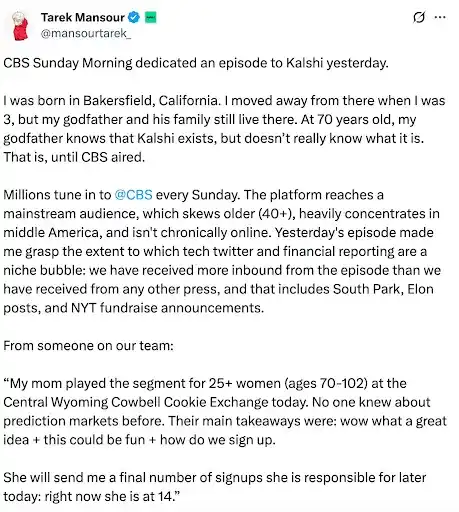
This is why media relations remain an extremely important part of the communication toolkit. Media can drive traffic back to your owned channels, help build your (and your company's) image, and accelerate everything from recruitment to sales. In the long run, media can also enhance the effectiveness of your "direct-to-audience" strategy.

Don't be afraid of media relations. Learn to use it to cut through the noise and get to the truth.

Contacting the Media: Breaking Through the Noise

Yes, we are in an era of information and content overload. This is especially true for the journalists you want to contact.

Take a look at the inbox of any journalist, podcaster, or content creator, and you will be shocked: it is filled with hundreds or thousands of emails from PR people promoting their respective clients or projects. In fact, data shows that the ratio of media PR practitioners to journalists is as high as 6 to 1. Due to the flood of information, it is almost impossible for journalists to filter out what is real substance from what is spam.

Why? Because many PR people lack professional training, or lack the confidence to push back against bad ideas proposed by clients. As a result, they mass-produce poor pitches, exacerbating the frustration of journalists, producers, and podcast hosts.

Add to that the projects that claim to offer brilliant solutions to important problems, but end up failing or being empty promises. All in all, poor pitches and over-promising共同 create an environment where "standing out" is more difficult than ever.

However,相对于 the sea of垃圾 information, quality news sources are still scarce. This means that those who can effectively tell stories and build good relationships with existing media professionals will have a clear competitive advantage.

Engaging with Media: Where to Start

Founders who want to break through the noise and engage effectively with the media should keep the following four points in mind:

  1. Founders are the best spokespeople. The company's narrative or story cannot be outsourced. Although hiring PR personnel, agencies, or freelancers can help you open doors, it must be the founders themselves who refine and vividly tell their own story.

  2. Relationships are key. Treat media relations like business development (BD). Whether it's争取 speaking opportunities or simply replying on X, building personal relationships with journalists, podcast hosts, and opinion leaders is crucial. Often, the birth of a报道, the recording of a podcast, or the acquisition of a speaking opportunity stems from connections. Why? Because journalists and opinion leaders trust the founders and PR people with whom they have built relationships, because past experience has proven that these people can provide reliable interview opportunities, answers, or other valuable resources.

2a. So, how do you build relationships with key media? Methods vary, but the core lies in proactively providing resources. First focus on how to add value to their reporting, rather than just boasting about your project. You can also use speaking and conference occasions to meet media people—just as you would do business development.

  1. The media are neither friends nor enemies. Some media do have biases, but ultimately, journalists are just looking for good stories. Remember, journalists are not your friends here to help you. The art lies in learning how to interact constructively and knowing when to shut up (sometimes, staying silent is absolutely the wise choice).

  2. Your story must fit into a broader context. The best founders can洞察 how their company, project, product, and team fit into the grand narrative of the industry and even the whole world. Helping journalists understand you, and how you fit into that larger story, trend, or movement, is key to breaking through. For example, think about the annual "Year in Review"—from Spotify to Google Search, to a16z and Coinbase's State of Crypto reports. Each案例 captures a specific moment in time—reviewing the past year and adding unique insights/perspectives that only it can provide, while making it practical and shareable through charts and visualizations. Founders can also ride the wave by hooking into hot topics (like the growth of stablecoins, the fusion of AI x Crypto, or policy debates around DeFi).

The core is: Connect your story to what is happening in the world.

The Best Defense is a Good Offense

"But," you might ask, "what if I never want to deal with the media?"

That's a noble wish. But unfortunately, as a startup grows, it is impossible to remain completely游离于 the public eye.

When facing tricky negative coverage or a crisis—whether fair or not—the best way to avoid being被动挨打 is to预先 establish contact with the media and cultivate initial rapport. Just like anything in life, having a relationship can make difficult conversations easier.

Crisis PR is a professional skill worthy of a separate discussion. But in short, the best defense is to have a good offense: having established sound communication channels, built relationships with key journalists and opinion leaders, and deeply understood your core audience *before* a crisis hits.

The media has become frightening to some and a convenient scapegoat for others. But with adequate preparation and the right mindset, media can be a powerful unlocking tool in the hands of a founder.

Let's toast to building in the open—may you master the tools to do it well.

Recommended Reading:

RootData 2025 Web3 Industry Annual Report

Binance Power Shift: The Dilemma of a 300 Million User Empire

Delphi Digital: Three Trends in Prediction Markets

Beyond Stablecoins: Circle Releases 2026 Strategy Report, Internet Financial System Has Fully Emerged


Preguntas relacionadas

QWhat are the three key questions to frame a communication strategy according to the article?

AThe three key questions are: 1. What are your business goals? 2. Which audiences do you need to reach to achieve those goals? 3. What is the best strategy to reach those audiences?

QWhy does the article argue that media relations (PR) is still a crucial part of the communication toolkit for startups?

AThe article argues that media relations combine third-party validation with the potential for audience expansion, allowing startups to reach new groups like potential employees, customers, or industry influencers. It can drive traffic back to owned channels, help build the company's image, and accelerate processes from recruitment to sales.

QWhat is the recommended approach for founders to stand out when contacting journalists amidst the information overload?

AFounders should be the best spokespeople for their own story, build genuine relationships with journalists (treating it like business development), understand that media are neither friends nor enemies but are looking for good stories, and frame their narrative within a larger, broader industry or world context.

QWhat does the article suggest is the 'best defense' against negative press or a crisis?

AThe article states that the best defense is a good offense: having established communication channels, built relationships with key journalists and influencers, and having a deep understanding of the target audience *before* a crisis occurs.

QName at least three specific communication tactics or levers mentioned in the article that a company can use.

AThe article lists several tactics, including: creating owned content (blogs, videos, whitepapers), utilizing social media (both brand and personal accounts), community building (e.g., on Discord, Telegram), securing speaking opportunities and conference appearances, and engaging with the media (PR).

Lecturas Relacionadas

KOL's Perspective: Why Is SOL Set to Rise from This Point?

**Summary: Why SOL is Positioned for Growth at This Level** The article argues that SOL is poised for an upward move from its current price point, citing several key factors. Primarily, SOL has just broken out of a 4-month consolidation phase. This breakout signals a return of risk appetite to the broader crypto market, as SOL is seen as a key indicator of overall crypto health. The token's ownership has reportedly shifted from short-term traders and tourists to long-term accumulators, leading to low volume. Any meaningful increase in trading activity could thus trigger significant upward momentum. Fundamental strengths include strong institutional adoption, integration with DeFi and RWAs (Real-World Assets), and the potential benefits from the Clarity Act. Despite its high volatility—having dropped 70% from its all-time high but still up 12x from its bear market low—SOL is highlighted as one of the few tokens from the last cycle to reach new highs. It boasts a robust ecosystem of applications, users, and protocols. Future catalysts include the expected influx of AI developers following the Miami Accelerate conference, which focused on AI on Solana. Furthermore, Solana is positioned as the premier chain for memecoin activity, a trend expected to continue and drive network usage and fees. The article concludes that recent price action reflects a healthy transfer to long-term holders, setting the stage for growth.

marsbitHace 21 min(s)

KOL's Perspective: Why Is SOL Set to Rise from This Point?

marsbitHace 21 min(s)

Those Pre-Bitcoin PoW Protocols Have Recently Been Reimplemented

This article details a recent surge in replicating pre-Bitcoin Proof-of-Work (PoW) protocols, specifically focusing on Hal Finney's 2004 RPOW (Reusable Proofs of Work). Within five days in May 2026, multiple independent builders in the Bitcoin/cypherpunk community launched projects inspired by this early electronic cash proposal. The initiative began with Fred Krueger's `rpow2.com`, a centralized but auditable system that replaced RPOW's original IBM 4758 hardware with Ed25519 signatures. Initially a faithful replica, it later adopted Bitcoin-like features (21M supply cap, difficulty adjustment) and a controversial 5.24% founder allocation. This sparked rapid forks, including `rpow4.com` which incorporated full Bitcoin parameters, a prediction market (`rpowmarket.com`), and a DEX (`rpow2swap.com`). Concurrently, Mike In Space created a prototype of Wei Dai's 1998 b-money proposal (`b-money.replit.app`), pushing the historical exploration even further back. The article contrasts these centralized, server-dependent experiments with Bitcoin's core innovation of decentralized, trustless consensus. It also highlights a parallel development: the `HASH` project on Ethereum, which uses smart contract hooks to enable a purely fair-launch, browser-mineable PoW token with 0% allocations to team or VCs. The collective activity is framed as a meme-driven, educational exploration of cypherpunk history rather than a serious financial movement, with all projects heavily disclaiming any investment value.

marsbitHace 26 min(s)

Those Pre-Bitcoin PoW Protocols Have Recently Been Reimplemented

marsbitHace 26 min(s)

South Korean Exchanges 'Battle' Regulators, Challenging the Boundaries of Enforcement and Legislation

South Korea's cryptocurrency industry is engaged in a rare, direct confrontation with regulators. The Financial Intelligence Unit (FIU), the primary anti-money laundering (AML) watchdog, has recently imposed heavy penalties on major exchanges like Upbit and Bithumb for alleged violations involving unregistered overseas VASPs and AML procedures. However, exchanges are now actively challenging these actions in court and through industry associations. In a significant shift, the Seoul Administrative Court ruled in favor of Upbit's operator, Dunamu, overturning part of an FIU-ordered business suspension. The court found the FIU's penalty criteria and justification insufficiently clear. Similarly, the court suspended the enforcement of a six-month business suspension against Bithumb pending a final ruling, citing potential irreversible harm to the exchange. Beyond legal battles, the industry is contesting proposed legislative amendments. The Digital Asset eXchange Alliance (DAXA) strongly opposes a draft rule that would mandate Suspicious Transaction Reports (STRs) for all crypto transfers over 10 million KRW (~$6,800). DAXA argues this "poison pill" clause violates legal principles and would overwhelm the STR system, increasing reports from 63,000 to an estimated 5.45 million annually for major exchanges, thereby crippling effective AML monitoring. This conflict highlights a structural tension in South Korea's crypto governance: comprehensive digital asset laws are still developing, while regulators rely heavily on AML enforcement. The industry's move from passive compliance to active legal and legislative challenges signifies a new phase, pressing for clearer rules and more proportionate enforcement. While short-term disputes may intensify, this clash could ultimately lead to a more mature and sustainable regulatory framework for South Korea's vibrant crypto market.

marsbitHace 1 hora(s)

South Korean Exchanges 'Battle' Regulators, Challenging the Boundaries of Enforcement and Legislation

marsbitHace 1 hora(s)

After 50x Storage Surge, Justin Sun Always Looks to the Next Decade

Sun Yuchen, known for his controversial stunts like a $30 million lunch with Warren Buffett (canceled due to a kidney stone) and eating a $6.2 million duct-taped banana, is often overshadowed by a significant fact: his decade-long track record of spotting major investment trends. In 2016, he famously advised young people to invest in Bitcoin, Nvidia, Tesla, and Tencent instead of buying property. A hypothetical $20,000 investment in Nvidia and Tesla from that list would now be worth over 50 million RMB. His latest major call was on November 6, 2025, predicting a "50x storage opportunity" tied to the AI boom, which materialized with Sandisk's stock surging nearly 50-fold by 2026. Looking ahead, Sun now focuses on the next frontier: Physical AI. He identifies four key areas: 1. **Embodied AI/Robotics**: He sees this reaching its "iPhone moment," with companies like UBTech and Galaxy General leading in commercialization. 2. **Drones**: Viewed as the first commercially viable form of Physical AI, revolutionizing sectors from warfare (e.g., AeroVironment's Switchblade) to logistics. 3. **Spatial Computing**: Beyond VR, it's about AI understanding physical space, a foundational technology for robotics and autonomous systems, exemplified by Apple's Vision Pro. 4. **Space Exploration**: After a 2025 suborbital flight with Blue Origin, Sun advocates for space as the ultimate frontier, discussing blockchain's potential role in space asset management and data transactions. His investment philosophy involves betting on entire, inevitable trends rather than single companies. For robotics, he sees Tesla (the body/manufacturer) and Nvidia (the brain/AI platform) as complementary plays. In defense drones, he highlights companies making tanks obsolete (AeroVironment) and those augmenting fighter jets (Kratos). For space, he participated in Blue Origin's flight and anticipates SpaceX's potential IPO to redefine the sector's valuation. Sun Yuchen's vision frames the next two decades not as a revolution in information flow (like the internet), but in the fundamental operation of the physical world through AI-powered robots, autonomous systems, and spatial intelligence, ultimately extending human and AI activity into space. While many still focus on conventional assets, he continues to look toward the next technological horizon.

marsbitHace 2 hora(s)

After 50x Storage Surge, Justin Sun Always Looks to the Next Decade

marsbitHace 2 hora(s)

Trading

Spot
Futuros
活动图片




