a16z Invests Heavily with $356 Million in HYPE, Surpassing Paradigm to Become the Largest External Holder

链捕手Publicado a 2026-05-21Actualizado a 2026-05-21

Resumen

On May 21st, HYPE surged past $59, reaching a new high since September 2025, with a market cap nearing $150 billion. Analysts attribute the rally to a short squeeze and significant ETF inflows. The launch of two U.S. spot ETFs for Hyperliquid has driven substantial capital, with their inflows at times surpassing those of Bitcoin and Ethereum ETFs. Major institutions are actively accumulating HYPE. Venture firm a16z has become the largest external holder with a $356 million position, surpassing Paradigm. Other firms like Goldman Sachs, Grayscale, and Galaxy Digital have also made large purchases, with Goldman reportedly selling portions of its XRP, ETH, and BTC holdings to buy HYPE. Bitwise CIO Matt Hougan calls HYPE one of the most "mispriced" assets, arguing its valuation should reflect Hyperliquid's broader platform beyond just a perpetual DEX token. The protocol generates substantial real revenue, using 97% of fees to buy back and burn HYPE. Its expansion into RWA commodities and prediction markets has driven user growth and transaction volume, now commanding about 70% of the on-chain perpetual DEX market. However, this rapid growth faces challenges. Traditional exchanges CME and ICE are pressuring the CFTC to regulate Hyperliquid, citing concerns over its impact on global commodity benchmarks. Concurrently, some major market makers have withdrawn significant liquidity from the platform. With HYPE up over 125% year-to-date, operational risks are rising. Large holders a...

Author: Zhou, ChainCatcher

On May 21, HYPE broke through $59, hitting a new high since September 2025, with a 24-hour gain exceeding 20%. Its market cap approached $15 billion, ranking 11th globally.
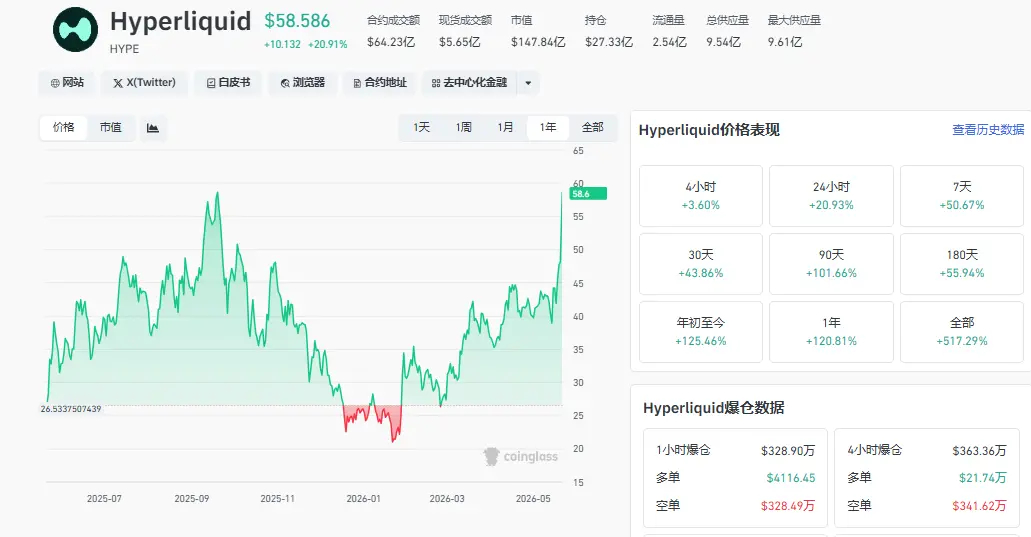
According to Santiment analysis, short squeezes and ETF fund inflows are the direct triggers for this rally.

Over the past few days, a large number of traders bet against HYPE, leading to a significant spike in negative funding rates across various trading platforms. As prices continued to rise, bearish traders were forced to buy back their positions, further driving up the price. Currently, HYPE's open interest remains high at over $1.92 billion, with new traders continuously entering the market, keeping the position scale stable.

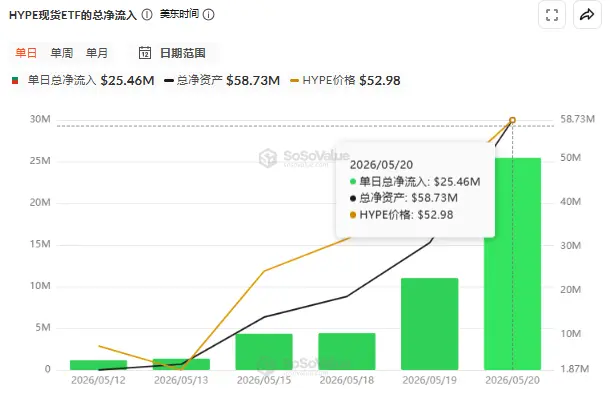
Simultaneously, ETF channels amplified the capital inflows. According to SoSoValue data, two US spot ETFs tracking Hyperliquid (21Shares' THYP and Bitwise's BHYP) recorded a combined net inflow of approximately $22.3 million in their first week of trading, with a single-day net inflow exceeding $25.46 million yesterday.

Analysts noted that in the first 6 trading days, the two Hyperliquid ETFs had 3 days where their market-cap-adjusted net inflows outperformed Bitcoin ETFs, and 5 days outperforming Ethereum ETFs. Among them, Bitwise announced that 10% of BHYP's management fees would be used to continuously buy and stake HYPE on the company's balance sheet.
Notably, over the past three days, a16z, Goldman Sachs, Grayscale, and Galaxy Digital have almost simultaneously made moves, and the largest external holder of HYPE has quietly changed hands.

According to on-chain analyst Ai Yi's monitoring, a16z began a large-scale accumulation mode in August 2025 and has accelerated the pace this year. Currently, it has accumulated 9.18 million HYPE tokens, worth approximately $356 million, at an average price of $38.77. The holdings are stored across dozens of addresses, mostly in a staked state, making it the largest external holder of HYPE by size, surpassing Paradigm, which previously held this position.

In the past 24 hours, a16z withdrew another 2.597 million tokens from major exchanges at an average price of $51.17, with an unrealized profit exceeding $79 million, and continues to add to its position.

Other institutions have also been active. Goldman Sachs recently sold over $152 million worth of XRP, $500 million worth of ETH, and $450 million worth of BTC, switching to buying HYPE. Grayscale-associated addresses bought and staked approximately $24.95 million worth of HYPE in the past week, adding another ~$12.1 million in the last 17 hours. Grayscale filed an S-1 registration for a HYPE spot ETF in January this year.

Additionally, Galaxy Digital-associated wallets bought about $8.8 million worth of HYPE in the past 2 hours; the insider whale agent Garrett Jin, also deposited 10 million USDC into Hyperliquid to directly buy HYPE.

Recently, Bitwise CIO Matt Hougan described HYPE as one of the "most mispriced" assets in the current crypto market. He believes the market still prices HYPE within the framework of a perpetual contract DEX token, while Hyperliquid's true scale far exceeds this framework. Nearly half of the platform's trading volume is now related to non-crypto assets, covering commodities, stock indices, RWAs, and even prediction markets.

Supporting this judgment is the real revenue generated by the Hyperliquid protocol itself. The platform directs 97% of fee revenue into the Assistance Fund, which continuously buys back and burns HYPE in the open market. Since 2025, it has repurchased over $2.49 billion, accounting for 46% of the industry's total buybacks.

On-chain data shows that Hyperliquid recently accounted for over 42% of total blockchain fee revenue across all networks.

Revenue sources are also expanding. Following Coinbase's collaboration with Circle as the USDC Treasury capital deployer, the AQAv2 upgrade was activated, expected to add approximately $440,000 in daily repurchase potential to the protocol from USDC reserve yield.

In terms of RWA, following the launch of HIP-3, trading volume for commodity perpetual contracts like oil, gold, and silver has continued to explode. During the Iran conflict, the daily peak trading volume for crude oil perpetual contracts once exceeded $2.2 billion.

Currently, the open interest for RWA perpetuals on the Hyperliquid platform has reached a new all-time high of $2.6 billion, doubling compared to two months ago. Total users have reached 1.2 million, with a total trading volume of $4.33 trillion, capturing about 70% of the on-chain perpetual DEX market share.

Regarding the HIP-4 prediction market, Hyperliquid officially launched its prediction market function in May this year. The daily trading volume of its first binary contract for BTC price direction was about three times the combined volume of similar markets on Polymarket and Kalshi. ChainCatcher provided detailed analysis in "Can Hyperliquid Win in the Prediction Market?".

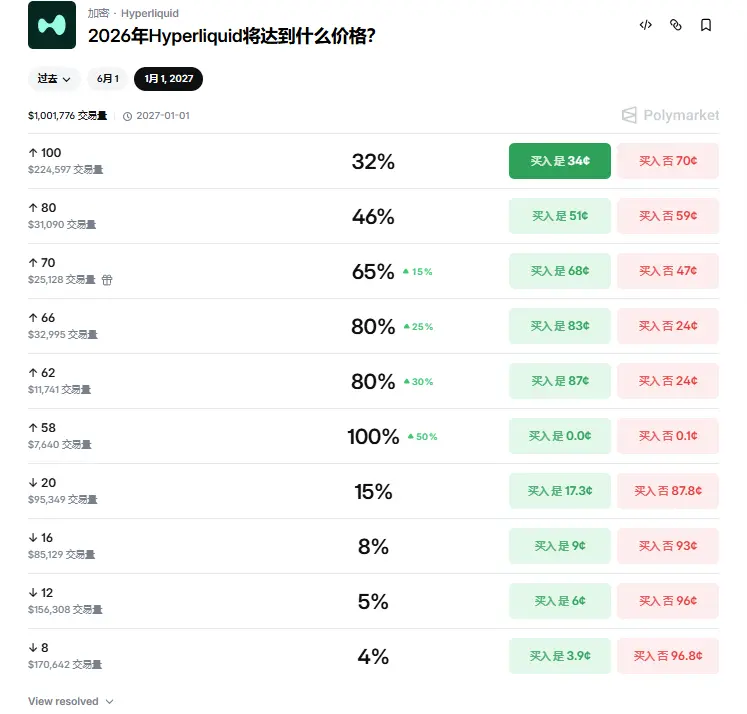
Latest data from Polymarket shows the market is betting an 80% probability that HYPE will reach $66 by the end of 2026, a 46% probability of reaching $80, and a 32% probability of reaching $100.
Previously, BitMEX co-founder Arthur Hayes publicly touted HYPE, suggesting it could reach $150 by August. Today, he posted again on social media, stating that HYPE is getting closer to setting a new all-time high.

Hayes's Maelstrom fund has been selling holdings like ENA, PENDLE, and ETHFI, switching to increase its HYPE position. According to HyperInsight monitoring, Arthur Hayes currently holds 247,334 HYPE, worth $14.5 million, with an unrealized profit exceeding $6.5 million.

However, Hyperliquid's rapid expansion has also brought trouble. Especially after the launch of HIP-3, the trading volume of on-chain commodity contracts quickly eroded the weekend and after-hours trading periods of traditional exchanges, directly stepping on Wall Street's interests.

Recently, CME and ICE have jointly pressured the US CFTC, demanding that Hyperliquid register and accept regulation, arguing that its anonymous, 24/7 trading environment could distort global oil price benchmarks.

Meanwhile, according to Hyperinsight on-chain monitoring, two addresses on Hyperliquid, marked as mainstream market makers, withdrew nearly 90% of BTC and ETH liquidity during the same period, with an estimated total withdrawal of nearly $100 million. ChainCatcher provided detailed analysis of this background in "Hyperliquid Disrupts Wall Street's Game: Regulation Uncertain, Market Makers Flee First?".

As the token price continues to climb, HYPE has achieved a gain of over 125% since the beginning of this year, and its FDV once surpassed SOL, indicating that operational risks can no longer be ignored. According to on-chain monitoring, some large holders have already established hundreds of millions of dollars worth of short positions for hedging while holding substantial HYPE spot positions.

Regulatory uncertainty persists, and the CFTC's stance towards Hyperliquid remains a variable hanging overhead. Beyond the battle between bulls and bears, this game concerning the boundaries of on-chain finance is also far from over.


Preguntas relacionadas

QAccording to the article, what are the two main catalysts for HYPE's recent price surge to a new high?

AThe two main catalysts are a short squeeze and ETF inflows.

QWhich investment firm has become the largest external holder of HYPE, surpassing Paradigm, and what is the total value of its holdings?

Aa16z has become the largest external holder of HYPE, with total holdings worth approximately $356 million.

QWhat key challenge or risk does Hyperliquid face from traditional financial institutions according to the article?

AHyperliquid faces pressure from traditional institutions like CME and ICE, who are pushing the CFTC to require Hyperliquid to register and be regulated, arguing its 24/7 anonymous trading could distort global oil price benchmarks.

QWhat does Bitwise CIO Matt Hougan describe HYPE as in the current crypto market, and what metric does he use to support his view of Hyperliquid's growth?

AMatt Hougan describes HYPE as one of the 'most mispriced' assets. He supports this by stating that nearly half of Hyperliquid's trading volume is now related to non-crypto assets like commodities, stock indices, and RWAs, moving beyond its original framework as a perps DEX token.

QWhat is the market's probability, according to Polymarket data mentioned in the article, of HYPE reaching $66 by the end of 2026?

AAccording to Polymarket data, the probability of HYPE reaching $66 by the end of 2026 is 80%.

Lecturas Relacionadas

It's Bankless That Needs Ethereum, Not Ethereum That Needs Bankless

Titled "Bankless Needs Ethereum, Not the Other Way Around," this article analyzes the significant recent news involving Bankless, a prominent crypto media outlet. Bankless co-founder David Hoffman announced the sale of all his ETH holdings, while the company also reportedly underwent major layoffs, with its founders parting ways. The news, likened to a high-profile defection, initially sent shockwaves through the Ethereum community, given Bankless's historical role as a key evangelist and "semi-official" narrative builder for Ethereum. For years, through its podcasts and writings, Bankless championed core Ethereum ideas like "ultrasound money" and the blockchain's role as a new financial settlement layer, acting as a crucial community hub and belief system during its growth phase. However, the article argues this development is not necessarily negative for Ethereum. It suggests Bankless's "first mission"—serving as Ethereum's passionate, inward-facing "propaganda department"—has largely been completed. As Ethereum matures and moves towards mainstream, institutional adoption, the narrative baton has shifted. Today, the value propositions of ETH are increasingly communicated to traditional finance by asset managers like BlackRock and VanEck, public companies adding ETH to their treasuries, and established financial figures. This represents a natural evolution towards a more decentralized, professional, and institutionally-focused narrative network. Therefore, while Bankless's retreat marks the end of an era, it signifies Ethereum's growing resilience and its reduced reliance on any single entity for belief, as its story is now carried forward by a broader and more mature ecosystem of advocates.

链捕手Hace 23 min(s)

It's Bankless That Needs Ethereum, Not Ethereum That Needs Bankless

链捕手Hace 23 min(s)

Google Officially Declares War

Google Declares War with AI-First I/O 2026 At its 2026 I/O developer conference, Google launched an aggressive, multi-pronged offensive, embedding AI across its ecosystem and challenging rivals on performance and price. The event showcased three major releases: Gemini 3.5 Flash, the video-centric Gemini Omni Flash, and the system-level AI assistant Spark. Gemini 3.5 Flash, despite being a smaller "Flash" model, outperforms its Pro counterpart in key benchmarks like mathematical reasoning (GSM8K) and coding (SWE-bench). Google attributes this to "extreme knowledge distillation" from a larger teacher model and a novel, highly granular MoE (Mixture of Experts) architecture with 256 experts, achieving sub-65ms response times. The native multi-modal model, Gemini Omni Flash, offers real-time video understanding with 120ms latency, enabling applications like preventing a cup from overfilling. The new Spark assistant gains deep Android system integration, allowing it to automate complex multi-app workflows based on voice commands. Complementing these, Google unveiled lightweight AI glasses featuring Micro-OLED displays and on-device Gemini chips for instant, offline translation and scene analysis. CEO Sundar Pichai announced Gemini has reached 900 million monthly active users, leveraged through integration into Chrome, Android, and Workspace. Google also slashed prices dramatically: the Gemini 3.5 Flash API is priced at a fraction of competitor rates. This price war is enabled by Google's vertically integrated TPU infrastructure. The strategy signals a shift: standalone AI models are becoming commoditized. Google's advantage lies in its "device + cloud + ecosystem + hardware" integration, aiming to reshape internet traffic from user-initiated searches to AI-driven service distribution. This move pressures pure-play AI firms like OpenAI and Anthropic on business models, and challenges Apple to respond in the next-generation, screen-less device race.

链捕手Hace 42 min(s)

Google Officially Declares War

链捕手Hace 42 min(s)

Top 10 Promising Emerging Hyperliquid Native Protocols to Watch

Title: A Review of 10 Emerging Native Protocols on Hyperliquid Hyperliquid is evolving beyond perpetual contracts into a comprehensive on-chain financial stack. This article highlights 10 key native protocols driving this growth: 1. **Monetrix**: A yield-optimizing protocol akin to Ethena, aggregating funding rates, HLP rewards, maker rebates, and HIP-3 into a single stablecoin yield. 2. **ROSETTA**: An automated stablecoin yield router, allocating USDC across top protocols (e.g., Felix, Aave, HLP) for optimal returns, factoring in gas and slippage. 3. **papertrade.xyz**: A fair-launched perpetuals protocol offering up to 1000x leverage, no funding rates, no slippage, and fully on-chain, oracle-based execution. 4. **alt.fun**: A launchpad where tokens are paired with leveraged perpetual positions (2x-5x), linking token price to trading activity and underlying position performance. 5. **Ventuals**: Pre-IPO perpetual contracts (built on HIP-3) allowing up to 10x leveraged speculation on valuations of private companies like SpaceX and Stripe. 6. **Liminal**: A delta-neutral yield protocol that captures funding rates via automated short positions and uses generated xTokens (xBTC, etc.) as DeFi collateral. 7. **Melt**: Brings tokenized stocks, commodities, and RWAs to Hyperliquid spot markets, enabling 24/7 trading alongside crypto assets. 8. **Chainsight**: An oracle and data infrastructure protocol providing low-latency (<3s) price feeds, volatility indices, and risk metrics for novel derivatives. 9. **rip.xyz**: Tokenized vault strategies on HyperEVM; its flagship rHYPURR offers liquidity and fractional exposure to a Hypurr NFT basket, priced hourly via NAV. 10. **Markets**: A perpetuals exchange (by Kinetiq) for trading stocks, forex, commodities, bonds, and crypto with up to 50x leverage, using USDH collateral and Kaiko oracles. These protocols form the foundational layer for generating real yield, liquidity, and innovative financial products natively on Hyperliquid.

marsbitHace 1 hora(s)

Top 10 Promising Emerging Hyperliquid Native Protocols to Watch

marsbitHace 1 hora(s)

Trading

Spot
Futuros

Artículos destacados

Cómo comprar HYPE

¡Bienvenido a HTX.com! Hemos hecho que comprar Hyperliquid (HYPE) sea simple y conveniente. Sigue nuestra guía paso a paso para iniciar tu viaje de criptos.Paso 1: crea tu cuenta HTXUtiliza tu correo electrónico o número de teléfono para registrarte y obtener una cuenta gratuita en HTX. Experimenta un proceso de registro sin complicaciones y desbloquea todas las funciones.Obtener mi cuentaPaso 2: ve a Comprar cripto y elige tu método de pagoTarjeta de crédito/débito: usa tu Visa o Mastercard para comprar Hyperliquid (HYPE) al instante.Saldo: utiliza fondos del saldo de tu cuenta HTX para tradear sin problemas.Terceros: hemos agregado métodos de pago populares como Google Pay y Apple Pay para mejorar la comodidad.P2P: tradear directamente con otros usuarios en HTX.Over-the-Counter (OTC): ofrecemos servicios personalizados y tipos de cambio competitivos para los traders.Paso 3: guarda tu Hyperliquid (HYPE)Después de comprar tu Hyperliquid (HYPE), guárdalo en tu cuenta HTX. Alternativamente, puedes enviarlo a otro lugar mediante transferencia blockchain o utilizarlo para tradear otras criptomonedas.Paso 4: tradear Hyperliquid (HYPE)Tradear fácilmente con Hyperliquid (HYPE) en HTX's mercado spot. Simplemente accede a tu cuenta, selecciona tu par de trading, ejecuta tus trades y monitorea en tiempo real. Ofrecemos una experiencia fácil de usar tanto para principiantes como para traders experimentados.

172 Vistas totalesPublicado en 2024.12.11Actualizado en 2026.04.28

Cómo comprar HYPE

Discusiones

Bienvenido a la comunidad de HTX. Aquí puedes mantenerte informado sobre los últimos desarrollos de la plataforma y acceder a análisis profesionales del mercado. A continuación se presentan las opiniones de los usuarios sobre el precio de HYPE (HYPE).

活动图片