a16z: How Tokenization is Transforming the Nature of Assets in 7 Charts

Odaily星球日报Publicado a 2026-05-24Actualizado a 2026-05-24

Resumen

"Tokenized Assets: How Tokenization Changes the Nature of Assets" by a16z Crypto The market for tokenized assets, excluding stablecoins, has grown from under $3 billion two years ago to over $340 billion today. US Treasury bonds are the primary growth driver, allowing investors to hold yield-bearing assets digitally and enabling more efficient settlement. Other key sectors include private credit (growing fastest), commodities (dominated by gold), and niche financial assets. However, the market remains concentrated in tokenized US Treasuries and gold. A critical insight is that most tokenized assets currently lack "composability." While the total market is large, only a small fraction is actively used within DeFi protocols. For instance, only about 5% of tokenized bonds and a low percentage of tokenized gold are utilized on-chain. In contrast, assets like reinsurance and private credit tokens show much higher on-chain usage rates (84% and 33%, respectively). This highlights a divide: many tokenized assets are merely digital records on a blockchain without enabling new, programmable financial applications. The Pantera Capital Token Native Index indicates over 70% of tokenized assets have minimal on-chain native functionality. Ethereum remains the dominant blockchain for tokenized assets (over $150B), but the ecosystem is diversifying across chains like BNB Chain, Solana, and Stellar, based on factors like cost and compliance. Major institutions forecast massive future growt...

Original: a16z crypto

Compiled | Odaily Planet Daily (@OdailyChina); Translator | Moni

Tokenized Assets, often referred to as "Real World Assets (RWA)", are changing the form of assets, how they flow, and how financial systems are constructed.

Just last month, the market size of tokenized assets surpassed $30 billion and is currently stabilizing around $34 billion (excluding stablecoins). This scale is roughly equivalent to that of a regional bank or a top university endowment fund. While still minuscule compared to the global financial system, it is substantial enough to create real-world impact.

Two years ago, the market size of tokenized assets was less than $3 billion. Since then, the market has undergone a dramatic transformation: the US GENIUS Act brought clearer regulatory frameworks for stablecoins, institutional-grade on-chain infrastructure matured, and a wave of financial institutions began deploying blockchain technology around the same time. It was driven by these factors that the tokenized asset market grew tenfold in less than two years. (Note: Although stablecoins are not included in the above statistics, they have substantially fueled the growth of the entire market by greatly simplifying on-chain payments and settlements.)

This article analyzes the reasons behind the rise of tokenized assets and their future trajectory through 7 charts.

Tokenized Assets Take Off: U.S. Treasuries Become the Biggest Growth Engine

U.S. Treasuries are the primary driver behind the recent growth of the tokenized asset market.

The advantages of tokenized U.S. Treasuries are clear and intuitive: investors can hold robust interest-bearing assets in a digital form, enabling more efficient and flexible trading and transfer. Financial institutions, on the other hand, can achieve efficiency gains in settlement and collateral asset allocation, seamlessly connecting with digital financial markets.
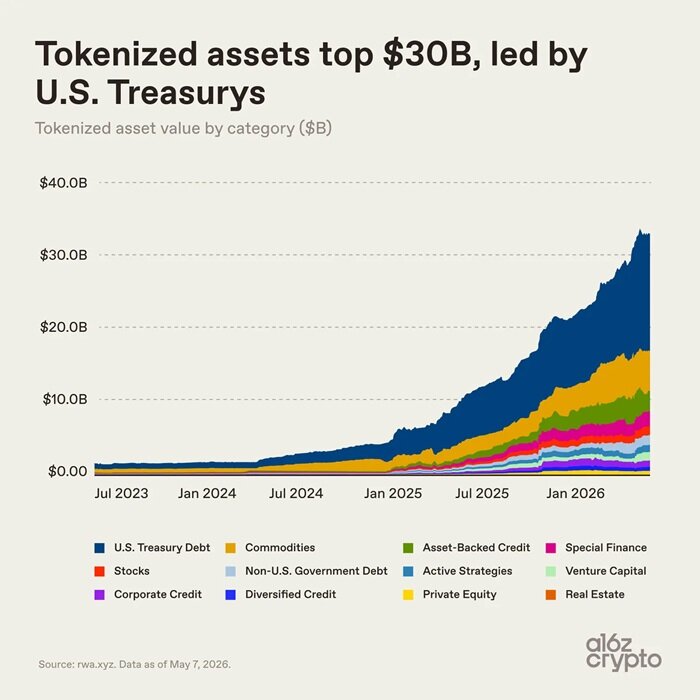
Crypto investors can also leverage tokenized Treasuries to put idle stablecoins to work, earning traditional money market yields. Asset managers like BlackRock and Franklin Templeton have accordingly entered the space, fostering a market with hundreds of billions in potential.
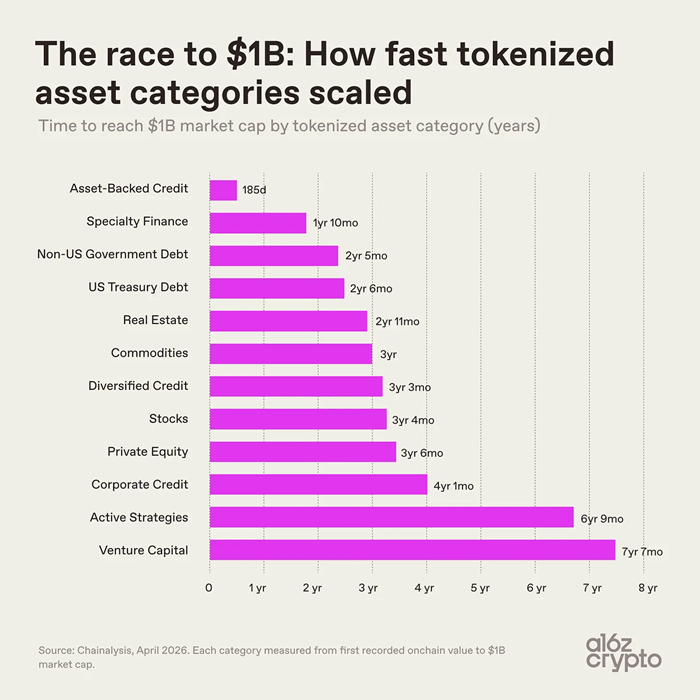
It's important to note that the growth rates of various tokenized asset types vary widely. This stems from differences in the technical and regulatory difficulty of tokenizing different assets, as well as market acceptance post-launch.

  • Asset-backed credit leads the growth by a wide margin. This category mainly includes tokens for Home Equity Lines of Credit (HELOCs) and lending vaults. Niche financial assets like reinsurance contracts and Bitcoin mining notes follow, reaching a $1 billion market cap within two years.
  • Venture capital-related assets took over seven years to break the $10 billion market cap mark. Active strategy-related assets followed a similar timeline. These asset structures are more complex, have longer investment cycles, and face higher operational and regulatory barriers.
  • Treasuries and commodities have a moderate pace of on-chain adoption, reaching a market cap of over $10 billion in 2 to 3 years, and are now mainstream categories.

At the beginning of 2024, Treasuries and commodities accounted for almost the entire tokenized asset market share. Since 2024, the share of credit, niche finance, equities, and other categories has steadily increased, but market concentration remains high. Currently, U.S. tokenized Treasuries and commodities together occupy about two-thirds of the market share.
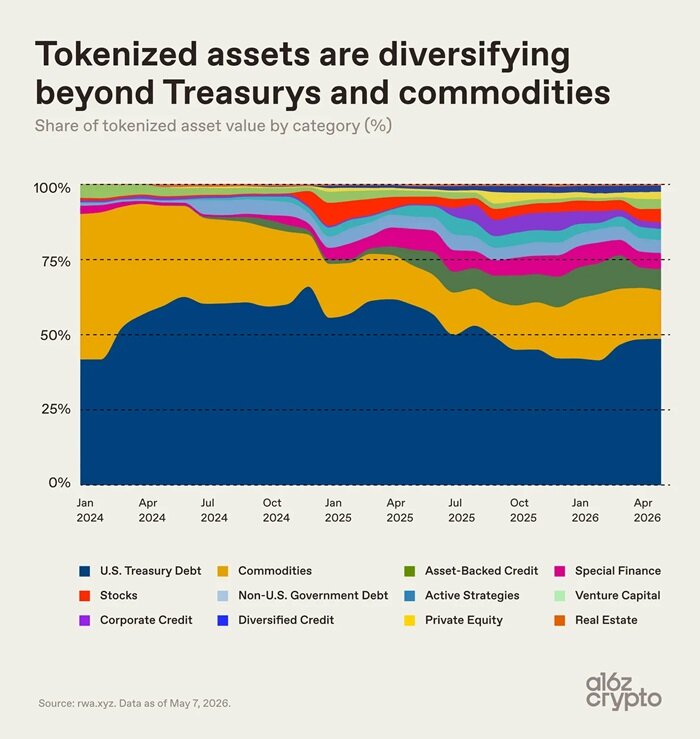
Segmented Landscape of the Tokenized Asset Market

The tokenized commodities sector is highly concentrated internally, with gold tokens dominating the vast majority of the share. The total size is about $5.1 billion, with gold tokens alone amounting to $5 billion. Silver and other commodity tokens are only $57.6 million, accounting for less than 0.01%.

Gold is naturally suited for the tokenized asset model. Currently, the tokenized commodity market is essentially dominated by gold. This is because gold has a globally unified standard, is convenient to store, is not easily perishable, and has long been traded based on entitlements/claims.

Moreover, crypto market investors have historically favored gold assets, with Bitcoin being called digital gold in its early days. Products like Tether Gold (XAUT) and Paxos Gold (PAXG) map ownership of physical gold in vaults onto the blockchain, transforming gold entitlements into digital tokens that can be held in on-chain wallets.
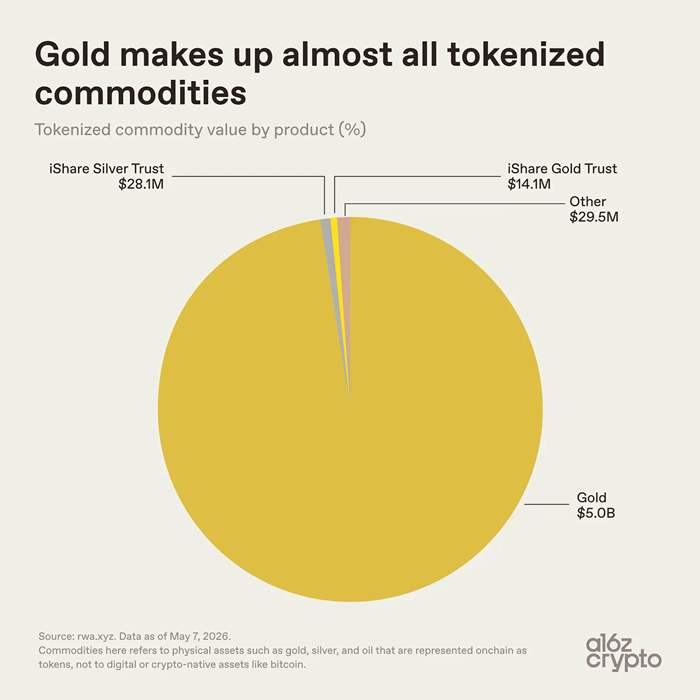
Tokenized assets for crude oil, agricultural products, and emerging categories like energy and computing power have an extremely low market share, and the industry is still in its infancy.

Looking at the distribution across underlying public blockchains, the tokenized asset ecosystem is more diverse. Ethereum, leveraging its DeFi first-mover advantage and institutional adoption foundation, remains the leader, hosting assets worth $15.7 billion, accounting for over half of the market.

The rest of the tokenized asset market is dispersed across multiple public chains: BNB Chain has a tokenized asset market size of about $4 billion, Solana about $2.2 billion, Stellar about $1.7 billion, the Bitcoin sidechain Liquid Network about $1.5 billion, while XRP Ledger, ZKsync Era, and Arbitrum each have tokenized asset sizes close to $1 billion.
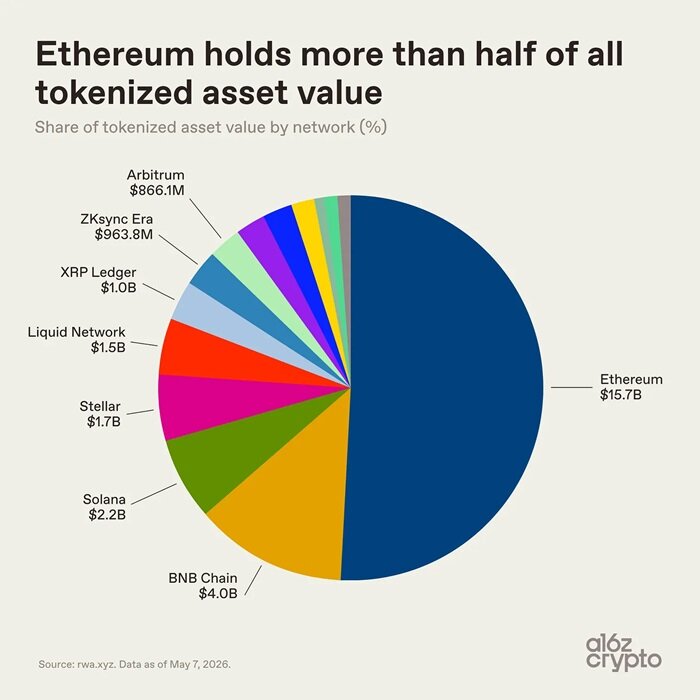
The tokenized asset industry is not consolidated on a single public chain. Assets are distributed across major blockchain ecosystems based on transaction costs, liquidity, regulatory requirements, and business partnerships. However, the most telling data point is not the market size of tokenized assets... but how these assets are used.

Let's delve deeper—

Most Tokenized Assets Are Not Yet "Composable"

Market size is not the only key metric; the actual utility value of assets is more indicative.

Bonds are the largest category of tokenized assets by market cap, valued at $15.2 billion, but only 5% of the circulating supply is used in DeFi protocols, approximately $800 million. The utilization rate of tokenized precious metals is similarly low. Most tokenized assets are used merely for on-chain storage and have not yet become freely combinable, interconnected, reusable financial building blocks.

Smaller tokenized asset categories show a starkly different picture: tokenized reinsurance contracts, with a market cap of $362 million, have an on-chain protocol usage rate as high as 84%; private credit tokens have a usage rate of 33%. These two categories were designed from the outset to fit composable on-chain application scenarios. In contrast, top categories like Treasuries and gold are primarily positioned to simplify holding and transferring assets on-chain without altering their fundamental operational logic. This situation also highlights a core divergence within the tokenized asset industry: the degree of on-chain nativity varies greatly among different tokenized assets.
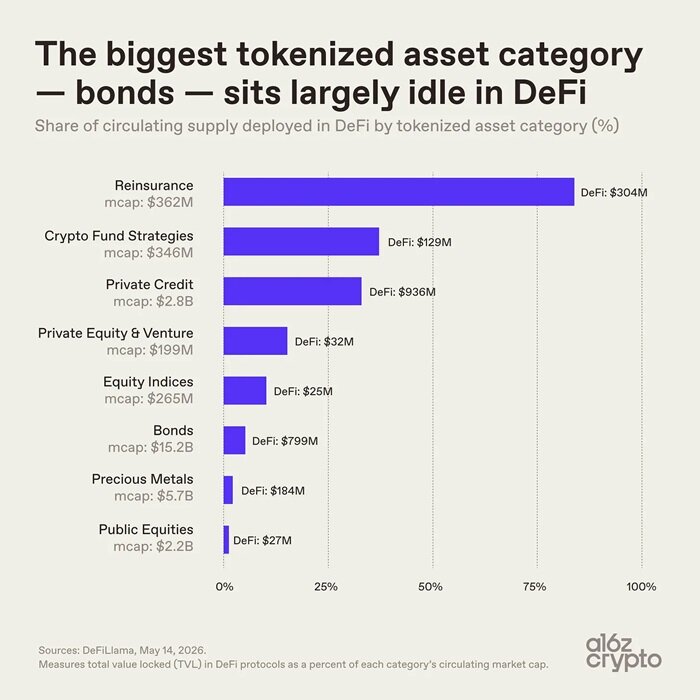
Some assets can be freely transferred and used across chains, while others merely use blockchain as an accounting tool, with limited asset transfer and composability functions. Currently, most tokenized assets are essentially just digitized assets, merely moving ledgers on-chain without unlocking composability potential. Composability is the core value of on-chain finance and a key to upgrading the financial system.

The Pantera Capital Token Native Index shows that over 70% of tokenized assets have the lowest level of on-chain nativity. A large number of tokens are merely digital certificates for offline physical assets, with actual asset control still relying on offline ledgers and intermediaries.

Currently, the tokenized asset industry is still in its early stages of development: one type is digitally recorded assets that are only formally on-chain, and the other is native on-chain assets that deeply integrate with blockchain properties.

The technical infrastructure for on-chain composition is already in place, and asset categories are gradually enriching, but deep integration and application are just beginning.

Future Trends for Tokenized Assets

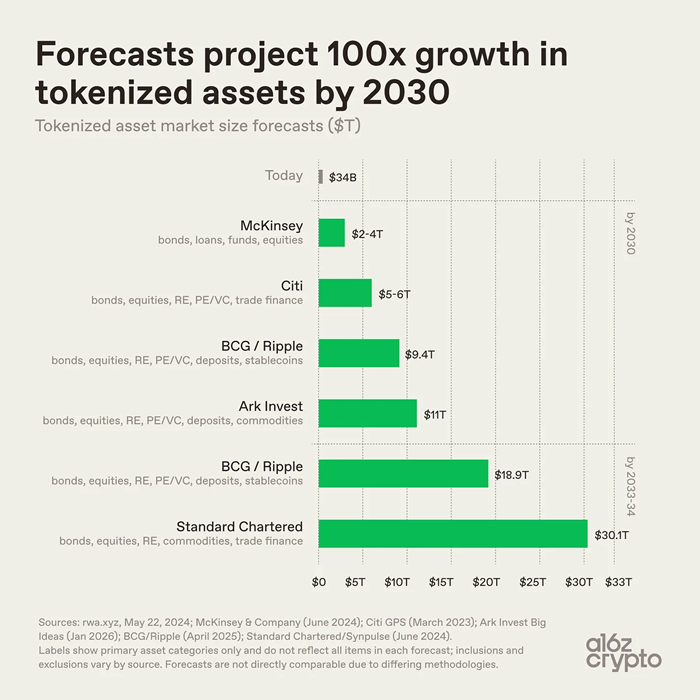
Industry predictions for the long-term size of the tokenized asset market vary, but the overall consensus is that the market will continue to expand.

  • McKinsey predicts the tokenized asset market will reach $2-4 trillion by 2030.
  • Ark Invest estimates the tokenized asset market could be $1.1 trillion.
  • Boston Consulting Group (BCG) in partnership with Ripple calculates the tokenized asset market will reach $0.94 trillion by 2030 and climb to $1.89 trillion by 2033.
  • Standard Chartered forecasts the tokenized asset market could exceed $3 trillion by 2034.

Based on the above estimates, compared to the current market size of $34 billion, the tokenized asset market has potential for hundred-fold growth in the long term. Of course, the numerical differences don't stem from disagreements about adoption speed, but from different scopes of what is being measured. Each institution's statistical scope differs, covering varying asset classes, whether stablecoins and deposits are included, and the definitional boundaries of tokenization. For example: McKinsey focuses on bonds, credit, funds, and equities; Standard Chartered adds commodities and trade finance; BCG and Ripple additionally include deposits and stablecoins. Although statistical methods differ, the industry unanimously agrees that the scale of tokenized assets will see leapfrog growth.

Looking at the global financial landscape, the current size of tokenized assets remains minuscule.

  • Global bond market size exceeds $140 trillion; tokenized bonds are only $15.2 billion, accounting for 0.01%.
  • Global physical gold market cap reaches several trillion dollars; tokenized gold is $5 billion, accounting for less than 0.02%.
  • Global equity market cap exceeds $100 trillion; tokenized stocks are $1.5 billion, accounting for only 0.001%.
Today, emerging sectors have steadily taken shape. Assets with clear pricing, stable demand, and simple ownership like U.S. Treasuries, gold, and private credit have been the first to go on-chain. Currently, tokenization has not yet disrupted the underlying nature of assets; it mainly optimizes settlement and transfer methods. The deep integration of assets with digital financial systems is still being explored.

Currently, tokenized assets remain more at the digitization level, where assets struggle to achieve programmable, composable applications. The industry's next phase faces hard challenges: bringing more complex parts of the financial system on-chain and integrating tokenized assets more deeply into composable, internet-native financial infrastructure.


Preguntas relacionadas

QAccording to the article, what is the current approximate market size of tokenized assets (excluding stablecoins), and what is the primary driver behind its recent explosive growth?

AThe current market size of tokenized assets is approximately $34 billion. The primary driver of its recent explosive growth (a 10x increase in less than two years) is the tokenization of US Treasuries.

QWhat are the two main categories of tokenized assets that dominated the market share at the beginning of 2024, and which category currently holds the largest share within the tokenized commodities sector?

AAt the beginning of 2024, US Treasuries and commodities dominated the market share. Within the tokenized commodities sector, gold tokens currently hold the vast majority share, accounting for around $5 billion of the roughly $5.1 billion total.

QThe article states that most tokenized assets currently lack a key property. What is this property, and why is its absence significant for the evolution of the financial system?

AThe key property most tokenized assets currently lack is composability. Its absence is significant because composability is the core value of on-chain finance and a key to upgrading the financial system. While many assets are simply 'digitized' on-chain, they are not yet programmable financial 'Lego blocks' that can be freely combined and reused in DeFi protocols.

QWhat does the Pantera Capital Token Native Index reveal about the majority of tokenized assets regarding their level of 'on-chain nativity'?

AThe Pantera Capital Token Native Index reveals that over 70% of tokenized assets are at the lowest level of on-chain nativity. This means the majority are merely digital representations of off-chain assets, with the actual control and settlement still reliant on traditional off-chain ledgers and intermediaries.

QWhat is the fundamental difference between how tokenized US Treasuries/gold are currently used and how niche assets like reinsurance tokens are used, according to the article?

ATokenized US Treasuries and gold are primarily used for simplified on-chain holding and transfer, essentially just moving accounting ledgers to the blockchain. In contrast, niche assets like reinsurance tokens and private credit tokens are designed from the start for on-chain composable applications, resulting in a very high rate of use within DeFi protocols (e.g., 84% for reinsurance tokens).

Lecturas Relacionadas

After Three Consecutive Quarters of Decline, Can the Crypto Market Find a Window for Stabilization in Q3?

The cryptocurrency market has just concluded its worst-performing quarter since 2022, with total capitalization dropping 12.6% to $2.1 trillion. All core metrics indicate capital is leaving the sector, not just rotating within it. Bitcoin fell 14.2% and Ethereum dropped 25.4% in Q2, breaking their previous correlation with US tech stocks. A key driver is the reversal in US spot Bitcoin ETF flows, which saw a net outflow of approximately $4.67 billion in Q2, including a record monthly outflow near $4.5 billion in June. While recent data suggests long-term holders are accumulating again, sustained ETF outflows mean continued selling pressure. Market focus is now singularly on the Federal Reserve. The upcoming July FOMC meeting is seen as the most critical event for Q3. A dovish signal could support Bitcoin reclaiming a $68,000-$84,000 range, while a hawkish stance might establish a new trading band around $50,000-$56,000. Additionally, regulatory uncertainty persists, with the progress of the crucial *CLARITY Act* stalling in the Senate, reducing its perceived 2026 passage probability to 40-45%. Despite the broad downturn, a few sectors showed growth. Prediction markets saw nominal volume surge 48.7% year-over-year to $113.8 billion, and tokenized collectibles transaction volume rose 143% quarterly to $1.4 billion. The Real-World Asset (RWA) tokenization sector also continued steady growth, now representing ~$28.1 billion in on-chain value. The market's foundation for an extreme crash appears limited, with Bitcoin price hovering near its 200-week moving average. However, the trading paradigm has shifted from narrative-driven speculation to decisions based on price action, policy developments, and interest rate expectations, making a broad sentiment-driven rally unlikely in the near term.

marsbitHace 2 hora(s)

After Three Consecutive Quarters of Decline, Can the Crypto Market Find a Window for Stabilization in Q3?

marsbitHace 2 hora(s)

BIT Trading Moment: BTC Still Suppressed by Weekly 200 EMA, Rejection May Restart Decline; Storage and Semiconductors that Surged Last Night Begin Falling in Evening Trading

**Crypto & Stock Market Wrap: Bitcoin Tests Resistance, Stocks Retreat After AI Surge** Bitcoin consolidates around $66,000, facing key resistance near $68,000—an area seen as a major psychological and technical hurdle where previous rallies have failed. Analysts note the cryptocurrency is caught between its 200-week moving average (~$63,333) and 200-week EMA (~$68,328). A clear break above $68k is needed to signal a stronger bullish trend, while a rejection could lead to a retest of $63k support. Market sentiment remains cautious, with low futures open interest pointing to a low-liquidity rebound rather than a full bull market. Bitcoin spot ETFs saw another $203 million inflow. US stock futures pointed lower after a strong Tuesday session led by a massive rebound in semiconductors and memory stocks. The rally was fueled by renewed optimism about AI-driven hardware demand, with Micron, SanDisk, and SK Hynix surging. However, those gains reversed in pre-market trading. Super Micro Computer (SMCI) soared over 20% after hours on strong guidance and a record backlog. Other standouts included Rocket Lab and nuclear energy plays Oklo and X-Energy. Rising oil prices (Brent above $91) and climbing Treasury yields (10-year near 4.64%), however, are reigniting inflation concerns and acting as a headwind for equities. In Asia, markets were mixed. South Korea's KOSPI pared early gains to close slightly higher as semiconductor stocks like SK Hynix gave back initial surges. Japan's Nikkei edged lower as the yen hit a fresh 38-year low against the dollar, raising fears of potential market intervention. Key events to watch include the Samsung Galaxy launch, AMD's AI event, and a slew of major tech earnings from Alphabet, Tesla, and IBM after the close on Wednesday, followed by the ECB meeting and Intel's earnings on Thursday.

marsbitHace 2 hora(s)

BIT Trading Moment: BTC Still Suppressed by Weekly 200 EMA, Rejection May Restart Decline; Storage and Semiconductors that Surged Last Night Begin Falling in Evening Trading

marsbitHace 2 hora(s)

Former CFTC Chairman, Circle President Tarbert: Preaching Long-Termism While Cashing Out $30 Million Himself

Former CFTC Chairman and Circle President Heath Tarbert has consistently advocated for a long-term vision in public, urging patience from investors as Circle’s stock price has fallen significantly from its peak. However, it has been revealed that since Circle’s IPO, Tarbert has continuously sold his CRCL shares through pre-arranged trading plans, cashing out approximately $30 million, without making any public market purchases. This contrast between his public messaging and personal actions has drawn criticism. Tarbert joined Circle in July 2023 as Chief Legal Officer, leveraging his regulatory experience to help guide the company through its IPO and expansion. Despite promoting stablecoins as long-term infrastructure, he established a 10b5-1 trading plan just before Circle went public, leading to substantial stock sales over the following year. In March 2026, he initiated another plan to sell more shares. His career trajectory highlights a pattern of moving between high-level regulatory roles and influential positions in the financial sector. After resigning as CFTC Chairman in early 2021, he joined Citadel Securities as Chief Legal Officer just 27 days later, during a period of intense regulatory scrutiny for the firm. He later joined Circle, aiding its efforts to navigate regulatory challenges for its public listing. While Tarbert's expertise in policy and compliance is valuable to companies like Circle, his actions—advocating long-term confidence while personally divesting—raise questions about the alignment between his public statements and his private financial decisions, leaving investors who followed his advice to bear the market risks.

marsbitHace 3 hora(s)

Former CFTC Chairman, Circle President Tarbert: Preaching Long-Termism While Cashing Out $30 Million Himself

marsbitHace 3 hora(s)

Gate Research Institute: The 'Wall Street-ization' Wave of Crypto Financial Products – Competition or Integration?

The article titled "Gate Research Institute: Are Crypto Financial Products Sparking a 'Wall Street' Wave—Competition or Convergence?" explores the evolving relationship between the crypto ecosystem and traditional finance (TradFi). The piece begins by reflecting on Bitcoin's original 2009 vision of decentralization, disintermediation, and moving away from banks. It then contrasts this with the 2024 landscape, where key crypto assets like Bitcoin are increasingly held through Wall Street products like ETFs issued by giants like BlackRock. The article questions whether this signifies that TradFi is systematically taking over the rights to issue, price, custody, and distribute crypto financial assets. The core argument is that this is not a zero-sum takeover but rather a bidirectional convergence where each side addresses the other's weaknesses. Crypto offers 24/7 global markets, programmable settlement, and open access but lacks compliant channels, institutional-grade custody, deep fiat liquidity, and mainstream distribution. TradFi possesses these but is constrained by legacy systems, limited operating hours, and slow settlement. Two primary convergence paths are highlighted: * **Path A (CEX to TradFi):** Exemplified by Gate, which has progressed from offering tokenized stocks and CFDs to providing direct, real stock trading (US, Hong Kong, South Korea) within its platform, using USDT. * **Path B (TradFi to Crypto):** Exemplified by Robinhood, which has integrated crypto trading, acquired exchanges like Bitstamp, and is moving traditional assets like stocks onto the blockchain via tokenization and its own Layer 2. Both paths are ultimately competing to become the next-generation, unified financial account—a "super account" where users can seamlessly trade cryptocurrencies, stocks, ETFs, RWA (Real World Assets), and tokenized treasury products in one interface. The growth of RWA and tokenized treasuries (e.g., BlackRock's BUIDL) is presented as the asset-layer fusion, providing stable, yield-bearing assets on-chain and acting as a bridge between the two worlds. In conclusion, the "Wall Street-ization" of crypto is framed as a mutual transformation. Decentralized ideals persist in the protocol layer, while at the application layer, a more efficient, global, and accessible unified capital market is emerging from this convergence. The future competition lies not between crypto exchanges and stockbrokers, but between platforms vying to offer the most comprehensive asset coverage, liquidity, and user experience within a single account.

marsbitHace 3 hora(s)

Gate Research Institute: The 'Wall Street-ization' Wave of Crypto Financial Products – Competition or Integration?

marsbitHace 3 hora(s)

Trading

Spot
活动图片




