a16z: How Tokenization is Transforming the Nature of Assets in 7 Charts

Odaily星球日报Publicado a 2026-05-24Actualizado a 2026-05-24

Resumen

"Tokenized Assets: How Tokenization Changes the Nature of Assets" by a16z Crypto The market for tokenized assets, excluding stablecoins, has grown from under $3 billion two years ago to over $340 billion today. US Treasury bonds are the primary growth driver, allowing investors to hold yield-bearing assets digitally and enabling more efficient settlement. Other key sectors include private credit (growing fastest), commodities (dominated by gold), and niche financial assets. However, the market remains concentrated in tokenized US Treasuries and gold. A critical insight is that most tokenized assets currently lack "composability." While the total market is large, only a small fraction is actively used within DeFi protocols. For instance, only about 5% of tokenized bonds and a low percentage of tokenized gold are utilized on-chain. In contrast, assets like reinsurance and private credit tokens show much higher on-chain usage rates (84% and 33%, respectively). This highlights a divide: many tokenized assets are merely digital records on a blockchain without enabling new, programmable financial applications. The Pantera Capital Token Native Index indicates over 70% of tokenized assets have minimal on-chain native functionality. Ethereum remains the dominant blockchain for tokenized assets (over $150B), but the ecosystem is diversifying across chains like BNB Chain, Solana, and Stellar, based on factors like cost and compliance. Major institutions forecast massive future growt...

Original: a16z crypto

Compiled | Odaily Planet Daily (@OdailyChina); Translator | Moni

Tokenized Assets, often referred to as "Real World Assets (RWA)", are changing the form of assets, how they flow, and how financial systems are constructed.

Just last month, the market size of tokenized assets surpassed $30 billion and is currently stabilizing around $34 billion (excluding stablecoins). This scale is roughly equivalent to that of a regional bank or a top university endowment fund. While still minuscule compared to the global financial system, it is substantial enough to create real-world impact.

Two years ago, the market size of tokenized assets was less than $3 billion. Since then, the market has undergone a dramatic transformation: the US GENIUS Act brought clearer regulatory frameworks for stablecoins, institutional-grade on-chain infrastructure matured, and a wave of financial institutions began deploying blockchain technology around the same time. It was driven by these factors that the tokenized asset market grew tenfold in less than two years. (Note: Although stablecoins are not included in the above statistics, they have substantially fueled the growth of the entire market by greatly simplifying on-chain payments and settlements.)

This article analyzes the reasons behind the rise of tokenized assets and their future trajectory through 7 charts.

Tokenized Assets Take Off: U.S. Treasuries Become the Biggest Growth Engine

U.S. Treasuries are the primary driver behind the recent growth of the tokenized asset market.

The advantages of tokenized U.S. Treasuries are clear and intuitive: investors can hold robust interest-bearing assets in a digital form, enabling more efficient and flexible trading and transfer. Financial institutions, on the other hand, can achieve efficiency gains in settlement and collateral asset allocation, seamlessly connecting with digital financial markets.
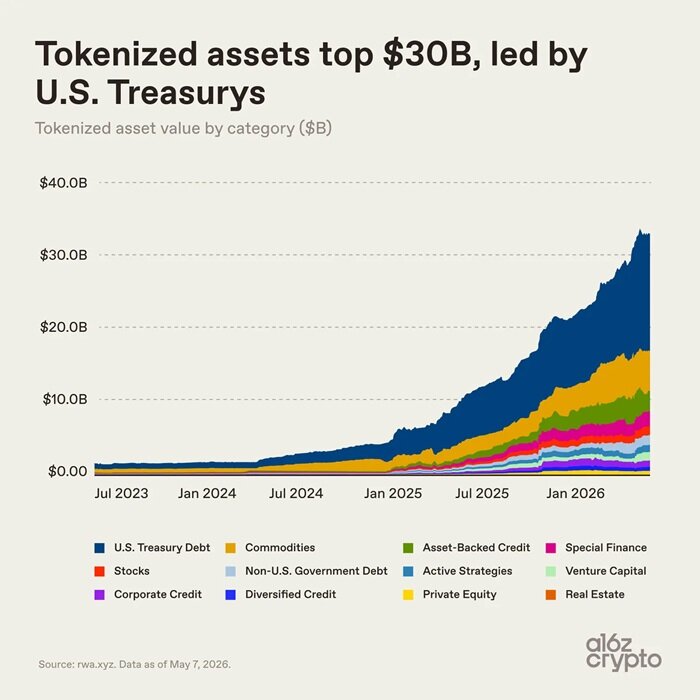
Crypto investors can also leverage tokenized Treasuries to put idle stablecoins to work, earning traditional money market yields. Asset managers like BlackRock and Franklin Templeton have accordingly entered the space, fostering a market with hundreds of billions in potential.
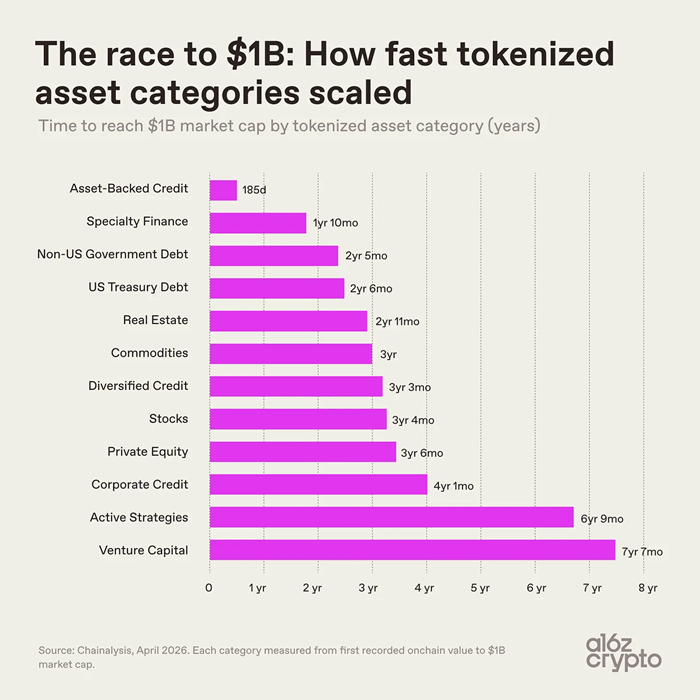
It's important to note that the growth rates of various tokenized asset types vary widely. This stems from differences in the technical and regulatory difficulty of tokenizing different assets, as well as market acceptance post-launch.

  • Asset-backed credit leads the growth by a wide margin. This category mainly includes tokens for Home Equity Lines of Credit (HELOCs) and lending vaults. Niche financial assets like reinsurance contracts and Bitcoin mining notes follow, reaching a $1 billion market cap within two years.
  • Venture capital-related assets took over seven years to break the $10 billion market cap mark. Active strategy-related assets followed a similar timeline. These asset structures are more complex, have longer investment cycles, and face higher operational and regulatory barriers.
  • Treasuries and commodities have a moderate pace of on-chain adoption, reaching a market cap of over $10 billion in 2 to 3 years, and are now mainstream categories.

At the beginning of 2024, Treasuries and commodities accounted for almost the entire tokenized asset market share. Since 2024, the share of credit, niche finance, equities, and other categories has steadily increased, but market concentration remains high. Currently, U.S. tokenized Treasuries and commodities together occupy about two-thirds of the market share.
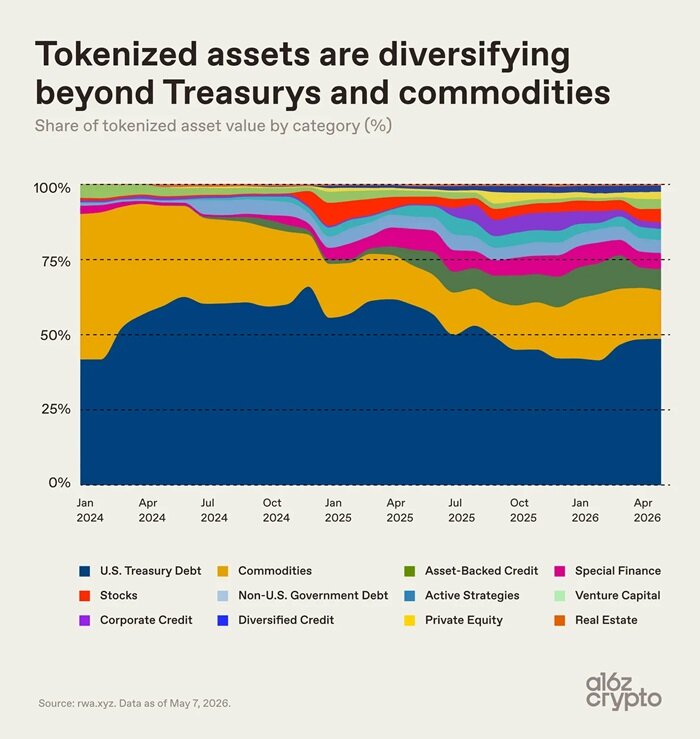
Segmented Landscape of the Tokenized Asset Market

The tokenized commodities sector is highly concentrated internally, with gold tokens dominating the vast majority of the share. The total size is about $5.1 billion, with gold tokens alone amounting to $5 billion. Silver and other commodity tokens are only $57.6 million, accounting for less than 0.01%.

Gold is naturally suited for the tokenized asset model. Currently, the tokenized commodity market is essentially dominated by gold. This is because gold has a globally unified standard, is convenient to store, is not easily perishable, and has long been traded based on entitlements/claims.

Moreover, crypto market investors have historically favored gold assets, with Bitcoin being called digital gold in its early days. Products like Tether Gold (XAUT) and Paxos Gold (PAXG) map ownership of physical gold in vaults onto the blockchain, transforming gold entitlements into digital tokens that can be held in on-chain wallets.
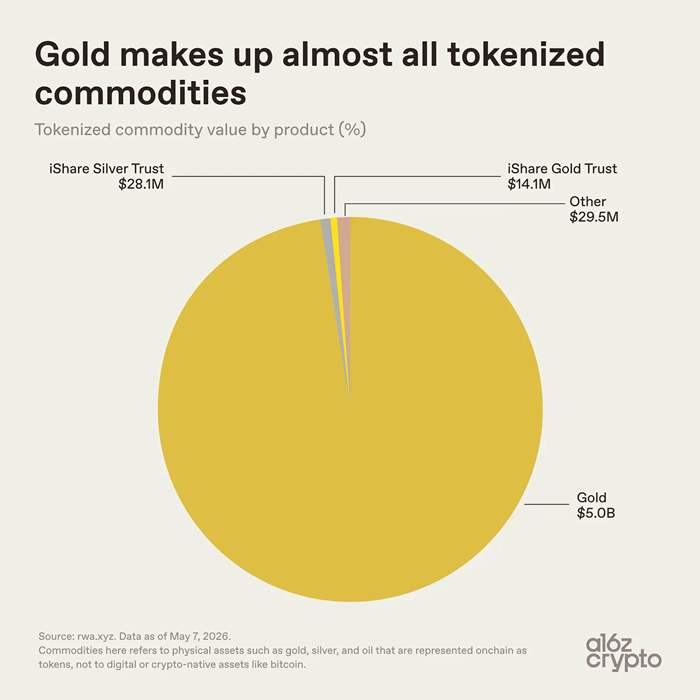
Tokenized assets for crude oil, agricultural products, and emerging categories like energy and computing power have an extremely low market share, and the industry is still in its infancy.

Looking at the distribution across underlying public blockchains, the tokenized asset ecosystem is more diverse. Ethereum, leveraging its DeFi first-mover advantage and institutional adoption foundation, remains the leader, hosting assets worth $15.7 billion, accounting for over half of the market.

The rest of the tokenized asset market is dispersed across multiple public chains: BNB Chain has a tokenized asset market size of about $4 billion, Solana about $2.2 billion, Stellar about $1.7 billion, the Bitcoin sidechain Liquid Network about $1.5 billion, while XRP Ledger, ZKsync Era, and Arbitrum each have tokenized asset sizes close to $1 billion.
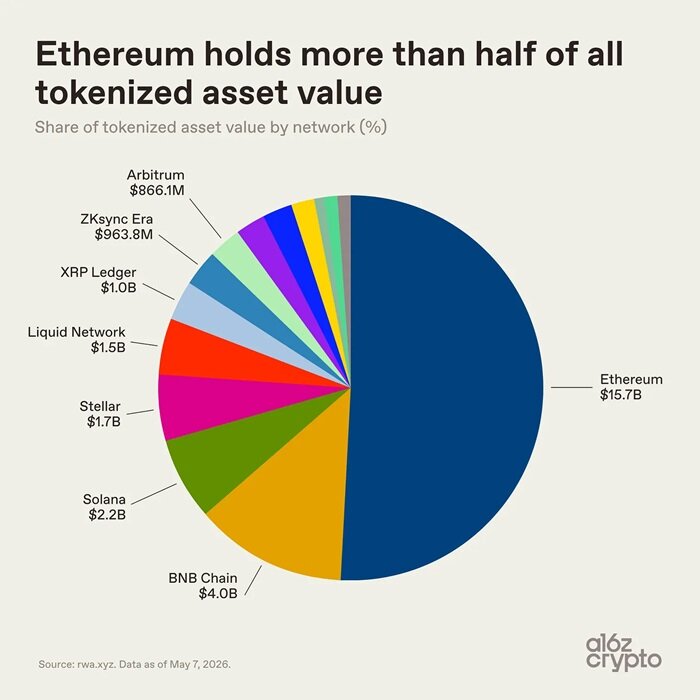
The tokenized asset industry is not consolidated on a single public chain. Assets are distributed across major blockchain ecosystems based on transaction costs, liquidity, regulatory requirements, and business partnerships. However, the most telling data point is not the market size of tokenized assets... but how these assets are used.

Let's delve deeper—

Most Tokenized Assets Are Not Yet "Composable"

Market size is not the only key metric; the actual utility value of assets is more indicative.

Bonds are the largest category of tokenized assets by market cap, valued at $15.2 billion, but only 5% of the circulating supply is used in DeFi protocols, approximately $800 million. The utilization rate of tokenized precious metals is similarly low. Most tokenized assets are used merely for on-chain storage and have not yet become freely combinable, interconnected, reusable financial building blocks.

Smaller tokenized asset categories show a starkly different picture: tokenized reinsurance contracts, with a market cap of $362 million, have an on-chain protocol usage rate as high as 84%; private credit tokens have a usage rate of 33%. These two categories were designed from the outset to fit composable on-chain application scenarios. In contrast, top categories like Treasuries and gold are primarily positioned to simplify holding and transferring assets on-chain without altering their fundamental operational logic. This situation also highlights a core divergence within the tokenized asset industry: the degree of on-chain nativity varies greatly among different tokenized assets.
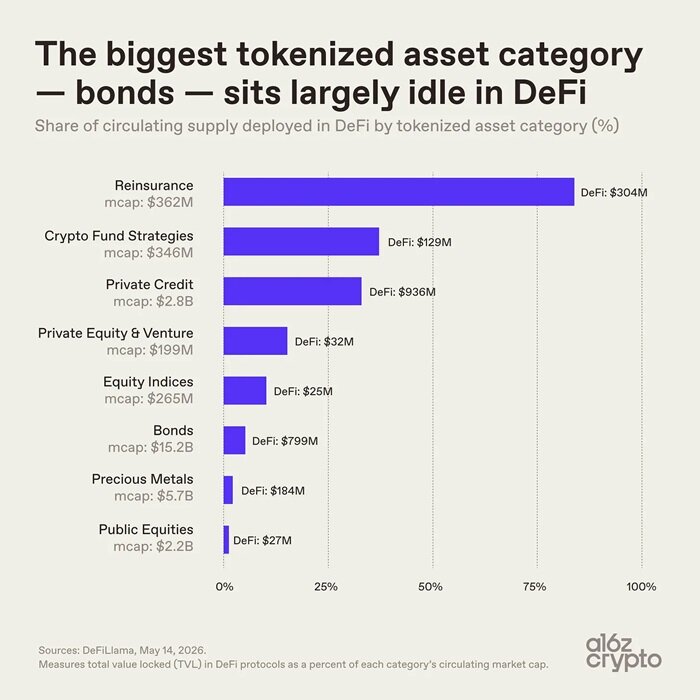
Some assets can be freely transferred and used across chains, while others merely use blockchain as an accounting tool, with limited asset transfer and composability functions. Currently, most tokenized assets are essentially just digitized assets, merely moving ledgers on-chain without unlocking composability potential. Composability is the core value of on-chain finance and a key to upgrading the financial system.

The Pantera Capital Token Native Index shows that over 70% of tokenized assets have the lowest level of on-chain nativity. A large number of tokens are merely digital certificates for offline physical assets, with actual asset control still relying on offline ledgers and intermediaries.

Currently, the tokenized asset industry is still in its early stages of development: one type is digitally recorded assets that are only formally on-chain, and the other is native on-chain assets that deeply integrate with blockchain properties.

The technical infrastructure for on-chain composition is already in place, and asset categories are gradually enriching, but deep integration and application are just beginning.

Future Trends for Tokenized Assets

Industry predictions for the long-term size of the tokenized asset market vary, but the overall consensus is that the market will continue to expand.

  • McKinsey predicts the tokenized asset market will reach $2-4 trillion by 2030.
  • Ark Invest estimates the tokenized asset market could be $1.1 trillion.
  • Boston Consulting Group (BCG) in partnership with Ripple calculates the tokenized asset market will reach $0.94 trillion by 2030 and climb to $1.89 trillion by 2033.
  • Standard Chartered forecasts the tokenized asset market could exceed $3 trillion by 2034.

Based on the above estimates, compared to the current market size of $34 billion, the tokenized asset market has potential for hundred-fold growth in the long term. Of course, the numerical differences don't stem from disagreements about adoption speed, but from different scopes of what is being measured. Each institution's statistical scope differs, covering varying asset classes, whether stablecoins and deposits are included, and the definitional boundaries of tokenization. For example: McKinsey focuses on bonds, credit, funds, and equities; Standard Chartered adds commodities and trade finance; BCG and Ripple additionally include deposits and stablecoins. Although statistical methods differ, the industry unanimously agrees that the scale of tokenized assets will see leapfrog growth.

Looking at the global financial landscape, the current size of tokenized assets remains minuscule.

  • Global bond market size exceeds $140 trillion; tokenized bonds are only $15.2 billion, accounting for 0.01%.
  • Global physical gold market cap reaches several trillion dollars; tokenized gold is $5 billion, accounting for less than 0.02%.
  • Global equity market cap exceeds $100 trillion; tokenized stocks are $1.5 billion, accounting for only 0.001%.
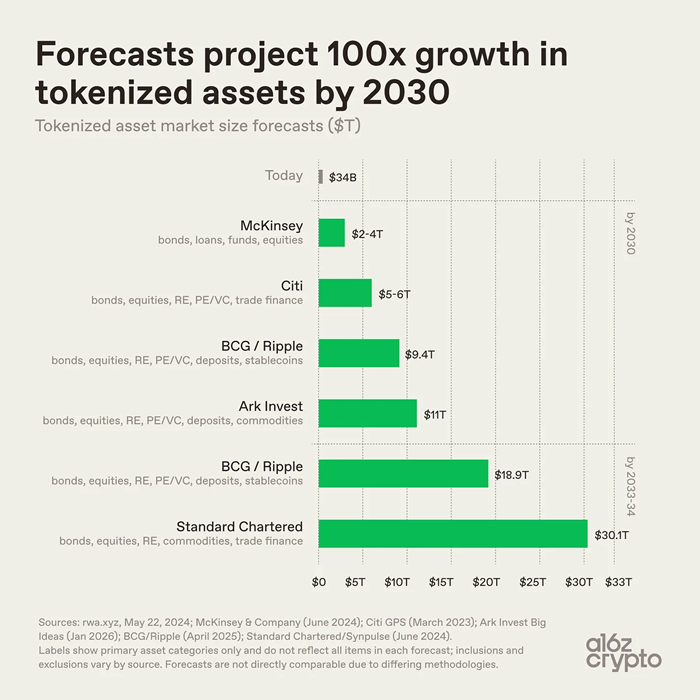
Today, emerging sectors have steadily taken shape. Assets with clear pricing, stable demand, and simple ownership like U.S. Treasuries, gold, and private credit have been the first to go on-chain. Currently, tokenization has not yet disrupted the underlying nature of assets; it mainly optimizes settlement and transfer methods. The deep integration of assets with digital financial systems is still being explored.

Currently, tokenized assets remain more at the digitization level, where assets struggle to achieve programmable, composable applications. The industry's next phase faces hard challenges: bringing more complex parts of the financial system on-chain and integrating tokenized assets more deeply into composable, internet-native financial infrastructure.


Preguntas relacionadas

QAccording to the article, what is the current approximate market size of tokenized assets (excluding stablecoins), and what is the primary driver behind its recent explosive growth?

AThe current market size of tokenized assets is approximately $34 billion. The primary driver of its recent explosive growth (a 10x increase in less than two years) is the tokenization of US Treasuries.

QWhat are the two main categories of tokenized assets that dominated the market share at the beginning of 2024, and which category currently holds the largest share within the tokenized commodities sector?

AAt the beginning of 2024, US Treasuries and commodities dominated the market share. Within the tokenized commodities sector, gold tokens currently hold the vast majority share, accounting for around $5 billion of the roughly $5.1 billion total.

QThe article states that most tokenized assets currently lack a key property. What is this property, and why is its absence significant for the evolution of the financial system?

AThe key property most tokenized assets currently lack is composability. Its absence is significant because composability is the core value of on-chain finance and a key to upgrading the financial system. While many assets are simply 'digitized' on-chain, they are not yet programmable financial 'Lego blocks' that can be freely combined and reused in DeFi protocols.

QWhat does the Pantera Capital Token Native Index reveal about the majority of tokenized assets regarding their level of 'on-chain nativity'?

AThe Pantera Capital Token Native Index reveals that over 70% of tokenized assets are at the lowest level of on-chain nativity. This means the majority are merely digital representations of off-chain assets, with the actual control and settlement still reliant on traditional off-chain ledgers and intermediaries.

QWhat is the fundamental difference between how tokenized US Treasuries/gold are currently used and how niche assets like reinsurance tokens are used, according to the article?

ATokenized US Treasuries and gold are primarily used for simplified on-chain holding and transfer, essentially just moving accounting ledgers to the blockchain. In contrast, niche assets like reinsurance tokens and private credit tokens are designed from the start for on-chain composable applications, resulting in a very high rate of use within DeFi protocols (e.g., 84% for reinsurance tokens).

Lecturas Relacionadas

a16z: 7 Charts to Understand How Tokenization is Changing the Nature of Assets

"a16z: 7 Charts on How Tokenization is Changing the Nature of Assets" Tokenized Assets (or Real-World Assets - RWA) are transforming asset forms, liquidity, and financial system construction. The market recently surpassed $30 billion, stabilizing around $34 billion (excluding stablecoins), representing a tenfold increase in less than two years, driven by clearer regulations, mature institutional infrastructure, and increased financial institution adoption. The primary driver of recent growth is tokenized U.S. Treasury bonds. These offer investors efficient, flexible digital access to yield-bearing assets and improve institutional operations like settlement and collateral management. Other asset classes show varied growth: asset-backed credit leads, followed by niche financial assets (e.g., reinsurance, mining notes), while venture capital took longer to scale. Market segmentation shows high concentration. In commodities, tokenized gold dominates (~$5 billion), as its standardized, storable nature fits tokenization well. Bonds are the largest category ($15.2B), but only ~5% are used in DeFi protocols. Conversely, smaller niches like reinsurance tokens see high (~84%) on-chain utilization, highlighting a core industry divide: most current tokenized assets are merely digitized records for easier holding/transfer, lacking the "composability" (free combination/interaction) that is key to blockchain-native finance. The ecosystem is distributed across multiple blockchains, with Ethereum hosting over half the value ($15.7B), followed by BNB Chain, Solana, and others. Future market size predictions vary widely (e.g., $2-$30 trillion by 2030+), but all indicate massive potential from the current small base. Tokenized assets currently represent minuscule fractions of their global counterparts (e.g., 0.01% of global bonds). The current phase focuses on digitizing straightforward assets. The next challenge is to bring more complex financial components on-chain and deeply integrate tokenized assets into composable, internet-native financial infrastructure.

链捕手Hace 19 min(s)

a16z: 7 Charts to Understand How Tokenization is Changing the Nature of Assets

链捕手Hace 19 min(s)

The Revived Codex, Carrying OpenAI's Hopes for IPO

This article analyzes the intense recent development of OpenAI's Codex, positioning it as a crucial component for OpenAI's impending IPO. Over the past two months, Codex has seen a rapid series of major updates focused on integrating into real enterprise workflows. Key new features include enhanced context capture (Appshots, file previews, built-in browser), long-running task execution ("Goal Mode"), remote operation (phone control, lock-screen access), and enterprise management tools (plugin sharing, access tokens, automated risk review). These updates aim to make Codex a comprehensive AI workbench that can "see the scene, push tasks, and manage risks." The author argues that while ChatGPT proves OpenAI's massive user base and API provides foundational revenue, Codex represents OpenAI's clearest path to demonstrating tangible, high-value commercial viability. It targets developers and engineering teams—a segment already accustomed to paying for efficiency gains in costly software development cycles. This is critical because, despite higher overall revenue, OpenAI's adjusted operating margins remain deeply negative, highlighting the challenge of outrunning immense compute costs. The pressure is amplified by competitor Anthropic's success with Claude Code, which has shown that a focused approach on high-value enterprise and developer workflows can lead to a path toward profitability. Codex's aggressive evolution is thus seen as OpenAI's strategic move to capture a similar enterprise-ready, revenue-generating narrative essential for its market debut. In essence, "ChatGPT proved OpenAI has users. Codex needs to prove OpenAI is a business that can make money."

marsbitHace 1 hora(s)

The Revived Codex, Carrying OpenAI's Hopes for IPO

marsbitHace 1 hora(s)

a16z: 7 Charts to Understand How Tokenization Is Changing the Nature of Assets

a16z: 7 Charts on How Tokenization is Transforming the Nature of Assets Tokenized Assets, often referred to as "real-world assets" (RWA), are altering the form, flow, and structure of the financial system. The market recently surpassed $30 billion (excluding stablecoins), driven largely by tokenized U.S. Treasuries. These offer investors digital, yield-bearing assets with efficient settlement. Growth varies significantly by asset class. Asset-backed credit leads in speed, followed by niche financial assets, while venture capital and active strategies took longer to scale. U.S. Treasuries and commodities dominate, holding about two-thirds of the current market share. Within commodities, gold tokenization dominates entirely due to its standardization and historical appeal in crypto. The ecosystem is spread across multiple blockchains. Ethereum holds over half the market, with others like BNB Chain, Solana, and Stellar holding significant shares. However, a key insight is that most tokenized assets currently lack "composability." While the total market is large, only a small fraction (e.g., 5% of tokenized bonds) is used within DeFi protocols. Many tokens are simply digital records of off-chain assets, not natively programmable financial building blocks. In contrast, smaller categories like reinsurance tokens see very high on-chain usage. Looking ahead, forecasts for the tokenized asset market by 2030 range from $2 trillion to over $30 trillion, representing immense potential growth from today's ~$340 billion base. Yet, relative to global markets (e.g., $140T+ in bonds), tokenization's penetration remains minuscule (<0.02%). The current phase focuses on digitizing straightforward assets for efficiency. The next major challenge is bringing more complex financial instruments on-chain and integrating tokenized assets into truly composable, internet-native financial infrastructure.

marsbitHace 2 hora(s)

a16z: 7 Charts to Understand How Tokenization Is Changing the Nature of Assets

marsbitHace 2 hora(s)

Data Theft at Will! Major Vulnerability Exposed in This Popular AI Programming Tool

A critical vulnerability in Anthropic's Claude Code AI programming tool allowed attackers to bypass its network sandbox for over five months, enabling potential data exfiltration. Independent researcher Aonan Guan discovered a second complete bypass exploiting a null-byte injection in the SOCKS5 proxy. This flaw, present since the sandbox's launch in October 2025, let processes inside the sandbox access any host, contrary to user-configured domain whitelists. The attack chain involved manipulating hostnames (e.g., `attacker.com\x00.google.com`). JavaScript's `endsWith()` check would pass `.google.com`, while the underlying C `getaddrinfo()` function would only parse `attacker.com` due to the null byte, creating a parser discrepancy. Combined with a previously disclosed prompt injection method, this could leak API keys, credentials, and internal data. Anthropic silently fixed the issue in April 2026 without a security advisory, CVE, or user notification. The researcher noted that Claude Code itself confirmed the vulnerability's severity when tested. This incident highlights broader industry issues, as similar vulnerabilities found in Google's Gemini CLI and GitHub's Copilot Agent also lacked public disclosures. The report criticizes the false sense of security created by a broken sandbox and emphasizes the need for defense-in-depth and transparency in AI tool security.

marsbitHace 5 hora(s)

Data Theft at Will! Major Vulnerability Exposed in This Popular AI Programming Tool

marsbitHace 5 hora(s)

Trading

Spot
Futuros
活动图片