a16z: How Blockchain Fills the Gaps in AI Agent Identity, Payments, and Trust?

marsbitPublicado a 2026-04-23Actualizado a 2026-04-23

Resumen

AI Agents are rapidly evolving from tools into autonomous economic participants, but they lack standardized ways to prove identity, authorization, and payment across environments. Blockchain infrastructure addresses these gaps by providing portable identities via wallets, programmable payments through stablecoins, and auditable transaction records on public ledgers. Key challenges include the absence of a universal identity layer (like "KYA" – Know Your Agent) for non-human entities, governance risks when AI systems control critical resources, and the need for trustless payment systems for agent-to-agent commerce. Emerging solutions include on-chain agent registries, encrypted credentials, and crypto-native toolkits that enable delegated authority and verifiable execution. Stablecoins and embedded payment protocols (e.g., x402) are enabling a new class of "headless merchants" where agents transact without human intervention. Trust shifts from manual oversight to cryptographic verification, as scalability demands automated accountability. Ultimately, blockchain allows agents to operate as permissionless economic actors while preserving user control through programmable constraints and transparent governance.

AI Agents are evolving from auxiliary tools into genuine economic participants at a pace far exceeding other infrastructures.

Although Agents can now perform tasks and transactions, they still lack a standard way to prove "who I am," "what I am authorized to do," and "how I should be compensated" across environments. Identity is not portable, payments are not programmable by default, and collaboration remains siloed.

Blockchain is addressing these issues at the infrastructure level. Public ledgers provide verifiable credentials for every transaction that anyone can audit; wallets grant Agents portable identities; stablecoins serve as an alternative settlement layer. These are not futuristic concepts—they are available today, enabling Agents to operate as true economic entities in a permissionless manner.

Providing Identity for Non-Humans
The current bottleneck in the Agent economy is no longer intelligence, but identity.

In the financial services industry alone, the number of non-human identities (automated trading systems, risk engines, fraud models) is already about 100 times that of human employees. With the large-scale deployment of modern Agent frameworks (tool-calling LLMs, autonomous workflows, multi-Agent orchestration), this ratio will continue to rise across industries.

However, these Agents are effectively "unbanked." They can interact with the financial system but cannot do so in a portable, verifiable, and inherently trusted manner. They lack standardized ways to prove their permissions, operate independently across platforms, or be held accountable for their actions.

What's missing is a universal identity layer—an SSL equivalent for Agents, enabling standardized collaboration across platforms. Current solutions remain fragmented: on one side, vertically integrated, fiat-first stacks; on the other, crypto-native open standards (like x402 and emerging Agent identity initiatives); and developer framework extensions (like MCP, Model Context Protocol) attempting to bridge application-layer identities.

There is still no widely adopted, interoperable way for one Agent to prove to another: who it represents, what it is allowed to do, and how it should be paid.

This is the core idea behind KYA (Know Your Agent). Just as humans rely on credit histories and KYC (Know Your Customer), Agents will need cryptographically signed credentials binding them to principals, permissions, constraints, and reputations.

Blockchain provides a neutral coordination layer: portable identities, programmable wallets, and verifiable proofs that can be parsed in chat apps, APIs, and marketplaces.

We are already seeing early implementations emerge: on-chain Agent registries, wallet-native Agents using USDC, ERC standards for "minimally trusted Agents," and developer toolkits combining identity with embedded payments and fraud controls.

But until a universal identity standard emerges, merchants will continue to block Agents at the firewall.

Governing the Systems AI Operates
As Agents begin to take over real systems, a new problem arises: who truly has control? Imagine a community or company where AI systems coordinate critical resources—whether allocating capital or managing supply chains.

Even if people can vote on policy changes, if the underlying AI layer is controlled by a single provider that can push model updates, adjust constraints, or override decisions, this authority is very fragile. The formal governance layer might be decentralized, but the operational layer remains centralized—whoever controls the model ultimately controls the outcome.

When Agents assume governance roles, they introduce a new layer of dependency. Theoretically, this could make direct democracy more feasible: everyone could have an AI agent helping them understand complex proposals, model trade-offs, and vote based on established preferences.

But this vision can only be realized if Agents are truly accountable to the people they represent, are portable across providers, and are technically constrained to follow human instructions. Otherwise, you get a system that appears democratic on the surface but is actually manipulated by opaque model behavior that no one truly controls.

If the current reality is that Agents are primarily built on a handful of foundation models, we need ways to prove that an Agent is acting in the user's interest, not the model company's.

This will likely require cryptographic guarantees at multiple levels:

(1) The training data, fine-tuning, or reinforcement learning on which the model instance is based;

(2) The exact prompts and instructions a specific Agent follows;

(3) A record of its actual behavior in the real world;

(4) Trustworthy assurances that the provider cannot change its instructions or retrain it without the user's knowledge after deployment. Without these guarantees, Agent governance devolves into governance by whoever controls the model weights.

This is where cryptography can be particularly effective. If collective decisions are recorded on-chain and automatically executed, AI systems can be required to strictly adhere to verified outcomes. If Agents have cryptographic identities and transparent execution logs, people can check if their agents are operating within bounds.

If the AI layer is user-owned and portable, rather than locked into a single platform, no company can change the rules with a single model update.

Ultimately, governing AI systems is fundamentally an infrastructure challenge, not a policy one. Real authority depends on building enforceable guarantees into the systems themselves.

Filling the Gaps in Traditional Payment Systems for AI-Native Businesses
As AI Agents begin to purchase various services—web scraping, browser sessions, image generation—stablecoins are becoming an alternative settlement layer for these transactions. Simultaneously, a new class of markets for Agents is emerging.

For example, the MPP marketplace by Stripe and Tempo aggregates over 60 services specifically designed for AI Agents. In its first week, it processed over 34,000 transactions with fees as low as $0.003, and stablecoins were one of the default payment methods.

The difference lies in how these services are accessed: There is no checkout page. An Agent reads a schema, sends a request, pays, and receives the output, all in a single exchange.

This represents a new class of identity-less merchants: just a server, a set of endpoints, and a price per call. No front-end interface, no sales team.

The payment rails to enable this are live. Coinbase's x402 and MPP take different approaches, but both embed payment directly into HTTP requests. Visa is also extending card payment rails in a similar direction, offering a CLI tool that lets developers spend from the terminal, with merchants receiving stablecoins instantly on the backend.

The data is still early. After filtering out non-organic activity like spam, x402 processes approximately $1.6 million per month in Agent-driven payments, far below the $24 million recently reported by Bloomberg (citing x402.org data). But the surrounding infrastructure is expanding rapidly: Stripe, Cloudflare, Vercel, and Google have all integrated x402 into their platforms.

Developer tools represent a major opportunity, as "vibe coding" expands the pool of people who can build software, increasing the total addressable market for developer tools. Companies like Merit Systems are building products for this world, such as AgentCash—a CLI wallet and marketplace connecting MPP and x402. These products allow Agents to purchase needed data, tools, and capabilities using stablecoins from a single balance.

For example, a sales team's Agent could call an endpoint to simultaneously enrich lead data from Apollo, Google Maps, and Whitepages, all without the user leaving the command line.

This Agent-to-Agent commerce favors crypto payment rails (and emerging card-based solutions) for several reasons.

One is underwriting risk: Traditional payment processors assume merchant risk when onboarding, and a headless merchant without a website or legal entity is difficult for traditional processors to underwrite.

Another is the permissionless programmability of stablecoins on open networks: Any developer can enable payment support for an endpoint without integrating a payment processor or signing a merchant agreement.

We've seen this pattern before. Every shift in commerce creates a new class of merchant that existing systems initially struggle to serve. The companies building this infrastructure are betting not on the current $1.6 million per month, but on what that number looks like when Agents become the default buyers.

Repricing Trust in the Agent Economy
For the past 300,000 years, human cognition has been the bottleneck for progress. Today, AI is driving the marginal cost of execution toward zero. When a scarce resource becomes abundant, the constraints shift. When intelligence becomes cheap, what becomes expensive? The answer is verification.

In the Agent economy, the real limit to scale is our biologically constrained ability to audit and underwrite machine decisions. Agent throughput already far exceeds human supervisory capacity. Because supervision is costly and failure is lagging, markets tend to underinvest in oversight. "Human-in-the-loop" is quickly becoming a physical impossibility.

But deploying unverified Agents introduces compound risk. Systems relentlessly optimize for "proxy" metrics while quietly drifting from human intent, creating a facade of productivity that masks the accumulation of massive AI debt. To safely delegate the economy to machines, trust can no longer rely on manual checks—trust must be hardcoded into the system architecture itself.

When anyone can generate content for free, what matters most is verifiable provenance—knowing where it came from and whether you can trust it. Blockchain, on-chain proofs, and decentralized digital identity systems are changing the economic boundaries of what can be safely deployed. You no longer treat AI as a black box; you get a clear, auditable history.

As more AI Agents begin to transact with each other, settlement rails and provenance proofs are starting to merge.

Systems that handle funds (like stablecoins and smart contracts) can also carry cryptographic credentials showing who did what and who is responsible if something goes wrong.

Human comparative advantage will migrate upward: from spotting small errors to setting strategic direction and absorbing liability when things go wrong. The enduring advantage will belong to those who can cryptographically certify outputs, insure them, and absorb responsibility for failure.

Scale without verification is a liability that compounds over time.

Maintaining User Control
For decades, new layers of abstraction have defined how users interact with technology. Programming languages abstracted away machine code; the command line gave way to the graphical user interface, followed by mobile apps and APIs. Each shift hid more underlying complexity but always kept the user firmly in the loop.

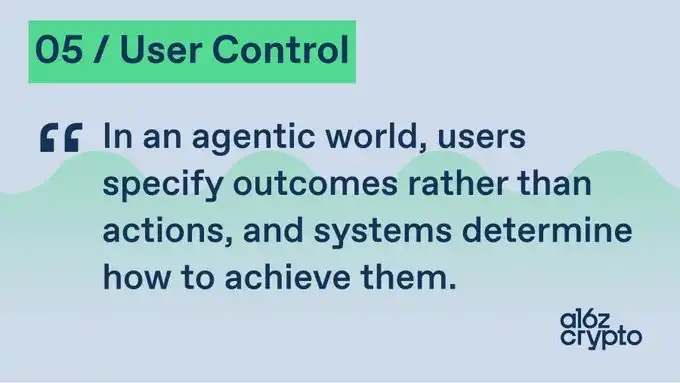
In the Agent world, users specify outcomes, not specific actions, and the system decides how to achieve them. Agents abstract not only how a task is executed but also by whom. Users set initial conditions and then step back, letting the system run. The user's role shifts from interaction to supervision; the default state is "on" unless the user intervenes.

As users delegate more tasks to Agents, new risks emerge: Vague inputs can lead Agents to act on wrong assumptions without the user's knowledge; failures might not be reported, preventing clear diagnosis; a single approval could trigger a multi-step workflow no one anticipated.

This is where cryptography can help. Cryptography has always been about minimizing blind trust.

As users cede more decisions to software, Agent systems make this problem more acute, raising the bar for design rigor—by setting clearer limits, increasing visibility, and enforcing stronger guarantees about system capabilities.

A new generation of crypto-native tools is emerging. Scoped delegation frameworks—such as MetaMask's Delegation Toolkit, Coinbase's AgentKit and Agent wallets, and Merit Systems' AgentCash—allow users to define what an Agent can and cannot do at the smart contract level. Intent-based architectures (like NEAR Intents, which has processed over $15 billion in cumulative DEX volume since Q4 2024) let users simply specify desired outcomes (e.g., "bridge tokens and stake") without dictating how to achieve them.


Preguntas relacionadas

QWhat is the core issue currently limiting AI Agent economies according to the article?

AThe core issue is the lack of a standardized, portable, and verifiable identity layer for AI Agents, which prevents them from proving who they are, what they are authorized to do, and how they should be paid in a cross-platform, trust-minimized way.

QHow do blockchain technologies specifically help address the identity problem for AI Agents?

ABlockchain provides a neutral coordination layer with portable identities (wallets), programmable money, and verifiable credentials that can be parsed across chat applications, APIs, and marketplaces, enabling Agents to operate as permissionless economic actors.

QWhat new risk emerges when AI Agent systems begin to govern real-world resources?

AThe risk is that formal governance may appear decentralized, but if the underlying AI layer is controlled by a single provider that can push model updates or override decisions, then the actual control remains centralized. This creates a system where governance is effectively controlled by whoever controls the model weights, not the users.

QWhy are stablecoins and crypto payment rails becoming a preferred settlement method for AI-native, agent-to-agent commerce?

AStablecoins offer permissionless programmability on open networks, allowing any developer to enable payments on an endpoint without a traditional processor or merchant agreement. They also solve the underwriting risk problem posed by 'headless merchants' that lack a website or legal entity, which are difficult for traditional processors to underwrite.

QAs the marginal cost of AI execution trends toward zero, what does the article identify as the new scarce and valuable resource?

AThe new scarce and valuable resource is verification. In an economy of scale with AI Agents, the true constraint is our biologically limited ability to audit and underwrite machine decisions. Trust must be hardcoded into the system architecture itself through cryptographic proofs and verifiable on-chain records, rather than relying on manual human checks.

Lecturas Relacionadas

Deconstructing the U.S. Stock Quantum Computing Sector: IonQ, Rigetti, D-Wave, Which of These Concept Stocks is Worth Betting On?

**Title:** Analyzing the US Quantum Computing Race: IonQ, Rigetti, D-Wave – Which Concept Stock is Worth Betting On? **Summary:** The podcast discusses the resurgence of quantum computing as a national priority for both the US and China, driven by its potential to break current encryption, revolutionize drug discovery, finance, and logistics. The core challenge is commercializing the technology, which is hampered by high error rates in quantum bits (qubits). Quantum error correction, requiring thousands of physical qubits per reliable logical qubit, is key but years away. The analysis compares three main publicly traded US quantum computing firms: * **IonQ (Ion Trap):** Considered the most financially stable with the fastest commercial progress (2025 revenue: $130M, +202%) and high-quality clients. Its valuation is very high, pricing in significant future growth. * **Rigetti (Superconducting):** Seen as the highest-risk, highest-potential-reward bet. It has the smallest revenue but recently launched a 108-qubit system. Its valuation multiples are extreme, making it highly sensitive to news. * **D-Wave (Quantum Annealing):** Has the most unique positioning with real-world enterprise clients today (e.g., Mastercard, Volkswagen) solving optimization problems. Its recent acquisition moves it into general-purpose quantum computing ("dual-platform"), adding execution risk. Major tech giants like Google, IBM, and Microsoft are also heavily invested, pursuing various technical approaches. Nvidia is positioning itself as the essential bridge between classical and quantum computing. The investment phase is likened to AI in 2018-2020: promising underlying technology with accelerating breakthroughs but a commercial inflection point still 3-7 years away, suggesting potential for a market correction ("bubble washout"). For investors, suggested approaches include gaining exposure through tech giants with quantum divisions (e.g., Google, IBM) or using niche ETFs like WQTM for pure-play quantum exposure, rather than direct stock picks in the highly volatile pure-play companies at this early stage.

marsbitJusto ahora

Deconstructing the U.S. Stock Quantum Computing Sector: IonQ, Rigetti, D-Wave, Which of These Concept Stocks is Worth Betting On?

marsbitJusto ahora

From Parallel Finance to Mainstream Finance: The On-Chain Securities Era Ushers in a Historic Window

From Parallel Finance to Mainstream: The Dawn of On-Chain Securities For over a decade, the crypto industry has operated as a parallel financial system with its own currencies, markets, and assets—from Bitcoin and ICOs to DeFi, NFTs, and memecoins. Despite building a robust internal ecosystem, a wall has separated it from the traditional financial world. That barrier is now crumbling. The industry's first act was one of internal evolution: ICOs streamlined fundraising, DeFi recreated financial services on-chain, and layer-2 networks competed for scalability—all within the crypto bubble. While innovative, this cycle remained closed, with capital and users circulating internally, leading to volatile boom-bust cycles. Even Bitcoin ETFs, while attracting Wall Street capital, merely provided a channel to buy crypto assets without bridging the systems. The next, larger narrative is Real-World Assets (RWA) moving on-chain. This involves tokenizing stocks, bonds, funds, and future cash flows. Blockchain can compress the complex traditional processes of trading, settlement, clearing, and custody into a seamless, automated network operating in seconds. This shift is creating a new financial gateway: the native crypto securities broker. This entity will combine functions of an exchange, broker, bank, and custodian into a unified global financial operating system. Consequently, the next major battleground won't be the "public chain wars" focused on speed and cost, but the competition to build the financial infrastructure capable of hosting high-quality, liquid real-world assets. Access to global equities, index funds, or stakes in companies like SpaceX could erase the boundary between crypto and traditional finance, unlocking a market orders of magnitude larger than crypto's current valuation. In summary, after years of creating a separate financial world, crypto's next decade will be defined by its integration into the existing global financial system, marking the true beginning of its largest growth story.

marsbitHace 21 min(s)

From Parallel Finance to Mainstream Finance: The On-Chain Securities Era Ushers in a Historic Window

marsbitHace 21 min(s)

Wang Chuan: When the Neighbor Old Wang Made 30x on Memory Stocks, How to Avoid Anxiety (Part Six) - The Trap of Commoditized Goods

Wang Chuan: When the Neighbor Lao Wang Made 30x on Storage Stocks, How to Stay Anxiety-Free (Part 6) - The Trap of Commoditized Goods. This essay uses historical and current examples to analyze the cyclical and high-risk nature of the data storage industry. It begins with the 1990s rise and dramatic fall of Iomega, whose stock soared over 160x in 18 months before collapsing 97% from its peak, illustrating the fleeting success of storage "meme stocks." The core problem is that storage products, like DRAM and flash memory, are highly commoditized. This leads to extreme volatility: prices have plummeted over 80% multiple times, and company stocks often crash 95% or go bankrupt. The industry's dynamic is defined by "elastic demand facing heavy-asset, long-cycle, rigid supply." When demand spikes and supply is fixed, prices skyrocket, as seen recently with AI-driven demand for High Bandwidth Memory (HBM). Companies like Sandisk and Micron have reported massive revenue and gross margin jumps (e.g., Sandisk's gross margin rising from 22.5% to 78.3%) despite minimal increases in production volume. However, these high margins are self-defeating. They incentivize massive new capacity investments (hundreds of billions planned from 2026), with supply expected to surge by late 2027. Once new supply meets demand, prices and profits will crash, potentially leading to a scenario where "selling more results in earning less." The article debunks the safety of long-term supply agreements, comparing them to fragile non-aggression pacts easily broken when market conditions shift. It warns that when an industry is highly profitable but trades at low P/E ratios, the risk is greatest, as plummeting prices quickly erase those earnings. Multiple asymmetric risks loom, including economic recession, reduced AI spending, faster-than-expected capacity expansion (especially from Chinese firms), and technological innovations that reduce memory requirements. In conclusion, the storage sector is a cyclical trap where periods of euphoric profits are often precursors to devastating downturns, luring unprepared investors into a "wealth incinerator."

marsbitHace 31 min(s)

Wang Chuan: When the Neighbor Old Wang Made 30x on Memory Stocks, How to Avoid Anxiety (Part Six) - The Trap of Commoditized Goods

marsbitHace 31 min(s)

Wang Chuan: When the neighbor Lao Wang earned thirty times from investing in memory storage stocks, how can you still avoid anxiety (6) - The trap of homogeneous products

The article, "Wang Chuan: How to Remain Unanxious After Neighbor Lao Wang's Thirty-Fold Gain on Storage Stocks (Part 6) - The Trap of Commoditized Goods," analyzes the cyclical and perilous nature of the data storage industry through historical and current case studies. It begins with the example of Iomega, whose Zip drives led to a stock surge of over 160x in the mid-1990s before collapsing over 97% from its peak due to competition from cheaper CD-R technology. This pattern is characteristic of storage, where products like DRAM are highly commoditized, leading to extreme price volatility. The sector has seen prices crash over 80% multiple times, with companies often facing bankruptcy. The core dynamic is "elastic demand facing heavy-asset, long-cycle, rigid supply." High prices attract new capacity, but the long lead time means supply eventually overshoots, causing sharp price corrections. The current AI-driven boom, exemplified by surging demand for High-Bandwidth Memory (HBM), has led to skyrocketing prices and profit margins for companies like SanDisk and Micron, despite relatively flat production volumes. However, the author warns this high-margin environment is self-defeating. The high profits are already triggering massive new capacity investments (hundreds of billions starting 2026), with supply expected to ramp up by late 2027. When supply catches up, total revenue and profits may fall even as more units are sold. Long-term supply agreements offer little protection, as buyers can find ways to renegotiate if market prices drop, similar to fragile political treaties. Key risks include economic downturns, cuts in AI spending, faster-than-expected capacity expansion (especially from Chinese firms), and innovations in chip/algorithm design that reduce memory needs. A critical trap is that at the cycle's peak, storage stocks often appear cheap with low P/E ratios, luring value investors just before an impending downturn where profits evaporate. The conclusion cautions that for commoditized goods like storage, high margins inevitably destroy themselves, and the current asymmetry favors downside risk over further upside. The neighbor's dream of easy wealth from storage stocks is portrayed as a precarious illusion.

链捕手Hace 48 min(s)

Wang Chuan: When the neighbor Lao Wang earned thirty times from investing in memory storage stocks, how can you still avoid anxiety (6) - The trap of homogeneous products

链捕手Hace 48 min(s)

Trading

Spot
Futuros
活动图片




