a16z Founder: In the Agent Era, What Truly Matters Has Changed

marsbitPublicado a 2026-04-25Actualizado a 2026-04-25

Resumen

Founder of a16z Marc Andreessen discusses the transformative shift into the Agent era in a recent podcast. He emphasizes that today’s AI is not an overnight breakthrough but the result of an 80-year evolution, now reaching practical utility. Key developments include the convergence of LLMs, reasoning models, coding capabilities, and agent-based recursive self-improvement. Andreessen describes agents as systems integrating LLMs with shells, file systems, markdown, and schedulers—combining new AI with established software components. This architecture enables introspection, state persistence, and cross-platform execution, moving beyond chatbots toward agent-first interaction. He predicts traditional UIs will fade as agents execute tasks on behalf of users or other bots. He compares the current AI investment cycle to the dot-com bubble but highlights stronger fundamentals, with major tech firms leading scalable, revenue-generating infrastructure expansion. Open source, edge inference, and local AI deployment are critical to global adoption and competition. Andreessen also addresses broader challenges: security risks, identity verification, financial infrastructure for agents, and organizational adoption. He cautions that societal and institutional barriers will shape the pace of AI integration, tempering both utopian and dystopian expectations.

Source:

This is the latest interview with a16z founder Marc Andreessen on the Latent Space podcast.

He is a renowned American internet entrepreneur and a key figure in the early development of the internet; after founding a16z, he has become a representative of top investors in Silicon Valley.

The entire conversation revolves around the history and latest trends of AI development, making it highly worth reading.

1. This Wave of AI Did Not Emerge Out of Nowhere; It Is the First Comprehensive "Start of Work" After an 80-Year Technological Marathon
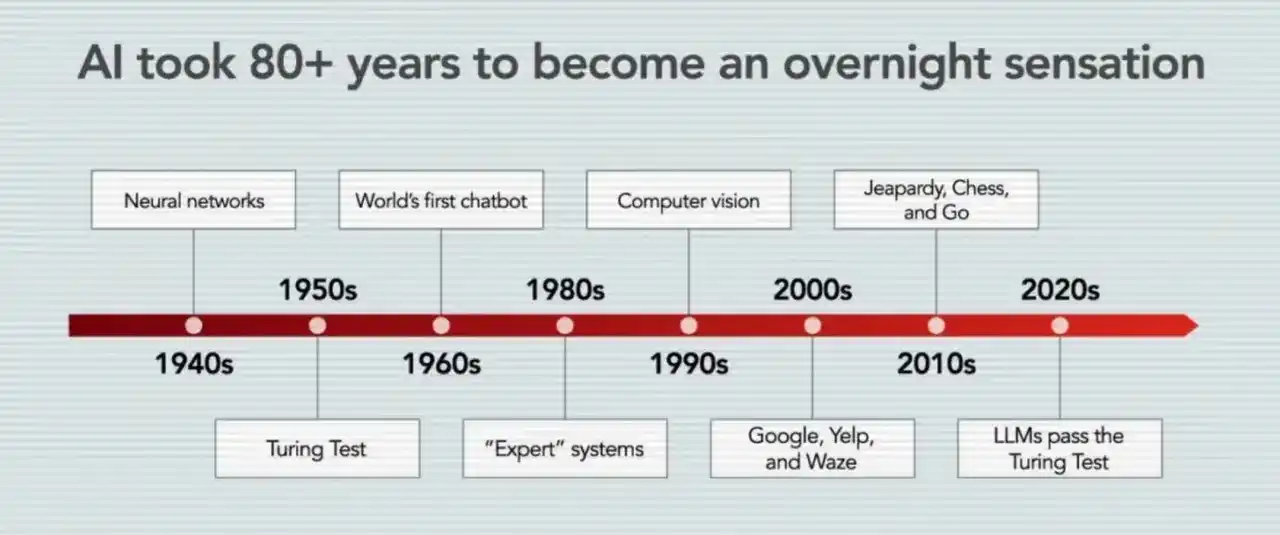
· This wave of AI did not emerge out of nowhere; it is the result of an 80-year technological marathon.

· Marc Andreessen directly refers to the present as an "80-year overnight success," meaning that the sudden explosion in the public eye is actually the concentrated release of decades of technological accumulation.

· He traces this technological lineage back to early neural network research and emphasizes that the industry has now accepted the judgment that "neural networks are the correct architecture."

· In his narrative, the key milestones are not single moments but a series of developments: AlexNet, Transformer, ChatGPT, reasoning models, and then agents and self-improvement.

· He particularly emphasizes that this time, it is not just text generation that has improved; four types of capabilities have emerged simultaneously: LLMs, reasoning, coding, and agents/recursive self-improvement.

· The reason he believes "this time is different" is not because the narrative is more compelling, but because these capabilities have already started to work on real-world tasks.

2. The Agent Architecture Represented by Pi and OpenClaw Is a Deeper Change in Software Architecture Than Chatbot
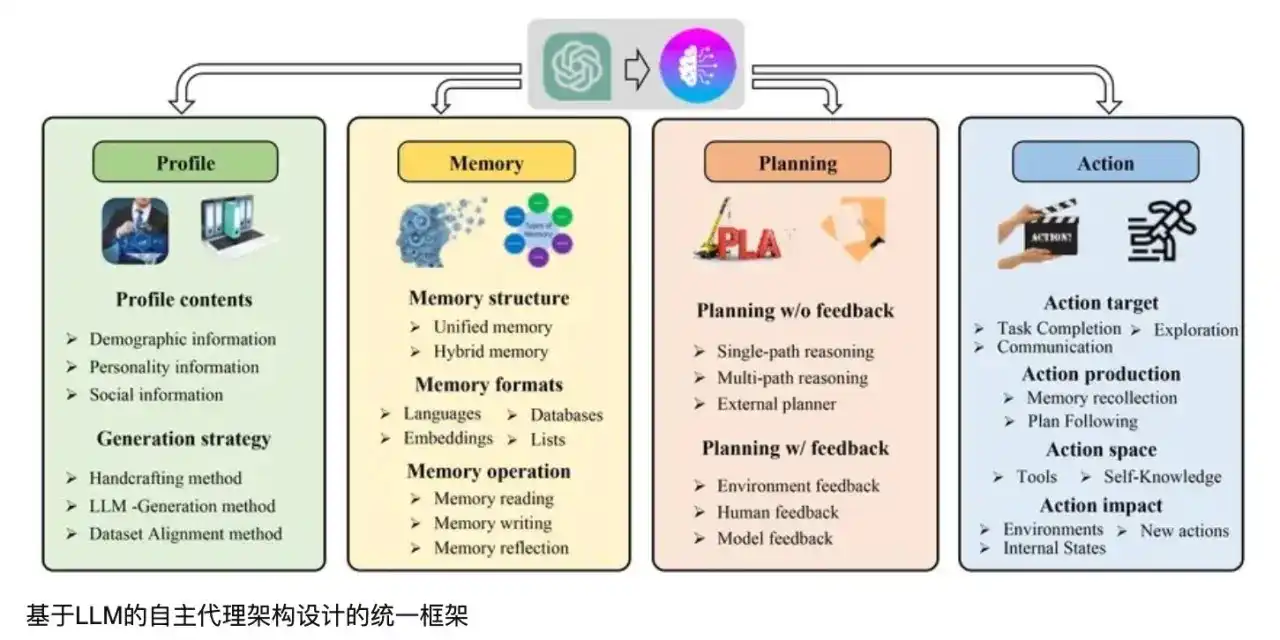
· He describes agents very concretely: essentially, they are "LLM + shell + file system + markdown + cron/loop." In this structure, the LLM is the core for reasoning and generation, the shell provides the execution environment, the file system saves the state, markdown makes the state readable, and cron/loop provides periodic awakening and task progression.

· He believes the importance of this combination lies in the fact that, apart from the model itself being new, all other components are mature, understandable, and reusable parts of the software world.

· The state of the agent is saved in files, allowing it to migrate across models and runtimes; the underlying model can be replaced, but the memory and state remain preserved.

· He repeatedly emphasizes introspection: the agent knows its files, can read its state, and can even rewrite its files and functions, moving toward "extend yourself."

· In his view, the real breakthrough is not just that "the model can answer," but that the agent can leverage existing Unix toolchains to integrate the potential capabilities of the entire computer.

3. Browsers, Traditional GUIs, and the Era of "Human-Clicking Software" Will Gradually Be Replaced by Agent-First Interaction Methods

· Marc Andreessen has explicitly stated that in the future, "you may no longer need a user interface."

· He further pointed out that the primary users of future software may not be humans but "other bots."

· This means that many of today's interfaces designed for human clicking, browsing, and form-filling will degenerate into execution layers called by agents in the background.

· In this world, humans are more like goal-setters: telling the system what they want, and then having agents call services, operate software, and complete processes.

· He connects this change to the broader future of software: high-quality software will become increasingly "abundant," no longer a scarce product handcrafted by a few engineers.

· He also predicts that the importance of programming languages will decline; models will write code across languages, translate between them, and in the future, humans will care more about explaining why the AI organized the code in a certain way rather than rigidly adhering to a specific language.

· He even mentions a more radical direction: conceptually, AI may not only output code but also directly output lower-level binary code or model weights.

4. This AI Investment Cycle Has Similarities to the 2000 Internet Bubble, but the Underlying Supply-Demand Structure Is Different

· Reflecting on 2000, he emphasizes that the crash was largely not because "the internet didn't work," but because of overbuilding in telecommunications and bandwidth infrastructure, with fiber optics and data centers being laid out too early and then taking a long time to be absorbed.

· He believes that today, there are indeed concerns about "overbuilding," but the main investors are large companies with strong cash flows like Microsoft, Amazon, and Google, rather than highly leveraged, fragile players.

· He particularly points out that today, as long as an investment in operable GPUs is made, it can usually be quickly converted into revenue, which is different from the大量闲置 capacity in 2000.

· He also emphasizes that what we are using now is a "sandbagged" version of the technology: due to shortages in GPU, memory, data center, and other supplies, the model's potential has not been fully unleashed.

· In his judgment, the real constraints in the coming years will not only be GPUs but also bottlenecks in the联动 of CPUs, memory, networks, and the entire chip ecosystem.

· He juxtaposes AI scaling laws with Moore's Law, believing that they not only describe规律 but also continuously stimulate capital, engineering, and industry collaboration to advance.

· He mentions a counterintuitive but important phenomenon: as software optimization speeds up, some older-generation chips may even become more economically valuable than when they were first purchased.

5. Open Source, Edge Inference, and Local Operation Are Not Peripheral but Part of the AI Competitive Landscape

· Marc Andreessen clearly believes that open source is very important, not just because it is free, but because it "teaches the world how it is made."

· He describes open-source releases like DeepSeek as a "gift to the world," because code + papers quickly disseminate knowledge and raise the entire industry's baseline.

· In his narrative, open source is not just a technical choice but also a geopolitical and market strategy: different countries and companies will adopt different openness strategies based on their commercial constraints and influence goals.

· He also emphasizes the importance of edge inference: in the coming years, centralized inference costs may not be low enough, and many consumer-level applications cannot bear the long-term high costs of cloud inference.

· He mentions a recurring pattern: what seems "impossible to run on a PC today" often becomes possible on local machines just a few months later.

· Besides cost, factors driving local operation include trust, privacy, latency, and usage scenarios: wearable devices, door locks, portable devices, etc., are more suitable for low-latency, on-site inference.

· His judgment is very direct: almost everything with a chip may come with an AI model in the future.

6. The Real Challenges of AI Lie Not Only in Model Capabilities but Also in Security, Identity, Money Flow, Organizational and Institutional Resistance

· On security, his judgment is very sharp: almost all potential security bugs will be更容易被发现, and there may be a short-term "computer security catastrophe."

· But he also believes that programming intelligences will scale the ability to patch vulnerabilities; in the future, the way to "protect software" may be to have bots scan and fix it.

· On the identity issue, he believes that "proof of bot" is not feasible because bots will become increasingly powerful; the真正可行的方向 is "proof of human," which is the combination of biometrics, cryptographic verification, and selective disclosure.

· He also discusses a frequently overlooked problem: if agents are to truly operate in the real world, they will eventually need money, payment capabilities, and even some form of bank accounts, cards, or stablecoin-like infrastructure. At the organizational level, he uses the framework of managerial capitalism, suggesting that AI may重新强化 founder-led companies, because bots are very good at reports, coordination, paperwork, and大量 "managerial work."

· However, he does not believe that society will quickly and smoothly accept AI: he cites examples like professional licenses, unions, dockworker strikes, government departments, K-12 education, and healthcare to illustrate that there are many institutional speed bumps in the real world.

· His judgment is that both AI utopians and doomsayers tend to overlook one thing: just because something is technologically possible does not mean that 8 billion people will immediately change accordingly.


Preguntas relacionadas

QAccording to Marc Andreessen, why is the current AI boom considered an '80-year overnight success'?

ABecause the public sees it as a sudden explosion, but it's actually the concentrated release of decades of technological accumulation, tracing back to early neural network research.

QWhat core components does Marc Andreessen describe as essential for an AI agent's architecture?

AHe describes it as 'LLM + shell + file system + markdown + cron/loop', where the LLM is the reasoning core, the shell provides the execution environment, the file system saves state, markdown ensures readability, and cron/loop enables periodic activation and task progression.

QHow does Marc Andreessen believe software interaction will change in the future with the rise of agents?

AHe believes traditional user interfaces like browsers and GUIs will be gradually replaced by agent-first interaction, where humans specify goals and agents call services and operate software to complete tasks, with software increasingly being used by 'other bots' rather than humans.

QWhat key difference does Marc Andreessen highlight between the current AI investment cycle and the 2000 internet bubble?

AHe points out that while there are concerns about overbuilding today, the current investments are primarily made by cash-rich large companies like Microsoft and Amazon, not highly leveraged fragile players. Furthermore, GPU investments can quickly turn into revenue, unlike the大量闲置容量 (massive idle capacity) of 2000.

QWhat is Marc Andreessen's view on the importance of open source and edge inference in AI?

AHe believes open source is crucial not just for being free, but for allowing the world to learn how AI is made, rapidly spreading knowledge. He also emphasizes the importance of edge inference for cost, trust, privacy, latency, and use cases, stating that almost anything with a chip will likely have an AI model in the future.

Lecturas Relacionadas

Microsoft is Afraid of Being Marginalized by AI Giants

Microsoft, once the defining force of the PC era, now faces a familiar challenge in the AI age: the risk of being relegated to a profitable but invisible infrastructure provider. This anxiety was laid bare at Build 2026, where CEO Satya Nadella unveiled a major strategic pivot. The catalyst was a quiet April agreement that dissolved Microsoft's exclusive licensing and cloud-hosting deal with OpenAI, its once-vital partner. This erased Microsoft's key AI moat. With OpenAI and Anthropic defining AI applications and gaining enterprise traction—even within Microsoft's own ranks—Nadella had to answer: without exclusivity, what is Microsoft's role? The answer was a suite of seven in-house AI models, a developer-focused AI workstation (Surface RTX Spark Dev Box), and, most crucially, the Agent 365 platform for enterprise AI governance. The models, notably targeting Anthropic's strengths in coding and enterprise, signal a defensive move. However, the broader strategy is to make the models themselves less decisive. Financially, Microsoft's AI revenue is strong, driven largely by Azure running others' models. Yet its user-facing products like Copilot show weak penetration and engagement. Microsoft earns infrastructure money but lacks direct user mindshare. Nadella's core fear is being "hollowed out." As OpenAI and Anthropic prepare for IPOs and gain financial independence, they may build their own infrastructure, threatening Azure's lucrative AI revenue stream. Microsoft's window is to entrench itself deeper: not as the model creator, but as the indispensable platform for securely deploying, managing, and governing all AI models within the enterprise through Agent 365. Build 2026 revealed Microsoft's bet: in the AI era, the ultimate power lies not in any single model, but in the enterprise "operating system" that controls them. Nadella is determined to ensure Microsoft is the driver of this new era, not just a passenger.

marsbitHace 4 min(s)

Microsoft is Afraid of Being Marginalized by AI Giants

marsbitHace 4 min(s)

CPU, Quietly Returning to the Center of the AI Computing Power Stage

Over the past three years, AI computing power narratives have been dominated by GPUs. However, starting in 2026, this story began to shift. While training large models remains GPU-intensive, the rapid growth of inference and AI agent workloads, which require high levels of task orchestration, concurrency, and data flow management, has highlighted a renewed critical role for CPUs. These are tasks GPUs are not designed to handle. Intel's recent launch of the Xeon 6+ processor, built on its Intel 18A process and featuring up to 288 efficiency cores (E-cores), exemplifies this strategic pivot. It is positioned not as a mere companion to GPUs but as the essential "control plane" for AI infrastructure, optimized for high-density, energy-efficient, and high-throughput workloads characteristic of AI agents and inference. This "CPU resurgence" is not about CPUs outperforming GPUs in raw computation. It reflects a systemic bottleneck: as AI scales from training single models to deploying countless intelligent agents, the demand for coordination and data handling surges. Major cloud providers are also developing their own high-density ARM-based server CPUs for similar workloads. However, Intel's success with this strategy faces significant challenges. Competition includes NVIDIA's integrated CPU-GPU solutions, the expanding adoption of cloud vendors' in-house ARM CPUs, and the crucial market test of Intel's 18A manufacturing process against rivals like TSMC's N2. In conclusion, CPUs are indeed reclaiming a central, though redefined, role in AI compute—managing the complex orchestration that enables massive-scale AI deployment. While the trend is clear, which company will ultimately lead this CPU resurgence remains an open question to be decided in the data centers of 2027 and beyond.

marsbitHace 25 min(s)

CPU, Quietly Returning to the Center of the AI Computing Power Stage

marsbitHace 25 min(s)

Trading

Spot
Futuros

Artículos destacados

Cómo comprar ERA

¡Bienvenido a HTX.com! Hemos hecho que comprar Caldera (ERA) sea simple y conveniente. Sigue nuestra guía paso a paso para iniciar tu viaje de criptos.Paso 1: crea tu cuenta HTXUtiliza tu correo electrónico o número de teléfono para registrarte y obtener una cuenta gratuita en HTX. Experimenta un proceso de registro sin complicaciones y desbloquea todas las funciones.Obtener mi cuentaPaso 2: ve a Comprar cripto y elige tu método de pagoTarjeta de crédito/débito: usa tu Visa o Mastercard para comprar Caldera (ERA) al instante.Saldo: utiliza fondos del saldo de tu cuenta HTX para tradear sin problemas.Terceros: hemos agregado métodos de pago populares como Google Pay y Apple Pay para mejorar la comodidad.P2P: tradear directamente con otros usuarios en HTX.Over-the-Counter (OTC): ofrecemos servicios personalizados y tipos de cambio competitivos para los traders.Paso 3: guarda tu Caldera (ERA)Después de comprar tu Caldera (ERA), guárdalo en tu cuenta HTX. Alternativamente, puedes enviarlo a otro lugar mediante transferencia blockchain o utilizarlo para tradear otras criptomonedas.Paso 4: tradear Caldera (ERA)Tradear fácilmente con Caldera (ERA) en HTX's mercado spot. Simplemente accede a tu cuenta, selecciona tu par de trading, ejecuta tus trades y monitorea en tiempo real. Ofrecemos una experiencia fácil de usar tanto para principiantes como para traders experimentados.

369 Vistas totalesPublicado en 2025.07.17Actualizado en 2026.06.02

Cómo comprar ERA

Discusiones

Bienvenido a la comunidad de HTX. Aquí puedes mantenerte informado sobre los últimos desarrollos de la plataforma y acceder a análisis profesionales del mercado. A continuación se presentan las opiniones de los usuarios sobre el precio de ERA (ERA).

活动图片












