a16z Bets on Energy Tokenization Experiment: How Will DayFi Use DeFi to Restructure the Power Grid? Jae 2025/12/13 12:00

marsbitPublicado a 2025-12-13Actualizado a 2025-12-13

Resumen

a16z Backs Energy Tokenization Experiment: How DayFi Aims to Restructure the Grid with DeFi As global tech giants compete for computing power, electricity has become a critical resource. DayFi, a decentralized energy capital markets protocol under the Daylight ecosystem, is launching a $50 million pre-deposit event on December 16. Backed by a16z Crypto and Framework Ventures, DayFi tokenizes future electricity revenue into tradable crypto assets. The protocol allows users to deposit stablecoins to mint GRID—a fully collateralized stablecoin—and then stake it to receive sGRID, a yield-bearing token representing a share in energy asset revenue. This creates a flywheel effect: liquidity funds distributed energy projects, which generate tokenized returns for holders. However, DayFi faces significant regulatory challenges. sGRID may be classified as a security by the SEC, requiring strict disclosures. Additionally, FERC’s restrictions on disclosing critical energy infrastructure data conflict with DeFi’s transparency requirements. Technical solutions like zero-knowledge proofs may be needed to verify收益 without exposing sensitive data. Valuation of the underlying energy assets—solar panels, batteries—also remains uncertain, with risks of depreciation and potential manipulation. Despite these hurdles, DayFi represents an ambitious attempt to bridge DeFi with physical energy grids, transforming electricity into a dynamic, tradable asset amid growing AI-driven power demand.

As global tech giants fiercely compete for every kilowatt-hour on the computing power battlefield, electricity has become a harder currency than data. AI energy consumption is devouring grid resources like a black hole, while traditional energy infrastructure remains mired in inefficiency.

An energy tokenization experiment is attempting to walk a tightrope between regulation and valuation, carving out an asset channel connecting blockchain and the power grid. In this gap between energy and computing power, Daylight has made its move, with its decentralized energy capital market protocol DayFi announcing a $50 million pre-deposit event opening on December 16th.

DayFi carries the ambition of "restructuring the power grid with DeFi," aiming to slice future electricity revenue into tradable crypto assets. Backing the protocol are top-tier capital firms like a16z Crypto and Framework Ventures. Their investment is not just in a single project but更像是在AI能源困局中埋下一枚伏笔 (like planting a seed in the AI energy dilemma).

Transforming Energy into Yield-Generating Assets, Securing Tens of Millions from a16z and Others

Daylight is an established DePIN project, founded in 2022, focused on building a distributed energy network for generating, storing, and sharing clean power. Project founder Jason Badeaux once stated: "Electricity demand is now increasing significantly, but the traditional way of adding capacity is too slow and too cumbersome. Distributed energy will provide the fastest and most economical way to scale energy production and storage on the grid."

However, distributed energy systems also face their own challenges, including lengthy sales cycles, extensive market education, and high costs. Typically, about 60% of the cost of a residential solar installation comes from customer acquisition and other inefficient aspects.

DayFi is the capitalization pipeline Daylight built to tackle this problem. The protocol, based on Ethereum, will use DeFi to provide funding for the development of distributed energy projects.

Investors can deposit stablecoins like USDT, USDS, use DayFi to mint the protocol's stablecoin GRID, and directly inject liquidity into distributed energy projects. GRID is a stablecoin built on the M0 tech stack, fully collateralized by U.S. Treasuries and cash, and does not inherently generate yield.

After staking GRID, investors receive the yield token sGRID as a certificate, entitling them to a share of the electricity revenue generated by the underlying energy assets. Essentially, sGRID is a composite yield coupon combining Treasury interest and solar power generation income. Users typically lock this capital for two months through Upshift's vaults, and K3 decides to lend it to borrowers using energy project revenue as collateral.

In other words, DayFi allows users to deposit stablecoin assets, use these funds for energy project financing, and return the profits earned by these projects to them in tokenized form.

DayFi's model design could create a positive flywheel effect: Liquidity is introduced into DayFi → Protocol funds are used to accelerate the construction of distributed energy → Projects become operational and generate energy revenue → Revenue is tokenized and returned to holders as yield.

Before DayFi's official launch, Daylight secured further capital support. In October this year, Daylight announced the completion of a $15 million equity financing led by Framework Ventures with participation from a16z Crypto and others, plus a $60 million credit facility led by Turtle Hill Capital. Prior to this, Daylight had raised a cumulative $9 million in seed funding between 2022 and 2024 from Union Square Ventures, 1kx, Framework Ventures, 6MV, and OpenSea Ventures, among others.

The entry of VCs like a16z was predictable; they have emphasized that "access to electricity is becoming the new moat in AI competition."

According to U.S. Energy Information Administration predictions, data center electricity consumption will surge from 4.4% in 2023 to 12% by 2028. This means that whoever can lock in cheap, stable power in the future holds the confidence to train large models.

The current grid's bottleneck lies precisely in monopoly and inefficiency. Data from Berkeley Lab shows that the backlog of new energy projects in the U.S. grid interconnection queue has reached 2,600 GW, with approval cycles often taking years. Large companies can secure resources through long-term power purchase agreements, while smaller players are left to endure high electricity prices and long waiting periods. DayFi's emergence may meet market needs.

Currently, Daylight is operating in Illinois and Massachusetts, with plans to expand to California and other U.S. regional markets.


Facing Dual Regulatory Pressures, Asset Valuation Questions Remain

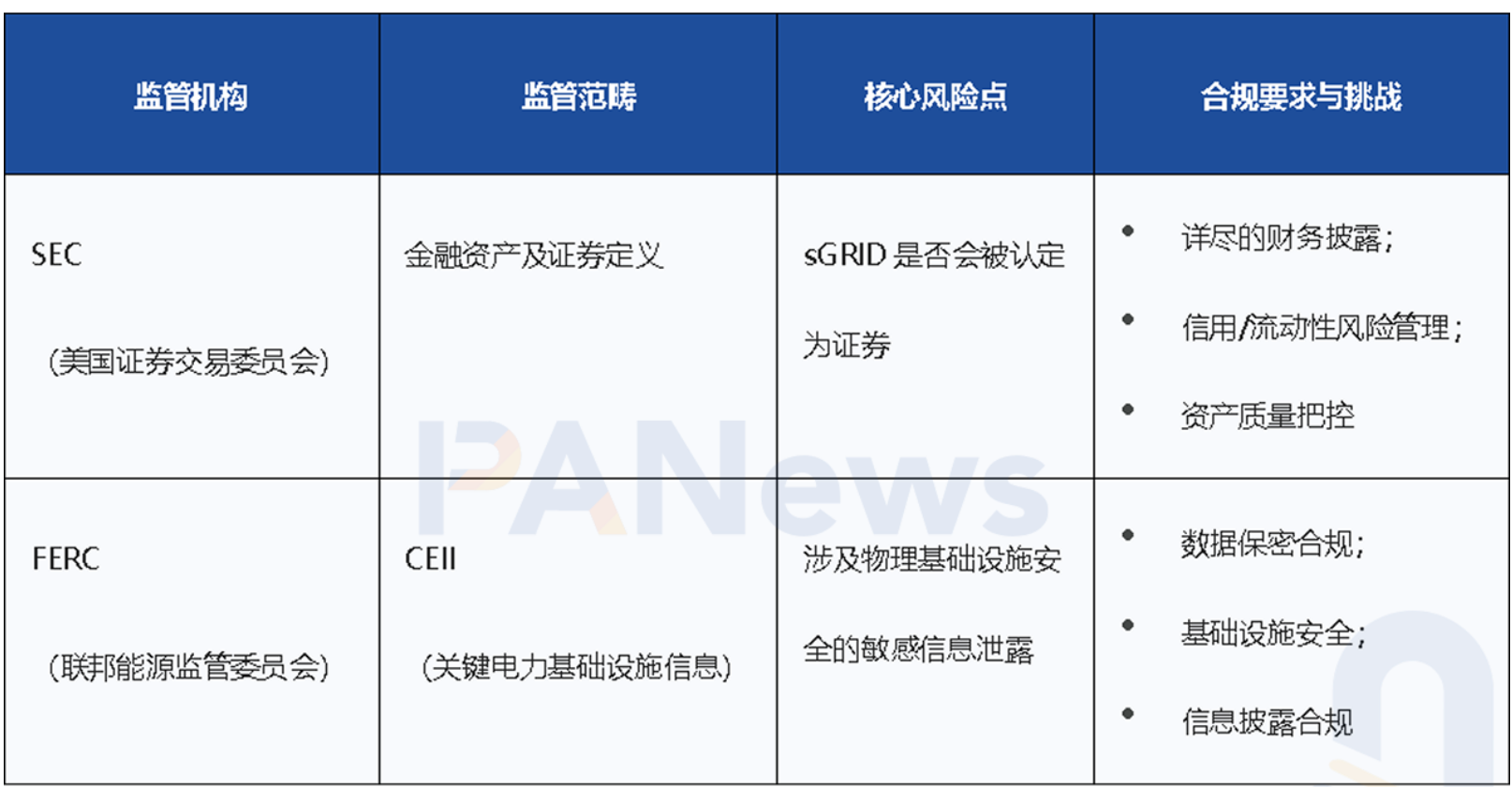
The ideal is丰满 (ambitious), but reality is布满监管荆棘 (littered with regulatory thorns). DayFi's foremost challenges come from the SEC (U.S. Securities and Exchange Commission) and FERC (Federal Energy Regulatory Commission).

sGRID represents the right to future electricity revenue, making it highly likely that the SEC will classify it as a security under the Howey Test. This means DayFi must fulfill the same disclosure obligations as traditional financial products: regularly reporting asset quality, cash flow status, risk management, and establishing investor protection mechanisms.

More complex regulatory conflicts come from FERC. Energy project information is often classified as CEII (Critical Electric Infrastructure Information), subject to strict confidentiality requirements. Disclosing details like power plant locations, design specifics, and operational data could threaten the physical security of the grid.

This directly contradicts the transparency ethos of DeFi. Blockchain requires revenue data to be verifiable on-chain; otherwise, it cannot prove the authenticity of the yield. If information is overly obscured for compliance, it risks becoming a "black box," undermining its decentralized foundation.

DayFi is essentially walking a tightrope. It must design a system that is "verifiable but not exposed," perhaps using technologies like Zero-Knowledge Proofs (ZKP) to disclose only the yield results to verifiers without leaking sensitive information like geographic coordinates of power plants.
Even if it navigates regulatory inquiries, DayFi faces another fundamental question: how much are the assets backing sGRID actually worth?

Unlike GRID, which is fully collateralized by cash equivalents, sGRID is pegged to the "net asset value" of distributed energy projects. And these assets—solar panels, storage batteries, inverters—can fluctuate wildly in value due to technological iteration and depreciation.

Crypto KOL @luyaoyuan also sharply questioned this: "The most虚 (inflated) part of the net value is the book value of deployed new energy assets, depreciated according to 2025 standards. It could easily include a bunch of废旧太阳能板 (scrap solar panels), batteries淘汰的 (discarded from) new energy vehicles, etc. The room for manipulation is too large."

Indeed, DayFi's whitepaper also repeatedly emphasizes that sGRID is not redeemable at any time and its value "fluctuates with the net value of the underlying assets." This effectively positions it as a kind of RWA (Real World Asset) net value index, but also opens up the possibility of valuation manipulation.

The problem is that power assets lack a consensus mechanism for on-chain valuation. Electricity revenue can be verified, but the residual value assessment of the power stations themselves may still rely on traditional audits, which fundamentally conflicts with the trustless principle of blockchain.

The endgame of AI is electricity. Energy is becoming the next main battlefield in AI competition. Even Musk recently emphasized that energy is the true currency and cannot be obtained through legislation. Amid surging energy demand and the popularity of the RWA concept, DayFi transforms energy from a static resource into a dynamic DeFi asset, allowing electricity traders, grid operators, and investors to utilize it efficiently on-chain. But is it a新能源DeFi协议 (new energy DeFi protocol) wrapped in green, or a pioneer destined to founder in regulatory fog or valuation bubbles? Its journey on-chain may provide the answer.


Preguntas relacionadas

QWhat is DayFi and how does it aim to transform the energy sector using DeFi?

ADayFi is a decentralized energy capital markets protocol developed by Daylight. It aims to transform the energy sector by converting future electricity fee revenue into liquid crypto assets. It allows investors to deposit stablecoins to mint the protocol's stablecoin GRID, which provides liquidity for distributed energy projects. Investors then receive sGRID tokens, which represent a share in the electricity revenue generated by the underlying energy assets, effectively turning energy into yield-generating DeFi assets.

QWhich major venture capital firms have invested in Daylight and DayFi, and what is the significance of their investment?

AMajor venture capital investors include a16z Crypto and Framework Ventures. Their investment is significant because it signals a strong belief that access to electricity is becoming a new competitive moat in the AI race. They are betting on a solution to the AI energy crisis by funding infrastructure that can provide cheap, stable power more efficiently than traditional grid expansion methods.

QWhat are the primary regulatory challenges that DayFi faces from U.S. regulators?

ADayFi faces significant regulatory challenges from the SEC and FERC. The sGRID token, which represents a right to future electricity revenue, could be classified as a security under the Howey Test by the SEC, requiring extensive disclosure and investor protection measures. Furthermore, FERC regulations classify much energy project information as Critical Electric Infrastructure Information (CEII), which must be kept confidential for grid security. This conflicts with the transparency required for DeFi, forcing DayFi to find a balance using technologies like zero-knowledge proofs.

QHow does the DayFi protocol create a 'flywheel effect' for distributed energy resources?

AThe DayFi protocol is designed to create a positive flywheel effect: liquidity is brought into DayFi → the protocol's funds are used to accelerate the construction of distributed energy projects → these projects become operational and generate energy revenue → that revenue is tokenized and distributed as yield back to the sGRID token holders. This cycle encourages more investment, leading to further growth of the distributed energy network.

QWhat are the concerns regarding the valuation of the assets backing the sGRID token?

AA major concern is that the value of sGRID is tied to the net asset value of distributed energy projects (like solar panels and batteries), which can depreciate quickly and be highly volatile. Critics argue there is significant room for manipulation in valuing these physical assets, such as overvaluing depreciated equipment. Unlike the fully collateralized GRID stablecoin, sGRID acts more like a Real World Asset (RWA) index whose value fluctuates, and its valuation may still rely on traditional audits, which conflicts with the trustless nature of blockchain.

Lecturas Relacionadas

Ethereum Q1 2026 Report: Fees Decline, Users and Transaction Volume Hit New Highs

Ethereum Q1 2026 Report: Fees Down, Users & Transactions Hit New Highs Token Terminal's Q1 2026 report on Ethereum presents a pivotal development: the network achieved record highs in monthly active users (13.2M, +85.9% YoY), total transactions (200.4M, +81.5% YoY), and throughput (25.78 TPS), while transaction fees on the mainnet plummeted by 47.9% quarter-over-quarter. This shift is attributed to the network's strategic move into a "low fees for scale" phase, exemplified by the Fusaka upgrade which increased data capacity and lowered block space costs, releasing pent-up demand (a manifestation of Jevons's Paradox). The report highlights a core narrative shift for Ethereum: from a DeFi-centric blockchain to a global financial settlement layer. It maintains a dominant position in tokenized assets, holding majority market shares among top chains in stablecoins (61.8%), tokenized funds (73.0%), and tokenized commodities (84.0%). Growth in tokenized funds (+73.1% YoY) and commodities (+325.9% YoY) was particularly strong, driven by institutions like BlackRock and JPMorgan entering the space. Contrasting these usage gains, several USD-denominated value metrics declined in Q1: fully diluted market cap fell 30.3% QoQ, total value locked (TVL) dropped 11.0%, and ecosystem transaction volume decreased 24.0%. The report interprets this as Ethereum prioritizing long-term network expansion and cementing its role as the default settlement layer for finance over short-term fee capture. The commentary from Etherealize argues that, much like the early internet, Ethereum's open, permissionless model is poised to win over closed alternatives as institutional tokenization accelerates.

marsbitHace 1 hora(s)

Ethereum Q1 2026 Report: Fees Decline, Users and Transaction Volume Hit New Highs

marsbitHace 1 hora(s)

He Just Raised 2.7 Billion, and Li Fei-Fei Also Invested

Pete Florence, a former senior research scientist at Google DeepMind and a key contributor to the Vision-Language-Action (VLA) model architecture, is deliberately distancing his startup, Generalist AI, from the trendy "world model" label. He argues that the industry should prioritize concrete goals over buzzwords. His goal is to create robots that can perform a vast range of unseen tasks with high speed and success rates, without needing task-specific training data. Recently, his company raised $400 million (¥2.7 billion) at a $2 billion valuation. Notable investors include NVIDIA's NVentures, Bezos Expeditions, NFDG, as well as Xiaomi co-founder Lin Bin, Zoom founder Eric Yuan, and renowned AI scientist Fei-Fei Li. Florence's approach stems from his academic background at MIT under Professor Russ Tedrake, focusing on understanding the physical world. After joining DeepMind, he developed models like Transporter Network and co-created the VLA framework. He left in 2025 to found Generalist AI. The company has launched two models: GEN-0, which demonstrated that scaling laws apply to physical motion, and GEN-1. GEN-1 was trained on over 500,000 hours of physical interaction data collected via a specialized wearable device. It achieves a 99% success rate on precise mechanical tasks like folding boxes and maintains performance three times faster than its predecessor. Florence believes GEN-1 is reaching a commercial utility threshold similar to the GPT-3 inflection point. The substantial funding round, following GEN-1's release, signifies strong investor confidence in Generalist AI's practical, goal-driven path to creating versatile, useful robots, regardless of the "world model" terminology.

marsbitHace 1 hora(s)

He Just Raised 2.7 Billion, and Li Fei-Fei Also Invested

marsbitHace 1 hora(s)

Two Legends Lost in Three Days: Is Google's AI Talent Dam Cracking?

In three days, Google lost two AI legends. On June 18, Noam Shazeer, co-author of the seminal "Attention is All You Need" paper and Gemini co-lead, left for OpenAI. Just 48 hours later, John Jumper, 2024 Nobel laureate and AlphaFold lead, departed DeepMind for Anthropic. This follows Andrej Karpathy joining Anthropic in May. These moves highlight a structural trend: top AI talent is concentrating at mission-driven, pre-IPO firms like OpenAI and Anthropic, while Google becomes a primary source. The exodus stems from a core mission mismatch. Google's ad-centric model often subordinates AI research to product and revenue goals, creating friction for pioneers like Shazeer, who returned in 2024 only to leave again. In contrast, OpenAI and Anthropic offer singular focus on pushing AI boundaries, whether towards AGI or safety-aligned models, which deeply appeals to top researchers like Jumper. Financial incentives amplify the pull. With both OpenAI and Anthropic nearing IPO, employees stand to gain immensely from equity, an upside Google's mature stock cannot match. Furthermore, the 2023 merger of Google Brain and DeepMind, intended to consolidate strength, has instead created cultural tension and slowed the path from research to product, as evidenced by Gemini's pace. This talent redistribution is reshaping the AI landscape. While Google retains vast data and compute resources, its true crisis is the quiet, continuous loss of the people who define the field's future. The real moat in AI is not infrastructure, but the concentration of brilliant minds—a battle Google is currently losing.

marsbitHace 3 hora(s)

Two Legends Lost in Three Days: Is Google's AI Talent Dam Cracking?

marsbitHace 3 hora(s)

Behind the AI Report Card, Lies a Chinese 'Exam Setter'

Beyond the familiar performance charts like MMLU-Pro and MMMU, which major AI models strive to ace, stands a key "examiner": Chinese-Canadian researcher Wenhu Chen. An assistant professor at the University of Waterloo and founder of TIGERLab, Chen addresses the crucial need for more rigorous AI evaluation. As models like GPT-4 began scoring near-perfect results on older benchmarks like MMLU, it became difficult to distinguish their true capabilities. In response, Chen introduced MMLU-Pro in 2024, featuring harder, more reasoning-focused questions with more answer choices, successfully reintroducing meaningful performance gaps. His work extends to multi-modal evaluation with MMMU and its enhanced version, MMMU-Pro. These benchmarks test a model's ability to understand and reason with complex information from images, charts, and text across diverse academic subjects, exposing the significant challenges even top models face in genuine comprehension. Chen's background in complex QA, table reasoning, and his experience at Google DeepMind on projects like Gemini inform his approach. He understands that effective benchmarks must anticipate how models might "cheat" by memorizing data or avoiding visual analysis. His lab also actively researches video understanding and generation models (e.g., UniVideo, Vamba), ensuring his evaluation work is grounded in practical model-building challenges. Now at Meta's Super Intelligence Lab, Chen continues his focus on multi-modal data and evaluation, representing the deep yet often unseen contributions of Chinese talent in shaping the fundamental tools of the AI industry.

marsbitHace 3 hora(s)

Behind the AI Report Card, Lies a Chinese 'Exam Setter'

marsbitHace 3 hora(s)

Trading

Spot
Futuros
活动图片