a16z: 7 Charts to Understand How Tokenization Is Changing the Nature of Assets

marsbitPublicado a 2026-05-24Actualizado a 2026-05-24

Resumen

a16z: 7 Charts on How Tokenization is Transforming the Nature of Assets Tokenized Assets, often referred to as "real-world assets" (RWA), are altering the form, flow, and structure of the financial system. The market recently surpassed $30 billion (excluding stablecoins), driven largely by tokenized U.S. Treasuries. These offer investors digital, yield-bearing assets with efficient settlement. Growth varies significantly by asset class. Asset-backed credit leads in speed, followed by niche financial assets, while venture capital and active strategies took longer to scale. U.S. Treasuries and commodities dominate, holding about two-thirds of the current market share. Within commodities, gold tokenization dominates entirely due to its standardization and historical appeal in crypto. The ecosystem is spread across multiple blockchains. Ethereum holds over half the market, with others like BNB Chain, Solana, and Stellar holding significant shares. However, a key insight is that most tokenized assets currently lack "composability." While the total market is large, only a small fraction (e.g., 5% of tokenized bonds) is used within DeFi protocols. Many tokens are simply digital records of off-chain assets, not natively programmable financial building blocks. In contrast, smaller categories like reinsurance tokens see very high on-chain usage. Looking ahead, forecasts for the tokenized asset market by 2030 range from $2 trillion to over $30 trillion, representing immense potenti...

This article is from:a16z crypto

Compiled by|Odaily Planet Daily(@OdailyChina); Translator|Moni

Tokenized Assets, often referred to as "Real World Assets (RWA)", are transforming the form of assets, how they flow, and how financial systems are constructed.

Just last month, the market size of tokenized assets surpassed $30 billion and is currently hovering around $34 billion (excluding stablecoins). This scale is roughly equivalent to a regional bank or a top-tier university endowment. While still minuscule compared to the global financial system, it is significant enough to have a tangible impact.

Two years ago, the tokenized asset market was worth less than $3 billion. Since then, the market has undergone dramatic changes: The US GENIUS Act has brought a clearer regulatory framework for stablecoins, institutional-grade on-chain infrastructure has matured, and a large number of financial institutions have nearly simultaneously begun deploying blockchain technology—it is precisely under the impetus of these factors that the tokenized asset market has grown tenfold in less than two years. (Note: While stablecoins are not included in the above statistics, they have substantially driven the growth of the entire market by greatly simplifying on-chain payments and settlements.)

This article will use 7 charts to analyze the reasons behind the rise of tokenized assets and their future trajectory.

Tokenized Assets Take Off: US Treasuries Become the Biggest Growth Engine

US Treasury bonds are the primary driver of the recent growth in the tokenized asset market.

The advantages of tokenized US Treasuries are clear and intuitive: investors can hold stable yield-generating assets in a digital form, enabling more efficient and flexible trading and transfer; financial institutions can achieve efficiency gains in settlement and collateral asset allocation, seamlessly connecting with digital financial markets.
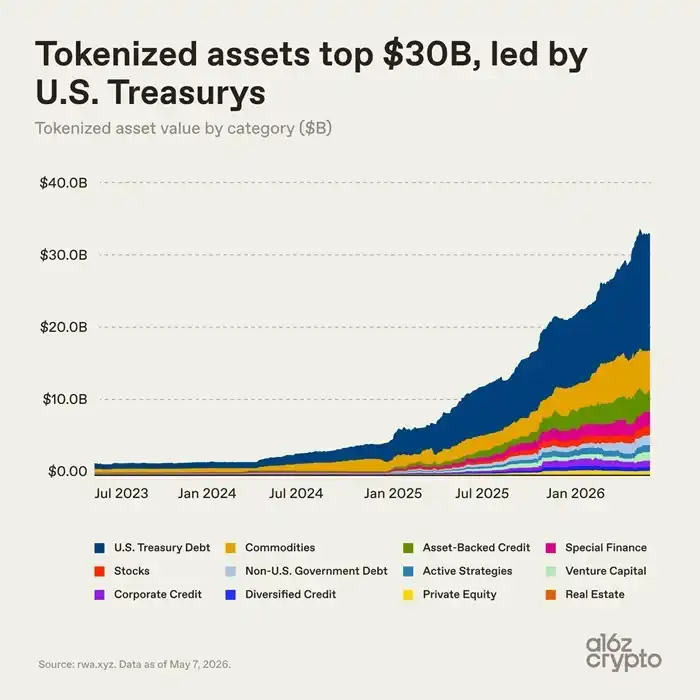
Crypto investors can also use tokenized Treasuries to leverage idle stablecoins to gain returns from traditional money markets. Asset management institutions like BlackRock and Franklin Templeton have strategically positioned themselves accordingly, catalyzing a trillion-dollar market.
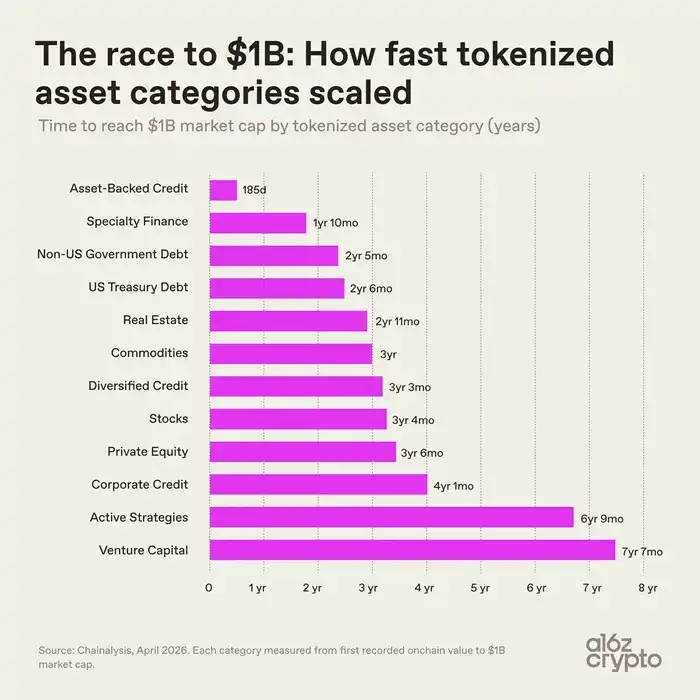
It is important to note that the growth rates of various tokenized assets vary widely, stemming from both the technical and regulatory difficulties of putting different assets on-chain and the market acceptance of products after launch.

  • Asset-backed credit assets have seen leading growth. Such tokenized assets mainly include tokenized home equity lines of credit, lending vault tokens, with reinsurance contracts, Bitcoin mining notes, and other niche financial assets following, reaching a market value of $1 billion within two years.
  • Venture capital assets took over seven years to exceed $10 billion in market value, with actively managed strategy assets following a similar cycle. These assets have complex structures, long investment horizons, and higher operational and regulatory barriers.
  • Treasuries and commodities have moved on-chain at a moderate pace, breaking the $10 billion market cap mark within 2 to 3 years and now representing mainstream categories.

At the beginning of 2024, Treasuries and commodities accounted for almost the entire tokenized asset market share. After 2024, the share of credit, niche finance, and equity categories steadily increased, but market concentration remains high. Currently, tokenized US Treasuries and commodities together account for about two-thirds of the market share.
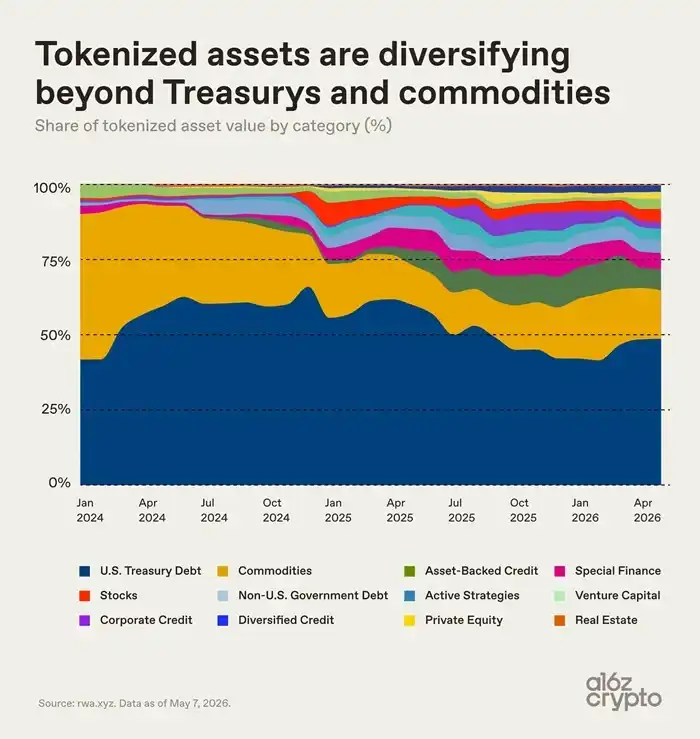
Segmentation of the Tokenized Asset Market

The commodity tokenization sector is highly concentrated internally, with gold tokens dominating the vast majority, with a total scale of approximately $5.1 billion, of which gold tokens account for $5.0 billion. Silver and other category tokens total only $57.6 million, accounting for less than 0.01%.

Gold is naturally suited to the tokenized asset model. Currently, the commodity token market is essentially led by gold because: gold has a global unified standard, is convenient to store, is not easily damaged, and has long been traded via claim certificates.

Furthermore, crypto market investors have historically favored gold assets, with Bitcoin being called digital gold in its early days. Products like Tether's gold token XAUT and Paxos's gold token PAXG map ownership of vaulted gold onto the blockchain, transforming physical gold claims into digital tokens that can be held in on-chain wallets.
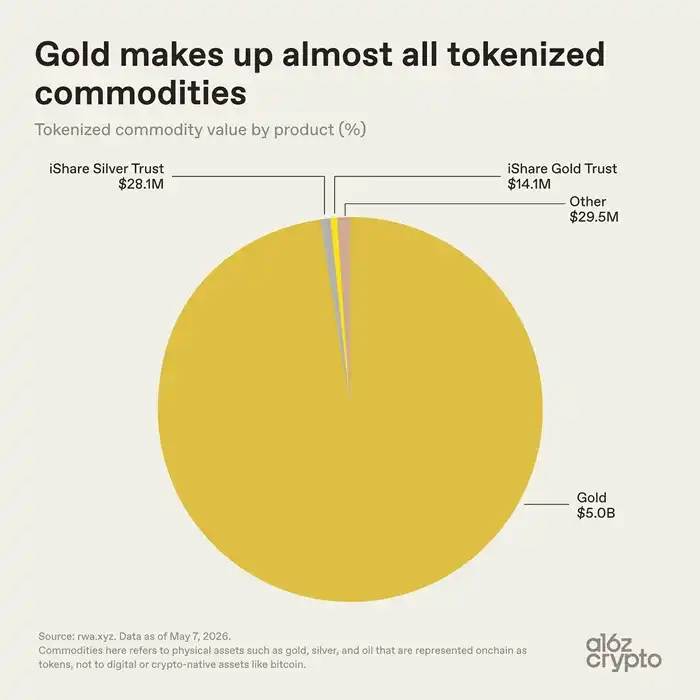
The market share for tokenized assets of crude oil, agricultural products, and emerging categories like energy and computing power is extremely low, with the industry still in its infancy.

Looking at the underlying public chain landscape, the tokenized asset ecosystem is more diversified. Ethereum, with its first-mover advantage in decentralized finance and institutional adoption foundation, still holds the leading position, hosting $15.7 billion in assets, accounting for over half of the market.

The remaining tokenized asset market is distributed across multiple public chains: BNB Chain's tokenized asset market size is about $4.0 billion, Solana about $2.2 billion, Stellar about $1.7 billion, Bitcoin sidechain Liquid Network about $1.5 billion. Tokenized asset sizes on XRP Ledger, ZKsync Era, and Arbitrum are all close to $1 billion.
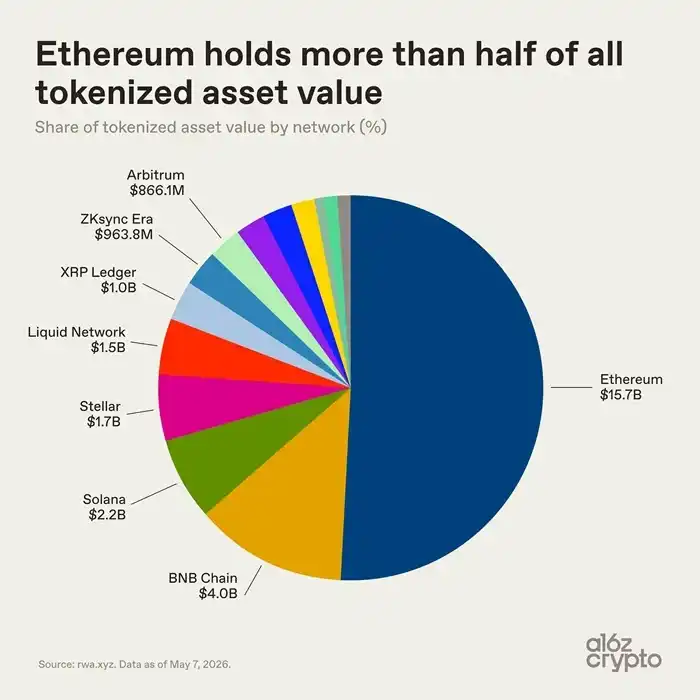
The tokenized asset industry has not consolidated onto a single public chain. Assets are distributed across major blockchain ecosystems based on transaction costs, liquidity, compliance requirements, and business partnerships. However, the most telling data point is not the size of the tokenized asset market... but how these assets are being used.

Let's continue the analysis—

Most Tokenized Assets Are Not Yet "Composable"

Market size is not the only core metric; the actual application value of assets is more informative.

Bonds are the largest category of tokenized assets by market capitalization, at $15.2 billion, but only 5% of the circulating supply is used in DeFi protocols, amounting to only about $800 million. The utilization rate of precious metal tokenized assets is similarly low. Most tokenized assets are only used for on-chain storage and have not yet become freely composable, interconnected, and reusable financial building blocks.

Smaller tokenized asset categories show the opposite performance: reinsurance tokens with a market cap of $362 million have an on-chain protocol usage rate as high as 84%; private credit tokens have a 33% usage rate. These two asset classes were designed from the outset for on-chain composability. In contrast, top categories like Treasuries and gold are positioned primarily to simplify holding and transferring assets on-chain, without altering their original operational logic. This situation also highlights a core divergence in the tokenized asset industry: the varying degrees of on-chain native-ness among different tokenized assets.
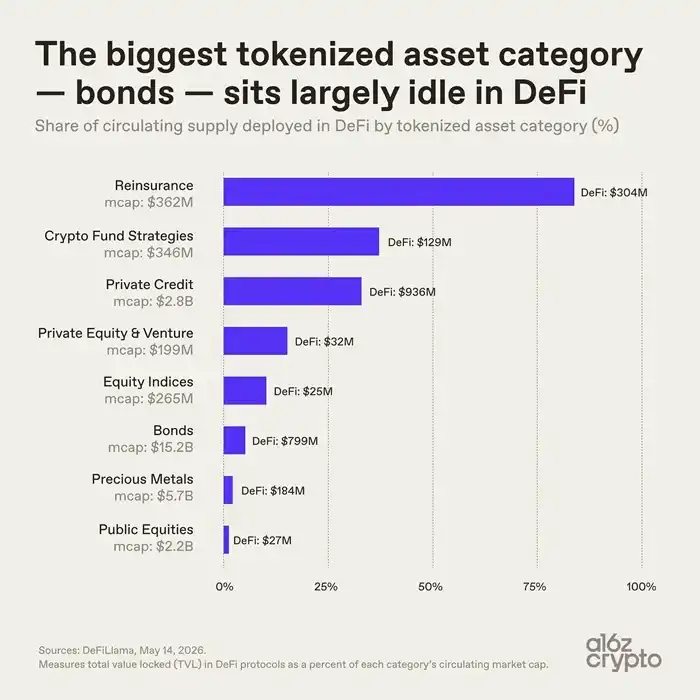
Some assets can be freely transferred and applied across chains, while others merely use the blockchain as a ledger tool, limiting asset transfer and composability functions. Currently, most tokenized assets are essentially just digitized assets, merely moving accounting onto the chain, without unlocking their composability potential. And composability is the core value of on-chain finance and a key to upgrading the financial system.

The Pantera Capital Token Native Index shows that over 70% of tokenized assets have the lowest level of on-chain native-ness. A large number of tokens are merely digital certificates for offline physical assets, with actual asset control still relying on offline ledgers and intermediaries.

Currently, the tokenized asset industry is still in its early stages: one type is assets that are only digitally recorded on-chain, and another is assets that are natively on-chain and deeply integrated with blockchain characteristics.

The on-chain composability technology infrastructure is ready, and asset categories are gradually enriching, but deep integration and application have just begun.

Future Trends of Tokenized Assets

Industry predictions for the long-term scale of the tokenized asset market vary, but all generally agree the market will continue to expand.

  • McKinsey predicts the tokenized asset market will reach $2-4 trillion by 2030;
  • Ark Invest estimates the tokenized asset market at $11 trillion;
  • Boston Consulting Group and Ripple jointly calculate that the tokenized asset market will reach $9.4 trillion by 2030 and climb to $18.9 trillion by 2033;
  • Standard Chartered predicts the tokenized asset market will exceed $30 trillion by 2034.

Based on the above institutional estimates, compared to the current market size of $34 billion, the future growth space for the tokenized asset market industry could be a hundredfold. Of course, the numerical differences are not due to disagreements about the speed of industry adoption, but rather to different statistical definitions. The scope of statistics varies among institutions, covering differences in asset categories, whether stablecoins and deposits are included, and the defined scope of tokenization. For example: McKinsey's statistics focus on bonds, credit, funds, and stocks; Standard Chartered adds commodities and trade finance; BCG and Ripple additionally include deposits and stablecoins. However, despite the differences in statistical scope, the industry unanimously agrees that the scale of tokenized assets will undergo a leap forward expansion.

Looking at the global financial landscape, the current size of tokenized assets is still minuscule.

  • The global bond market is over $140 trillion, while tokenized bonds are only $15.2 billion, accounting for 0.01%;
  • The global physical gold market is worth tens of trillions of dollars, while tokenized gold is $5 billion, accounting for less than 0.02%;
  • The global stock market is over a hundred trillion dollars, while tokenized stocks are $1.5 billion, accounting for only 0.001%.
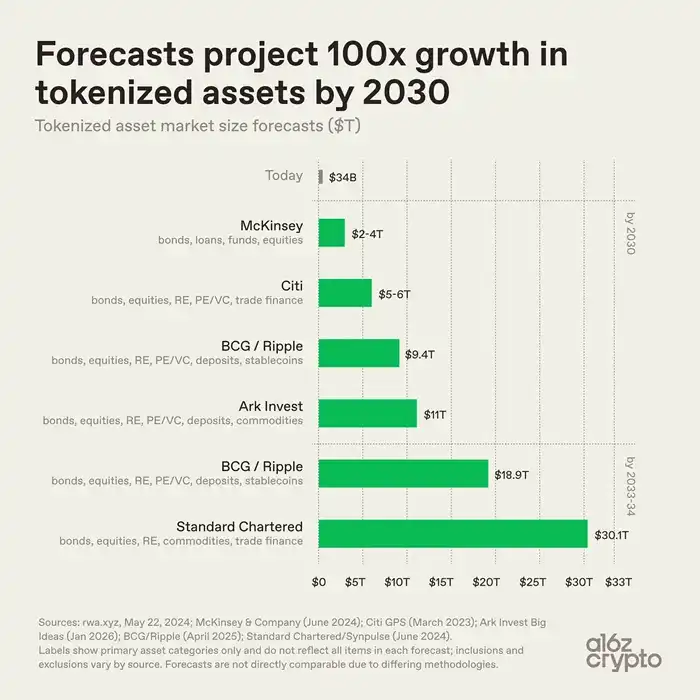
Today, emerging sectors have steadily taken shape. Assets with clear pricing, stable demand, and simple ownership, such as US Treasuries, gold, and private credit, have taken the lead in going on-chain. Currently, tokenization has not yet disrupted the underlying nature of assets, only optimizing the settlement and transfer methods. The deep integration of assets with the digital financial system is still being explored.

Currently, tokenized assets are more about digitization, and assets struggle to achieve programmable composable applications. The next phase of the industry faces a core challenge: bringing the more complex parts of the financial system on-chain and more deeply integrating tokenized assets into composable, internet-native financial infrastructure.


Preguntas relacionadas

QWhat is the primary driver behind the recent explosive growth of the tokenized asset market?

AThe primary driver is U.S. Treasury bonds, which offer investors a stable, interest-bearing asset in a digital format with efficient settlement and transfer.

QAccording to the article, which specific type of tokenized asset currently dominates the commodities sector and why is it particularly well-suited for tokenization?

AGold dominates the tokenized commodities sector. It's well-suited because it has a globally unified standard, is easy to store, doesn't deteriorate, and has historically traded via ownership certificates, making its transition to a tokenized form natural.

QWhat key metric, beyond market size, does the article highlight as crucial for understanding the true value of tokenized assets?

AThe key metric is how the assets are *used*, specifically their utilization and composability within DeFi protocols, which reveals their actual integration and functional value beyond just being a digital record.

QWhat is the major limitation of most current tokenized assets like bonds and gold, as identified in the article?

AMost current tokenized assets lack 'composability.' They are often just digital records of off-chain assets, managed by traditional intermediaries, and are not deeply integrated or programmable within the DeFi ecosystem for combined, innovative uses.

QWhat is identified as the next critical challenge for the tokenized asset industry?

AThe next critical challenge is to bring more complex parts of the financial system on-chain and to integrate tokenized assets more deeply into composable, internet-native financial infrastructure, moving beyond simple digitization to true programmability.

Lecturas Relacionadas

AI PC Battle: Bet on the Toll Booth, Not the Camp

**Title:** The AI PC Battle: Don't Bet on Sides, Bet on the Tollbooth **Summary:** The AI PC competition is moving beyond simple "x86 vs. Arm" narratives. The core investment thesis should focus on identifying which players can sustain margins, cash flow, and pricing power throughout the upgrade cycle, rather than backing a particular architecture. The opportunity is analyzed in three layers: 1. **The Advanced Foundry Tollbooth:** TSMC is positioned to collect "tolls" regardless of which chip designer wins, due to its dominant ~70% share in advanced semiconductor manufacturing, which is essential for high-end AI PC chips. 2. **Compute & Platform Spillover:** AMD represents an offensive in the x86 CPU+GPU space, while NVIDIA leverages its GPU and CUDA software stack dominance. Both benefit from the demand for increased local AI compute. 3. **Architecture Diffusion & Turnaround Plays:** ARM and Intel offer potential for significant upside (elasticity), but investments here require stricter discipline due to higher execution risks and competitive challenges. The industry is transitioning from concept to shipment validation. While short-term forecasts for AI PC adoption have been revised down slightly due to tariffs and procurement delays, the long-term trend towards AI becoming a standard PC feature remains intact. The key driver for upgrade cycles will be whether compelling enterprise applications (e.g., privacy-sensitive computing, low-latency inference) emerge beyond consumer-focused features like meeting summarization. Investment strategy should prioritize companies with platform-level advantages and recurring revenue streams. TSMC offers high certainty as the foundational tollbooth. AMD presents a strong offensive play within the established ecosystem. ARM and Intel are higher-risk, higher-potential-reward turnaround bets. The report cautions against chasing short-term hype and emphasizes a disciplined, long-term approach focused on buying ecosystem strength and cash-flow certainty after market enthusiasm subsides. **Key Risks:** Underwhelming AI PC applications slowing upgrade cycles; slow improvement in Windows on Arm compatibility; macro/tariff impacts on PC demand; potential advanced node supply-demand mismatches affecting TSMC; high overall AI sector valuations making stocks vulnerable to a risk-off shift in markets.

marsbitHace 16 min(s)

AI PC Battle: Bet on the Toll Booth, Not the Camp

marsbitHace 16 min(s)

Ten-Thousand-Word Analysis: From $10 to $290, MRVL Wins the Entire AI Era by 'Not Making GPUs'

Marvell Technology's stock price surged from under $10 in 2016 to a record $290 in June 2026, fueled not by making GPUs, but by dominating AI infrastructure connectivity. This analysis argues the market misvalues MRVL as merely a smaller Broadcom in custom AI chips, overlooking its true, unique position. Marvell's core strength lies in enabling high-speed data flow for AI clusters through three interconnected businesses. First, it holds a commanding ~70% market share in high-speed optical DSPs (essential for data center light modules), a deep-moat business with accelerating growth. Second, its custom AI chip design business serves hyperscalers like AWS, Microsoft, and Google, with a significant revenue pipeline despite lower margins. Third, stable cash flows come from Ethernet switch chips and enterprise storage controllers. Together, they form a full-stack "AI data movement" platform. CEO Matt Murphy's transformative leadership since 2016, involving strategic divestments, key acquisitions (like Inphi for optical DSPs), and securing long-term agreements with major cloud providers, repositioned the company. A pivotal $2 billion strategic investment from NVIDIA in 2026 underscored Marvell's critical role in the AI ecosystem, particularly through collaborations like NVLink Fusion. While Marvell faces risks—including client concentration (losing the Amazon Trainium3 design), lower-margin business mix, competitive threats, insider selling, and complex supply chains—its fundamentals remain strong. The optical interconnect moat is widening with the acquisition of Celestial AI (photonics fabric), and financial metrics show accelerating revenue growth and operating leverage. With a PEG ratio suggesting undervaluation relative to its growth, the thesis is that the market undervalues Marvell's monopolistic position in AI "plumbing" while overemphasizing its competitive custom chip segment. The story transcends investing, symbolizing how in any complex system—from the internet to AI—the value of "connection" ultimately surpasses that of individual "nodes."

marsbitHace 46 min(s)

Ten-Thousand-Word Analysis: From $10 to $290, MRVL Wins the Entire AI Era by 'Not Making GPUs'

marsbitHace 46 min(s)

AI Relay Stations Spark Heated Debate on Zhihu: Behind Cheap Tokens, What Are Users Really Worried About?

A discussion on Zhihu about "AI relay stations" shifted the niche developer topic of "cheap tokens" into broader user awareness. Users moved beyond simply questioning the legitimacy of these services to focus on practical concerns: Where do cheap tokens truly come from? Is the model being accessed the real one? Can relay stations see prompts, code, and API keys? For occasional users, are the risks worth it? The core debate centered less on price and more on trust. A primary worry is model authenticity—the risk of "model swapping," where users paying for a premium model might be routed to a cheaper one, creating an information asymmetry. Others argued that cost comparisons matter; while cheaper than official pay-as-you-go APIs, relay stations may not be the lowest-cost option versus subscriptions, domestic models, or free tiers, making user needs assessment crucial. Speculation about token sources ranged from legitimate bulk discounts to gray-area methods like account sharing or exploiting regional pricing. This opacity makes risk assessment difficult for users. Data security emerged as a critical concern, especially for enterprise use. When processing sensitive information like code, contracts, or client data, the inability to verify a relay station's data handling, retention, or access policies poses significant compliance and confidentiality risks. The evolving consensus suggests relay stations can be used cautiously for low-sensitivity, disposable tasks (e.g., summarizing public info, simple translation). However, they should not be the default for sensitive, professional, or production workflows involving proprietary data, Agents, or automated systems. Recommendations include avoiding large prepayments, not relying on a single service, using test prompts to monitor quality, anonymizing data where possible, and keeping official channels as backups. Ultimately, the discussion framed tokens not just as a billing unit but as a measure of real cost encompassing price, model integrity, data security, and service stability. The popularity of relay stations highlights user demand for affordable access, but the debate underscores a key trade-off: the savings from cheap tokens may come at the price of trust, transparency, and control over one's data and AI experience.

marsbitHace 1 hora(s)

AI Relay Stations Spark Heated Debate on Zhihu: Behind Cheap Tokens, What Are Users Really Worried About?

marsbitHace 1 hora(s)

In-Depth Research Report on TradFi: The Convergence Wave of Crypto and Traditional Finance

In 2026, the crypto industry is undergoing a profound infrastructure-level transformation—TradFi assets are migrating on-chain at an unprecedented pace. According to CoinGecko's Q1 2026 report, the total value locked (TVL) of tokenized real-world assets (RWA) has surpassed $31 billion, a nearly 4x increase from $7.8 billion at the beginning of 2025, with the sector’s aggregate market capitalization reaching $19.3 billion. Among these, the market cap of tokenized stocks surged from $2 million to $486 million, with Q1 spot trading volume reaching $15.1 billion—a single quarter already surpassing the entire second half of 2025. RWA perpetual contract Q1 trading volume reached a staggering $524.8 billion, far exceeding the $313 billion for all of 2025. Meanwhile, BlackRock's BUIDL fund has reached $2.3 billion in scale and has filed for two new tokenized funds, signaling that the world's largest asset manager's tokenization strategy is evolving from pilot to product suite expansion. HTX, as a core participant in the crypto exchange sector, officially launched TradFi perpetual futures products including NVDA, AAPL, MSFT, META, and SPY in 2026, enabling crypto users to gain 24/7 trading access to core U.S. equities. Boston Consulting Group predicts that global tokenized asset scale could reach $16 trillion by 2030, while McKinsey offers a conservative estimate of approximately $2 trillion. The on-chain migration of TradFi assets is no longer a "future narrative" but a structural transformation unfolding in real time, as crypto exchanges evolve from single crypto asset trading platforms toward "multi-asset-class trading infrastructure."

HTX LearnHace 1 hora(s)

In-Depth Research Report on TradFi: The Convergence Wave of Crypto and Traditional Finance

HTX LearnHace 1 hora(s)

Trading

Spot
Futuros
活动图片




