A Well-Designed "Self-Detonation": Analysis of the PGNLZ Attack Incident

marsbitPublicado a 2026-01-28Actualizado a 2026-01-28

Resumen

On January 27, 2026, an attacker executed a well-orchestrated exploit against the PGNLZ token on BNB Smart Chain, resulting in approximately $100k in losses. The attacker initiated a flash loan of 1,059 BTCB from Moolah Protocol, used it as collateral on Venus Protocol to borrow 30 million USDT, and then exchanged 23,337,952 USDT for 982,506 PGNLZ on PancakeSwap. These PGNLZ tokens were intentionally burned (sent to a dead address), drastically reducing the liquidity pool supply. This manipulation caused the price of PGNLZ to surge from approximately $0.10 to over $5,528 per token. The attacker then invoked a fee-on-transfer function, triggering a built-in burn mechanism (_executeBurnFromLP) that further depleted the pool, leaving only a minuscule amount of PGNLZ and artificially inflating the price to an extreme 40 billion times its original value. Finally, the attacker drained the liquidity pool, repaid the flash loan, and netted a significant profit. The root cause was identified as a flawed deflationary economic model with insufficient validation during fee processing and LP burns, allowing price manipulation. The incident underscores the importance of rigorous economic model design and multi-audit practices before contract deployment.

Background Introduction

On January 27, 2026, we monitored an attack on the PGNLZ project on the BNB Smart Chain:

https://bscscan.com/tx/0xa7488ff4d6a85bf19994748837713c710650378383530ae709aec628023cd7cc

After detailed analysis, the attacker continuously launched attacks against the PGNLZ project on January 27, 2026, resulting in a loss of approximately 100k USD.

Attack and Incident Analysis

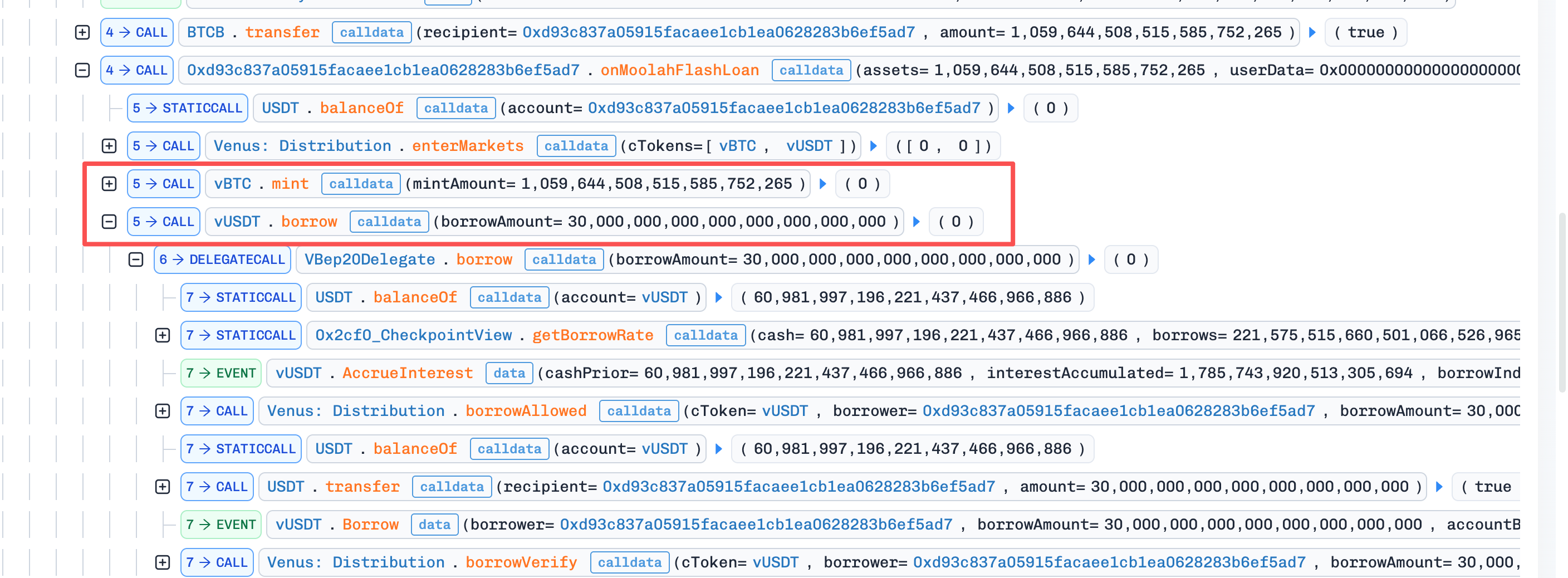
The attacker first borrowed 1,059 BTCB via a flash loan from Moolah Protocol,

Subsequently, they collateralized the 1,059 BTCB on Venus Protocol to borrow 30,000,000 USDT.
Next, the attacker called the function `swapTokensForExactTokens` on PancakeSwap, using 23,337,952 USDT to exchange for 982,506 PGNLZ, but then burned these PGNLZ (sent them to 0xdead).
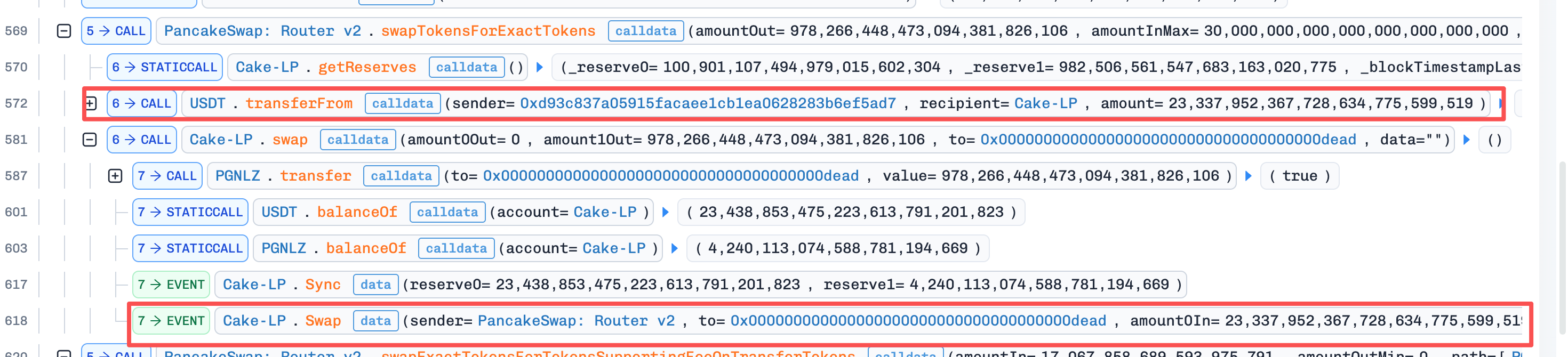
Before the swap, the PancakeSwap Pool contained 100,901 USDT and 982,506 PGNLZ, making the price of PGNLZ 1 PGNLZ = 0.1 USDT. After the swap, the PancakeSwap Pool had 23,438,853 USDT and 4,240 PGNLZ remaining, making the price of PGNLZ 1 PGNLZ = 5,528 USDT.

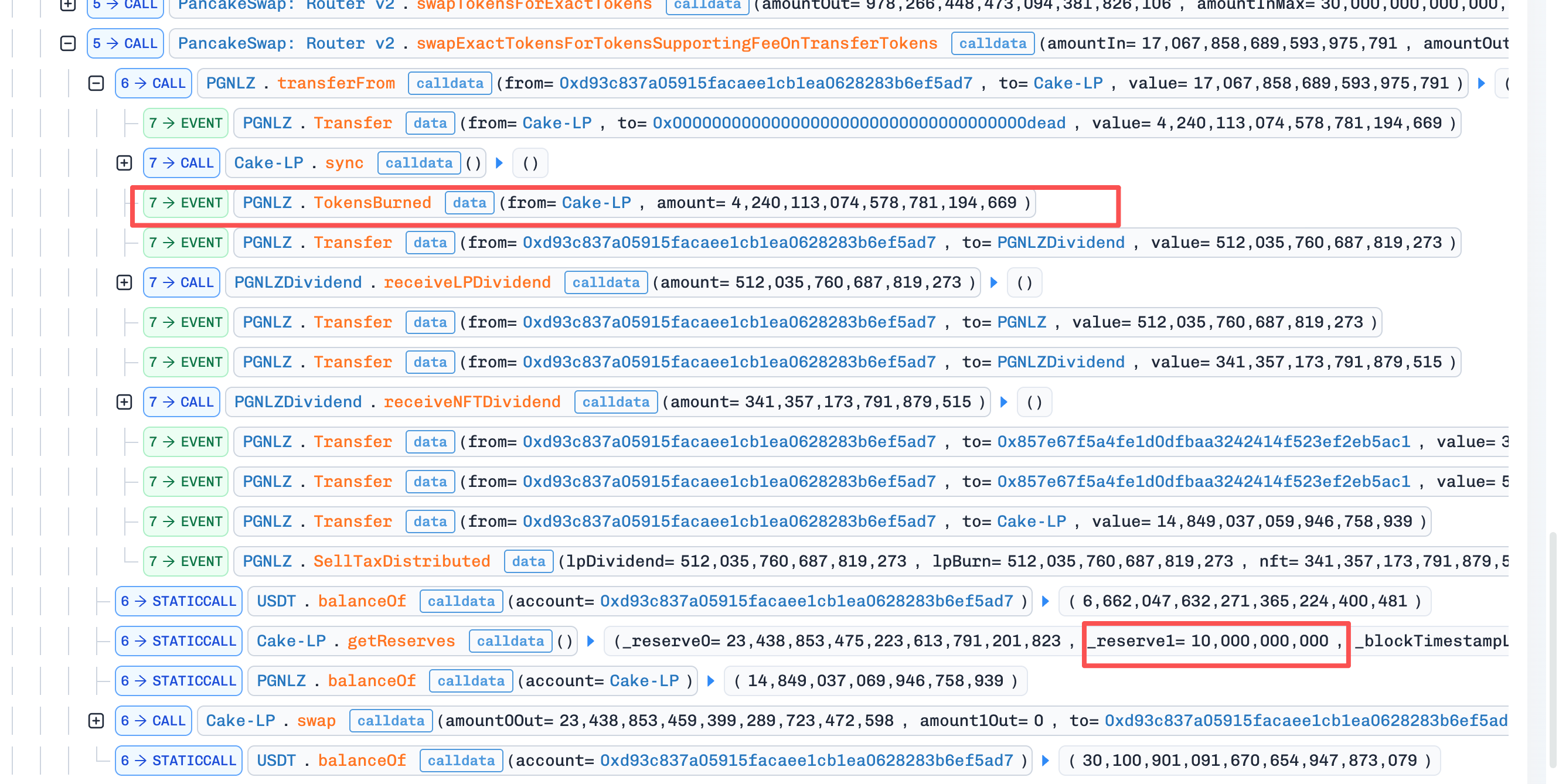
Subsequently, the attacker called the function `swapExactTokensForTokensSupportingFeeOnTransferTokens`. This function primarily supports Fee-On-Transfer Tokens, i.e., tokens that incur fees on transactions. PGNLZ uses `_update` to handle transaction fees. The specific call chain is: transferFrom -> _spendAllowance -> _transfer -> _update

Since this was a sell, `_handleSellTax` was called.
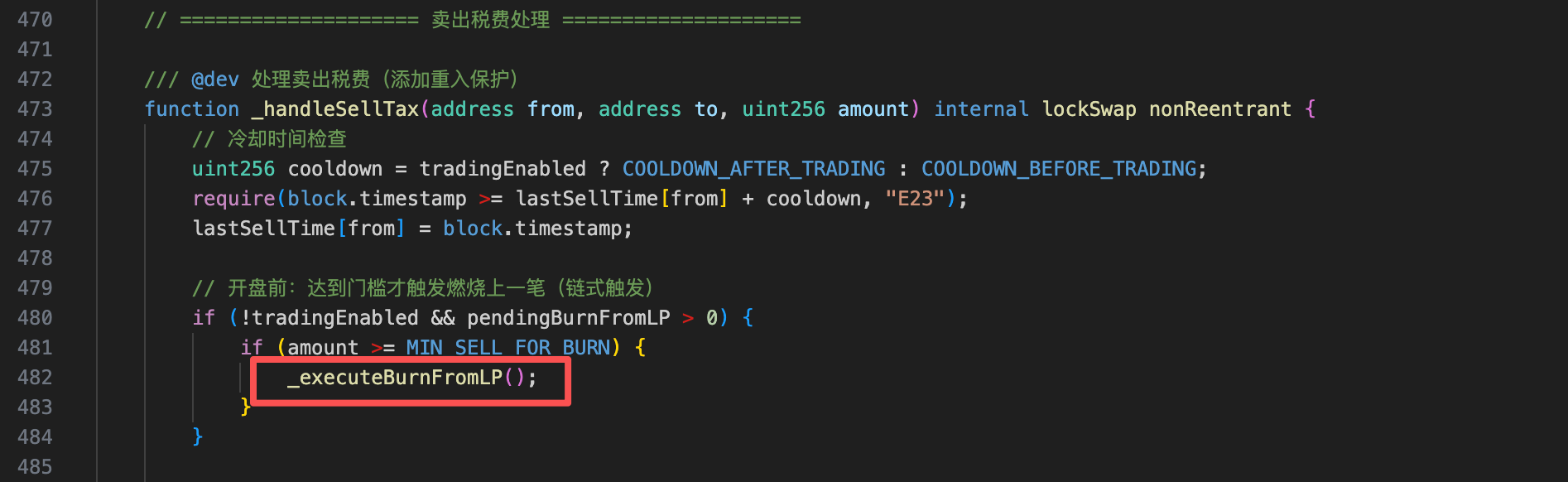
Let's look at how `_executeBurnFromLP` is implemented.
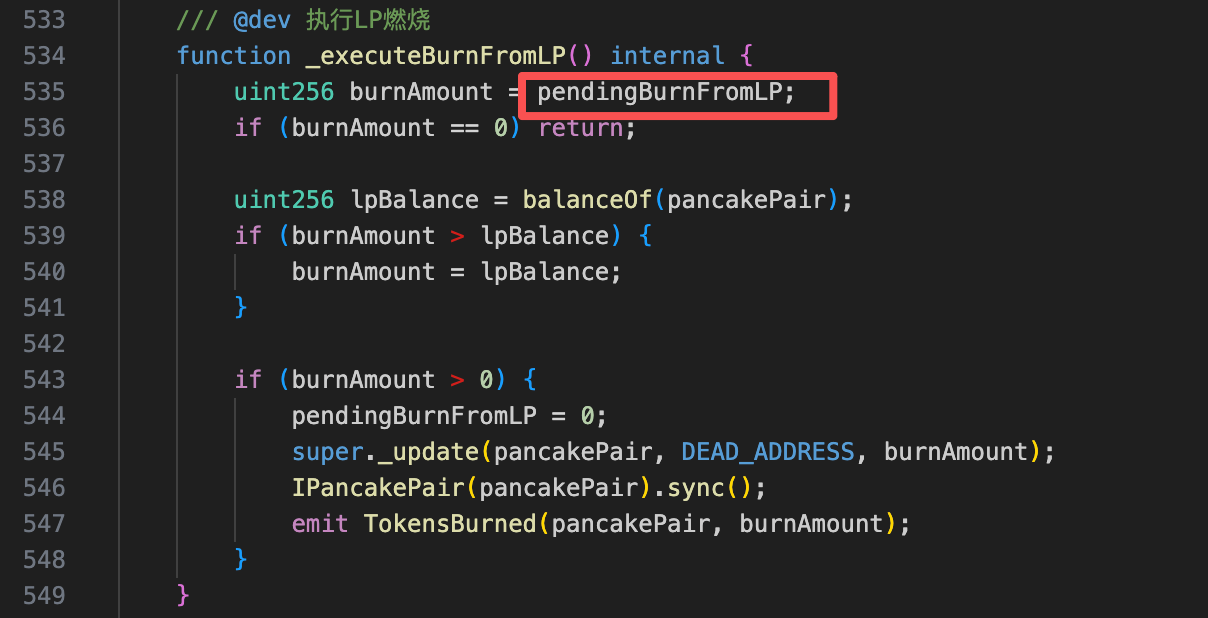
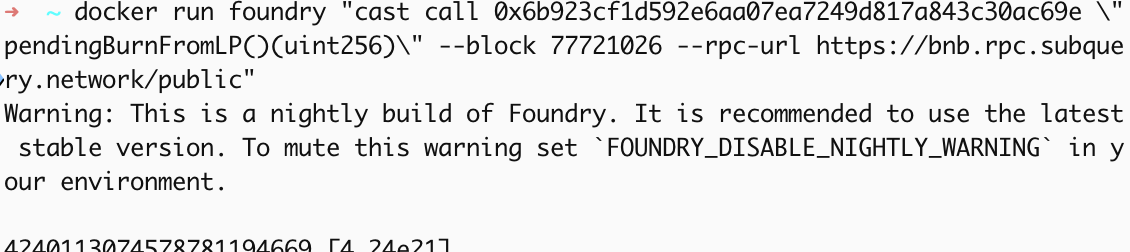
It can be seen that `_executeBurnFromLP` uses `_update` to burn the quantity of PGNLZ specified by `pendingBurnFromLP`. In the previous block, `pendingBurnFromLP` was queried as 4,240,113,074,578,781,194,669.
After the burn, the LP Pool was left with only 0.00000001 PGNLZ, making the price 1 PGNLZ = 234,385,300,000,000 USDT, a 40 Billion-fold increase.
Finally, the attacker drained the LP Pool, repaid the flash loan, and profited 100k USDT.

Summary

The cause of this vulnerability was the deflationary economic model, which lacked validation during fee deductions or LP Pool burns. This allowed the attacker to manipulate the token's price using its deflationary characteristics. It is recommended that project teams conduct thorough multi-party validation when designing economic models and code execution logic. Before contract deployment, opt for cross-audits from multiple auditing firms during the audit phase.


Criptos en tendencia

Preguntas relacionadas

QWhat was the total financial loss caused by the attack on the PGNLZ project?

AThe attack resulted in a loss of approximately 100,000 USD.

QHow did the attacker manipulate the price of PGNLZ token during the attack?

AThe attacker first swapped a large amount of USDT for PGNLZ and burned the tokens, drastically reducing the supply in the liquidity pool. This caused the price of PGNLZ to skyrocket by 40 billion times, from 0.1 USDT to 234,385,300,000,000 USDT per token.

QWhich function did the attacker exploit to handle the fee-on-transfer mechanism during the sell operation?

AThe attacker exploited the function swapExactTokensForTokensSupportingFeeOnTransferTokens, which triggered the _handleSellTax function and subsequently _executeBurnFromLP to burn a massive amount of PGNLZ tokens from the liquidity pool.

QWhat was the root cause of the vulnerability in the PGNLZ project?

AThe vulnerability was caused by a deflationary economic model that lacked proper checks when deducting fees or burning tokens from the pool, allowing the attacker to manipulate the token's price through supply reduction.

QWhich protocols did the attacker use to obtain the initial funds for the attack?

AThe attacker used a flash loan from Moolah Protocol to borrow 1,059 BTCB, which was then collateralized on Venus Protocol to borrow 30,000,000 USDT.

Lecturas Relacionadas

Senior Trader's Confession: How to Trade Market's False Expectations?

Veteran trader's case study: trading the market's "wrong expectations". This trade centered on a textbook "expectation error" after a weak CPI report. While the market initially priced in broad monetary easing (sending Nasdaq to 30,060), the crucial 30-year real yield hit a 20-year high. This signaled a fractured transmission mechanism: short-term rates eased, but long-term funding costs (vital for tech valuations) refused to fall. The trader executed five short positions on the Nasdaq (NQ) as it fell from 30,060 to 28,768. The core methodology: don't just trade the data, but analyze the market's implied causal chain and identify where it breaks. In this case, the chain was: Weak CPI → Policy Easing → Lower Long-Term Funding Costs → NQ Valuation Expansion. The break occurred between policy easing and long-term rates. The "veto variable" – long-term real yields – refused to confirm the bullish narrative. Trades were structured around "fast variables" (price) temporarily repairing while "slow variables" (funding conditions) remained broken. The article outlines a repeatable framework: 1) Map the market's implied causal chain. 2) Identify the veto variable. 3) Observe if it rejects the narrative. 4) Enter when price still follows the old script. 5) Choose the cleanest asset expression (e.g., short NQ, not broad S&P). 6) Define both invalidation and fulfillment exit conditions. The key insight: Alpha often comes not from an information edge, but from a "reaction function edge" – recognizing when the market is applying an outdated causal logic to new data. The critical question: What causal chain is the market's first reaction relying on, and is that chain still valid today?

marsbitHace 24 min(s)

Senior Trader's Confession: How to Trade Market's False Expectations?

marsbitHace 24 min(s)

Opinion: The Hedging Relationship Between U.S. Treasuries and Stocks Has Broken Down, and BTC, as a Risk Asset, Is Under Dual Pressure

For the past 20 years, U.S. investors relied on a free insurance policy: when stocks fell, bonds rose, cushioning portfolio losses. This reliable inverse correlation underpinned entire financial strategies. However, this mechanism broke down around 2020 and has not recovered. Currently, the two-month rolling correlation between the S&P 500 and 10-year Treasury yields is at -0.69, its lowest level since 1996, indicating stocks and bonds are moving in sync to an unprecedented degree, eliminating the traditional portfolio shock absorber. The失效 of this hedge is not simply due to lost confidence in U.S. debt. The key driver is the shift from growth-dominated to inflation-dominated market narratives. When growth fears prevail, stocks and bonds move inversely. Since 2022, persistent inflation volatility has been the dominant factor, causing both asset classes to suffer simultaneously from higher inflation expectations. Investors now seek safety without duration risk, favoring cash, dollars, and short-term Treasuries while selling long-duration bonds. Record U.S. deficits, rising net interest payments, and waning foreign demand (e.g., from Japan) are pressuring long-term yields, with the 30-year yield surpassing 5%. This environment places Bitcoin, as a risk asset on the far end of the risk curve, under dual pressure. Higher risk-free rates increase the opportunity cost of holding non-yielding assets like Bitcoin, while falling equities reduce overall risk appetite. Bitcoin's performance has become highly sensitive to macro conditions such as real yields, dollar strength, and financial conditions. While its long-term thesis as a fixed-supply asset outside the sovereign credit system is strengthened by these fiscal trends, the same conditions hurt it in the short term. The return of bonds as a effective hedge requires inflation volatility to subside, growth risks to retake dominance, and the Fed to have room to ease policy. Until then, Bitcoin trades in a market where the deepest asset class no longer absorbs shocks, removing the safety floor for all risk assets, especially those that pay nothing to wait.

marsbitHace 25 min(s)

Opinion: The Hedging Relationship Between U.S. Treasuries and Stocks Has Broken Down, and BTC, as a Risk Asset, Is Under Dual Pressure

marsbitHace 25 min(s)

Funding Weekly | Crypto.com Secures $400M Investment, CeFi and Stablecoin Sectors Continue to Attract Capital

Crypto Weekly Investment Recap: Funds Converge on CeFi, Stablecoins, and AI Last week's crypto and AI investment landscape saw significant capital concentration, with a few large deals dominating. **Crypto/Web3 Highlights (July 13-19):** Total investment exceeded **$812 million** across 17 deals. Key trends: * **Centralized Finance (CeFi) & Stablecoins** remained a major magnet, led by **Crypto.com**'s massive **$400 million** raise from Citadel Securities, valuing the exchange at $20B. * **Infrastructure & Tools** saw 7 deals, including **Cyclops** ($20M for stablecoin payments) and **ADI Chain** ($50M for stablecoin settlement infrastructure). * **DeFi** had 2 deals, such as AI-native DEX **Quote Trade** ($4M). * Other notable raises: API broker **Alpaca** ($135M), cross-border platform **Flex** ($70M), treasury firm **ORANGE JUICE** ($40M), and prediction market **Pascal** ($9M). * **Acquisitions:** Keyrock bought BlockFills' trading unit, SBI Holdings acquired Singapore exchange Coinhako, and MoonPay bought startup Glide. **AI & Robotics Highlights:** Investment momentum in AI remained very strong. * Nvidia-backed AI cloud service **Fireworks** raised a massive **$1.5 billion** at a $17.5B valuation. * In robotics, **Walden Robotics** (spun out from Toyota) secured **$300 million**, and Chinese humanoid firm ****逐际动力** **(Climax Dynamics) raised nearly **$200 million** in a Pre-IPO round. * Other significant AI raises included Indian programming platform **Emergent** ($130M) and drone company **Brinc** ($125M), backed by Sam Altman. Overall, the trend shows capital flowing heavily into established crypto financial services, stablecoin infrastructure, and large-scale AI/robotics commercialization.

marsbitHace 1 hora(s)

Funding Weekly | Crypto.com Secures $400M Investment, CeFi and Stablecoin Sectors Continue to Attract Capital

marsbitHace 1 hora(s)

The Gentlest Bear Market? BTC Bears Exit, ARK and Bitwise Collectively Bullish

**Title: The Mildest Bear Market? BTC Shorts Exit, ARK and Bitwise Collectively Bullish** Bitcoin continues to consolidate around $75,000 while Ethereum struggles near $1,900. Market data shows $116 million in liquidations over 24 hours, with $62.7 million from short positions, and the Fear & Greed Index remains at 35 (Fear). According to Polymarket, there's a 33% probability BTC falls below $50,000 this year. ARK Invest's Q2 2026 Bitcoin report notes technical weakness but identifies potential bottoming signals, including a record high in long-term holder supply, suggesting selling exhaustion. Bitwise's Juan Leon calls this the "structurally mildest bear market" on record, with a ~50% drawdown from highs, less severe than past cycles. He highlights institutional accumulation and a shift in investor dialogue from survival to entry points. Technical analysis from Bit suggests a potential C-wave low may have formed, with an ideal bottoming range between $50,000-$55,000. However, glassnode's CryptoVizArt warns that failure to break $66,000 could signal a local top, as new buyer accumulation is concentrated there. Analyst Darkfost identifies a critical support band between $59,000-$70,000, where 50% of BTC's circulating supply has changed hands. Notably, trader Doctor Profit announced closing all crypto short positions—including BTC shorts from $115k-$125k and over 100 altcoin shorts—for significant profit. He has begun a phased accumulation of Bitcoin spot starting at $64,000, reversing his previous $40k-$50k target, citing structural positives like regulatory clarity and institutional adoption. He argues the anticipated September/October bottom may arrive earlier than the herd expects.

Foresight NewsHace 2 hora(s)

The Gentlest Bear Market? BTC Bears Exit, ARK and Bitwise Collectively Bullish

Foresight NewsHace 2 hora(s)

Trading

Spot

Artículos destacados

Qué es $WELL

WELL3, $$WELL: Revolucionando la Salud y el Bienestar con DePIN y AI Introducción En el paisaje de la tecnología digital que evoluciona rápidamente, el sector de la salud y el bienestar se encuentra a la vanguardia de la innovación, esforzándose por mejorar la atención al paciente y promover estilos de vida más saludables. Un jugador groundbreaking en este dominio es WELL3, un proyecto pionero de Web3 que busca revolucionar cómo las personas se relacionan con su salud. Aprovechando tecnologías como la Red de Infraestructura Física Descentralizada (DePIN), la Identidad Descentralizada (DID) y la Inteligencia Artificial (AI), WELL3 tiene como objetivo fomentar trayectorias de salud seguras y potenciadas por datos. Este artículo completo profundiza en los aspectos centrales de WELL3, $$WELL, explorando sus funcionalidades, creadores, inversores y características únicas. ¿Qué es WELL3, $$WELL? WELL3 sirve como una plataforma innovadora destinada a redefinir el enfoque hacia la salud y el bienestar. Enfocado en integrar DePIN y DID junto con sistemas de IA, el proyecto está diseñado para crear experiencias personalizadas para los usuarios, al tiempo que asegura la seguridad y privacidad de los datos de salud de los individuos. Con una cifra impresionante de más de un millón de usuarios pre-registrados, la misión principal de WELL3 gira en torno a mejorar el bienestar a través de trayectorias de salud seguras y basadas en datos. En su esencia, WELL3 emplea tecnologías avanzadas de blockchain para garantizar que los usuarios tengan control total sobre su información personal. Este proyecto no solo aborda los desafíos de la seguridad y accesibilidad de los datos, sino que también aspira a crear una comunidad vibrante conectada por un compromiso compartido con una mejor salud. Características Clave de WELL3: DePIN y DID: Estas tecnologías permiten la propiedad y autenticación segura de los datos, dando a los usuarios control total sobre su información. Integración de IA: Utilizando análisis de IA, WELL3 ofrece ideas y soluciones personalizadas adaptadas a las necesidades de salud individuales. Compromiso Comunitario: Facilita un entorno de apoyo donde los usuarios pueden conectarse, compartir experiencias y motivarse mutuamente hacia una vida más saludable. Creadores de WELL3, $$WELL La identidad del creador de WELL3 permanece no especificada en la información disponible. A medida que el proyecto avanza, pueden surgir más detalles que arrojen luz sobre las mentes visionarias detrás de esta iniciativa transformadora. Inversores de WELL3, $$WELL WELL3 ha recibido apoyo de una miríada de entidades de inversión influyentes, destacando su credibilidad y potencial en el espacio de la salud y el bienestar. Los inversores notables incluyen: Animoca Brands AWS Samsung The Spartan Group Blocore Fenbushi Capital Newman Group Soul Capital XY Finance Lumoz El respaldo de estas organizaciones establecidas demuestra una fuerte creencia en la misión de WELL3, proporcionándole los recursos necesarios para innovar y expandir sus ofertas. ¿Cómo Funciona WELL3, $$WELL? WELL3 opera fusionando tecnologías avanzadas en un marco multichain, asegurando una experiencia de usuario fluida e innovadora. A continuación, se presentan algunos factores que posicionan de manera única a WELL3 en el mercado del bienestar: 1. Propiedad Segura de Datos Con la integración de DePIN y DID, los usuarios pueden mantener el control total sobre su información personal de salud. Este nivel de seguridad es primordial en la era digital actual, donde las filtraciones de datos y el acceso no autorizado son rampantes. A través de WELL3, la propiedad de datos es descentralizada, permitiendo a los usuarios gestionar proactivamente su información. 2. Personalización a través de IA WELL3 implementa análisis impulsados por IA para proporcionar a los usuarios información de salud personalizada. Al aprovechar el poder de la IA, la plataforma puede ofrecer recomendaciones y soluciones individualizadas, alentando a los usuarios a alcanzar sus objetivos de salud de manera más efectiva. 3. Marco Multichain El proyecto WELL3 está diseñado para funcionar a través de múltiples plataformas de blockchain, incluyendo Bitcoin, Ethereum, Polygon, Solana, Blast y TON. Esta capacidad multichain asegura que los usuarios puedan interactuar con la plataforma sin problemas en diferentes redes, mejorando la accesibilidad y la usabilidad. 4. Token WELL Central en el ecosistema de WELL3 es el Token WELL, que cumple múltiples funciones incluyendo utilidad, gobernanza y recompensas. El token permite la participación en el ecosistema, apoya el intercambio de datos de salud y incentiva a los usuarios en función de su compromiso con la plataforma. Cronología de WELL3, $$WELL La trayectoria de WELL3 muestra hitos significativos en su desarrollo, cada uno contribuyendo al éxito general del proyecto. Aquí hay una breve cronología de eventos críticos en la historia de WELL3: 10 de febrero de 2024: WELL3 lanzó su proyecto NFT, ascendiendo rápidamente a la prominencia como la colección de NFT más grande en la cadena opBNB con más de 324,000 propietarios y alcanzando 8 millones de NFT creados para el 27 de abril de 2024. Venta Pública: El proyecto logró un notable valor total bloqueado (TVL) de aproximadamente 15,237.2 ETH en solo siete días, indicando un robusto interés y respaldo del mercado. Lanzamiento de WELL ID: La plataforma vio más de 900,000 usuarios registrarse para el WELL ID y su correspondiente lista blanca de NFT Ring, marcando una fase significativa de adopción dentro del ecosistema. Desarrollo de Alianzas: WELL3 estableció alianzas con entidades líderes incluyendo Animoca Brands, AWS, Samsung y otras para mejorar su ecosistema y expandir su alcance. Volumen de Transacciones: WELL3 ha facilitado más de $17 millones en transacciones, reflejando su creciente utilidad y compromiso dentro de la comunidad de salud y bienestar. Puntos Clave sobre WELL3, $$WELL Como una iniciativa progresiva que se desplaza hacia el mercado del bienestar, WELL3 ha identificado varios elementos vitales que contribuirán a su éxito continuo. Aquí hay algunos puntos clave a tener en cuenta: Tokenomics El token $$WELL tiene un suministro máximo de 42 mil millones, con un significativo 71% destinado a iniciativas comunitarias. Esta estrategia de distribución enfatiza el compromiso del proyecto con su base de usuarios y la sostenibilidad a largo plazo. Período de Bloqueo Para asegurar estabilidad dentro del ecosistema, los tokens se liberan en lotes durante un período de bloqueo de 24 meses, promoviendo la confianza y seguridad entre los usuarios. Desarrollo del Ecosistema La visión de WELL3 se extiende hacia la creación de un ecosistema integral y sostenible para fomentar un compromiso comunitario próspero, comportamientos que mejoren la salud y soluciones digitales que aborden las necesidades urgentes del dominio del bienestar. Ajuste de Mercado La industria del bienestar, valorada en $5.6 billones, presenta una oportunidad lucrativa que WELL3 busca aprovechar. Con una tasa de crecimiento anual anticipada de 5-10%, el proyecto está idealmente posicionado en medio de una creciente tendencia hacia estilos de vida conscientes de la salud. Dispositivos Portátiles La introducción del Anillo WELL3, un dispositivo portátil incentivado por criptomonedas, se alinea con la creciente demanda de datos de salud personalizados. Este dispositivo no solo mejora la experiencia del usuario, sino que también redefine lo que significa estar comprometido con la salud de uno en el contexto de Web3. Conclusión WELL3 representa un avance significativo en la integración de la tecnología blockchain dentro del sector de la salud y el bienestar. Al abordar cuestiones cruciales sobre la propiedad de datos, personalización y compromiso comunitario, esta plataforma innovadora ofrece una solución de vanguardia para mejorar el bienestar individual. Con un sólido respaldo de inversores notables y un compromiso con tecnologías pioneras, WELL3 está preparado para tener un impacto duradero en el paisaje del bienestar. Para aquellos que buscan navegar las complejidades de la salud en la era digital, WELL3 es, sin duda, uno a seguir mientras continúa evolucionando y creciendo.

75 Vistas totalesPublicado en 2024.07.14Actualizado en 2024.12.03

Qué es $WELL

Cómo comprar WELL

¡Bienvenido a HTX.com! Hemos hecho que comprar Moonwell Artemis (WELL) sea simple y conveniente. Sigue nuestra guía paso a paso para iniciar tu viaje de criptos.Paso 1: crea tu cuenta HTXUtiliza tu correo electrónico o número de teléfono para registrarte y obtener una cuenta gratuita en HTX. Experimenta un proceso de registro sin complicaciones y desbloquea todas las funciones.Obtener mi cuentaPaso 2: ve a Comprar cripto y elige tu método de pagoTarjeta de crédito/débito: usa tu Visa o Mastercard para comprar Moonwell Artemis (WELL) al instante.Saldo: utiliza fondos del saldo de tu cuenta HTX para tradear sin problemas.Terceros: hemos agregado métodos de pago populares como Google Pay y Apple Pay para mejorar la comodidad.P2P: tradear directamente con otros usuarios en HTX.Over-the-Counter (OTC): ofrecemos servicios personalizados y tipos de cambio competitivos para los traders.Paso 3: guarda tu Moonwell Artemis (WELL)Después de comprar tu Moonwell Artemis (WELL), guárdalo en tu cuenta HTX. Alternativamente, puedes enviarlo a otro lugar mediante transferencia blockchain o utilizarlo para tradear otras criptomonedas.Paso 4: tradear Moonwell Artemis (WELL)Tradear fácilmente con Moonwell Artemis (WELL) en HTX's mercado spot. Simplemente accede a tu cuenta, selecciona tu par de trading, ejecuta tus trades y monitorea en tiempo real. Ofrecemos una experiencia fácil de usar tanto para principiantes como para traders experimentados.

115 Vistas totalesPublicado en 2024.12.10Actualizado en 2026.06.02

Cómo comprar WELL

Discusiones

Bienvenido a la comunidad de HTX. Aquí puedes mantenerte informado sobre los últimos desarrollos de la plataforma y acceder a análisis profesionales del mercado. A continuación se presentan las opiniones de los usuarios sobre el precio de WELL (WELL).

活动图片