A Turning Point Approaches: The "Net Long vs. Net Short" Structure Presents a Historically Rare State

marsbitPublicado a 2026-03-09Actualizado a 2026-03-09

Resumen

The cryptocurrency market is exhibiting a historically rare structure in perpetual futures, with directional long positions nearly equal to directional short positions, signaling a potential major shift (变盘). Analysis using Ethena's transparency dashboard reveals that Ethena's deployed capital, which acts as a proxy for excess long demand in the market, has plummeted to $790 million—just 71% of its 2025 low and 12.9% of its October 2025 peak. This sharp decline, occurring amid relatively stable prices since Bitcoin's crash to $60,000, suggests a significant reduction in speculative long leverage and a rise in directional shorting or hedging demand, particularly from VCs and projects hedging illiquid assets. While this balanced state could theoretically persist, it is extremely uncommon in other asset markets, indicating that a volatility surge and market turn may be imminent.

This article is from: Kyle Soska

Compiled by | Odaily Planet Daily (@OdailyChina); Translator | Azuma (@azuma_eth)

Editor's Note: The market has been oscillating at low levels. Will the future direction be up or down? Ramiel Capital Chief Investment Officer Kyle Soska analyzes the long-short structure of the perpetual futures market in his latest article and attempts to provide an answer by examining changes in market risk appetite.

The highlight of Kyle's analysis method is that by incorporating data disclosures from Ethena, he excludes basis positions and hedging positions, which have some noise impact on the price direction, and focuses only on net long and net short positions, which more directly determine the market's direction. His final conclusion is that the current market's net long vs. net short structure is in a historically rare state. While it's possible this could become the new normal, observing other asset markets reveals that such a trend is generally extremely difficult to sustain long-term. In other words, a turning point may be imminent.

Below is the original content by Kyle Soska, compiled by Odaily Planet Daily.

The cryptocurrency market has been in a risk-off state for several consecutive months. I have been sifting through various forms of market data, hoping to find signs of a potential market turnaround. This article will delve into the market structure of perpetual futures and, combined with data from the Ethena transparency dashboard, explore changes in market risk appetite.

Ethena's currently deployed capital has fallen to its lowest level in years, only 71% of the low point in 2025. This is not a criticism of Ethena, but rather a reflection of the current market state. Directional shorts have nearly equaled directional longs — an extremely rare structure in the crypto market that has historically been difficult to sustain long-term.

The cryptocurrency market has long been characterized by extremely high asset volatility and the widespread use of high leverage by traders. Since the BitMEX era, perpetual futures have become the highest volume product, with trading volumes typically 5 to 20 times that of the spot market. As the core hub providing leverage to retail investors in the market, observing the perpetual futures market can provide a good reflection of the overall risk appetite of the crypto market.

Ethena provides us with a unique window into the crypto derivatives market. As shown in the figure below, Ethena's strategy essentially executes a carry trade in cryptocurrency, and its logic is very simple — when a trader goes long on a crypto asset, Ethena acts as the counterparty and goes short. Simultaneously, Ethena buys an equivalent amount of the asset in the spot market to hedge its short position.
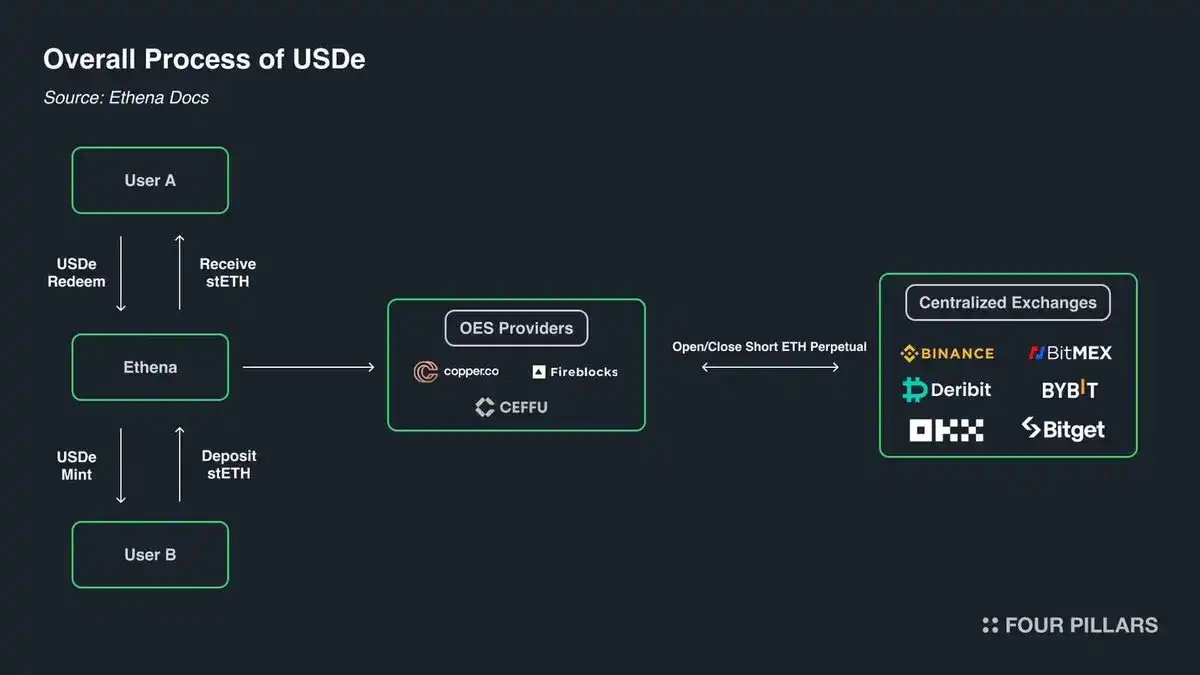
In a sense, Ethena provides "Leverage-as-a-Service":

  • Traders want exposure to rising crypto assets but lack sufficient capital;
  • Ethena has capital but has a lower risk appetite;
  • Therefore, traders borrow capital from Ethena through perpetual futures, and their cost is the "basis" + "perpetual funding rate".

According to the structure of perpetual futures, every long position is matched by a short position; they are always 1:1. Each open interest represents a cash flow agreement between two parties. The exchange's role is to match these contracts, ensuring that every contract always has a sufficiently funded long and short holder. The matrix below shows the four possible outcomes when an exchange matches contracts.
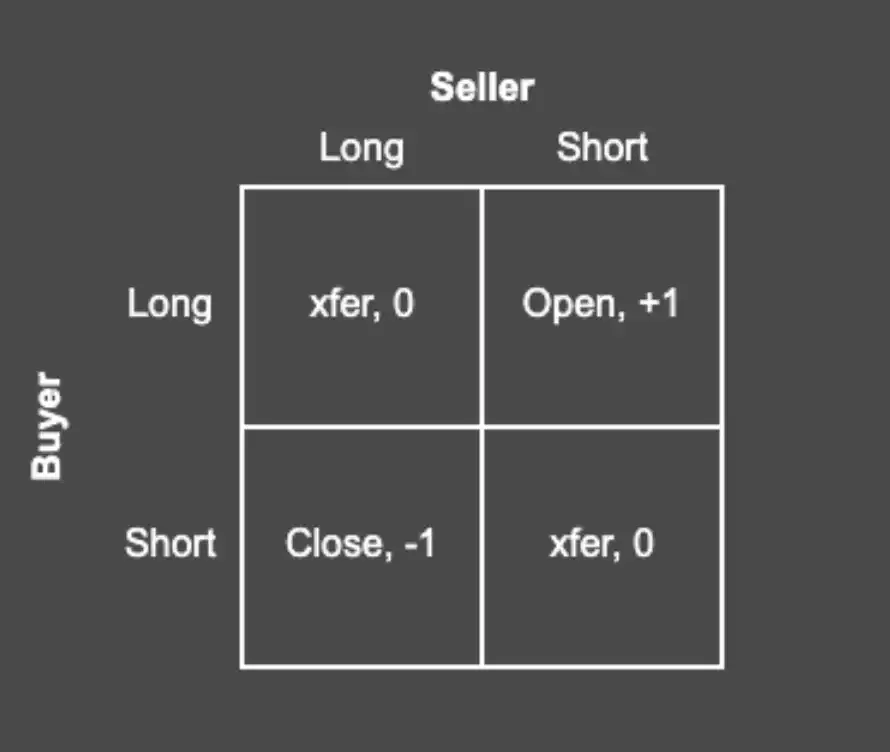
Every trade has a buyer and a seller. When the buyer and seller of a contract are both long or both short, the exchange only needs to transfer the contract ownership between the two parties. This transfer does not create or destroy any contracts. When the buyer is long and the seller is short, a new contract must be created: the buyer gets a long position, the seller gets a short position, thereby increasing the open interest by 1. Conversely, if the seller is long and the buyer is short, the exchange can unbind both parties from a specific contract and delete that contract, thereby reducing the open interest by 1.

So who holds these contracts in a typical market? Essentially, there are four types of contract holders:

  • Directional longs want exposure to price increases. They are risk-seeking participants, and their risk demand depends on the strength of market risk appetite.
  • Directional shorts comprise two types of participants: those who want exposure to asset price declines, and those who want to hedge their holdings in a more tax-efficient manner. For example, VCs and company employees who receive compensation in tokens often want to hedge future unlockable tokens to lock in the current price. For many altcoins, market liquidity is often too thin to support effective direct hedging, or the relevant market may not even exist. In such cases, companies like Cumberland, Wintermute, FalconX, Flowdesk, Amber, etc., can construct a dynamically managed synthetic position: by shorting a number of highly liquid and correlated assets (like Bitcoin and Ethereum) to hedge an exposure to a less liquid asset (e.g., Monad). This category also includes projects like Neutrl, which use this hedging structure as a yield strategy.
  • Basis traders are opportunistic shorts. They are not concerned with price direction but voluntarily match the excess demand from directional longs when market imbalances occur. In most market environments, long demand tends to exceed short demand, and their role is to fill this gap. Their scale is typically highly elastic and can expand or shrink rapidly.
  • Perp-Perp arbitrageurs hold both long and short positions in perpetual futures simultaneously. Their role is to connect prices between different perpetual futures markets and eliminate any slight price differences after deducting transaction fees. Their long and short positions are perfectly matched at any given moment.

According to the structure of perpetual futures, every contract must be 1:1 long-short matched, so we know that "Directional longs + Arbitrage longs = Directional shorts + Basis shorts + Arbitrage shorts"; furthermore, due to the arbitrage structure, we also know that "Arbitrage longs = Arbitrage shorts"; canceling this relationship out from the first equation gives us "Directional longs = Directional shorts + Basis shorts".

Ethena provides us with a proxy metric for all basis shorts, thereby helping us observe the structural comparison between directional longs and directional shorts.

The chart below shows the balance sheet disclosed by Ethena, which divides assets into cash and deployed capital, for the time range from December 27, 2024, to March 7, 2026.
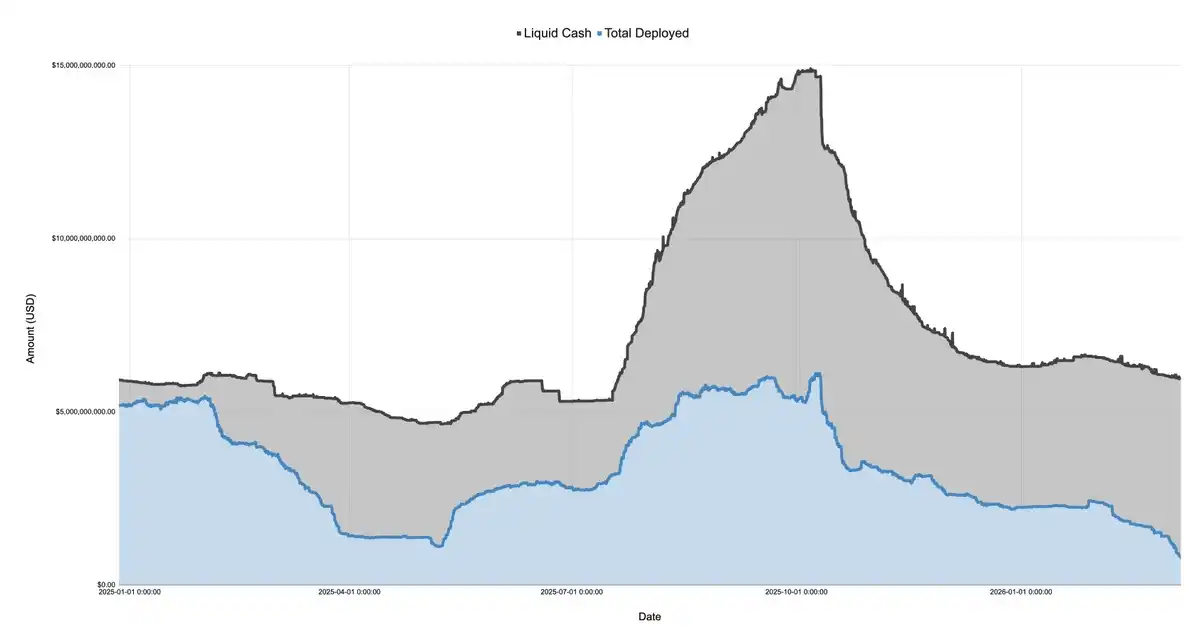
In 2025, following the launch of the TRUMP token in January, the market quickly entered a risk-off state, continuing to decline during the initial tariff discussions and the "Liberation Day" event in April. During this period, Ethena's deployed capital plummeted from over $5 billion to about $1.1 billion, a drop of more than 75%.

Remember, Ethena's deployed capital can be seen as a proxy for excess long demand in the market. Although Ethena is not the only institution executing this trade, its scale is very large (at times accounting for about 25% of the total size on Binance and Bybit). As long as Ethena has excess cash, it would theoretically expand its positions to fill the unmet long demand in the market. This means that while overall long demand may not have fallen by 75%, the excess long demand not absorbed by directional shorts did indeed decrease by that much.

The chart below shows the change in deployed capital in Ethena's balance sheet relative to its total size, the 2025 low, and the 2025 high.
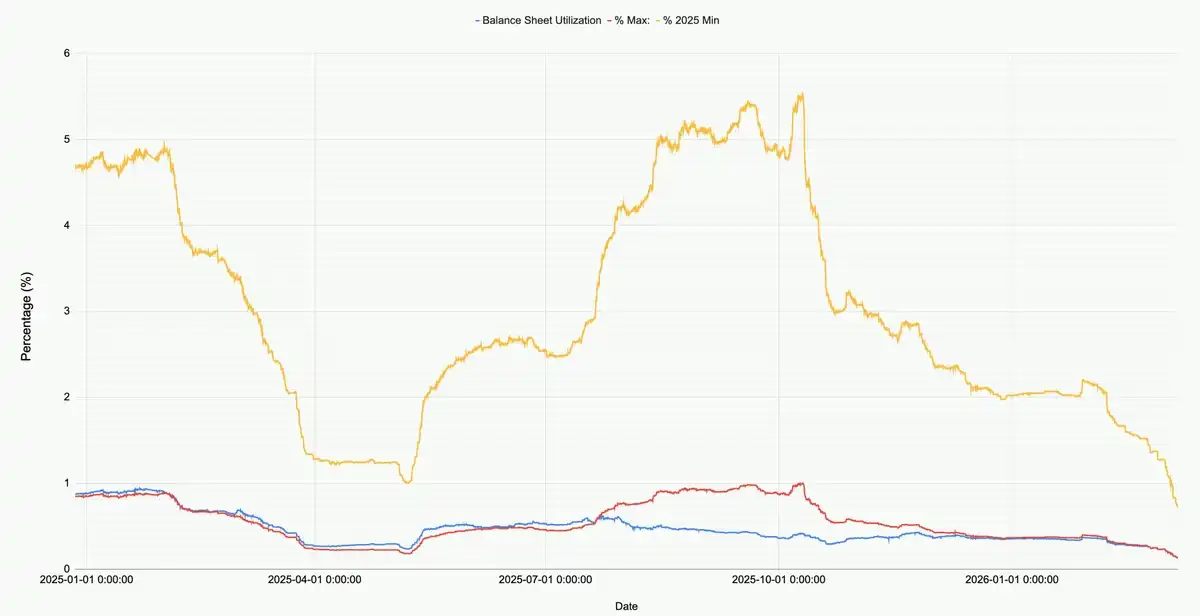
Looking at the current market, Ethena's deployed capital across all markets (BTC, ETH, SOL, BNB, XRP, HYPE) is $790 million. This figure is only 71% of the 2025 low and 12.9% of the pre-October 10th high. This number is not a criticism of Ethena but a reflection of the overall market state — net long demand in the current market is at a historically low level.

It is worth noting that during the market crash when Bitcoin fell to $60,000, Ethena still deployed over $2 billion in capital. Yet, just one month later, after February 8, 2026, deployed capital plummeted by 60%.

The chart below zooms in on Ethena's deployed capital and Bitcoin's price movement since January of this year.
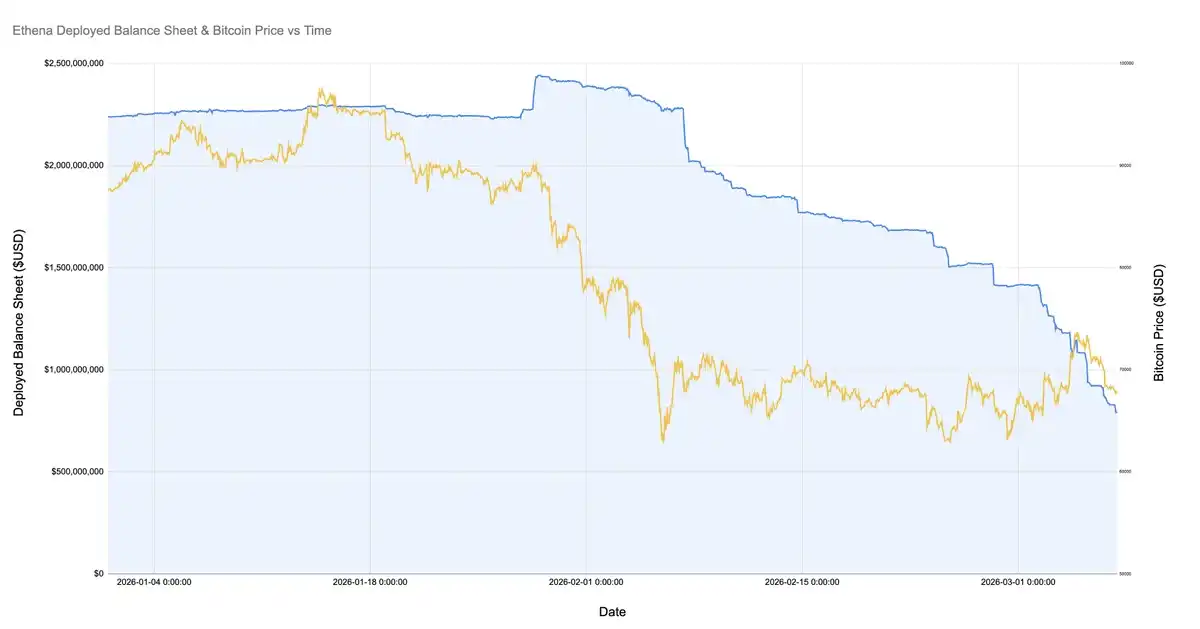
Since BTC fell to $60,000, Ethena's basis positions have shrunk from over $2 billion to less than $800 million. This change is quite intriguing because the overall market price has been relatively stable during this period. There are three possible explanations for this situation:

  • Basis trades from the February crash are gradually being closed. These trades were profitable but unsustainable (the basis became more negative, but the funding rate was also negative);
  • Directional short and hedging demand has increased, squeezing out opportunistic basis traders;
  • Insufficient demand for leveraged long exposure.
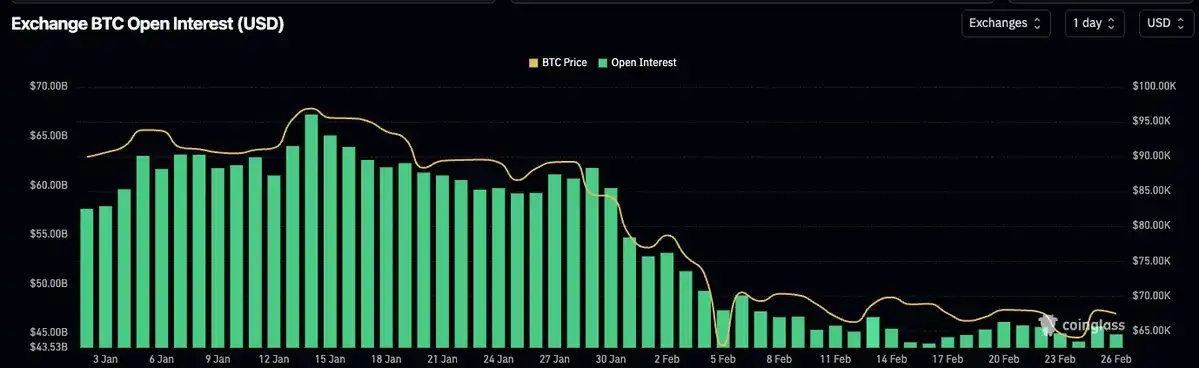
In my opinion, the reality is mainly a combination of the first two possibilities, with the third having a smaller impact. As shown in the figure above, during the period when Ethena was gradually closing positions, the open interest for Bitcoin and other major assets remained generally stable. At the same time, funding rates were negative for a considerable period, and coins like SOL had cumulative negative funding rates on multiple exchanges. This indicates that market demand for directional shorting or hedging exposure is rising.

If I had to guess, I think many small and medium-sized crypto companies and VCs are going through a crisis. Think of those small-cap projects (like Eigen, Grass, Monad, etc.). There could be hundreds of such tokens, and each project corresponds to multiple VCs, a project team, a company treasury, and a large number of employees. VCs need to limit losses and lock in profits to meet fund investment requirements, and project companies need to protect their operational capital reserves and employee size. This creates a situation where all participants must squeeze as much yield as possible from limited resources, and the solution is often a "crowded trade," namely actively managed structured products that short a basket of correlated assets.

We can see some signs of these structured products in some of ETH's short-term spikes, as these rallies often trigger short covering and drive synchronous increases in many small and mid-cap crypto assets. Another piece of evidence is the noticeable crowding out of opportunistic basis trading (e.g., Ethena) from the market.

Whatever the reason, we can be sure that for almost the first time in crypto market history, directional longs and directional shorts have nearly reached complete parity.

Theoretically, there is no reason why this state cannot become the new normal, or that this structure must change. But if we look at markets in other asset classes, we find that such a trend is very rare to sustain long-term.


Preguntas relacionadas

QWhat is the current state of the net long vs. net short structure in the perpetual futures market according to the article?

AThe net long vs. net short structure is in a historically rare state where directional shorts have almost reached parity with directional longs, a situation that is extremely rare and difficult to sustain long-term in the crypto market.

QHow does Ethena's deployed capital serve as an indicator for the market's risk appetite?

AEthena's deployed capital acts as a proxy for the market's excess long demand that is not absorbed by directional shorts. Its current sharp decline to multi-year lows reflects a significant drop in the market's overall risk-on appetite and net long demand.

QWhat are the four types of contract holders in the perpetual futures market as described in the article?

AThe four types are: 1. Directional longs (speculating on price increases), 2. Directional shorts (speculating on price decreases or hedging existing holdings), 3. Basis traders (opportunistic shorts filling excess long demand), and 4. Perp-Perp arbitrageurs (holding matched long and short positions to profit from price differences between markets).

QWhat major event does the article suggest might be causing an increase in directional short or hedging demand?

AThe article suggests that many small and mid-sized crypto companies and VCs might be facing a crisis, leading them to engage in a 'crowded trade' of actively managing structured products to short a basket of correlated assets to limit losses, lock in profits, and protect treasury and payroll funds.

QWhat does the article conclude about the likelihood of the current market structure persisting?

AThe article concludes that while theoretically this balanced structure could become a new normal, observing other asset classes shows that such a trend is extremely rare to maintain for a long time, implying that a significant market move (a turning point) is likely coming soon.

Lecturas Relacionadas

Single-Day Plunge of 30%, Arthur Hayes Suddenly Liquidates: Why Did ZEC Get Exploded by Security Issues?

On June 5th, Zcash founder Zooko Wilcox disclosed a critical soundness vulnerability in the project's latest Orchard privacy pool. This flaw, found in the elliptic curve multiplication constraints, could allow an attacker to create unlimited counterfeit ZEC within the shielded pool, with transactions appearing valid. The vulnerability was discovered in late May by security researcher Taylor Hornby, who utilized Anthropic's new Opus 4.8 AI model for a targeted audit. The Zcash ecosystem had already performed an emergency network upgrade to patch the issue. However, the detailed disclosure triggered severe market panic, causing ZEC's price to plummet over 30% in a single day. Notably, prominent investor Arthur Hayes announced he had sold his entire ZEC position following the news. The incident starkly challenges the "technological trust" narrative central to privacy coins. Despite years of top-tier cryptographic audits, the bug persisted until uncovered with advanced AI-assisted research. This highlights the growing gap between theoretical perfection and practical implementation in privacy technology. The event serves as a industry-wide warning: in an AI-driven security landscape, the assumption that "undiscovered equals safe" is obsolete. It underscores the urgent need for continuous, proactive security practices combining AI audits, formal verification, and rapid response mechanisms.

foresightnews_apiHace 12 min(s)

Single-Day Plunge of 30%, Arthur Hayes Suddenly Liquidates: Why Did ZEC Get Exploded by Security Issues?

foresightnews_apiHace 12 min(s)

Breaking the Curse of DeFi Cascading Liquidations, Vitalik Proposes a New Solution

**Vitalik Buterin Proposes New DeFi Design to Eliminate Forced Liquidations** Ethereum co-founder Vitalik Buterin has published a proposal for a new decentralized finance (DeFi) architecture aimed at removing the automatic liquidation mechanisms prevalent in current lending protocols. The core idea involves creating synthetic assets using options as building blocks, fundamentally avoiding the抵押借贷结构 that triggers forced sell-offs. The proposal responds to a recurring flaw in DeFi: during sharp market downturns, mass自动清算 of under-collateralized positions can exacerbate price declines, creating systemic selling pressure and market instability, as evidenced by recent crypto market volatility. Buterin's model would split an asset like 1 ETH into two option-like derivatives, P and N, pegged to a price index with a set strike price and expiration. At expiry, an oracle determines the settlement price to allocate the underlying ETH between P and N holders. This design eliminates the "cliff" of instant liquidation. Instead, a position's value would gradually drift from its target peg if not actively rebalanced by the user, transferring the rebalancing decision from the protocol to the user or automated tools. A key advantage is the reduced reliance on high-frequency, real-time oracle price feeds, which are vulnerable to manipulation and errors in current systems. The delayed settlement in the options model allows for more robust, fault-tolerant oracle designs. However, significant challenges remain for practical adoption. High transaction costs (slippage) from frequent rebalancing on automated market makers (AMMs) could erode user funds. The model may not be suitable for stablecoins requiring a strict 1:1 dollar peg, as it inherently allows for value drift. Success would depend on developing new liquidity provisioning models and deep markets for these synthetic assets. The proposal represents a fundamental rethinking of DeFi risk management, challenging the industry to explore alternatives to被动集中平仓 rather than merely optimizing existing liquidation processes. It remains a theoretical framework awaiting implementation and testing by development teams.

foresightnews_apiHace 15 min(s)

Breaking the Curse of DeFi Cascading Liquidations, Vitalik Proposes a New Solution

foresightnews_apiHace 15 min(s)

Bitcoin's Decline Marks the Transformation of Crypto

Title: The Decline of Bitcoin Marks the Transformation of Crypto While Bitcoin's price recently fell below $70,000, down approximately 45% from its peak, the broader crypto industry is not following it into decline. Instead, crypto is maturing and evolving beyond its dependence on Bitcoin's price movements. Two of Bitcoin's core functions are being usurped. First, AI has captured its role as the primary speculative asset. AI, with its tangible revenue, explosive demand, and massive capital inflows ($700-830 billion in 2024), is siphoning off the speculative "hot money" that once drove Bitcoin. It also contributes to a sustained high-interest-rate environment, further tightening liquidity for assets like Bitcoin. Second, dollar-pegged stablecoins like USDC and USDT have replaced Bitcoin as the crypto market's foundational currency and primary on/off-ramp. Most trading pairs and on-chain transactions are now settled in stablecoins, severing the historical link where all capital inflows had to pass through Bitcoin first. This decoupling allows projects to thrive based on their own fundamentals rather than Bitcoin's price. Examples include Hyperliquid, an on-chain derivatives exchange with annual revenues of $8-13 billion, and prediction market platform Polymarket, valued at $200 billion with $3.65 billion in annual fees. These projects are evaluated on traditional metrics like revenue and user growth. New opportunities are emerging, particularly around privacy. Privacy coins like Zcash (ZEC) are seeing surging demand, while infrastructure like NEAR enables private, cross-chain asset transfers without requiring users to hold a specific token—privacy becomes a universal service layer. In this new paradigm, stablecoins are the universal cash, various project tokens represent equity, and privacy-enabled cross-chain coordination layers (like NEAR) act as the critical infrastructure connecting a fragmented, multi-chain ecosystem. Bitcoin is now just one asset among many. The era where the entire crypto market moved in lockstep with Bitcoin is over. The industry's health should now be judged by project fundamentals—real revenue, active users, and tokenomics that capture value—and the development of the underlying infrastructure enabling a mature, dollar-denominated crypto economy.

foresightnews_apiHace 18 min(s)

Bitcoin's Decline Marks the Transformation of Crypto

foresightnews_apiHace 18 min(s)

Lightspark CEO: In Ten Years, Bitcoin Will Be as Invisible as TCP/IP, Yet Power Trillions in Daily Transactions

A decade from now, Bitcoin will function like TCP/IP — invisible yet foundational, supporting trillions in daily transactions globally, according to Lightspark CEO David Marcus. In this future, a coffee shop in Lagos receives instant payment, a manufacturer in São Paulo settles an invoice with a supplier in Ho Chi Minh City, and a freelancer in Bangalore gets paid weekly from an Austin startup — all via Bitcoin's settlement layer, with none of the parties consciously interacting with it. This vision parallels the adoption of open protocols: first driven by necessity where existing systems fail, then scaling rapidly as tools mature and economic benefits become clear. The structural shift begins with wallets. Modern non-custodial wallets, like Spark, allow users to hold dollars, local currency, and Bitcoin in a single address, seamlessly switching between them. This eliminates friction and revolutionizes global custody, moving significant deposits to user-controlled keys not by ideology, but by superior utility. As a result, Bitcoin becomes the default savings layer for billions, as its fixed supply and appreciating value make it a rational choice for savers holding it alongside stablecoins in their everyday wallets. Businesses follow a similar path, from small companies in emerging markets to multinational corporations, holding Bitcoin alongside operational stablecoins. The latest trend is direct Bitcoin transactions for commerce. When both parties hold Bitcoin, transacting in it becomes the simplest option — no conversions, no intermediary currency. This starts in niche areas like high-value B2B settlements but grows as infrastructure makes sending Bitcoin as easy as stablecoins. An accelerating force is AI agents. By 2036, AI agents conducting commerce on behalf of individuals and firms will increasingly choose Bitcoin for settlement. Optimizing for speed, finality, and minimal counterparty risk across jurisdictions, they find Bitcoin's global, neutral, and programmable network ideal for netting and settling obligations. Thus, Bitcoin is becoming the native currency for machine commerce, just as it has become a native savings asset for humans. The global monetary system is being rebuilt from the protocol layer: open infrastructure, default self-custody, Bitcoin settling everything underneath, with stablecoins as the interface. Most users won't think about Bitcoin when they transact — and they won't need to.

foresightnews_apiHace 22 min(s)

Lightspark CEO: In Ten Years, Bitcoin Will Be as Invisible as TCP/IP, Yet Power Trillions in Daily Transactions

foresightnews_apiHace 22 min(s)

Trading

Spot
Futuros
活动图片




