A Once-in-300-Years Event? Independent Solo Miner "Hits the Jackpot," Claims $220K Bitcoin Block Reward Alone

marsbitPublished on 2026-04-10Last updated on 2026-04-10

Abstract

A solo Bitcoin miner with only 70 TH/s of hashrate has successfully mined block 944,306, earning the full 3.128 BTC block reward (approx. $222,000). This miner’s computing power represents just 0.000007% of the total network hashrate, making the probability of such an event roughly once every 300 years on average. The miner used CKpool’s solo mining service, which allows individual miners to work independently rather than in a pool, keeping the full reward minus a 2% fee. This is the 313th solo block mined via CKpool since 2014. Remarkably, this is the second such unlikely event within ten days, highlighting the lottery-like nature of solo mining—where small miners occasionally win big despite extremely low odds.

Author: Claude, Shenchao TechFlow

Shenchao Guide: An independent miner with only 70 TH/s of computing power successfully mined Bitcoin block 944,306 through CKpool's solo mode, claiming the full reward of 3.128 BTC (approximately $222,000 USD). This computing power represents only 0.000007% of the entire network's total, theoretically taking an average of 300 years to mine a single block.

An independent Bitcoin miner has just accomplished a feat of probability.

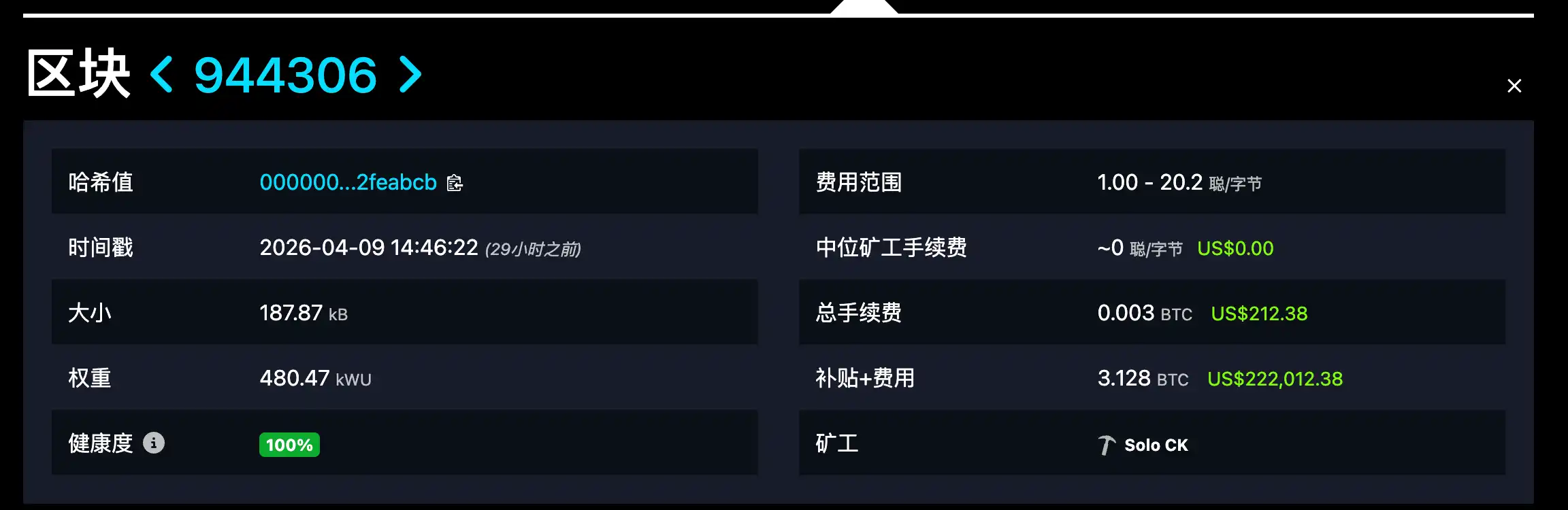
On April 9th, a miner with approximately 70 TH/s of power successfully solved Bitcoin block 944,306 using CKpool's solo mining service, receiving the full block reward of 3.128 BTC, worth about $222,000 USD at the time. This consisted of a 3.125 BTC block subsidy and 0.003 BTC in transaction fees.

70 TH/s is roughly equivalent to a Bitmain Antminer S17+ produced in 2019. Compared to the current Bitcoin network's total hashrate of about 1.02 ZH/s (1,020,000,000 TH/s), this single miner's share was a mere 0.000007%.
A One-in-a-Hundred-Thousand Daily Probability, Theoretically a Once-in-300-Years Event

CKpool developer Con Kolivas confirmed the event on platform X, noting that a miner of this hashpower size has a daily probability of solving a block of about one in a hundred thousand, translating to an expected value of roughly once every 300 years.

CKpool is a mining pool service that allows miners to operate in solo mode. Unlike traditional pools that aggregate hashrate and distribute rewards proportionally, solo mode involves miners accepting an extremely low probability of success individually, but should they succeed, they keep the full block reward (minus a 2% platform charge). Miners do not need to operate their own full Bitcoin node; they simply point their mining hardware to CKpool's servers to participate.

This is the 313th solo block produced by CKpool since its launch in 2014.

Second Solo Jackpot in Ten Days, Small Miners Score Surprise Wins

This is not the only recent solo mining surprise. Just about a week earlier, another CKpool miner mined block 943,411, receiving a reward of approximately $210,000 USD. That miner had higher hashrate but was considered small-scale nonetheless, with a daily success probability of about one in twenty-eight thousand.

Two solo wins within ten days constitutes a rare clustering phenomenon in statistical terms, but it does not change the fundamental landscape. Currently, Bitcoin mining is dominated by large mining pools. According to public data, Foundry USA, AntPool, and ViaBTC collectively control over 65% of the network's total hashrate. The operational hashrate of listed mining companies like Bitdeer and MARA Holdings reaches 71 EH/s and 61.7 EH/s respectively, representing a difference of six orders of magnitude compared to 70 TH/s.

For independent miners, solo mining is essentially a lottery ticket: daily electricity costs are only a few dollars, but the winning payout exceeds $220,000 USD. The expected value is negative, but the asymmetric return structure continues to attract a group of mining enthusiasts to participate persistently.
Trending Cryptos

Related Questions

QWhat was the hashrate of the solo miner who successfully mined Bitcoin block 944,306, and how much was the block reward worth?

AThe solo miner had a hashrate of 70 TH/s and received a full block reward of 3.128 BTC, which was worth approximately $222,000 at the time.

QWhat is the 70 TH/s hashrate as a percentage of the total Bitcoin network hashrate, and what is the theoretical average time for such a miner to find a block?

AThe 70 TH/s hashrate represents 0.000007% of the total network hashrate (approximately 1.02 ZH/s). Theoretically, a miner of this size would find a block on average once every 300 years.

QWhat is CKpool and how does its solo mining mode differ from traditional pooled mining?

ACKpool is a mining pool service that allows miners to operate in solo mode. Unlike traditional pooled mining, where miners combine their hashrate and share rewards proportionally, solo miners work alone, face extremely low success probability, but keep the full block reward (minus a 2% platform fee) if they successfully mine a block, without needing to run a full Bitcoin node.

QHow many solo blocks has CKpool produced since its launch in 2014?

ACKpool has produced a total of 313 solo blocks since its launch in 2014.

QWhat was notable about solo mining events on CKpool in the 10 days prior to this article?

AApproximately a week before this event, another CKpool solo miner with a small hashrate (though higher than 70 TH/s) successfully mined block 943,411, receiving a reward of about $210,000. Two such unlikely solo mining successes within ten days is a statistically rare clustering event.

Related Reads

Backed by $80 Million, Alta is Building the Infrastructure to Bring Global Banking Onchain

Alta, a financial infrastructure company building institutional-grade blockchain infrastructure for global finance, has announced $80 million in total funding, including a $47.5 million Series A led by Index Ventures with participation from GV, Blackbird Ventures, Square Peg, and Capital 49, plus $32.5 million in prior seed financing. Unlike blockchains built mainly for crypto-native applications, Alta is designed to meet the privacy, compliance, neutrality, and operational needs of regulated financial institutions while supporting transactions across assets, chains, and jurisdictions. Its architecture is built on recursive zero-knowledge cryptography, keeping balances, transactions, identities, and compliance policies private while verifying that transactions meet required rules. CEO Loong Wang said existing blockchains aren't designed for institutional privacy and compliance requirements, and Alta builds these features directly into the chain. President Catherine Porter noted that as AI agents increasingly make financial decisions and execute transactions, trust becomes even more critical. Airwallex has chosen to build on Alta, connecting its global payments infrastructure to Alta's blockchain technology, supporting stablecoin pay-ins and pay-outs plus connectivity to local fiat payment networks across 200 countries and 90 currencies. Alta's first product will help businesses manage liquidity more efficiently, reducing cash buffers tied up in prefunded accounts—an estimated $4 trillion globally—through tokenized assets, just-in-time funding, more efficient foreign exchange, and instant movement in and out of yield-bearing tokenized assets. Investors praised the founding team's deep-tech blockchain engineering, institutional go-to-market knowledge, and track record of scaling multi-billion-dollar businesses. The new funding will support continued development of Alta's blockchain infrastructure, expansion of institutional partnerships and global financial connectivity, and growth of its engineering and compliance teams.

TheNewsCrypto6h ago

Backed by $80 Million, Alta is Building the Infrastructure to Bring Global Banking Onchain

TheNewsCrypto6h ago

Hitting a Record for U.S. Tech IPO Fundraising, Anthropic to Raise Up to $90.4 Billion, Fully Diluted Valuation of $1.4 Trillion

Anthropic is pursuing what would be the largest tech IPO in U.S. history, targeting a fully diluted valuation of $1.4 trillion and aiming to become the first publicly listed frontier AI lab. According to its SEC filing, Anthropic seeks to raise up to $90.4 billion through an IPO and private placement—a base IPO of up to $64.4 billion plus $26 billion from seven tech giants (Alphabet, Nvidia, AMD, Broadcom, Micron, Microsoft and TSMC). Shares are priced at $70–78; at the top end the valuation is about $1.02 trillion, slightly above its $965 billion private valuation. The stock will list on Nasdaq under ANT, with Goldman Sachs and Morgan Stanley as lead underwriters, pricing on Nov 18. Including the greenshoe, proceeds could approach $100 billion, surpassing SpaceX's $86.5 billion record. The filing reveals rapid growth: Q3 revenue neared $17 billion versus $1.4 billion a year earlier, with annualized revenue around $81 billion as of Oct 31 and over 11,900 customers spending more than $100,000 annually. Profitability remains unstable—Q3 operating expenses jumped 292% to $17.5 billion, producing a $567 million operating loss after a brief Q2 profit, hit by $5 billion in short-term compute contracts and $2 billion in non-cash charitable matching costs. Price cuts trimmed Q3 revenue growth by about $600 million. Costs are enormous: total committed spending is $895 billion, mostly for compute and chips, with about $70 billion due within a year. Revenue depends almost entirely on AI services. Anthropic is embedding Claude in healthcare, life sciences, legal and accounting work, with over 90% of its codebase now contributed by Claude. It lists as a public benefit corporation with a Long-Term Benefit Trust controlling board elections, and warns AI could pose catastrophic or existential risks. Rival OpenAI targets a 2027 IPO at a $1.25 trillion valuation. Each of Anthropic's seven co-founders holds about 1.4%.

marsbit6h ago

Hitting a Record for U.S. Tech IPO Fundraising, Anthropic to Raise Up to $90.4 Billion, Fully Diluted Valuation of $1.4 Trillion

marsbit6h ago

Trading

Spot

Hot Articles

What is $BITCOIN

DIGITAL GOLD ($BITCOIN): A Comprehensive Analysis Introduction to DIGITAL GOLD ($BITCOIN) DIGITAL GOLD ($BITCOIN) is a blockchain-based project operating on the Solana network, which aims to combine the characteristics of traditional precious metals with the innovation of decentralized technologies. While it shares a name with Bitcoin, often referred to as “digital gold” due to its perception as a store of value, DIGITAL GOLD is a separate token designed to create a unique ecosystem within the Web3 landscape. Its goal is to position itself as a viable alternative digital asset, although specifics regarding its applications and functionalities are still developing. What is DIGITAL GOLD ($BITCOIN)? DIGITAL GOLD ($BITCOIN) is a cryptocurrency token explicitly designed for use on the Solana blockchain. In contrast to Bitcoin, which provides a widely recognized value storage role, this token appears to focus on broader applications and characteristics. Notable aspects include: Blockchain Infrastructure: The token is built on the Solana blockchain, known for its capacity to handle high-speed and low-cost transactions. Supply Dynamics: DIGITAL GOLD has a maximum supply capped at 100 quadrillion tokens (100P $BITCOIN), although details regarding its circulating supply are currently undisclosed. Utility: While precise functionalities are not explicitly outlined, there are indications that the token could be utilized for various applications, potentially involving decentralized applications (dApps) or asset tokenization strategies. Who is the Creator of DIGITAL GOLD ($BITCOIN)? At present, the identity of the creators and development team behind DIGITAL GOLD ($BITCOIN) remains unknown. This situation is typical among many innovative projects within the blockchain space, particularly those aligning with decentralized finance and meme coin phenomena. While such anonymity may foster a community-driven culture, it intensifies concerns about governance and accountability. Who are the Investors of DIGITAL GOLD ($BITCOIN)? The available information indicates that DIGITAL GOLD ($BITCOIN) does not have any known institutional backers or prominent venture capital investments. The project seems to operate on a peer-to-peer model focused on community support and adoption rather than traditional funding routes. Its activity and liquidity are primarily situated on decentralized exchanges (DEXs), such as PumpSwap, rather than established centralized trading platforms, further highlighting its grassroots approach. How DIGITAL GOLD ($BITCOIN) Works The operational mechanics of DIGITAL GOLD ($BITCOIN) can be elaborated on based on its blockchain design and network attributes: Consensus Mechanism: By leveraging Solana’s unique proof-of-history (PoH) combined with a proof-of-stake (PoS) model, the project ensures efficient transaction validation contributing to the network's high performance. Tokenomics: While specific deflationary mechanisms have not been extensively detailed, the vast maximum token supply implies that it may cater to microtransactions or niche use cases that are still to be defined. Interoperability: There exists the potential for integration with Solana’s broader ecosystem, including various decentralized finance (DeFi) platforms. However, the details regarding specific integrations remain unspecified. Timeline of Key Events Here is a timeline that highlights significant milestones concerning DIGITAL GOLD ($BITCOIN): 2023: The initial deployment of the token occurs on the Solana blockchain, marked by its contract address. 2024: DIGITAL GOLD gains visibility as it becomes available for trading on decentralized exchanges like PumpSwap, allowing users to trade it against SOL. 2025: The project witnesses sporadic trading activity and potential interest in community-led engagements, although no noteworthy partnerships or technical advancements have been documented as of yet. Critical Analysis Strengths Scalability: The underlying Solana infrastructure supports high transaction volumes, which could enhance the utility of $BITCOIN in various transaction scenarios. Accessibility: The potential low trading price per token could attract retail investors, facilitating wider participation due to fractional ownership opportunities. Risks Lack of Transparency: The absence of publicly known backers, developers, or an audit process may yield skepticism regarding the project's sustainability and trustworthiness. Market Volatility: The trading activity is heavily reliant on speculative behavior, which can result in significant price volatility and uncertainty for investors. Conclusion DIGITAL GOLD ($BITCOIN) emerges as an intriguing yet ambiguous project within the rapidly evolving Solana ecosystem. While it attempts to leverage the “digital gold” narrative, its departure from Bitcoin's established role as a store of value underscores the need for a clearer differentiation of its intended utility and governance structure. Future acceptance and adoption will likely depend on addressing the current opacity and defining its operational and economic strategies more explicitly. Note: This report encompasses synthesised information available as of October 2023, and developments may have transpired beyond the research period.

5.0k Total ViewsPublished 2025.05.14Updated 2025.05.14

What is $BITCOIN

Discussions

Welcome to the HTX Community. Here, you can stay informed about the latest platform developments and gain access to professional market insights. Users' opinions on the price of BTC (BTC) are presented below.

活动图片