A New Red Line for Crypto? Washington Targets On‑Chain “Death Bets” In Prediction Markets

bitcoinistPublicado a 2026-03-11Actualizado a 2026-03-11

Resumen

A new U.S. bill called the DEATH BETS Act, introduced by Senator Adam Schiff and Representative Mike Levin, aims to explicitly ban prediction market contracts related to terrorism, assassination, war, or an individual’s death on CFTC-regulated platforms. The legislation responds to concerns over platforms like Kalshi and Polymarket offering contracts tied to events such as assassinations, military actions, or political removals. Critics argue these markets allow unethical profiting from real-world violence and human suffering. If passed, the law would push such trading to unregulated offshore platforms while allowing conventional prediction markets (e.g., elections or economic data) to continue. The move signals broader regulatory scrutiny over what crypto-based prediction markets can offer.

A Democratic U.S. Senator from California is introducing new legislation targeting crypto‐driven prediction markets

An Act Against Death

On March 10, Democrat U.S. Senator Adam Schiff (California) and Representative Mike Levin (CA-49) introduced the DEATH BETS Act, a bill aimed explicitly at banning prediction market contracts tied to terrorism, assassination, war or an individual’s death on any platform registered in the Commodity Futures Trading Commission (CTFC). This includes regulated venues like Kalshi or Polymarket’s newly U.S. licensed arm, plus other designated contract markets (DCM) that list event contracts via brokers.

The current law, the Commodity Exchange Act, gives authority to the CFTC to bar contracts tied to terrorism, war or assassination if they are deemed to be “contrary to the public interest”. Schiff’s proposed bill would revoke such flexibility: the senator argues that the agency has too much discretion as it rewrites prediction‐market rules under Chair Mike Selig:

At a time when CFTC Chair Selig has indicated that he will rewrite the rules on prediction markets, the CFTC can no longer be granted this discretion. The DEATH BETS Act will unequivocally ban these contracts.

The DEATH BETS Act And The Crypto World

The proposed bill follows the Senate Democrats pressure to the CFTC to “halt prediction contracts that involve betting on physical injury, death or war”, as stated on a letter sent to Chair Michael Selig in February 23. The letter specifically quotes Polymarket’s on-chain “dangerous prediction contracts” on whether the Artemis II would explode, if Venezuela’s former regime head Nicolás Maduro would be removed from power and if Ukraine’s Myrnohad would be captured by Russian forces.

“The Wild West”

In Senator Schiff’s words, the prediction markets have turned into “the Wild West”:

There is no justification for gambling on lives, or public benefit to be derived by such a market. With regulators turning a blind eye, prediction markets have rapidly become the Wild West.

Now, the Iran war episode takes the spotlight, as the Senator’s office highlights that a bet on whether Iran’s Ali Khamenei would be “out as Supreme Leader” had $54 million in trading volume on Kalshi before it was paused. There are hundreds of millions in Iran‐related bets, with a reported 10 wallets making over $1.2–1.4 million in profit right before U.S. strikes.

Rep. Levin stressed the importance of not letting “someone make money off the outbreak of war or the deaths of American service members”.

We already saw what that looks like: over half a billion dollars was wagered on the timing of U.S. military strikes on Iran alone. That is unacceptable, and this legislation puts a stop to it.

What The DEATH BET Act Means For Traders

Under the DEATH BET Act, CFTC‐supervised platforms will likely become safer but more limited, while riskier war/death flows are pushed further into offshore or permissionless crypto venues, where legal and reputational risks spike. Bets on elections, inflation points and macro data will continue to be safe game, but Washington aims to draw the line on banally “gambling” with the lives of real people.

The DEATH BET Act isn’t a ban on crypto prediction markets, but it is a signal that the next regulatory battles in crypto won’t just be over Bitcoin or ETFs: they’ll be over what the industry considers acceptable to let people bet on.
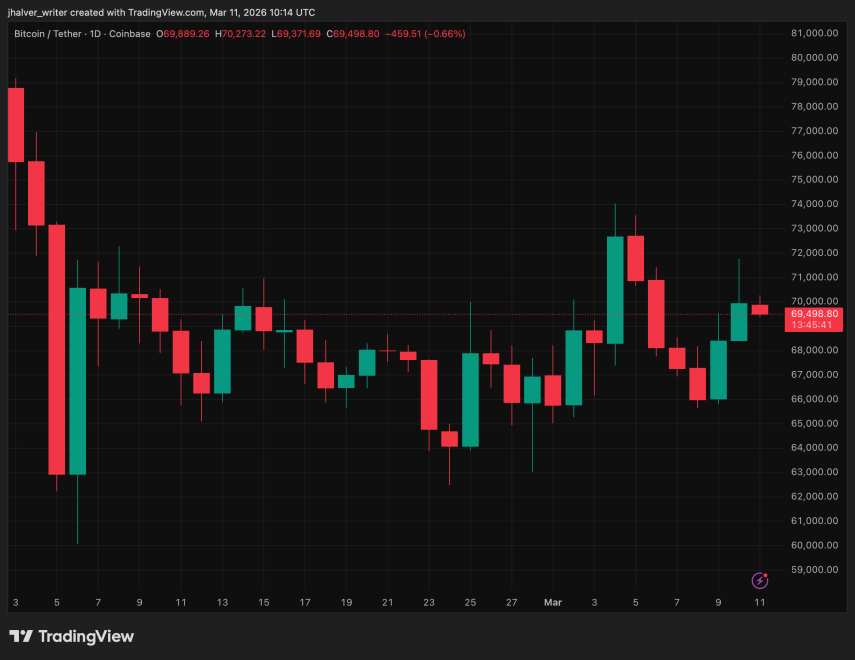
BTC’s price trends to the downside on the daily chart. Source: BTCUSDT on Tradingview

Cover image from Perplexity, BTCUSDT chart from Tradingview

Preguntas relacionadas

QWhat is the main purpose of the DEATH BETS Act introduced by Senator Schiff?

AThe DEATH BETS Act aims to explicitly ban prediction market contracts tied to terrorism, assassination, war, or an individual's death on any platform registered with the CFTC.

QWhich specific examples of prediction contracts did Senate Democrats cite in their letter to CFTC Chair Michael Selig?

AThe letter cited Polymarket's on-chain contracts on whether the Artemis II would explode, if Venezuela's Nicolás Maduro would be removed from power, and if Ukraine's Myrnohad would be captured by Russian forces.

QHow does Senator Schiff characterize the current state of prediction markets in his statement?

ASenator Schiff characterized prediction markets as 'the Wild West' where regulators have been turning a blind eye to gambling on lives.

QWhat significant trading activity was mentioned regarding Iran-related prediction markets?

AA bet on whether Iran's Ali Khamenei would be 'out as Supreme Leader' had $54 million in trading volume on Kalshi before being paused, with reported profits of $1.2-1.4 million for some traders before U.S. strikes.

QWhat will be the practical effect of the DEATH BET Act on trading platforms according to the article?

ACFTC-supervised platforms will become safer but more limited, while riskier war/death betting will be pushed to offshore or permissionless crypto venues, increasing legal and reputational risks there.

Lecturas Relacionadas

Misjudged A-Shares: Resilience, Expectations, and Confidence

China's A-share market recently faced selling pressure, especially in tech sectors, initially triggered by a global tech sell-off that began in South Korea. However, the article argues this is a case of "mistaken injury" and highlights the market's underlying resilience. This resilience stems from three main pillars: **1) Tech Sector Fundamentals:** Unlike Korea's market dominated by a few memory chip stocks, China's tech sector is diversified across computing, communications, electronics, and semiconductors, supported by dual narratives of global AI supply chains and domestic substitution. Core areas like optical modules and fiber optics continue to show strong earnings growth. **2) "National Team" Support:** State-backed institutions and large corporations have made significant market purchases and announced buybacks, providing liquidity and signaling confidence. This is seen as a stabilizing policy signal, often associated with market bottoms. **3) Broader Market Pillars:** Other major sectors are showing endogenous recovery momentum. Consumer stocks benefit from stabilizing CPI and signs of sector recovery (e.g., liquor price hikes). Cyclical sectors like aluminum have high earnings, potential price increases due to tight supply, and low valuations. The financial sector offers stable dividends and low valuations. The conclusion is that the sell-off was driven by external contagion, not a collapse in fundamentals. With strong policy support and recovering momentum across key sectors, the A-share market possesses the toughness to regain stability.

marsbitHace 12 min(s)

Misjudged A-Shares: Resilience, Expectations, and Confidence

marsbitHace 12 min(s)

The Clarity Act's Journey Through Congress: The Thorny Path of Bipartisan Compromise in the U.S.

The U.S. Congress is struggling to advance the crypto market structure bill known as the Clarity Act, with bipartisan compromise proving difficult. Key hurdles include unresolved disputes over "yield" products and, more critically, the inclusion of strong ethics provisions for elected officials—a non-negotiable demand for many Democrats. While a compromise on yield was reached in May, securing only limited Democratic support in committee, the separate Senate Agriculture Committee version later passed with no Democratic votes due to the ethics impasse. As Republicans push for a full Senate vote in July, demands for ethics rules have expanded, and other contentious issues like developer protections and concerns from law enforcement and large banks further complicate negotiations. Despite consensus on the need for legislation, the path forward is unclear. Recent discussions between senators and White House officials aim to find acceptable ethics language. Some lawmakers question whether a compromise text can garner enough bipartisan support, with one Democrat stating the current proposal lacks the strong ethics provisions required for their vote. Potential short-term goals for the crypto community include symbolic Senate action before the August recess, a longer-term aim for passage by 2026, or establishing a detailed framework that addresses ethics and other compromises. The process remains arduous, relying on the traditional, vote-by-vote effort to build bipartisan support.

marsbitHace 31 min(s)

The Clarity Act's Journey Through Congress: The Thorny Path of Bipartisan Compromise in the U.S.

marsbitHace 31 min(s)

Are Kalshi and Polymarket Founders at Odds? This Business Rivalry Is More Brutal Than You Think

"The Rivalry Between Kalshi and Polymarket Founders Turns Bitter and Litigious" The intense feud between Tarek Mansour, CEO of Kalshi, and Shayne Coplan, founder of Polymarket, has escalated far beyond typical business competition into personal animosity and regulatory battles. Both lead billion-dollar prediction market platforms, but their approaches differ sharply. Kalshi positions itself as the compliant operator, securing U.S. regulatory approval before launching. In contrast, Polymarket initially operated offshore, allowing U.S. users to access its platform via VPN, which drew regulatory scrutiny. The conflict reached a peak in November 2024 when FBI agents raided Coplan's New York apartment. While Coplan publicly blamed political motives, his team privately suspected Kalshi was involved. According to sources, Kalshi's lawyers had previously reported Polymarket's operations to federal prosecutors, highlighting its accessibility to U.S. users despite a ban. This incident fueled mutual accusations and underhanded tactics, including social media smear campaigns and attempts to sabotage each other's major business deals. Their rivalry also played out in Washington, influencing regulatory debates. Kalshi actively lobbied against Polymarket's practices, framing them as illegal and unethical. Polymarket, after facing a CFTC fine and investigation, later acquired a licensed U.S. firm to launch a domestic app, regaining a foothold. Despite the hostility, both companies have seen massive growth, with combined trading volumes soaring. However, increased regulatory scrutiny, particularly around insider trading on Polymarket's platform, continues to pose challenges. The founders' deep-seated mutual disdain ensures their battle for market dominance remains as much a personal vendetta as a commercial one.

marsbitHace 40 min(s)

Are Kalshi and Polymarket Founders at Odds? This Business Rivalry Is More Brutal Than You Think

marsbitHace 40 min(s)

Trading

Spot
活动图片





