A New Project in the ZEC Space: Vitalik's Only Coin Purchase in Two Years

marsbitPublicado a 2026-08-25Actualizado a 2026-08-25

Resumen

Amidst the bullish market, Ethereum co-founder Vitalik Buterin made his first significant public investment in a new project token in nearly two years. In the first public CCA auction for The Interfold on Uniswap, he invested 16 ETH (approx. $28,000). Following its TGE on August 19th, $FOLD's price surged over 7x, driven largely by the "Vitalik bought it" narrative before a listing on Upbit caused another spike. The price has since settled back to a range primarily supported by this narrative. The Interfold is a privacy-focused project by Gnosis Guild, a protocol enabling multiple untrusting parties to perform verifiable computations without exposing private inputs. While technically complex compared to simpler privacy assets like ZEC, the project has gained significant attention due to Vitalik's public endorsement, repeated mentions at events, and his committed, unsold investment. Analysts view $FOLD optimistically. Unlike his previous investment in Truemarkets' $TRUE, which never listed on major exchanges, $FOLD quickly listed on Upbit, boasts a ~$27M circulating market cap (~$100M FDV), and benefits from a strong ETH and overall market sentiment. The primary investment thesis revolves around attention-driven factors—Vitalik's backing and market liquidity—rather than its complex underlying technology. However, at its current valuation, some question whether the risk/reward remains attractive compared to other chains with strong momentum.

In the midst of a heated market, Vitalik has finally made his move again after two years.

Last month, Vitalik invested 16 ETH (approximately $28,000) in the first round of the CCA public auction for The Interfold on Uniswap. Prior to this, the last time Vitalik made a substantial public investment in a new project token or related asset was in November 2024, when he invested 32 ETH (approximately $107,000) in the public NFT sale of the prediction market Truemarkets.

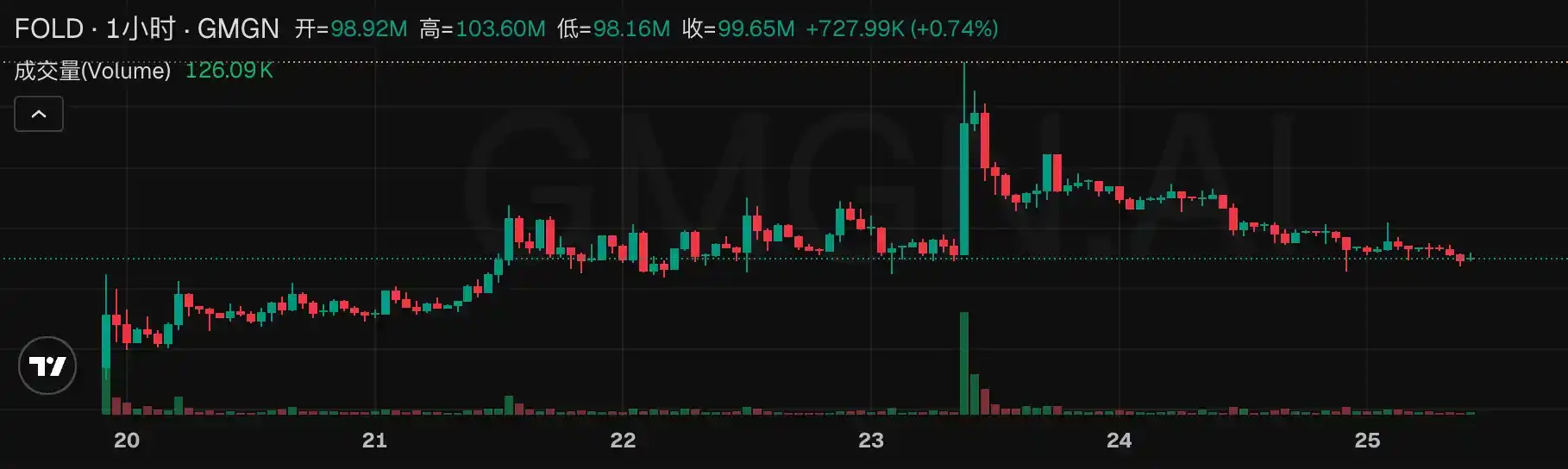
On August 19th, $FOLD underwent its TGE, subsequently skyrocketing more than 7 times at its peak. This price surge can be examined in two phases. On August 23rd, Upbit listed $FOLD, causing its price to double instantly and briefly reach a market cap of around $230 million. Before this, the momentum was almost entirely driven by the narrative 'Vitalik bought it,' with on-chain players organically building consensus around this story, pushing the coin's market cap from approximately $28 million to a high of around $140 million.

After the sudden positive news of the Upbit listing, $FOLD did not ride the market trend higher but instead retraced to levels seen before the news broke. Therefore, we can roughly say that the coin has now returned to the value range dictated by the 'Vitalik bought it' narrative:
In reality, the 'Vitalik bought it' narrative surrounding the $FOLD token is more substantial than it seems. This is a privacy-focused project, an open-source privacy protocol developed by Gnosis Guild. It enables multiple distrusting independent parties to collaboratively perform verifiable computations, yielding a shared result, without exposing their private inputs, relying on a single operator, or using trusted hardware.

For specific use cases, consider a DAO where anyone can vote privately; no one can see any individual voting record, yet everyone can verify the authenticity of the final voting result.

Encrypted data inputs are submitted to the protocol's encrypted execution environment, E3. Each computation involving encrypted data creates an independent E3. After the computation concludes, the E3 is terminated, leaving no data traces behind.

Nodes that perform the ciphertext computations and decryption need to stake $FOLD to qualify.

Compared to ZEC, ZEC itself is an asset primarily focused on privacy, whereas The Interfold is a multi-party private computation protocol that allows various parties collaborating on a task to complete it together without sharing their respective data. When imagining real-world applications, this feels quite hardcore, especially regarding the necessity for privacy protection.

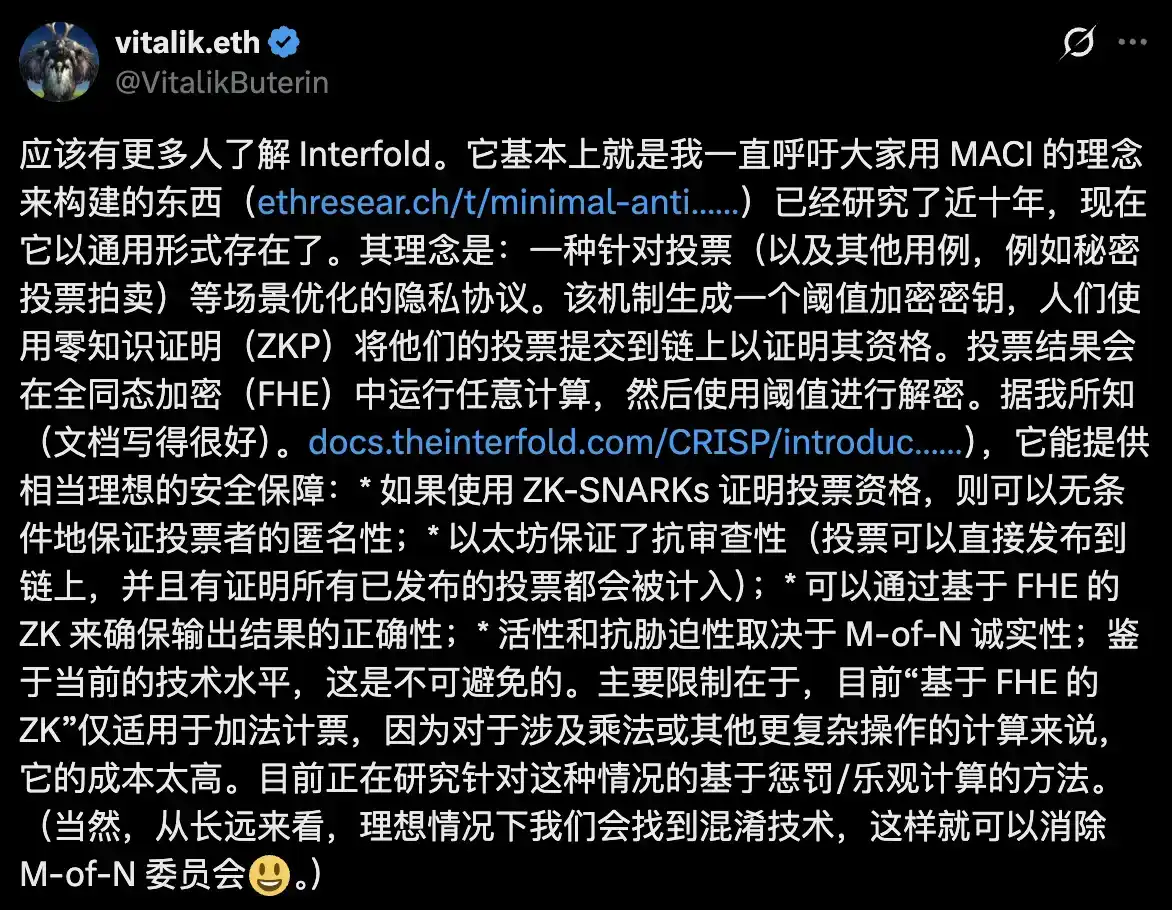
In terms of how easily narratives are accepted, something like ZEC is simple: 'the private version of Bitcoin, nobody sees where my money goes.' However, understanding something like The Interfold presents a higher barrier. Vitalik directly promoted this project on X as early as the end of May this year. Just looking at his reasons for recommending it shows it's not easily grasped...
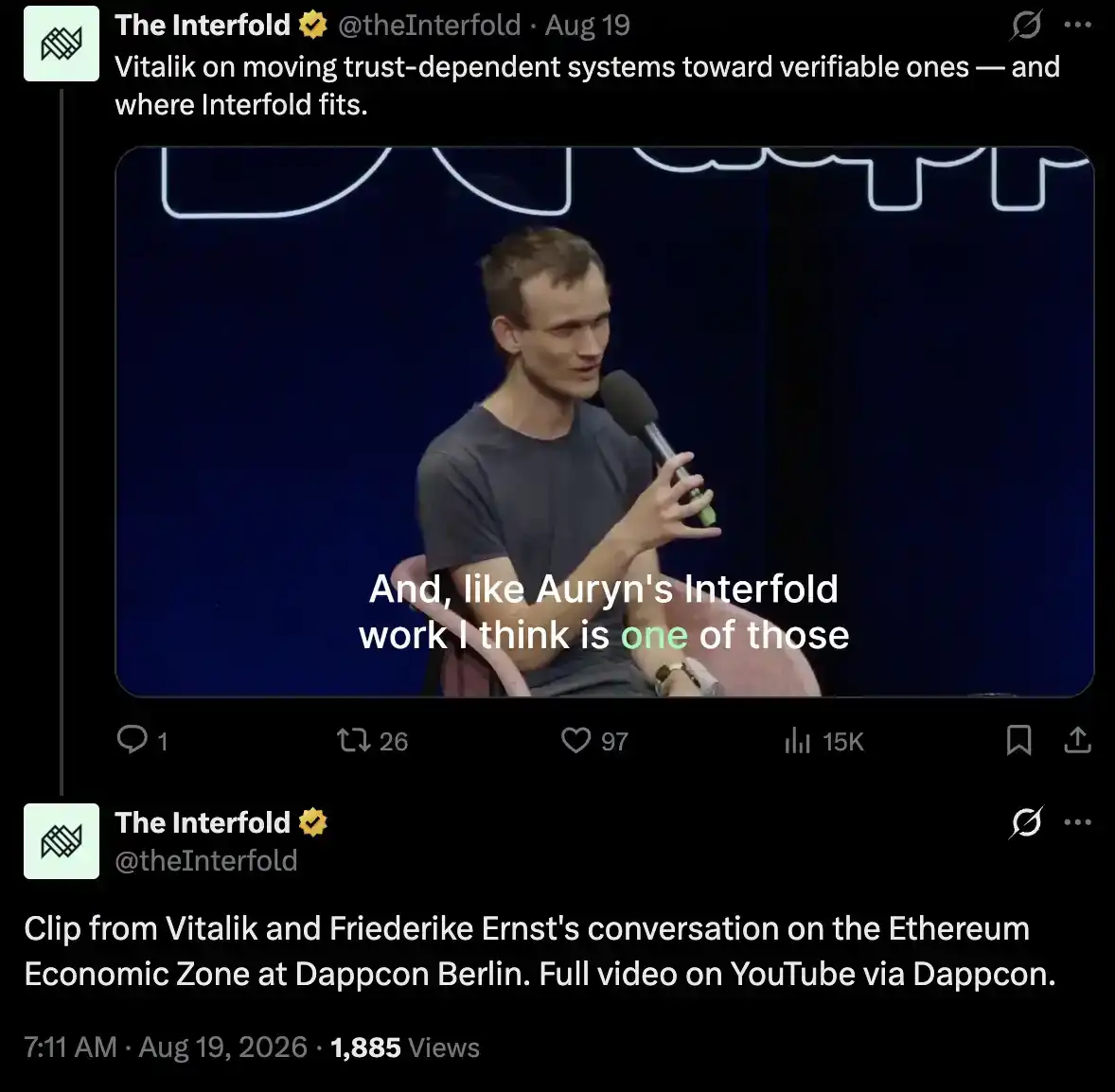
At dappcon in July this year, Vitalik mentioned the project again on stage:
Furthermore, while Vitalik invested 16 ETH in the public auction, he has not yet claimed the tokens from his participation in the sale, let alone sold any. Based on the various behaviors mentioned above, one could say players don't really care about what The Interfold can be used for. It's enough to know it's a project that Vitalik is optimistic about, has repeatedly mentioned, and has personally invested in.

As for where this token might go from here, my personal view is relatively optimistic. Firstly, it's difficult to compare it to Truemarkets, the prediction market Vitalik participated in last time. When $TRUE had its TGE last year, the market environment was incomparable to now, and $TRUE wasn't listed on any exchange, major or minor.

$TRUE's fully diluted market cap didn't break $20 million at its peak. $FOLD currently has about 27% circulating, with a circulating market cap of approximately $27 million and an FDV of around $100 million. For a project that listed on Upbit just days after its TGE, $FOLD seems to have room from this perspective.

For projects Vitalik supports with his own money, for medium-to-short-term trading, one could assume he won't sell—at least with Truemarkets, he hasn't moved his holdings, whether during the current price lows or the peak last October. The 'Vitalik bought it' narrative for $FOLD is likely to persist, especially since he himself keeps mentioning it. The probability of waking up one day to find the narrative changed to 'Vitalik sold' is indeed quite low.

Secondly, although this project is a legitimate privacy protocol, from a speculative standpoint, there's nothing wrong with approaching it with a meme coin mindset. The positive catalysts we can list now—ETH strength, overall good on-chain market conditions, Upbit listing, and Vitalik repeatedly mentioning it—are all essentially attention-driven logic. The bet is that in a generally liquid market, ETH will also have its own hotly chased asset.

The inherent complexity of its technology and use cases means that for most on-chain players, the attention-grabbing factors won't be the tech or use cases themselves, but rather the multiple attention-driven factors mentioned above.

However, with decent profit potential on Robinhood, BSC, Solana, and other chains, speculating on a project with a circulating market cap nearing $30 million, and on the Ethereum mainnet—a chain currently lacking much heat—could be seen as either getting ahead of the curve or being too niche. It's hard to judge at this point. At the current price level, while $FOLD has Vitalik's endorsement, the risk-reward ratio might not be particularly enticing either.

Criptos en tendencia

Preguntas relacionadas

QWhat did Vitalik do for the first time in two years regarding a new project, according to the article?

AHe invested 16 ETH (approximately $28,000) in the first public CCA auction for The Interfold (FOLD) on Uniswap.

QWhat are the main narrative drivers behind the FOLD token's price movement mentioned in the article?

AThe primary narrative driver is 'Vitalik bought it.' Additional factors include its listing on Upbit, the overall positive market sentiment, and Vitalik's repeated public mentions of the project.

QHow does The Interfold (FOLD) project differ from ZEC (Zcash) in its core function?

AZEC is primarily a privacy-focused cryptocurrency asset. In contrast, The Interfold is a multi-party privacy computation protocol that allows multiple parties to jointly perform verifiable computations without revealing their private inputs to each other.

QWhat is the article's author's general outlook on the future price action of the FOLD token?

AThe author expresses a relatively optimistic view. Reasons include the sustained 'Vitalik bought' narrative (as he is unlikely to sell), the project's Upbit listing, and the favorable market conditions. However, the author notes that at its current valuation, the risk/reward may not be highly attractive.

QAccording to the article, why might The Interfold's technology be less important for its short-term trading potential?

AThe technology and use cases are complex and difficult for most users to understand. Therefore, short-term attention and trading are driven more by narratives and factors like Vitalik's endorsement and exchange listings rather than the project's technical fundamentals.

Lecturas Relacionadas

Wall Street Morning Report: Nvidia Falls for 7 Consecutive Days, AI Stocks Continue to Bleed Out; U.S. Treasury Buybacks Criticized as Temporary Fix, Inflation and Deficit Are the Real Big Problems

Wall Street Morning Report: Tech and Treasury Tensions U.S. stocks were mixed. The Dow gained 0.26%, supported by defensive and consumer staples stocks, while the S&P 500 fell 0.28% and the Nasdaq dropped 0.76% amid a sell-off in AI hardware. The U.S. announced new sanctions targeting Iran's key economic sectors, temporarily easing oil prices (Brent -2.35%). However, concerns over potential disruption to the Strait of Hormuz could pressure European natural gas prices. Meanwhile, the Treasury's upcoming bond buyback plan faced criticism from major banks (Goldman Sachs, Deutsche Bank, Citadel), who argue it doesn't address the root causes of high long-term yields: persistent inflation and the massive fiscal deficit. The 10-year Treasury yield dipped slightly to around 4.70%. Gold rose, with Citi raising its short-term target to $4,800/oz. The AI hardware and semiconductor sector saw intense selling. The Philadelphia Semiconductor Index fell nearly 3%. NVIDIA dropped 2.91%, marking its seventh consecutive daily decline—its longest losing streak since 2022—due to pre-earnings caution despite strong analyst estimates. Memory chip stocks (Micron -6%, others down 5-6%) fell after Samsung's shareholder returns disappointed, raising cycle peak fears. Optical communications was also a big loser, led by Applied Optoelectronics (-14%) on equity dilution concerns. Wall Street is growing wary of off-balance-sheet credit risks in AI infrastructure financing. In other moves, Tesla fell 3.83% on a major China recall. Meta rose 1.66% on news of its upcoming "Hatch" AI platform. Defensive stocks like Visa and Walmart supported the Dow. Key upcoming events include the Jefferies Semiconductor Conference (Aug 25-26), Gamescom (Aug 26-30), and NVIDIA's earnings report (Aug 28).

marsbitHace 22 min(s)

Wall Street Morning Report: Nvidia Falls for 7 Consecutive Days, AI Stocks Continue to Bleed Out; U.S. Treasury Buybacks Criticized as Temporary Fix, Inflation and Deficit Are the Real Big Problems

marsbitHace 22 min(s)

Analog Chip Giants TI and ADI Are Stepping Up

Analog chip giants Texas Instruments (TI) and Analog Devices (ADI) have both reported strong quarterly results, signaling an industry recovery. TI's Q2 2026 revenue reached $5.463 billion, a 23% year-over-year (YoY) increase. ADI's Q3 FY2026 revenue hit $4.022 billion, up 40% YoY, marking a new quarterly record. Both companies benefited from rising demand in industrial and data center markets, though their growth paths differed. TI experienced broad-based strength across its segments. Industrial revenue (33% of total) grew approximately 30% YoY, while data center revenue (9%) doubled. The automotive segment (33%) also showed a strong rebound, attributed to demand from China's EV/hybrid market and low inventory levels at automakers. ADI's growth was led by its industrial (49% of revenue, +53% YoY) and communications (16%, +84% YoY) segments, with data center products constituting 80% of the latter. Management highlighted a significant "AI exposure," with data center and ATE-related businesses now accounting for 20% of total revenue. Key differences emerged in their strategies and supply chain dynamics. ADI attributed a larger portion of its growth to AI infrastructure demand and has built "strategic inventory" to a record high of ~$1.93 billion to support future growth, despite channel inventory being below target levels. Its product lead times have extended to up to six months, and price increases are contributing to margin expansion. TI's inventory remained high at $4.6 billion but saw improved turnover. The company emphasized that its growth is primarily volume-driven, with minimal contribution from recent price hikes. TI maintains a competitive lead time below 13 weeks and expressed confidence in its capacity sufficiency for the next three years. In summary, both companies are riding a recovery wave fueled by industrial and AI/data center demand. TI's approach leverages its broad market presence and prepared capacity, while ADI is more focused on AI-driven growth and strategic inventory buildup. Their differing paths highlight the evolving structure of demand within the analog semiconductor market's rebound.

marsbitHace 47 min(s)

Analog Chip Giants TI and ADI Are Stepping Up

marsbitHace 47 min(s)

Trading

Spot

Artículos destacados

Cómo comprar T

¡Bienvenido a HTX.com! Hemos hecho que comprar Threshold Network Token (T) sea simple y conveniente. Sigue nuestra guía paso a paso para iniciar tu viaje de criptos.Paso 1: crea tu cuenta HTXUtiliza tu correo electrónico o número de teléfono para registrarte y obtener una cuenta gratuita en HTX. Experimenta un proceso de registro sin complicaciones y desbloquea todas las funciones.Obtener mi cuentaPaso 2: ve a Comprar cripto y elige tu método de pagoTarjeta de crédito/débito: usa tu Visa o Mastercard para comprar Threshold Network Token (T) al instante.Saldo: utiliza fondos del saldo de tu cuenta HTX para tradear sin problemas.Terceros: hemos agregado métodos de pago populares como Google Pay y Apple Pay para mejorar la comodidad.P2P: tradear directamente con otros usuarios en HTX.Over-the-Counter (OTC): ofrecemos servicios personalizados y tipos de cambio competitivos para los traders.Paso 3: guarda tu Threshold Network Token (T)Después de comprar tu Threshold Network Token (T), guárdalo en tu cuenta HTX. Alternativamente, puedes enviarlo a otro lugar mediante transferencia blockchain o utilizarlo para tradear otras criptomonedas.Paso 4: tradear Threshold Network Token (T)Tradear fácilmente con Threshold Network Token (T) en HTX's mercado spot. Simplemente accede a tu cuenta, selecciona tu par de trading, ejecuta tus trades y monitorea en tiempo real. Ofrecemos una experiencia fácil de usar tanto para principiantes como para traders experimentados.

923 Vistas totalesPublicado en 2024.12.10Actualizado en 2026.06.02

Cómo comprar T

Discusiones

Bienvenido a la comunidad de HTX. Aquí puedes mantenerte informado sobre los últimos desarrollos de la plataforma y acceder a análisis profesionales del mercado. A continuación se presentan las opiniones de los usuarios sobre el precio de T (T).

活动图片