A New Player Enters at Third Place, Rothera Disrupts the Prediction Market Landscape

marsbitPublicado a 2026-06-22Actualizado a 2026-06-22

Resumen

"Rothera Skyrockets to Third in Prediction Market Rankings, Disrupting Industry Landscape" Rothera, Robinhood's newly launched prediction market platform, has rapidly climbed to become the third-largest player in the sector by trading volume, trailing only giants Kalshi and Polymarket. Its growth is attributed not to attracting new users, but to migrating existing Robinhood user orders away from partner Kalshi. Previously, Robinhood served as a major distribution channel for Kalshi, accounting for an estimated 25%-35% of its volume. With the launch of Rothera, Robinhood now internally executes events like World Cup contracts, capturing revenue that was previously shared with Kalshi. Data shows Rothera's weekly trading volume surged from $21.9 million to $559 million within weeks, reaching nearly one-fifth of Polymarket's volume. Analysts estimate Robinhood's prediction market business could generate around $10 billion in annual revenue at this pace, potentially surpassing its historical crypto revenue peak. In response, Kalshi is reportedly exploring new distribution channels by engaging with investment banks for a potential IPO, requiring them to integrate their systems with Kalshi to access institutional clients. This shift highlights a new competitive focus in prediction markets: controlling user access and distribution channels rather than just product offerings.

By|Azuma(@azuma_eth)

Last week, Odaily Planet Daily published an article titled "The First Prediction Market Stock Appears!", which primarily mentioned that Robinhood is intercepting orders that previously needed to be executed via Kalshi by building its own prediction market, Rothera. This move aims to reduce revenue sharing with Kalshi and retain profits within its own ecosystem.

Although it was anticipated that Rothera would not face the typical cold start problems of other competitors, its data performance over the past week has still far exceeded our previous expectations. After all, it's hard to imagine that a platform, just launched half a month ago, could directly parachute into third place in the highly competitive prediction market track, trailing only the two giants, Kalshi and Polymarket.
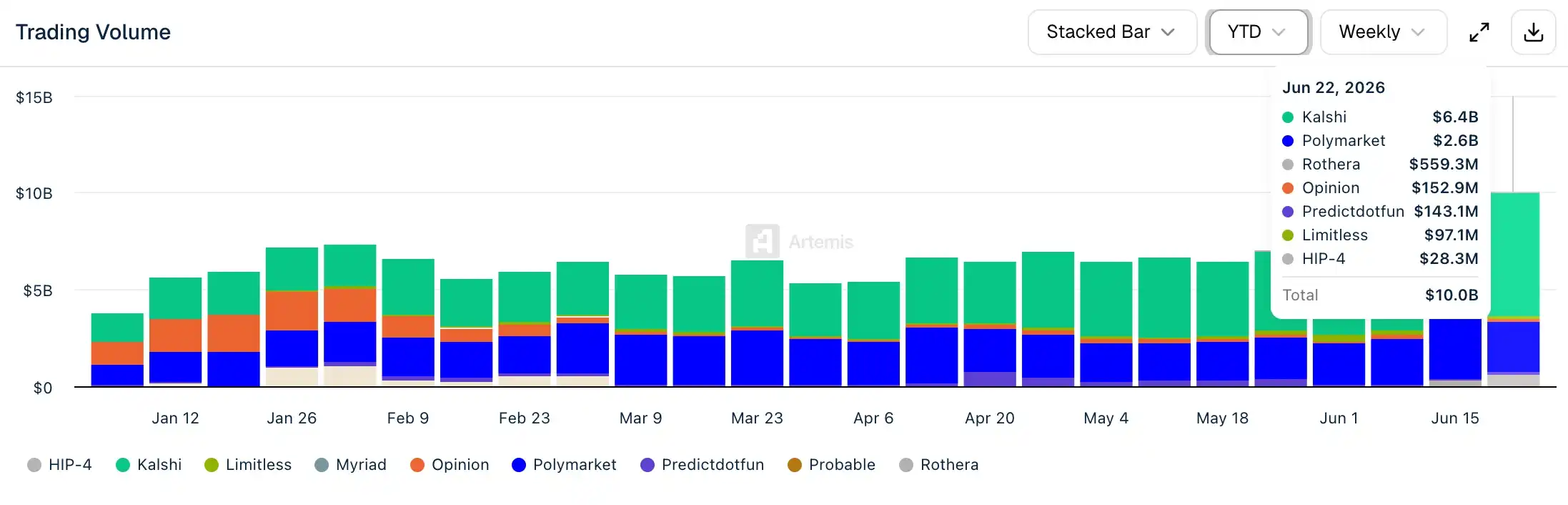
Data from Artemis shows that for the week ending June 8th, as a new platform, Rothera's weekly trading volume was only $21.9 million, still showing a significant gap compared to second-tier platforms like Opinion, Predict, and Limitless. However, for the week ending June 15th, Rothera's weekly trading volume directly jumped to industry third place, reaching $276 million. In the latest week ending June 22nd, Rothera's weekly trading volume has increased to $559 million, almost one-fifth of Polymarket's.

Atypical Growth Case (Can skip if you've read the previous article)

It's important to clarify that Rothera's rise is essentially not due to creating incremental users (though some users may have entered due to the World Cup), but rather a migration of existing orders, not the creation of new users.

Over the past year or so, Robinhood has been one of Kalshi's most important distribution channels. Leveraging tens of millions of retail users and mature access to stock, options, and cryptocurrency trading, Robinhood has funneled a large volume of orders to Kalshi. Piper Sandler analysts estimated that trades completed through the Robinhood channel accounted for about 25%-35% of Kalshi's total trading volume.

The problem is that while these orders came from Robinhood users, they didn't belong to Robinhood itself. Under the previous cooperation model, Robinhood acted more like a front-end traffic portal, while Kalshi was the true infrastructure provider responsible for matching, clearing, and settlement. Revenue generated from each transaction needed to be shared between the two parties.

Rothera is the weapon Robinhood is using to break this profit-sharing model. Since early this month, Robinhood has begun migrating some World Cup-related event contracts to be executed internally on Rothera. This means a large volume of orders that might have previously gone to Kalshi are now retained within Robinhood's own system.

Therefore, in a sense, the surge in Rothera's trading volume is less of a threat to other prediction markets like Polymarket, Predict, or Limitless, and more akin to directly "draining blood" from Kalshi.

Robinhood's Value Capture

The rapid growth of Rothera most directly strengthens Robinhood's ability to capture value from prediction market-related orders on this platform.

Hood House, an investment research media outlet long tracking Robinhood, combined public data to state that as of June 20th, Robinhood's prediction market business traded a total of 34,700 contracts daily, corresponding to daily revenue of approximately $4.9 million.
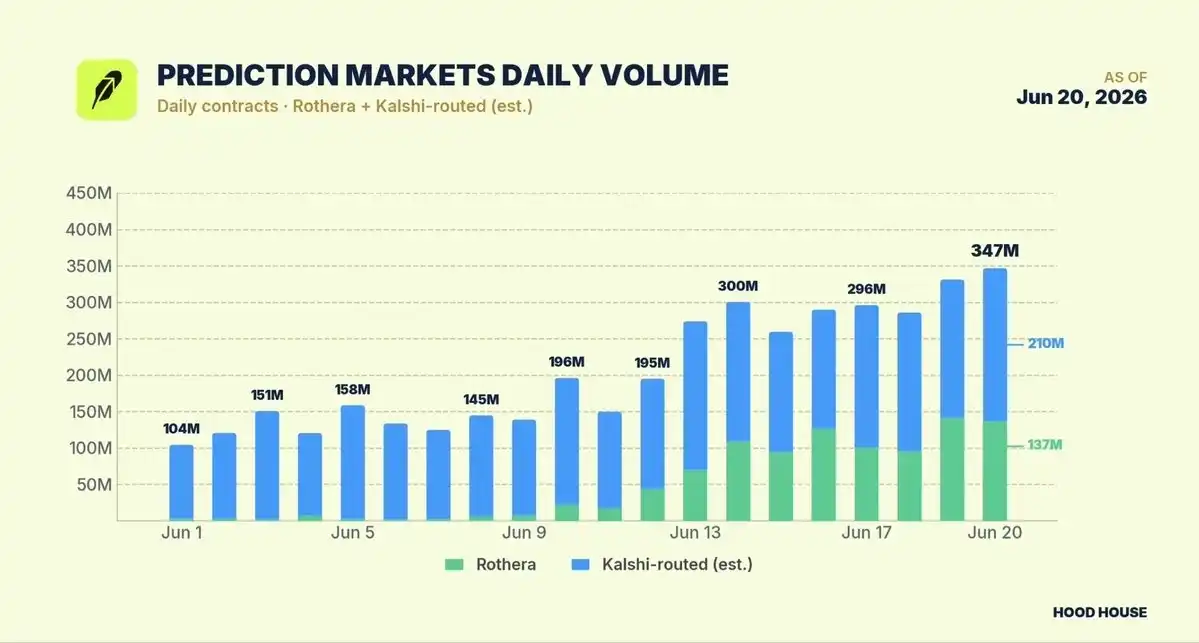
Hood House then disclosed its calculation logic:

  • Rothera (primarily hosting World Cup-related markets) daily trading volume had reached 137 million contracts, corresponding to a trading value of approximately $47 million;
  • For comparison, Kalshi's total daily trading volume was about 1.5 billion contracts, corresponding to a trading value of about $416 million; excluding World Cup-related markets, Kalshi's trading volume was about 1 billion contracts, corresponding to a trading value of about $260 million;
  • Considering that Robinhood users still contribute about 20% (a conservative estimate) of Kalshi's non-World Cup market trading volume, this means that about 210 million contracts and $52 million in trading value from Kalshi's non-World Cup related event contracts were completed via Robinhood.

Hood House further made an aggressive estimate based on this, stating that if this growth rate continues, Robinhood's prediction market business has the opportunity to achieve revenue on the scale of billions of dollars this year. This figure even surpasses the historical peak of Robinhood's cryptocurrency-related revenue, which was approximately $900 million achieved in 2025.

Kalshi's Countermeasure: Finding New Channels

Faced with Rothera's rapid rise, Kalshi is clearly aware of the problem.

For Kalshi, Robinhood was both a partner and one of the most important traffic sources in the past. However, as Robinhood begins migrating more and more orders to its own platform, the relationship between the two has become one of direct competition.

A recent piece of news disclosed by The Information may reveal Kalshi's response strategy. Informed sources revealed that Kalshi has begun early, informal discussions with several investment banks regarding a potential future IPO. More notably, Kalshi has presented a clear requirement in its communications with these banks — to be considered for underwriting qualifications in the future IPO, these institutions need to prioritize completing technical integration of their systems with Kalshi. This would allow their institutional clients to directly participate in trading event contracts on the Kalshi platform.

In other words, Kalshi is leveraging the IPO opportunity to find new distribution channels, integrating prediction markets into the client networks of banks, brokerages, and other financial institutions. This also represents a subtle change occurring in the competitive landscape of the prediction market industry. In the past, the focus was on who could offer more contracts or design better products. Now, as prediction markets gradually move into the mainstream financial system, the competitive focus is shifting to another dimension — whoever controls the user access points can more effectively control value.

The rise of Rothera has already demonstrated the significance of distribution capability. Parachuting into third place in the track seems effortless. Challenging Kalshi and Polymarket in the future may not seem like an impossible task either.


Preguntas relacionadas

QWhat is the main reason for the rapid rise of Robinhood's prediction market platform Rothera according to the article?

AThe main reason is the migration of existing orders, not the creation of new users. Robinhood, previously a key distribution channel for Kalshi, began directing orders related to events like the World Cup to its own platform Rothera instead of Kalshi, capturing more value internally.

QHow does Rothera's weekly trading volume compare to that of the industry leader Polymarket as of the latest data mentioned?

AAs of the week ending June 22, Rothera's weekly trading volume reached $5.59 billion, which is nearly one-fifth (or approximately 20%) of Polymarket's volume.

QWhat is Kalshi's reported strategy for responding to the competition from Rothera?

AKalshi is reportedly exploring new distribution channels by discussing a potential future IPO with investment banks. A key requirement is that banks seeking underwriting roles must integrate their systems with Kalshi to allow their institutional clients direct access to trade event contracts on Kalshi's platform.

QWhat major shift in the prediction market competition is highlighted as a result of Rothera's growth?

AThe focus of competition is shifting from merely providing more contracts or better products to controlling user access points. The article states that 'whoever can control the user entry point can more effectively control the value.'

QWhat was the estimated daily revenue for Robinhood's prediction market business as of June 20, according to the Hood House analysis cited?

AAccording to Hood House's analysis based on public data, Robinhood's prediction market business generated an estimated daily revenue of approximately $4.9 million on June 20.

Lecturas Relacionadas

Funding Weekly | Crypto.com Secures $400M Investment, CeFi and Stablecoin Sectors Continue to Attract Capital

Crypto Weekly Investment Recap: Funds Converge on CeFi, Stablecoins, and AI Last week's crypto and AI investment landscape saw significant capital concentration, with a few large deals dominating. **Crypto/Web3 Highlights (July 13-19):** Total investment exceeded **$812 million** across 17 deals. Key trends: * **Centralized Finance (CeFi) & Stablecoins** remained a major magnet, led by **Crypto.com**'s massive **$400 million** raise from Citadel Securities, valuing the exchange at $20B. * **Infrastructure & Tools** saw 7 deals, including **Cyclops** ($20M for stablecoin payments) and **ADI Chain** ($50M for stablecoin settlement infrastructure). * **DeFi** had 2 deals, such as AI-native DEX **Quote Trade** ($4M). * Other notable raises: API broker **Alpaca** ($135M), cross-border platform **Flex** ($70M), treasury firm **ORANGE JUICE** ($40M), and prediction market **Pascal** ($9M). * **Acquisitions:** Keyrock bought BlockFills' trading unit, SBI Holdings acquired Singapore exchange Coinhako, and MoonPay bought startup Glide. **AI & Robotics Highlights:** Investment momentum in AI remained very strong. * Nvidia-backed AI cloud service **Fireworks** raised a massive **$1.5 billion** at a $17.5B valuation. * In robotics, **Walden Robotics** (spun out from Toyota) secured **$300 million**, and Chinese humanoid firm ****逐际动力** **(Climax Dynamics) raised nearly **$200 million** in a Pre-IPO round. * Other significant AI raises included Indian programming platform **Emergent** ($130M) and drone company **Brinc** ($125M), backed by Sam Altman. Overall, the trend shows capital flowing heavily into established crypto financial services, stablecoin infrastructure, and large-scale AI/robotics commercialization.

marsbitHace 57 min(s)

Funding Weekly | Crypto.com Secures $400M Investment, CeFi and Stablecoin Sectors Continue to Attract Capital

marsbitHace 57 min(s)

The Gentlest Bear Market? BTC Bears Exit, ARK and Bitwise Collectively Bullish

**Title: The Mildest Bear Market? BTC Shorts Exit, ARK and Bitwise Collectively Bullish** Bitcoin continues to consolidate around $75,000 while Ethereum struggles near $1,900. Market data shows $116 million in liquidations over 24 hours, with $62.7 million from short positions, and the Fear & Greed Index remains at 35 (Fear). According to Polymarket, there's a 33% probability BTC falls below $50,000 this year. ARK Invest's Q2 2026 Bitcoin report notes technical weakness but identifies potential bottoming signals, including a record high in long-term holder supply, suggesting selling exhaustion. Bitwise's Juan Leon calls this the "structurally mildest bear market" on record, with a ~50% drawdown from highs, less severe than past cycles. He highlights institutional accumulation and a shift in investor dialogue from survival to entry points. Technical analysis from Bit suggests a potential C-wave low may have formed, with an ideal bottoming range between $50,000-$55,000. However, glassnode's CryptoVizArt warns that failure to break $66,000 could signal a local top, as new buyer accumulation is concentrated there. Analyst Darkfost identifies a critical support band between $59,000-$70,000, where 50% of BTC's circulating supply has changed hands. Notably, trader Doctor Profit announced closing all crypto short positions—including BTC shorts from $115k-$125k and over 100 altcoin shorts—for significant profit. He has begun a phased accumulation of Bitcoin spot starting at $64,000, reversing his previous $40k-$50k target, citing structural positives like regulatory clarity and institutional adoption. He argues the anticipated September/October bottom may arrive earlier than the herd expects.

Foresight NewsHace 1 hora(s)

The Gentlest Bear Market? BTC Bears Exit, ARK and Bitwise Collectively Bullish

Foresight NewsHace 1 hora(s)

The Evolution of Order in the AI & Web3 Era: The Competitive Dimensions and Exploratory Path of m&W

The article explores the evolution of order in the AI & Web3 era, framing the competition around establishing new foundations for human-AI collaboration. It argues that as AI Agents become core economic participants, the existing Web3 infrastructure—focused on assets, identity, and decentralized governance—is insufficient. The core challenge shifts to building trust, assessing complex contributions, and creating fair value distribution among diverse human and AI actors. The analysis positions the m&WDAO project within this landscape by comparing it to existing paradigms: Colony (human-centric DAO governance), SingularityNET (AI service exchange), Gitcoin Passport (Sybil-resistant identity), and Farcaster/Lens (open social graphs). m&W's distinct path, termed EcoFi (Ecological Finance/Order), aims to integrate these layers. Its three-phase evolution is outlined: 1) **m&W 1.0: Credit Anchoring** - filtering high-quality "Builder" nodes and converting their contributions into non-transferable SBTs (Soulbound Tokens) as a bedrock of trust. 2) **m&W 2.0: Collaborative Economy** - deploying the EcoFi protocol to enable verified, complex task collaboration with a hybrid AI/human judgment system for valuation and dispute resolution, creating a closed-loop value system. 3) **m&W 3.0: Intelligent Order** - where human-originated SBT credit enables trusted AI Agent "digital twins" to participate in a mature human-AI co-creation economy. The conclusion asserts that while other projects solve discrete problems (proving identity, governing contributions, exchanging AI capabilities), m&W's ultimate mission is to address the foundational question of a new socio-economic order for the coming era of human-AI collaborative networks.

链捕手Hace 1 hora(s)

The Evolution of Order in the AI & Web3 Era: The Competitive Dimensions and Exploratory Path of m&W

链捕手Hace 1 hora(s)

Trading

Spot
活动图片