A Less 'Hawkish' 'Hawkish Rate Cut' and Balance Sheet Expansion Buying Bonds That 'Is Not QE'

深潮Publicado a 2025-12-11Actualizado a 2025-12-11

Resumen

The Federal Reserve cut interest rates by 25 basis points for the third consecutive time in 2024, lowering the target range to 3.50%-3.75%. The decision revealed the largest internal dissent in six years, with three officials opposing the move. The updated dot plot continues to project only one more rate cut in 2025, signaling a significant slowdown in the pace of easing. Chair Jerome Powell emphasized that the current policy stance allows the Fed to be patient and data-dependent, noting that no one is assuming the next move will be a hike. Simultaneously, the Fed announced it would begin purchasing short-term Treasury bills to maintain ample reserves in the banking system, with an initial $40 billion in purchases planned for the next month. Powell stressed that these operations are for reserve management purposes and do not represent a change in monetary policy stance. The economic projections were slightly revised, with upgrades to GDP growth and minor downgrades to inflation expectations. The labor market is showing signs of cooling, with the unemployment rate rising and job growth slowing.

Source: Wall Street Journal

The Federal Reserve cut interest rates again at the conventional pace as the market expected, but it exposed the largest divergence among voting policymakers in six years, signaling a slowdown in the pace of action next year and a potential pause in the near term. The Fed also, as expected by Wall Street, initiated reserve management operations, deciding to buy short-term Treasury bonds by year-end to address pressures in the money markets.

On Wednesday, December 10, Eastern Time, the Federal Reserve announced after its FOMC monetary policy meeting that the target range for the federal funds rate was lowered from 3.75%-4.00% to 3.50%-3.75%. This marks the third 25-basis-point rate cut this year, bringing the total reduction for the year to 75 basis points. Since September of last year, this easing cycle has cumulatively cut rates by 175 basis points.

It is worth noting that the Fed's interest rate decision faced three dissenting votes for the first time since 2019. Governor Milan, appointed by Trump, continued to advocate for a 50-basis-point cut, while two regional Fed presidents and four non-voting members supported holding rates steady. In effect, seven officials opposed the decision, reportedly the largest divergence in 37 years.

The dot plot released after the meeting showed that the interest rate path forecast by Fed policymakers remained consistent with the one published three months ago, still projecting one 25-basis-point rate cut next year. This implies that the pace of rate cuts next year will slow significantly compared to this year.

As of Tuesday's close, CME Group's FedWatch Tool showed that the futures market priced in an approximately 88% probability of a 25-basis-point cut this week, while the probability of at least another 25-basis-point cut did not reach 71% until next June. The probabilities for such a cut at the January, March, and April meetings next year all remained below 50%.

The predictions reflected by the CME tool can be summarized by the recently popular term "hawkish cut." It refers to the Fed cutting rates this time while simultaneously signaling a potential pause in action, with no further cuts in the near term.

Nick Timiraos, a veteran Fed reporter known as the "new Fed whisperer," stated bluntly after the meeting that the Fed "signaled it may pause on rate cuts for now" due to "rare" internal disagreements over whether to worry more about inflation or the job market.

Timiraos pointed out that three officials dissented from the 25-basis-point cut at this meeting, and the stalled decline in inflation and cooling labor market made this meeting the most divisive in recent years.

Powell emphasized at the post-meeting press conference that he did not believe "a rate hike at the next meeting" was anyone's base case. The current level of rates allows the Fed to be patient and observe how the economy evolves. He also stated that the available data so far does not indicate a change in the economic outlook, and the scale of Treasury purchases may remain high in the coming months.

01 Fed Cuts Rates by 25 Basis Points as Expected, Still Projects One Cut Next Year, Initiates RMP Buying $40B in Short-Term Bonds

On Wednesday, December 10, Eastern Time, the Federal Reserve announced after its FOMC monetary policy meeting that the target range for the federal funds rate was lowered from 3.75%-4.00% to 3.50%-3.75%. This marks the third consecutive FOMC meeting with a rate cut, each by 25 basis points, bringing the total reduction for the year to 75 basis points. Since September last year, this easing cycle has cumulatively cut rates by 175 basis points.

It is worth noting that the Fed's interest rate decision faced three dissenting votes for the first time since 2019. Trump-appointed Governor Milan continued to advocate for a 50-basis-point cut, while two regional Fed presidents and four non-voting members supported holding rates steady. In effect, seven officials opposed the decision, reportedly the largest divergence in 37 years.

A key change in this meeting's statement compared to the previous one was in the interest rate guidance. Although the decision was to cut rates, the statement no longer broadly said that, when considering further rate cuts, the FOMC would assess incoming data, the evolving outlook, and the balance of risks. Instead, it more explicitly referred to considering the "extent and timing" of future adjustments. The statement now reads:

"In considering the extent and timing of any adjustments to the target range for the federal funds rate, the Committee will carefully assess incoming data, the evolving outlook, and the balance of risks."

The meeting statement reiterated that inflation remains somewhat elevated and that the downside risks to employment have increased in recent months. It removed the phrase "remains low" regarding the unemployment rate, noting it had risen slightly to 4.4% as of September.

The addition of "extent and timing" regarding further rate cuts is seen as signaling a higher bar for future cuts.

Another important change in this meeting's statement compared to the last was the addition of a new paragraph specifically noting the intention to purchase short-term bonds to maintain ample reserve balances in the banking system. The statement wrote:

"The Committee views reserve balances as having declined to ample levels and will begin purchases of Treasury bills, as needed, to maintain ample reserve balances over time."

This amounts to announcing the start of so-called reserve management operations, rebuilding liquidity buffers in the money markets. Year-end often sees market disruptions as banks typically reduce activity in the repo market to support their balance sheets for regulatory and tax settlements.

The statement said reserves have declined to ample levels and, to maintain ample reserves, will begin buying short-term bills this Friday. The New York Fed plans to buy $40 billion in short-term bills over the next 30 days and expects Reserve Management Purchases (RMP) of short-term bills to remain high in the first quarter of next year.

The median projection of Fed officials' interest rate forecasts released after Wednesday's meeting showed that their expectations this time were exactly the same as the previous ones published in September.

Fed officials currently also project that, after three rate cuts this year, there will likely be one 25-basis-point cut each in the next two years.
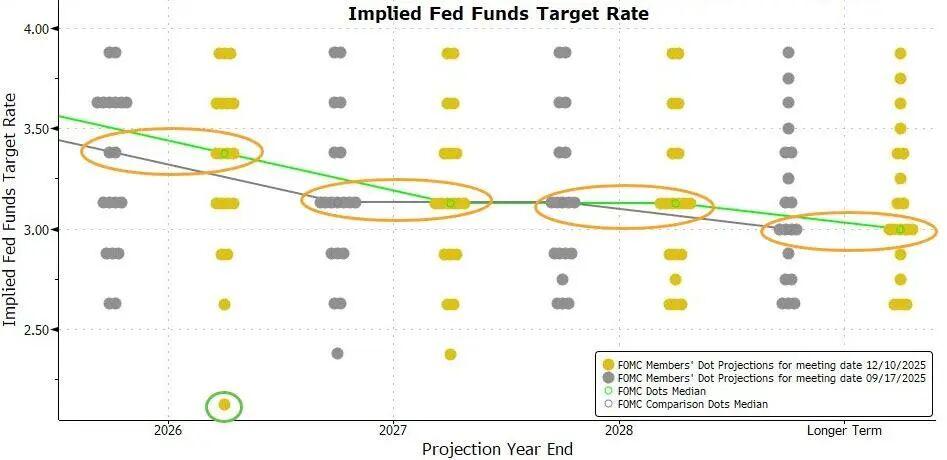
Many had expected that the dot plot reflecting future interest rate movements would show Fed policymakers leaning more hawkish. This dot plot did not show such a tendency; instead, it was slightly more dovish compared to the previous one.

Among the 19 Fed officials providing forecasts, seven now project the interest rate next year to be between 3.5% and 4.0%, compared to eight who projected this last time. This means that the number of officials expecting no rate cuts next year decreased by one.

The economic projections released after the meeting showed that Fed officials raised their GDP growth forecasts for this year and the subsequent three years, and slightly lowered the unemployment rate forecast for 2027, i.e., the year after next, by 0.1 percentage point, while leaving the forecasts for other years unchanged. This adjustment indicates that the Fed views the labor market as more resilient.

Simultaneously, Fed officials slightly lowered their forecasts for PCE inflation and core PCE inflation for this year and next year by 0.1 percentage point each. This reflects a slightly stronger confidence in inflation slowing over the coming period.

02 Powell: Current Rates Allow for Patience, Does Not Believe 'Next Move is a Hike' is Anyone's Base Case

With today's cut, the Fed has lowered the policy rate by a total of 75 basis points over the past three meetings. Powell said this will help gradually return inflation to 2% after the effects of tariffs fade.

He said the adjustments made to the policy stance since September have brought the policy rate into the range of various estimates of "neutral interest rates." The median projection of FOMC members shows the appropriate level for the federal funds rate at the end of 2026 is 3.4% and 3.1% at the end of 2027, unchanged from September.

Powell stated that currently, inflation risks are tilted to the upside, while employment risks are tilted to the downside, presenting a challenging situation.

A reasonable baseline is that the impact of tariffs on inflation will be relatively short-lived, essentially a one-time shift in the price level. Our job is to ensure this one-time price increase does not evolve into a persistent inflation problem. But at the same time, downside risks to employment have increased in recent months, and the overall balance of risks has changed. Our policy framework requires balance between the two aspects of our dual mandate. Therefore, we believe a 25-basis-point cut at this meeting was appropriate.

Given the stalled progress in bringing inflation down, Fed officials had hinted before this week's decision that further cuts might require evidence of labor market weakness. Powell said at the press conference:

"Where we are right now allows us to be patient and watch how the economy evolves."

In the Q&A session, regarding the question of whether the next policy adjustment is necessarily downward now that rates are closer to neutral, or if policy risks have truly turned two-way, Powell responded that no one has rate hikes as their base case currently, and he hasn't heard such views. There are differing views within the Committee: some members believe the current policy stance is appropriate and advocate maintaining the status quo for further observation; others believe another cut may be needed this year or next, perhaps even more than one.

When members write down their judgments on the policy path and appropriate interest rate levels, expectations are mainly concentrated on a few scenarios: either maintaining the current level, implementing a small cut, or a slightly larger cut. Powell emphasized that the current mainstream expectations do not include a rate hike scenario.

Powell stated that as a separate decision, the Fed also decided to initiate purchases of short-term U.S. Treasury bills, with the sole purpose of maintaining ample reserve supplies over time, thereby ensuring the Fed can control the policy rate effectively. He stressed that these issues are separate from the monetary policy stance itself and do not represent a change in policy orientation.

He said the scale of short-term bill purchases may remain high in the coming months, and the Fed isn't strictly "worried" about money market tensions, just that this situation came a bit sooner than expected.

Powell also stated that, according to the New York Fed's announcement, the initial scale of asset purchases will reach $40 billion in the first month and may remain high in the following months to alleviate anticipated short-term money market pressures. Afterwards, the scale of purchases is expected to decline, with the specific pace depending on market conditions.

Regarding the labor market, Powell said that although official October and November employment data are not yet available, existing evidence suggests that both layoffs and hiring remain at low levels. Simultaneously, households' perceptions of job availability and businesses' sense of hiring difficulty continue to decline. The unemployment rate continues to rise slightly, reaching 4.4%, and employment growth has slowed noticeably compared to earlier this year. The Fed also removed the phrase "the unemployment rate has remained low" from the statement.

Powell said in the subsequent Q&A that after adjusting for overestimation in the employment data, job growth may have turned slightly negative since April.


Preguntas relacionadas

QWhat was the outcome of the December 10th FOMC meeting regarding the federal funds rate?

AThe Federal Reserve lowered the target range for the federal funds rate from 3.75%-4.00% to 3.50%-3.75%, marking the third 25 basis point cut of the year.

QWhat does the term 'hawkish cut' refer to in the context of this article?

AA 'hawkish cut' refers to the Fed's decision to cut interest rates while simultaneously signaling that it may pause and not cut rates again in the near future.

QWhat new policy did the Fed announce alongside the rate cut to address money market pressures?

AThe Fed announced it would begin purchasing short-term Treasury bills to maintain an ample supply of reserves in the banking system, starting with a plan to buy $40 billion over the next 30 days.

QAccording to the dot plot, how many rate cuts do Fed officials project for the year 2025?

AFed officials' median projection, as shown in the dot plot, indicates one 25 basis point rate cut for the year 2025.

QWhat was Chairman Powell's stance on the possibility of the next policy move being a rate increase?

AChairman Powell stated that he does not believe a rate hike is anyone's base case assumption for the next policy move and that the mainstream expectations were for either holding rates steady or for small cuts.

Lecturas Relacionadas

Top 10 Promising Emerging Hyperliquid Native Protocols to Watch

Title: A Review of 10 Emerging Native Protocols on Hyperliquid Hyperliquid is evolving beyond perpetual contracts into a comprehensive on-chain financial stack. This article highlights 10 key native protocols driving this growth: 1. **Monetrix**: A yield-optimizing protocol akin to Ethena, aggregating funding rates, HLP rewards, maker rebates, and HIP-3 into a single stablecoin yield. 2. **ROSETTA**: An automated stablecoin yield router, allocating USDC across top protocols (e.g., Felix, Aave, HLP) for optimal returns, factoring in gas and slippage. 3. **papertrade.xyz**: A fair-launched perpetuals protocol offering up to 1000x leverage, no funding rates, no slippage, and fully on-chain, oracle-based execution. 4. **alt.fun**: A launchpad where tokens are paired with leveraged perpetual positions (2x-5x), linking token price to trading activity and underlying position performance. 5. **Ventuals**: Pre-IPO perpetual contracts (built on HIP-3) allowing up to 10x leveraged speculation on valuations of private companies like SpaceX and Stripe. 6. **Liminal**: A delta-neutral yield protocol that captures funding rates via automated short positions and uses generated xTokens (xBTC, etc.) as DeFi collateral. 7. **Melt**: Brings tokenized stocks, commodities, and RWAs to Hyperliquid spot markets, enabling 24/7 trading alongside crypto assets. 8. **Chainsight**: An oracle and data infrastructure protocol providing low-latency (<3s) price feeds, volatility indices, and risk metrics for novel derivatives. 9. **rip.xyz**: Tokenized vault strategies on HyperEVM; its flagship rHYPURR offers liquidity and fractional exposure to a Hypurr NFT basket, priced hourly via NAV. 10. **Markets**: A perpetuals exchange (by Kinetiq) for trading stocks, forex, commodities, bonds, and crypto with up to 50x leverage, using USDH collateral and Kaiko oracles. These protocols form the foundational layer for generating real yield, liquidity, and innovative financial products natively on Hyperliquid.

marsbitHace 49 min(s)

Top 10 Promising Emerging Hyperliquid Native Protocols to Watch

marsbitHace 49 min(s)

Musk Posted a Recruitment Ad for SpaceX, and After Reading the Comments Section, I Understood

On May 20th, SpaceX filed for a landmark IPO with a $1.75 trillion valuation. Shortly after, Elon Musk posted a recruitment call on X, seeking "world-class engineers and physicists" for SpaceX. The application process was starkly simple: email with three bullet points proving "exceptional ability," with real, complex projects as a plus. Musk promised to review qualifying emails himself. The post garnered millions of views and thousands of replies, revealing a spectrum of responses. Most comments, including a highly-upvoted humorous one listing absurd "skills," merely listed credentials or experiences in a conventional, non-differentiating way. This highlighted a key insight: a traditional resume listing degrees and skills often fails to demonstrate true exceptionalism. Effective self-presentation requires "performance efficiency." A standout reply came from an OpenAI engineering lead, who simply stated "codex." This demonstrated that for those who have built significant, recognized products, the product itself becomes the ultimate resume. The article argues that in the AI era, any tangible, shareable output—a tool, research, or online project—serves as a living, self-evident credential more powerful than a list of attributes. However, a twist emerged when applicants found the provided email address non-functional, leading to speculation that the post might also serve as an IPO publicity stunt, projecting an image of aggressive talent acquisition to investors. Ultimately, the episode served as a microcosm: some participate through performance, others through proof of work, while some question the reality of the stage itself. It underscores the enduring challenge of defining and demonstrating value in an age of abundant, yet often superficial, content.

marsbitHace 1 hora(s)

Musk Posted a Recruitment Ad for SpaceX, and After Reading the Comments Section, I Understood

marsbitHace 1 hora(s)

Cutting Off OpenAI, Anthropic Acquires the Tool Provider Used by a Quarter of Global Developers

Anthropic has acquired Stainless, a developer tool company that automatically generated official SDKs (Software Development Kits) for AI giants including OpenAI, Anthropic, Meta, and Cloudflare. The deal, reportedly valued at around $300 million, marks a strategic shift for Anthropic as it builds its "AI agent" infrastructure. Stainless acted as a "translator," converting complex API specifications into ready-to-use code libraries for developers. Its tools indirectly reached about a quarter of professional software developers globally. Following the acquisition, Stainless will shut down its public products and its team will join Anthropic to focus on internal platform development, notably for the Claude Platform. Existing SDKs remain with their respective client companies but will no longer receive updates from Stainless. This move is part of Anthropic's broader 18-month strategy to assemble a complete "agent stack." The stack consists of the Claude model at its core, the newly acquired Stainless for standardized API interfaces, and the Model Context Protocol (MCP), an open standard for connecting agents to external tools and data. This contrasts with OpenAI's focus on model generations and consumer-scale compute. Anthropic believes an agent's ultimate utility depends on its ability to connect to external systems. By internalizing the SDK layer and promoting MCP as a connection standard, Anthropic aims to lock in long-term ecosystem advantages and create path dependency, moving beyond the transient lead provided by any single model generation.

marsbitHace 1 hora(s)

Cutting Off OpenAI, Anthropic Acquires the Tool Provider Used by a Quarter of Global Developers

marsbitHace 1 hora(s)

Trading

Spot
Futuros

Artículos destacados

Cómo comprar HPP

¡Bienvenido a HTX.com! Hemos hecho que comprar House Party Protocol (HPP) sea simple y conveniente. Sigue nuestra guía paso a paso para iniciar tu viaje de criptos.Paso 1: crea tu cuenta HTXUtiliza tu correo electrónico o número de teléfono para registrarte y obtener una cuenta gratuita en HTX. Experimenta un proceso de registro sin complicaciones y desbloquea todas las funciones.Obtener mi cuentaPaso 2: ve a Comprar cripto y elige tu método de pagoTarjeta de crédito/débito: usa tu Visa o Mastercard para comprar House Party Protocol (HPP) al instante.Saldo: utiliza fondos del saldo de tu cuenta HTX para tradear sin problemas.Terceros: hemos agregado métodos de pago populares como Google Pay y Apple Pay para mejorar la comodidad.P2P: tradear directamente con otros usuarios en HTX.Over-the-Counter (OTC): ofrecemos servicios personalizados y tipos de cambio competitivos para los traders.Paso 3: guarda tu House Party Protocol (HPP)Después de comprar tu House Party Protocol (HPP), guárdalo en tu cuenta HTX. Alternativamente, puedes enviarlo a otro lugar mediante transferencia blockchain o utilizarlo para tradear otras criptomonedas.Paso 4: tradear House Party Protocol (HPP)Tradear fácilmente con House Party Protocol (HPP) en HTX's mercado spot. Simplemente accede a tu cuenta, selecciona tu par de trading, ejecuta tus trades y monitorea en tiempo real. Ofrecemos una experiencia fácil de usar tanto para principiantes como para traders experimentados.

142 Vistas totalesPublicado en 2026.04.29Actualizado en 2026.04.29

Cómo comprar HPP

Qué es GENIUS

I. Introducción al Proyecto1. ¿Qué es Genius?Genius (GENIUS) se posiciona como el “terminal en cadena definitivo”, una plataforma de trading descentralizada enfocada en la privacidad y la velocidad. Al integrar tecnología de privacidad de primer nivel, busca construir una infraestructura de trading privado de próxima generación en redes como BNB Chain, permitiendo a los usuarios interactuar en cadena con una experiencia fluida comparable a los intercambios centralizados.2. ¿Cómo Funciona Genius?La arquitectura técnica central de Genius está estructurada de la siguiente manera:(1) Invisible en la cadena: Los usuarios no necesitan manejar manualmente aprobaciones de múltiples pasos para operaciones entre cadenas, envoltura de activos o gestión compleja de gas.(2) Trading sin firma: A través de integraciones como Turnkey, Genius permite el trading instantáneo sin confirmaciones emergentes o autorización por transacción.(3) Agregador de Agregadores: Genius está impulsado por una pila de agregación de clase mundial integrada con más de 150 DEXs, reclamando una eficiencia de cotización superior en comparación con productos competidores.(4) Gestión de Cuentas: La plataforma adopta una arquitectura no custodial y aprovecha Turnkey y Lit Protocol para la gestión de claves, permitiendo a los usuarios acceder de manera segura a sus cuentas a través de claves de acceso.3. ¿Quién Creó Genius?Según sus Términos de Servicio oficiales, Genius fue desarrollado por Shuttle Labs, Inc. Basado en la cuenta oficial de X del proyecto, Ryan Myher es uno de los contribuyentes clave que impulsa la iteración del producto, incluyendo desarrollos como el lanzamiento del protocolo Ghost, así como un mayor compromiso con la comunidad.El fundador de Binance, CZ, se ha unido oficialmente al proyecto como asesor, con el objetivo de ayudar al equipo a construir una experiencia de trading en cadena más rápida y que preserve la privacidad.Además, el proyecto ha recibido un fuerte respaldo de YZi Labs, que ha invertido en Genius y trabaja junto a la Fundación Genius, responsable de mantener el Protocolo Genius Bridge (GBP).4. Tokenómica de GeniusGENIUS es el token nativo del ecosistema Genius. Hasta ahora, el proyecto no ha publicado un documento completo de tokenómica.Según las últimas divulgaciones oficiales, Genius incorpora un mecanismo deflacionario, y el 4.6% del suministro total de tokens ya había sido quemado durante la fase de lanzamiento inicial.Sistema de Puntos Genius (GP):(1) Comercio para Ganar: La plataforma ha establecido un fondo de recompensas de 200 millones de Puntos Genius, y los usuarios ganan GP por cada comercio ejecutado a través del terminal.(2) Clasificación y Insignias: Genius cuenta con un sistema de insignias basado en progresión que va desde Inteligente hasta Dios, con niveles más altos desbloqueando beneficios y ventajas adicionales.(3) Rendimiento Nativo: Los usuarios que posean activos designados como usdGG en el panel pueden ganar rendimiento nativo directamente sin pasar por un staking complejo.(4) Incentivos por Referidos: Los referidores pueden ganar reembolsos de tarifas de más del 45% pagados en USDC, junto con GP adicionales.5. Cronograma & Hitos ClaveMarzo 2020: Se creó la cuenta oficial de X del proyecto, marcando el inicio de su fase de preparación temprana.13 de enero de 2026: Genius anunció una inversión de varios millones de dólares de YZi Labs y simultáneamente confirmó a CZ como asesor para acelerar la construcción de su infraestructura de trading privado.18 de abril de 2026: El proyecto anunció que el protocolo de privacidad Ghost se lanzaría pronto.29 de abril de 2026: El protocolo Ghost se abrió oficialmente a sus primeros 50 testers, marcando el comienzo de una nueva era para el trading privado en BNB Chain. Al mismo tiempo, el equipo confirmó que el 4.6% de los tokens han sido quemados.​II. Información del Token1) Información BásicaNombre del token: GENIUS (Genius)III. Enlaces RelacionadosSitio web:https://www.tradegenius.com/homeExploradores:https://bscscan.com/address/0x1f12b85aac097e43aa1555b2881e98a51090e9a6Redes Sociales:https://x.com/GeniusTerminalNota: La introducción del proyecto proviene de los materiales publicados o proporcionados por el equipo oficial del proyecto, que es solo para referencia y no constituye asesoramiento de inversión. HTX no se hace responsable de ninguna pérdida directa o indirecta resultante.

251 Vistas totalesPublicado en 2026.04.29Actualizado en 2026.05.12

Qué es GENIUS

Cómo comprar GENIUS

¡Bienvenido a HTX.com! Hemos hecho que comprar Genius (GENIUS) sea simple y conveniente. Sigue nuestra guía paso a paso para iniciar tu viaje de criptos.Paso 1: crea tu cuenta HTXUtiliza tu correo electrónico o número de teléfono para registrarte y obtener una cuenta gratuita en HTX. Experimenta un proceso de registro sin complicaciones y desbloquea todas las funciones.Obtener mi cuentaPaso 2: ve a Comprar cripto y elige tu método de pagoTarjeta de crédito/débito: usa tu Visa o Mastercard para comprar Genius (GENIUS) al instante.Saldo: utiliza fondos del saldo de tu cuenta HTX para tradear sin problemas.Terceros: hemos agregado métodos de pago populares como Google Pay y Apple Pay para mejorar la comodidad.P2P: tradear directamente con otros usuarios en HTX.Over-the-Counter (OTC): ofrecemos servicios personalizados y tipos de cambio competitivos para los traders.Paso 3: guarda tu Genius (GENIUS)Después de comprar tu Genius (GENIUS), guárdalo en tu cuenta HTX. Alternativamente, puedes enviarlo a otro lugar mediante transferencia blockchain o utilizarlo para tradear otras criptomonedas.Paso 4: tradear Genius (GENIUS)Tradear fácilmente con Genius (GENIUS) en HTX's mercado spot. Simplemente accede a tu cuenta, selecciona tu par de trading, ejecuta tus trades y monitorea en tiempo real. Ofrecemos una experiencia fácil de usar tanto para principiantes como para traders experimentados.

182 Vistas totalesPublicado en 2026.04.29Actualizado en 2026.05.12

Cómo comprar GENIUS

Discusiones

Bienvenido a la comunidad de HTX. Aquí puedes mantenerte informado sobre los últimos desarrollos de la plataforma y acceder a análisis profesionales del mercado. A continuación se presentan las opiniones de los usuarios sobre el precio de A (A).

活动图片