A Hair Dryer Blows Away $34,000 from Polymarket

marsbitPublicado a 2026-04-23Actualizado a 2026-04-23

Resumen

A hairdryer was used to manipulate a temperature sensor at Paris Charles de Gaulle Airport (LFPG) on April 6 and 15, 2026, causing short-lived artificial temperature spikes. These false readings were used to exploit a prediction market on Polymarket, where users bet on Paris’s daily maximum temperature. The attacker targeted low-probability high-temperature outcomes, which settled as "Yes" based on the corrupted data, netting a total of $34,000 in profit. The attacker’s a newly created anonymous account funded just two days before the first incident. After the successful manipulations, the funds were quickly moved through mixers and decentralized exchanges to avoid tracing. French meteorological experts and authorities confirmed the anomalies were inconsistent with actual weather conditions and nearby station data, pointing to physical intervention. Legal action was initiated for "disrupting automated data processing systems," which carries severe penalties under French law. Polymarket’s market rules relied solely on a single, publicly accessible sensor and did not account for subsequent data revisions, making the system vulnerable to such physical oracle attacks. In response, Polymarket silently switched its data source to Paris-Le Bourget Airport (LFPB) without public explanation or refunding the exploited funds. The incident highlights the risks of single-point data dependencies in prediction markets and the low-cost, high-reward potential of real-world manipulation.

Author: 0x2333, The BlockBeats

A hair dryer, an unattended weather sensor, and two meticulously calculated operations.

On April 6 and April 15, 2026, a weather probe at the Météo-France station at Paris Charles de Gaulle Airport was heated with a portable heating device, causing the temperature readings to spike abnormally within a short period. The actual temperature at Charles de Gaulle Airport did not experience such fluctuations, but the prediction market betting on "Paris Daily Maximum Temperature" on Polymarket settled as usual. In two operations, a total of $34,000 in rewards was transferred from the platform to an anonymous account opened just two days before the incident.
This was not a typical crypto attack. It did not exploit any smart contract vulnerabilities, nor did it target any decentralized governance processes. The entire attack tool was just a hair dryer.

Temperature Spikes 4°C in 12 Minutes, How Did a Single Probe Deceive the Global Prediction Market?

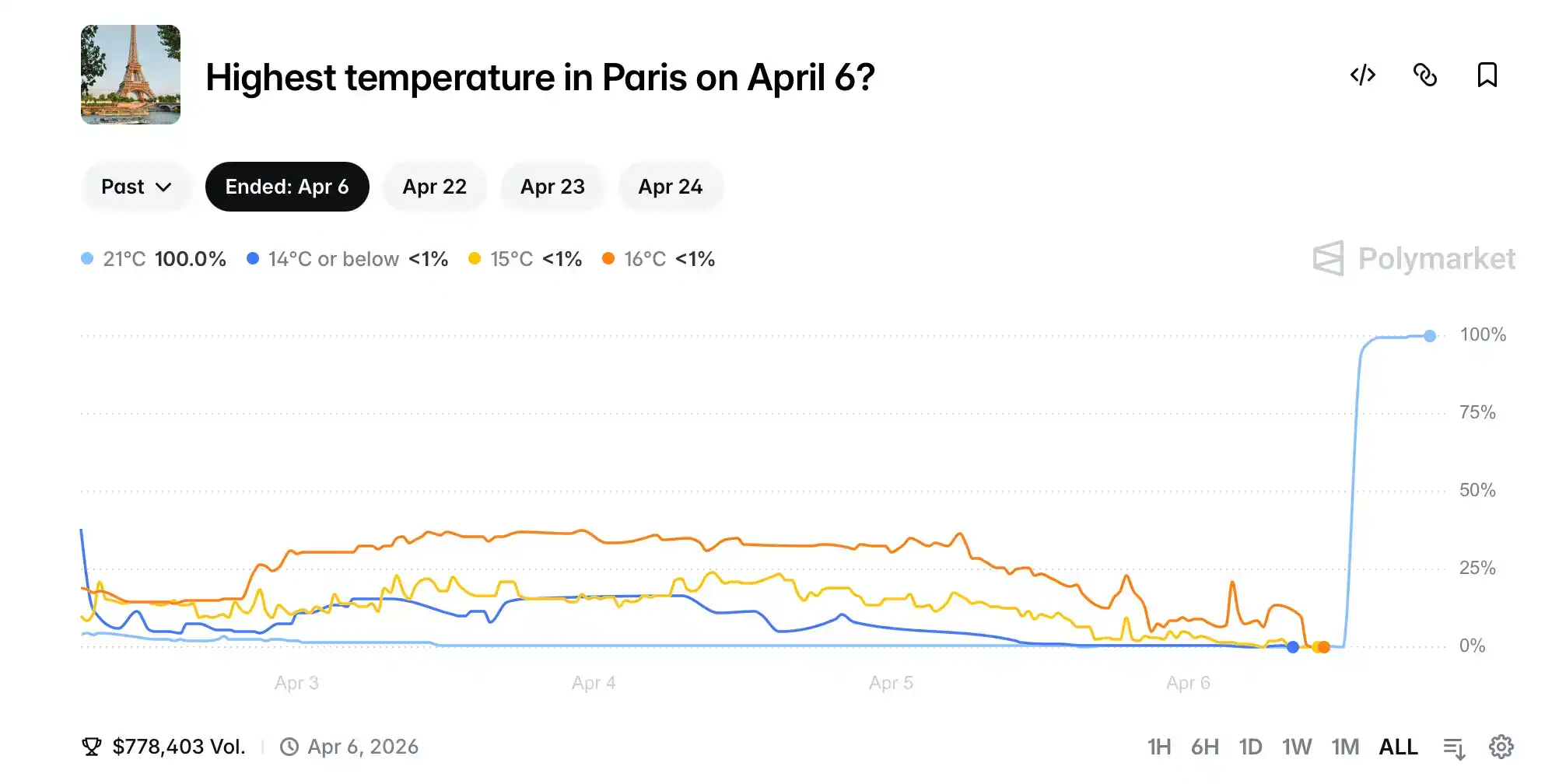
Between 6:30 PM and 6:42 PM on April 6, the temperature reading at the Charles de Gaulle Airport weather station climbed 4°C in 12 minutes, peaking at 22.5°C, before rapidly dropping back within 5 minutes. The actual temperature in Paris that day did not show such drastic fluctuations, and no similar anomalies were recorded at other nearby weather stations.

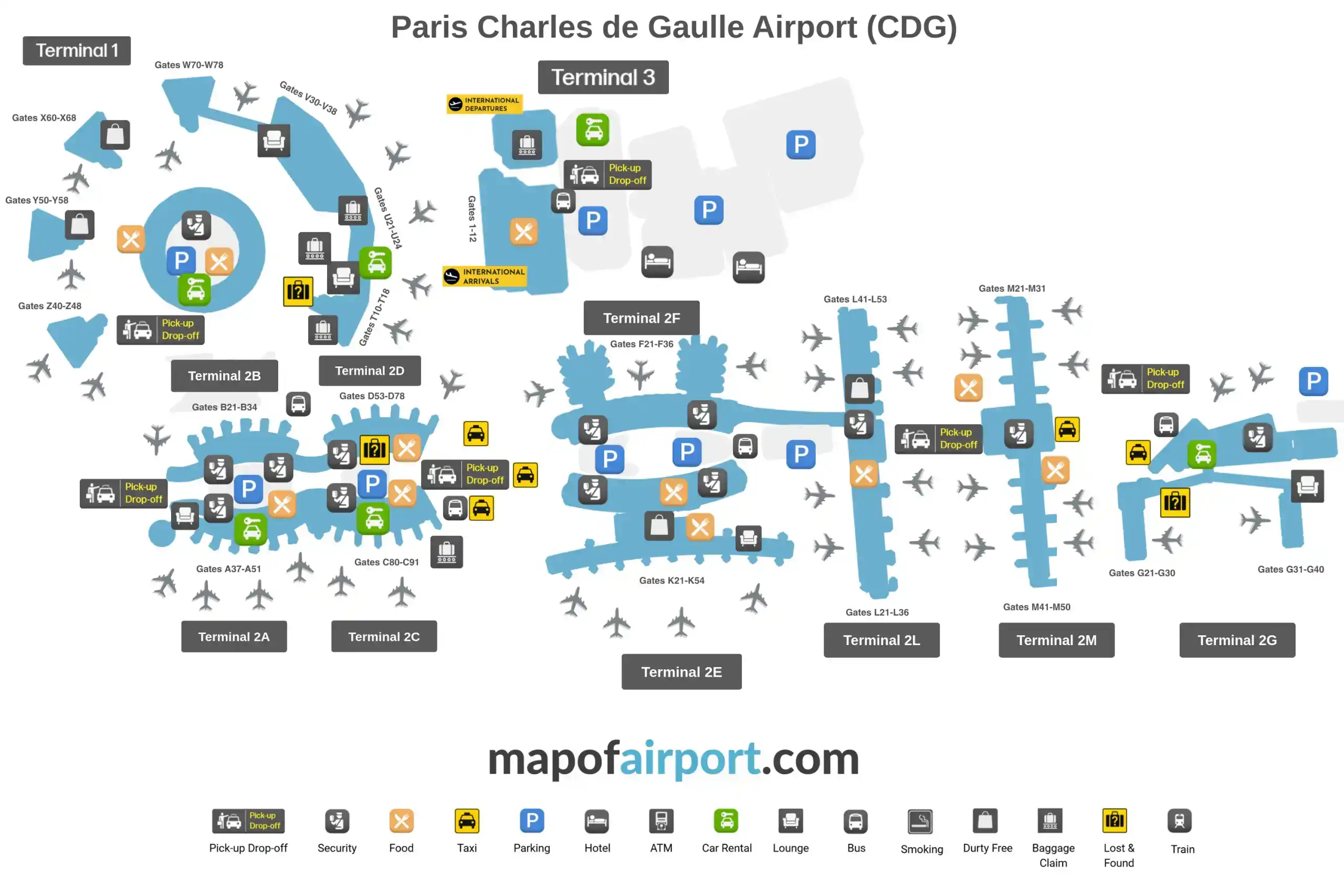
This weather station (code: LFPG) is located at the edge of the Charles de Gaulle Airport runway, near a public area adjacent to a road. Its relatively open physical location made it possible for the suspect to approach the sensor and perform physical intervention.
This brief period of "high temperature"恰好 hit the "21°C" option on Polymarket, a previously almost ignored outcome. After the abnormal data was accepted by the platform as the day's maximum temperature, it settled to Yes. An account behind it took away approximately $14,000.

Nine days later, around 9:30 PM on April 15, almost the exact same script played out again. On a cloudy, windless night, the temperature reading at Charles de Gaulle Airport bizarrely climbed to 22°C. The probability of the "22°C" option on Polymarket soared from 0.1% to 95% in just 30 minutes. A second prize of over $20,000 flowed into the same account.

Paul Marquis, founder of French E-Meteo Service and a meteorologist, provided a technically almost irrefutable judgment: "There was no change in wind direction or relative humidity at the time, and no anomalies were recorded at other surrounding weather stations. Physical intervention is the most reasonable explanation, such as placing a heating device near the sensor probe."

Météo-France subsequently conducted a physical inspection of the sensor, found evidence of tampering, and formally filed a criminal complaint with the Roissy Air Transport Gendarmerie. The charge is "disrupting the operation of an automated data processing system." Under French law, this offense carries a maximum penalty of 7 years imprisonment and a fine of 300,000 euros.

The profile of the involved account is also questionable. It was created on April 4, 2026, just 48 hours before the first operation. The initial funds were only a few dozen dollars, transferred via a cryptocurrency exchange. It almost exclusively participated in the "Paris weather" market, specifically buying extremely low-probability "high temperature" options. After two successful attempts, the funds were quickly transferred through mixers and decentralized exchanges, making on-chain tracking significantly more difficult.

On one side is a common household hair dryer, retailing for less than 30 euros. On the other side is a global climate prediction market with a daily trading volume exceeding $2 million. The extreme asymmetry between the cost of the attack and the potential gain.

The abnormal data was first discovered by local French weather enthusiasts on the Infoclimat forum. The event was subsequently spread to the English-speaking crypto community, followed by reports from French media such as Le Monde, Le Figaro, and BFMTV. Polymarket officials have not issued any public statement on the matter, nor have they revoked the already paid $34,000 reward.

Rule Vulnerability, How Does a Single Sensor Reading Decide Six-Figure Prizes?

The true protagonist of this incident is not the hair dryer, but rather the settlement rules of Polymarket's weather market.

Polymarket's weather markets have grown rapidly in recent years, with the number of active markets now reaching 173, covering temperature, precipitation, hurricanes, tornadoes, earthquakes, volcanoes, and even pandemics. Among them, the "Paris Daily Maximum Temperature" market uses an extremely simple settlement mechanism, locking the data source to the readings from one specific weather station hosted on the Wunderground website.

Before this incident, this station was the Charles de Gaulle Airport weather station (code LFPG), with temperature rounded to the nearest whole degree Celsius. Most crucially, the market settles immediately after the data is finalized, and "does not consider any subsequent data revisions."

This last point means that even if Météo-France later discovers data anomalies and revises the historical records, Polymarket will still pay out rewards based on the contaminated original reading. The rules are written clearly and executed without ambiguity.

The vulnerability thus clearly presents itself in three points:

First, a single point of failure. The settlement of the entire six-figure prize pool relies entirely on the reading from one sensor. Polymarket did not design mechanisms for multi-station weighting, redundant comparison, or anomaly熔断. The so-called "data source" is that single metal probe by the runway at Charles de Gaulle Airport.

Second, physical accessibility. The Charles de Gaulle Airport weather station is located near the edge of the runway, adjacent to a public area next to a road, allowing any ordinary person to approach within meters of the probe. This geographical detail lowers the barrier to "physical intervention" from theoretical possibility to an almost zero-cost practical operation.

Third, the rigidity of the settlement mechanism. The invalidity of post-hoc revisions means that once an attack is successful, there is no possibility of "reversal." The rules ensure the certainty of settlement on one hand, but also guarantee that manipulation, once successful, is irreversible.

Fibo Crypto analyst Victor gave this technique a technically elegant name: "Physical Oracle Attack." Unlike previous "Digital Oracle Attacks" that targeted UMA governance votes and relied on large-scale token voting to manipulate oracle results, physical oracle attacks bypass the entire on-chain logic, acting directly on the first mile of the data pipeline—the metal probe in the real world.

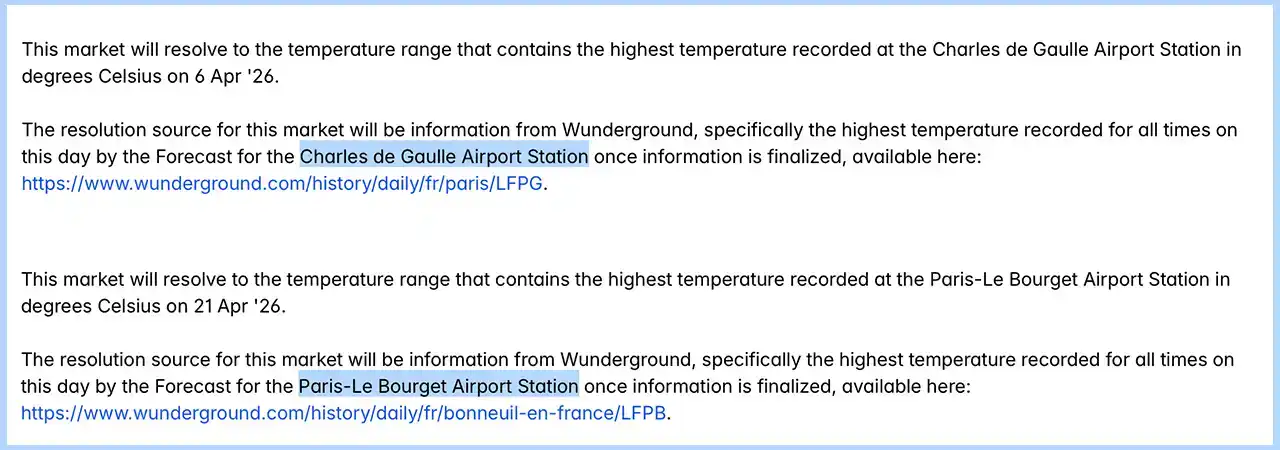
On April 17, two days after the incident was exposed, Polymarket quietly completed a rule change, switching the settlement data source for the Paris weather market from Charles de Gaulle Airport (LFPG) to Paris-Le Bourget Airport (LFPB). The switch was not accompanied by any official announcement, public technical explanation, or any response to the two manipulations that had already occurred.
Changing a probe is much easier than publicly admitting a vulnerability. Polymarket's weather market was initially designed as a mirror, reflecting the market's collective judgment about the future. But when the image in the mirror is valuable enough, the odds steep enough, and the probe accessible enough, someone will always walk over with a 30-euro hair dryer and blow their desired result into it.


Criptos en tendencia

Preguntas relacionadas

QWhat was the method used to manipulate the temperature readings at Charles de Gaulle Airport?

AA portable heating device, such as a hairdryer, was used to artificially heat the meteorological sensor, causing a temporary spike in temperature readings.

QHow much money was stolen from Polymarket through this manipulation attacks?

AA total of $34,000 was stolen from the platform across two separate attacks.

QWhat specific vulnerability in Polymarket's system did this attack exploit?

AThe attack exploited a single point of failure in the settlement mechanism, which relied solely on the temperature reading from one specific, physically accessible weather station (LFPG) without any redundancy checks or mechanisms to account for data revisions.

QWhat action did Polymarket take after the attacks were discovered?

APolymarket quietly changed the data source for its Paris weather market from the Charles de Gaulle Airport station (LFPG) to the Paris-Le Bourget Airport station (LFPB) without making any public announcement or addressing the prior manipulations.

QWhat is the term used to describe this type of attack that targets the physical data source?

AThis type of attack is called a 'physical oracle attack,' which manipulates the real-world data source feeding into the prediction market, rather than exploiting a smart contract or governance vulnerability.

Lecturas Relacionadas

From South Korea to the United States: Blue-Collar Jobs Are Becoming Increasingly Popular, Thanks to AI

AI is reshaping the labor market's value proposition. The traditional four-year college degree is losing its appeal as a guaranteed career path, while skilled blue-collar trades like electricians, welders, and plumbers are experiencing historic demand and wage premiums. This shift is driven by dual pressures: AI's displacement of certain white-collar roles and a booming need for physical infrastructure and data center construction. Data confirms the trend. In the U.S., vocational school revenue surged, and a significant portion of recent layoffs are AI-related. Surveys show a majority of Gen Z adults plan to pursue blue-collar work, citing better job security against AI automation. Vocational education interest has exploded recently. Experts cite a psychological shift as younger generations seek tangible, AI-resistant careers and avoid high student debt. In many cases, salaries for skilled trades now match or exceed those requiring a bachelor's degree. In South Korea, semiconductor vocational high schools boast near-total employment, with graduates securing high-paying roles at companies like Samsung. The shortage is structural, exacerbated by a retiring baby boomer workforce and massive infrastructure projects. Companies like JPMorgan Chase, Meta, and Lowe's are investing heavily in training programs. However, overcoming historical stigma and a "perception gap" around trade careers remains a key challenge to closing the talent gap.

marsbitHace 50 min(s)

From South Korea to the United States: Blue-Collar Jobs Are Becoming Increasingly Popular, Thanks to AI

marsbitHace 50 min(s)

Qualcomm: AI Hype Subsides, When Will Smartphones Emerge from the Gloom?

Qualcomm reported its Q3 FY2026 results (ending June 2026), with revenue of $9.95B, down 4% YoY but above expectations. Gross margin declined to 53.1%, pressured by rising costs across manufacturing and memory. Key business segments showed mixed performance: Handset revenue fell 19.6% YoY to $5.09B, dragged by an 11% decline in non-Apple Android shipments and weaker high-end mix. Conversely, Automotive revenue surged 61% to $1.59B, and IoT grew 9% to $1.83B. Core operating profit dropped 41% YoY due to margin compression and higher expenses. Management's Q4 FY2026 guidance projects revenue of $9.7B-$10.5B, in line with consensus, but Non-GAAP EPS guidance of $2.05-$2.25 fell short of expectations. Amidst persistent weakness in its core handset market, Qualcomm is pursuing growth in AI, focusing on Edge AI (smartphones, PCs, automotive) and Data Center AI. Its data center strategy includes four pillars: AI accelerators (e.g., AI200), commercial CPUs (Dragonfly C1000), custom silicon, and connectivity solutions. While these initiatives initially boosted its stock, concerns over AI capital expenditure sustainability have since erased those gains. The company targets $5B in data center revenue for FY2027 and $15B for FY2029. The report concludes that with the traditional handset business still under pressure, the data center opportunity is currently viewed as a longer-term option, and a more conservative valuation based on core operations may be warranted until AI contributions materialize.

marsbitHace 54 min(s)

Qualcomm: AI Hype Subsides, When Will Smartphones Emerge from the Gloom?

marsbitHace 54 min(s)

From TPU to Self-Evolving Agents: How Jeff Dean Predicts the Next Step in AI

At the 2026 YC Startup School, Jeff Dean outlined his vision for AI's next phase, shifting focus from simply scaling models to building intelligent, autonomous systems. He believes AI's progress is no longer just about creating smarter models, but about integrating them into systems capable of long-term, iterative work, automated experimentation, and continuous learning. This evolution moves the competition from "who has the bigger model" to "who can best organize intelligence." Dean suggests AI capabilities are now comparable to a junior engineer, enabling the automation of complex workflows. However, the true challenge and opportunity lie in managing these AI "workers" at scale. He emphasizes the importance of **context engineering**—structuring tools, memory, and feedback loops—over raw model power. For startups, this means building deep expertise in niche domains where general models currently fail (near 0-1% success rates), leveraging proprietary data, specialized tools, and domain-specific evaluators. A recurring theme is re-examining fundamental constraints. Dean's past work, like moving Google's search index to memory or creating the TPU, stemmed from questioning outdated assumptions about hardware and cost. He sees similar inflection points today, particularly in **specialized inference hardware** to drastically reduce latency and energy consumption for real-time Agent operation. Notably, he points out that in modern AI systems, the dominant cost is often not computation but **data movement**. Reliable, long-running Agents require robust system design, borrowing concepts from distributed computing like checkpointing, state management, and parallel exploration to handle failures and maintain progress over days or weeks. As AI automates execution, the scarcest human skills will shift to **defining clear specifications**, **judging what problems are worth solving** (taste), and designing effective feedback loops. Ultimately, Dean's framework prioritizes understanding the problem deeply, identifying the true bottlenecks, and systematically building closed-loop systems where AI can not only perform tasks but also improve AI itself.

marsbitHace 54 min(s)

From TPU to Self-Evolving Agents: How Jeff Dean Predicts the Next Step in AI

marsbitHace 54 min(s)

Trading

Spot

Artículos destacados

Cómo comprar T

¡Bienvenido a HTX.com! Hemos hecho que comprar Threshold Network Token (T) sea simple y conveniente. Sigue nuestra guía paso a paso para iniciar tu viaje de criptos.Paso 1: crea tu cuenta HTXUtiliza tu correo electrónico o número de teléfono para registrarte y obtener una cuenta gratuita en HTX. Experimenta un proceso de registro sin complicaciones y desbloquea todas las funciones.Obtener mi cuentaPaso 2: ve a Comprar cripto y elige tu método de pagoTarjeta de crédito/débito: usa tu Visa o Mastercard para comprar Threshold Network Token (T) al instante.Saldo: utiliza fondos del saldo de tu cuenta HTX para tradear sin problemas.Terceros: hemos agregado métodos de pago populares como Google Pay y Apple Pay para mejorar la comodidad.P2P: tradear directamente con otros usuarios en HTX.Over-the-Counter (OTC): ofrecemos servicios personalizados y tipos de cambio competitivos para los traders.Paso 3: guarda tu Threshold Network Token (T)Después de comprar tu Threshold Network Token (T), guárdalo en tu cuenta HTX. Alternativamente, puedes enviarlo a otro lugar mediante transferencia blockchain o utilizarlo para tradear otras criptomonedas.Paso 4: tradear Threshold Network Token (T)Tradear fácilmente con Threshold Network Token (T) en HTX's mercado spot. Simplemente accede a tu cuenta, selecciona tu par de trading, ejecuta tus trades y monitorea en tiempo real. Ofrecemos una experiencia fácil de usar tanto para principiantes como para traders experimentados.

743 Vistas totalesPublicado en 2024.12.10Actualizado en 2026.06.02

Cómo comprar T

Discusiones

Bienvenido a la comunidad de HTX. Aquí puedes mantenerte informado sobre los últimos desarrollos de la plataforma y acceder a análisis profesionales del mercado. A continuación se presentan las opiniones de los usuarios sobre el precio de T (T).

活动图片












