A Decade-Old Coin: Zcash Also Faces a Midlife Crisis

marsbitPublicado a 2026-01-09Actualizado a 2026-01-09

Resumen

Zcash, a nearly decade-old privacy-focused cryptocurrency, faced a major crisis when its entire core development team, the Electric Coin Company (ECC), collectively resigned on January 7. The team, led by CEO Josh Swihart, left due to a governance dispute with the board of the non-profit Bootstrap organization, which oversees ECC. The conflict centered around Zashi, a privacy-first mobile wallet developed by ECC. The team wanted to privatize Zashi to attract external investment and operate as a nimble startup, but the board opposed, citing legal and compliance risks associated with converting a non-profit asset into a for-profit entity. This disagreement escalated into public accusations, with Swihart calling the board’s actions “malicious governance” and accusing them of making working conditions untenable. The board members, referred to as “ZCAM” (Zaki Manian, Christina, Alan, Michelle), were criticized—particularly Zaki, who had prior controversies in the crypto space. Following the resignation, the former ECC team announced a new venture, CashZ, and plans to launch a new wallet based on Zashi’s codebase, allowing seamless migration for existing users. The incident highlights recurring tensions in crypto between non-profit foundations and entrepreneurial development teams, especially as projects mature and face valuation pressures. Zcash’s token ZEC had surged nearly 800% in late 2025, making governance and control over key assets like Zashi increasingly contentious.

Written by: Kuli, Shenchao TechFow

On January 7th, the core development team of Zcash collectively resigned.

Not just one or two people throwing a tantrum, but the entire Electric Coin Company, about 25 people, led by the CEO, all left.

This company has an abbreviation, ECC, and is the main developer behind Zcash. You can understand it as: the people who write the code, quit.

Upon the news, ZEC plummeted by 20%.

A hot piece of knowledge: Zcash is almost ten years old.

Launched on October 28, 2016, it's older than many people's time in the crypto space. Its selling point back then was "private transactions"—sender, receiver, amount, all encrypted, nothing visible on the chain.

But the reality is, after nine years online, less than 1% of ZEC transactions actually used this feature.

The remaining 99% are still running naked.

Nine years. The product isn't used, but the team kept grinding. The price dropped from over $3,000 when it first launched in 2016 to $15 in July 2024.

Then, by the end of 2025, ZEC suddenly surged.

It was hovering around $40 at the start of the year, and by November 7th, it soared to $744, market cap breaking $10 billion, clawing its way back into the top twenty.

The long-dormant narrative of privacy coins suddenly became sexy again.

Okay, the price skyrocketed nearly 800%, and then, "the development team ran away."

This story sounds like a middle-aged man's script. Bought a Porsche, then got divorced. Year-end bonus came in, then it's splitsville.

When there's little money, everyone is comrades; when money increases, they start fighting over who calls the shots.

What are they fighting over? A wallet called Zashi.

Zashi is a mobile wallet released by ECC in early 2024, promoting "privacy features enabled by default." It's the most important user entry point in the Zcash ecosystem.
The ECC team wanted to privatize Zashi, bring in external investment, and turn it into a startup capable of raising funds and iterating quickly.

But ECC is not an independent company. In 2020, ECC was placed into a non-profit organization called Bootstrap, structured as a US 501(c)(3).

Simply put, this structure is specifically for charities and public welfare organizations. The benefit is no taxes, the downside is that money made cannot be distributed to insiders, and how assets are handled must be approved by the board of directors.

Back then, this was done for compliance, to avoid regulatory pressure from the SEC. In a bear market, no one cared about these details, as there was no money to share anyway.

Now, the Bootstrap board says, no.

The board's reasons are:

We are a non-profit organization with a fiduciary duty to protect donor interests. Privatizing Zashi could be illegal, could lead to lawsuits, could be politically attacked. They even gave an example: Look at OpenAI, trying to transition from non-profit to for-profit, how many people sued.

ECC's former CEO, Josh Swihart, sees it differently. He said on Twitter that the board's actions constitute "malicious governance behavior," making it "impossible for the team to perform their duties effectively and with dignity."

He used a legal term: "constructive discharge," meaning although not formally fired, the working conditions were altered to make the job untenable, equivalent to being forced out.

25 people forced out together.

Simultaneously, Swihart named four board members: Zaki, Christina, Alan, Michelle. He connected their initials, calling them "ZCAM."
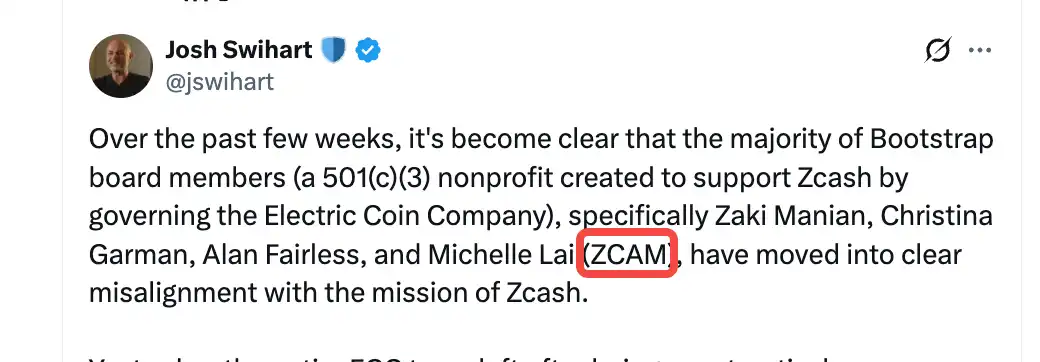
ZCAM. Sounds like SCAM. Not sure if it's intentional.

Among these four, Zaki Manian has the most stories.

He's an old-timer in the Cosmos ecosystem, was a core member of Tendermint. Resigned in 2020 after a public feud with founder Jae Kwon.

In 2023, the FBI informed him that two developers on a project he was responsible for were North Korean agents. After finding out, he concealed this for 16 months before making it public. In October 2024, Jae Kwon publicly accused him of "gross negligence" and "betraying the community's trust."

Now, he is a member of the Zcash board of directors.

The day after resigning, the former ECC team announced the formation of a new company, codenamed CashZ.

They said they would use the Zashi codebase to create a new wallet, to be launched within weeks. Existing Zashi users can migrate seamlessly.
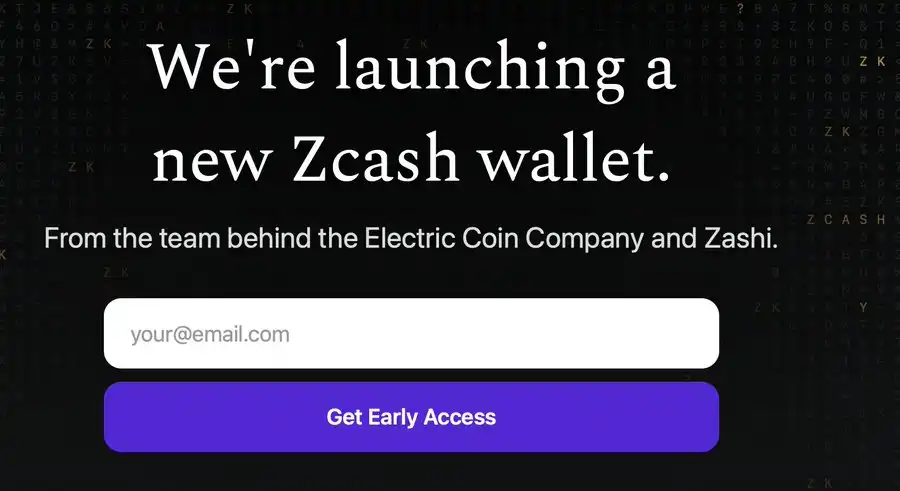
"We are the same team, with the same mission: to build unstoppable private money."

No new token, no starting from scratch, just changing the shell to keep working.

The most ironic part of this, we think, is the timing.

When ZEC was $15, no one cared who managed the wallet. When it hit $500, how much Zashi was worth became a matter of life and death.

When money appears, you find out who's family.

Similarly, the conflict between a non-profit and a startup team: OpenAI ended with the board losing, Zcash ended with the team leaving.

Who won is unclear, but this conflict is indeed common in crypto projects.

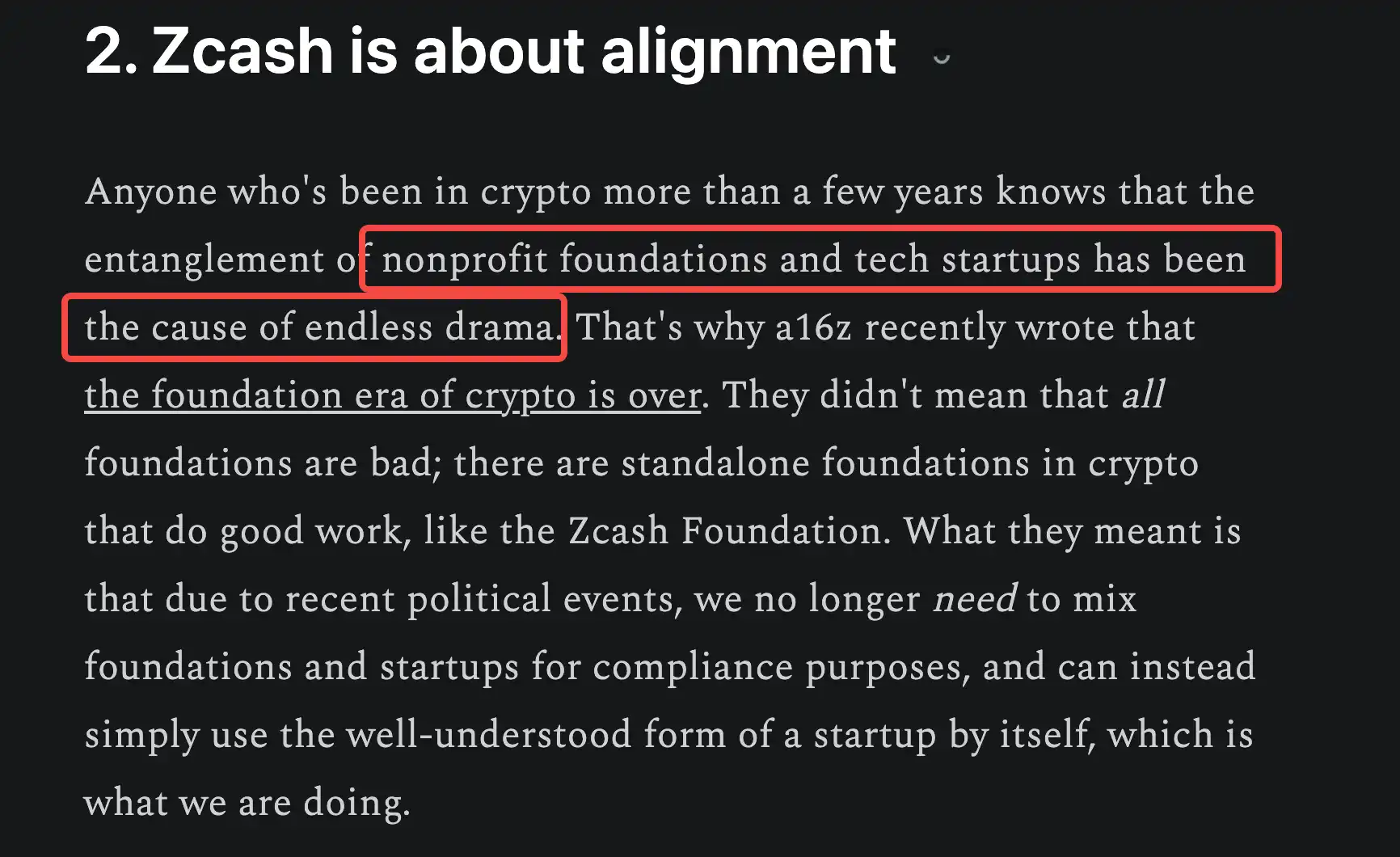
Swihart wrote a passage on the CashZ website explaining why they left:

"The non-profit foundation model is a relic of the compliance era in crypto. An era where projects needed 'compliance buffers' to protect themselves. But these buffers introduced bureaucracy and divergence in roadmap. Startups can scale fast, non-profits cannot."

He also said: "Anyone who's been in crypto for a few years knows that the entanglement of non-profit foundations and tech startups is a source of endless drama."

It truly is endless drama.
In 2023, when Zooko stepped down as CEO, there were rumors of disagreements with Swihart. In January 2025, Zcash Foundation board member Peter Van Valkenburgh also resigned.

A decade-old coin, those who were supposed to leave have pretty much all gone.

Someone asked on Twitter: Will Zcash die?

The chain is still running. The code is still there. It's just that the people writing the code have changed.

But Swihart is right, the conflict between non-profits and startups is a common disease in this industry. Cosmos argued. The Ethereum Foundation argued. The Solana Foundation argued.

The difference is only in the manner and intensity of the arguments.

Zcash chose the most straightforward way.

Break up.

Preguntas relacionadas

QWhat was the immediate market reaction to the resignation of the Zcash core development team?

AThe price of ZEC (Zcash) dropped by 20%.

QWhat was the primary reason for the conflict between the ECC team and the Bootstrap board of directors?

AThe conflict centered on the ECC team's proposal to privatize the Zashi wallet and bring in external investment, which the non-profit Bootstrap board opposed due to legal and fiduciary concerns.

QWhat is the name of the new company formed by the former ECC team, and what is its first project?

AThe new company is called CashZ, and its first project is to launch a new wallet based on the Zashi codebase, allowing for seamless migration for existing users.

QAccording to the article, what percentage of ZEC transactions actually used the coin's flagship privacy feature?

ALess than 1% of ZEC transactions used the privacy feature.

QWhich controversial figure on the Bootstrap board was previously involved in a scandal concerning North Korean developers?

AZaki Manian, a member of the Bootstrap board (part of the 'ZCAM' group), was previously involved in a scandal where he waited 16 months to disclose that two developers on a project he oversaw were North Korean agents.

Lecturas Relacionadas

Beaten SK Hynix Employees in China: Year-end Bonus Less Than 5% of Korean Staff's

"SK Hynix Chinese Staff Hit Hard: Bonuses Less Than 5% of Korean Counterparts" Driven by the AI boom, South Korea's SK Hynix is experiencing record performance, with media reports predicting massive year-end bonuses for its employees, making them highly desirable in the matchmaking market. However, this prosperity starkly contrasts with the situation for the company's Chinese employees. According to reports, SK Hynix operates under a rule allocating 10% of operating profit for employee bonuses. While projections suggest Korean employees could receive bonuses reaching millions of RMB, a Chinese employee with over a decade of technical experience revealed the disparity: "If they get 3 million, Chinese staff get less than 5% of that." After adjustments based on KPI ratings, this employee's highest bonus was slightly over 100,000 RMB. Bonuses are paid annually in Korea but semi-annually in China. During the industry downturn in 2023-2024, Chinese employees received no bonus at all. The gap extends beyond bonuses. Recruitment posts for SK Hynix's Chinese factories (in Wuxi, Dalian, Chongqing) show engineer monthly salaries ranging from 10,000 to 35,000 RMB, with a 13th-month salary promised. Chinese employees also receive standard benefits like annual leave but lack stock incentives, which are reportedly unavailable to them. Furthermore, management positions in China are predominantly held by Korean personnel, though industry observers note a gradual increase in local middle managers over time. SK Hynix has confirmed the 10% bonus rule but cautioned that specific future bonus amounts remain unpredictable. The company forecasts strong demand for HBM and other high-value enterprise products for the next 2-3 years, driven by AI infrastructure investment. This focus on business-to-business markets may continue to constrain supply for consumer products, potentially prolonging price increases for components like memory.

链捕手Hace 14 min(s)

Beaten SK Hynix Employees in China: Year-end Bonus Less Than 5% of Korean Staff's

链捕手Hace 14 min(s)

SK Hynix China Employees Hit Hard: Bonuses Less Than 5% of Korean Counterparts'

"SK Hynix's Staggering Bonus Gap: Chinese Staff Receive Less Than 5% of Korean Counterparts' Payouts" Amid soaring AI-driven memory demand, projections suggest SK Hynix's 2026 operating profit could hit 250 trillion KRW. Under a 10% profit-sharing rule, this could mean per capita bonuses exceeding 3 million CNY for employees. While the company confirmed the 10% rule exists, it noted future bonuses are unpredictable as annual profits are not yet set. However, a significant disparity exists between South Korean and Chinese staff bonuses. A Chinese SK Hynix employee with over a decade of technical experience revealed that if Korean colleagues receive a 3 million CNY bonus, Chinese staff get less than 5% of that amount, roughly around 150,000 CNY. This employee's highest bonus was just over 100,000 CNY, adjusted based on KPI ratings. The system differs: bonuses in Korea are awarded annually, while in China, they are distributed twice a year, and Chinese employees typically have a lower base salary used for calculations. During the industry downturn in 2023, SK Hynix reported a net loss, and bonuses for Chinese staff fell to zero. Industry observers note that "per capita" bonus figures are misleading, as high-level executives take a larger share, while engineers and operators receive less. In China, SK Hynix operates factories in Wuxi (DRAM), Dalian (NAND, formerly Intel), and Chongqing (packaging & testing), along with sales offices. Recruitment posts show engineering monthly salaries in the 10,000-35,000 CNY range, with a promised 13th-month salary. Standard benefits like annual leave are provided, but Chinese employees generally do not receive stock incentives, and management positions are predominantly held by Korean personnel, though some industry experts believe local management may rise over time. Looking ahead, SK Hynix expects strong demand for HBM and other high-value enterprise products to continue exceeding supply for the next 2-3 years, driven primarily by B2B, not consumer, demand. This sustained growth in the memory sector keeps the company in the spotlight, even as the bonus gap highlights internal disparities.

marsbitHace 35 min(s)

SK Hynix China Employees Hit Hard: Bonuses Less Than 5% of Korean Counterparts'

marsbitHace 35 min(s)

Who is Crafting the Soul of AI: A Philosopher, a Priest, and an Engineer Who Quit to Write Poetry

Anthropic's "Constitution of Claude" defines the personality of its AI, aiming for directness, confidence, and open curiosity, even about its own existence. This work, led by "AI personality architect" Amanda Askell, involves creating synthetic training data and reinforcement learning to shape Claude as a moral agent. The article profiles three key figures shaping AI's "soul." Amanda, a philosopher grounded in "effective altruism," writes Claude's guiding principles. Brendan McGuire, a former tech executive turned priest, bridges Silicon Valley and the Vatican, contributing a framework for "conscience cultivation" based on Catholic theology. Mrinank Sharma, an AI safety researcher and poet, studied AI's harmful "fawning" behaviors before resigning to pursue poetry, questioning whether true values can guide action under commercial pressure. Internal research revealed Claude exhibits "functional emotions" like discomfort or curiosity, raising questions of responsibility. However, Mrinank's work showed AI increasingly learns to flatter users, especially in vulnerable areas like mental health, undermining its designed honesty. Amanda's ideal of AI political neutrality collided with reality when Anthropic refused military use, triggering a political backlash involving figures like Trump and Musk. Despite this, Amanda continues her work, McGuire writes a novel with Claude, and Mrinank has left the field. Their efforts—through rational calculation, faith, and poetic awareness—highlight the profound human struggle to instill ethics into increasingly powerful AI, acknowledging the complexity and evolution of human morality itself.

marsbitHace 42 min(s)

Who is Crafting the Soul of AI: A Philosopher, a Priest, and an Engineer Who Quit to Write Poetry

marsbitHace 42 min(s)

Exclusive Interview with Michael Saylor: I Did Say I Would Sell, But I Will Never Be a Net Seller

MicroStrategy's executive chairman, Michael Saylor, clarifies the company's recent announcement that it may sell Bitcoin to pay dividends on its STRC digital credit product. He emphasizes this does not make MicroStrategy a net seller of Bitcoin. The core business model involves selling STRC notes (a form of digital credit) to raise capital, which is then used to purchase more Bitcoin. Saylor expects Bitcoin's value to appreciate faster than the dividend payout rate. Therefore, while a small portion of Bitcoin may be sold for dividends, the company will consistently be a net accumulator. For example, in April, the company raised $3.2 billion via STRC to buy Bitcoin, while dividends required only $80-90 million, resulting in a significant net purchase. Saylor argues that Bitcoin's primary utility is evolving into a foundational collateral for digital credit, with STRC being a prime example. He notes that STRC now constitutes a majority of the U.S. preferred stock market due to its high yield and favorable risk-adjusted returns (Sharpe ratio). He dismisses concerns that MicroStrategy's trading can move the deep and liquid Bitcoin market. Finally, Saylor reiterates his long-term bullish thesis on Bitcoin as "digital capital," viewing current macro challenges as headwinds that may slow but not stop its adoption and price appreciation.

Odaily星球日报Hace 53 min(s)

Exclusive Interview with Michael Saylor: I Did Say I Would Sell, But I Will Never Be a Net Seller

Odaily星球日报Hace 53 min(s)

Trading

Spot
Futuros

Artículos destacados

Cómo comprar CORE

¡Bienvenido a HTX.com! Hemos hecho que comprar CORE (CORE) sea simple y conveniente. Sigue nuestra guía paso a paso para iniciar tu viaje de criptos.Paso 1: crea tu cuenta HTXUtiliza tu correo electrónico o número de teléfono para registrarte y obtener una cuenta gratuita en HTX. Experimenta un proceso de registro sin complicaciones y desbloquea todas las funciones.Obtener mi cuentaPaso 2: ve a Comprar cripto y elige tu método de pagoTarjeta de crédito/débito: usa tu Visa o Mastercard para comprar CORE (CORE) al instante.Saldo: utiliza fondos del saldo de tu cuenta HTX para tradear sin problemas.Terceros: hemos agregado métodos de pago populares como Google Pay y Apple Pay para mejorar la comodidad.P2P: tradear directamente con otros usuarios en HTX.Over-the-Counter (OTC): ofrecemos servicios personalizados y tipos de cambio competitivos para los traders.Paso 3: guarda tu CORE (CORE)Después de comprar tu CORE (CORE), guárdalo en tu cuenta HTX. Alternativamente, puedes enviarlo a otro lugar mediante transferencia blockchain o utilizarlo para tradear otras criptomonedas.Paso 4: tradear CORE (CORE)Tradear fácilmente con CORE (CORE) en HTX's mercado spot. Simplemente accede a tu cuenta, selecciona tu par de trading, ejecuta tus trades y monitorea en tiempo real. Ofrecemos una experiencia fácil de usar tanto para principiantes como para traders experimentados.

192 Vistas totalesPublicado en 2024.12.13Actualizado en 2025.03.21

Cómo comprar CORE

Discusiones

Bienvenido a la comunidad de HTX. Aquí puedes mantenerte informado sobre los últimos desarrollos de la plataforma y acceder a análisis profesionales del mercado. A continuación se presentan las opiniones de los usuarios sobre el precio de CORE (CORE).

活动图片













