A Century-Long Journey of an Egg: From Wall Street to Polymarket

marsbitPublicado a 2026-03-02Actualizado a 2026-03-02

Resumen

The article traces the historical journey of egg futures, once one of the most active commodities traded on Wall Street. Beginning at the Chicago Butter and Egg Board (which later became the CME), egg futures were highly active in the early 20th century. However, by the 1980s, industrial farming and improved supply chains reduced price volatility, leading to the decline of egg futures trading in traditional markets. In 2013, China’s Dalian Commodity Exchange revived egg futures due to market volatility. More recently, egg price speculation has moved to Polymarket, a prediction market platform. One trader, "xcnstrategy," reportedly earned significant profits by shorting egg price intervals, likely leveraging expertise in commodity markets or agriculture. The piece highlights a broader trend: crypto and prediction markets like Polymarket and Hyperliquid are increasingly serving as 24/7 trading venues for traditional assets—including oil, gold, and forex—especially during periods when conventional markets are closed. This was evident during recent U.S.-Iran tensions when traders used these platforms to hedge and price assets amid traditional market closures. The evolution reflects an ongoing shift in price discovery power from established exchanges to decentralized, always-on crypto markets—echoing the original purpose of futures markets: to manage risk and determine prices.

"We went from eggs to yen"—this financial reminiscence from CME legend Leo Melamed bears witness to a time when eggs were once one of the world's most active futures products.

In the first half of the 20th century, egg futures were among the hottest trading instruments in Chicago. Trading volume in some years was second only to grain varieties, and there were even instances where futures trading far exceeded the volume of physical circulation.

The predecessor of the Chicago Mercantile Exchange (CME), the world's largest derivatives market, was called the "Chicago Butter and Egg Board." This was the foundation of what would later become a derivatives empire, and as the name implies, the exchange initially traded only two things: butter and eggs.

After the 1970s, the U.S. egg-laying industry rapidly industrialized, cold chains matured, and price fluctuations were gradually "smoothed out." As uncertainty began to fade, the noise in the trading pits quieted down. In 1982, egg futures officially exited the Chicago Mercantile Exchange. It didn’t collapse dramatically; rather, it was as if the times quietly turned off the lights.

In 2013, the Dalian Commodity Exchange in mainland China reignited this product. At that time, mainland China's egg-laying industry was still highly fragmented, with sharp price fluctuations, making hedging needs real and urgent.

Egg futures trading did not disappear; it merely migrated. And today, this migration has taken another step forward. The venue for trading egg prices has moved to Polymarket.
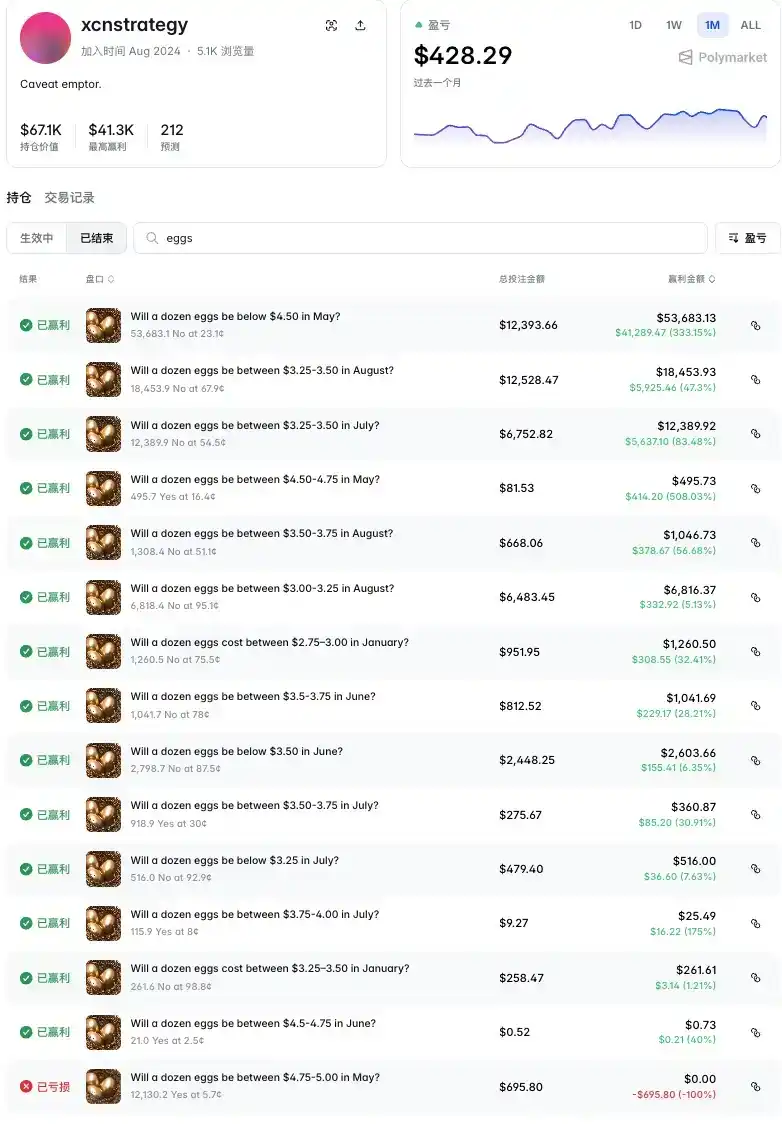
A trader with the ID "xcnstrategy" established positions in multiple expiration months—January, May, June, July, and August—for egg price predictions. The vast majority of these trades were shorting the "Yes" for certain price ranges, meaning betting that eggs would not reach certain price levels. The total betting amount was $44,800, with nearly $100,000 in profits. Out of 15 trades, all but the first were profitable.

The most recent trade was also the most profitable: a $12,393 bet on "No" for "a dozen eggs in May below $4.50," yielding a profit of $41,289 (+333%).

Speculations about xcnstrategy’s true identity, aside from possibly being an "egg enthusiast," include many who believe he is likely someone with a commodities market background or agricultural data research capabilities, analyzing that the U.S. avian flu-induced egg price surge starting in 2025 was a short-term phenomenon and that the market overestimated the probability of sustained high prices. Others think he is an industry insider in the egg supply chain, hedging against the volatility inherent in the industry.
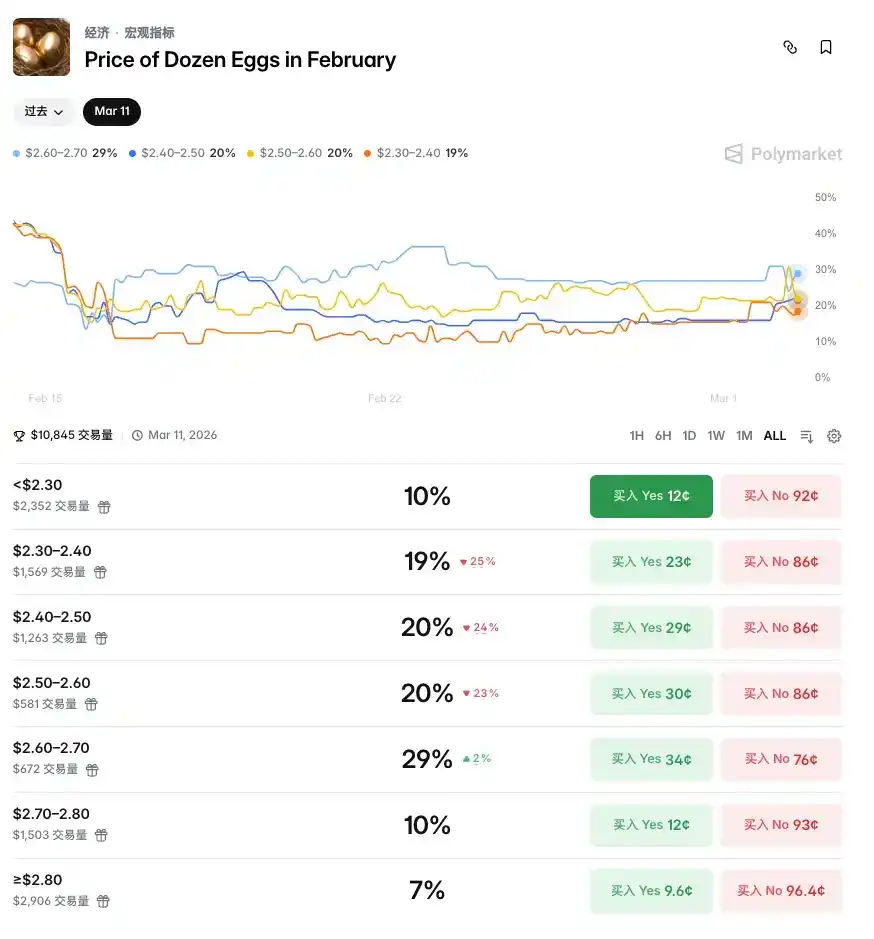
Eggs are just one example. The traditional asset标的 available for trading on Polymarket are far more diverse than one might imagine: from crude oil (CL), gold (GC), silver (SI), and other commodities to various foreign exchange rates and housing data—all can be found as markets on Polymarket.
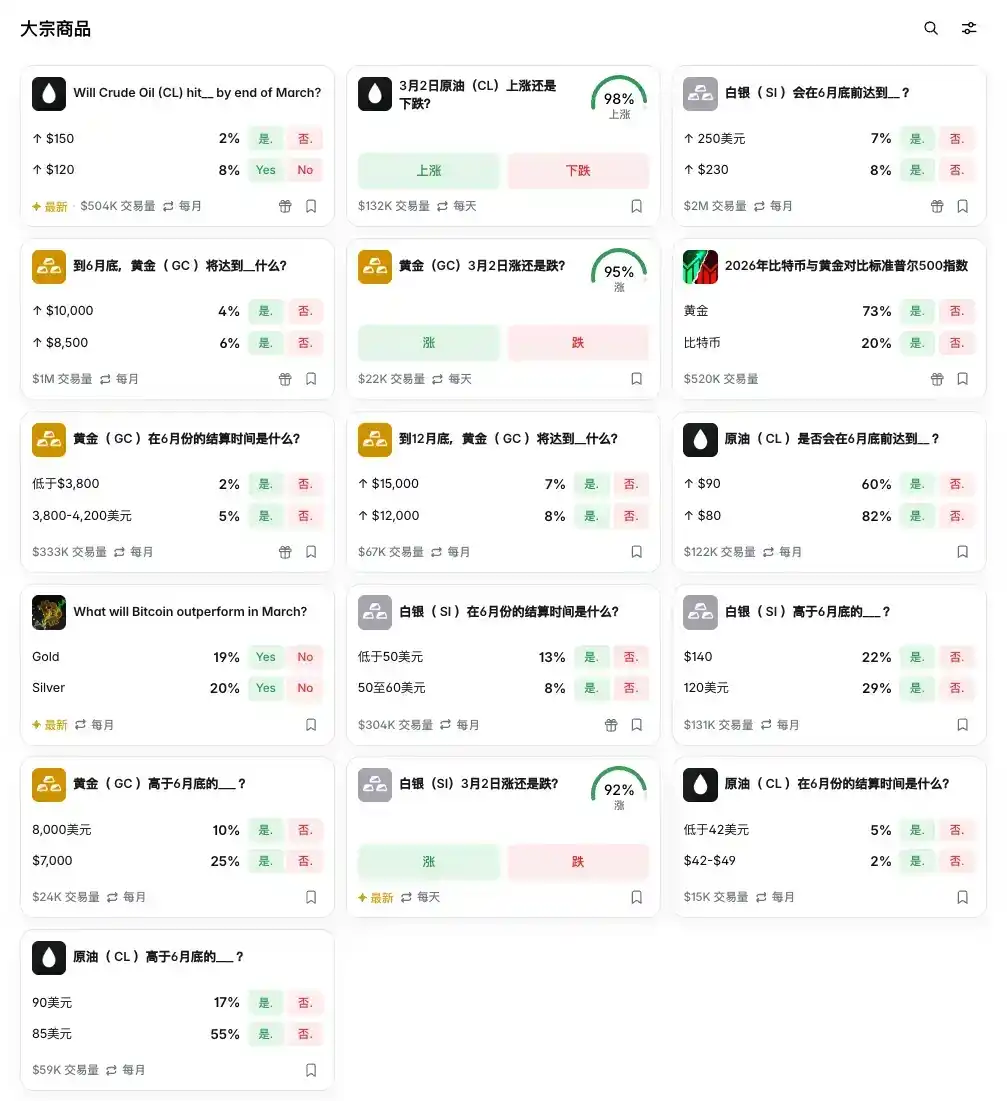
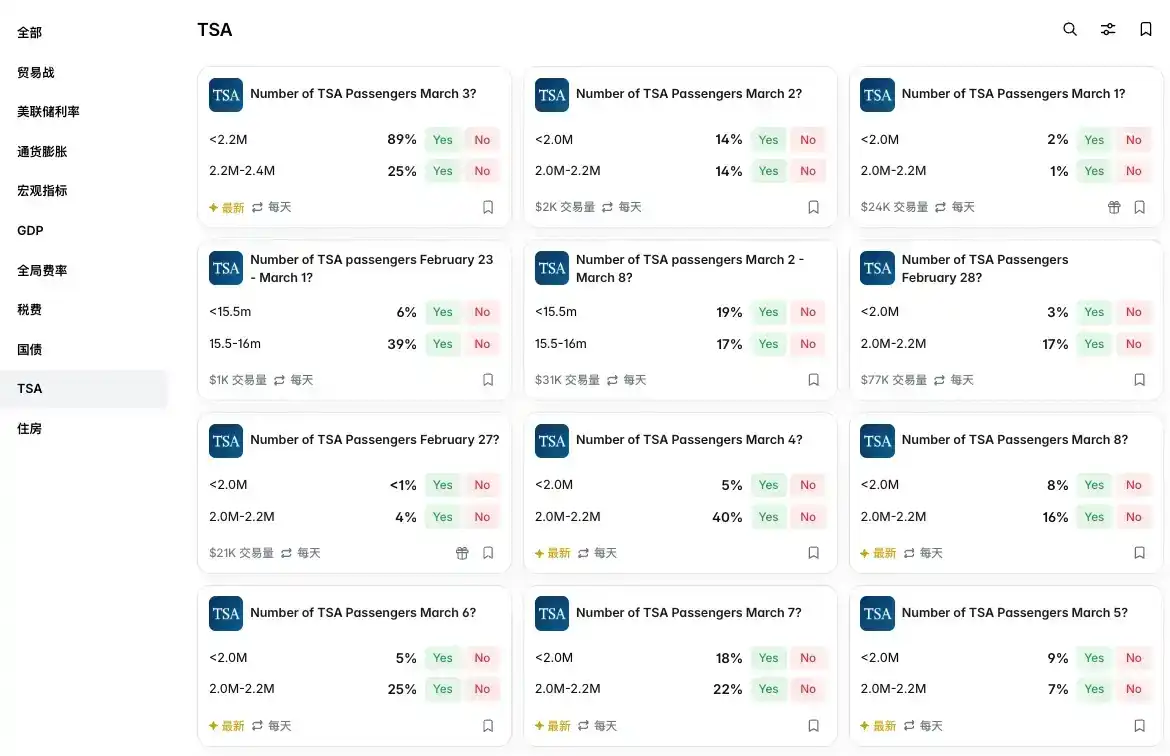
Operating 24/7 without closing is one of the biggest advantages of trading such markets on Polymarket. This advantage is particularly evident during traditional financial market closures, as seen with the U.S.-Iran conflict escalation last weekend.

In this regard, Hyperliquid shares the same advantage. The perpetual contracts on Hyperliquid, linked to crude oil and gold, have no expiration dates and run continuously, 24/7.

This leads to an increasingly hard-to-ignore phenomenon: the crypto market is quietly taking on the price discovery function of traditional financial markets, especially when the latter are closed.

Traditional futures markets have fixed trading hours; CME's crude oil and gold contracts close on weekends, and foreign exchange markets see liquidity dry up late at night. This means that when geopolitical shocks erupt after Friday's close, participants are left in the dark—unable to hedge, express views, or price assets.

Last weekend's U.S.-Iran conflict escalation is the latest validation. According to Bloomberg, around the time the conflict broke out, a large number of traders flocked to Hyperliquid to trade perpetual contracts linked to crude oil and gold to hedge against the geopolitical shock—while traditional markets were shut, crypto derivatives markets were the only place with the lights on. Investment firm executive Avi Felman had previously predicted that "Hyperliquid will become indispensable for fund managers because it’s 24/7." This judgment was concretely validated during this conflict.

At the same time, gold tokenization is accelerating another logic: when gold exists in the form of on-chain tokens and is continuously priced in decentralized markets, it no longer needs to wait for the London Metal Exchange or CME to open. To some extent, the tokenized gold market is acting as a "shadow pre-market" for traditional gold markets, pricing gold over the weekend and allowing price discovery to occur before traditional markets open.

In 2020, then the world's second-largest trading platform, FTX, launched tokenized stocks, allowing platform users to trade Tesla and NVIDIA shares with stablecoins. The idea was to capture pricing power—when U.S. stocks were closed, FTX's Tesla tokens could fill the market void, allowing users to trade Tesla stock when the company announced new models on Saturday, thereby influencing Nasdaq's Monday opening.

Unfortunately, due to liquidity issues, the pricing effect ultimately did not materialize. Six years later, tokenization has come full circle back to this vision. Today, Polymarket and Hyperliquid are viewed not merely as cryptocurrency trading platforms. Polymarket is already officially recognized as a public opinion polling agency and information exchange hub, while Hyperliquid is seen as a new type of full-asset trading platform.

Price discovery power has always been one of the core powers in financial infrastructure.

Back in the day, Chicago butter and egg merchants established the CME because they needed a venue to discover prices and transfer risks. Over a hundred years later, the same logic is replaying on-chain, only the medium has changed.

You might think the market is trading eggs, but in reality, the market is fighting for pricing power.


Preguntas relacionadas

QWhat was the original name of the Chicago Mercantile Exchange (CME) and what products did it initially trade?

AThe original name was the Chicago Butter and Egg Board, and it initially traded only two products: butter and eggs.

QWhy did the trading of egg futures decline and eventually cease on the CME in 1982?

AThe decline was due to the rapid industrialization of the U.S. egg-laying industry and the maturation of the cold chain, which smoothed out price volatility, reducing the uncertainty and need for hedging, leading to its quiet discontinuation.

QWhat is the significant advantage of trading assets like eggs, oil, and gold on platforms like Polymarket and Hyperliquid compared to traditional markets?

AThe significant advantage is that they operate 24/7, allowing for continuous trading, price discovery, and risk management even when traditional financial markets are closed, such as during weekends or overnight.

QAccording to the article, how did the recent U.S.-Iran conflict demonstrate the value of crypto derivative markets like Hyperliquid?

AWhen the conflict escalated over a weekend, traditional markets were closed, but traders flocked to Hyperliquid to trade perpetual contracts linked to oil and gold, making it the only available venue to hedge risks and express market views, thus validating its role in pricing during off-hours.

QWhat broader financial function are platforms like Polymarket and Hyperliquid increasingly seen as fulfilling, beyond just trading cryptocurrencies?

AThey are increasingly seen as fulfilling the core financial function of price discovery and acting as information hubs or full-asset trading platforms, effectively competing for pricing power that was traditionally held by established exchanges like the CME.

Lecturas Relacionadas

OpenAI Post-Training Engineer Weng Jiayi Proposes a New Paradigm Hypothesis for Agentic AI

OpenAI engineer Weng Jiayi's "Heuristic Learning" experiments propose a new paradigm for Agentic AI, suggesting that intelligent agents can improve not just by training neural networks, but also by autonomously writing and refining code based on environmental feedback. In the experiment, a coding agent (powered by Codex) was tasked with developing and maintaining a programmatic strategy for the Atari game Breakout. Starting from a basic prompt, the agent iteratively wrote code, ran the game, analyzed logs and video replays to identify failures, and then modified the code. Through this engineering loop of "code-run-debug-update," it evolved a pure Python heuristic strategy that achieved a perfect score of 864 in Breakout and performed competitively with deep reinforcement learning (RL) algorithms in MuJoCo control tasks like Ant and HalfCheetah. This approach, termed Heuristic Learning (HL), contrasts with Deep RL. In HL, experience is captured in readable, modifiable code, tests, logs, and configurations—a software system—rather than being encoded solely into opaque neural network weights. This offers potential advantages in explainability, auditability for safety-critical applications, easier integration of regression tests to combat catastrophic forgetting, and more efficient sample use in early learning stages, as demonstrated in broader tests on 57 Atari games. However, the blog acknowledges clear limitations. Programmatic strategies struggle with tasks requiring long-horizon planning or complex perception (e.g., Montezuma's Revenge), areas where neural networks excel. The future vision is a hybrid architecture: specialized neural networks for fast perception (System 1), HL systems for rules, safety, and local recovery (also System 1), and LLM agents providing high-level feedback and learning from the HL system's data (System 2). The core proposition is that in the era of capable coding agents, a significant portion of an AI's learned experience could be maintained as an auditable, evolving software system.

marsbitHace 31 min(s)

OpenAI Post-Training Engineer Weng Jiayi Proposes a New Paradigm Hypothesis for Agentic AI

marsbitHace 31 min(s)

Your Claude Will Dream Tonight, Don't Disturb It

This article explores the recent phenomenon of AI companies increasingly using anthropomorphic language—like "thinking," "memory," "hallucination," and now "dreaming"—to describe machine learning processes. Focusing on Anthropic's newly announced "Dreaming" feature for its Claude Agent platform, the piece explains that this function is essentially an automated, offline batch processing of an agent's operational logs. It analyzes past task sessions to identify patterns, optimize future actions, and consolidate learnings into a persistent memory system, akin to a form of reinforcement learning and self-correction. The article draws parallels to similar features in other AI agent systems like Hermes Agent and OpenClaw, which also implement mechanisms for reviewing historical data, extracting reusable "skills," and strengthening long-term memory. It notes a key difference from human dreaming: these AI "dreams" still consume computational resources and user tokens. Further context is provided by discussing the technical challenges of managing AI "memory" or context, highlighting the computational expense of large context windows and innovations like Subquadratic's new model claiming drastically longer contexts. The core critique argues that this strategic use of human-centric vocabulary does more than market products; it subtly reshapes user perception. By framing algorithms with terms associated with consciousness, companies blur the line between tool and autonomous entity. This linguistic shift can influence user expectations, tolerance for errors, and even perceptions of responsibility when systems fail, potentially diverting scrutiny from the companies and engineers behind the technology. The article concludes by speculating that terms like "daydreaming" for predictive task simulation might be next, continuing this trend of embedding the idea of an "inner life" into computational processes.

marsbitHace 33 min(s)

Your Claude Will Dream Tonight, Don't Disturb It

marsbitHace 33 min(s)

Trading

Spot
Futuros
活动图片