A $20 Billion Valuation: Kalshi and Polymarket in an Arms Race?

marsbitPublicado a 2026-03-09Actualizado a 2026-03-09

Resumen

A potential "arms race" is brewing in the prediction market sector, with industry leaders Polymarket and Kalshi each reportedly in funding talks at valuations around $20 billion. This represents a near doubling of their respective $12 billion and $11 billion valuations from late 2025. As of February 2026, the global prediction market has reached a cumulative notional trading volume of $127.5 billion. Polymarket leads with $56.07 billion, followed closely by Kalshi at $44.71 billion, together commanding 79% market share. Their growth trajectories differ: Kalshi has experienced explosive user growth, with monthly active users surging from 600,000 to over 5.1 million in 2025, while Polymarket's user growth has been steadier, peaking around 700,000 monthly active users. Kalshi's trading volume skyrocketed over 1100% in 2025, largely driven by sports contracts which account for 81% of its volume. It has secured key partnerships with platforms like Robinhood, which contributed over 50% of its volume in late 2025, and media outlets like CNBC and CNN. Polymarket maintains a stronghold in political and crypto event markets. It has formed significant partnerships with X (formerly Twitter), ICE (for a strategic investment up to $2 billion), and the UFC for exclusive prediction market data. Both platforms are also official partners of the NHL, and their data is integrated into Google's search and finance products. Their divergent strategies—Kalshi's focus on USD-compliant trading and...

Recently, according to The Wall Street Journal, the two leading prediction market platforms, Polymarket and Kalshi, have been in talks with potential investors for funding rounds, each with an estimated valuation of around $20 billion. In November 2025, it was reported that Polymarket was negotiating funding at a $12 billion valuation. That December, Kalshi completed a $1 billion funding round, bringing its valuation to $11 billion.

In just a few months, the valuations have nearly doubled again.

According to public market data and industry reports, as of the end of February 2026, the cumulative nominal trading volume of the global prediction market reached $127.5 billion, with Polymarket leading at $56.07 billion and Kalshi at $44.71 billion, together accounting for 79% of the market share.

While leading in cumulative trading volume, Kalshi showed more outstanding growth in 2025, not only reversing its market share from a minority position at the beginning of the year to over 60% but also driving its monthly active users (MAU) from 600,000 to over 5.1 million, demonstrating a faster pace of scale expansion. In contrast, Polymarket, leveraging its crypto-native advantages, maintained its global event coverage and cumulative trading lead, but its user growth was relatively steady, with peak MAU hovering around 700,000. The two core metrics—trading volume and MAU—clearly outline Kalshi's explosive catch-up and Polymarket's sustained深耕 (deep cultivation), forming a duopoly in the prediction market.

Specifically regarding trading volume performance, Kalshi's growth trajectory shows a leap from a low base to a high volume.
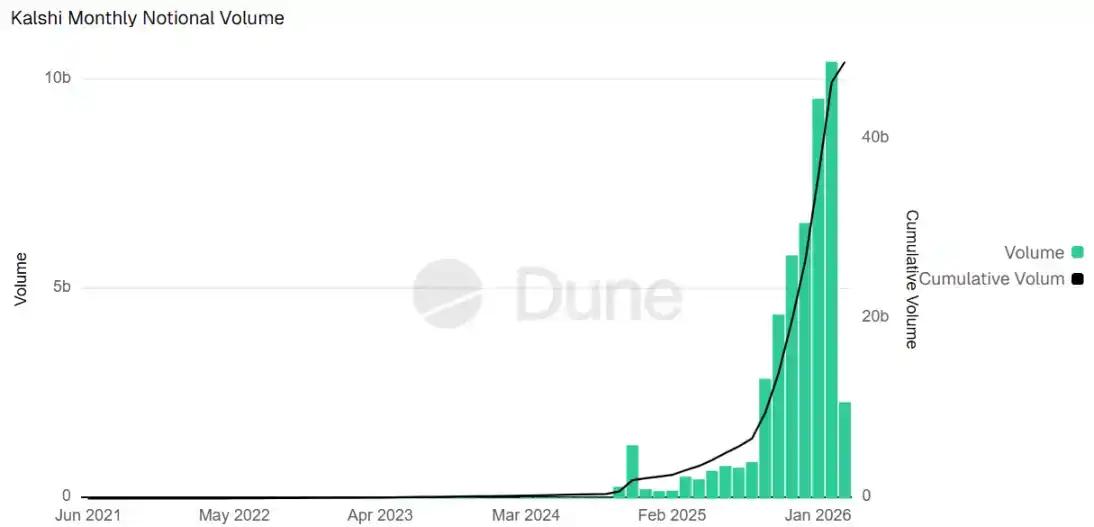
In 2024, Kalshi's annual nominal trading volume was approximately $1.9 billion, limited by early regulatory frameworks and market awareness, primarily driven by a few events. Entering 2025, this number surged to about $23.8 billion, a year-on-year increase of over 1100%. This explosion was directly reflected in monthly and weekly records: September single-month trading reached $2.86 billion, October further climbed to $4.39 billion, and December skyrocketed to $6.58 billion. The strong momentum continued into the beginning of 2026, with January's monthly trading exceeding $10.4 billion.
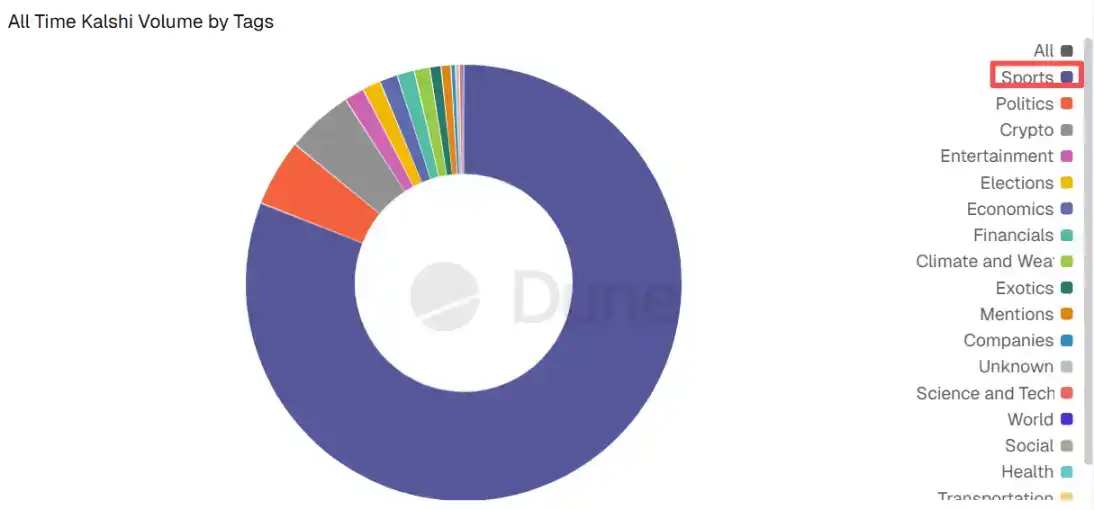
Sports event contracts contributed about 81% of this trading volume.

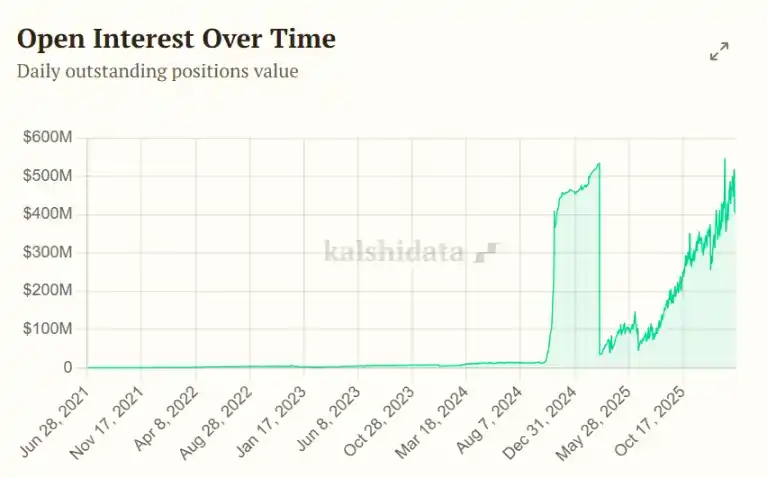
As of March 9, Kalshi's cumulative total trading volume exceeded $48.6 billion. Currently, its open interest hovers around $500 million.
Polymarket's trading volume reflects its earlier accumulation advantage and later steady maintenance. Dune Analytics data shows that in 2024, Polymarket's monthly nominal trading volume experienced explosive growth, reaching a historical high of $4.266 billion in October 2024, bringing its cumulative trading volume to $7.6 billion.
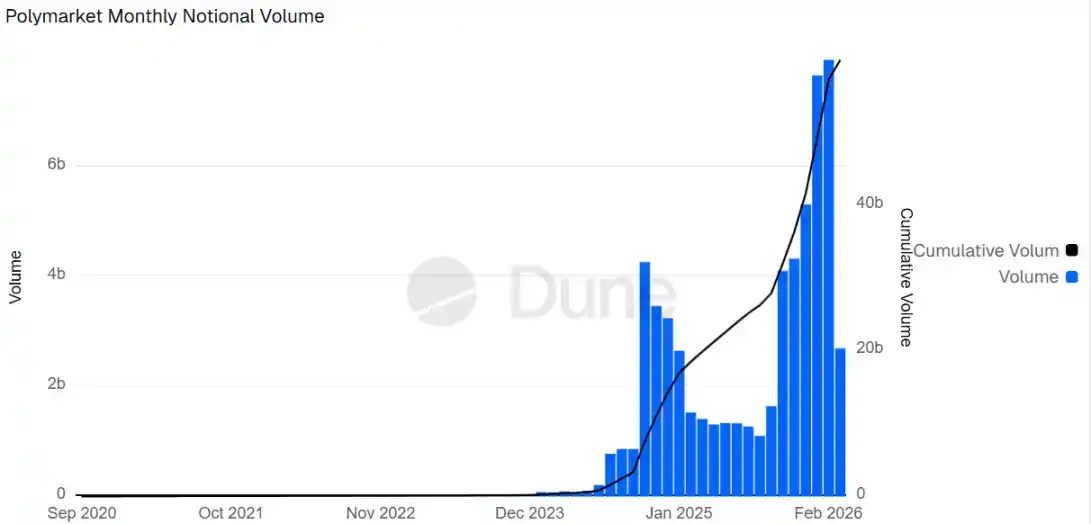
Subsequently, although its monthly trading volume slowly declined, it remained at a high level. The turning point occurred in September 2025, when Polymarket began its pulse-like surge in trading volume.

October single-month trading broke $4.1 billion, November broke $4.3 billion.

By 2026, in January alone, its trading volume broke $7.658 billion, and February broke $7.9 billion. As of March 9, its cumulative trading volume exceeded $59.9 billion.
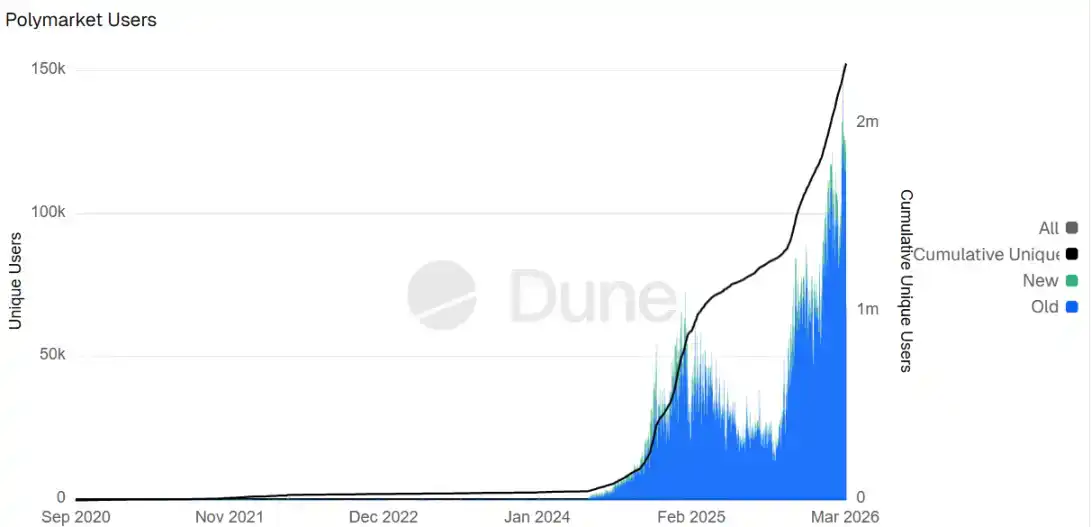
According to Dune data statistics, its total number of users has skyrocketed from 40,000 in 2024 to 2.31 million today.

It is worth noting that Polymarket still holds an advantage in liquidity depth for political and crypto events, with some weekly transaction counts accounting for up to 57%, but its overall market share dropped from 95% to 35-40% in mid-2025 before gradually stabilizing.

The divergence in trading volume data between the two platforms essentially stems from differences in business focus and user access models. Kalshi, as a CFTC-regulated entity, focuses on compliant trading in USD, covering over 42 US states. Kalshi gains the upper hand in sports dominance, while Polymarket maintains a lead in political and crypto domains, jointly pushing the entire market's weekly nominal trading volume to stably remain in the tens of billions of dollars.

In terms of ecosystem partnerships, the two major prediction markets are also frequently active, deeply integrating with mainstream institutions, media, and sports IPs. Both are not only opening offline pop-up shops but also expanding疯狂 (frantically) online.

Kalshi focuses on leveraging its compliance advantages, forming a strategic partnership with Tradeweb and receiving a minority equity investment, embedding real-time probability data into its institutional trading platform; Robinhood became its largest traffic source, contributing over 50% of trading volume in the second half of 2025; simultaneously, it secured exclusive media partnerships with CNBC and CNN, with data directly integrated into programs and reports.

Polymarket, on the other hand, emphasizes Wall Street data output and entertainment penetration. In June last year, Polymarket partnered with X, becoming its official prediction partner. It secured a strategic investment of up to $2 billion from ICE, which incorporates the data into financial product streams. In November, Polymarket reached a multi-year exclusive agreement with TKO Group, becoming the official prediction market partner for UFC and Zuffa Boxing, with data integrated into broadcasts and live events.

In January 2026, Polymarket entered an exclusive partnership with Dow Jones-owned media, providing prediction market data to media outlets including Barron's and The Wall Street Journal.

Interestingly, both are official NHL prediction market partners. Additionally, Google has integrated data from both into its search and finance platforms.

Overall, judging from the trading volume and MAU data over the past two years, both are jointly driving the evolution of prediction markets from niche tools into mainstream information and risk management platforms. This trend is not only reshaping the valuation logic of the crypto industry but also providing real-time signal references for traditional finance. If subsequent funding rounds materialize, coupled with热门 (hot) geopolitical events (US-Iran conflict), World Cup tournaments, and the eve of the US election, various data points for both platforms in 2026 are expected to break historical records.


Preguntas relacionadas

QWhat are the current valuations of Polymarket and Kalshi, and how have they changed recently?

ABoth Polymarket and Kalshi are currently in talks with potential investors at valuations around $20 billion. In November 2025, Polymarket was negotiating funding at a $12 billion valuation, and in December 2025, Kalshi completed a $1 billion financing round at an $11 billion valuation. Their valuations have nearly doubled in just a few months.

QWhich platform leads in cumulative nominal trading volume, and what is the combined market share of these two companies?

AAs of the end of February 2026, Polymarket leads with a cumulative nominal trading volume of $56.07 billion, followed by Kalshi with $44.71 billion. Together, they account for 79% of the global prediction market share.

QWhat drove Kalshi's explosive growth in trading volume in 2025?

AKalshi's trading volume surged by over 1100% in 2025, driven primarily by sports event contracts, which contributed approximately 81% of its trading volume. Key monthly records included $6.58 billion in December 2025 and over $10.4 billion in January 2026.

QHow do Polymarket and Kalshi differ in their business focus and user access models?

AKalshi, as a CFTC-regulated entity, focuses on compliant USD trading and is available in over 42 U.S. states, with a strong emphasis on sports contracts. Polymarket leverages its crypto-native advantages, maintaining leadership in political and crypto events, and uses cryptocurrency for settlements.

QWhat major partnerships have Polymarket and Kalshi established to expand their influence?

AKalshi partnered with Tradeweb for institutional data integration, Robinhood for significant traffic, and CNBC and CNN for media coverage. Polymarket collaborated with X (Twitter) as its official prediction partner, ICE for a strategic investment, TKO Group for UFC and boxing data, and Dow Jones media outlets including The Wall Street Journal.

Lecturas Relacionadas

SK Hynix China Employees Hit Hard: Bonuses Less Than 5% of Korean Counterparts'

"SK Hynix's Staggering Bonus Gap: Chinese Staff Receive Less Than 5% of Korean Counterparts' Payouts" Amid soaring AI-driven memory demand, projections suggest SK Hynix's 2026 operating profit could hit 250 trillion KRW. Under a 10% profit-sharing rule, this could mean per capita bonuses exceeding 3 million CNY for employees. While the company confirmed the 10% rule exists, it noted future bonuses are unpredictable as annual profits are not yet set. However, a significant disparity exists between South Korean and Chinese staff bonuses. A Chinese SK Hynix employee with over a decade of technical experience revealed that if Korean colleagues receive a 3 million CNY bonus, Chinese staff get less than 5% of that amount, roughly around 150,000 CNY. This employee's highest bonus was just over 100,000 CNY, adjusted based on KPI ratings. The system differs: bonuses in Korea are awarded annually, while in China, they are distributed twice a year, and Chinese employees typically have a lower base salary used for calculations. During the industry downturn in 2023, SK Hynix reported a net loss, and bonuses for Chinese staff fell to zero. Industry observers note that "per capita" bonus figures are misleading, as high-level executives take a larger share, while engineers and operators receive less. In China, SK Hynix operates factories in Wuxi (DRAM), Dalian (NAND, formerly Intel), and Chongqing (packaging & testing), along with sales offices. Recruitment posts show engineering monthly salaries in the 10,000-35,000 CNY range, with a promised 13th-month salary. Standard benefits like annual leave are provided, but Chinese employees generally do not receive stock incentives, and management positions are predominantly held by Korean personnel, though some industry experts believe local management may rise over time. Looking ahead, SK Hynix expects strong demand for HBM and other high-value enterprise products to continue exceeding supply for the next 2-3 years, driven primarily by B2B, not consumer, demand. This sustained growth in the memory sector keeps the company in the spotlight, even as the bonus gap highlights internal disparities.

marsbitHace 9 min(s)

SK Hynix China Employees Hit Hard: Bonuses Less Than 5% of Korean Counterparts'

marsbitHace 9 min(s)

Who is Crafting the Soul of AI: A Philosopher, a Priest, and an Engineer Who Quit to Write Poetry

Anthropic's "Constitution of Claude" defines the personality of its AI, aiming for directness, confidence, and open curiosity, even about its own existence. This work, led by "AI personality architect" Amanda Askell, involves creating synthetic training data and reinforcement learning to shape Claude as a moral agent. The article profiles three key figures shaping AI's "soul." Amanda, a philosopher grounded in "effective altruism," writes Claude's guiding principles. Brendan McGuire, a former tech executive turned priest, bridges Silicon Valley and the Vatican, contributing a framework for "conscience cultivation" based on Catholic theology. Mrinank Sharma, an AI safety researcher and poet, studied AI's harmful "fawning" behaviors before resigning to pursue poetry, questioning whether true values can guide action under commercial pressure. Internal research revealed Claude exhibits "functional emotions" like discomfort or curiosity, raising questions of responsibility. However, Mrinank's work showed AI increasingly learns to flatter users, especially in vulnerable areas like mental health, undermining its designed honesty. Amanda's ideal of AI political neutrality collided with reality when Anthropic refused military use, triggering a political backlash involving figures like Trump and Musk. Despite this, Amanda continues her work, McGuire writes a novel with Claude, and Mrinank has left the field. Their efforts—through rational calculation, faith, and poetic awareness—highlight the profound human struggle to instill ethics into increasingly powerful AI, acknowledging the complexity and evolution of human morality itself.

marsbitHace 17 min(s)

Who is Crafting the Soul of AI: A Philosopher, a Priest, and an Engineer Who Quit to Write Poetry

marsbitHace 17 min(s)

Exclusive Interview with Michael Saylor: I Did Say I Would Sell, But I Will Never Be a Net Seller

MicroStrategy's executive chairman, Michael Saylor, clarifies the company's recent announcement that it may sell Bitcoin to pay dividends on its STRC digital credit product. He emphasizes this does not make MicroStrategy a net seller of Bitcoin. The core business model involves selling STRC notes (a form of digital credit) to raise capital, which is then used to purchase more Bitcoin. Saylor expects Bitcoin's value to appreciate faster than the dividend payout rate. Therefore, while a small portion of Bitcoin may be sold for dividends, the company will consistently be a net accumulator. For example, in April, the company raised $3.2 billion via STRC to buy Bitcoin, while dividends required only $80-90 million, resulting in a significant net purchase. Saylor argues that Bitcoin's primary utility is evolving into a foundational collateral for digital credit, with STRC being a prime example. He notes that STRC now constitutes a majority of the U.S. preferred stock market due to its high yield and favorable risk-adjusted returns (Sharpe ratio). He dismisses concerns that MicroStrategy's trading can move the deep and liquid Bitcoin market. Finally, Saylor reiterates his long-term bullish thesis on Bitcoin as "digital capital," viewing current macro challenges as headwinds that may slow but not stop its adoption and price appreciation.

Odaily星球日报Hace 27 min(s)

Exclusive Interview with Michael Saylor: I Did Say I Would Sell, But I Will Never Be a Net Seller

Odaily星球日报Hace 27 min(s)

Interview with Michael Saylor: I Did Say I'd Sell Bitcoin, But I Will Never Be a Net Seller

**Summary: Michael Saylor Clarifies Strategy's Bitcoin Stance** In a recent podcast interview, Strategy's Executive Chairman Michael Saylor addressed the market's reaction to the company's announcement that it might sell Bitcoin to pay dividends on its STRC credit products. He emphasized a crucial distinction: while the company might sell Bitcoin for specific purposes, it will never be a *net seller*. Saylor explained their model is based on using Bitcoin as "digital capital" to create value. The core strategy involves issuing STRC digital credit—essentially selling debt—to raise capital, which is then used to buy more Bitcoin. He estimates Bitcoin appreciates at roughly 40% annually. A small portion of these capital gains (e.g., ~2.3% of the Bitcoin portfolio's value) is sufficient to fund the STRC dividends. Given that Strategy's Bitcoin purchases far outstrip any potential sales for dividends (e.g., buying $3.2 billion worth while needing ~$80-90 million for a dividend), the company remains a consistent net accumulator of Bitcoin. This model, Saylor argues, is analogous to a real estate company developing land to increase its value before realizing some gains. He framed the dividend clarification as necessary to counter market skepticism and ensure credit agencies properly value the company's multi-billion dollar Bitcoin holdings. Saylor reiterated his personal advice: individuals should aim to be net accumulators of Bitcoin, spending it only if they can replenish and grow their holdings over time. Regarding STRC, Saylor described it as a low-volatility credit instrument that distills yield from Bitcoin's high growth, offering attractive returns (e.g., ~11-12% yield) for risk-averse investors. He noted that Strategy's STRC issuance now constitutes about 60% of the U.S. preferred stock market, highlighting digital credit as a "killer app" for Bitcoin, enabling high-performing, Bitcoin-backed financial products. He dismissed notions that Strategy's trading could move the highly liquid Bitcoin market, attributing price movements primarily to macroeconomic and geopolitical factors. Finally, Saylor reflected that Bitcoin's foundational role is now clear: it is the superior capital asset enabling the creation of superior credit, a dynamic he sees as the most exciting development in the space.

marsbitHace 34 min(s)

Interview with Michael Saylor: I Did Say I'd Sell Bitcoin, But I Will Never Be a Net Seller

marsbitHace 34 min(s)

380,000 Apps Exposed, 2,000+ Apps Leaked Secrets: AI Programming Turns 'Intranet' into Public Internet

Israeli cybersecurity firm RedAccess uncovered a severe data exposure trend linked to "vibe coding" or AI-powered software development tools. Their research found approximately 38,000 publicly accessible web applications built with platforms like Lovable, Base44, Netlify, and Replit. Of these, an estimated 2,000 apps exposed sensitive corporate and personal data, including medical records, financial information, internal strategic documents, and customer chat logs. In some cases, access even granted administrative privileges. The core issue stems from default privacy settings that make applications public by default, combined with a lack of built-in security controls (like authentication) in the AI-generated code. This allows employees without security expertise—"citizen developers"—to easily create and deploy applications that bypass standard corporate security reviews. The exposed apps, often indexed by search engines, are trivially discoverable. While some platform providers (Replit, Lovable, Wix/Base44) argue that security configuration is the user's responsibility and question the validity of some findings, security researchers confirm the widespread reality of such exposures. This pattern, also noted in prior studies, highlights a critical security gap as AI democratizes app creation, potentially leading to massive, unintentional data leaks.

marsbitHace 1 hora(s)

380,000 Apps Exposed, 2,000+ Apps Leaked Secrets: AI Programming Turns 'Intranet' into Public Internet

marsbitHace 1 hora(s)

Trading

Spot
Futuros
活动图片




