A $117 Million XRP Deal Just Happened, And No One Knows Who Did It

bitcoinistPublicado a 2026-02-20Actualizado a 2026-02-20

Resumen

A staggering $117 million worth of XRP (81 million tokens) was transferred between two unidentified wallets on the Ripple blockchain, drawing significant attention due to its scale and anonymity. Crypto analyst Ripple Bull Winkle shared on-chain data confirming the transaction but noted that the identities of the sender and receiver remain unknown. The lack of exchange involvement and wallet labels has led to speculation that a whale may be accumulating XRP ahead of a potential market shift or acting on insider information. The transfer occurred amid a broader decline in XRP’s price, which has fallen from 2025 highs above $3 to under $1.50. Market analyst Crypto Tony described the current trend as "most certainly bearish," suggesting further downside toward $1.38. Commenters are divided on whether the move signals upcoming selling or is merely a routine operational transfer.

A staggering $117 million worth of XRP has just shifted hands on the Ripple blockchain in a transaction that has left even seasoned crypto watchers wondering about the wallets involved. According to data publicly shared by crypto analyst Ripple Bull Winkle, on-chain records include timestamps, exact amounts, hashes, and transaction fees, but nothing about the identities of the sender or receiver.

Analyst Reveals Under-The-Radar XRP Transfer

A massive 81 million XRP, valued at roughly $117 million, was transferred on the Ripple network, and the identities behind it remain unknown. Ripple Bull Winkle revealed the move in a post on X, sharing screenshots of on-chain data from Whale Alert showing millions of the token shifting between two crypto wallets with no labels, no exchange involvement, and no public trace.

Notably, the large-scale transfer took place on Tuesday, February 17, drawing the crypto community’s attention for its sheer scale and anonymity. According to Ripple Bull Winkle, transactions of this size never happen by accident. He suggested that the movement was deliberate, hinting at strategic positioning rather than a routine transfer.
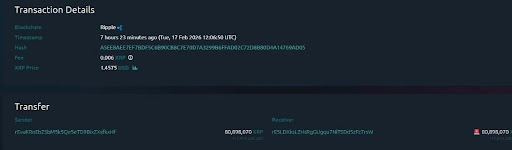
Source: Chart from Ripple Bull Winkle on X

The analyst also noted that the lack of identifiable wallets also fuels speculation that a whale may be accumulating XRP ahead of an event or market shift, though nothing is certain yet. He further remarked that “someone knows something,” implying that insiders or large holders may be acting on information not yet visible to the broader crypto market.

Interestingly, Ripple’s blockchain logs confirm the transfer and provide the wallet addresses involved, but reveal nothing about who orchestrated the substantial transfer. The timing of the transaction amid the broader decline in the XRP price adds another layer of intrigue. Notably, the altcoin has been in a pronounced downtrend for months, dropping from 2025 highs above $3 to under $1.5 at the time of writing. This steep decline has been driven by a combination of market factors, including sell-side pressure.

Commenters on Ripple Bull Winkle’s post have speculated that the 81 million XRP transfer could signal upcoming selling. At the same time, they also caution that the move may have no deeper significance and could simply be a wallet-to-wallet transfer for security or operational purposes.

The Trend Remains Largely Bearish

In a more price-focused analysis, market analyst Crypto Tony stated that XRP’s current trend is “most certainly bearish.” This assessment comes as the cryptocurrency continues to break key support zones and trade below former resistance levels.

Crypto Tony indicated that the altcoin’s price could continue its downtrend, potentially declining further toward $1.38. At its current price of 1.42, this would represent a significant correction of approximately 2.8%. Notably, the analyst has highlighted a resistance level above $1.5 on his accompanying chart, suggesting XRP could revisit this area if it regains bullish momentum.

XRP trading at $1.41 on the 1D chart | Source: XRPUSDT on Tradingview.com

Preguntas relacionadas

QWhat was the total value of the XRP transaction that occurred on the Ripple blockchain, as mentioned in the article?

AThe total value of the XRP transaction was $117 million.

QAccording to the article, which crypto analyst first revealed and shared on-chain data about the large XRP transfer?

AThe crypto analyst Ripple Bull Winkle first revealed and shared the on-chain data about the transfer in a post on X.

QWhat reason did Ripple Bull Winkle suggest for the large, anonymous transfer of 81 million XRP?

ARipple Bull Winkle suggested the movement was deliberate, hinting at strategic positioning, and that a whale may be accumulating XRP ahead of an event or market shift.

QWhat is the current bearish price target for XRP mentioned by market analyst Crypto Tony?

AMarket analyst Crypto Tony indicated that XRP's price could continue its downtrend, potentially declining further toward $1.38.

QWhat key piece of information is missing from the on-chain data regarding this large XRP transaction?

AThe on-chain data is missing the identities of the sender and receiver; the wallets involved have no labels and the transfer had no exchange involvement.

Lecturas Relacionadas

Those Pre-Bitcoin PoW Protocols Have Recently Been Reimplemented

This article details a recent surge in replicating pre-Bitcoin Proof-of-Work (PoW) protocols, specifically focusing on Hal Finney's 2004 RPOW (Reusable Proofs of Work). Within five days in May 2026, multiple independent builders in the Bitcoin/cypherpunk community launched projects inspired by this early electronic cash proposal. The initiative began with Fred Krueger's `rpow2.com`, a centralized but auditable system that replaced RPOW's original IBM 4758 hardware with Ed25519 signatures. Initially a faithful replica, it later adopted Bitcoin-like features (21M supply cap, difficulty adjustment) and a controversial 5.24% founder allocation. This sparked rapid forks, including `rpow4.com` which incorporated full Bitcoin parameters, a prediction market (`rpowmarket.com`), and a DEX (`rpow2swap.com`). Concurrently, Mike In Space created a prototype of Wei Dai's 1998 b-money proposal (`b-money.replit.app`), pushing the historical exploration even further back. The article contrasts these centralized, server-dependent experiments with Bitcoin's core innovation of decentralized, trustless consensus. It also highlights a parallel development: the `HASH` project on Ethereum, which uses smart contract hooks to enable a purely fair-launch, browser-mineable PoW token with 0% allocations to team or VCs. The collective activity is framed as a meme-driven, educational exploration of cypherpunk history rather than a serious financial movement, with all projects heavily disclaiming any investment value.

marsbitHace 3 min(s)

Those Pre-Bitcoin PoW Protocols Have Recently Been Reimplemented

marsbitHace 3 min(s)

South Korean Exchanges 'Battle' Regulators, Challenging the Boundaries of Enforcement and Legislation

South Korea's cryptocurrency industry is engaged in a rare, direct confrontation with regulators. The Financial Intelligence Unit (FIU), the primary anti-money laundering (AML) watchdog, has recently imposed heavy penalties on major exchanges like Upbit and Bithumb for alleged violations involving unregistered overseas VASPs and AML procedures. However, exchanges are now actively challenging these actions in court and through industry associations. In a significant shift, the Seoul Administrative Court ruled in favor of Upbit's operator, Dunamu, overturning part of an FIU-ordered business suspension. The court found the FIU's penalty criteria and justification insufficiently clear. Similarly, the court suspended the enforcement of a six-month business suspension against Bithumb pending a final ruling, citing potential irreversible harm to the exchange. Beyond legal battles, the industry is contesting proposed legislative amendments. The Digital Asset eXchange Alliance (DAXA) strongly opposes a draft rule that would mandate Suspicious Transaction Reports (STRs) for all crypto transfers over 10 million KRW (~$6,800). DAXA argues this "poison pill" clause violates legal principles and would overwhelm the STR system, increasing reports from 63,000 to an estimated 5.45 million annually for major exchanges, thereby crippling effective AML monitoring. This conflict highlights a structural tension in South Korea's crypto governance: comprehensive digital asset laws are still developing, while regulators rely heavily on AML enforcement. The industry's move from passive compliance to active legal and legislative challenges signifies a new phase, pressing for clearer rules and more proportionate enforcement. While short-term disputes may intensify, this clash could ultimately lead to a more mature and sustainable regulatory framework for South Korea's vibrant crypto market.

marsbitHace 56 min(s)

South Korean Exchanges 'Battle' Regulators, Challenging the Boundaries of Enforcement and Legislation

marsbitHace 56 min(s)

After 50x Storage Surge, Justin Sun Always Looks to the Next Decade

Sun Yuchen, known for his controversial stunts like a $30 million lunch with Warren Buffett (canceled due to a kidney stone) and eating a $6.2 million duct-taped banana, is often overshadowed by a significant fact: his decade-long track record of spotting major investment trends. In 2016, he famously advised young people to invest in Bitcoin, Nvidia, Tesla, and Tencent instead of buying property. A hypothetical $20,000 investment in Nvidia and Tesla from that list would now be worth over 50 million RMB. His latest major call was on November 6, 2025, predicting a "50x storage opportunity" tied to the AI boom, which materialized with Sandisk's stock surging nearly 50-fold by 2026. Looking ahead, Sun now focuses on the next frontier: Physical AI. He identifies four key areas: 1. **Embodied AI/Robotics**: He sees this reaching its "iPhone moment," with companies like UBTech and Galaxy General leading in commercialization. 2. **Drones**: Viewed as the first commercially viable form of Physical AI, revolutionizing sectors from warfare (e.g., AeroVironment's Switchblade) to logistics. 3. **Spatial Computing**: Beyond VR, it's about AI understanding physical space, a foundational technology for robotics and autonomous systems, exemplified by Apple's Vision Pro. 4. **Space Exploration**: After a 2025 suborbital flight with Blue Origin, Sun advocates for space as the ultimate frontier, discussing blockchain's potential role in space asset management and data transactions. His investment philosophy involves betting on entire, inevitable trends rather than single companies. For robotics, he sees Tesla (the body/manufacturer) and Nvidia (the brain/AI platform) as complementary plays. In defense drones, he highlights companies making tanks obsolete (AeroVironment) and those augmenting fighter jets (Kratos). For space, he participated in Blue Origin's flight and anticipates SpaceX's potential IPO to redefine the sector's valuation. Sun Yuchen's vision frames the next two decades not as a revolution in information flow (like the internet), but in the fundamental operation of the physical world through AI-powered robots, autonomous systems, and spatial intelligence, ultimately extending human and AI activity into space. While many still focus on conventional assets, he continues to look toward the next technological horizon.

marsbitHace 1 hora(s)

After 50x Storage Surge, Justin Sun Always Looks to the Next Decade

marsbitHace 1 hora(s)

The Billionaires Behind the Most Expensive Midterm Election in History

"The Most Expensive Midterm Elections and Their Billionaire Backers" This analysis details the unprecedented scale of spending in the 2026 midterm elections, highlighting the key billionaire donors shaping the political landscape. Jeff Yass, founder of Susquehanna International Group, has contributed over $81 million, ranking third among individual donors behind George Soros ($102.6M) and Elon Musk ($84.8M). Yass is a major donor to Trump's MAGA Inc. and supports school choice and various candidates. Overall, federal committees have raised over $4.7 billion this cycle, with political ad spending projected to reach $10.8 billion. Republican-aligned groups are significantly out-raising their Democratic counterparts. "Dark money" from undisclosed sources continues to grow. The core stakes involve control of Congress and policy direction for Trump's final term. Donors are also motivated by specific issues: Sergey Brin and Chris Larsen are funding opposition to a proposed California wealth tax and supporting crypto-friendly policies. Other top donors include OpenAI's Greg Brockman and his wife Anna ($50M total to MAGA Inc. and an AI-focused PAC), Richard Uihlein ($45.3M to conservative causes), venture capitalists Marc Andreessen and Ben Horowitz (each over $44M to crypto/AI PACs and MAGA Inc.), Miriam Adelson ($42.6M to GOP leadership PACs), Paul Singer ($33.9M), and Diane Hendricks ($25.8M to MAGA Inc.). The article notes that the peak fundraising period is still ahead, with major primaries approaching.

marsbitHace 1 hora(s)

The Billionaires Behind the Most Expensive Midterm Election in History

marsbitHace 1 hora(s)

Trading

Spot
Futuros

Artículos destacados

Cómo comprar ONE

¡Bienvenido a HTX.com! Hemos hecho que comprar Harmony (ONE) sea simple y conveniente. Sigue nuestra guía paso a paso para iniciar tu viaje de criptos.Paso 1: crea tu cuenta HTXUtiliza tu correo electrónico o número de teléfono para registrarte y obtener una cuenta gratuita en HTX. Experimenta un proceso de registro sin complicaciones y desbloquea todas las funciones.Obtener mi cuentaPaso 2: ve a Comprar cripto y elige tu método de pagoTarjeta de crédito/débito: usa tu Visa o Mastercard para comprar Harmony (ONE) al instante.Saldo: utiliza fondos del saldo de tu cuenta HTX para tradear sin problemas.Terceros: hemos agregado métodos de pago populares como Google Pay y Apple Pay para mejorar la comodidad.P2P: tradear directamente con otros usuarios en HTX.Over-the-Counter (OTC): ofrecemos servicios personalizados y tipos de cambio competitivos para los traders.Paso 3: guarda tu Harmony (ONE)Después de comprar tu Harmony (ONE), guárdalo en tu cuenta HTX. Alternativamente, puedes enviarlo a otro lugar mediante transferencia blockchain o utilizarlo para tradear otras criptomonedas.Paso 4: tradear Harmony (ONE)Tradear fácilmente con Harmony (ONE) en HTX's mercado spot. Simplemente accede a tu cuenta, selecciona tu par de trading, ejecuta tus trades y monitorea en tiempo real. Ofrecemos una experiencia fácil de usar tanto para principiantes como para traders experimentados.

230 Vistas totalesPublicado en 2024.12.12Actualizado en 2025.03.21

Cómo comprar ONE

Discusiones

Bienvenido a la comunidad de HTX. Aquí puedes mantenerte informado sobre los últimos desarrollos de la plataforma y acceder a análisis profesionales del mercado. A continuación se presentan las opiniones de los usuarios sobre el precio de ONE (ONE).

活动图片









