UK Crypto Regulation Enters Countdown: What Changes Are in the FCA's New Rules?

Foresight NewsPublicado a 2026-07-02Actualizado a 2026-07-02

Resumen

UK Crypto Regulation Enters Countdown: Key Changes in FCA's New Rules The UK Financial Conduct Authority (FCA) has published its final crypto asset regulatory policy, marking a shift from consultation to implementation. The new regime, set to fully expand from October 25, 2027, moves crypto businesses from registration to authorisation. A critical window from September 30, 2026, to February 28, 2027, allows existing firms to apply for transitional provisions, enabling them to continue operating while their authorisation is reviewed. Existing registrations will not automatically convert. The rules cover a broad range of activities including stablecoin issuance, custody, trading platform operation, arranging deals, staking, and lending. Authorised firms must meet new prudential capital requirements, with permanent minimum capital ranging from £750,000 for proprietary trading to £75,000 for arranging deals. They must also hold a basic liquid asset buffer for operational resilience. Market integrity rules now apply to trading platforms and intermediaries, covering areas like insider trading and requiring best execution checks against at least three UK-authorised venues. Custodians face enhanced client asset protection rules (CASS 17), focusing on ownership, reconciliation, and private key management. For stablecoins, issuers must provide full backing from issuance and allow redemption at par value within a T+1 timeframe. Reserve assets are categorised into core (e.g., demand...


Written by: KarenZ, Foresight News


A countdown clock is rewriting the UK crypto market.


If a platform helps users buy crypto, facilitates trading, custodies assets, or issues stablecoins in the UK, the core questions it faces next are straightforward: does its business fall under the FCA's new regulatory scope? Does it need to apply for authorization? Can it continue operating during the application review period?


At the end of June 2026, the UK Financial Conduct Authority (FCA) issued a set of crypto asset regulatory policy statements covering stablecoin issuance, custody, trading platforms, intermediaries, staking, lending, market abuse, disclosure, prudential capital, and the applicability of the FCA Handbook.


According to the FCA's Crypto Roadmap, this marks the transition of UK crypto regulation from years of consultation to the final rule-making stage.


From Registration to Authorization


The UK has previously regulated the crypto industry, but its scope was relatively limited. Since January 2020, crypto asset trading service providers and custodian wallet providers operating in the UK have needed to register with the FCA under anti-money laundering regulations; in 2023, financial promotion rules began to apply to crypto asset marketing.


This change goes further. The FCA stated that the UK Parliament passed the *Financial Services and Markets Act 2000 (Cryptoassets) Regulations 2026* on February 4, 2026, bringing a broader range of crypto asset activities into the FCA's regulatory perimeter for the first time. Under the new regime, the full scope of regulated activities will be extended from October 25, 2027.


This regime covers a significant number of entities. The relevant activities listed by the FCA include: issuing qualifying stablecoins, custodying crypto assets, operating qualifying crypto asset trading platforms, trading qualifying crypto assets (as principal or agent), arranging qualifying crypto asset trading services (including crypto lending), arranging qualifying crypto asset staking services, and more.


In other words, regarding crypto-specific regulation, the UK regulator is not targeting just one segment. Issuance, trading, matching, brokerage, custody, staking, lending—if an activity falls within the definitions of the new regime, it will likely need to enter the FCA's authorization system.


The Most Critical Window, Determining Whether Business Can Continue During Review


For crypto companies already operating in the UK market, the period from September 30, 2026, to February 28, 2027, is the most crucial to watch.


The FCA stated that if a firm wishes to rely on the *savings provisions*, which are transitional grandfathering clauses, the application window is planned to open on September 30, 2026, and close on February 28, 2027. Eligible companies that submit applications within this window can continue to carry out specified activities before the FCA makes its decision.


This is not a mere date reminder. It determines whether existing firms can continue operating while awaiting authorization review. Missing the window may cause a company to lose the protection to continue relevant business during the transition period.


The FCA also explicitly stated that existing registrations will not be automatically converted. Firms currently registered under the *Financial Services and Markets Act 2000 (FSMA)* or the *Money Laundering Regulations*, authorized under payment service or electronic money rules, or relying on FSMA s.21 approval for financial promotions—if their business falls within the scope of the new regulated crypto asset activities—will still need to obtain the corresponding authorization.


This will force many companies to re-evaluate their business boundaries. Models that were sufficient under anti-money laundering registration or financial promotion rules may no longer suffice under the new regime. Companies must first determine if they fall within the regulatory scope, then prepare authorization applications, capital arrangements, risk control systems, and client asset protection mechanisms.


Beyond Authorization: Capital and Risk Control Thresholds


Obtaining authorization is not the only challenge. This time, the FCA has broken down many compliance requirements that were previously easily relegated to slogans into more concrete rules.


Regarding prudential capital, PS26/12 sets out the permanent minimum capital requirements for different businesses. Firms trading qualifying crypto assets as principal: £750,000; issuing qualifying stablecoins: £350,000; custodying crypto assets, providing qualifying crypto asset staking services, operating qualifying crypto asset trading platforms: £150,000; trading as agent and arranging trades: £75,000.
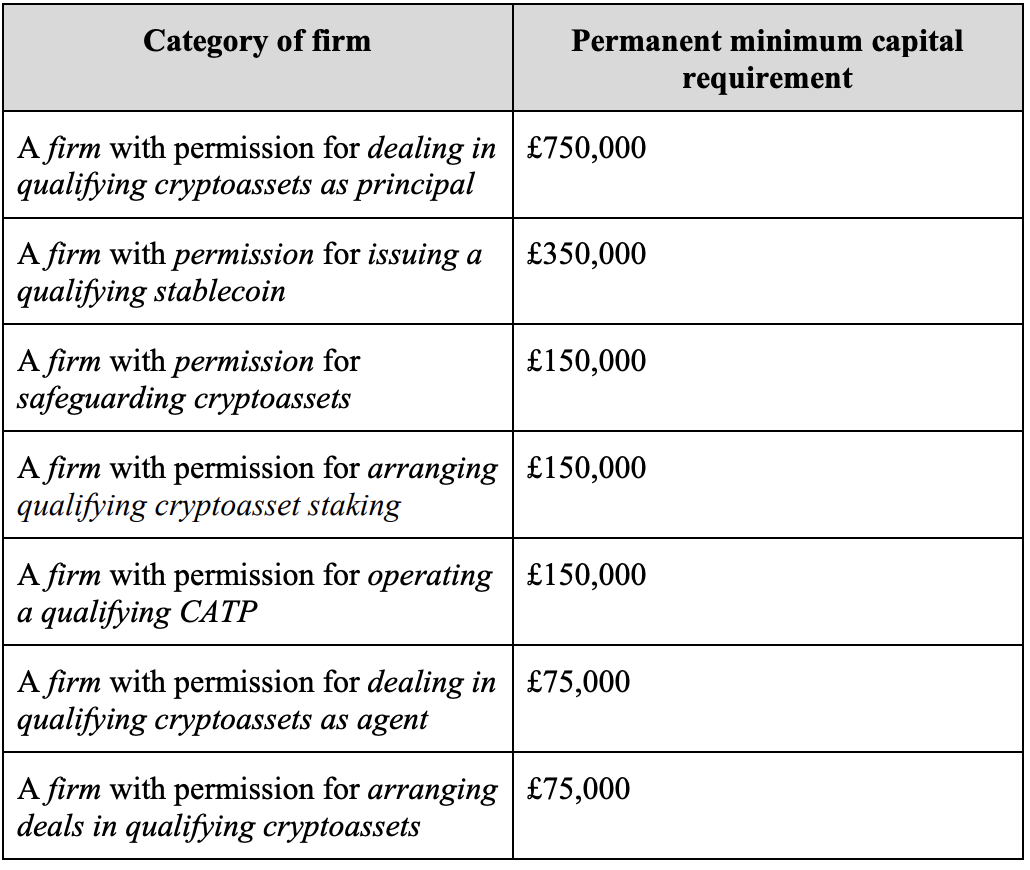


These figures may not seem high, but they are just the baseline. The FCA explained that a firm's minimum own funds requirement is the highest of three values: the permanent minimum capital requirement, the fixed overheads requirement, and the K-factor requirement. The permanent minimum capital is the baseline, while the K-factor is further calculated based on the scale of business activities and risk exposure. The FCA also emphasized that the permanent minimum capital is an authorization threshold; firms cannot obtain authorization first and then gradually meet the requirement in phases afterwards.


The FCA has also introduced a basic liquid asset requirement. Relevant firms must hold core liquid assets amounting to one-third of the fixed overheads requirement plus 1.6% of the total value of client guarantees. The purpose of this liquidity buffer is pragmatic: firms cannot meet capital requirements only on paper; they must also have sufficient liquid assets to support operations, orderly wind-down, or handling client-related obligations under stress scenarios.


Trading platforms and intermediaries also face more detailed market conduct rules. In its press release, the FCA stated that the new framework will introduce market integrity rules covering areas like insider trading and market manipulation; in the regime overview, the FCA also included trading platforms and intermediaries within the scope of activity rules in PS26/11, specifically mentioning requirements such as best execution and price checks across multiple execution venues. PS26/11 further stipulates that relevant firms need to establish client order handling procedures to ensure client orders are executed promptly, fairly, and expeditiously, and to reference prices from at least 3 reliable UK authorized execution venues for price checks where possible.


If there are fewer than 3 UK authorized venues where the order can be executed, existing available venues should be checked. The FCA simultaneously emphasized that this is not a mechanical price comparison for each trade, nor does it require orders to be executed only at the 3 venues checked. It requires firms to use reliable price sources to validate their execution policies and be able to demonstrate that the execution outcomes delivered to clients are at least as good as those that would have been achieved in comparable circumstances at these UK authorized venues.


The focus for custody businesses is client asset protection. In PS26/11, the FCA confirmed that CASS 17 protection requirements will apply to client crypto assets, with rule focuses including ownership, record keeping, asset reconciliation, and private key management. In short, platforms cannot merely state that "assets are transparent on-chain"; they must also prove they know which assets belong to which clients, whether their ledgers match on-chain assets, and that private key control will not be compromised due to internal processes or external attacks.


The FCA's cost-benefit analysis provides a more tangible figure: it estimates that custody protection rules could prevent approximately £60 million in consumer losses annually.


Lending and staking are also brought into a more detailed consumer protection framework. For crypto lending, the FCA retains core protection requirements for retail clients, including enhanced disclosure, client consent, appropriateness tests, record keeping, over-collateralization, and negative balance protection. Negative balance protection means that a retail client's losses in a crypto borrowing arrangement should not exceed the market value of the collateral they have specifically provided for that borrowing.


For staking services, the FCA retains requirements for disclosure, contract terms, client consent, and record keeping, but makes adjustments for automatic staking arrangements, allowing clients to consent to ongoing staking covering current and future holdings, provided relevant conditions are met and annual notifications are given.


Stablecoins Placed Beside Payment Ambitions


Stablecoins are a category of activity treated separately within this regulatory framework.


The FCA stated that qualifying stablecoins issued in the UK will be required to be fully backed and redeemable at par value, to support their use as "money-like instruments."


The core of PS26/10 is to require stablecoin issuers to establish an auditable mechanism around backing assets, redemption, disclosure, and asset protection. The FCA's final rules require UK stablecoin issuers to provide full backing for their stablecoins from the moment they are minted, including tokens held by the issuer itself; tokens that have been permanently destroyed no longer require backing asset coverage. The FCA's reasoning is direct: stablecoins are liquid, and if unsupported tokens enter the market, it could undermine confidence in their 1:1 peg.


Regarding redemption, the FCA requires UK stablecoin issuers to provide the right to redeem at par value and complete redemptions within a T+1 timeframe. However, the final rules adjust the starting point: T+1 no longer starts from the submission of a complete redemption request, but from when the issuer receives the stablecoins to be redeemed into its wallet. This allows AML/KYC checks to be completed before T+1, avoiding squeezing anti-money laundering reviews into the redemption timeline.


Regarding backing assets, the FCA divides stablecoin reserves into two tiers: core backing assets and expanded backing assets.


Core backing assets include demand deposits and short-term government debt instruments; expanded backing assets include longer-term government debt instruments, shares in public debt CNAV money market funds, and repo or reverse repo arrangements with government debt instruments as the underlying and a maturity not exceeding 7 days.


The FCA sets two liquidity requirements: First, issuers must meet the On-demand Deposit Requirement (ODDR), meaning they must hold at least 5% of the backing asset pool as demand deposits. Second, issuers must also meet the Core Backing Asset Requirement (CBAR), meaning they must hold an additional percentage of core backing assets, with the percentage being the higher of 5% and the highest single-day redemption ratio over the past 180 redemption days. Demand deposits used to meet the ODDR cannot also be used to meet the CBAR.


The focus of this design is to prevent issuers from allocating more to long-term or complex assets for yield, yet being unable to provide sufficient high-liquidity assets during concentrated user redemptions.


Beyond this, there is a larger regulatory division of labor. The FCA and the Bank of England issued a joint statement on the same day explaining the regulatory pathway for systemic stablecoin issuers. "General UK stablecoin issuers" are regulated by the FCA; if a UK stablecoin issuer is designated by HM Treasury as having "systemic importance," it may transition from sole FCA regulation to joint regulation by the FCA and the Bank of England.


PS26/10 also mentions that in the Bank of England's draft rules, the backing asset composition for systemic stablecoins may shift to a maximum of 70% UK sovereign debt with a remaining maturity of less than 6 months, and a minimum of 30% central bank deposits; individual stablecoins may also be subject to a provisional issuance cap of £40 billion and required to offer T+0 redemption.


This indicates that the UK does not view stablecoins solely as exchange-denominated tools. As long as they continue to approach payment and settlement scenarios, regulatory focus will expand from investment risk to reserve safety, redemption stability, and financial infrastructure reliability.


Summary


The FCA still cautions that the vast majority of crypto assets are highly speculative, and consumers may lose all their principal. The new rules do not eliminate such risks, nor do they endorse crypto assets. What they change is another matter: the UK is beginning to address crypto business using more comprehensive financial regulatory language.


Under the new framework, crypto-related companies must also demonstrate whether capital is sufficient, how client assets are protected, whether trade execution is fair, if stablecoins can be redeemed according to rules, and who is responsible if risks get out of control.


By October 25, 2027, when the countdown ends, those that truly remain will be the companies that can clearly articulate their business boundaries, client assets, capital buffers, and risk responsibilities.

Criptos en tendencia

Preguntas relacionadas

QWhat is the most crucial application window for existing crypto firms under the new UK FCA regime, and what does it allow?

AThe most crucial window is from September 30, 2026, to February 28, 2027. Firms that submit their applications during this period and meet the conditions can rely on the 'savings provisions' (transitional arrangements). This allows them to continue their designated crypto-related activities while the FCA processes their application for authorization.

QWill a firm's existing registration with the FCA (e.g., for AML purposes) automatically convert into a full authorization under the new crypto regime?

ANo. Existing registrations under the Money Laundering Regulations, authorizations under the Payment Services or E-money rules, or financial promotions approvals will NOT automatically convert to authorization. Any firm whose activities fall within the scope of the new regulated crypto asset business must apply for and obtain the appropriate FCA authorization.

QWhat are the key new regulatory requirements for a crypto asset custodian under the FCA's final rules (PS26/11)?

AKey requirements for custodians under PS26/11 include: Client Asset (CASS 17) protection rules focused on client asset segregation, accurate record-keeping, regular reconciliation of holdings on and off-chain, and secure private key management. The rules aim to ensure firms can prove which assets belong to which client and that private keys are not at risk from internal failures or external attacks.

QHow does the FCA's new framework (PS26/10) structure the reserve assets for 'Qualifying Stablecoin' issuers?

AThe FCA structures stablecoin reserves into two tiers. 'Core backing assets' include demand deposits and short-term government debt instruments. 'Expanded backing assets' include longer-term government debt, CNAV money market fund shares, and short-term repos (≤7 days). Issuers must also meet specific liquidity buffers: a 5% On-demand Deposit Requirement (ODDR) and a Core Backing Asset Requirement (CBAR) based on peak redemption history.

QWhat is the potential regulatory path for a stablecoin issuer deemed 'systemically important' in the UK?

AA stablecoin issuer designated by HM Treasury as 'systemically important' would move from being regulated solely by the FCA to a dual-regulatory regime with joint supervision by the FCA and the Bank of England (BoE). The BoE's proposed rules for such issuers could include stricter reserve asset requirements (e.g., up to 70% in short-term UK sovereign debt and at least 30% in central bank deposits) and a potential T+0 redemption timeframe.

Lecturas Relacionadas

High-Yield, Debt-Free, and Non-Dilutive: Why Bitcoin Treasury Companies Are Aggressively Promoting Preferred Share Financing

Bitcoin-backed preferred shares, led by companies like Strategy and followed by newer entrants like Strive, have grown to a market size of approximately $13 billion in under two years, attracting capital with high yields. A 2026 report from BitcoinTreasuries.net and Apyx projects this segment could grow from nearly 1% to 3-5% of the global $1.3 trillion preferred share market by 2030, with long-term potential reaching 10%. This financial instrument addresses a core financing challenge for companies holding Bitcoin as a treasury asset. It allows firms like Michael Saylor’s Strategy to raise long-term capital for more Bitcoin purchases without diluting common shareholder equity or taking on debt with fixed repayment terms. Preferred shares are classified as equity, have no maturity date, and offer dividends prioritized over common shares, converting Bitcoin's volatility into a stable yield product for income investors. Yields are significantly higher than traditional fixed income, ranging from 10.8% to 15.2% for top issuers. Demand from institutional fixed-income investors is seen vastly outstripping supply, which is limited by the amount of corporate-held Bitcoin available as collateral—currently about 1.26 million BTC ($83 billion), with Strategy holding 67%. A key safety feature is the high collateral coverage ratio of 3.8x to 4.5x, meaning each dollar of preferred equity is backed by $3.8-$4.5 in Bitcoin. Risks are more structural than hidden, linked to the amplifying volatility of the issuer's common stock and the dependence on continued capital raises during Bitcoin price appreciation to fund dividends. Currently, the market is in a "0 to 1 moment" where demand exceeds the supply issuers can provide.

Foresight NewsHace 47 min(s)

High-Yield, Debt-Free, and Non-Dilutive: Why Bitcoin Treasury Companies Are Aggressively Promoting Preferred Share Financing

Foresight NewsHace 47 min(s)

Trading

Spot

Artículos destacados

Qué es DOGE M

Doge Matrix ($doge m): La Nueva Raza de Criptomonedas Impulsadas por la Comunidad Introducción En el paisaje en constante evolución de las criptomonedas, nuevos proyectos emergen constantemente, cada uno con el objetivo de captar el interés de inversores y entusiastas por igual. Uno de los últimos en entrar en este dominio es Doge Matrix, representado por el símbolo de ticker $doge m. Este proyecto ha atraído atención gracias a sus raíces en la popular cultura de memes que rodea a Dogecoin, estableciendo su lugar dentro del espacio web3. Este artículo tiene como objetivo proporcionar un análisis integral de Doge Matrix, cubriendo su visión general, creador, inversores, funcionalidad, cronología y aspectos notables. ¿Qué es Doge Matrix ($doge m)? Doge Matrix es un proyecto de criptomoneda impulsado por la comunidad que aparentemente se basa en el atractivo generalizado de Dogecoin, una moneda digital conocida por su mascota Shiba Inu y sus orígenes en memes. Si bien los objetivos generales de Doge Matrix no están ampliamente definidos, se caracteriza por un compromiso con la participación y el apoyo de la comunidad. A diferencia de las criptomonedas tradicionales que a menudo enfatizan la utilidad o el valor intrínseco a través de tecnologías subyacentes, Doge Matrix se posiciona dentro de un espacio que abraza el fenómeno cultural de las criptomonedas, apelando particularmente a aquellos que resuenan con la ética de los activos basados en memes. Aprovechando las fortalezas de la comunidad de Dogecoin, Doge Matrix opera como parte de un ecosistema más amplio, invitando a la participación y el compromiso de usuarios que comparten un interés en la criptomoneda y el paisaje digital. ¿Quién es el Creador de Doge Matrix ($doge m)? La identidad del creador de Doge Matrix sigue siendo desconocida. Esta falta de transparencia no es un acontecimiento poco común en el espacio de las criptomonedas, donde algunos proyectos se lanzan sin revelar las identidades de sus fundadores. La ausencia de información sobre el equipo fundador puede generar preguntas entre los posibles inversores sobre la responsabilidad y dirección del proyecto. ¿Quiénes son los Inversores de Doge Matrix ($doge m)? Hasta el momento, no hay información disponible públicamente que detalle los inversores o fundaciones de inversión que respaldan a Doge Matrix. El proyecto parece depender principalmente del apoyo de la comunidad en lugar de inversiones institucionales. Este modelo se alinea con la naturaleza impulsada por la comunidad de la iniciativa, fomentando un entorno donde la dirección del proyecto es moldeada por sus participantes en lugar de ser dictada por unos pocos patrocinadores financieros seleccionados. ¿Cómo Funciona Doge Matrix ($doge m)? Los detalles sobre los mecanismos operativos de Doge Matrix son algo vagos, reflejando una tendencia más amplia de proyectos en el espacio de las monedas meme donde las funcionalidades innovadoras no siempre están claramente articuladas. No obstante, Doge Matrix parece estar diseñado para aprovechar el ecosistema existente de criptomonedas alentar la participación de los usuarios mientras se conecta con las referencias culturales familiares asociadas a Dogecoin. Sus características potencialmente únicas derivan de las interacciones comunitarias en lugar de avances tecnológicos, enfatizando experiencias compartidas y colaboración entre los poseedores de tokens. Si bien las innovaciones exactas no se han delineado explícitamente, el proyecto parece crear un espacio donde los miembros de la comunidad pueden interactuar, compartir ideas y propulsar el potencial del proyecto hacia adelante. Cronología de Doge Matrix ($doge m) Reflexionar sobre la cronología del proyecto revela eventos notables que han definido su trayectoria hasta ahora: 25 de noviembre de 2024: Doge Matrix alcanzó su valor máximo histórico, marcando un hito significativo en su historia temprana. 1 de enero de 2025: Por el contrario, Doge Matrix alcanzó su valor mínimo histórico, ilustrando la volatilidad a menudo asociada con las criptomonedas, especialmente en las primeras etapas del ciclo de vida de un proyecto. En curso: El proyecto continúa siendo activamente negociado y respaldado por su comunidad, aunque aún no se han divulgado hitos u objetivos futuros específicos. Puntos Clave Sobre Doge Matrix ($doge m) Enfoque Comunitario En el corazón de Doge Matrix hay un compromiso con la participación de la comunidad. El proyecto prospera sobre la premisa de colaboración y objetivos compartidos entre sus miembros, enfatizando la importancia del esfuerzo colectivo. A diferencia de los proyectos centralizados que a menudo tienen una estructura de liderazgo definida, Doge Matrix actualmente muestra un enfoque más fluido hacia la gobernanza, donde la voz de cada miembro de la comunidad importa. Volatilidad El mercado de criptomonedas es notorio por su volatilidad, y Doge Matrix no es una excepción. Su historial de precios refleja fluctuaciones significativas entre valores altos y bajos, lo cual es típico de muchas nuevas criptomonedas, pero subraya los riesgos asociados con la inversión en tokens emergentes. Falta de Información Detallada Una de las características más llamativas de Doge Matrix es la escasez de información detallada sobre sus fundamentos tecnológicos y mecanismos operativos. Esta ambigüedad requiere que los posibles inversores realicen una diligencia debida exhaustiva antes de involucrarse con el proyecto. Conclusión En resumen, Doge Matrix ($doge m) ilustra una nueva ola de proyectos de criptomonedas que se apoyan en gran medida en la participación de la comunidad y la relevancia cultural. Si bien carece de ciertos detalles, como liderazgo claro, objetivos definidos y funcionalidad detallada, el proyecto ha logrado generar interés dentro de la comunidad cripto, aprovechando el atractivo establecido de la cultura de memes. Al igual que con cualquier inversión en el espacio de las criptomonedas, comprender los riesgos inherentes y realizar una investigación exhaustiva es esencial para los participantes potenciales. Doge Matrix se erige como un recordatorio de la naturaleza dinámica y, a veces, impredecible de la industria cripto, marcada por una evolución constante y entusiasmo por iniciativas impulsadas por la comunidad.

432 Vistas totalesPublicado en 2025.02.03Actualizado en 2025.02.03

Qué es DOGE M

Qué es $M

Entendiendo Mantis ($M): Una Nueva Era en la Interoperabilidad entre Cadenas En el paisaje en constante evolución de Web3 y las criptomonedas, nuevos proyectos se esfuerzan por ofrecer soluciones innovadoras destinadas a mejorar la experiencia del usuario y expandir las posibilidades funcionales dentro del ecosistema financiero descentralizado. Uno de estos proyectos que está ganando atención es Mantis ($M), un protocolo pionero fundado en los principios de interoperabilidad entre cadenas y liquidaciones basadas en intenciones. Este artículo profundiza en los aspectos esenciales de Mantis, incluyendo su funcionalidad central, creadores, respaldo de inversión, características innovadoras y hitos críticos. ¿Qué es Mantis ($M)? Mantis se describe como un protocolo de liquidación de intenciones multi-dominio que simplifica las interacciones entre cadenas, permitiendo a los usuarios ejecutar transacciones financieras complejas a través de varias plataformas de blockchain sin problemas. El protocolo opera a través de tres capas principales: Expresión de Intenciones: Los usuarios pueden articular sus objetivos de transacción utilizando un lenguaje natural facilitado por el DISE LLM, un modelo de lenguaje de IA avanzado. Por ejemplo, un usuario podría expresar el deseo de intercambiar Ethereum (ETH) por Solana (SOL) con una tolerancia de deslizamiento específica del 1%. Ejecución: Esta capa emplea una red de solucionadores que compiten para cumplir con las intenciones de los usuarios. Las transacciones se ejecutan utilizando mecanismos como Coincidencia de Deseos (CoWs) y Subastas de Flujo de Órdenes (OFAs), que aseguran que las demandas de los usuarios se satisfagan de manera óptima. Liquidación: Aprovechando el protocolo de Comunicación Inter-Blockchain (IBC), Mantis permite transacciones atómicas entre cadenas, permitiendo a los usuarios operar a través de varias cadenas soportadas, incluyendo Ethereum, Solana y Cosmos. Mantis está diseñado para introducir generación de rendimiento nativa para activos inactivos, utilizando pruebas criptográficas para mantener la integridad de las transacciones a lo largo de todo el proceso. Creadores y Equipo de Desarrollo Mantis fue concebido por la Composable Foundation, una organización impulsada por la investigación notable por su énfasis en soluciones de interoperabilidad de blockchain. Esta fundación colabora con instituciones académicas de renombre, incluyendo la Universidad de Harvard y la Universidad de Lisboa, contribuyendo a extensos esfuerzos de investigación y desarrollo que informan la arquitectura y funcionalidad de Mantis. El compromiso de la Composable Foundation de fomentar la innovación en el espacio de blockchain posiciona a Mantis como una solución robusta para la creciente demanda de interoperabilidad entre múltiples redes de blockchain. Inversores y Respaldo Si bien los detalles específicos sobre inversores individuales no se han divulgado públicamente, Mantis disfruta de un respaldo sustancial de varias entidades, incluyendo: Subvenciones del ecosistema de cadenas habilitadas por IBC, que apoyan el crecimiento del protocolo y su integración dentro de ecosistemas de finanzas descentralizadas. Asociaciones estratégicas con proveedores de infraestructura que mejoran las capacidades de la red de Mantis y sus estrategias de implementación. Financiamiento a través del tesoro de la Composable Foundation, asegurando un apoyo financiero sostenido para el desarrollo continuo y los costos operativos. Estos esfuerzos colaborativos reflejan un consenso entre las partes interesadas sobre la importancia de mejorar la funcionalidad entre cadenas y la utilidad potencial de las innovaciones infraestructurales de Mantis. Innovaciones Clave Mantis se distingue por varias innovaciones pioneras que mejoran su funcionalidad y utilidad: Intenciones Agnósticas a la Cadena: Los usuarios pueden iniciar transacciones desde cualquier cadena soportada mientras liquidan en otra. Esta flexibilidad empodera a los usuarios, impulsando una mayor interacción entre diferentes plataformas. Interfaz Potenciada por IA: La integración del DISE LLM permite a los usuarios realizar operaciones complejas de DeFi utilizando lenguaje natural, simplificando así las interacciones y haciendo que la tecnología blockchain sea accesible a un público más amplio. Captura de MEV Inter-Dominio: Mantis crea un mercado interno para el valor máximo extraíble (MEV) a través de competencias entre solucionadores. Este enfoque innovador permite una mayor eficiencia y extracción de valor en transacciones complejas. Capa de Liquidación Modular: El protocolo soporta varios métodos de verificación, incluyendo pruebas de conocimiento cero y rollups optimistas, proporcionando un marco versátil que puede adaptarse a las tecnologías de blockchain emergentes. Línea de Tiempo Histórica El desarrollo de Mantis está marcado por varios hitos críticos que trazan su trayectoria y crecimiento: | Año | Hito | |————|———————————————————————–| | 2022 | Desarrollo del concepto inicial dentro de la división de investigación de la Composable Foundation. | | Q3 2024 | Lanzamiento de la testnet con capacidades de puenteo entre Solana y Ethereum. | | Q1 2025 | Evento de Generación de Token (TGE) anticipado junto con el lanzamiento de la mainnet. | | Q2 2025 | Integración esperada del DISE LLM y expansión de las capacidades entre cadenas. | | 2025 H2 | Soporte planeado para más de 15 cadenas a través de futuras actualizaciones de IBC. | Esta línea de tiempo describe la evolución de Mantis, desde discusiones conceptuales hasta la implementación activa y fases de crecimiento futuro. Estrategia de Crecimiento del Ecosistema La estrategia de Mantis para el crecimiento del ecosistema incluye varias iniciativas diseñadas para fomentar la participación de los usuarios y el compromiso de los desarrolladores: Sistema de Créditos: Los usuarios pueden ganar créditos del protocolo al proporcionar liquidez y participar en programas de referidos. Estos créditos son canjeables por incentivos en el futuro, fomentando una comunidad de usuarios robusta. Kit de Desarrollo de Software Modular (SDK): Este conjunto de herramientas empodera a los desarrolladores para crear aplicaciones basadas en modelos impulsados por intenciones utilizando la infraestructura de Mantis, promoviendo así la innovación dentro de su ecosistema. Modelo de Gobernanza: A medida que el protocolo madura, los poseedores de tokens $M tendrán voz en la gobernanza del protocolo, permitiéndoles votar sobre actualizaciones y cambios propuestos, mejorando así el compromiso de la comunidad y la descentralización. Mantis representa un avance significativo en el ámbito de la arquitectura entre cadenas. Al integrar sin problemas algoritmos avanzados de IA con un marco de liquidación robusto, Mantis busca abordar los problemas de fragmentación dentro de los ecosistemas multi-cadena. Su enfoque innovador prioriza la mejora de la experiencia del usuario mientras se adhiere a los principios fundamentales de descentralización y seguridad, estableciendo un nuevo estándar para la futura interoperabilidad de las tecnologías blockchain. A medida que Mantis continúa su camino de crecimiento e implementación, promete ser un proyecto a seguir de cerca en el competitivo paisaje de Web3 y las finanzas descentralizadas. Con su enfoque en cruzar fronteras y elevar la participación del usuario, Mantis está preparado para ser una parte integral de los futuros desarrollos en el espacio de las criptomonedas.

47 Vistas totalesPublicado en 2025.03.18Actualizado en 2025.03.18

Qué es $M

Cómo comprar M

¡Bienvenido a HTX.com! Hemos hecho que comprar MemeCore (M) sea simple y conveniente. Sigue nuestra guía paso a paso para iniciar tu viaje de criptos.Paso 1: crea tu cuenta HTXUtiliza tu correo electrónico o número de teléfono para registrarte y obtener una cuenta gratuita en HTX. Experimenta un proceso de registro sin complicaciones y desbloquea todas las funciones.Obtener mi cuentaPaso 2: ve a Comprar cripto y elige tu método de pagoTarjeta de crédito/débito: usa tu Visa o Mastercard para comprar MemeCore (M) al instante.Saldo: utiliza fondos del saldo de tu cuenta HTX para tradear sin problemas.Terceros: hemos agregado métodos de pago populares como Google Pay y Apple Pay para mejorar la comodidad.P2P: tradear directamente con otros usuarios en HTX.Over-the-Counter (OTC): ofrecemos servicios personalizados y tipos de cambio competitivos para los traders.Paso 3: guarda tu MemeCore (M)Después de comprar tu MemeCore (M), guárdalo en tu cuenta HTX. Alternativamente, puedes enviarlo a otro lugar mediante transferencia blockchain o utilizarlo para tradear otras criptomonedas.Paso 4: tradear MemeCore (M)Tradear fácilmente con MemeCore (M) en HTX's mercado spot. Simplemente accede a tu cuenta, selecciona tu par de trading, ejecuta tus trades y monitorea en tiempo real. Ofrecemos una experiencia fácil de usar tanto para principiantes como para traders experimentados.

849 Vistas totalesPublicado en 2025.07.02Actualizado en 2026.06.02

Cómo comprar M

Discusiones

Bienvenido a la comunidad de HTX. Aquí puedes mantenerte informado sobre los últimos desarrollos de la plataforma y acceder a análisis profesionales del mercado. A continuación se presentan las opiniones de los usuarios sobre el precio de M (M).

活动图片