Why Bitcoin Ignores Bad News from the US? The Answer is in the QCP Report

cryptonews.ruPublicado a 2026-08-18Actualizado a 2026-08-18

Resumen

The Bitcoin market is showing resilience despite weak US economic data and high oil prices, according to a QCP Capital report. While poor retail sales and consumer sentiment figures lowered expectations for an immediate Fed rate hike, persistently high oil prices complicate the inflation outlook. Bitcoin itself is trading in a narrow range just above $63,000, absorbing negative news without a significant breakdown. Similarly, Ethereum remains around $1,900. Market volatility is compressing, with implied volatility exceeding realized volatility, creating conditions for short volatility strategies, though QCP warns of significant risks if volatility spikes unexpectedly. Trader focus is now shifting to key upcoming events: the FOMC meeting minutes, July's PCE inflation data, and the Jackson Hole Economic Symposium, which could provide a new directional catalyst for the market currently stuck in a wait-and-see pattern.

A report from trading firm QCP Capital has noted that the Bitcoin market remains in a stable range despite weak macroeconomic data from the US and rising oil prices. Analysts at the company point out that the asset's quotes are holding near the lower boundary of its recent trading channel, while volatility continues to decline.
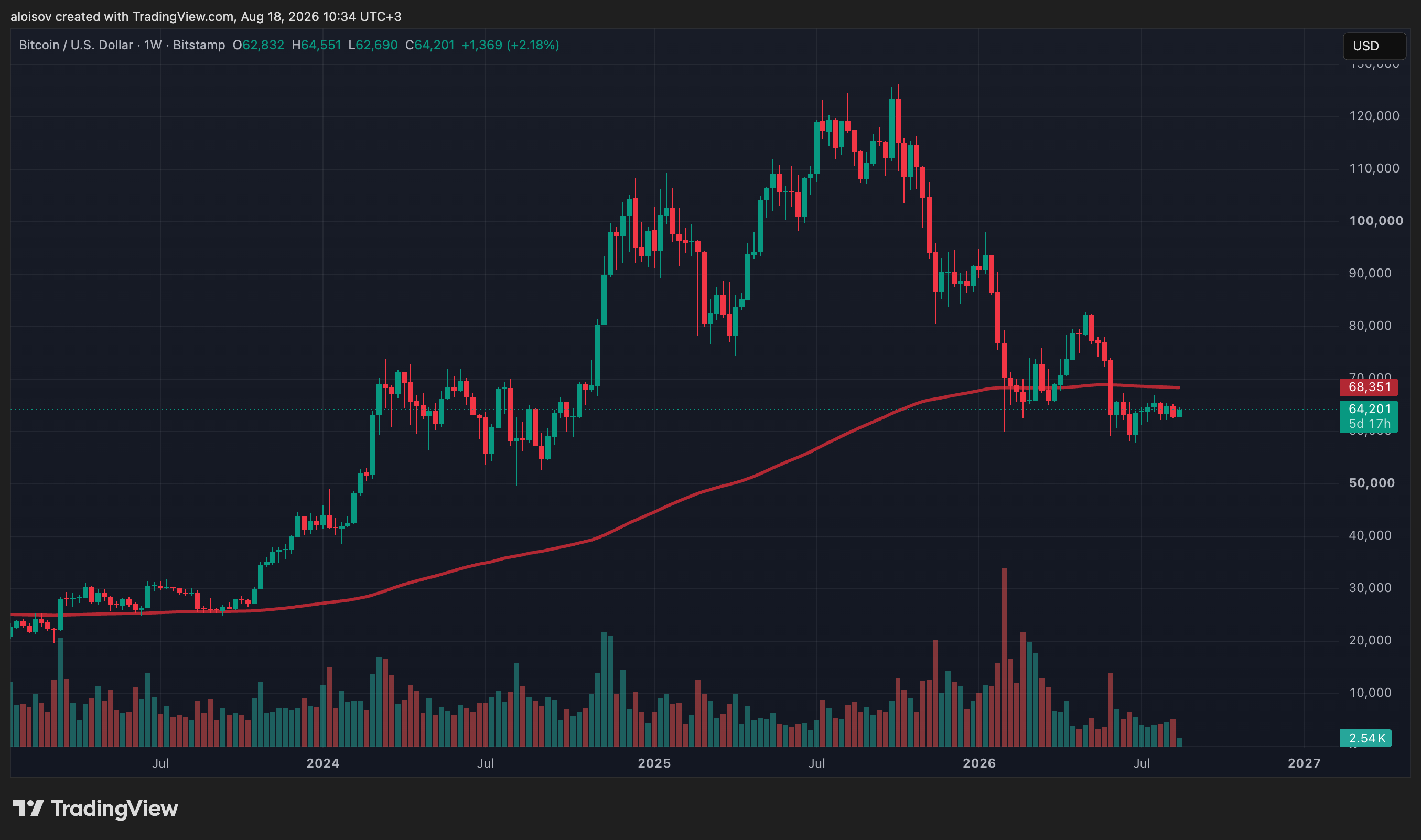
1-week BTC/USD chart and 200EMA. Source: Bitstamp

Weak Data, Strong Oil

U.S. stock indexes closed Friday, August 14th, slightly in the red: the S&P 500 lost 0.17%, the Nasdaq Composite fell 0.28%, and the Dow Jones dropped by approximately 108 points. According to QCP, economic statistics provided a more significant signal. The University of Michigan's preliminary Consumer Sentiment Index fell to 51.0 in August from 55.2 in July, and retail sales in July declined by 0.6%—the strongest monthly drop since May 2025.

Coupled with weaker labor market data released earlier this month, this statistics have reduced expectations for an immediate tightening of monetary policy. Federal funds rate futures now price in roughly a 30% probability of a 25 basis point rate hike at the September meeting. However, inflation remains above the target level, so the future policy trajectory will still depend on incoming data.

Oil remains the main counterweight to weakening business activity. WTI traded around $82.40, and Brent around $88.70 early Monday amid unresolved negotiations concerning the Strait of Hormuz. High energy prices can translate into general inflation and inflation expectations, complicating the interpretation of weak activity data for regulators.

The Range Holds, No Momentum

Against this backdrop, Bitcoin continues, as QCP notes, to "stagnate" rather than sharply decline. The spot price is holding just above $63,000 after a drop of about 3% over the week, continuing to fluctuate within the range that has defined its dynamics in recent weeks.

Analysts emphasize an important difference from the previous review: Bitcoin continues to absorb negative macroeconomic and geopolitical news without a sustained breakdown to the downside.

Instead of looking for directional signals at specific price levels, QCP suggests focusing on the fact that Bitcoin remains near the lower boundary of its recent range. A sustained exit beyond this channel would provide more information about market participants' positioning than the relatively restrained fluctuations within it.

Ethereum shows a similar lack of momentum, trading around $1,900 in recent sessions. Thus, the entire crypto market is currently characterized more by restrained conviction among participants than by acute stress.

Volatility is Compressing

The options market reflects the same calm. Bitcoin's one-week implied volatility is around 26%, while the seven-day realized volatility is closer to 20%. This gap means that options are still pricing in more movement than Bitcoin has actually demonstrated recently.

This is where the essence of the strategy analyzed by QCP in its report comes into play—so-called short volatility. The concept is simple: when implied volatility is higher than realized volatility, a trader can sell options, hoping to profit from the difference between how much movement is "priced in" and how much movement actually occurs.

  • The trader sells options (calls, puts, or their combinations) on Bitcoin or Ethereum

  • The option buyer pays a premium for the right, but not the obligation, to buy or sell the asset at a fixed price

  • If realized volatility turns out to be lower than what was priced into the option, the seller can potentially profit from the decay of the option's time value

  • However, if the market moves sharply and unexpectedly, the option seller incurs a loss, which is theoretically unlimited for naked positions

QCP explicitly warns: such a gap between implied and realized volatility is often called a positive volatility risk premium, but it does not mean that short volatility strategies are automatically profitable. Realized volatility can spike sharply, especially in the face of unexpected macroeconomic, geopolitical, or crypto-specific events—and then losses on sold options can exceed the premium received.

Overall, volatility has decreased over the past week as several scheduled catalyst events have passed. The U.S. Congress is on recess, so risks from the legislative agenda are also reduced for the near term, although the macroeconomic calendar remains busy.

Focus on the Jackson Hole Symposium

Market attention is shifting back to monetary policy. On Wednesday, the minutes of the July FOMC (Federal Open Market Committee—the body of the U.S. Federal Reserve responsible for the interest rate) meeting will be released—the document may provide more details on the 9-to-3 vote to keep the rate unchanged, including the arguments of the three committee members who voted for an increase.

Next, on August 26th, the July PCE index (Personal Consumption Expenditures index—a key inflation indicator monitored by the Fed) and the second estimate of Q2 GDP will be released, and from August 27th to 29th, the Economic Policy Symposium in Jackson Hole will take place. This year's theme is "Financial Innovations: Implications for Payments and Policy," making the event particularly significant for both monetary policy participants and digital asset market players.

For the crypto market, the backdrop remains more balanced than directional. Weak consumption and sentiment data have reduced some pressure in favor of further policy tightening, while high oil prices continue to complicate the inflation picture. Meanwhile, restrained realized volatility and sideways range movement indicate that neither side has yet gained sustained momentum.

Key Events

  • August 19 — FOMC meeting minutes

  • August 26 — U.S. July PCE index, second estimate of Q2 GDP

  • August 27–29 — Economic Policy Symposium in Jackson Hole

  • September 15–16 — FOMC meeting

The Bitcoin range resembles a taut but unbroken string—the market tests its boundaries again and again, yet a breakout has not occurred so far.

Currently, price and volatility are moving in sync, as if frozen in anticipation of a new external impulse—be it inflation data or signals from the Fed at the Jackson Hole symposium.

AI Opinion

From the perspective of machine data analysis, Bitcoin's range-bound phase finds a parallel in the asset's history after reaching peaks. As Hash Telegraph noted, after peaking at $73,679 in March 2024, Bitcoin traded for almost eight months within a $20,000 wide channel before breaking out on the backdrop of Trump's election victory. Similar mechanics—a prolonged hang-up in a wide channel after a local high followed by a sharp exit on an external trigger—recur in the asset's history more often than is commonly assumed when assessing the current pause.

The macroeconomic calendar rarely creates such a density of catalysts in a row—the FOMC minutes, PCE index, and Jackson Hole symposium form a kind of decision-making funnel, where the market postpones positioning until the last event. The risk of such a waiting strategy is that participants may react simultaneously to several signals, rather than sequentially, which can abruptly widen the range instead of a smooth breakout. Will the current channel remain relevant after the symposium, or will a new narrative on digital payments set a different trajectory for the crypto market?


Criptos en tendencia

Preguntas relacionadas

QAccording to the QCP Capital report, how does the bitcoin market react to negative US macro news?

AThe bitcoin market is absorbing the negative macroeconomic and geopolitical news without a sustained breakdown to the downside. It remains within a stable range, showing resilience and a lack of clear directional momentum.

QWhat key US economic data points mentioned in the article are currently weakening market expectations for an immediate policy tightening?

AThe weakening data points include the University of Michigan's preliminary consumer sentiment index dropping to 51.0 in August, July retail sales falling by 0.6%, and earlier weaker-than-expected labor market data. These have reduced expectations for an immediate monetary tightening by the Fed.

QWhat trading strategy related to volatility does QCP discuss, and what are its risks?

AQCP discusses the 'short volatility' strategy. This involves selling options when implied volatility is higher than realized volatility, aiming to profit from the decay of time value. The key risk is that realized volatility can spike unexpectedly due to macro, geopolitical, or crypto-specific events, potentially causing losses that exceed the premium received.

QWhat upcoming economic events are highlighted as key catalysts for the market's focus?

AThe key upcoming events are: the FOMC meeting minutes on August 19, the July PCE index and the second estimate of Q2 GDP on August 26, and the Jackson Hole Economic Symposium from August 27 to 29.

QWhat historical pattern regarding bitcoin's price action after a peak is mentioned in the article's 'AI Opinion' section?

AThe 'AI Opinion' section notes a historical pattern where after reaching a peak (like the $73,679 high in March 2024), bitcoin often trades within a wide range for an extended period before breaking out sharply due to an external trigger, such as a major political event.

Lecturas Relacionadas

Century-Old Chain Director Regulations Revived, a16z Faces Antitrust Investigation

The US Department of Justice has launched an antitrust investigation into venture capital firm Andreessen Horowitz (a16z), according to people familiar with the matter. The probe centers on whether a16z partners improperly hold board seats at competing artificial intelligence companies, specifically Databricks Inc. and Fivetran Inc., which both provide data collection and analytics services. a16z co-founder Ben Horowitz sits on Databricks' board, while partner Martin Casado is on Fivetran's board. The previously unreported investigation, ongoing for nearly a year, began around the time regulators reviewed and ultimately approved Fivetran's acquisition of a rival, dbt labs, last October. The inquiry revives a Biden-era enforcement focus on "interlocking directorates" under a 1914 law, where individuals or entities serve on the boards of direct competitors. While typical resolutions involve directors resigning from one board, this case is notable because the concern involves multiple partners from the same firm serving on competing boards. The scrutiny is heightened by a16z's significant political connections and influence, including donations to groups supporting both Trump and Harris, and its advocacy for relaxed AI regulations. A16z, managing $90 billion in assets, is a major investor in AI startups. The DOJ has not decided on any action, and the investigation may conclude without charges.

marsbitHace 3 min(s)

Century-Old Chain Director Regulations Revived, a16z Faces Antitrust Investigation

marsbitHace 3 min(s)

What Is the Cost of Bitcoin Mining Companies Going All-In on AI?

Bitcoin mining companies are undergoing a massive transformation, pivoting from cryptocurrency mining to AI infrastructure and high-performance computing (HPC) services. This shift is driven by the severe profitability crisis in Bitcoin mining following the 2024 halving and the October 2025 market crash, which pushed mining costs as high as $140,000 while Bitcoin's price fell to around $63,000. In response, major public miners like Core Scientific and TeraWulf are rebranding as "energy infrastructure platforms" or "AI cloud service providers." Their revenue structures have flipped, with AI/HPC hosting now constituting over 70-80% of quarterly revenue, dramatically surpassing declining Bitcoin mining income. They are securing massive, long-term contracts worth tens of billions of dollars with tech giants like AMD, CoreWeave, and Anthropic, locking in future cash flow. However, this all-in bet on AI carries significant risks. The AI compute market lacks Bitcoin's self-correcting mechanism, where unprofitable miners exit, reducing network difficulty and boosting profitability for those who remain. An AI compute supply glut could rapidly drive prices down, making today's lucrative long-term contracts burdensome. Furthermore, the transition is largely one-way; retrofitting facilities for AI and signing decade-plus contracts makes it nearly impossible to return to mining when its profitability eventually rebounds. Some companies, like Marathon Digital and Hut 8, are taking a more hedged approach. They are funding AI expansion through debt secured by Bitcoin holdings or by spinning off mining into separate subsidiaries, rather than completely divesting. This strategy maintains the optionality to shift power load back to Bitcoin mining if it becomes profitable again, positioning them as flexible power operators rather than being captive to a single, unproven market cycle. The article concludes that while the pivot to AI is a necessary survival move for many, abandoning Bitcoin mining entirely for long-term AI contracts is a risky gamble that could backfire.

marsbitHace 7 min(s)

What Is the Cost of Bitcoin Mining Companies Going All-In on AI?

marsbitHace 7 min(s)

Walsh May "Beat Around the Bush" at Global Central Bankers' Conference, but Internal Fed Division Is the Real Focus?

With the annual Jackson Hole symposium approaching, market expectations are rising for clues from Federal Reserve Chair Kevin Wash's upcoming speech on September monetary policy. However, analysts caution that expectations for clear guidance may be overstated, while underestimating the Fed's growing internal divisions. Since taking office in May, Wash has adopted a notably less communicative style than his predecessor, downplaying forward guidance and emphasizing policy independence from market pricing. His scheduled speech on "Financial Innovation in Payments" is thus more likely to focus on broad narratives than near-term policy signals. The more significant focus lies within the Fed itself. At Wash's first meeting in June, nearly half the committee's dot plot projections hinted at a 2026 rate hike need. The July meeting saw three regional Fed presidents dissent in favor of an immediate rate increase—an unusually high level of early-term dissent. This internal rift presents a clearer signal of policy uncertainty than any public speech. Market pricing currently shows high conviction for a September pause, with prediction markets assigning roughly a 74% probability to unchanged rates. Despite this consensus, traders remain wary of potential hawkish surprises amid mixed economic data. Analysts suggest that for investors, tracking the evolving voting patterns within the FOMC may offer more insight into future rate direction than parsing Wash's likely guarded Jackson Hole remarks.

marsbitHace 8 min(s)

Walsh May "Beat Around the Bush" at Global Central Bankers' Conference, but Internal Fed Division Is the Real Focus?

marsbitHace 8 min(s)

Automotive Chips Initiate a New Round of Game

After two years of deep inventory correction, the global automotive semiconductor industry is signaling a turning point in the second half of 2026, entering a structural upcycle. Unlike the broad-based shortages of 2022, this recovery is characterized by significant divergence across different chip segments, driven by 800V high-voltage platforms, high-level autonomous driving, and ongoing localization of supply chains in China. The industry-wide destocking cycle has concluded, with inventory levels at automakers and Tier 1 suppliers returning to healthy ranges. Key indicators, including rising OEM orders, lengthening component lead times, improving vendor revenues, and the initiation of price hikes by major suppliers like Infineon and Texas Instruments, confirm the start of a replenishment cycle. Segments are diverging into three tiers based on demand and supply dynamics. The first and strongest tier includes Silicon Carbide (SiC), high-voltage IGBTs, and automotive power management chips, fueled by the rapid adoption of 800V platforms. The second tier, experiencing a moderate recovery, comprises high-end 32-bit MCUs and automotive NOR Flash/DRAM, benefiting from advanced compute domains and AI-driven capacity constraints on mature nodes. The third tier, consisting of low-voltage MOSFETs and basic body electronics, remains stable with ample supply. The core growth logic has shifted from pure vehicle sales volume to increasing semiconductor content per vehicle. This is propelled by the transition to domain/centralized E/E architectures, software-defined vehicles, and new applications like commercial vehicle electrification and V2X communications. While the domestic Chinese supply chain is seizing this window for localization, risks remain, including potential softness in end-demand, future SiC oversupply, and possible easing of 8-inch wafer capacity constraints. In the near term, key segments are expected to see simultaneous volume and price increases, with the industry's cyclicality gradually giving way to more prominent long-term growth characteristics.

marsbitHace 28 min(s)

Automotive Chips Initiate a New Round of Game

marsbitHace 28 min(s)

Trading

Spot

Artículos destacados

Qué es BITCOIN

Entendiendo HarryPotterObamaSonic10Inu (ERC-20) y Su Posición en el Espacio Cripto En los últimos años, el mercado de criptomonedas ha sido testigo de un aumento en la popularidad de las monedas meme, capturando el interés no solo de los comerciantes, sino también de aquellos que buscan compromiso comunitario y valor de entretenimiento. Entre estos tokens únicos se encuentra HarryPotterObamaSonic10Inu (ERC-20), un proyecto intrigante que mezcla referencias culturales en el tejido de las criptomonedas. Este artículo profundiza en los aspectos clave de HarryPotterObamaSonic10Inu, explorando sus mecanismos, ethos impulsado por la comunidad y su relación con el paisaje cripto más amplio. ¿Qué es HarryPotterObamaSonic10Inu (ERC-20)? Como su nombre sugiere, HarryPotterObamaSonic10Inu es una moneda meme construida sobre la blockchain de Ethereum, clasificada bajo el estándar ERC-20. A diferencia de las criptomonedas tradicionales que pueden enfatizar la utilidad práctica o el potencial de inversión, este token prospera en el valor de entretenimiento y la fuerza de su comunidad. El proyecto tiene como objetivo fomentar un entorno donde los usuarios comprometidos puedan reunirse, compartir ideas y participar en actividades inspiradas por diversos fenómenos culturales. Una característica notable de HarryPotterObamaSonic10Inu es su cero impuestos en las transacciones. Este atractivo elemento tiene como objetivo incentivar el comercio y la participación comunitaria, sin cargos adicionales que puedan disuadir a los comerciantes de pequeña escala. El suministro total de la moneda está establecido en mil millones de tokens, una cifra que marca su intención de mantener una circulación sustancial dentro de la comunidad. Creador de HarryPotterObamaSonic10Inu (ERC-20) Los orígenes de HarryPotterObamaSonic10Inu están algo envueltos en misterio; los detalles sobre el creador siguen siendo desconocidos. El desarrollo de este token carece de un equipo identificable o de un plan explícito, lo cual no es inusual dentro del sector de monedas meme. En cambio, el proyecto ha surgido de manera orgánica, con su progreso muy dependiente del entusiasmo y la participación de su comunidad. Inversores de HarryPotterObamaSonic10Inu (ERC-20) En cuanto a inversiones externas y respaldo, HarryPotterObamaSonic10Inu también sigue siendo ambiguo. El token no lista ninguna fundación de inversión conocida o apoyo organizacional significativo. En cambio, la savia del proyecto es su comunidad de base, que informa su crecimiento y sostenibilidad a través de la acción colectiva y el compromiso en el espacio cripto. ¿Cómo Funciona HarryPotterObamaSonic10Inu (ERC-20)? Como una moneda meme, HarryPotterObamaSonic10Inu opera principalmente fuera de los marcos tradicionales que a menudo rigen el valor de los activos. Hay varios aspectos distintivos que definen cómo funciona el proyecto: Transacciones Sin Impuestos: Sin tarifas impositivas en las transacciones, los usuarios pueden comprar y vender el token libremente sin preocuparse por costos ocultos. Compromiso Comunitario: El proyecto prospera en la interacción comunitaria, aprovechando plataformas de redes sociales para crear entusiasmo y facilitar la participación. Las discusiones, el intercambio de contenido y el compromiso son elementos cruciales que ayudan a expandir su alcance y fomentar la lealtad entre los seguidores. Sin Utilidad Práctica: Cabe señalar que HarryPotterObamaSonic10Inu no ofrece utilidad concreta dentro del ecosistema financiero. Más bien, se clasifica como un token principalmente para actividades de entretenimiento y comunitarias. Referencia Cultural: El token incorpora astutamente elementos de la cultura popular para atraer interés, conectando con entusiastas de los memes y seguidores de las criptomonedas por igual. HarryPotterObamaSonic10Inu ejemplifica cómo las monedas meme operan de manera diferente a los proyectos de criptomonedas más tradicionales, ingresando al mercado como construcciones sociales innovadoras en lugar de activos utilitarios. Cronología de HarryPotterObamaSonic10Inu (ERC-20) La historia de HarryPotterObamaSonic10Inu está marcada por varios hitos notables: Creación: El token surgió de un meme viral, capturando la imaginación de muchos entusiastas de las criptomonedas. Las fechas específicas de creación no están disponibles, subrayando su ascenso orgánico. Listado en Exchanges: HarryPotterObamaSonic10Inu ha llegado a varios exchanges, permitiendo un acceso y comercio más fácil por parte de la comunidad. Iniciativas de Compromiso Comunitario: Actividades continuas destinadas a mejorar la interacción comunitaria, incluyendo concursos, campañas en redes sociales y generación de contenido por parte de fanáticos y defensores. Planes de Expansión Futuros: La hoja de ruta del proyecto incluye el lanzamiento de una colección de NFT, mercancía y un sitio de comercio electrónico relacionado con sus temas culturales, involucrando aún más a la comunidad e intentando añadir más dimensiones a su ecosistema. Puntos Clave Sobre HarryPotterObamaSonic10Inu (ERC-20) Naturaleza Impulsada por la Comunidad: El proyecto prioriza la participación colectiva y la creatividad, asegurando que la involucración de los usuarios esté a la vanguardia de su desarrollo. Clasificación como Moneda Meme: Representa la epítome de las criptomonedas basadas en el entretenimiento, diferenciándose de los vehículos de inversión tradicionales. Sin Afiliación Directa con Bitcoin: A pesar de la similitud en el nombre del ticker, HarryPotterObamaSonic10Inu es distinto y no tiene relación con Bitcoin u otras criptomonedas establecidas. Enfoque en la Colaboración: HarryPotterObamaSonic10Inu está diseñado para crear un espacio para la colaboración y el intercambio de historias entre sus poseedores, proporcionando una vía para la creatividad y el vínculo comunitario. Perspectivas Futuras: La ambición de expandirse más allá de su premisa inicial hacia NFTs y mercancías describe un camino para que el proyecto potencialmente ingrese a avenidas más tradicionales dentro de la cultura digital. A medida que las monedas meme continúan capturando la imaginación de la comunidad de criptomonedas, HarryPotterObamaSonic10Inu (ERC-20) se destaca debido a sus lazos culturales y su enfoque centrado en la comunidad. Si bien puede no encajar en el molde típico de un token impulsado por la utilidad, su esencia radica en la alegría y la camaradería fomentadas entre sus seguidores, destacando la naturaleza en evolución de las criptomonedas en una era cada vez más digital. A medida que el proyecto continúa desarrollándose, será importante observar cómo las dinámicas comunitarias influyen en su trayectoria en el cambiante paisaje de la tecnología blockchain.

2.8k Vistas totalesPublicado en 2024.04.01Actualizado en 2024.12.03

Qué es BITCOIN

Cómo comprar BTC

¡Bienvenido a HTX.com! Hemos hecho que comprar Bitcoin (BTC) sea simple y conveniente. Sigue nuestra guía paso a paso para iniciar tu viaje de criptos.Paso 1: crea tu cuenta HTXUtiliza tu correo electrónico o número de teléfono para registrarte y obtener una cuenta gratuita en HTX. Experimenta un proceso de registro sin complicaciones y desbloquea todas las funciones.Obtener mi cuentaPaso 2: ve a Comprar cripto y elige tu método de pagoTarjeta de crédito/débito: usa tu Visa o Mastercard para comprar Bitcoin (BTC) al instante.Saldo: utiliza fondos del saldo de tu cuenta HTX para tradear sin problemas.Terceros: hemos agregado métodos de pago populares como Google Pay y Apple Pay para mejorar la comodidad.P2P: tradear directamente con otros usuarios en HTX.Over-the-Counter (OTC): ofrecemos servicios personalizados y tipos de cambio competitivos para los traders.Paso 3: guarda tu Bitcoin (BTC)Después de comprar tu Bitcoin (BTC), guárdalo en tu cuenta HTX. Alternativamente, puedes enviarlo a otro lugar mediante transferencia blockchain o utilizarlo para tradear otras criptomonedas.Paso 4: tradear Bitcoin (BTC)Tradear fácilmente con Bitcoin (BTC) en HTX's mercado spot. Simplemente accede a tu cuenta, selecciona tu par de trading, ejecuta tus trades y monitorea en tiempo real. Ofrecemos una experiencia fácil de usar tanto para principiantes como para traders experimentados.

6.1k Vistas totalesPublicado en 2024.12.12Actualizado en 2026.06.02

Cómo comprar BTC

Qué es $BITCOIN

ORO DIGITAL ($BITCOIN): Un Análisis Integral Introducción al ORO DIGITAL ($BITCOIN) ORO DIGITAL ($BITCOIN) es un proyecto basado en blockchain que opera en la red Solana, cuyo objetivo es combinar las características de los metales preciosos tradicionales con la innovación de las tecnologías descentralizadas. Aunque comparte un nombre con Bitcoin, a menudo referido como “oro digital” debido a su percepción como un refugio de valor, ORO DIGITAL es un token separado diseñado para crear un ecosistema único dentro del paisaje Web3. Su meta es posicionarse como un activo digital alternativo viable, aunque los detalles sobre sus aplicaciones y funcionalidades aún están en desarrollo. ¿Qué es ORO DIGITAL ($BITCOIN)? ORO DIGITAL ($BITCOIN) es un token de criptomoneda diseñado explícitamente para su uso en la blockchain de Solana. A diferencia de Bitcoin, que proporciona un papel de almacenamiento de valor ampliamente reconocido, este token parece centrarse en aplicaciones y características más amplias. Aspectos notables incluyen: Infraestructura Blockchain: El token está construido sobre la blockchain de Solana, conocida por su capacidad para manejar transacciones de alta velocidad y bajo costo. Dinámicas de Suministro: ORO DIGITAL tiene un suministro máximo limitado a 100 cuatrillones de tokens (100P $BITCOIN), aunque los detalles sobre su suministro circulante no se han divulgado actualmente. Utilidad: Si bien las funcionalidades precisas no están delineadas explícitamente, hay indicios de que el token podría ser utilizado para diversas aplicaciones, potencialmente involucrando aplicaciones descentralizadas (dApps) o estrategias de tokenización de activos. ¿Quién es el Creador de ORO DIGITAL ($BITCOIN)? En la actualidad, la identidad de los creadores y el equipo de desarrollo detrás de ORO DIGITAL ($BITCOIN) sigue siendo desconocida. Esta situación es típica entre muchos proyectos innovadores dentro del espacio blockchain, particularmente aquellos alineados con las finanzas descentralizadas y fenómenos de monedas meme. Si bien tal anonimato puede fomentar una cultura impulsada por la comunidad, intensifica las preocupaciones sobre la gobernanza y la responsabilidad. ¿Quiénes son los Inversores de ORO DIGITAL ($BITCOIN)? La información disponible indica que ORO DIGITAL ($BITCOIN) no tiene patrocinadores institucionales conocidos ni inversiones destacadas de capital de riesgo. El proyecto parece operar en un modelo de peer-to-peer centrado en el apoyo y la adopción de la comunidad en lugar de rutas de financiamiento tradicionales. Su actividad y liquidez se sitúan principalmente en intercambios descentralizados (DEX), como PumpSwap, en lugar de plataformas de trading centralizadas establecidas, lo que resalta aún más su enfoque de base. Cómo Funciona ORO DIGITAL ($BITCOIN) Los mecanismos operativos de ORO DIGITAL ($BITCOIN) pueden elaborarse en función de su diseño blockchain y atributos de red: Mecanismo de Consenso: Al aprovechar el único proof-of-history (PoH) de Solana combinado con un modelo de proof-of-stake (PoS), el proyecto asegura una validación de transacciones eficiente que contribuye al alto rendimiento de la red. Tokenómica: Si bien los mecanismos deflacionarios específicos no se han detallado extensamente, el vasto suministro máximo de tokens implica que podría atender microtransacciones o casos de uso nicho que aún están por definirse. Interoperabilidad: Existe el potencial de integración con el ecosistema más amplio de Solana, incluyendo varias plataformas de finanzas descentralizadas (DeFi). Sin embargo, los detalles sobre integraciones específicas permanecen no especificados. Cronología de Eventos Clave Aquí hay una cronología que destaca hitos significativos relacionados con ORO DIGITAL ($BITCOIN): 2023: El despliegue inicial del token ocurre en la blockchain de Solana, marcado por su dirección de contrato. 2024: ORO DIGITAL gana visibilidad al estar disponible para trading en intercambios descentralizados como PumpSwap, permitiendo a los usuarios comerciar contra SOL. 2025: El proyecto presencia actividad de trading esporádica y potencial interés en compromisos liderados por la comunidad, aunque no se han documentado asociaciones notables o avances técnicos hasta el momento. Análisis Crítico Fortalezas Escalabilidad: La infraestructura subyacente de Solana soporta altos volúmenes de transacciones, lo que podría mejorar la utilidad de $BITCOIN en varios escenarios de transacción. Accesibilidad: El potencial bajo precio de trading por token podría atraer a inversores minoristas, facilitando una participación más amplia debido a oportunidades de propiedad fraccionada. Riesgos Falta de Transparencia: La ausencia de patrocinadores, desarrolladores o un proceso de auditoría conocidos públicamente puede generar escepticismo sobre la sostenibilidad y confiabilidad del proyecto. Volatilidad del Mercado: La actividad de trading depende en gran medida del comportamiento especulativo, lo que puede resultar en una volatilidad de precios significativa y en incertidumbre para los inversores. Conclusión ORO DIGITAL ($BITCOIN) surge como un proyecto intrigante pero ambiguo dentro del ecosistema de Solana en rápida evolución. Si bien intenta aprovechar la narrativa del “oro digital”, su alejamiento del papel establecido de Bitcoin como refugio de valor subraya la necesidad de una diferenciación más clara de su utilidad y estructura de gobernanza previstas. La aceptación y adopción futura dependerán probablemente de abordar la actual opacidad y de definir sus estrategias operativas y económicas de manera más explícita. Nota: Este informe abarca información sintetizada disponible hasta octubre de 2023, y pueden haber ocurrido desarrollos más allá del período de investigación.

567 Vistas totalesPublicado en 2025.05.13Actualizado en 2025.05.13

Qué es $BITCOIN

Discusiones

Bienvenido a la comunidad de HTX. Aquí puedes mantenerte informado sobre los últimos desarrollos de la plataforma y acceder a análisis profesionales del mercado. A continuación se presentan las opiniones de los usuarios sobre el precio de BTC (BTC).

活动图片