Author: Decentralised.co
Compiled by: Shenchao TechFlow
Shenchao TechFlow Note: When stablecoin monthly settlement volume surpassed the U.S. ACH network for the first time, the role of the dollar is no longer just a reserve currency, but an exported technology of U.S. institutions. This article dissects how the blockchain rail is delivering dollar liquidity globally through three lenses: cross-border payments, tokenized assets, and on-chain credit. For investors, this directly points to where the opportunities for the next wave of infrastructure lie.
Exporting U.S. Institutions
The initial inspiration for this article came from a note Marc from OMVC shared with us. He posits that stablecoins solve the orchestration layer problem, not the dollar scarcity layer problem. Dollar scarcity is the deeper, unsolved issue; using stablecoins doesn't resolve it. You need to inject dollar liquidity into these markets.
This article builds on his perspective. I've observed a batch of startups building a global financial orchestration layer on the blockchain rail. My thesis is that the blockchain rail will become the infrastructure for exporting U.S. institutions and assets globally. This article will present an argument for why this may be the case. It is one of a series of notes we plan to publish discussing how our internal thesis on crypto and the blockchain rail will evolve.
The opening chapter of *The Sovereign Individual* quotes Herodotus. He recounts the silent trade between Carthaginian merchants and an unnamed Libyan tribe on the west coast of Africa. The Carthaginians would arrive by ship, unload their goods on the shore, return to their vessel, and raise smoke. The locals would then come down, inspect the goods, and leave gold beside them. If the Carthaginians felt the price was unfair, they would wait for the buyers to leave more gold on the shore. This process would repeat until both sides agreed on a price. No words were exchanged, but they had a common language.
This was 2,500 years ago, long before the World Bank, SWIFT, blockchain, and perhaps even most civilizations. After all these years, the essence of commerce remains the same. It is the exploration of a common language to find a fair price. In market terms, the price can be an interest rate we understand, an FX cost, or the amount of dollars to pay. But all commerce is an attempt to create a unified common language.
Organizations like the World Bank and IMF helped create a common institutional language for sovereign finance. SWIFT did the same for cross-border, inter-bank communication. Visa, Mastercard, and DTCC then extended that grammar to payments, cards, clearing, and settlement. For over 70 years, global commerce has relied on institutions that make strangers recognizable to each other, because one factor in maintaining global peace is commerce.
If your economy depends on a nation doing business with you, the probability of you bombing them is fairly low. Intertwined economies often yield periods of less conflict. But these institutions have limits in their ability to establish trust. This trust is written into legislation, banking relationships, and operational processes, but cannot be verified or enforced through shared technology.
Perhaps a global ledger continuously verified by all relevant parties could offer a better solution.
Visa realizes this. Mastercard realizes this. DTCC realizes this. Even SWIFT realizes this. The drive to adopt blockchain, in various forms, is about creating a common language for commerce at a global scale. We've held a simple internal thesis: blockchain is about to do to capital markets assets what the internet did to information. The marginal cost of access will fall to zero, verification will become faster, and the world will become a single capital market.
Tokenization is an attempt to create a common language for the world's economies to speak to each other. But the assets flowing through this language are only as meaningful as the institutions backing them are strong. For an economy to be strong, it needs institutions that know how to balance risk (through interest rates) with the interests of its people (through regulation). The U.S. stands out because it has strong institutions that allow technology to be developed, exported, and capitalized on effectively. Silicon Valley likely wouldn't exist elsewhere without U.S. capital markets and institutional nature. Delaware is where global startups incorporate because it has both the capital and the institutions that make those startups possible.
The dollar is a mechanism that allows the world to benefit from these institutions. Stablecoins are an export of the stability U.S. institutions provide to its citizens. Tokenization is the grammar to execute this common language. The data supports my claim.
Today, total stablecoin supply is around $315 billion. Tether alone holds roughly $141 billion in direct and indirect exposure to U.S. Treasuries, ranking 17th among global holders of U.S. debt, above South Korea and the UAE. In February 2026, stablecoins settled $7.2 trillion in a single month, surpassing the U.S. Automated Clearing House (ACH) network for the first time. The world economy is coming on-chain. Tokenized stocks, credit, and treasuries are the on-ramps for this shift. As we said in that article, blockchain lets fintech apps turn into full-stack platforms.
Vertically Integrated Capital Aggregators
This means developers around the world will soon be able to leverage assets provided by these fintech products to build services for their users.
Take Robinhood, for tokenized stocks and real-world assets (RWA).
Take Centrifuge, for tokenized AAA-grade credit through products like JAAA.
BlackRock's BUIDL does the same for money market funds.
Ondo is bringing public securities on-chain.
Apollo and Hamilton Lane are bringing private credit and private market funds on-chain via Securitize.
Superstate is building for public companies to issue and trade stock on-chain.
You can even buy a share of Blockchain Capital's tokenized venture fund on-chain.
But users don't interface with them directly. The dollar is the on-ramp for most emerging markets. Exporters, freelancers—almost anyone in an emerging market earning dollars—will soon realize they hold a tool with three functions, all of which are attractive.
This asset is an inflation hedge compared to local currency. Simply holding dollars can turn into more capital over time.
This asset can speak to global capital markets via Hyperliquid, tokenized stocks, and meme assets.
It is also highly liquid and can be sent anywhere in the world with a click.
In many emerging markets, these dollar representations may trade at a premium. During market stress and specific periods, premiums have reached 10-15%. Businesses that can translate regional economic flows into a global ledger will prove to be massively valuable. These firms extract context from regional institutions and make it understandable globally.
This is a rerun of the internet. Google Maps charted the world's streets. Your social feed charted the world's culture. Today, a new set of products is charting the provenance and flow of assets.
We see several startups solving this in unique ways.
The Rail Is The Key
Exports and imports are the most frequent form of communication between nation-states. Swift is the messaging layer carrying that communication. But the speed of clearing a transaction varies dramatically depending on the region. If you are an importer in Nigeria, sourcing from China, your supplier might ask for 60% of the payment in dollars upfront.
But dollars are often not easy to get. Nation-states restrict dollar access to maintain their own foreign reserves. A dollar wire to China—assuming you have the right relationship, at the right bank, with the right account balance—can take 7 to 10 days. In most cases, one doesn't meet all three conditions.
If the Chinese supplier accepts stablecoin payments, they forgo up to 13% in export tax rebates. So, people in these two economies do want to talk to each other in trade, but the rails don't support it. Part of this is documentation challenges, another part is fraud risk, and the last is the difficulty of suing across economies if something goes wrong.
Keyrails' role is less a lender and more a payments and credit orchestration layer for this kind of transaction. It doesn't lend from its own balance sheet. Instead, it acts as a clearing house connecting importers with external capital providers—non-bank financial institutions (NBFIs), fintechs, and, more recently, on-chain treasuries—while controlling the payment rails the borrowed funds can use. Lenders earn ~15-20% annualized, borrowers pay 20-25%. Keyrails keeps ~2.5-5% of the spread, plus fees from the payment rails.
Keep in mind, this is a borrowing rate, not an exchange rate, which is the parallel alternative for most importers.
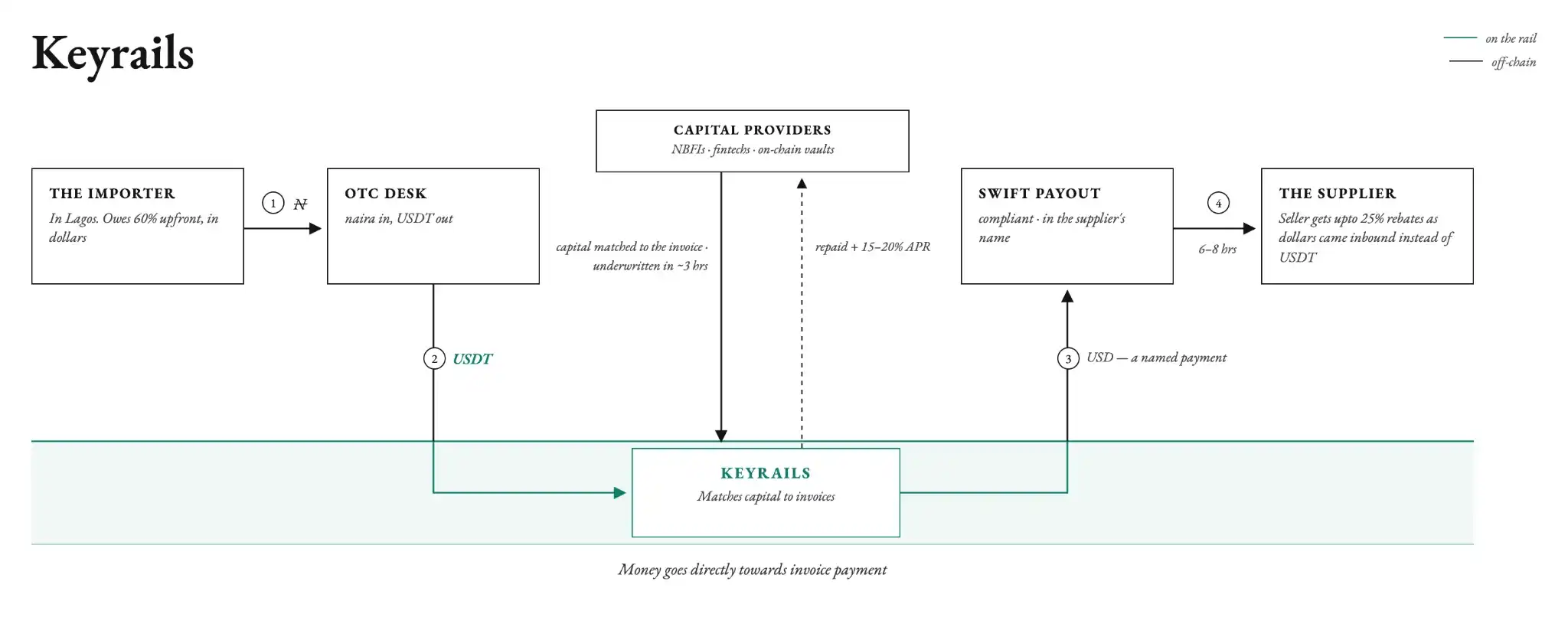
Keyrails absorbs naira in the form of USDT, after conversion at a regional OTC desk or exchange. Keyrails then pays the supplier via its SWIFT rail. Lenders pull three months of transaction history via API and approve loans in about three hours. Funds never reach the borrower. Instead, capital is directly matched against seller invoices and settled in China via SWIFT.
This math works because borrowers are comparing Keyrails to parallel market FX premiums, not to cheap bank loans that don't exist. If the status quo cost is a 20-30% currency conversion premium during stress times, and it takes 7-10 days to clear, then a loan at 20-25% APR that settles in 6 to 8 hours can still be cheaper, especially if the loan term is short. At a three-month term, 20-25% APR means ~1% interest for that period, not counting fees and collateral impact. That's significantly lower than paying a 20-30% FX premium upfront.
For the seller, the benefit is equally simple: dollars enter their bank account directly as a compliant, named payment, preserving their eligibility for local export rebates, which stablecoin settlement doesn't offer. Part of this is the lack of liquidity in these currency pairs in emerging markets.
In this case, Keyrails' primary value is not that it has the cheapest capital. Its value is that it controls the rail that makes lending safe. It standardizes the digital capture of trade data, creates payment rails across countries, and restricts fund use within its ecosystem so borrowed money can only go towards real invoices. Its moat is a combination of underwriting data, compliant settlement, and usage-restricted funds. With every transaction completed, the system gets better at making regional trade flows understandable to global dollar capital.
Programmable Credit
We notice one of our own portfolio companies focusing on a different part of the equation. Keyrails' focus is moving money faster between unorganized sectors. Semiliquid provides infrastructure to keep collateral stationary between known counterparties sharing collateral. The shared idea is controlling the perimeter. In Keyrails' case, funds can only exit via approved payment rails. In Semiliquid's case, assets don't need to leave custody at all.
Tokenization itself only changes the representation of an asset. It doesn't automatically make the asset useful as collateral. If a bank, fund, or trading desk holds tokenized Treasuries, money market funds, stocks, or credit instruments at a custodian, it would be much more productive if it could borrow against them. Without margin, a tokenized asset is mostly just a digital wrapper for an existing asset. With credit, it becomes part of a larger financial machine.
Semiliquid's Programmable Credit Protocol (PCP) allows borrowers and lenders to finance tokenized instruments without moving them out of custody. The borrower keeps the asset at the custodian and continues to earn the underlying yield. The lender gets an enforceable claim on that asset. If the borrower repays, the lock is lifted. If the borrower defaults, the lender can take over the collateral as per pre-agreed rules. The useful phrasing here is "delivery vs. lock": cash can move, but the collateral stays put until execution is needed.
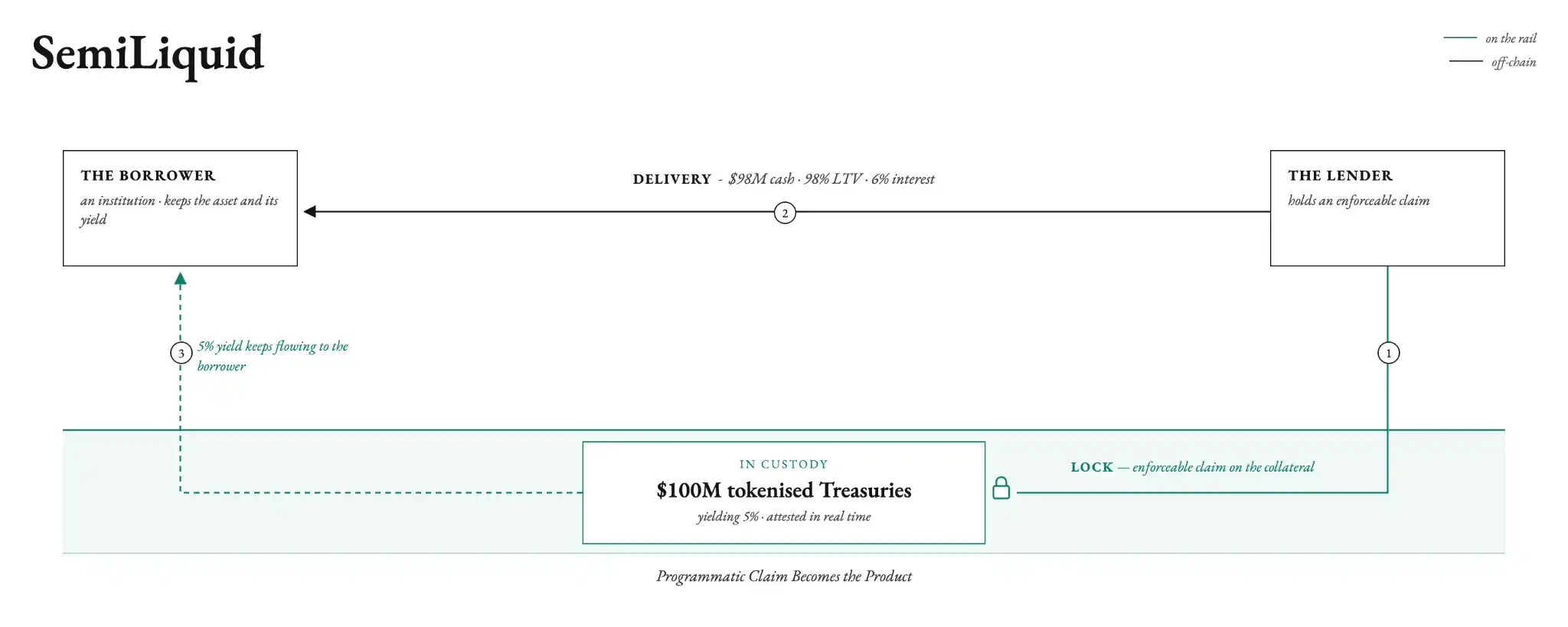
Run the math. Assume an institution holds $100 million in tokenized Treasuries yielding 5% annually. Borrowing at a 98% loan-to-value (LTV) ratio gives it $98 million in liquidity without selling the underlying. At a 6% annual borrowing rate, the nominal interest cost is $5.88 million per year. But if the Treasuries keep generating 5%, the collateral brings in $5 million per year. So the borrower's net cost is ~$880,000, or ~0.9% on $98 million borrowed, not yet counting protocol fees, valuation haircuts, and custody fees.
The borrower isn't paying 6% purely for the loan. They're paying the spread between their debt cost and the retained earnings from their collateral. In traditional arrangements, that yield might be eaten by the bank or custodian. With programmable collateral, the asset can stay locked for the lender while the yield still flows back to the borrower. SemiLiquid is extending this logic across a broader network of tokenized assets and institutions that want to lend to each other.
The difference is in the assets involved, the speed of underwriting, and who keeps the yield.
This is different from DeFi lending markets like Aave. Institutions don't have to move assets into open smart contract pools, accept public liquidation mechanisms, or price in the risk premium of permissionless lending. They can leave assets at a regulated custodian while making them financeable. For lenders, the benefits are faster diligence and clearer execution. The custodian can prove collateral status in real time, and the protocol prevents the same asset from being re-pledged within the same rail.
One way to understand its importance is to look at the collapses of Three Arrows Capital and Archegos. 3AC left creditors with ~$3.5 billion in claims. Archegos created similar blind spots in traditional finance: Bill Hwang's family office built overlapping swap exposures across multiple prime brokers, with Credit Suisse alone losing ~$5.5 billion on the unwind. In each case, the problem wasn't just price drops. It was that lenders lacked a shared, real-time view of what collateral existed, where it was held, and whether the same balance sheet strength was being presented to multiple counterparties.
SemiLiquid attempts to fill that trust gap with real-time collateral verification. Loans don't need to be publicly visible to the market, but involved parties can know if collateral exists, is locked, and is executable.
Traditional secured loans often require lawyers, back-office, custodians, and manual reconciliation to coordinate a single financing transaction. SemiLiquid compresses this process into programmable credit infrastructure. More importantly, it turns idle tokenized assets into collateral that can back borrowing, margin, and repo-like activity. This matters because the next phase of tokenization won't be about just putting assets on-chain. It will be about making those assets useful enough for institutions to earn a few extra basis points, borrow against them, and use them without giving up custody.
Eating the $Chip
GPUs are the core of the AI economy. They are computing your answers as you keep asking questions on Thursday afternoons. They are also expensive, so Meta, Amazon, Alphabet, and Microsoft spent ~$410 billion in CapEx in 2025 and plan to spend ~$725 billion in 2026, a ~77% increase.
Simply put, if agriculture were the primary income source, GPUs would be the tractors: production machines that turn capital expenditure into recurring output.
Businesses get credit lines to buy GPUs, provided the hardware generates revenue by renting out compute through third parties. But data centers and smaller AI infrastructure companies often can't access the same low-cost capital as Google, Amazon, or Microsoft. This is the underserved part of the market. There, even calculating loan terms is difficult. GPU prices, performance-per-dollar, and residual values shift as model efficiency improves and enterprise demand evolves.
As of writing, USD.AI's total value locked (TVL) is ~$398 million, with ~$202 million deployed in active loans. Loan sizes have grown from $1–5 million at launch to a $98 million line against a 2,304 GPU cluster. The collateral model has moved far beyond pilot scale.
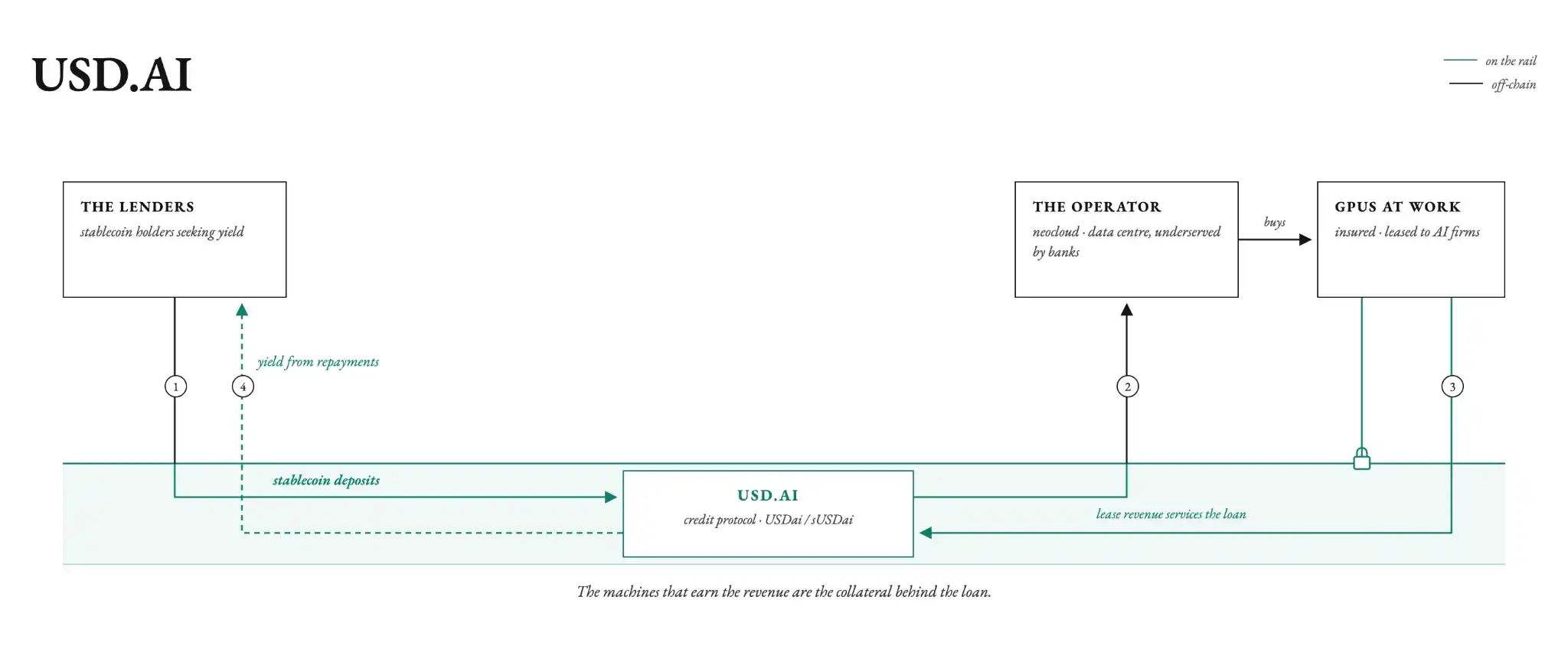
Lenders on USD.AI get access to a market driven by hyperscaler demand and AI compute growth. Borrowers, on the other hand, benefit from financing existing assets without finding traditional capital channels. And they get funding faster. Both sides benefit from the fact that, if things go wrong, GPUs can be repossessed as collateral.
USD.AI's core customer isn't just data centers. Nor just startups or hyperscalers. It's anyone interacting with the GPU economy. Its value is in creating a liquid loan market around a productive, physical, and hard-to-finance asset. And underwriting requires years of specialized experience because a single bad loan could call the legitimacy of the whole market into question. In other words, they translate GPU-native context into a global liquidity pool seeking to lend stablecoins against it.
Context Is Where the Money Is
These businesses look very different from what we used to think of as "DeFi." They leverage tokenization, blockchain rails, and stablecoins to accelerate markets that have traditionally been underserved or disorganized. The moats of these products come not just from code, but from the deep, rich context generated with each product transaction cycle. A loan on SemiLiquid's PCP, a borrow on USD.AI's CHIP, and a transaction on Keyrails have one thing in common. Each transaction makes the platform generate trust and credibility that is hard to replicate. It also gives these businesses a way to audit their own processes.
The value of these firms won't come just from transaction volume, but from the context they build around their product users, borrowers, and counterparties. This is very similar to how banks operate. The longer a customer stays at a bank, the more value the bank can extract from each marginal customer through credit cards, mortgages, or fixed-income products. In turn, these businesses can escape the cyclical seasonality inherent to crypto. Unlike exchanges or trading products, the demand for imports/exports, loans, and margin is stable, applicable across the entire economy.
In other words, this is how crypto grows beyond trading and speculation to become the operating system for real-world capital formation.