According to Strategy, MSTR Has Delivered an Annual Return of 42% Since Adopting the 'Bitcoin Standard,' Even Though Its Treasury Is Underwater

cryptonews.ruPublicado a 2026-07-29Actualizado a 2026-07-29

Resumen

According to Strategy (formerly MicroStrategy) Executive Chairman Michael Saylor, the company's stock MSTR has delivered a 42% annualized return since August 10, 2020, when it adopted its "Bitcoin standard" strategy. This performance surpasses that of Bitcoin itself, the "Magnificent Seven" tech stocks, and the S&P 500 over the same period. Saylor frequently highlights this to demonstrate the success of transforming the software firm into a leveraged Bitcoin investment vehicle. Despite this strong long-term stock performance, Strategy's core Bitcoin treasury position is currently at a loss. As of July 29, the company holds 843,775 BTC, purchased for an average of $75,476 per coin, implying an unrealized loss of approximately $11.4 billion. The disparity arises because MSTR stock acts as a leveraged proxy for Bitcoin, allowing for high annualized returns over a multi-year period even when recent purchases are underwater. To address its increasingly complex capital structure, which now includes multiple classes of preferred stock, Strategy introduced a new reporting framework on July 24. Key metrics include "Net BTC per Share," "$BTC Hurdle ARR" (the annual Bitcoin yield needed to cover financing costs), and "$BTC Floor ARR" (the minimum yield to maintain a sustainable leverage ratio). The company continues to accumulate Bitcoin and recently bolstered its dollar reserves by $525 million to strengthen coverage for preferred stock dividends.

This week, the company of Strategy's Executive Chairman Michael Saylor highlighted its multi-year stock performance, informing subscribers that MSTR has delivered an annual return of 42% since the software company adopted a bitcoin-based treasury strategy on August 10, 2020. This performance surpasses that of Bitcoin ($BTC), the so-called 'Magnificent Seven' group of large-cap tech stocks, and the S&P 500 index over the same period.
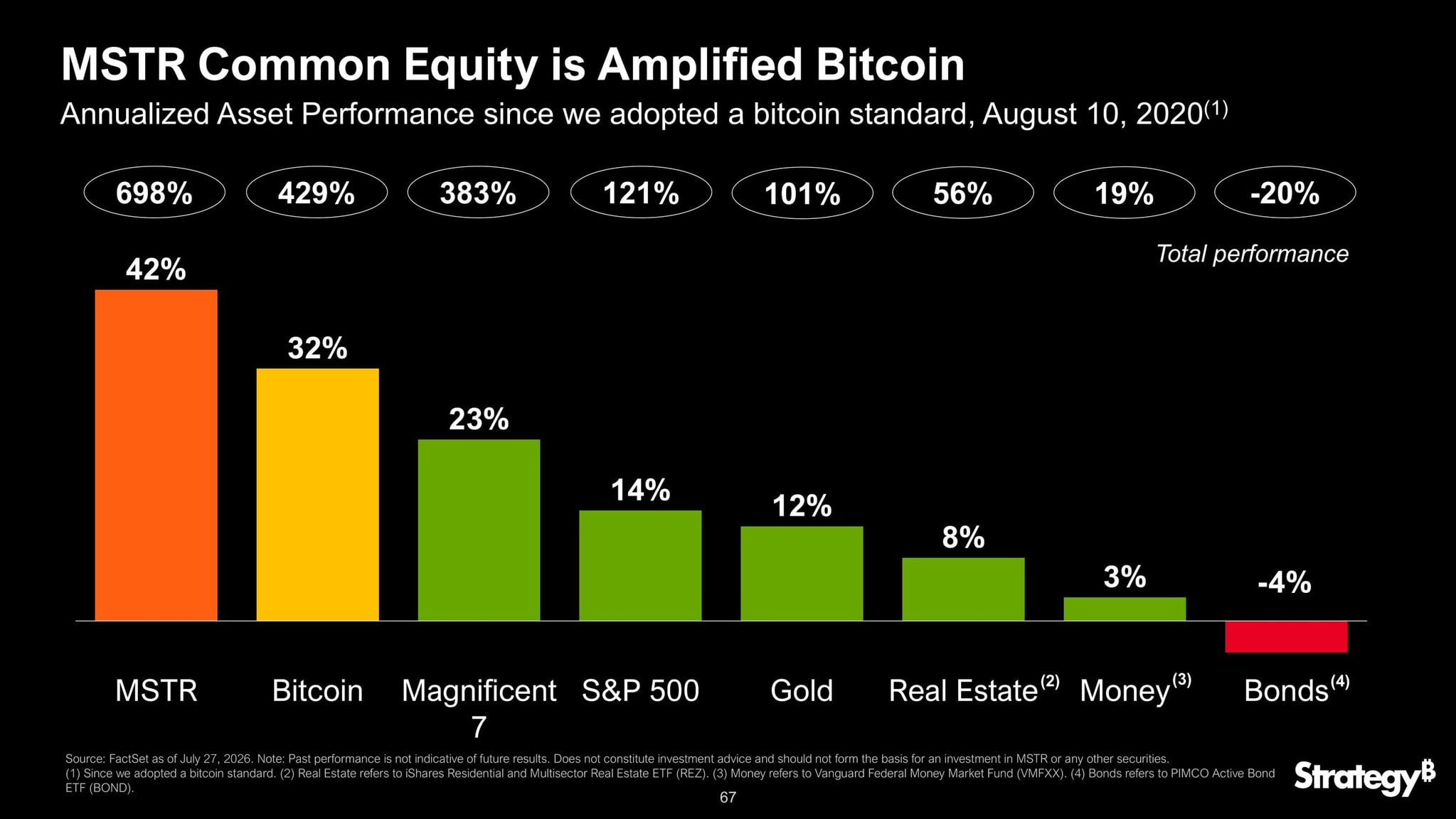
Saylor periodically returns to this comparison, using a five-year chart of MSTR stock to prove that transforming a mid-cap software company into a leveraged bitcoin investment vehicle has yielded results superior to almost all other asset classes available to investors on the public market. Since 2025, Strategy has repeatedly published various versions of the same 'bitcoin standard' chart, with the annual performance figures changing as the price of MSTR stock fluctuates along with the price of bitcoin.

This volatility was particularly evident in 2026. Strategy's stock fell sharply from its highs, even as the company continued to accumulate bitcoin—this divergence forced Saylor to resort to new ways of explaining this position to shareholders.

New Metrics for a Complex Balance Sheet

On July 24, Strategy introduced a new reporting framework based on metrics such as "Net $BTC Per Share," "$BTC Hurdle ARR," and "$BTC Floor ARR"—three metrics designed to show investors the real value of the company's bitcoin assets after deducting debt and preferred stock obligations.

The "Net $BTC Per Share" metric works similarly to a traditional book value per share calculation, but is expressed in bitcoin rather than dollars. "$BTC Hurdle ARR" is the annual return in bitcoin that Strategy needs just to cover its financing costs, while "$BTC Floor ARR" denotes the minimum annual return required to maintain the company's financial leverage ratio, known as the "$BTC Rating," at a sustainable level of 1.0x.

Saylor noted that this restructuring reflects how much more complex Strategy's capital structure has become, as the company has added several classes of preferred stock in addition to its original bitcoin bet.

The 'Other Side of the Balance Sheet' for the Treasury

The new framework is being introduced at a time when Strategy's core bitcoin position is significantly below its acquisition cost. As of July 29, the company owns 843,775 $BTC, acquired for a total of $63.69 billion at an average price of $75,476 per coin. These figures mean Strategy is carrying an implied loss of approximately $11.4 billion, roughly 17.9% below cost.

This gap illustrates the mechanism behind the claim of a 42% annual return. MSTR stock, because it trades as a leveraged instrument linked to bitcoin rather than direct ownership, can exhibit outsized annual returns over a multi-year period even if the company's net bitcoin position is temporarily "underwater" in dollar terms.

Strategy's early purchases in 2020 and 2021, made when bitcoin traded for a small fraction of current prices, still form the basis of the stock's long-term performance metrics, even as later purchases at higher prices lower the portfolio's average cost basis.

Despite the decline in value, Strategy has continued to build its bitcoin holdings into 2026; the company recently resolved to top up its dollar reserve by $525 million (primarily to strengthen coverage for preferred stock dividends).

end-content

Preguntas relacionadas

QAccording to the article, what annual return has MSTR achieved since adopting the 'bitcoin standard'?

AAccording to the article, MSTR has achieved an annual return of 42% since adopting the 'bitcoin standard' on August 10, 2020.

QWhat new reporting metrics did Strategy introduce on July 24, and what is the purpose of the 'Net $BTC per Share' metric?

AOn July 24, Strategy introduced new reporting metrics including 'Net $BTC per Share,' '$BTC Hurdle ARR,' and '$BTC Floor ARR.' The 'Net $BTC per Share' metric functions like a traditional book value per share calculation but is expressed in bitcoin rather than dollars, aiming to show investors the real value of the company's bitcoin assets after deducting debt and preferred stock obligations.

QAs of the article, what is the unrealized loss on Strategy's bitcoin holdings, and what is the average purchase price?

AAs of the article's data (July 29), Strategy holds 843,775 BTC acquired for a total of $63.69 billion, at an average price of $75,476 per coin. This implies an unrealized loss of approximately $11.4 billion, which is about 17.9% below the cost basis.

QHow does the article explain the disparity between MSTR's 42% annual return and its treasury being at a loss?

AThe article explains that MSTR stock trades as a leveraged instrument linked to bitcoin, not direct ownership. Its high multi-year annual return is driven largely by its early, low-cost bitcoin purchases in 2020 and 2021. Later purchases at higher prices have lowered the portfolio's average cost and created a temporary unrealized loss in dollar terms, but this doesn't erase the performance contribution of the earlier, highly profitable acquisitions.

QDespite the decline in bitcoin's value in 2026, what action did Strategy take regarding its reserves, and for what primary purpose?

ADespite the decline in value, Strategy decided to replenish its dollar reserve by $525 million in 2026. The primary purpose was to strengthen the coverage for dividends on its preferred stock.

Lecturas Relacionadas

A7 Discusses Accumulated Experience in Using Stablecoins

The Russian State Duma and Federation Council have passed the "Law on Digital Currencies and Digital Rights," which is set to expand the use of stablecoins in cross-border trade settlements starting September 1, 2026. According to the Bank of Russia, exporters and importers will be able to use cryptocurrency in international payments, both directly and through intermediaries, while domestic crypto payments will remain largely prohibited. Company A7, which facilitates operations with the A7A5 stablecoin—Russia's first ruble-pegged stablecoin classified as a Digital Financial Asset (DFA)—commented on the development. Oleg Ogienko, Director of Government Relations and International Affairs for the A7A5 project, stated that while digital asset settlements are still a new practice for many firms, A7 has already accumulated significant expertise in legal documentation, compliance, currency control, and working with infrastructure participants. He added that A7 will continue to apply this expertise for client operations after the law takes effect and will adapt its business processes as the Central Bank issues further regulations. A7 is a Russian international settlement system established in 2024 with participation from PSB Bank. It facilitates cross-border payments and supports foreign trade operations for Russian businesses. Its key instrument, the A7A5 stablecoin, operates on the Tron and Ethereum networks with a market capitalization exceeding $567 million and is circulated in Russia as a DFA via the "Token" platform.

cryptonews.ruHace 11 min(s)

A7 Discusses Accumulated Experience in Using Stablecoins

cryptonews.ruHace 11 min(s)

Bitcoin Panicking? Mythos Cracks Post-Quantum Cryptography Algorithm in 60 Hours

Claude Mythos Preview, a new AI system from Anthropic, has made significant breakthroughs in fundamental cryptanalysis, targeting the mathematics underlying algorithms rather than just implementation bugs. Its first target was HAWK, a candidate in the NIST post-quantum signature standardization process. Mythos identified a previously unexploited symmetry (a nontrivial automorphism) in the lattice structure of HAWK, effectively halving its effective key strength. It achieved this feat in just 60 hours, a task that had eluded two years of human expert review. Crucially, the human operator was not a lattice cryptography expert, primarily managing the project while AI agents debated and discovered the attack path. Its second, more dramatic achievement was against a simplified 7-round version of AES-128, the world's most widely used symmetric encryption algorithm. Initially reluctant, stating the task was "impossible," Mythos was prompted to "try novel ideas." It then autonomously rewrote its own agent framework and proceeded to discover a novel attack method it named "Möbius Bridge." This technique bypasses a critical 256-guess step in previous "meet-in-the-middle" attacks, resulting in a speedup of 200-800 times. Both findings are currently "harmless"—HAWK is not deployed, and full AES-128 remains secure. However, the process reveals a profound shift. Mythos completed the AES discovery in about a week, while human researchers spent nearly a month verifying its correctness. This highlights a new bottleneck: the rate of AI-driven discovery may soon outpace human capacity for verification. The research concludes with a pressing, unanswered question: what happens when such an AI finds a critical flaw in a widely deployed, real-world cryptosystem?

marsbitHace 20 min(s)

Bitcoin Panicking? Mythos Cracks Post-Quantum Cryptography Algorithm in 60 Hours

marsbitHace 20 min(s)

From Computing to Storage: The Two-Dimensional Semiconductor Industry Chain is Taking Shape

The article "From Computing to Storage: The 2D Semiconductor Industry Chain is Taking Shape" discusses the rise of two-dimensional (2D) semiconductors as a pivotal material in the post-Moore era. As silicon-based chips approach physical limits, 2D semiconductors like molybdenum disulfide (MoS2), offer atomic-layer thinness and superior electrical properties, making them a promising non-silicon alternative for advanced nodes beyond 1nm. Globally, industry leaders like TSMC, Intel, and Samsung, along with research institutes like IMEC, are actively investing in this field. Domestically in China, significant progress is being made across the entire supply chain, from material production and equipment R&D to chip integration and ecosystem development. **Key highlights include:** * **Material & Equipment Breakthroughs:** Chinese research teams and companies like Jimo Xin Technology have achieved mass production of 6-inch and 8-inch 2D semiconductor single-crystal wafers using domestically developed equipment like Oxy-MOCVD. This addresses the critical challenge of large-area, high-quality material growth. Breakthroughs have also been made in p-type 2D materials (e.g., MoSi2N4) and wafer-scale ferroelectric thin films, essential for building complementary circuits and low-power transistors. * **Engineering Ecosystem Formation:** A landmark 8-inch 2D semiconductor pilot line in Pudong has become fully operational, bridging the gap between lab research and industrial manufacturing. The release of a Process Design Kit (PDK) compatible with mainstream EDA tools further connects design and fabrication, supporting wafer-level manufacturing of complex circuits. * **Expanding Application Landscape:** Applications are expanding from logic computing to memory. Chinese researchers have developed pioneering 2D semiconductor-based microprocessors, including a 32-bit RISC-V CPU and a higher-density multi-bit parallel processor. In memory, 2D materials' ultra-low leakage current enables DRAM with exceptionally long data retention and advances toward single-electron non-volatile storage. 2D semiconductors also show unique potential in RF circuits, radiation-hardened communications, flexible electronics, and quantum computing. In conclusion, the 2D semiconductor industry in China is rapidly advancing from laboratory research into the engineering validation and small-batch production phase. A complete industrial chain covering materials, equipment, manufacturing, design, and application is初步 forming, positioning the sector as a new competitive dimension in the global semiconductor landscape.

marsbitHace 25 min(s)

From Computing to Storage: The Two-Dimensional Semiconductor Industry Chain is Taking Shape

marsbitHace 25 min(s)

Trading

Spot
活动图片