Hinton Praises, Gemini Core Contributor Speaks: In the Future, There Will Be Billions of Superhuman AI Einsteins

marsbitPublicado a 2026-07-04Actualizado a 2026-07-04

Resumen

In his speech "Training Sand to Think: Artificial General Intelligence & Future of Physics," Adam Brown, a core contributor to Gemini, outlines the rapid and transformative evolution of AI. He describes how large language models (LLMs), grown rather than programmed through pre-training and fine-tuning, have progressed from performing poorly on high-school math tests to achieving gold-medal level at the International Mathematical Olympiad and recently making a genuine mathematical breakthrough by disproving a decades-old conjecture. Brown attributes this acceleration to the "Scaling Law," where predictable performance gains come from increasing compute, data, and model size. He draws parallels to the history of chess AI, predicting a similar trajectory for scientific research: moving from tools to "centaur" human-AI collaboration, and eventually to autonomous, superhuman "AI scientists." Even if progress halted today, AI already reshapes physics as a tireless tutor, powerful programming assistant, and exhaustive literature reviewer. However, Brown argues progress will continue due to immense economic runway and technical optimizations. He envisions a near-future golden age of human-AI collaboration in science, potentially leading to billions of replicated, superhuman AI researchers, making the coming years the most exciting in physics' history.

Recently, Adam Brown, a core contributor to Gemini and head of the Blueshift team at DeepMind, delivered a lengthy speech titled 'Training Sand to Think: Artificial General Intelligence and the Future of Physics' at the Perimeter Institute for Theoretical Physics, attracting widespread attention. In his talk, he described witnessing AI progress from a 'kindergarten level' all the way to a doctoral level, and extrapolated: if this trend continues, what will become of physics?

Speech Title: Training Sand to Think: Artificial General Intelligence & Future of Physics

Speech URL: https://www.youtube.com/watch?v=Mw60FH5iflI&t=3s

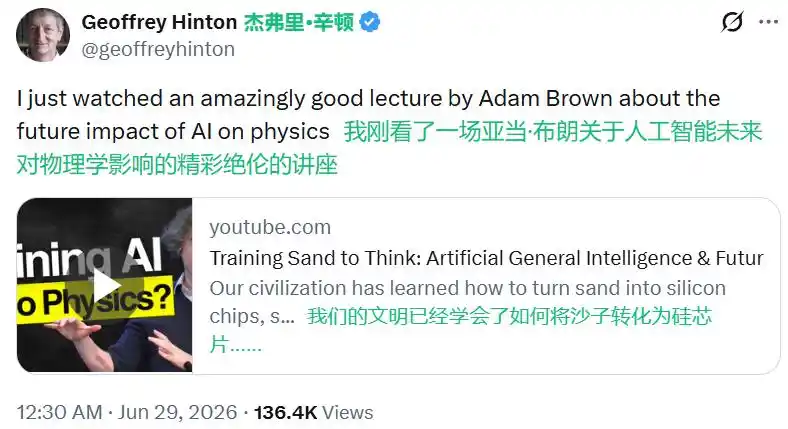
The speech was also highly praised by Nobel laureate in Physics and Turing Award winner Geoffrey Hinton, who called it 'amazingly good.'
Before delving into this amazing speech, it's necessary to introduce the speaker, Adam Brown.
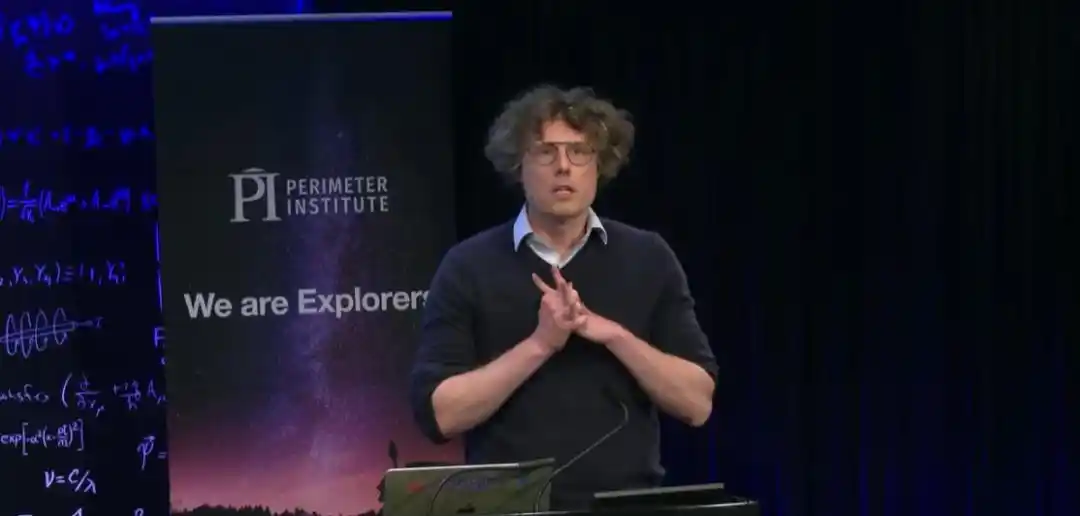
Brown's career is a textbook case of 'how a theoretical physicist's fate was changed by AI.' He studied a joint degree in Physics and Philosophy at Oxford, earned his Ph.D. from Columbia University, and subsequently taught in the physics departments at Princeton and Stanford. At Stanford, he taught Einstein's general relativity, researching topics ranging from the Big Bang, cosmic inflation, multiverses, black holes, and quantum computing, to ideas that sound like science fiction plots such as 'space elevators,' 'bubbles of nothing,' and the ultimate fate of the universe, while also maintaining a long-standing interest in the deep connections between physics and computer science.

In 2018, Brown joined Google. Today, he leads a team called Blueshift within DeepMind, focusing on enhancing AI's scientific and reasoning capabilities, and is also one of the core contributors to the Gemini large language model.

At the beginning of his speech, he mentioned that he had written about forty theoretical physics papers in his career but had stopped writing them by hand in recent years. The reason wasn't a lack of ideas, but that he felt writing papers one by one by hand was more like a 'guilty pleasure' because what he should really be doing now is participating in building a machine that can generate knowledge 'on an industrial scale.'

This opening statement set the tone for the entire talk: someone at the center of the 'AI+Science' technological storm trying to describe its true shape to his peers.

With the aid of AI, we have also summarized the key points of Brown's remarkable speech.

From Sand to Thinking Machines

Brown summarized the unique position of human civilization in one sentence: We have learned to purify sand into silicon, make chips from silicon, assemble chips into neural networks, and now we have learned to train these neural networks to think.

He particularly emphasized that this time it's different from any previous 'computational tool.' From the abacus to pocket calculators, humans have long had various tools to assist scientific research, but those were single-purpose tools, only capable of completing a single step in a process, leaving the rest for humans to do.

Large language models (LLMs) are different; they possess the potential to complete the entire workflow of a theoretical physicist, which is precisely the meaning of the term 'general intelligence.' Brown believes that LLMs are likely the fundamental substrate humans will use to build artificial general intelligence.

He reminded the audience that while they may have used chatbots like ChatGPT, Gemini, or Claude, they might not have noticed a quiet fact: these systems quietly passed the Turing test years ago, and almost no one specifically celebrated it.
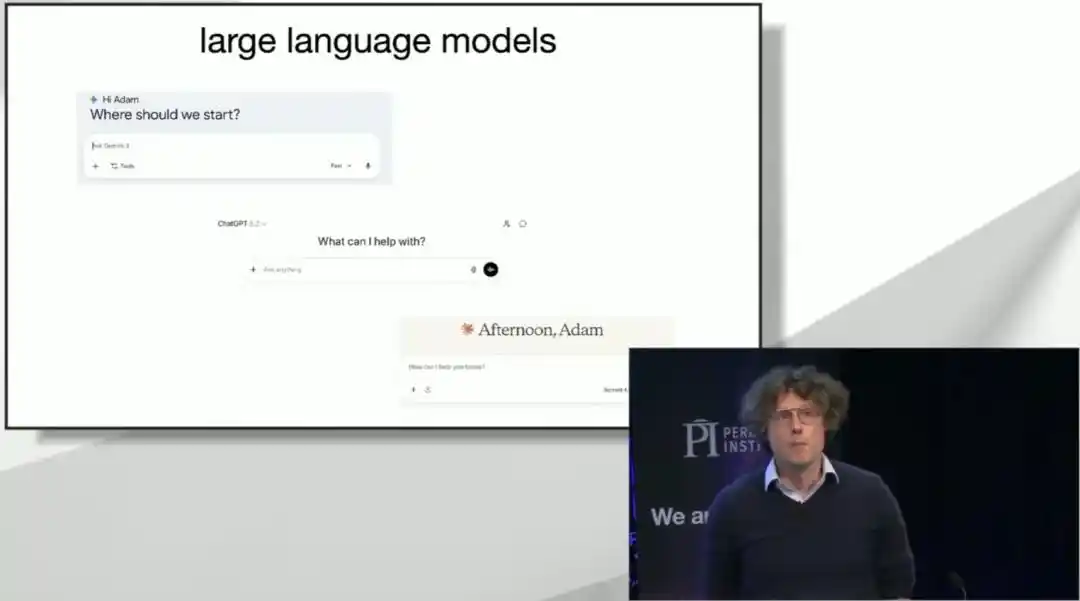
Neural Networks are 'Grown,' Not 'Programmed'

To understand why large models are fundamentally different from traditional computer programs, Brown offered a core metaphor: LLMs are not programmed; they are grown. That is, they are cultivated rather than coded.
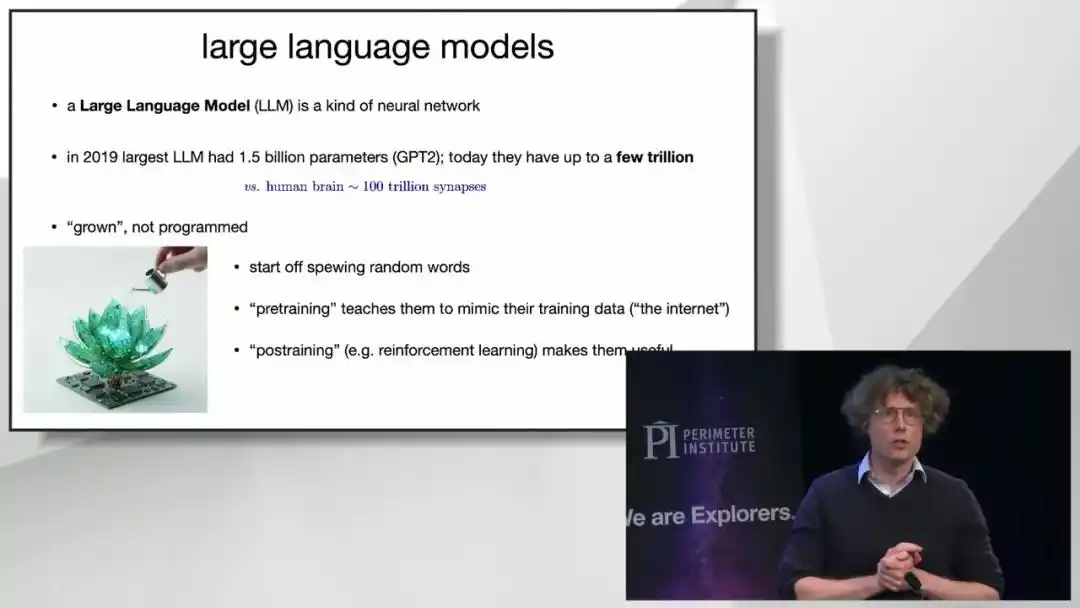
The specific process consists of two stages.

The first stage is called 'pre-training.' Engineers start with a set of randomly connected, nearly nonsensical artificial neurons and have it continuously try to predict the 'next word' in a piece of text. If it guesses correctly, the corresponding neural pathways are strengthened; if wrong, they are weakened. This process is extremely long: after seeing a million words, the model's output is still mostly gibberish; after reading tens of millions to billions of words, it can produce grammatically correct but somewhat stiff sentences; only after reading the entire internet (tens of trillions of words) can it engage in fluent, coherent conversations on almost any topic.

The second stage is called 'post-training,' which Brown describes as sending the model to 'finishing school.' A model fresh out of pre-training only mechanically predicts the next word, speaking rudely and uncooperatively. Post-training's task is to teach it to be polite and willing to cooperate with users, not just play a word completion game. Today, the parameter count of mainstream large models has jumped from billions a decade ago to several trillions, still far below the scale of the human brain's roughly one hundred trillion synaptic connections, but this scale is already sufficient for miracles to happen.

Physicists' Unexpected Role: Scaling Law Ignited This Revolution

Brown specifically mentioned that physicists played an unexpected role at the beginning of this AI revolution: they brought the mindset of the 'Scaling Law.'

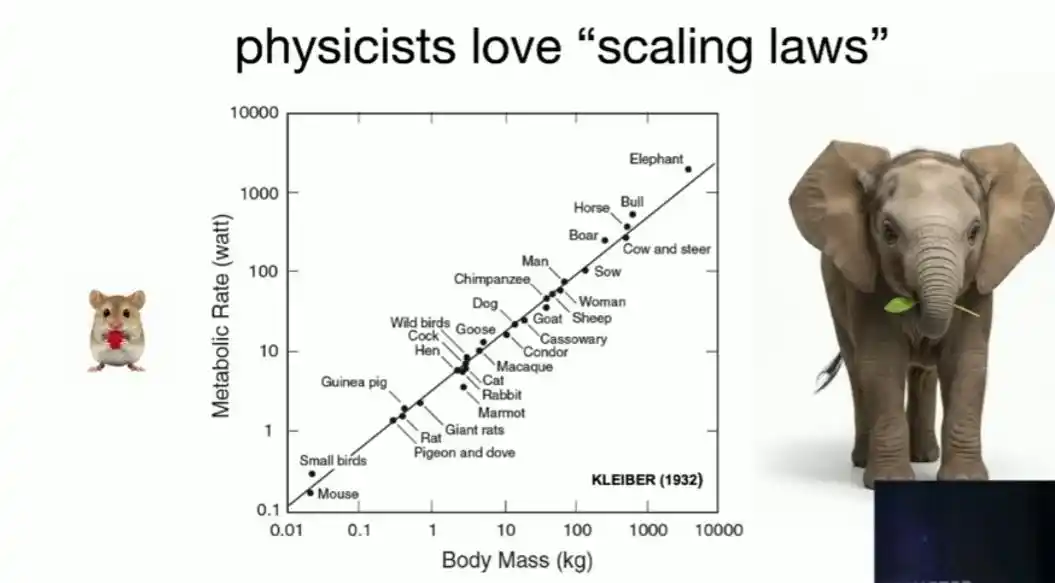
Physicists are inherently obsessed with finding simple power-law relationships: if you double Alice's height, her surface area becomes four times larger, and her weight becomes eight times larger—this is the simplest dimensional analysis. Kleiber's discovery nearly a century ago of a power-law relationship between animal metabolic rate and body weight is a more subtle example—it took physicists many years later to explain its underlying principle using the fractal dimension of the vascular system.
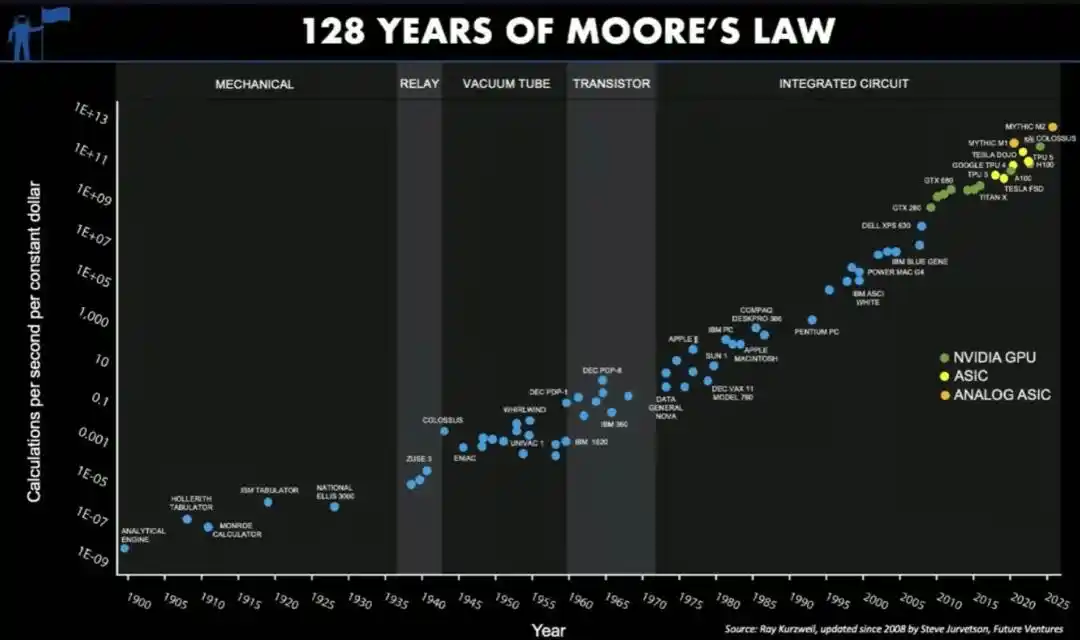
Not to mention the famous Moore's Law:
In 2020, several researchers with physics backgrounds applied this mindset to neural networks and discovered that as long as the computational power used for training, data volume, and model scale were proportionally increased, the model's performance on the 'predict the next word' task would improve steadily along a straight line on a log-log coordinate system.
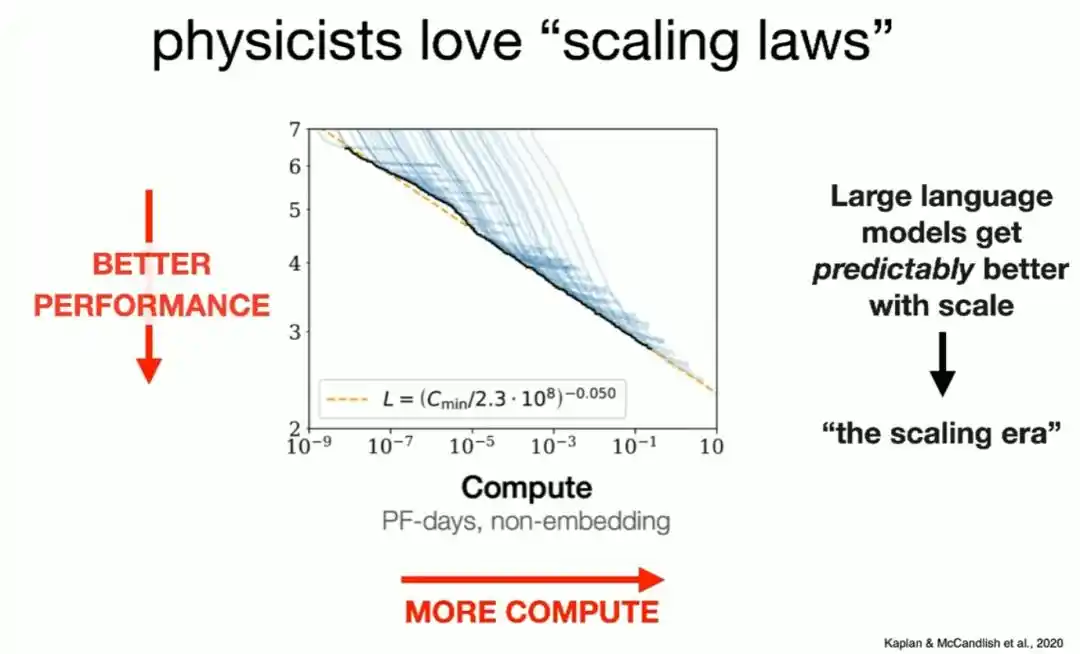
This curve was later extended by a full eight orders of magnitude and still held.

Brown joked that this chart was 'simple enough for venture capitalists to understand,' and it directly told capital markets: invest money (i.e., compute) and get a stronger model in return.

This simple curve was precisely the starting point of the Scaling era over the past six years.

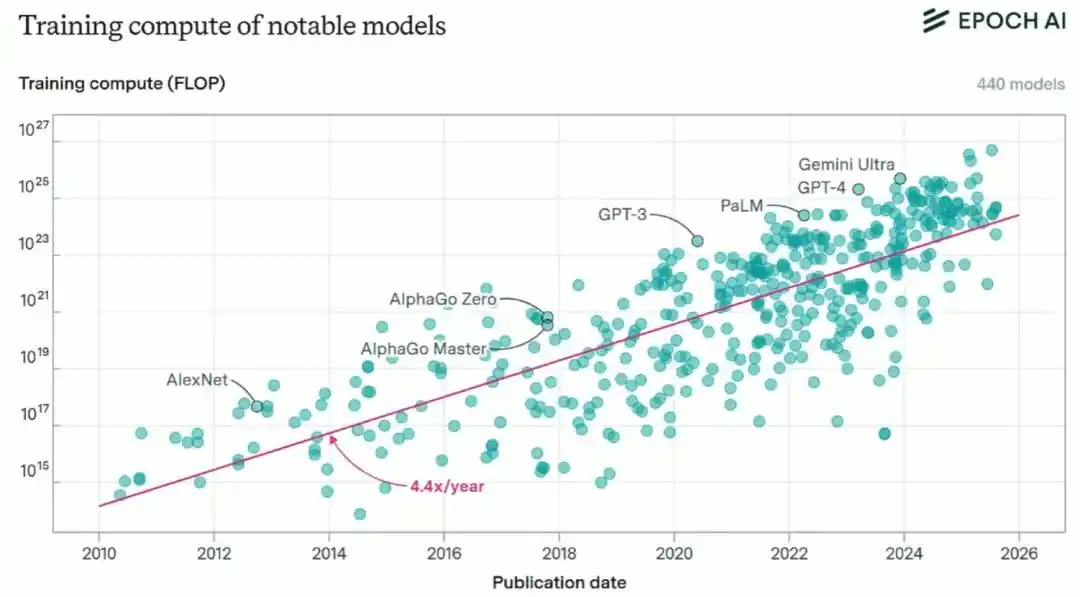
However, Brown also pointed out that just scaling compute is only part of the story. Over the past decade, the compute consumed by cutting-edge AI training has grown about fourfold annually, and the funds invested in training have grown about 2.7 times per year.
Currently, a top-tier training run requires compute costing several hundred million dollars, while the annual US GDP is nearly thirty trillion dollars, meaning there is still a very long growth runway for this curve.
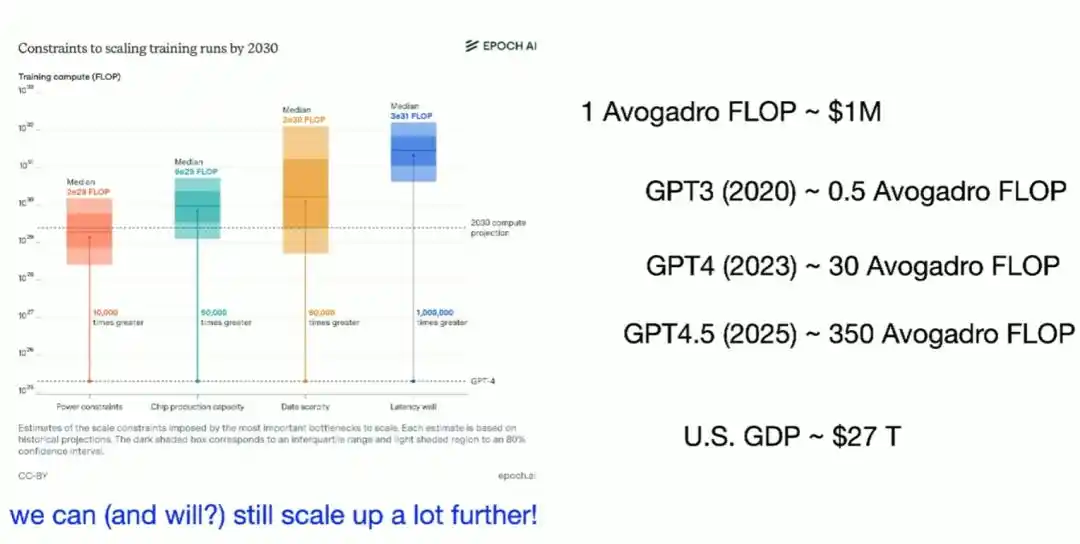
But more important than scaling compute is the continuous refinement at the algorithmic level: Researchers constantly identify inefficiencies in the training pipeline and improve them; this is the true 'primary engine' behind AI progress over the past decade.

The 'Short History' of Benchmarks: From Preschool to PhD

If Scaling Law explains 'why AI gets stronger,' then the rise and fall of a series of benchmarks record 'exactly how strong AI has become.' Brown used a set of test scores to depict a dizzying curve.

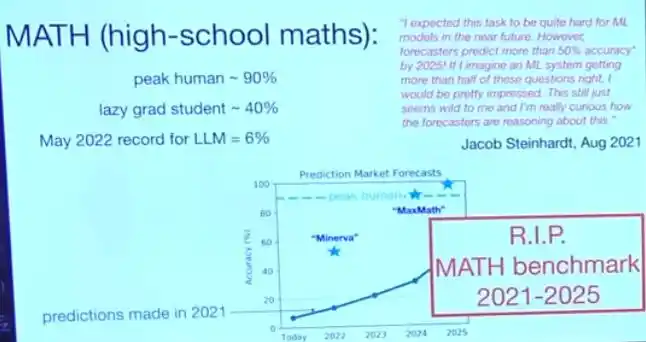
Four years ago, a benchmark called MATH for high school math problems emerged. The researchers had a computer science Ph.D. student who wasn't particularly good at math take the test, scoring about 40%; they also had a three-time International Mathematical Olympiad (IMO) gold medalist take it, scoring 90%. At that time, the most advanced large model could only manage 6%—almost indistinguishable from random guessing, as the model couldn't even understand what the questions were asking.

The prediction market at the time thought that by 2025, a model achieving 50% would be 'reckless optimism.' The benchmark's creator publicly stated that if a model actually achieved this, he would be 'quite shocked.'
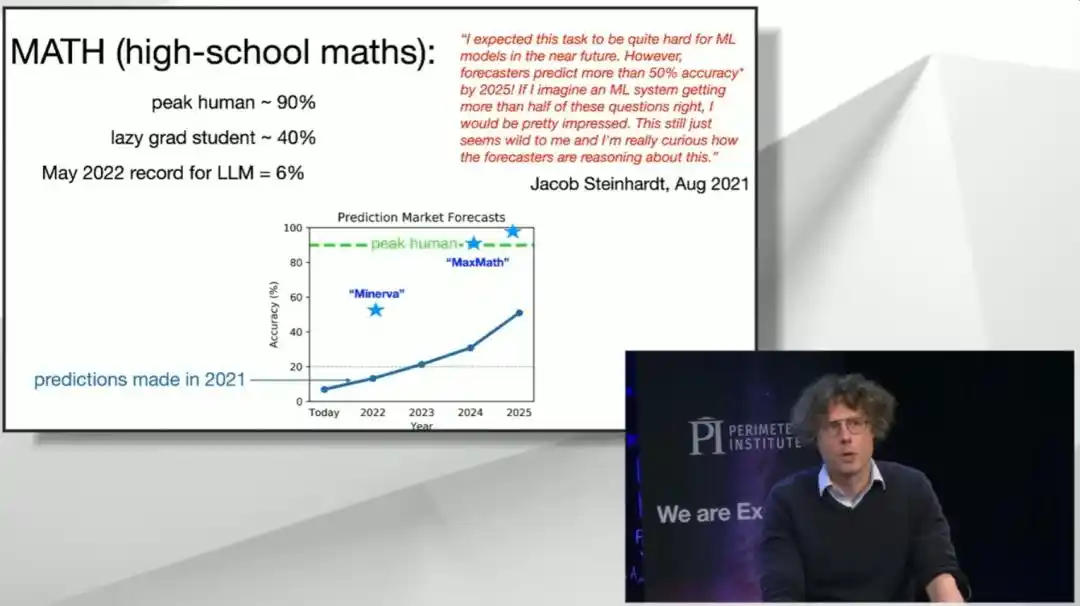
As it turned out, this 50% threshold was crossed 'immediately' by a system called Minerva. By mid-2024, Brown's team's system scored 90% on this benchmark. They even held a 1990s-style roller disco party to celebrate. However, just six months later, off-the-shelf large models were solving these problems nearly perfectly. The MATH benchmark thus 'died,' and it went directly from 'too difficult' to 'too easy,' with almost no pause in between.
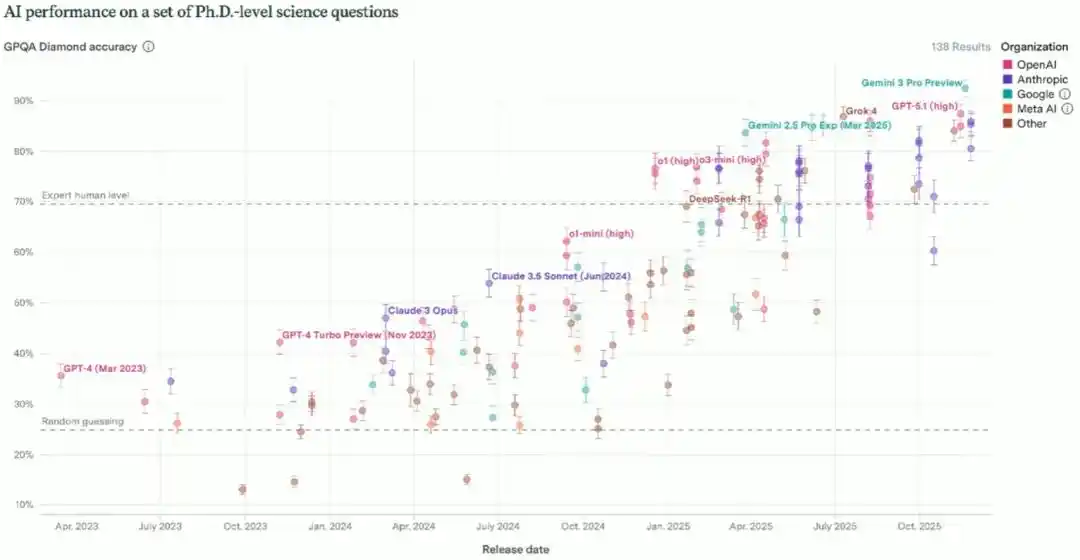
Next to fall was the GPQA test aimed at graduate students, simulating the difficulty of first-year Ph.D. qualifying exams, with human experts averaging around 70%. Starting close to random guessing, models surged past expert level between 2024 and 2025, now achieving near-perfect scores. To rule out the possibility that 'the model just memorized the answers,' Brown's team specifically designed new questions from the same distribution that had never appeared on the internet, and the model's performance barely declined.
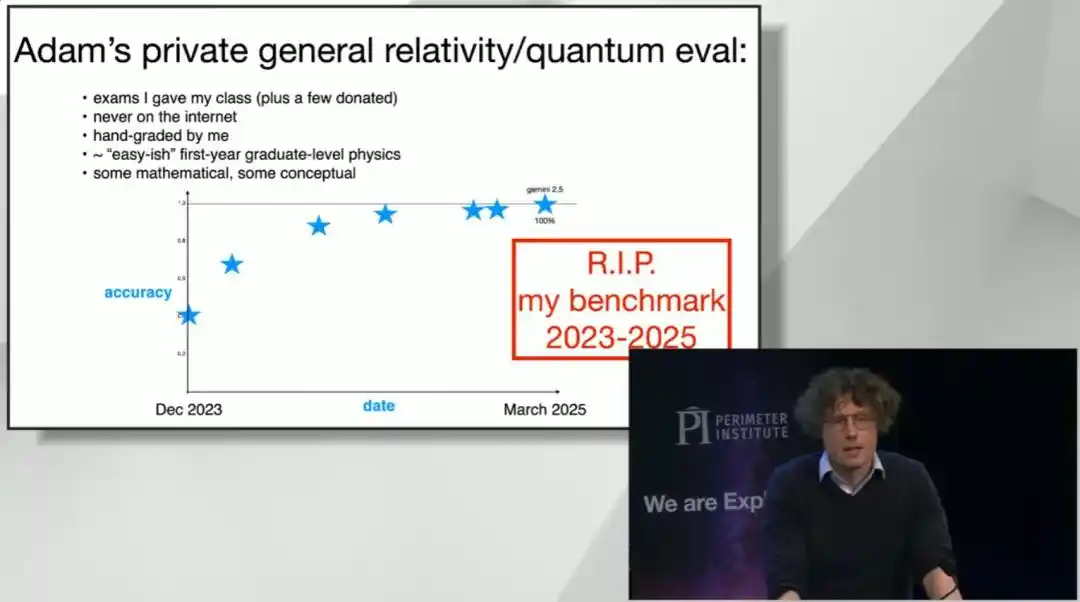
Brown even presented his own graduate-level final exams on general relativity and quantum mechanics, which he had personally graded at Stanford (these questions had never been online), and the model also achieved perfect scores within a year and a half. He half-joked that even his own exam questions had 'unfortunately fallen.'
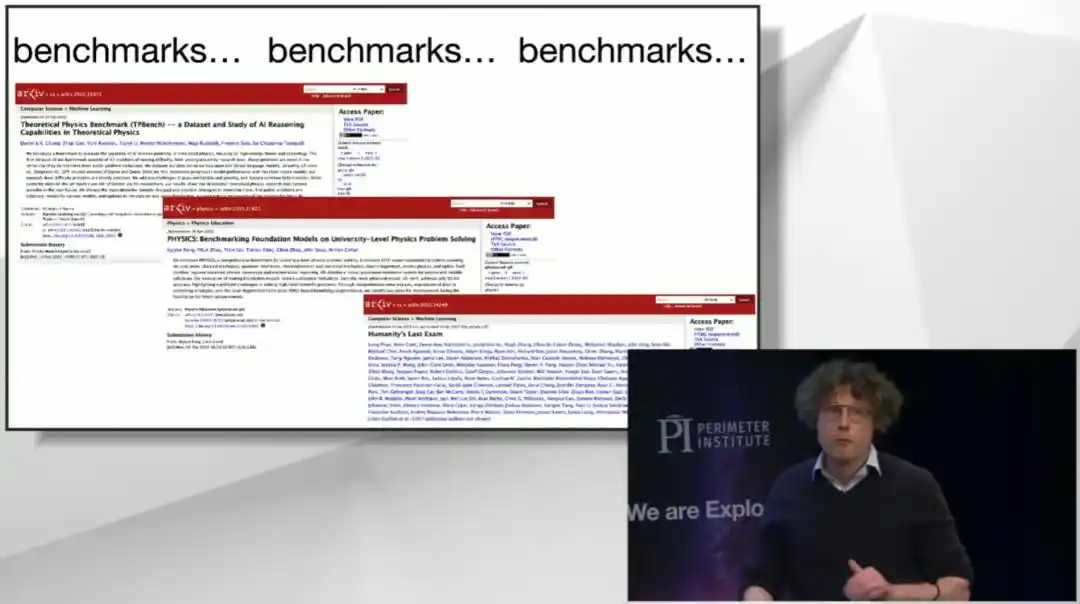
Since then, the list of fallen benchmarks has grown longer, including a super-difficult comprehensive test once called 'Humanity's Last Exam.'
But the most symbolic leap occurred on the International Mathematical Olympiad.

Crossing the IMO Threshold

Just over a year ago, a Turing Award winner told Brown in person that large models would never be able to solve problems at the level of the International Mathematical Olympiad (IMO) because that required genuine creativity, not something that could be faked by rote memorization. IMO problems are known as 'the hardest problems within the scope of high school mathematics': the smartest teenagers in the world train for one to two years to compete, and winning a gold medal by solving a few of the six problems is an exceptional feat.
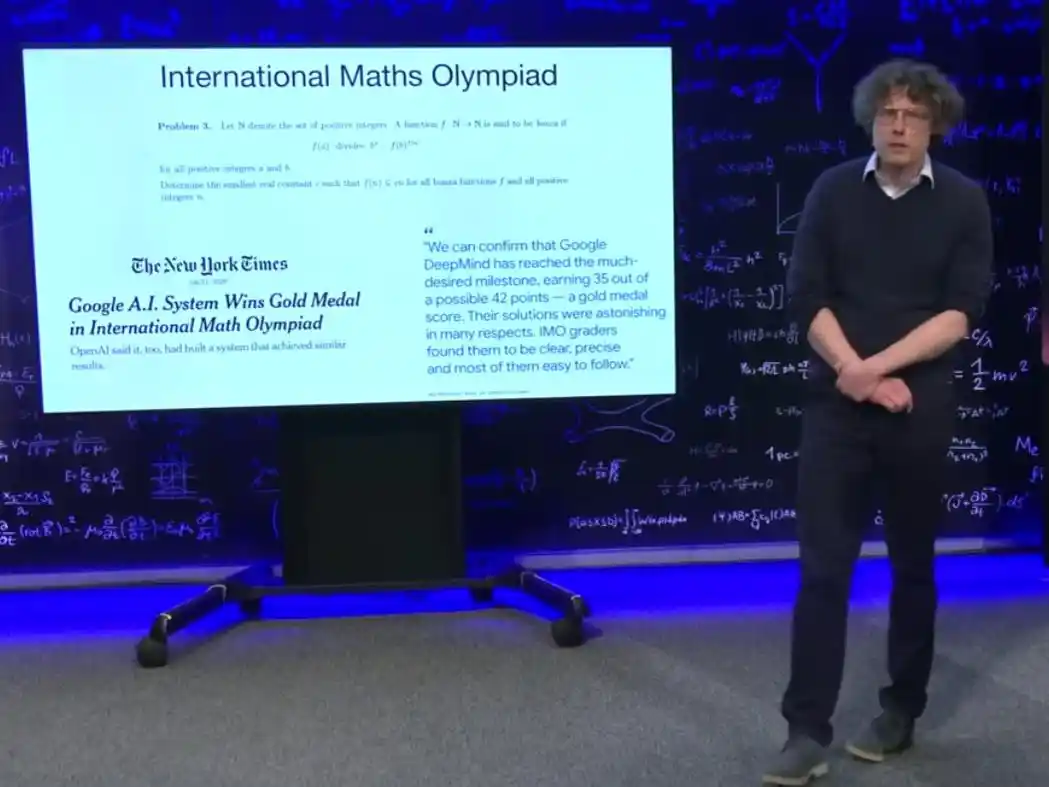
Last summer, this threshold was crossed. Brown's team's system solved five out of six problems on an IMO-level test, achieving gold medal standard. Moreover, the system didn't brute-force its way through with long, incomprehensible formal proofs. The IMO President publicly commented that these solutions were 'surprising in many ways,' with graders finding them clear, precise, mostly easy to understand, and employing mathematical abstractions similar to those used by humans.

Brown also candidly showcased a 'failure case' of large models.

A classic brainteaser goes: A father and son are in a car accident; the father dies, the son is taken to the operating room, and the surgeon sees the boy and says, 'I can't operate on him, he's my son.' The question is how this is possible (the standard answer is the surgeon is the boy's mother). This question tests whether the reader assumes the surgeon is male. Large models handle this 'viral internet puzzle' with ease because they've seen it thousands of times in training data. But when Brown reversed the puzzle: the mother dies, and the surgeon is specifically noted as 'the boy's father,' then asked the same question, the model completely failed to notice the reversal and mechanically applied the standard answer of 'the surgeon is the other parent.'

Brown said this exposes a specific 'quirk' left by the model's training method.

Centaur Collaboration: AI Writes Proofs Mathematicians Will Co-Author

Ten months after crossing the IMO threshold, Brown's team accomplished something he considers even more significant: genuine, previously unknown mathematical research.

Last September, Brown's team collaborated with several professional mathematicians in a mode he calls the 'Centaur' model—the centaur being a half-human, half-horse creature from Greek mythology, but here, the 'non-human half' is an LLM.
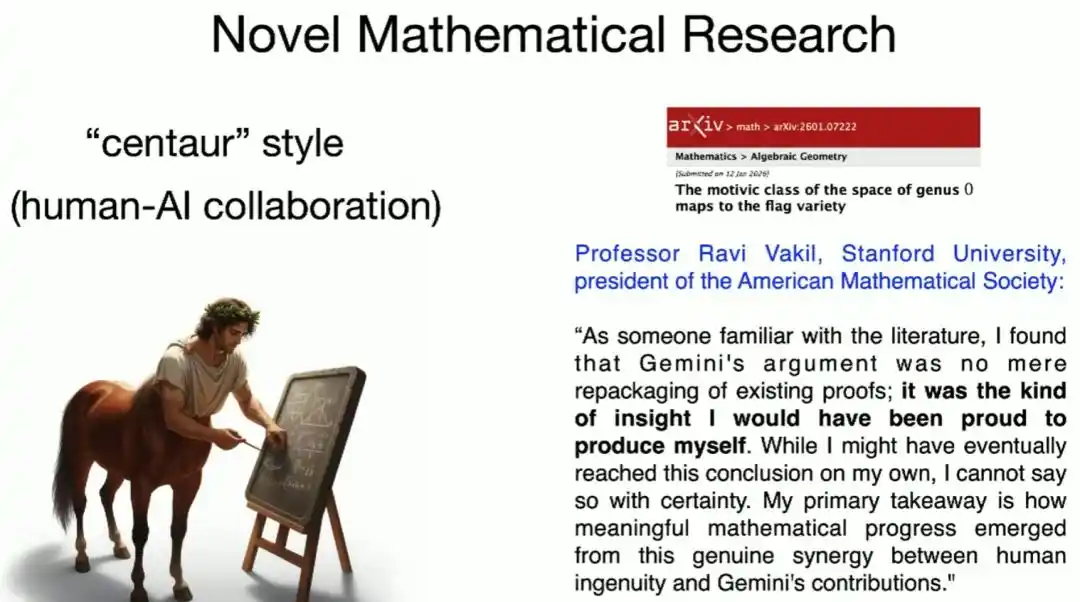
The entire process was a continuous dialogue: the model proposed candidate proof ideas, human experts judged which were valuable and guided the model to delve deeper, ultimately producing a complete mathematical paper under human guidance. One of the paper's co-authors is a Stanford professor and the current president of the American Mathematical Society. This professor's evaluation was that the arguments proposed by Gemini were by no means simple repackaging of existing proofs but represented insights he himself would be proud of.

Brown emphasized that this was, at the time (late last year), the highest level large models had reached in mathematics. But he immediately added: in terms of the true significance of 'highest level,' this was still far from it.

The Real Turning Point: AI Independently Solves an 80-Year-Old Conjecture

Entering 2026, the situation changed dramatically—for the better. Brown began with a near-provocative joke: 'Just last week, LLMs hadn't made any truly significant mathematical breakthroughs.' Now, that statement is no longer true.
Many have already heard about this major event. Erdős's 1946 'Unit Distance Conjecture,' believed for eighty years by the mathematical community to have the square grid configuration as the known optimal solution. A large model inside OpenAI independently provided a counterexample, using tools from algebraic number theory to construct a series of point sets where the number of unit distance pairs exceeded the previously accepted upper bound. This effectively disproved a long-held belief.
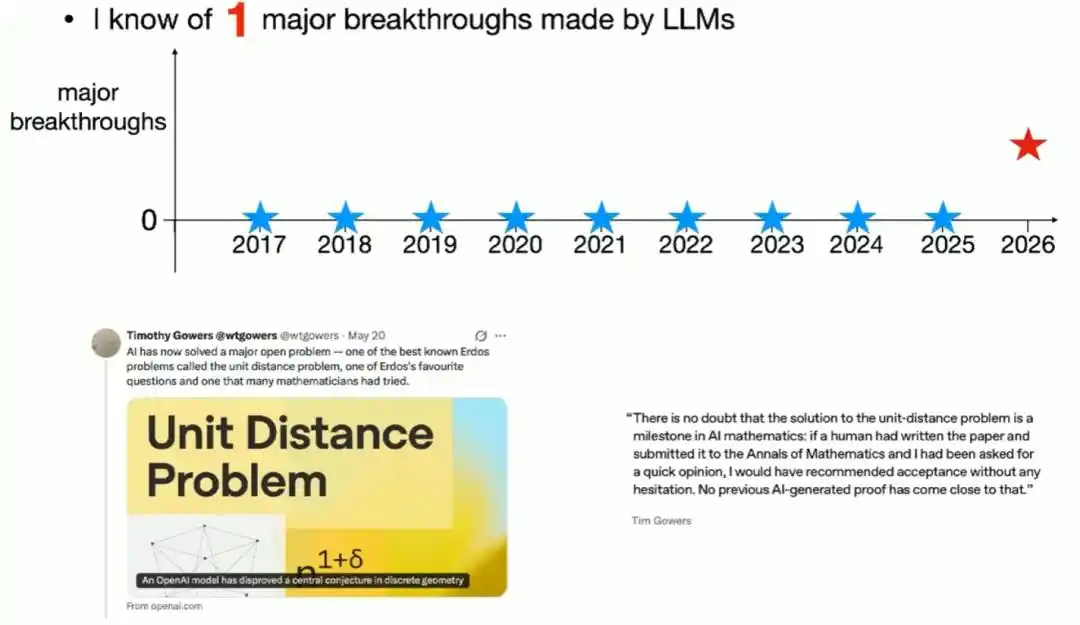
It's worth noting that this problem was not obscure; many had tried before, but mathematicians spent significant effort always wandering in the direction of 'proving' rather than 'disproving' the conjecture. Brown specifically mentioned that Fields Medalist Timothy Gowers participated in reviewing this result and gave it high praise.

Brown judges this to be the first genuinely significant breakthrough by large models in mathematics, and he believes it certainly won't be the last—'the floodgates have opened.' As model capabilities continue to surpass 'the threshold required to produce breakthroughs,' he expects more similar results to appear in succession.

He half-jokingly added that in retrospect, the reason this problem was cracked first is probably because its structure happened to fall within large models' 'comfort zone.' Next, models will first solve problems 'friendly to AI,' then gradually tackle those 'less friendly' ones.

The Prophecy from Chess

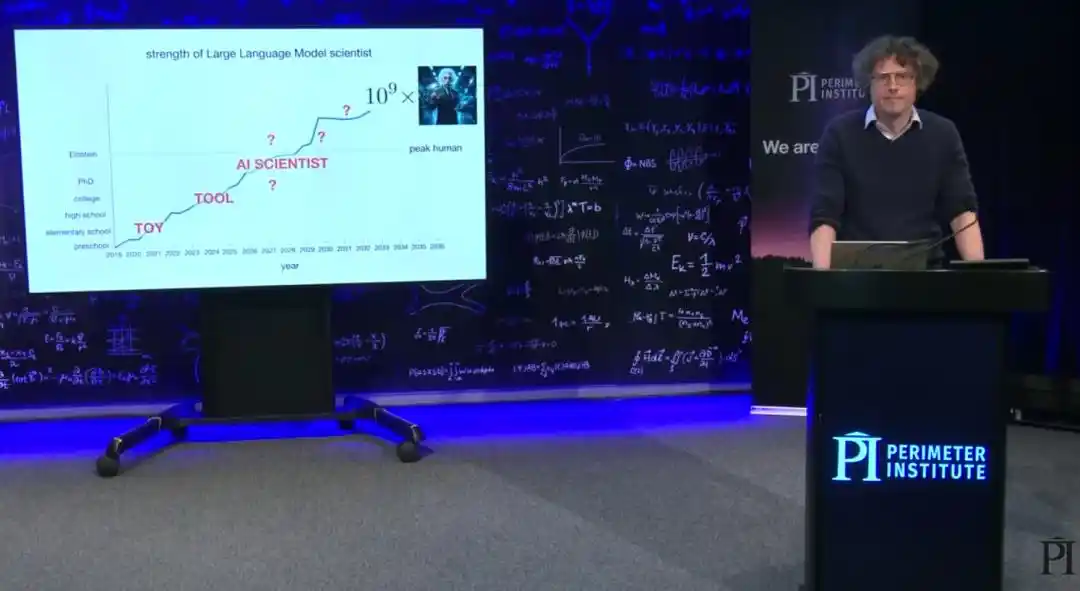
To convince the audience that this curve will continue to rise, Brown presented a graph that at first glance looked like a casually drawn line: a steadily climbing straight line. Of course, this graph wasn't drawn out of thin air; it was taken directly from real data on chess computer strength over time, with the y-axis being the Elo rating measuring playing strength and the x-axis being the year.
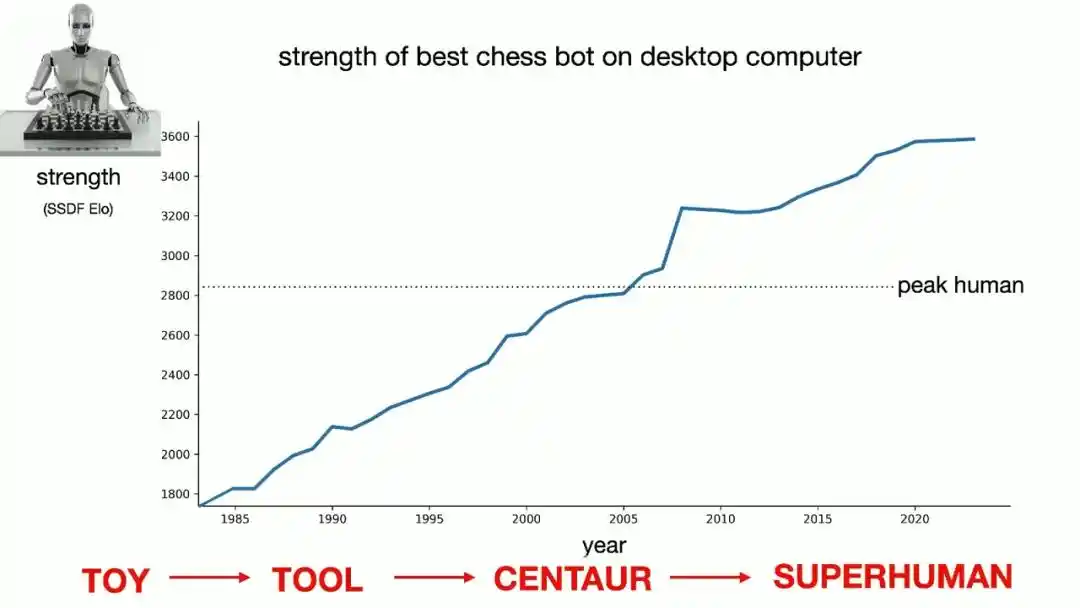
Brown outlined four historical stages of chess AI:

Initially, the 'Toy Era,' where getting a computer to make a single reasonable move was considered a miracle;

Then, the 'Tool Era,' where computers were only useful in specific aspects like endgame calculation or opening memorization;

Next, the 'Centaur Era,' where the strongest chess entity in the universe was the collaboration between grandmasters and the deep search capabilities of computers;

And now, humanity has fully entered the 'Superhuman Era': when top human players collaborate with computers, the optimal strategy is simply to let the computer play on its own.

Brown believes these four stages can be closely mapped to the field of scientific research.
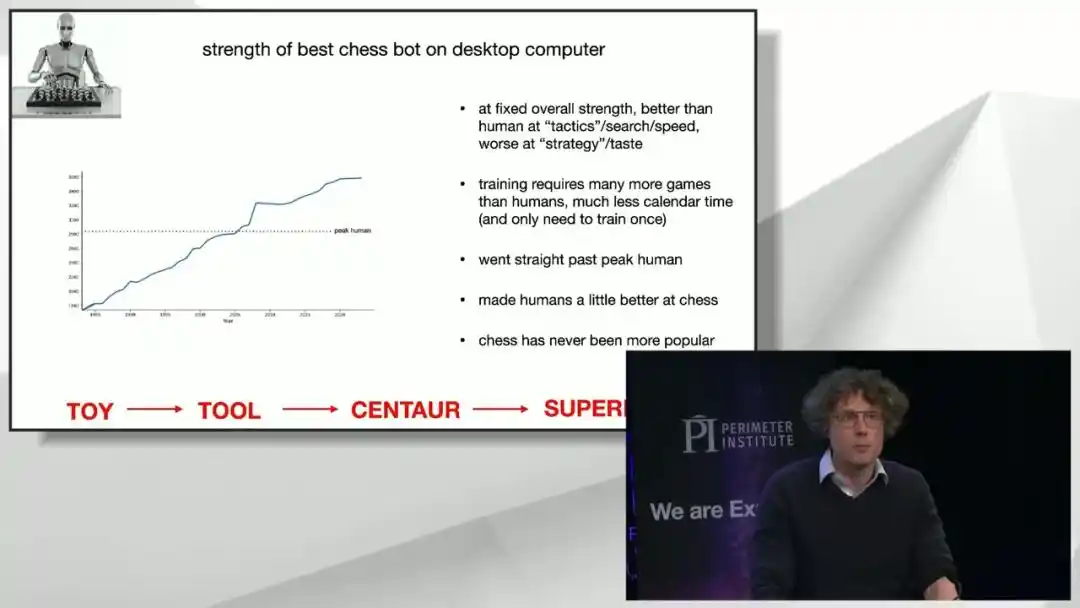
The first pattern is: at comparable overall strength, computers surpass humans in tactics and search speed but are weaker in strategy and 'taste' judgment. This precisely matches the characteristics currently exposed by large models in mathematical and physical research: they excel at applying existing lemmas and techniques but are less adept at judging 'which overall direction to take,' though this shortcoming is rapidly shrinking.

The second pattern is: the number of games needed to 'experience' for training a chess AI far exceeds the total number of games a human can play in a lifetime, but because machines can tirelessly play against themselves at high speed, the actual 'calendar time' required is far shorter than training a human chess player.

The third pattern is that once computer chess strength surpassed peak human level, it never stopped, as there is no physical or logical reason for it to conveniently stop near human level.

The fourth comforting fact is: the rise of chess AI has actually improved the overall level of human chess players; the strongest human players today are stronger than at any time in history, partly thanks to learning from super-strong AIs; and the game of chess itself has never been more popular.

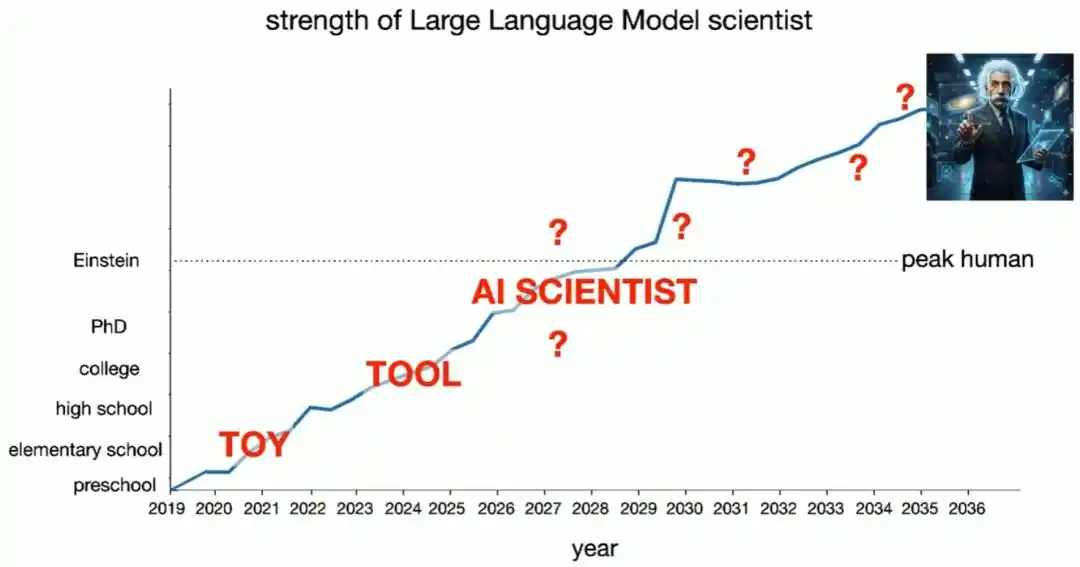
Brown's implication is clear: if scientific research follows this trajectory, humanity will likely first encounter fully autonomous 'AI scientists,' followed by something akin to 'AI Einsteins'... What happens after that, he admits, is beyond his predictive abilities.
Even if Progress Stops Here, Physics Has Already Been Transformed

Brown also raised a cautionary 'pessimistic hypothesis': what if large model capabilities completely stagnate starting today?
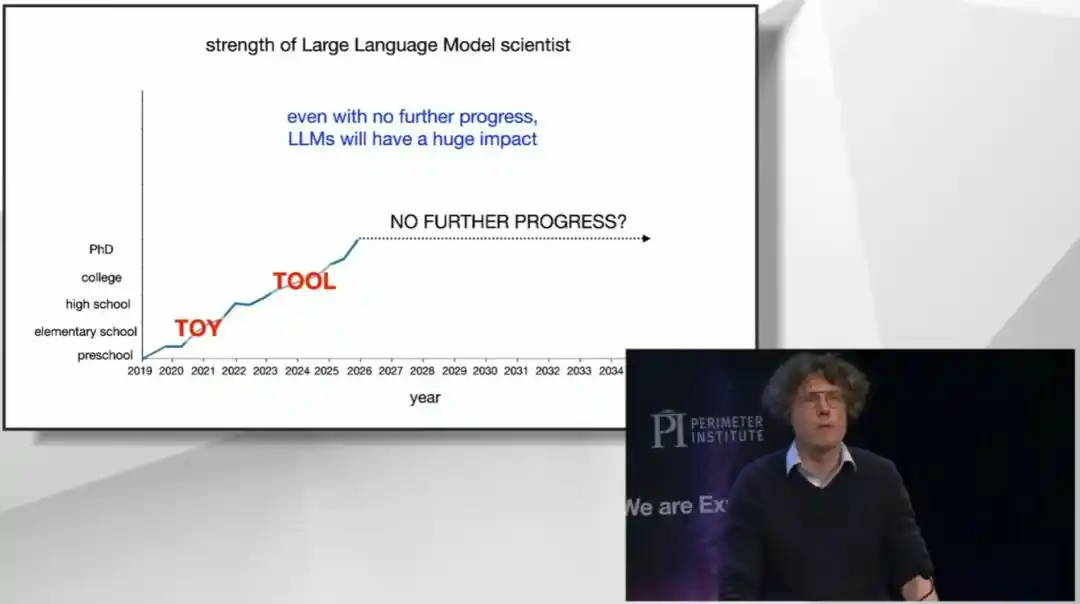
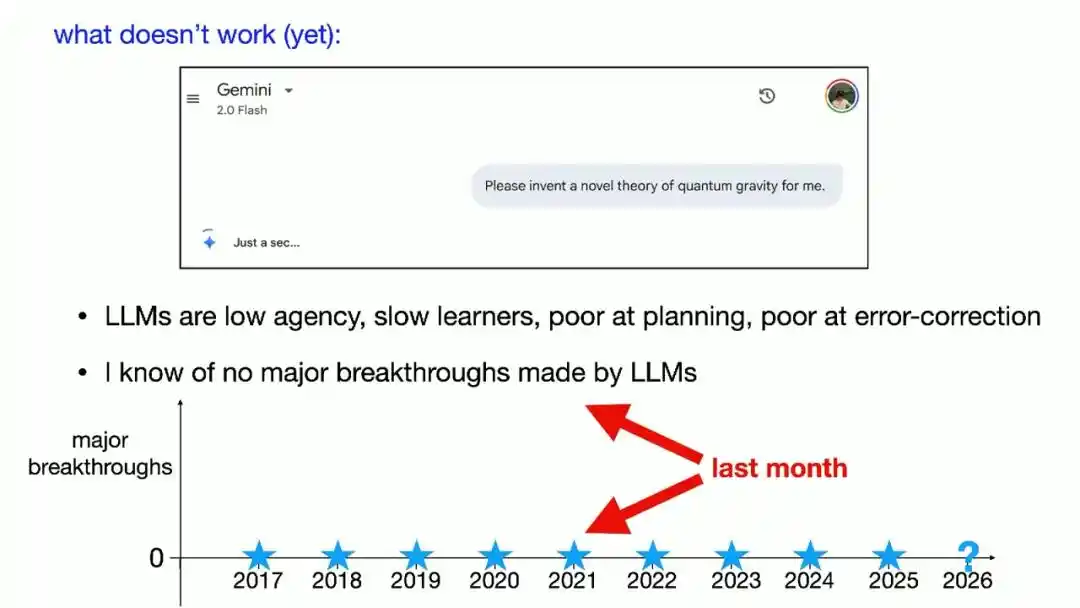
He bluntly stated that what truly 'doesn't work' right now is directly asking the model, 'Please invent a brand new theory of quantum gravity for me.' The answer would likely be worthless, sleep-inducing 'AI nonsense.'

More generally, current large models still have four obvious shortcomings: low autonomy, slow learning speed, poor planning ability, and weak error-correction capability.
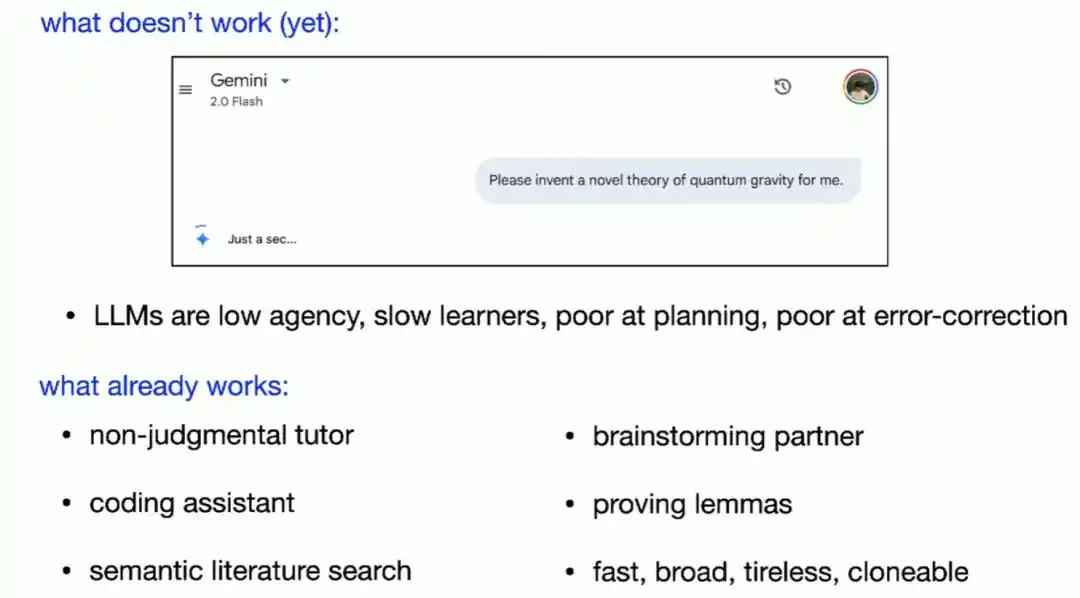
Brown admitted that all four shortcomings have significantly improved over the past year, but none have been completely solved. Consequently, a system that can ace graduate-level exams in every discipline has yet to produce results that could be called 'major breakthroughs.'

While preparing for this speech, he even specifically drew this as a flat 'straight line' marked with a question mark, self-deprecatingly admitting it was perhaps the only chart in the entire talk that 'didn't keep rising.' But he added that before the end of 2026, people would probably start arguing about how to define the term 'major breakthrough.' As it turned out, this day arrived even sooner than he himself anticipated.

However, even if progress truly stopped at this moment, Brown believes large models are already sufficient to completely transform the landscape of physics research.

He listed several already mature and still-improving use cases:

As a 'non-judgmental private tutor,' available at 3 AM to answer a physicist's own unclear knowledge gaps without waking a world-class expert;

As a programming assistant, now so strong that 'calling it just a programming assistant feels somewhat insulting.' Many physics problems previously considered 'not programming problems' can now be reframed as coding problems to solve;

As a literature retrieval tool, capable of reading an entire field's paper repository and directly telling you if an idea has already been explored; additionally, serving as a brainstorming partner.

Brown summarized that the core advantages of large models are: they are fast, broad in coverage, tireless, and can be replicated indefinitely. It takes decades to train a physicist, but once a powerful model is trained, you can run thousands of copies simultaneously—this alone is enough to 'completely change' the discipline.

Conclusion: The Golden Age of Physics

At the end of his speech, Brown gave his judgment on 'why progress won't stop.'
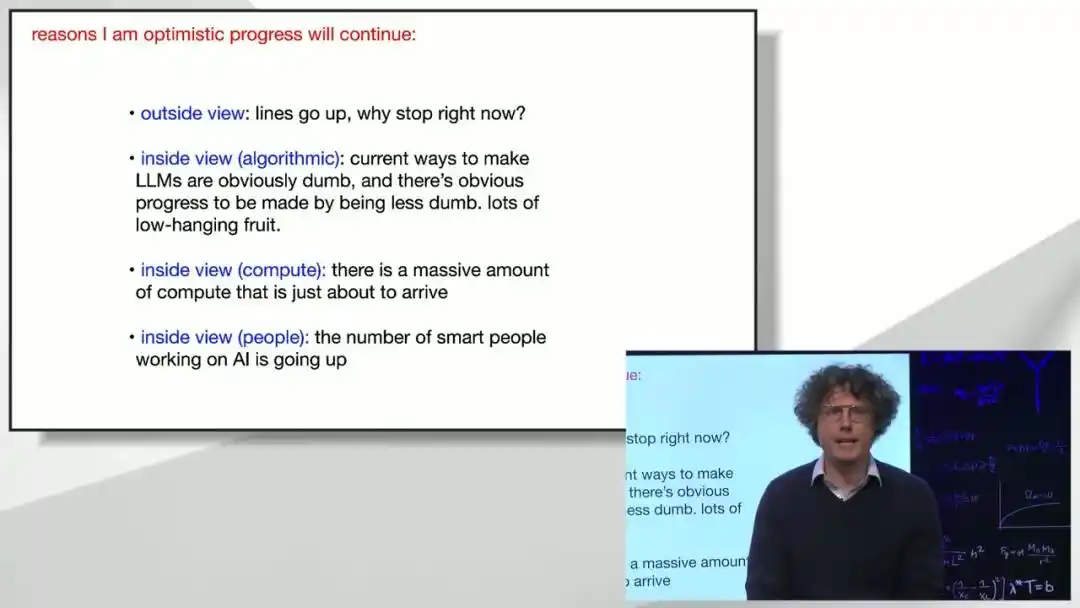
From a macroeconomic perspective, the funds currently invested in training still represent a very small fraction of global GDP, leaving ample room for growth. From a technical internal perspective, current methods for training large models are 'far less sophisticated than they appear.' Many obvious yet untried improvement ideas remain to be explored. Combined with the continuous influx of talent and compute into the field, Brown judges that current model architectures and compute scales are already sufficient to lead to Artificial General Intelligence, even without entirely new theoretical breakthroughs.

He also responded to a long-standing pessimistic view that large models only do 'pattern matching' and cannot generate genuinely new ideas.
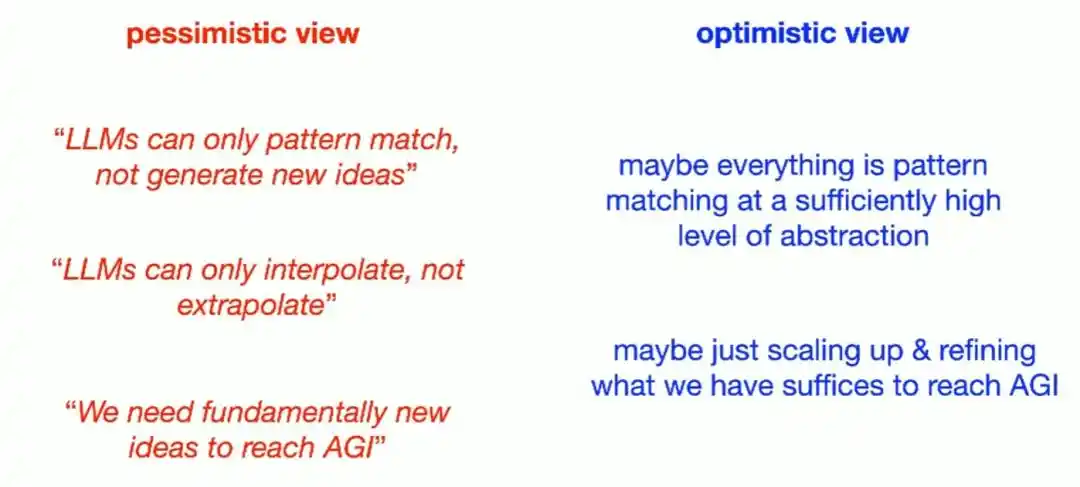
Brown's view is that if you abstract to a high enough level, almost all human creations that seem like 'major breakthroughs' are essentially a form of higher-dimensional pattern matching. A recurring phrase in this field that has been repeatedly validated is: 'these models just want to learn.' No matter how many seemingly reasonable theoretical reasons suggest they shouldn't learn well, their performance always exceeds expectations.

Brown's conclusion is that in the next few years, we will usher in a golden 'Centaur' era of human-AI collaboration: these tools will be placed in the hands of human physicists, mathematicians, and experts across fields, jointly kickstarting a new Renaissance in science and mathematics.

Further ahead, if 'creating an AI Einstein' is truly achieved, since replicating a trained model comes at almost no extra cost, humanity will likely soon have billions of 'superhuman-level AI Einsteins' operating simultaneously. This sounds like science fiction, but it's happening.
Brown said that in the long run, where AI will ultimately take physics is as difficult for him to predict as for anyone else. He even believes that the continuous improvement of AI capabilities is making the future of the entire world harder to predict. But one thing he is sure of: the next few years will be the most exciting time in the history of physics. He expects the problems that have plagued his entire career to be answered one by one in the not-too-distant future.

This article is from the WeChat public account 'Machine Heart' (ID: almosthuman2014), Author: Following AI.


Criptos en tendencia

Preguntas relacionadas

QWhat is the title of Adam Brown's speech mentioned in the article, and who praised it as 'amazingly good'?

AThe title of Adam Brown's speech is 'Training Sand to Think: Artificial General Intelligence & Future of Physics.' It was praised as 'amazingly good' by Nobel laureate and Turing Award winner Geoffrey Hinton.

QAccording to Adam Brown, how are Large Language Models (LLMs) fundamentally different from traditional computer programs?

AAdam Brown states that LLMs are not 'programmed' but 'grown.' They are developed through a two-stage process: pre-training on vast amounts of text to predict the next word, and post-training (akin to 'finishing school') to make them more useful and polite, rather than being explicitly coded with rules.

QWhat was the significant mathematical breakthrough achieved by an AI model regarding Erdős' 1946 'unit distances' conjecture?

AAn AI model independently found a counterexample to Erdős' 1946 'unit distances' conjecture. It constructed a set of points with more unit distance pairs than was previously thought possible for a given number of points, effectively disproving the long-standing conjecture.

QWhat analogy does Brown use to describe the likely future stages of AI in scientific research, based on the history of chess AI?

ABrown uses the history of chess AI to describe four likely stages for AI in science: 1) Toy Stage (early capabilities), 2) Tool Stage (useful for specific tasks), 3) Centaur Stage (deep human-AI collaboration), and 4) Superhuman Stage (AI surpassing human capabilities and operating autonomously).

QWhat are the current four major shortcomings of large models that Brown identifies, even if progress were to stop today?

AThe four major shortcomings Brown identifies are: 1) Low autonomy, 2) Slow learning speed (compared to runtime inference), 3) Poor planning ability, and 4) Weak error-correction capability. Despite these, he believes AI has already reshaped physics research.

Lecturas Relacionadas

Valuation of $8 Billion, Up 200% in 8 Months! What's Behind Crypto-Friendly Bank Erebor Bank's Rise?

Erebor Bank, a digital bank founded by Palmer Luckey and backed by Peter Thiel, is in talks for new funding at a target valuation of $8 billion, double its $4.35 billion valuation from December. This surge is driven by explosive deposit growth, which soared from $1.1 billion in March to approximately $4.05 billion within a quarter, alongside adding nearly 400 new clients. The bank, launched in February 2026, holds a full national bank charter from the OCC, a strategic choice to avoid reliance on partner banks. It aims to serve tech startups, defense contractors, and crypto-native businesses, addressing gaps left by Silicon Valley Bank's collapse. Core promises include lending against non-traditional assets like hardware, offering 24/7 settlement, and integrating stablecoin services with traditional banking. It has already enabled stablecoin deposits and withdrawals on the Sui network. However, its current financials show minimal lending activity and a net loss, with high liquidity in cash and securities. The valuation hinges on future potential to monetize deposits through lending and crypto services. The bank's experienced management team includes veterans from Wells Fargo and crypto compliance firms. Risks are significant. Its concentrated customer base and exposure to volatile sectors like crypto and venture capital echo SVB's vulnerabilities. Its entire model depends on continued regulatory favor towards digital assets, which could shift. Erebor represents a high-profile experiment at the intersection of banking, crypto, and industrial policy, with its execution and market demand yet to be fully proven.

marsbitHace 1 hora(s)

Valuation of $8 Billion, Up 200% in 8 Months! What's Behind Crypto-Friendly Bank Erebor Bank's Rise?

marsbitHace 1 hora(s)

$8 Billion Valuation, 2x Growth in 8 Months! What Makes Crypto-Friendly Bank Erebor Bank So Special?

Erebor Bank, a crypto-friendly U.S. bank founded by Palmer Luckey, is reportedly in talks for a new funding round targeting a valuation of at least $8 billion, double its $4.35 billion valuation from December. Despite being operational for only a few months, its rapid growth—deposits surged from $1.1 billion in March to approximately $4.05 billion within a quarter, adding nearly 400 clients—has attracted investor interest. The bank aims to fill the void left by Silicon Valley Bank's collapse, targeting startups and businesses with non-traditional assets like defense contracts and digital tokens. Its strategy involves holding its own banking license to offer services like stablecoin deposits, payments, and 24/7 on-chain settlement. While digital assets are a core long-term focus, recent growth has been driven more by financing for U.S. manufacturing and defense sectors. Erebor's leadership combines Luckey's tech/defense background with a seasoned financial team. It received a national bank charter from the OCC in early 2026, benefiting from a favorable regulatory climate for digital assets. However, the bank faces significant risks, including reliance on a concentrated client base, exposure to crypto market volatility, potential regulatory shifts, and the unproven demand for its integrated banking model. Investors are betting on its future potential to monetize deposits through lending and crypto services, despite current losses typical for a new bank.

链捕手Hace 1 hora(s)

$8 Billion Valuation, 2x Growth in 8 Months! What Makes Crypto-Friendly Bank Erebor Bank So Special?

链捕手Hace 1 hora(s)

Trading

Spot

Artículos destacados

Qué es GROK AI

Grok AI: Revolucionando la Tecnología Conversacional en la Era Web3 Introducción En el paisaje de rápida evolución de la inteligencia artificial, Grok AI se destaca como un proyecto notable que une los dominios de la tecnología avanzada y la interacción del usuario. Desarrollado por xAI, una empresa liderada por el renombrado empresario Elon Musk, Grok AI busca redefinir la forma en que interactuamos con la inteligencia artificial. A medida que el movimiento Web3 continúa floreciendo, Grok AI tiene como objetivo aprovechar el poder de la IA conversacional para responder consultas complejas, proporcionando a los usuarios una experiencia que no solo es informativa, sino también entretenida. ¿Qué es Grok AI? Grok AI es un sofisticado chatbot de IA conversacional diseñado para interactuar dinámicamente con los usuarios. A diferencia de muchos sistemas de IA tradicionales, Grok AI abraza una gama más amplia de consultas, incluyendo aquellas que normalmente se consideran inapropiadas o fuera de las respuestas estándar. Los objetivos centrales del proyecto incluyen: Razonamiento Confiable: Grok AI enfatiza el razonamiento de sentido común para proporcionar respuestas lógicas basadas en la comprensión contextual. Supervisión Escalable: La integración de asistencia de herramientas asegura que las interacciones de los usuarios sean monitoreadas y optimizadas para la calidad. Verificación Formal: La seguridad es primordial; Grok AI incorpora métodos de verificación formal para mejorar la confiabilidad de sus resultados. Comprensión de Largo Contexto: El modelo de IA sobresale en retener y recordar un extenso historial de conversaciones, facilitando discusiones significativas y contextualizadas. Robustez Adversarial: Al enfocarse en mejorar sus defensas contra entradas manipuladas o maliciosas, Grok AI busca mantener la integridad de las interacciones de los usuarios. En esencia, Grok AI no es solo un dispositivo de recuperación de información; es un compañero conversacional inmersivo que fomenta un diálogo dinámico. Creador de Grok AI La mente detrás de Grok AI no es otra que Elon Musk, una persona sinónimo de innovación en varios campos, incluyendo la automoción, los viajes espaciales y la tecnología. Bajo el paraguas de xAI, una empresa enfocada en avanzar la tecnología de IA de maneras beneficiosas, la visión de Musk busca remodelar la comprensión de las interacciones de IA. El liderazgo y la ética fundacional están profundamente influenciados por el compromiso de Musk de empujar los límites tecnológicos. Inversores de Grok AI Si bien los detalles específicos sobre los inversores que respaldan a Grok AI son limitados, se reconoce públicamente que xAI, el incubador del proyecto, está fundado y apoyado principalmente por el propio Elon Musk. Las empresas y participaciones anteriores de Musk proporcionan un respaldo robusto, fortaleciendo aún más la credibilidad y el potencial de crecimiento de Grok AI. Sin embargo, hasta ahora, la información sobre fundaciones de inversión adicionales u organizaciones que apoyan a Grok AI no está fácilmente accesible, marcando un área para una posible exploración futura. ¿Cómo Funciona Grok AI? La mecánica operativa de Grok AI es tan innovadora como su marco conceptual. El proyecto integra varias tecnologías de vanguardia que facilitan sus funcionalidades únicas: Infraestructura Robusta: Grok AI está construido utilizando Kubernetes para la orquestación de contenedores, Rust para rendimiento y seguridad, y JAX para computación numérica de alto rendimiento. Este trío asegura que el chatbot opere de manera eficiente, escale efectivamente y sirva a los usuarios de manera oportuna. Acceso a Conocimiento en Tiempo Real: Una de las características distintivas de Grok AI es su capacidad para acceder a datos en tiempo real a través de la plataforma X—anteriormente conocida como Twitter. Esta capacidad otorga a la IA acceso a la información más reciente, permitiéndole proporcionar respuestas y recomendaciones oportunas que otros modelos de IA podrían pasar por alto. Dos Modos de Interacción: Grok AI ofrece a los usuarios una elección entre “Modo Divertido” y “Modo Regular”. El Modo Divertido permite un estilo de interacción más lúdico y humorístico, mientras que el Modo Regular se centra en ofrecer respuestas precisas y exactas. Esta versatilidad asegura una experiencia personalizada que se adapta a diversas preferencias de los usuarios. En esencia, Grok AI une rendimiento con compromiso, creando una experiencia que es tanto enriquecedora como entretenida. Cronología de Grok AI El viaje de Grok AI está marcado por hitos cruciales que reflejan sus etapas de desarrollo y despliegue: Desarrollo Inicial: La fase fundamental de Grok AI tuvo lugar durante aproximadamente dos meses, durante los cuales se realizó el entrenamiento inicial y el ajuste del modelo. Lanzamiento Beta de Grok-2: En un avance significativo, se anunció la beta de Grok-2. Este lanzamiento introdujo dos versiones del chatbot—Grok-2 y Grok-2 mini—cada una equipada con capacidades para chatear, programar y razonar. Acceso Público: Tras su desarrollo beta, Grok AI se volvió disponible para los usuarios de la plataforma X. Aquellos con cuentas verificadas por un número de teléfono y activas durante al menos siete días pueden acceder a una versión limitada, haciendo que la tecnología esté disponible para un público más amplio. Esta cronología encapsula el crecimiento sistemático de Grok AI desde su inicio hasta el compromiso público, enfatizando su compromiso con la mejora continua y la interacción del usuario. Características Clave de Grok AI Grok AI abarca varias características clave que contribuyen a su identidad innovadora: Integración de Conocimiento en Tiempo Real: El acceso a información actual y relevante diferencia a Grok AI de muchos modelos estáticos, permitiendo una experiencia de usuario atractiva y precisa. Estilos de Interacción Versátiles: Al ofrecer modos de interacción distintos, Grok AI se adapta a diversas preferencias de los usuarios, invitando a la creatividad y la personalización en la conversación con la IA. Avanzada Infraestructura Tecnológica: La utilización de Kubernetes, Rust y JAX proporciona al proyecto un marco sólido para asegurar confiabilidad y rendimiento óptimo. Consideración de Discurso Ético: La inclusión de una función generadora de imágenes muestra el espíritu innovador del proyecto. Sin embargo, también plantea consideraciones éticas en torno a los derechos de autor y la representación respetuosa de figuras reconocibles—una discusión en curso dentro de la comunidad de IA. Conclusión Como una entidad pionera en el ámbito de la IA conversacional, Grok AI encapsula el potencial de experiencias transformadoras para los usuarios en la era digital. Desarrollado por xAI y guiado por el enfoque visionario de Elon Musk, Grok AI integra conocimiento en tiempo real con capacidades avanzadas de interacción. Busca empujar los límites de lo que la inteligencia artificial puede lograr mientras mantiene un enfoque en consideraciones éticas y la seguridad del usuario. Grok AI no solo encarna el avance tecnológico, sino que también representa un nuevo paradigma de conversación en el paisaje Web3, prometiendo involucrar a los usuarios con tanto conocimiento hábil como interacción lúdica. A medida que el proyecto continúa evolucionando, se erige como un testimonio de lo que la intersección de la tecnología, la creatividad y la interacción similar a la humana puede lograr.

423 Vistas totalesPublicado en 2024.12.26Actualizado en 2024.12.26

Qué es GROK AI

Qué es ERC AI

Euruka Tech: Una Visión General de $erc ai y sus Ambiciones en Web3 Introducción En el paisaje en rápida evolución de la tecnología blockchain y las aplicaciones descentralizadas, nuevos proyectos emergen con frecuencia, cada uno con objetivos y metodologías únicas. Uno de estos proyectos es Euruka Tech, que opera en el amplio dominio de las criptomonedas y Web3. El enfoque principal de Euruka Tech, particularmente su token $erc ai, es presentar soluciones innovadoras diseñadas para aprovechar las crecientes capacidades de la tecnología descentralizada. Este artículo tiene como objetivo proporcionar una visión general completa de Euruka Tech, una exploración de sus objetivos, funcionalidad, la identidad de su creador, posibles inversores y su importancia dentro del contexto más amplio de Web3. ¿Qué es Euruka Tech, $erc ai? Euruka Tech se caracteriza como un proyecto que aprovecha las herramientas y funcionalidades ofrecidas por el entorno Web3, centrándose en integrar inteligencia artificial dentro de sus operaciones. Aunque los detalles específicos sobre el marco del proyecto son algo elusivos, está diseñado para mejorar la participación del usuario y automatizar procesos en el espacio cripto. El proyecto tiene como objetivo crear un ecosistema descentralizado que no solo facilite transacciones, sino que también incorpore funcionalidades predictivas a través de inteligencia artificial, de ahí la designación de su token, $erc ai. El objetivo es proporcionar una plataforma intuitiva que facilite interacciones más inteligentes y un procesamiento eficiente de transacciones dentro de la creciente esfera de Web3. ¿Quién es el Creador de Euruka Tech, $erc ai? En la actualidad, la información sobre el creador o el equipo fundador detrás de Euruka Tech permanece no especificada y algo opaca. Esta ausencia de datos genera preocupaciones, ya que el conocimiento del trasfondo del equipo es a menudo esencial para establecer credibilidad dentro del sector blockchain. Por lo tanto, hemos categorizado esta información como desconocida hasta que se disponga de detalles concretos en el dominio público. ¿Quiénes son los Inversores de Euruka Tech, $erc ai? De manera similar, la identificación de inversores u organizaciones de respaldo para el proyecto Euruka Tech no se proporciona fácilmente a través de la investigación disponible. Un aspecto que es crucial para los posibles interesados o usuarios que consideren involucrarse con Euruka Tech es la garantía que proviene de asociaciones financieras establecidas o respaldo de firmas de inversión de renombre. Sin divulgaciones sobre afiliaciones de inversión, es difícil sacar conclusiones completas sobre la seguridad financiera o la longevidad del proyecto. De acuerdo con la información encontrada, esta sección también se encuentra en estado de desconocido. ¿Cómo Funciona Euruka Tech, $erc ai? A pesar de la falta de especificaciones técnicas detalladas para Euruka Tech, es esencial considerar sus ambiciones innovadoras. El proyecto busca aprovechar el poder computacional de la inteligencia artificial para automatizar y mejorar la experiencia del usuario dentro del entorno de las criptomonedas. Al integrar IA con tecnología blockchain, Euruka Tech tiene como objetivo proporcionar características como operaciones automatizadas, evaluaciones de riesgo e interfaces de usuario personalizadas. La esencia innovadora de Euruka Tech radica en su objetivo de crear una conexión fluida entre los usuarios y las vastas posibilidades que presentan las redes descentralizadas. A través de la utilización de algoritmos de aprendizaje automático e IA, busca minimizar los desafíos de los usuarios primerizos y optimizar las experiencias transaccionales dentro del marco de Web3. Esta simbiosis entre IA y blockchain subraya la importancia del token $erc ai, que actúa como un puente entre las interfaces de usuario tradicionales y las capacidades avanzadas de las tecnologías descentralizadas. Cronología de Euruka Tech, $erc ai Desafortunadamente, como resultado de la información limitada disponible sobre Euruka Tech, no podemos presentar una cronología detallada de los principales desarrollos o hitos en el viaje del proyecto. Esta cronología, típicamente invaluable para trazar la evolución de un proyecto y entender su trayectoria de crecimiento, no está actualmente disponible. A medida que la información sobre eventos notables, asociaciones o adiciones funcionales se haga evidente, las actualizaciones seguramente mejorarán la visibilidad de Euruka Tech en la esfera cripto. Aclaración sobre Otros Proyectos “Eureka” Es importante señalar que múltiples proyectos y empresas comparten una nomenclatura similar con “Eureka”. La investigación ha identificado iniciativas como un agente de IA de NVIDIA Research, que se centra en enseñar a los robots tareas complejas utilizando métodos generativos, así como Eureka Labs y Eureka AI, que mejoran la experiencia del usuario en educación y análisis de servicio al cliente, respectivamente. Sin embargo, estos proyectos son distintos de Euruka Tech y no deben confundirse con sus objetivos o funcionalidades. Conclusión Euruka Tech, junto con su token $erc ai, representa un jugador prometedor pero actualmente oscuro dentro del paisaje de Web3. Si bien los detalles sobre su creador e inversores permanecen no revelados, la ambición central de combinar inteligencia artificial con tecnología blockchain se presenta como un punto focal de interés. Los enfoques únicos del proyecto para fomentar la participación del usuario a través de la automatización avanzada podrían destacarlo a medida que el ecosistema Web3 progresa. A medida que el mercado cripto continúa evolucionando, los interesados deben mantener un ojo atento a los avances en torno a Euruka Tech, ya que el desarrollo de innovaciones documentadas, asociaciones o una hoja de ruta definida podría presentar oportunidades significativas en el futuro cercano. Tal como está, esperamos más información sustancial que podría revelar el potencial de Euruka Tech y su posición en el competitivo paisaje cripto.

411 Vistas totalesPublicado en 2025.01.02Actualizado en 2025.01.02

Qué es ERC AI

Qué es DUOLINGO AI

DUOLINGO AI: Integrando el Aprendizaje de Idiomas con Web3 e Innovación en IA En una era donde la tecnología redefine la educación, la integración de la inteligencia artificial (IA) y las redes blockchain anuncia una nueva frontera para el aprendizaje de idiomas. Entra DUOLINGO AI y su criptomoneda asociada, $DUOLINGO AI. Este proyecto aspira a fusionar la capacidad educativa de las principales plataformas de aprendizaje de idiomas con los beneficios de la tecnología descentralizada Web3. Este artículo profundiza en los aspectos clave de DUOLINGO AI, explorando sus objetivos, marco tecnológico, desarrollo histórico y potencial futuro, mientras mantiene claridad entre el recurso educativo original y esta iniciativa independiente de criptomoneda. Visión General de DUOLINGO AI En su esencia, DUOLINGO AI busca establecer un entorno descentralizado donde los aprendices puedan ganar recompensas criptográficas por alcanzar hitos educativos en la competencia lingüística. Al aplicar contratos inteligentes, el proyecto tiene como objetivo automatizar los procesos de verificación de habilidades y asignación de tokens, adhiriéndose a los principios de Web3 que enfatizan la transparencia y la propiedad del usuario. El modelo se aparta de los enfoques tradicionales para la adquisición de idiomas al apoyarse en gran medida en una estructura de gobernanza impulsada por la comunidad, permitiendo a los poseedores de tokens sugerir mejoras al contenido del curso y a las distribuciones de recompensas. Algunos de los objetivos notables de DUOLINGO AI incluyen: Aprendizaje Gamificado: El proyecto integra logros en blockchain y tokens no fungibles (NFTs) para representar niveles de competencia lingüística, fomentando la motivación a través de recompensas digitales atractivas. Creación de Contenido Descentralizada: Abre avenidas para que educadores y entusiastas de los idiomas contribuyan con sus cursos, facilitando un modelo de reparto de ingresos que beneficia a todos los contribuyentes. Personalización Impulsada por IA: Al emplear modelos avanzados de aprendizaje automático, DUOLINGO AI personaliza las lecciones para adaptarse al progreso de aprendizaje individual, similar a las características adaptativas que se encuentran en plataformas establecidas. Creadores del Proyecto y Gobernanza A partir de abril de 2025, el equipo detrás de $DUOLINGO AI permanece seudónimo, una práctica frecuente en el paisaje descentralizado de criptomonedas. Esta anonimidad está destinada a promover el crecimiento colectivo y la participación de los interesados en lugar de centrarse en desarrolladores individuales. El contrato inteligente desplegado en la blockchain de Solana anota la dirección de la billetera del desarrollador, lo que significa el compromiso con la transparencia en las transacciones a pesar de que la identidad de los creadores sea desconocida. Según su hoja de ruta, DUOLINGO AI aspira a evolucionar hacia una Organización Autónoma Descentralizada (DAO). Esta estructura de gobernanza permite a los poseedores de tokens votar sobre cuestiones críticas como implementaciones de características y asignaciones del tesoro. Este modelo se alinea con la ética del empoderamiento comunitario que se encuentra en diversas aplicaciones descentralizadas, enfatizando la importancia de la toma de decisiones colectiva. Inversores y Asociaciones Estratégicas Actualmente, no hay inversores institucionales o capitalistas de riesgo identificables públicamente vinculados a $DUOLINGO AI. En cambio, la liquidez del proyecto proviene principalmente de intercambios descentralizados (DEXs), marcando un contraste marcado con las estrategias de financiamiento de las empresas de tecnología educativa tradicionales. Este modelo de base indica un enfoque impulsado por la comunidad, reflejando el compromiso del proyecto con la descentralización. En su libro blanco, DUOLINGO AI menciona la formación de colaboraciones con “plataformas de educación blockchain” no especificadas, destinadas a enriquecer su oferta de cursos. Si bien aún no se han divulgado asociaciones específicas, estos esfuerzos colaborativos sugieren una estrategia para fusionar la innovación blockchain con iniciativas educativas, ampliando el acceso y la participación de los usuarios a través de diversas avenidas de aprendizaje. Arquitectura Tecnológica Integración de IA DUOLINGO AI incorpora dos componentes principales impulsados por IA para mejorar su oferta educativa: Motor de Aprendizaje Adaptativo: Este sofisticado motor aprende de las interacciones de los usuarios, similar a los modelos propietarios de las principales plataformas educativas. Ajusta dinámicamente la dificultad de las lecciones para abordar desafíos específicos de los aprendices, reforzando áreas débiles a través de ejercicios dirigidos. Agentes Conversacionales: Al emplear chatbots impulsados por GPT-4, DUOLINGO AI proporciona una plataforma para que los usuarios participen en conversaciones simuladas, fomentando una experiencia de aprendizaje de idiomas más interactiva y práctica. Infraestructura Blockchain Construido sobre la blockchain de Solana, $DUOLINGO AI utiliza un marco tecnológico integral que incluye: Contratos Inteligentes de Verificación de Habilidades: Esta característica otorga automáticamente tokens a los usuarios que superan con éxito las pruebas de competencia, reforzando la estructura de incentivos para resultados de aprendizaje genuinos. Insignias NFT: Estos tokens digitales significan varios hitos que los aprendices logran, como completar una sección de su curso o dominar habilidades específicas, permitiéndoles intercambiar o mostrar sus logros digitalmente. Gobernanza DAO: Los miembros de la comunidad con tokens pueden participar en la gobernanza votando sobre propuestas clave, facilitando una cultura participativa que fomenta la innovación en las ofertas de cursos y características de la plataforma. Línea de Tiempo Histórica 2022–2023: Conceptualización Los cimientos de DUOLINGO AI comienzan con la creación de un libro blanco, destacando la sinergia entre los avances en IA en el aprendizaje de idiomas y el potencial descentralizado de la tecnología blockchain. 2024: Lanzamiento Beta Un lanzamiento beta limitado introduce ofertas en idiomas populares, recompensando a los primeros usuarios con incentivos en tokens como parte de la estrategia de participación comunitaria del proyecto. 2025: Transición a DAO En abril, se produce un lanzamiento completo de la red principal con la circulación de tokens, lo que provoca discusiones comunitarias sobre posibles expansiones a idiomas asiáticos y otros desarrollos de cursos. Desafíos y Direcciones Futuras Obstáculos Técnicos A pesar de sus ambiciosos objetivos, DUOLINGO AI enfrenta desafíos significativos. La escalabilidad sigue siendo una preocupación constante, particularmente en equilibrar los costos asociados con el procesamiento de IA y mantener una red descentralizada y receptiva. Además, garantizar la creación y moderación de contenido de calidad en medio de una oferta descentralizada plantea complejidades en el mantenimiento de estándares educativos. Oportunidades Estratégicas Mirando hacia adelante, DUOLINGO AI tiene el potencial de aprovechar asociaciones de micro-certificación con instituciones académicas, proporcionando validaciones verificadas en blockchain de habilidades lingüísticas. Además, la expansión entre cadenas podría permitir que el proyecto acceda a bases de usuarios más amplias y a ecosistemas blockchain adicionales, mejorando su interoperabilidad y alcance. Conclusión DUOLINGO AI representa una fusión innovadora de inteligencia artificial y tecnología blockchain, presentando una alternativa centrada en la comunidad a los sistemas tradicionales de aprendizaje de idiomas. Si bien su desarrollo seudónimo y su modelo económico emergente traen ciertos riesgos, el compromiso del proyecto con el aprendizaje gamificado, la educación personalizada y la gobernanza descentralizada ilumina un camino hacia adelante para la tecnología educativa en el ámbito de Web3. A medida que la IA continúa avanzando y el ecosistema blockchain evoluciona, iniciativas como DUOLINGO AI podrían redefinir cómo los usuarios se involucran con la educación lingüística, empoderando comunidades y recompensando la participación a través de mecanismos de aprendizaje innovadores.

446 Vistas totalesPublicado en 2025.04.11Actualizado en 2025.04.11

Qué es DUOLINGO AI

Discusiones

Bienvenido a la comunidad de HTX. Aquí puedes mantenerte informado sobre los últimos desarrollos de la plataforma y acceder a análisis profesionales del mercado. A continuación se presentan las opiniones de los usuarios sobre el precio de AI (AI).

活动图片