Actually, the Largest Use Case for Stablecoin Payments Is Not Cross-Border

marsbitPublicado a 2026-08-16Actualizado a 2026-08-16

Resumen

Based on an analysis of $15.2 billion in identified on-chain stablecoin transfers, the data reveals that cross-border remittances represent only a portion of stablecoin demand. The dominant use case is domestic transfers, accounting for 62.6% ($9.5B) of the identified volume. Key markets include Turkey, South Korea, Mexico, Indonesia, and the US. This indicates stablecoins are widely used for domestic payments, transactions, and dollar-denominated savings within countries. Furthermore, 73.0% of all identified transaction volume (including domestic) stays within the sender's broader geographic region. The Asia-Pacific (APAC) region leads in stablecoin activity, contributing 41.0% of total sent volume and 41.6% of global domestic volume. It also shows a net inflow of funds, with Indonesia, Singapore, and South Korea being notable recipients. Major cross-border corridors already exist, such as Turkey-Indonesia and US-Mexico. Within APAC, corridors like Taiwan-Indonesia and Indonesia-South Korea show significant bilateral flows. For institutions, the key market opportunities currently lie in domestic settlement services and developing cross-border payment channels within the APAC region, which combines the largest transaction scale, high domestic usage, and positive net inflows.

Author: Heechang Kang, Four Pillars CSO

Compiled by: Jiahuan, ChainCatcher

This analysis is based on Allium's geographic payment data, covering $15.2 billion in identified on-chain transfers with known sending and receiving countries. As most on-chain transactions currently cannot be attributed to specific countries, the data in this article only reflects the identified sample.

Of this $15.2 billion in identifiable stablecoin transaction volume, 62.6% were domestic transfers. Of all identifiable transaction volume, 73.0% of funds ultimately flowed to the sender's region. Therefore, cross-border remittances are actually only one part of the current demand for stablecoins.

The Asia-Pacific (APAC) region is leading, accounting for 41.0% of total sent transaction volume and 41.6% of global domestic transaction volume, while also showing net inflows, with Indonesia, Singapore, and South Korea seeing particularly notable net inflows.

For institutions assessing stablecoin payment demand, domestic settlement services and cross-border payment channels in the Asia-Pacific region are currently the most noteworthy market opportunities.

1. Stablecoin Transactions Are Primarily a 'Domestic Business'
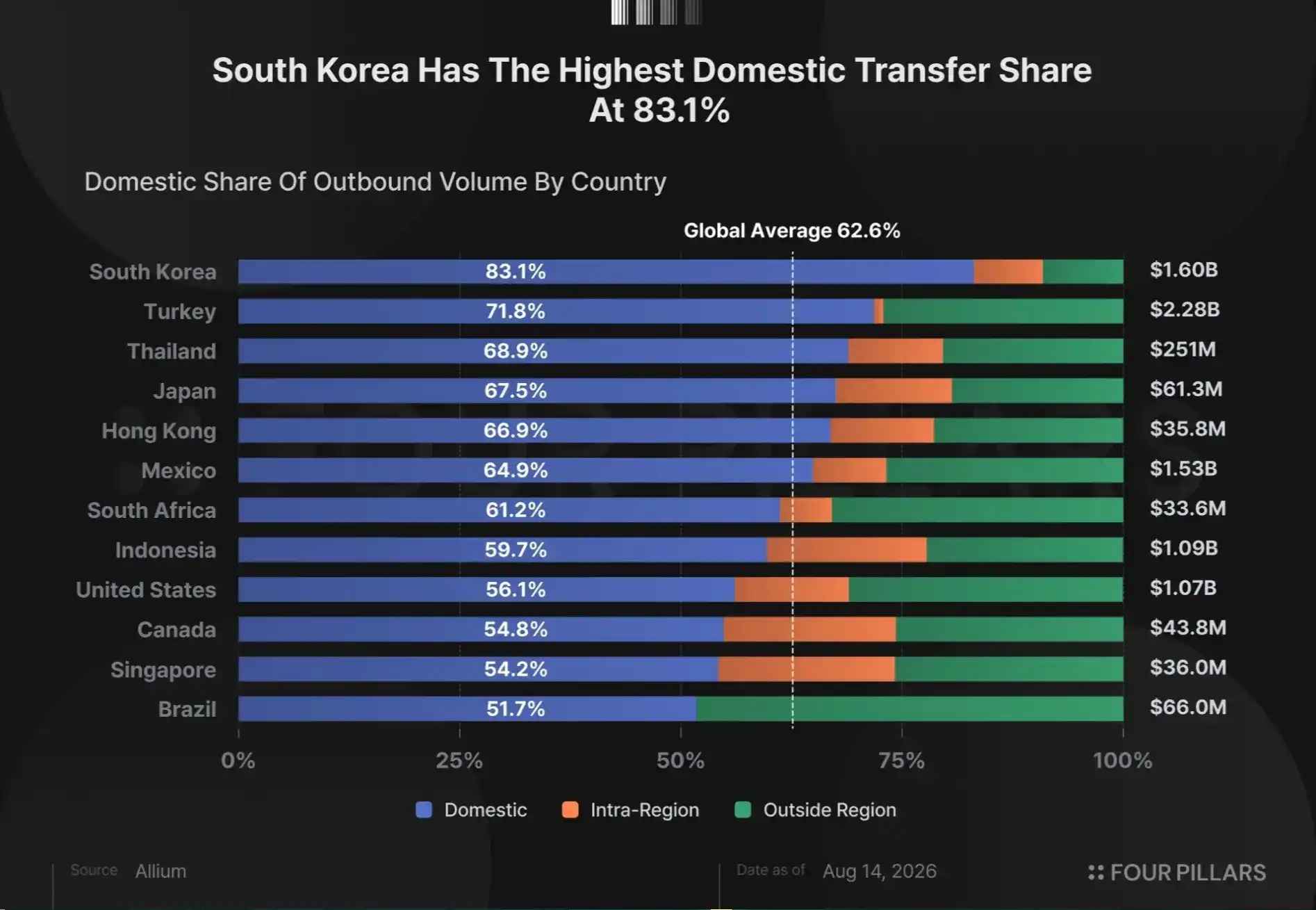
Domestic transfers, which occur between wallets located in the same country, amounted to $9.5 billion, constituting 62.6% of the $15.2 billion identifiable transaction volume.

Regardless of region or market size, domestic transfers represent the largest destination for funds in most markets with outflow activity.

Turkey ($2.28B), South Korea ($1.6B), Mexico ($1.53B), Indonesia ($1.09B), and the United States ($1.07B) together contributed 79.5% of global domestic stablecoin transaction volume.

These transactions are completed directly between public blockchain wallets, without the need to go through card networks or bank payment systems.

Such a large volume of domestic transactions indicates that users are employing stablecoins within their local markets for payments, trading, and US dollar-denominated savings. Therefore, cross-border remittances are just one part of the stablecoin use case.

For institutions designing stablecoin services, domestic payments and settlements currently correspond to a larger actual transaction volume compared to focusing solely on cross-border remittances.

2. After Crossing Borders, Funds Also Prefer to Stay Within the Region
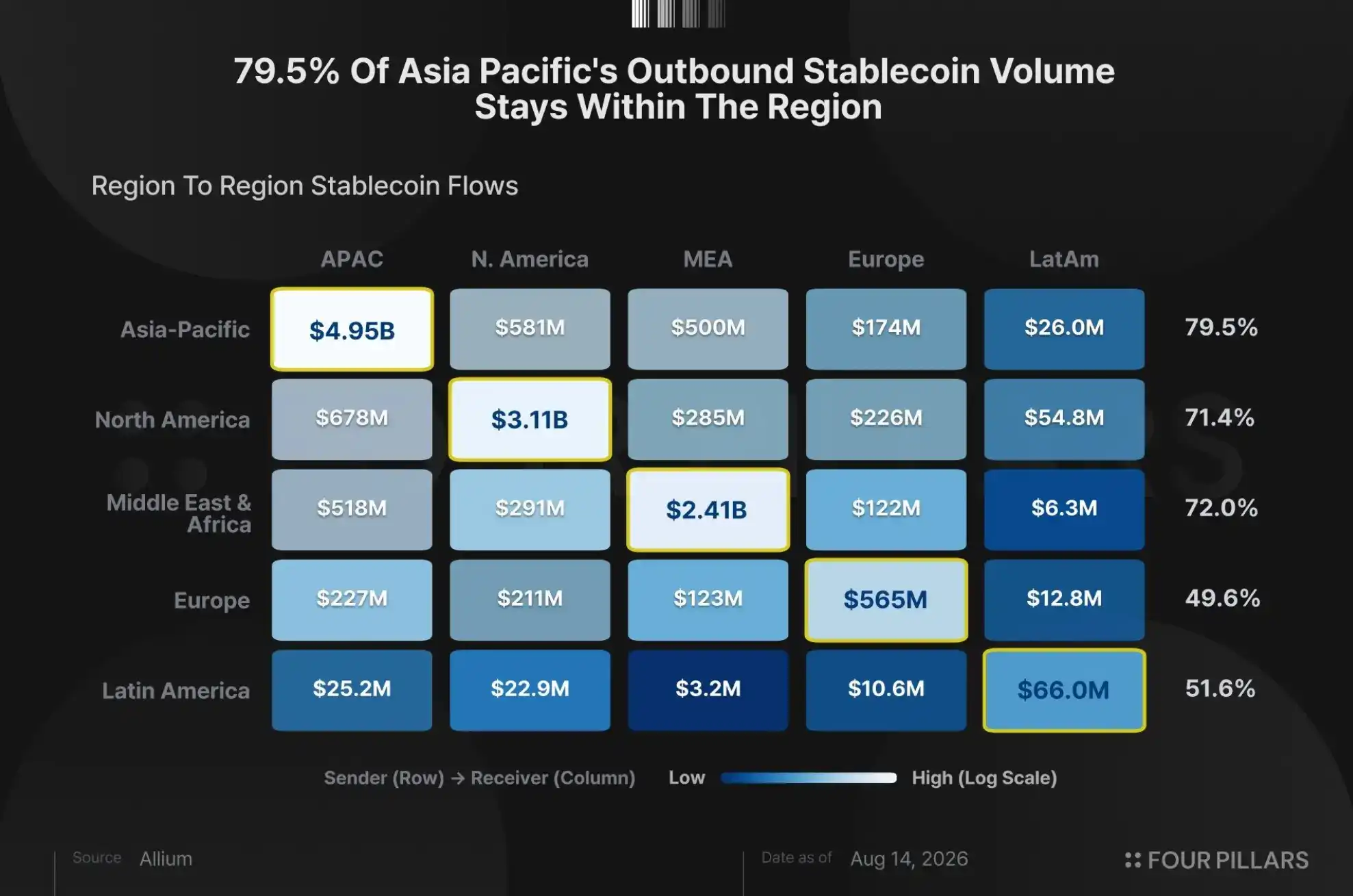
Including domestic transfers, 73.0% of transaction volume occurs within the sender's region, meaning within the same continent.

Specifically, 79.5% of funds from APAC remain within the region, followed by the Middle East and Africa at 72.0%, North America at 71.4%, and Europe at 49.6%.

Looking at fund flows between regions, transactions are clearly concentrated within regions, meaning most identifiable stablecoin transactions currently still occur within the sender's region.

Excluding domestic transfers, within the $5.68 billion cross-border transaction volume, the share of intra-regional transactions drops to 27.8%.

Here, APAC's intra-regional transaction share remains high at 43.7%, or $995 million out of $2.28 billion in cross-border transactions. In contrast, North America is at 27.0%, and the Middle East and Africa is only 6.3%.

As the largest market in the Middle East and Africa, most of Turkey's cross-border stablecoin funds flow to Asia and the Americas.

Within APAC, transaction volumes for Taiwan to Indonesia ($138 million), Indonesia to Taiwan ($124 million), and Indonesia to South Korea ($89 million) are already substantial.

The existing transaction volumes provide a foundation for building regional stablecoin payment infrastructure in APAC.

Indonesia, Taiwan, South Korea, Australia, and Thailand together participated in approximately $1 billion in intra-regional cross-border transactions, while also generating $3.96 billion in domestic transaction volume.

Institutions can use these existing liquidity flows and bilateral demands to determine which cross-border payment corridors are worth prioritizing.

For institutions planning to build regional payment infrastructure, cross-border corridors such as Taiwan to Indonesia and Indonesia to South Korea have already formed quantifiable bilateral demand, providing a market basis for early investment.

Currently, transactions where Allium can identify both sending and receiving countries account for only 2.9% of all observed transaction volume. As more transactions have their country information identified, the rankings of these current cross-border corridors may still change.

3. APAC Has Become the Largest Stablecoin Transaction Market
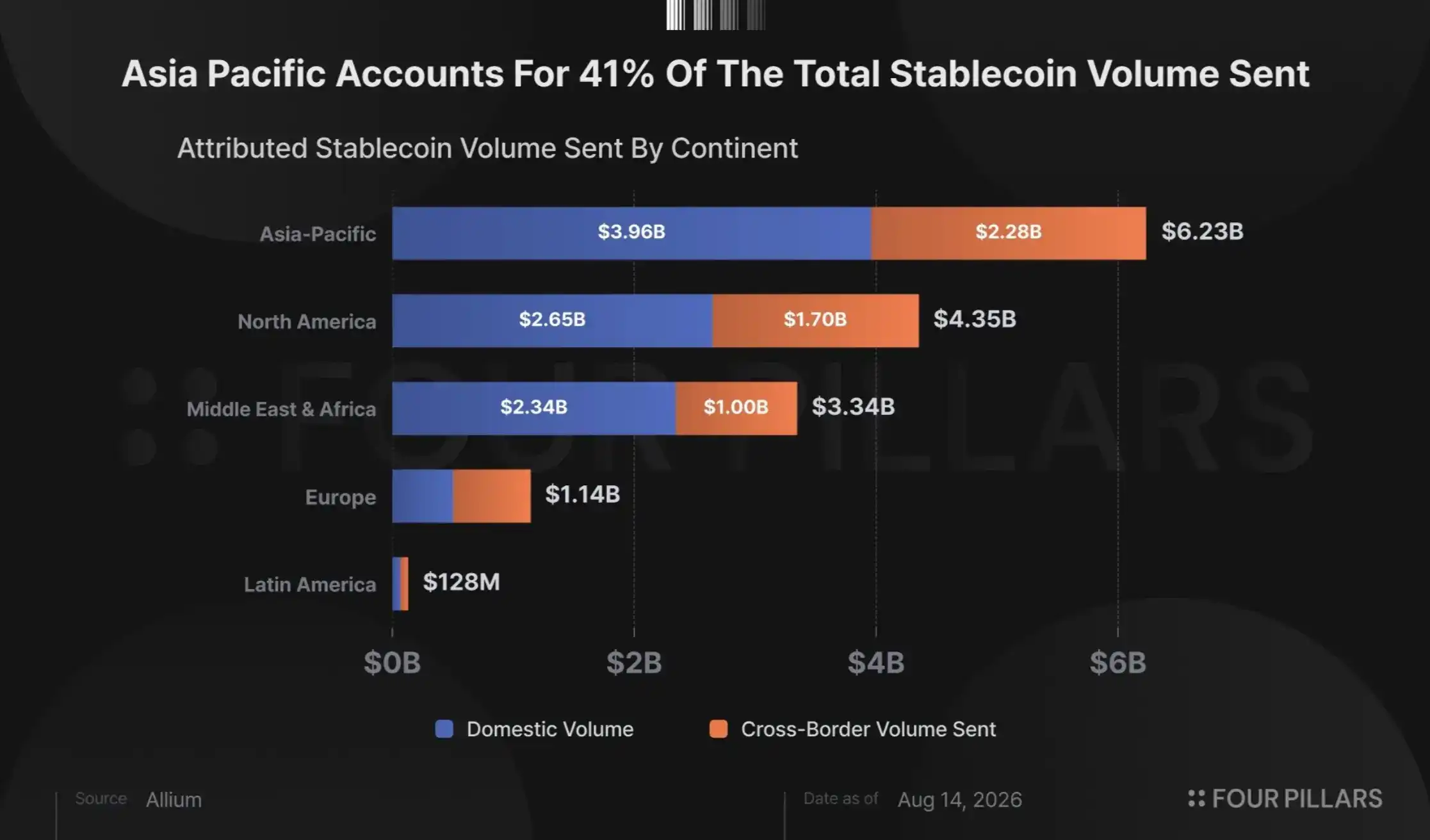
The APAC region is the largest in this dataset, sending $6.23 billion in stablecoins, accounting for 41.0% of identifiable volume; and receiving $6.4 billion, accounting for 42.1%.

In terms of sent volume, APAC is significantly higher than North America at 28.6%, the Middle East and Africa at 22.0%, Europe at 7.5%, and Latin America at 0.8%.

Simultaneously, APAC generated $3.96 billion in domestic transaction volume, equivalent to 41.6% of the global total domestic stablecoin transaction volume.

This concentration is also evident in major cross-border transactions. Of the world's 15 largest cross-border stablecoin payment corridors, 9 involve at least one APAC market, with Indonesia alone appearing in 6 of these corridors.

Turkey to Indonesia ($206 million)and United States to Mexico ($206 million) are the two largest unidirectional cross-border payment corridors.

Combining transaction volumes in both directions, bilateral trade volume between Indonesia and Turkey reaches $363 million, Indonesia and Taiwan reach $262 million, and South Korea and Turkey reach $190 million.

These figures indicate that substantial capital flows have already formed between Asian markets and markets outside Asia with high stablecoin adoption.

Net inflow data shows similar characteristics.

The APAC region received $167 million more than it sent, showing an overall net inflow; meanwhile, the United States recorded the largest net outflow in the sample.

Indonesia (+$111 million), Singapore (+$57.9 million), and South Korea (+$31.7 million) are among the markets with the largest net inflows in this sample.

Therefore, for institutions evaluating current stablecoin payment demand, the APAC region simultaneously possesses the largest identifiable transaction volume, the highest domestic transaction volume, and positive stablecoin net inflows.


Preguntas relacionadas

QAccording to the article's data analysis, what is the proportion of domestic transfers within the total identified stablecoin transaction volume?

ADomestic transfers account for 62.6% of the identified $15.2 billion stablecoin transaction volume.

QWhich region is identified as the largest market for stablecoin transactions based on the data, and what is its share of the total identified sending volume?

AThe Asia-Pacific (APAC) region is the largest market, accounting for 41.0% of the total identified sending volume.

QWhat are the two largest one-way cross-border corridors for stablecoin payments mentioned in the article?

AThe two largest one-way cross-border payment corridors are Turkey to Indonesia ($206 million) and the United States to Mexico ($206 million).

QWhat specific opportunity does the article highlight for institutions assessing stablecoin payment demand, apart from cross-border remittances?

AThe article highlights that domestic payment and settlement services represent a larger actual transaction volume and are a more significant market opportunity compared to focusing solely on cross-border remittances.

QWhich three countries in the Asia-Pacific region are mentioned as having the largest net inflows of stablecoins in the sample data?

AIndonesia (+$111 million), Singapore (+$57.9 million), and South Korea (+$31.7 million) are mentioned as having the largest net inflows among APAC markets in the sample.

Lecturas Relacionadas

$2 Trillion: Countdown to AI's Largest IPO in History

The countdown for the largest IPO in AI history, a potential $2 trillion listing for Anthropic, is underway for October. The staggering valuation, reportedly projected by several investors, contrasts with the company's own internal restraint on setting a public target. Founded five years ago by former OpenAI core members, Anthropic's growth has been meteoric. Annual recurring revenue (ARR) surged from ~$9B in late 2025 to $47B by May 2026, with Q2 2026 revenue of $11.5B marking a 14x year-over-year increase. Bank valuations are even based on internal 2028 revenue forecasts of $190-200B. A key growth driver is Claude Code, its AI coding assistant. Its ARR quintupled in five months to $2.5B by February 2026, now constituting nearly 20% of total revenue. Surveys indicate Anthropic commands roughly 40% of enterprise LLM spending, doubling OpenAI's share in programming-specific use. However, alongside this explosive growth, reports detail significant internal cultural strife. Critics describe a divisive "priesthood" of PhD executives, led by CEO Dario Amodei, who promote a "save humanity" narrative that some employees find cult-like and alienating. This has reportedly created a demoralized workforce and a covert "underground network" of dissent among engineers torn between lucrative pre-IPO equity and a toxic work environment. Anthropic now faces a pivotal paradox: pursuing its mission of "safe" AI requires immense capital for compute, yet that capital demands relentless commercial growth. As it approaches its historic IPO, the company must navigate intense regulatory scrutiny, soaring operational costs, and internal tensions—any of which could destabilize its post-listing trajectory, much like SpaceX's significant post-IPO stock drop. The stage is set for a defining moment in tech history.

marsbitHace 3 hora(s)

$2 Trillion: Countdown to AI's Largest IPO in History

marsbitHace 3 hora(s)

AI Boosting Efficiency and Cutting Costs Makes VC Increasingly Expensive

"AI for Cost Reduction Makes VC Funding More Expensive" Despite the "cost-reduction and efficiency" narrative of AI, venture capital (VC) investment in the AI sector is becoming increasingly costly. While AI tools lower the initial costs for many startups—with team sizes shrinking across funding stages—the market is polarizing. For top-tier AI teams, especially those from leading companies like Google and OpenAI, funding rounds are now larger and valuations are higher than ever at the seed and early stages. For example, new ventures by prominent researchers are securing billions in funding with valuations reaching tens of billions before having a mature product. This creates a "barbell" market: lightweight startups need less capital, while elite AI firms attract massive investments early on. This dynamic raises the cost for VCs to acquire and maintain meaningful ownership stakes. As valuations soar early, securing the same equity percentage requires significantly larger capital commitments. VCs must now invest more upfront and reserve substantial funds for follow-on rounds to avoid dilution, prompting large firms like Accel and a16z to raise massive new funds. Consequently, capital is concentrating intensely in a few perceived winners like OpenAI and Anthropic, widening the gap between large and small VC funds. While high valuations bake in future growth expectations, they also compress potential returns, demanding that portfolio companies achieve unprecedented scale. For major VCs, the core strategy is clear: secure early positions in potential winners and maintain the capital to keep investing as valuations rapidly escalate.

marsbitHace 3 hora(s)

AI Boosting Efficiency and Cutting Costs Makes VC Increasingly Expensive

marsbitHace 3 hora(s)

Trading

Spot
活动图片