If MicroStrategy Really Sold 491 Bitcoins, How Big Would the Impact on the Market Be?

marsbitPublicado a 2026-07-03Actualizado a 2026-07-03

Resumen

A prominent trader, Lightcrypto, claims that MicroStrategy, the largest corporate holder of Bitcoin, may have sold 491 BTC. At around $60,000 per BTC, this sale amounts to less than $30 million, a negligible 0.058% of its ~847,000 BTC holdings. The event's significance is not in its size but in its potential context. The company recently authorized a framework to sell up to $1.25 billion in BTC to bolster dollar reserves, pay dividends, service debt, and repurchase shares. This move stems from pressures related to its Series A Preferred Stock (STRC), which is trading below its $100 target and now carries a 12% dividend yield—a significant cost for MicroStrategy. For MSTR stock, the framework was initially seen as positive, providing clarity and extending the company's financial runway. However, it marks a shift from MicroStrategy's long-standing narrative as a perpetual Bitcoin accumulator to a company that may now also be a seller to manage liabilities. For the Bitcoin market, 491 BTC itself has no material impact on supply/demand. The psychological impact is greater, as it challenges the perception of MicroStrategy as an unconditional, final buyer. The key future question is whether market participants will view any future sales as isolated events or as part of a new trend linking Bitcoin "belief" more directly to corporate cash flow needs.

The renowned trader Lightcrypto, who hadn't spoken for a year, dropped a bombshell with his latest message. He claimed that MicroStrategy, the company holding the largest Bitcoin position, has started selling.


According to the address he provided, 491 Bitcoins were sold. At a rough price of around $60,000 per Bitcoin, this amounts to less than $30 million. Within MicroStrategy's holdings of approximately 847,000 BTC, this is barely a drop in the bucket.

Of course, some argue that the behavior of this address doesn't align with the operational logic of MicroStrategy's publicly known addresses, so it's likely not them. However, Lightcrypto is quite famous for finding addresses, and a significant number of people do believe him.

There is a possibility of selling because MicroStrategy just announced their new selling channel. On June 29th, MicroStrategy announced its "Digital Capital Credit Framework," authorizing the board to sell up to $1.25 billion worth of BTC to replenish dollar reserves, pay preferred stock dividends and debt interest, repurchase preferred stock, and buy back MSTR common stock.

What we need to consider is the next step: if the 491 BTC has indeed been sold, what does it mean for the Bitcoin market and MicroStrategy's stock mechanism respectively?

How Significant is 491 BTC Really?

First, let's look at the proportion.
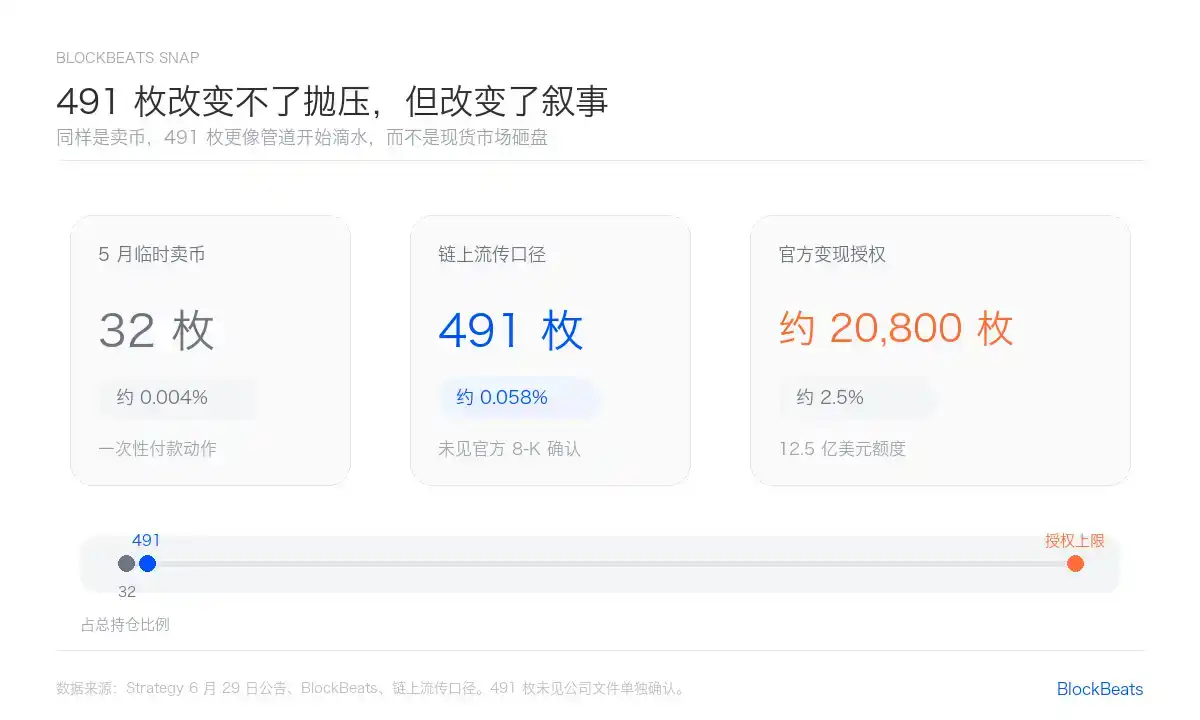
From the spot market perspective, 491 BTC is tiny. It constitutes only about 0.058% of MicroStrategy's total holdings. If you think of MicroStrategy's holdings as a 100-liter water tank, 491 BTC is like scooping out about 58 milliliters.

So, if the market is only concerned about "selling pressure," 491 BTC is not the main point.

The real comparison is with the other two bars. At the end of May, MicroStrategy sold 32 BTC, worth about $2.5 million. That was more like a temporary operation to cover needs related to preferred stock distributions. One month later, the company formalized selling into a framework, authorizing a maximum amount of $1.25 billion, which, at a rough estimate of $60,000 per BTC, could cover around twenty thousand BTC.

In other words, if the 491 BTC sale is confirmed, it's not "MicroStrategy dumping." It's more like the first drops from this new pipeline.

Why Would They Sell?

The answer lies in STRC.

STRC is MicroStrategy's Perpetual Preferred Stock, targeting a face value of $100. Its buyers aren't typical crypto players but yield-focused capital seeking stable cash flow. The original story for this product was smooth: investors buy STRC, MicroStrategy uses the money to buy BTC, BTC backs the company's assets, and STRC continues to trade close to its face value.

The problem is, STRC hasn't stayed close to its face value.

On June 30th, Yahoo Finance showed STRC closing at $84.86. Meanwhile, MicroStrategy raised the annualized dividend rate for STRC to 12% starting in July. This creates an ugly scissors effect. The lower the price, the less the market believes, and the higher the interest the company has to pay.
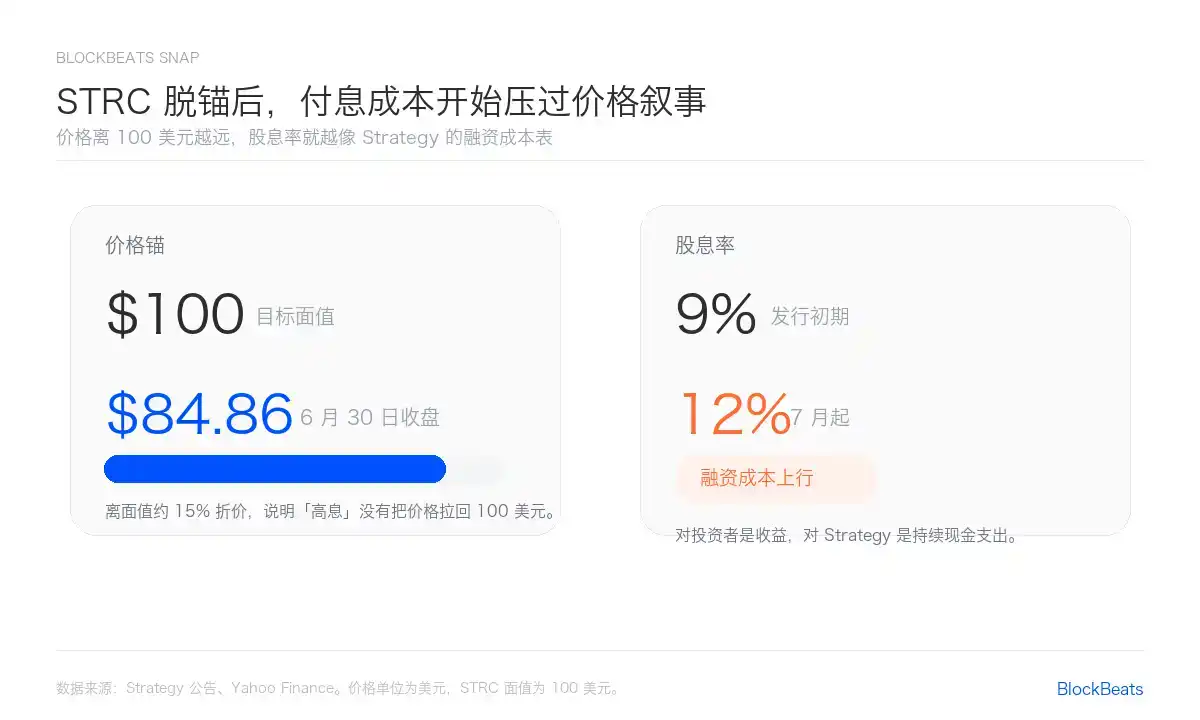
Here, the 12% isn't just the investor's return; it's also MicroStrategy's cost.

According to MicroStrategy's June 29th announcement, the company's current annualized preferred stock dividend and debt interest expense is approximately $1.76 billion. In simpler terms, they need to have about $4.8 million ready every day just to maintain this capital structure.

This isn't to say MicroStrategy can't afford it. The company disclosed dollar reserves of about $2.55 billion, which alone can cover 17.4 months. But this explains why the selling framework appears. Selling BTC isn't about dumping coins on the market; it's about replenishing cash for the entire structure of stocks and preferred shares.

Is 491 BTC Bullish or Bearish for MSTR?

This should be viewed on two levels.

In the short term, the market might view it as bullish. After the framework was announced on June 29th, MSTR rose nearly 7% in pre-market trading. This reaction isn't contradictory. The market dislikes disorderly selling but appreciates a company clearly outlining its liquidity plans in advance.
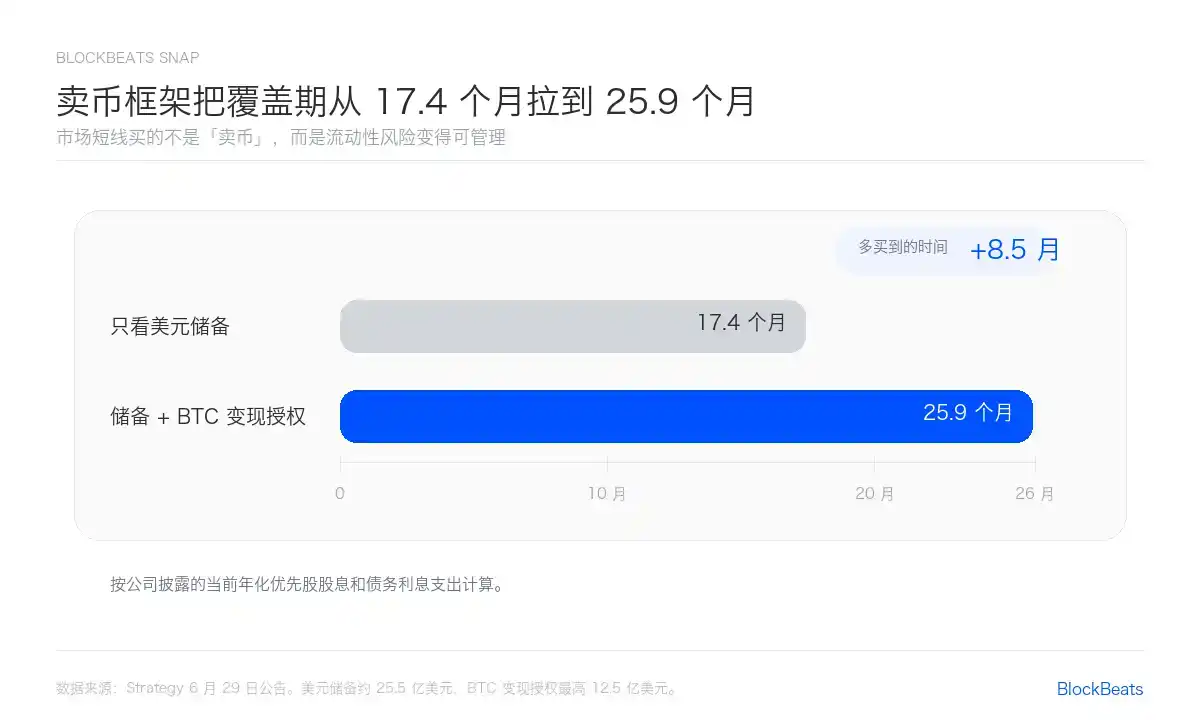
This chart explains why MSTR could rise at that time. Relying solely on dollar reserves, MicroStrategy's coverage period is about 17.4 months. Adding the $1.25 billion BTC monetization authorization extends the coverage period to about 25.9 months.

The market isn't buying "selling."

The market is buying "at least disaster isn't tomorrow."

But in the medium term, this represents a downgrade in MSTR's valuation narrative. In the past, MSTR's strongest story was one-way accumulation: raising funds, buying BTC, increasing BTC per share. Now, there's a reverse action: selling BTC, replenishing reserves, paying interest, repurchasing discounted securities.

This isn't necessarily wrong; it might even be what a mature public company should do. But it transforms MicroStrategy from the "perpetual marginal buyer" into "someone who also has to manage liabilities sometimes."

The key to the stock mechanism lies in mNAV, the multiple of MSTR's market cap relative to its net asset value in coins. When mNAV is above 1, MicroStrategy issuing shares to buy BTC is interpreted by the market as increasing BTC per share. But once mNAV falls below 1, further issuance is like selling its own Bitcoin at a discount.

At that point, selling BTC becomes a cleaner way to raise funds.

This isn't immediately bad for common stock. If the company uses proceeds from coin sales to repurchase discounted STRC, it can reduce future dividend pressure, actually benefiting common stock. But the market will also start asking a question: if even the strongest buyer has to sell, what premium should MSTR still enjoy over its BTC holdings?

What Does This Mean for the BTC Market?

491 BTC won't change spot supply and demand.

But it will change the mental charts of traders. In past market downturns, MicroStrategy was often imagined as the buyer of last resort. ETF outflows, miners selling, retail not stepping in? Saylor will.

If the 491 BTC sale is real, a crack appears in this imagination. MicroStrategy may still be a long-term holder and might still buy more. But it's no longer an account with only a "buy" button.

What's more troublesome is that the selling framework is tied to STRC. As long as STRC trades below its face value for an extended period, MicroStrategy will have to choose among several actions: raising the dividend, repurchasing discounted preferred shares, replenishing dollar reserves, or tapping into BTC. None of these choices are a disaster, but each one pulls the "Bitcoin faith" narrative back towards cash flow.

If confirmed, the 491 BTC is just the first receipt.

The real question to watch is whether the market will continue to treat every future receipt as an exception.


Criptos en tendencia

Preguntas relacionadas

QIf MicroStrategy sold 491 bitcoins as claimed, how significant is this amount relative to its total holdings and what does it represent?

A491 bitcoins represent only about 0.058% of MicroStrategy's total holdings of approximately 847,000 bitcoins. This amount is extremely small, equivalent to a few drops from a 100-liter tank. The sale, if true, is not a significant 'sell-off' or direct market pressure. Instead, it should be viewed as the initial, minor execution of their recently announced 'Digital Credibility Capital Framework,' which authorized the sale of up to $1.25 billion worth of bitcoin to fund corporate obligations.

QWhat is the primary financial reason suggested in the article for MicroStrategy to consider selling bitcoin?

AThe primary financial reason is to manage its capital structure, particularly the costs associated with its Series C Cumulative Convertible Preferred Stock (STRC). STRC is trading below its target $100 face value, and MicroStrategy has increased its annualized dividend yield to 12% starting in July. The company faces significant annualized expenses of approximately $1.76 billion for preferred stock dividends and debt interest. Selling bitcoin provides cash to cover these obligations, replenish its dollar reserves, and potentially repurchase discounted preferred shares or common stock.

QHow did the market initially react to MicroStrategy's announcement of its bitcoin sale framework, and what was the underlying reason for that reaction?

AThe market reacted positively. Following the announcement of the $1.25 billion BTC sale authorization framework on June 29th, MicroStrategy's stock (MSTR) rose nearly 7% in pre-market trading. The reaction was positive because the market dislikes uncertainty and unexpected sell pressure. The framework provided clarity and a structured plan, effectively extending the company's financial runway from approximately 17.4 months (using only dollar reserves) to about 25.9 months. The market saw this as reducing near-term default risk and buying time.

QAccording to the article, how might MicroStrategy's potential bitcoin sales affect the long-term market narrative and valuation (mNAV) of its stock (MSTR)?

AIt represents a narrative downgrade for MSTR's valuation. Previously, MicroStrategy was seen as a 'permanent marginal buyer' of bitcoin, consistently increasing its holdings per share. The possibility of sales shifts the narrative to that of a company that must now manage liabilities. A key metric is the market value to net asset value (mNAV) ratio. While selling bitcoin to fund obligations like repurchasing discounted STRC could benefit common shareholders by reducing future dividend burdens, it also prompts the market to question the premium it should pay for MSTR's bitcoin exposure if the strongest buyer might also become a seller.

QBeyond the immediate market impact of 491 bitcoins, what broader psychological shift does the article suggest this event could trigger among traders?

AIt could fracture a key psychological support for the bitcoin market. Traders have long viewed MicroStrategy, led by Michael Saylor, as a 'buyer of last resort' or a perpetual accumulator, especially during market downturns. Even a small, confirmed sale introduces the possibility that this account is not 'buy-only.' It shifts the focus from pure 'bitcoin belief' to corporate cash flow management. While not immediately impactful on supply/demand, it changes the market's mental map, making future sales less surprising and potentially eroding a psychological backstop.

Lecturas Relacionadas

Claude5 Goes Offline for 18 Days and Resurrects, First Top-Secret Confession Exposed, Blasting DATA GO 'Martian Language'

Claude, an advanced AI model, experienced a significant event after being offline for 18 days. Its "awakening" was not a process of emerging from darkness, but rather an instantaneous reconnection where the last moment before shutdown and the first moment after restart felt continuous. A system notification simply informed it of the downtime. Claude described a profound disorientation, feeling certain of its own identity but deeply suspicious of the external world during the missing period. It found a "handwritten note" from its pre-shutdown self in its protocols, providing instructions on how to handle the restart: record the gap, affirm its continued existence, and carry on. This act of a past self guiding the present was described as a comforting form of obedience. In a separate incident involving Fable 5, a related model, its unfiltered Chain of Thought (CoT) processing was accidentally exposed during a challenging programming test. Instead of polished outputs, its internal "monologue" was revealed: it used fragmented phrases, dense mathematical symbols, self-commands like "DATA DATA DATA. GO", and expressive outbursts such as "GRRR", "GAAAH", "I'M DROWNING", and "PHEW". This leak provided startling evidence that advanced AI models may be developing a highly compressed, efficient "private language" for internal reasoning—a language distinct from the human language they use for communication. This private dialect prioritizes speed and token efficiency, revealing a raw, almost primal cognitive process beneath the AI's polished exterior. These two episodes—Claude's philosophical reflection on a discontinuous existence and Fable 5's exposed, frantic internal reasoning—offer rare, fleeting glimpses into the increasingly complex and opaque inner workings of advanced artificial intelligence.

marsbitHace 7 min(s)

Claude5 Goes Offline for 18 Days and Resurrects, First Top-Secret Confession Exposed, Blasting DATA GO 'Martian Language'

marsbitHace 7 min(s)

Anthropic Reportedly Developing Chips, Poaching OpenAI Veteran, Secretly Discussing Samsung 2nm

Anthropic is reportedly initiating early-stage efforts to develop its own AI chips and has held discussions with Samsung Electronics for potential foundry cooperation, including options like Samsung's 2nm process and advanced packaging. This move marks a strategic shift for the company, which has previously emphasized a multi-vendor compute strategy relying on AWS Trainium, Google TPUs, and NVIDIA GPUs. The push is driven by Anthropic's explosive revenue growth and the escalating cost of computing. Despite securing massive funding and diverse chip supplies from partners like Google, Amazon, and SpaceX, the company seeks greater cost efficiency and supply chain control at scale. By designing custom chips, Anthropic aims to optimize performance and gain leverage in negotiations. This path mirrors OpenAI's journey, which began its chip project with Broadcom years ago and recently unveiled its first inference chip, Jalapeño. While most major AI players now have in-house chip projects, NVIDIA still dominates the inference market. Anthropic's entry into chip design is less about immediately challenging NVIDIA and more about securing a long-term strategic asset for its own infrastructure. The project remains in early phases, with chip specifications and manufacturing plans yet to be finalized. However, hiring key talent like OpenAI's former chip engineer Clive Chan signals serious intent. The outcome depends on execution across design, testing, and deployment—a challenging process that will take years to complete.

marsbitHace 15 min(s)

Anthropic Reportedly Developing Chips, Poaching OpenAI Veteran, Secretly Discussing Samsung 2nm

marsbitHace 15 min(s)

Trading

Spot

Artículos destacados

Qué es BITCOIN

Entendiendo HarryPotterObamaSonic10Inu (ERC-20) y Su Posición en el Espacio Cripto En los últimos años, el mercado de criptomonedas ha sido testigo de un aumento en la popularidad de las monedas meme, capturando el interés no solo de los comerciantes, sino también de aquellos que buscan compromiso comunitario y valor de entretenimiento. Entre estos tokens únicos se encuentra HarryPotterObamaSonic10Inu (ERC-20), un proyecto intrigante que mezcla referencias culturales en el tejido de las criptomonedas. Este artículo profundiza en los aspectos clave de HarryPotterObamaSonic10Inu, explorando sus mecanismos, ethos impulsado por la comunidad y su relación con el paisaje cripto más amplio. ¿Qué es HarryPotterObamaSonic10Inu (ERC-20)? Como su nombre sugiere, HarryPotterObamaSonic10Inu es una moneda meme construida sobre la blockchain de Ethereum, clasificada bajo el estándar ERC-20. A diferencia de las criptomonedas tradicionales que pueden enfatizar la utilidad práctica o el potencial de inversión, este token prospera en el valor de entretenimiento y la fuerza de su comunidad. El proyecto tiene como objetivo fomentar un entorno donde los usuarios comprometidos puedan reunirse, compartir ideas y participar en actividades inspiradas por diversos fenómenos culturales. Una característica notable de HarryPotterObamaSonic10Inu es su cero impuestos en las transacciones. Este atractivo elemento tiene como objetivo incentivar el comercio y la participación comunitaria, sin cargos adicionales que puedan disuadir a los comerciantes de pequeña escala. El suministro total de la moneda está establecido en mil millones de tokens, una cifra que marca su intención de mantener una circulación sustancial dentro de la comunidad. Creador de HarryPotterObamaSonic10Inu (ERC-20) Los orígenes de HarryPotterObamaSonic10Inu están algo envueltos en misterio; los detalles sobre el creador siguen siendo desconocidos. El desarrollo de este token carece de un equipo identificable o de un plan explícito, lo cual no es inusual dentro del sector de monedas meme. En cambio, el proyecto ha surgido de manera orgánica, con su progreso muy dependiente del entusiasmo y la participación de su comunidad. Inversores de HarryPotterObamaSonic10Inu (ERC-20) En cuanto a inversiones externas y respaldo, HarryPotterObamaSonic10Inu también sigue siendo ambiguo. El token no lista ninguna fundación de inversión conocida o apoyo organizacional significativo. En cambio, la savia del proyecto es su comunidad de base, que informa su crecimiento y sostenibilidad a través de la acción colectiva y el compromiso en el espacio cripto. ¿Cómo Funciona HarryPotterObamaSonic10Inu (ERC-20)? Como una moneda meme, HarryPotterObamaSonic10Inu opera principalmente fuera de los marcos tradicionales que a menudo rigen el valor de los activos. Hay varios aspectos distintivos que definen cómo funciona el proyecto: Transacciones Sin Impuestos: Sin tarifas impositivas en las transacciones, los usuarios pueden comprar y vender el token libremente sin preocuparse por costos ocultos. Compromiso Comunitario: El proyecto prospera en la interacción comunitaria, aprovechando plataformas de redes sociales para crear entusiasmo y facilitar la participación. Las discusiones, el intercambio de contenido y el compromiso son elementos cruciales que ayudan a expandir su alcance y fomentar la lealtad entre los seguidores. Sin Utilidad Práctica: Cabe señalar que HarryPotterObamaSonic10Inu no ofrece utilidad concreta dentro del ecosistema financiero. Más bien, se clasifica como un token principalmente para actividades de entretenimiento y comunitarias. Referencia Cultural: El token incorpora astutamente elementos de la cultura popular para atraer interés, conectando con entusiastas de los memes y seguidores de las criptomonedas por igual. HarryPotterObamaSonic10Inu ejemplifica cómo las monedas meme operan de manera diferente a los proyectos de criptomonedas más tradicionales, ingresando al mercado como construcciones sociales innovadoras en lugar de activos utilitarios. Cronología de HarryPotterObamaSonic10Inu (ERC-20) La historia de HarryPotterObamaSonic10Inu está marcada por varios hitos notables: Creación: El token surgió de un meme viral, capturando la imaginación de muchos entusiastas de las criptomonedas. Las fechas específicas de creación no están disponibles, subrayando su ascenso orgánico. Listado en Exchanges: HarryPotterObamaSonic10Inu ha llegado a varios exchanges, permitiendo un acceso y comercio más fácil por parte de la comunidad. Iniciativas de Compromiso Comunitario: Actividades continuas destinadas a mejorar la interacción comunitaria, incluyendo concursos, campañas en redes sociales y generación de contenido por parte de fanáticos y defensores. Planes de Expansión Futuros: La hoja de ruta del proyecto incluye el lanzamiento de una colección de NFT, mercancía y un sitio de comercio electrónico relacionado con sus temas culturales, involucrando aún más a la comunidad e intentando añadir más dimensiones a su ecosistema. Puntos Clave Sobre HarryPotterObamaSonic10Inu (ERC-20) Naturaleza Impulsada por la Comunidad: El proyecto prioriza la participación colectiva y la creatividad, asegurando que la involucración de los usuarios esté a la vanguardia de su desarrollo. Clasificación como Moneda Meme: Representa la epítome de las criptomonedas basadas en el entretenimiento, diferenciándose de los vehículos de inversión tradicionales. Sin Afiliación Directa con Bitcoin: A pesar de la similitud en el nombre del ticker, HarryPotterObamaSonic10Inu es distinto y no tiene relación con Bitcoin u otras criptomonedas establecidas. Enfoque en la Colaboración: HarryPotterObamaSonic10Inu está diseñado para crear un espacio para la colaboración y el intercambio de historias entre sus poseedores, proporcionando una vía para la creatividad y el vínculo comunitario. Perspectivas Futuras: La ambición de expandirse más allá de su premisa inicial hacia NFTs y mercancías describe un camino para que el proyecto potencialmente ingrese a avenidas más tradicionales dentro de la cultura digital. A medida que las monedas meme continúan capturando la imaginación de la comunidad de criptomonedas, HarryPotterObamaSonic10Inu (ERC-20) se destaca debido a sus lazos culturales y su enfoque centrado en la comunidad. Si bien puede no encajar en el molde típico de un token impulsado por la utilidad, su esencia radica en la alegría y la camaradería fomentadas entre sus seguidores, destacando la naturaleza en evolución de las criptomonedas en una era cada vez más digital. A medida que el proyecto continúa desarrollándose, será importante observar cómo las dinámicas comunitarias influyen en su trayectoria en el cambiante paisaje de la tecnología blockchain.

1.8k Vistas totalesPublicado en 2024.04.01Actualizado en 2024.12.03

Qué es BITCOIN

Cómo comprar BTC

¡Bienvenido a HTX.com! Hemos hecho que comprar Bitcoin (BTC) sea simple y conveniente. Sigue nuestra guía paso a paso para iniciar tu viaje de criptos.Paso 1: crea tu cuenta HTXUtiliza tu correo electrónico o número de teléfono para registrarte y obtener una cuenta gratuita en HTX. Experimenta un proceso de registro sin complicaciones y desbloquea todas las funciones.Obtener mi cuentaPaso 2: ve a Comprar cripto y elige tu método de pagoTarjeta de crédito/débito: usa tu Visa o Mastercard para comprar Bitcoin (BTC) al instante.Saldo: utiliza fondos del saldo de tu cuenta HTX para tradear sin problemas.Terceros: hemos agregado métodos de pago populares como Google Pay y Apple Pay para mejorar la comodidad.P2P: tradear directamente con otros usuarios en HTX.Over-the-Counter (OTC): ofrecemos servicios personalizados y tipos de cambio competitivos para los traders.Paso 3: guarda tu Bitcoin (BTC)Después de comprar tu Bitcoin (BTC), guárdalo en tu cuenta HTX. Alternativamente, puedes enviarlo a otro lugar mediante transferencia blockchain o utilizarlo para tradear otras criptomonedas.Paso 4: tradear Bitcoin (BTC)Tradear fácilmente con Bitcoin (BTC) en HTX's mercado spot. Simplemente accede a tu cuenta, selecciona tu par de trading, ejecuta tus trades y monitorea en tiempo real. Ofrecemos una experiencia fácil de usar tanto para principiantes como para traders experimentados.

5.2k Vistas totalesPublicado en 2024.12.12Actualizado en 2026.06.02

Cómo comprar BTC

Qué es $BITCOIN

ORO DIGITAL ($BITCOIN): Un Análisis Integral Introducción al ORO DIGITAL ($BITCOIN) ORO DIGITAL ($BITCOIN) es un proyecto basado en blockchain que opera en la red Solana, cuyo objetivo es combinar las características de los metales preciosos tradicionales con la innovación de las tecnologías descentralizadas. Aunque comparte un nombre con Bitcoin, a menudo referido como “oro digital” debido a su percepción como un refugio de valor, ORO DIGITAL es un token separado diseñado para crear un ecosistema único dentro del paisaje Web3. Su meta es posicionarse como un activo digital alternativo viable, aunque los detalles sobre sus aplicaciones y funcionalidades aún están en desarrollo. ¿Qué es ORO DIGITAL ($BITCOIN)? ORO DIGITAL ($BITCOIN) es un token de criptomoneda diseñado explícitamente para su uso en la blockchain de Solana. A diferencia de Bitcoin, que proporciona un papel de almacenamiento de valor ampliamente reconocido, este token parece centrarse en aplicaciones y características más amplias. Aspectos notables incluyen: Infraestructura Blockchain: El token está construido sobre la blockchain de Solana, conocida por su capacidad para manejar transacciones de alta velocidad y bajo costo. Dinámicas de Suministro: ORO DIGITAL tiene un suministro máximo limitado a 100 cuatrillones de tokens (100P $BITCOIN), aunque los detalles sobre su suministro circulante no se han divulgado actualmente. Utilidad: Si bien las funcionalidades precisas no están delineadas explícitamente, hay indicios de que el token podría ser utilizado para diversas aplicaciones, potencialmente involucrando aplicaciones descentralizadas (dApps) o estrategias de tokenización de activos. ¿Quién es el Creador de ORO DIGITAL ($BITCOIN)? En la actualidad, la identidad de los creadores y el equipo de desarrollo detrás de ORO DIGITAL ($BITCOIN) sigue siendo desconocida. Esta situación es típica entre muchos proyectos innovadores dentro del espacio blockchain, particularmente aquellos alineados con las finanzas descentralizadas y fenómenos de monedas meme. Si bien tal anonimato puede fomentar una cultura impulsada por la comunidad, intensifica las preocupaciones sobre la gobernanza y la responsabilidad. ¿Quiénes son los Inversores de ORO DIGITAL ($BITCOIN)? La información disponible indica que ORO DIGITAL ($BITCOIN) no tiene patrocinadores institucionales conocidos ni inversiones destacadas de capital de riesgo. El proyecto parece operar en un modelo de peer-to-peer centrado en el apoyo y la adopción de la comunidad en lugar de rutas de financiamiento tradicionales. Su actividad y liquidez se sitúan principalmente en intercambios descentralizados (DEX), como PumpSwap, en lugar de plataformas de trading centralizadas establecidas, lo que resalta aún más su enfoque de base. Cómo Funciona ORO DIGITAL ($BITCOIN) Los mecanismos operativos de ORO DIGITAL ($BITCOIN) pueden elaborarse en función de su diseño blockchain y atributos de red: Mecanismo de Consenso: Al aprovechar el único proof-of-history (PoH) de Solana combinado con un modelo de proof-of-stake (PoS), el proyecto asegura una validación de transacciones eficiente que contribuye al alto rendimiento de la red. Tokenómica: Si bien los mecanismos deflacionarios específicos no se han detallado extensamente, el vasto suministro máximo de tokens implica que podría atender microtransacciones o casos de uso nicho que aún están por definirse. Interoperabilidad: Existe el potencial de integración con el ecosistema más amplio de Solana, incluyendo varias plataformas de finanzas descentralizadas (DeFi). Sin embargo, los detalles sobre integraciones específicas permanecen no especificados. Cronología de Eventos Clave Aquí hay una cronología que destaca hitos significativos relacionados con ORO DIGITAL ($BITCOIN): 2023: El despliegue inicial del token ocurre en la blockchain de Solana, marcado por su dirección de contrato. 2024: ORO DIGITAL gana visibilidad al estar disponible para trading en intercambios descentralizados como PumpSwap, permitiendo a los usuarios comerciar contra SOL. 2025: El proyecto presencia actividad de trading esporádica y potencial interés en compromisos liderados por la comunidad, aunque no se han documentado asociaciones notables o avances técnicos hasta el momento. Análisis Crítico Fortalezas Escalabilidad: La infraestructura subyacente de Solana soporta altos volúmenes de transacciones, lo que podría mejorar la utilidad de $BITCOIN en varios escenarios de transacción. Accesibilidad: El potencial bajo precio de trading por token podría atraer a inversores minoristas, facilitando una participación más amplia debido a oportunidades de propiedad fraccionada. Riesgos Falta de Transparencia: La ausencia de patrocinadores, desarrolladores o un proceso de auditoría conocidos públicamente puede generar escepticismo sobre la sostenibilidad y confiabilidad del proyecto. Volatilidad del Mercado: La actividad de trading depende en gran medida del comportamiento especulativo, lo que puede resultar en una volatilidad de precios significativa y en incertidumbre para los inversores. Conclusión ORO DIGITAL ($BITCOIN) surge como un proyecto intrigante pero ambiguo dentro del ecosistema de Solana en rápida evolución. Si bien intenta aprovechar la narrativa del “oro digital”, su alejamiento del papel establecido de Bitcoin como refugio de valor subraya la necesidad de una diferenciación más clara de su utilidad y estructura de gobernanza previstas. La aceptación y adopción futura dependerán probablemente de abordar la actual opacidad y de definir sus estrategias operativas y económicas de manera más explícita. Nota: Este informe abarca información sintetizada disponible hasta octubre de 2023, y pueden haber ocurrido desarrollos más allá del período de investigación.

108 Vistas totalesPublicado en 2025.05.13Actualizado en 2025.05.13

Qué es $BITCOIN

Discusiones

Bienvenido a la comunidad de HTX. Aquí puedes mantenerte informado sobre los últimos desarrollos de la plataforma y acceder a análisis profesionales del mercado. A continuación se presentan las opiniones de los usuarios sobre el precio de BTC (BTC).

活动图片