By Bo Yang, Tencent Tech
Anthropic is building its own chip, and like Musk, has chosen Samsung over TSMC.
The Information, citing three informed sources, reported that Anthropic has initiated early-stage work on a self-developed AI chip and is in discussions with Samsung to manufacture this chip using Samsung's most advanced 2-nanometer process and packaging technology.
The aforementioned sources said that Anthropic is also defining the chip's functions, performance metrics, and its integration scheme within servers or clusters. Currently, the company has begun discussions with several design service providers, but it is far from the detailed design, testing, and mass production stages. The sources also cautioned that Anthropic could still abandon the project midway.
Public information shows that Anthropic's chip team has begun forming. For instance, on June 9th, the company poached Clive Chan, an early member of OpenAI's custom chip team.
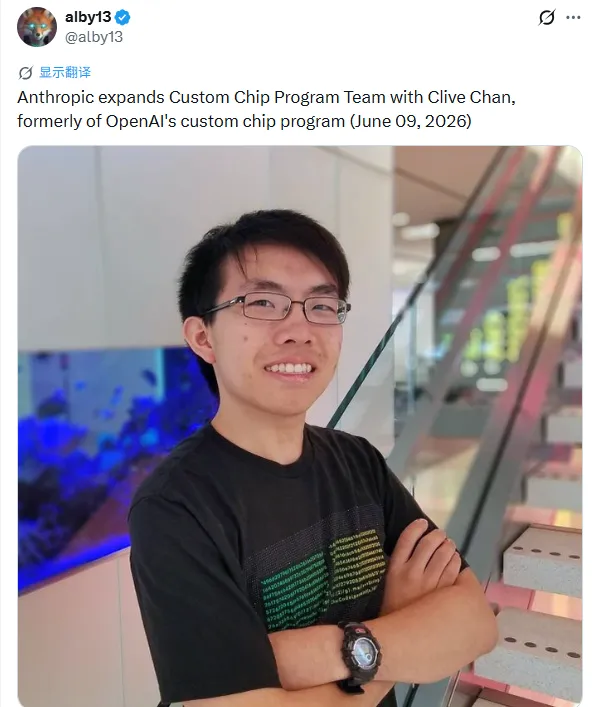
Clive Chan, an early member of OpenAI's custom chip team, has joined Anthropic
Anthropic has been extremely cautious in its external statements regarding self-developed chips, only emphasizing that future computing power expansion will still primarily rely on AWS's Trainium, Google's TPU, and NVIDIA's GPUs, while declining to comment on its own chip roadmap.
In fact, rumors about Anthropic's plans to develop its own chip emerged months ago. Reuters reported in April that Claude's computational demands were growing too rapidly, outpacing available computing power, leading Anthropic to consider building its own chips. However, at that time, it was just a preliminary consideration. Now, it appears the matter has moved a step forward.
It should be noted that the disclosure of Anthropic's entry into chip-making coincides with a two-day plunge in global semiconductor stocks. The Philadelphia Semiconductor Index fell nearly 12% over two sessions, its largest drop since June 5th. Memory chip stocks were hit particularly hard, with Samsung Electronics falling 9.1% and SanDisk dropping 14.1% overnight.
01 A Foreshadowing from a Funding Round, and Samsung Foundry's Breakout Battle
Samsung becoming Anthropic's partner is not surprising.
In May of this year, Anthropic completed a $650 billion Series H funding round, with Samsung Electronics participating as a strategic investor, alongside other memory chip giants SK Hynix and Micron Technology.
At that time, memory chip supply was tight, forcing consumer electronics manufacturers like Apple to raise prices. A direct benefit of this investment was binding Anthropic to the chip suppliers critical to its growth.
But Samsung's calculations extend beyond financial returns.
The company is a king in the memory chip sector, but has consistently lagged behind TSMC in the foundry business. TSMC's advanced production lines remain the industry standard for cutting-edge AI chips, but the current demand for AI chips is straining TSMC's capacity. This provides Samsung an opportunity to win customers with its 2nm technology.
According to The Information, Google is already considering having Samsung manufacture some of its future TPUs. If Samsung can also secure Anthropic, it would be a significant victory for its foundry business.
Two informed sources revealed that Anthropic is evaluating Samsung's 2nm manufacturing process and advanced packaging facilities. "2nm" is one of the most advanced chip manufacturing technologies, making processors denser and more energy-efficient. Advanced packaging places the main processor closer to high-speed memory, allowing data to travel faster within the chip.
Samsung is NVIDIA's manufacturing partner for HBM memory and LPU chips; conversely, Samsung relies on NVIDIA's software for chip production. The two companies are jointly building an AI chip factory in South Korea. If Anthropic joins the customer list, Samsung gains another chip in its efforts to catch up to TSMC in advanced process nodes.
Samsung's confidence in courting Anthropic is backed by South Korea's national-level bet on the semiconductor industry.
The South Korean government recently announced a decade-long investment plan led by the Samsung Group (Samsung Electronics' parent company) and SK Group (SK Hynix's parent company), with a combined investment of $518 billion to build four memory chip factories in South Korea.
Samsung alone announced on July 2nd an investment plan for the Chungcheong region exceeding 140 trillion won, approximately $90 billion. Under this plan, Samsung Electronics will build next-generation HBM production bases in Cheongju and Wonyang, adding five production lines. Since the AI boom, HBM has been in short supply; expansion could increase Samsung's revenue by tens of billions of dollars in the coming years. Samsung Electro-Mechanics is also expanding AI server packaging substrate capacity in Sejong City while simultaneously investing in advanced packaging technology R&D.
By participating in Anthropic's funding round, Samsung is betting on becoming the latter's long-term hardware partner.
02 Inference Chips: A Breakthrough Point for a Costly Cycle
Anthropic's first 2nm chip, like OpenAI's, is expected to focus on inference.
Custom inference chips would allow Anthropic's models to run faster, consume less power, reduce cloud bills, and be specifically hardware-optimized for Claude.
Previously, OpenAI selected Broadcom to design an inference chip codenamed "Jalapeño," aiming to run large language models more efficiently. OpenAI claimed the chip is more energy-efficient with better performance per watt than competitors.
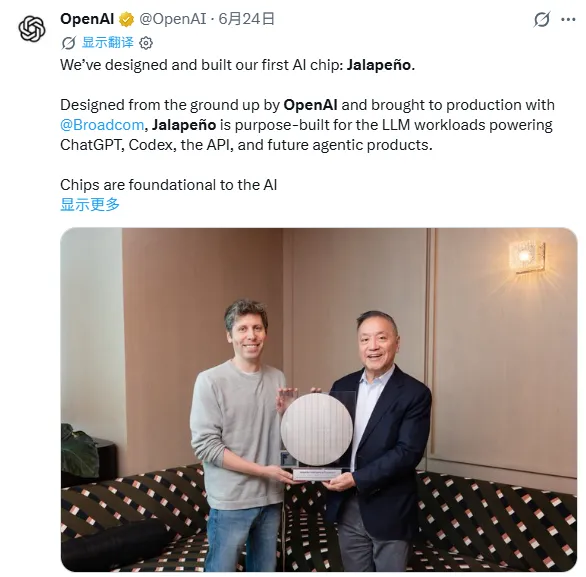
OpenAI partners with Broadcom to design an inference chip codenamed "Jalapeño"
Google has TPU, Amazon has Trainium, Microsoft has Maia, and Meta is also working on its own. Anthropic is almost the last major AI lab still fully reliant on others' chips. The allure of autonomy in this area is too strong.
In February of this year, Anthropic CEO Dario Amodei, in an interview with podcast host Dwarkesh Patel, discussed the logic behind compute strategy.
Amodei said: "If I assume revenue continues to grow 10x per year, then by the end of 2026 it's $100 billion, and by the end of 2027 it's $1 trillion. I could order $1 trillion worth of compute based on that. But what if I'm wrong? What if the growth multiplier is 5x instead of 10x? If revenue in 2027 is only $800 billion instead of $1 trillion, then I'm bankrupt. No hedge can save me."
Therefore, Amodei must find a balance for Anthropic: purchase enough compute to handle high-growth scenarios, but avoid over-expansion to the point where a slowdown in growth would crush the company under its upfront investments.
Amodei revealed that the global compute capacity built this year is roughly 10 to 15 gigawatts, approximately tripling annually. By 2028 or 2029, the industry's annual compute investment will reach several trillion dollars. He believes this is the trend the industry is following.
Developing its own chip is like raising the stakes in this gamble.
On one hand, any efficiency gain in inference from a self-developed chip can save substantial costs across clusters at the gigawatt scale. On the other hand, when everyone is scrambling for processors, data centers, and power, having its own chip provides extra leverage in negotiations.
03 Supply Chain "Nesting Doll": Who Depends on Whom?
Anthropic desires chip independence, but this web is becoming increasingly intricate.
Programmer Benny Lam pointed out a phenomenon on social media: every US AI lab is collaborating with Asian foundries for custom chips. The result is not independence but tighter entanglement of the supply chain.
Anthropic needs Samsung's fabs to reduce reliance on NVIDIA. NVIDIA needs Samsung's fabs to meet its expanding capacity demands. And Samsung needs to retain both major customers simultaneously to keep its foundry business competitive against TSMC.
The three are bound together; none can leave the others.
Lam commented that the trend towards custom chips was supposed to give AI labs more independence, but each new collaboration between a US lab and an Asian foundry makes this network denser and harder to disentangle.
Tech blogger Vaibhav Sisinty also noted Samsung's unique role in this chess game.
He wrote that Samsung's investment in Anthropic's $650 billion funding round wasn't just for financial returns. Samsung is a chip manufacturer, memory supplier, advanced packaging factory. Its investment bets on becoming Anthropic's hardware partner. With millions of queries daily, Anthropic pays for compute resources each time—its bill is astronomical. Whoever controls its own inference chip controls its scaling speed and cost.
04 NVIDIA's Fortress Remains Formidable
Designing a competitive AI chip is extremely complex. Architecture, software, manufacturing, testing, large-scale deployment—each step requires significant time. Anthropic cannot abandon its current hardware partners in the short term.
Looking at Anthropic's current compute layout, its strategy is clear. The company has consistently adhered to a multi-cloud leasing approach, unlike OpenAI or xAI which have individually tied themselves to NVIDIA hardware. It uses chips from Amazon, Google, and NVIDIA, and is negotiating chip cooperation with Microsoft and the UK startup Fractile.
Anthropic's ties with Amazon and Google are particularly deep.
In April 2026, Anthropic expanded its collaboration with AWS, committing to invest over $100 billion in the next decade, securing 5 gigawatts of new compute capacity, including custom chips like Trainium2, Trainium3, and Trainium4. Amazon's cumulative investment in Anthropic has reached tens of billions of dollars.
Simultaneously, Anthropic signed long-term agreements with Google and Broadcom to secure approximately 3.5 gigawatts of next-generation TPU compute starting in 2027. Previously in 2025, the two parties had already signed agreements worth hundreds of billions of dollars, involving millions of TPUs and over 1 gigawatt of capacity.
Claude is also one of the few frontier models simultaneously available on AWS, Google Cloud, and Azure.
And that's not all. In May 2026, Anthropic leased the entire capacity of the SpaceX Colossus 1 compute cluster from xAI.
Located in a Memphis data center, this cluster houses over 220,000 NVIDIA GPUs, consuming over 300 megawatts of power, with a monthly rent of approximately $1.25 billion. The total contract value is hundreds of billions of dollars, running until around 2029. The two parties have even discussed deploying multi-gigawatt compute capacity in orbit.
Wide-ranging deployment and multi-vendor parallelism is Anthropic's way of spreading risk.
But for now, NVIDIA remains the house in this game. According to The Information's estimates, despite the ongoing financing and design activities in the inference chip market, NVIDIA's market share has actually risen to 74% in recent years. CEO Jensen Huang consistently asserts that NVIDIA's chips are more efficient than any alternative for inference tasks.