When dozens of people speak simultaneously in your ear, it's likely very difficult to distinguish what each one is saying.
It's the same for mobile phones. But the difference is, mobile phones can precisely filter out the specific "sounds" they want to hear using built-in RF filters.
The RF filter, a seemingly insignificant small component, is actually one of the most critical devices in a mobile phone's RF front-end. As 5G phones support an increasing number of frequency bands, the wireless signals a single phone needs to handle become more complex, placing higher demands on both the quantity and quality of RF filters.
In 2025, the global RF front-end chip market size is about 44 billion USD, approximately 314.3 billion RMB; the Chinese market is about 115 billion RMB, already accounting for about 36% of the global market. However, the share truly belonging to Chinese manufacturers is only about 10%—the combined revenue of six major domestic RF front-end companies in 2025 is about 12 billion RMB, a mere 10.5% of the Chinese market. The vast majority of market share is taken by American, Japanese, and Korean companies.
Within the RF front-end, filters represent an even more tempting "bone".
According to Yole data, the global mobile terminal RF filter market was about 7.35 billion USD in 2022, growing to about 9.2 billion USD in 2025, with an average annual growth rate close to 8%. Within this, the BAW filter market size has already reached about 3.2 billion USD, accounting for over 30% of the entire filter market, and is expected to maintain double-digit growth for the next several years.
But a tempting bone is still a bone. The barriers to entry for BAW filters are particularly high, demanding strict requirements in materials, wafer manufacturing, thin-film processes, packaging, and yield. More troublesome is the fact that global industry leaders have established extremely deep patent barriers around these technologies. This means it's difficult for latecomers to develop products that bypass these patents, let alone achieve real mass production and commercialization.
MegaTech is a prime example. This domestic company, which has been working on RF filters for years, disclosed in this year's earnings briefing that due to continuous losses in its RF business, it has currently ceased investment in BAW products.
On one side is a nearly 10-billion-dollar filter market that is still growing rapidly; on the other, a domestic manufacturer with years of filter experience is suspending investment in BAW.
This may seem contradictory, but it precisely exposes the true cruelty of the BAW market: the market is huge but the barriers are high. Developing the technology is just the starting point; achieving mass production and maintaining competitiveness are the future challenges for survival in this industry.
Over the past few years, domestic BAW has been more about solving the problem of "whether we have it"; now, more and more companies are beginning to enter the stages of mass production, shipping, and competing for customers. Even among domestic companies themselves, patent and product competition is beginning to lead to lawsuits.
From "Almost Zero" to Domestic Companies Starting to Have "Something to Fight Over"
In June of this year, a patent lawsuit between domestic BAW companies brought the changes happening in this domestic industry to light.
On June 12th, Roos Micro announced that Wuhan Minsheng's BAW filters were suspected of infringing its Chinese patent No. ZL201010267632.6, and had already filed a lawsuit with the Shenzhen Intermediate People's Court. Wuhan Minsheng subsequently responded that it had not yet received relevant judicial documents and believed its products did not cover all technical features of the involved patent, thus not constituting infringement.
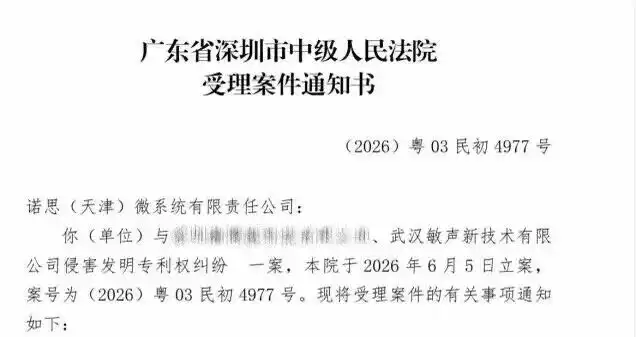
Roos Micro sues Wuhan Minsheng
Roos Micro is one of the domestic companies that started in BAW relatively early, focusing on R&D and industrialization of Bulk Acoustic Wave filters for a long time. Patent ZL201010267632.6 is one of its representative patents. This patent primarily involves a core component of BAW filters—a piezoelectric resonator, a technology that can relatively simply and effectively improve device performance. Its structure is typical and clear; if peers borrow this structure in their products, it is easily identifiable, leaving little room for argument.
This is not the first time Roos Micro has used this patent for litigation. Earlier this year, it sued another domestic BAW company, Aifoguangtong, alleging its C3f-type BAW resonator chips and series filter products were suspected of infringement. Even earlier, this patent was involved in a years-long patent dispute between Roos Micro, Apple, and Avago, which was ultimately settled in 2024, with a cross-license agreement reached for some Chinese patents.
Wuhan Minsheng, founded in 2019, though established later, has already achieved mass production of BAW filters, possesses an 8-inch production line, has over 20 mass-produced products, and supplies to more than 40 clients. By April 2026, Wuhan Minsheng had cumulatively shipped over 800 million RF filter chips, with applications ranging from mobile phones and tablets to IoT, networking base stations, and satellites/aerospace. Consider that it only cooperated with Silex Microsystems to build its 8-inch BAW production line around 2022, achieved mass production in July 2023, and reached 100 million shipments by the end of 2024—in less than two years, its shipment volume has increased eightfold.
Whether Wuhan Minsheng actually infringes is still to be determined. What's noteworthy is that with the large-scale entry of domestic BAW into mass production, BAW is no longer just a story of "domestic substitution," but has genuinely become an industry competition.
Changes in Technology Paths and the High Patent Wall
Behind this competition lies changes in the technological path of RF filters themselves.
Currently, the two most widely used acoustic filters in mobile phone RF front-ends are SAW and BAW. Simply put, SAW allows the acoustic wave to propagate along the material's surface, while BAW lets it propagate inside a thin-film structure. They utilize resonance characteristics at different frequencies to filter out the desired signals and suppress the unwanted ones.
In the past, SAW, with its mature process and lower cost, was the mainstay of mobile phone filters. However, with the advent of 4G, 5G, and even 6G, mobile phones need to support an increasing number of frequency bands, higher frequencies, and increasingly crowded signals. Traditional SAW started struggling to meet the requirements for high frequency, high bandwidth, and low loss simultaneously. This is when the importance of BAW filters began to emerge.
But the BAW filter industry has long been a "small but beautiful" and highly concentrated one. For a very long time, the global BAW filter market was essentially dominated by two American companies: Broadcom and Qorvo. QYResearch data shows that in 2024, just these two companies accounted for a combined 91% revenue share of the global BAW filter market; data for 2025 even indicates that Broadcom alone held about 84% of the global BAW market.
One of the most important reasons behind this high degree of industry monopoly is undoubtedly patent barriers.
In 2021, Qorvo taught latecomers a lesson with one lawsuit.
In October 2021, Qorvo sued the American BAW filter company Akoustis, accusing it of infringing BAW-related patents and misappropriating trade secrets. In May 2024, a U.S. jury overwhelmingly sided with Qorvo, finding Akoustis liable for patent infringement and willful, malicious misappropriation of trade secrets, awarding Qorvo approximately 38.59 million USD in damages.
That wasn't the end. The court later added attorney's fees and interest, bringing the total to over 57 million USD, while also issuing a permanent injunction against the involved products, prohibiting their manufacture, sale, or import into the United States.
For a company whose business is BAW filters, the massive damages were already hard to bear, but the inability to sell products was the final blow, directly leading to its bankruptcy months later. By 2025, most of Akoustis's core assets, including its BAW filter business, were purchased by a SpaceX-affiliated company for 30.2 million USD.
A single patent lawsuit brought down a BAW company that had been operating for over a decade. It's clear that patents are not only the foundation of this industry but also the most important weapon determining whether a company stays at the table.
This industrial landscape directly leads to another outcome—leading companies possess absolute pricing power. Even a super-client like Apple finds it difficult to hold a strong position against them.
In 2023, Apple was reported to be planning to gradually self-develop some of its RF chips. The market widely believed this was both an attempt by Apple to reduce supply chain dependency and a consideration to increase its bargaining power against Broadcom. Ultimately, however, Apple did not exclude Broadcom's FBAR filters from its supply chain; instead, it signed a multi-year agreement with Broadcom that year to continue purchasing 5G RF components, including FBARs.
By this year, this cooperation is deepening further. Apple and Broadcom have extended their partnership to 2031, with the new multi-year agreement expected to be worth over 30 billion USD. Broadcom will expand its RF component manufacturing capacity, including for FBAR filters, in the United States. Apple stated this would be its largest commitment to date under its U.S. manufacturing initiative.
The entire BAW industry, though under 10 billion USD, is a highly profitable business. Back in 2015, Broadcom (then Avago) was already selling large volumes of FBAR filters (one technical path for BAW) in its wireless communications business. Avago's overall gross margin that year reached 52%; meanwhile, Qorvo's overall gross margin for fiscal year 2026 reached 45.9%. Of course, both companies' businesses extend far beyond BAW filters, but this at least indicates that leading companies holding core RF technologies and high-value products indeed possess strong profitability.
For comparison, Murata, the most important Japanese manufacturer of SAW filters globally, has an overall operating profit margin of only 16.0%, while the operating profit margin for its SAW filter, RF module, and high-frequency communication module business is merely 1.4%.
Domestic BAW, Starting to Have Something to Fight Over
Looking back domestically, the development speed of domestic BAW in the past two years has been astonishing.
Consider that the overall domestic substitution rate for filters in 2024 was still around 10%-15%, with the rate for high-frequency (above 3GHz) products almost 0%. At that time, almost no domestic manufacturer had achieved shipments for high-frequency BAW filters. Even earlier, in 2021, among the U.S. sanctions against Huawei, key components including high-frequency filters were used as sanction tools.
But by today in 2026, a group of domestic players has emerged in BAW. Companies like Roos Micro, Wuhan Minsheng, Hantashang, Newsemi, and Kaiyuan Communication have already formed their own product lines and technological paths in the BAW field. Simultaneously, companies like Silex Microsystems and Runxin Perception have started providing the wafer manufacturing capabilities required for BAW. The entire industry has crossed the technological breakthrough phase and entered a stage of industrial differentiation.
Roos Micro and Hantashang have chosen the IDM model, keeping design, process, and manufacturing in-house. Wuhan Minsheng and Silex Microsystems adopted a "design + foundry" approach, separating device design and manufacturing capabilities—Wuhan Minsheng is responsible for BAW product R&D, design, and marketing, while Silex Microsystems provides the 8-inch MEMS wafer manufacturing platform, jointly building a BAW production line. Hantashang and Newsemi are simultaneously developing BAW and SAW, hoping to extend further from filters to RF front-end modules.
In other words, domestic BAW is no longer just a few companies doing technology verification in labs; it's beginning to form a genuine industry cluster.
This change is also evident in shipment volumes. In 2025, the D-BAW filters from Newsemi's cooperation with Runxin Perception (under China Resources Microelectronics) shipped over 300 million units in the past year, entering mainstream brand mobile phones and tablets, with some models even making it into domestic and international high-end flagship products.
Wuhan Minsheng's pace is similarly fast. By April 2026, the company's cumulative shipments of RF filter chips had exceeded 800 million. Its headquarters production base under construction, when operating at full capacity, is expected to achieve a monthly capacity of 10,000 wafers of domestically produced RF filter wafers. Wuhan Minsheng's Chairman, Professor Sun Chengliang of Wuhan University, mentioned in an interview that technical problems are no longer the biggest obstacle currently, "How to transform technological leadership into sustainable market advantage and commercial success is what I think about the most right now."
Hantashang has taken another route, having built its own BAW wafer manufacturing line with a maximum monthly capacity of 3,000 wafers, and is further expanding into other filter products like SAW.
Once entering the commercial market, friction is almost inevitable. Whose patents are more solid, whose products perform better, whose costs are lower, who can secure more clients, who can scale production larger—these will all determine the final outcome.
Viewed from this angle, the patent lawsuit between Roos Micro and Wuhan Minsheng takes on a completely different meaning. It is not an isolated case of "internal consumption" within the domestic BAW industry; rather, it's a very normal, even inevitable, phenomenon once the industry begins to form real competition.
From this perspective, what domestic BAW has truly crossed might not be a specific technological threshold, but the step from being unable to produce to having the qualification to compete.
From here on, what determines victory is no longer just technology, but who can turn patents, processes, yield, and clients into genuine market share. For this "tempting bone" once firmly held by overseas giants, Chinese companies now finally have something to fight over.
This article is from WeChat public account: Ke Gong Li Liang , author: Ke Gong Li Liang