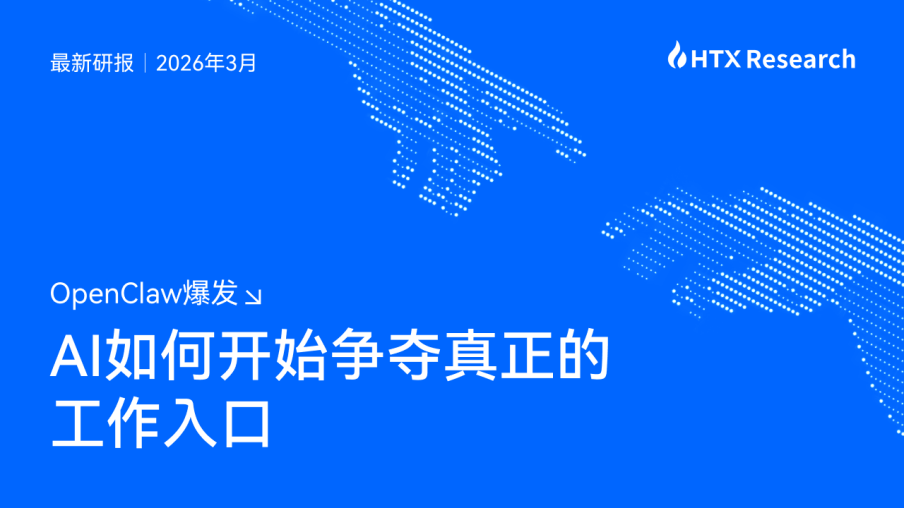
Recently, HTX Research, the research department under Huobi HTX, released its latest report "From the OpenClaw Surge: How AI Begins to Compete for the True Work Entry Point". It systematically analyzes the industry trend of AI evolving from a Q&A tool to an executable hosting layer, centered around the rapidly rising open-source project OpenClaw, and provides an in-depth analysis of Huobi HTX's product layout and differentiated competitive strategy in the AI direction.
The core issue of the report is: when AI no longer just "answers questions" but starts "executing tasks," who will control the next phase's work entry point.围绕这个问题,研报从产品形态、市场驱动力、人机分工演变、中国市场机会与风险门槛五个维度展开分析。
The Emergence of the AI Execution Layer: From "Better at Chatting" to "Actually Doing Things"
The reason OpenClaw has attracted widespread market attention is that its focus is not on answer quality, but on execution capability. It is defined as a personal AI assistant running on users' own devices, capable of receiving tasks through messaging entries like WhatsApp, Telegram, Slack, Feishu, Teams, and more, and联动 files, browsers, calendars, email, and terminals to complete actions. The report points out that it is competing not for a new chat interface, but for the execution entry point of the AI era—humans gradually retreat to the positions of goal definition and key judgment, while部分 execution chains begin to be undertaken by digital agents.
Behind this transformation, five trends have matured simultaneously: model capabilities have entered a "good enough phase," sufficient to support moderately complex multi-step tasks; the high-frequency nature of messaging entries allows AI to be embedded into existing work interfaces without requiring user migration; open-source distribution mechanisms enable projects to quickly break through the developer circle; the self-hosted model addresses data sovereignty concerns; and the practical need for small teams to "do more with fewer people" provides the most direct driving force.
Special Adaptability in the Chinese Market
The report特别指出 that the传播势能 of OpenClaw in the Chinese market cannot be ignored. A significant amount of real work for many small and medium-sized teams in China occurs between message-driven interfaces like企业微信, Feishu, and customer service backends, which are naturally suitable for the penetration of such execution layer tools. Cities like Shenzhen and Wuxi have already introduced subsidies, office space, and entrepreneurial support policies around the OpenClaw ecosystem, linking it to the "one-person company" narrative. High message-density scenarios such as content teams, agency operations, investment research monitoring, and customer service分流 are considered the most likely directions to achieve initial落地 success.
Security and Governance: Three Thresholds from a Hot Project to Infrastructure
However, OpenClaw still needs to cross three thresholds to become infrastructure. First is the security threshold—recently, there have been cases of malicious installation packages being spread through伪造 GitHub repositories and search ads. Second is the governance threshold—enterprises need clear permission auditing, action replay, and manual approval mechanisms. Third is the template threshold—if a general platform lacks industry-level access templates, it will be difficult to cross the chasm from "trying it out" to "long-term use."
Huobi HTX's AI Path: From Model Aggregation to Platform-Level Service Entry
As a global crypto exchange deeply involved in the AI field, Huobi HTX's path in the AI direction complements the trend represented by OpenClaw. OpenClaw represents the direction of "AI as an execution layer," while Huobi HTX is advancing the practical落地 of "AI as a platform service entry and ecosystem connector."
The self-developed AINFT product launched within the Huobi HTX system aggregates the capabilities of mainstream large models including OpenAI, Anthropic, and Google. Users can call upon different models through a single entry point without switching between multiple platforms. At the login level, AINFT uses TronLink wallet signatures,无需绑定手机号或信用卡, aligning with crypto-native user habits. At the payment level, it adopts a "Pay-as-you-go" mechanism, breaking away from the traditional monthly subscription logic of AI products, which better suits the high-frequency, small-amount, elastic usage characteristics of on-chain users.
This product design demonstrates that Huobi HTX's understanding of AI has upgraded from an "efficiency tool" to a "platform capability extension"—in the future, users may enter the platform not necessarily just for trading, but also to use AI and intelligent services, which subsequently leads them back to trading and platform activities.
In terms of competitive strategy, against the backdrop of current trading platforms纷纷推出 AI Skills, Huobi HTX has adopted a more focused, differentiated approach: HTX AI Skills initially covered spot and contract trade execution upon launch, with subsequent plans to supplement market analysis, market intelligence, and a built-in AI assistant within the App, aiming to establish a closed loop around the four key layers of "trade execution, risk assessment, market intelligence, user entry." The report points out that the core of competitiveness lies not in the堆叠 of Skill quantity, but in who最先串联 execution, risk, intelligence, and entry into a complete user experience.
The Track is Still Early, But the Direction is Clear
The evolution of AI from a tool layer to an execution layer is still at a very early stage, with security, governance, and ecosystem maturity far from being in place. However, the surge of OpenClaw has already allowed the market to see relatively clearly that the next step of AI competition may no longer be just about parameter and answer quality comparisons, but will extend to comprehensive aspects of entry control, permission governance, skill ecology, and organizational trust. Huobi HTX's提前布局 in this direction provides a noteworthy industry sample for how crypto platforms can transform AI from an external capability into a long-term asset that is operable and capable of growth.
About HTX Research
HTX Research is the exclusive research department under Huobi HTX, responsible for conducting in-depth analysis on a wide range of areas including cryptocurrency, blockchain technology, and emerging market trends, writing comprehensive reports, and providing professional assessments. HTX Research is committed to providing data-based insights and strategic foresight, playing a key role in shaping industry perspectives and supporting informed decision-making in the digital asset field. With rigorous research methods and cutting-edge data analysis, HTX Research is always at the forefront of innovation, leading the development of industry thought, and promoting a deeper understanding of the constantly changing market dynamics.Visit Us.
If you wish to communicate, please contact [email protected]