By Sleepy
At the end of 2022, not long after ChatGPT was released, Mao Wenchao borrowed an employee's phone. He typed a question into the dialog box: Will Xiaohongshu be disrupted?
It was reported that from then on, he asked his team to report on AI progress every two weeks. Every two weeks—indicating the machine hadn't given him a reassuring answer.
In August 2023, he wrote in an internal letter that he had discovered, while chatting with foreign friends, that many questions people asked ChatGPT were about life experience: how to choose products, how to use them, how to avoid pitfalls. This overlapped with Xiaohongshu's business.
But then he added, this was because overseas markets lacked such accumulated experience, while Xiaohongshu had it. This moat, for the time being, was not easily shaken by AI.
The term 'moat' had mostly been used by entrepreneurs to convince investors before, but this time it sounded more like something he said to soothe his own anxieties.
That year, Xiaohongshu had just turned ten, its monthly active users surpassed 300 million, and it turned its first annual profit: $3.7 billion in revenue, $500 million in net profit, with profits expected to double the next year, exceeding $1 billion.
In business history, companies die in two ways: dying poor or dying rich. Countless die poor, not much to say. Those that die rich always make the news; Kodak had money in the bank when it died, Nokia was still industry number one when it fell.
Having money and having longevity are two different things. Prosperity doesn't dispel fear; it only turns fear into a series of concrete actions.
In 2026, these actions intensified.
On June 8th, Xiaohongshu launched RED Skill, a component that can be attached under notes, which can be copied for use by Agents.
Earlier, on April 30th, the AI-first department Dots was established, bundling models, infrastructure, engineering, and product under it, reporting directly to the new President, Ke Nan.
Even earlier, it acquired the company behind the AI search product Diandian, and obtained a payment license.
Its strategic investment list began to include MiniMax, Moonshot AI, and a series of AI hardware companies.
Over the past thirteen years, the consumption experiences, lifestyle habits, and daily judgments left by hundreds of millions of users in their notes have been its true foundation. With AI's arrival, it wants to reprocess these judgments, first turning them into answers, then into tools, and finally into business. If you don't want to be disrupted, you have to act first.
But can experience withstand such processing? To answer this, we must go back to 2013, back to the era of China's own Great Voyage.
The Great Voyage of Seventy Million People
In June 2013, Qu Fang left her job at a foreign company and co-founded Xiaohongshu with Mao Wenchao in Shanghai. Their first product wasn't an app; it was a PDF titled "Xiaohongshu Outbound Shopping Guide."
That year, the number of Chinese outbound tourist trips exceeded seventy million, equivalent to the entire population of France taking a trip abroad.
Europeans' Great Voyage brought back spices, gold, and colonies. Chinese people's Great Voyage brought back skincare products, rice cookers, and guides. The items were smaller, but the human desire was the same: to bring home the good things from afar.
The world of goods outside the national gates suddenly opened wide. Duty-free shop shelves were crowded with tourists holding up phones, with no one telling them what was worth buying. The information gap was like a mineral deposit; whoever first gathered the experiences of those who had gone before could become the mine owner.
That PDF was posted online and downloaded 500,000 times in less than a month. A few months later, it grew into an app; a few years later, it grew into the phones of hundreds of millions of people.
When Chinese people encounter a problem, they never ask for a manual; they ask people.
Fei Xiaotong wrote in "From the Soil" that trust in a rural society doesn't rely on contracts but on familiarity. Apprentices learn from masters, new brides ask their mothers-in-law, first-time city-goers look for fellow villagers. For millennia, experience has been passed down generation by generation, not quickly, but adequately.
This adequacy had two prerequisites: people lived close together, and life moved slowly. Both prerequisites were lost over the past few decades. Hundreds of millions left their hometowns, moving into apartment buildings where they didn't even know their neighbors' surnames. Purchasable goods grew from a few hundred types on supply and marketing cooperative shelves to hundreds of millions on e-commerce pages. It's hard to ask an elder who has never used a robot vacuum which model to buy. The experienced haven't had time to become experienced.
The internet claimed to solve this problem, but ended up magnifying it. People invented the internet to obtain information, but eventually, there was so much information that no one dared trust any of it. Because most online information comes from sellers, and the seller's job is not to help you judge, but to persuade you to pay. Judgment can only come from someone who isn't trying to make money from you.
Xiaohongshu gathered the "I've tried this" moments scattered among hundreds of millions of strangers. A girl in Guangzhou writes that a certain foundation gets cakey on her oily skin; a young man in Shenyang notes down eleven pitfalls in home renovation; a mother writes about her weeks of hesitation between two types of baby food.
Most who write these are unknown, not experts, their language isn't necessarily rigorous, and there may be sponsored content or misjudgments mixed in, but these words have warmth.
Encyclopedias pursue definitions, advertisements pursue persuasion. These notes pursue nothing; they are just testimonies, flawed testimonies. In a courtroom, it's precisely this kind that is most credible; testimony that's too perfect seems rehearsed. The industry later gave this a name: content seeding.
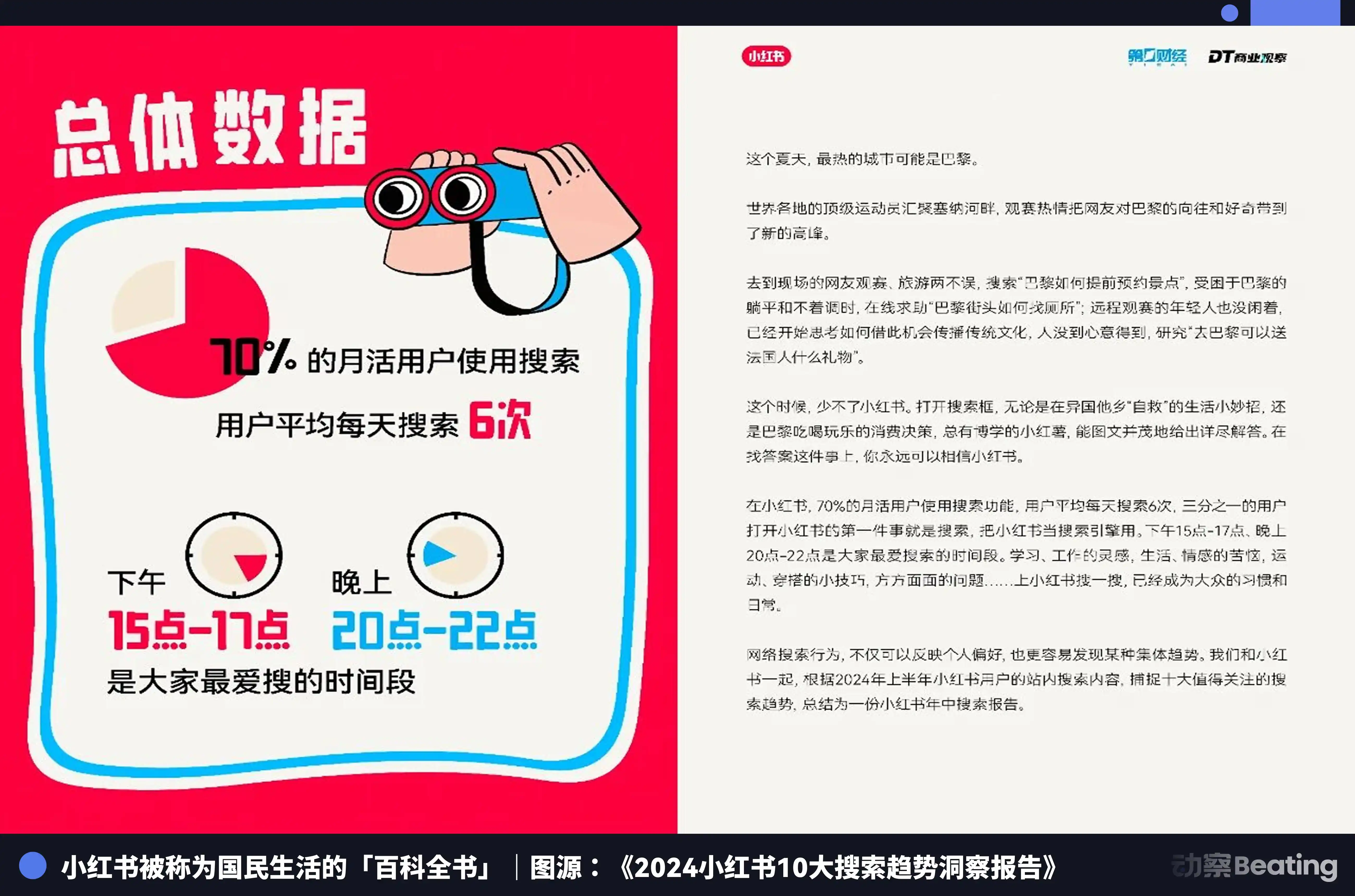
By the end of 2024, daily searches on this app approached 600 million. What people search here is rarely knowledge; it's mostly life: renovation, serums, travel guides. Search engines give you information; Xiaohongshu gives you others' experiences. There are, of course, ads, and it may not always give the most precise answer, but people are still willing to look, because many questions in life have no standard answers.
Behind 600 million searches are 600 million moments of hesitation, people holding their phones late at night unable to decide. This is Xiaohongshu's entire asset.
Then, AI arrived.
Patience Has Run Out
Thirty years of the internet is a history of the decline of human patience.
In the portal era, information was organized into directories; people had to find it themselves. The search engine era brought links; people had to click themselves. With the information feed, even searching became unnecessary; the algorithm feeds you. Each change shortened patience a bit. With the AI generation, information is made directly into answers; human patience has run out.
This isn't the user's fault. People's love for convenience knows no bounds; wheels, elevators, remote controls were all invented this way. Once someone gets used to an AI dialog box, it's hard to go back to flipping through posts and filtering themselves.
Xiaohongshu's difficulty lies in the fact that its most valuable part is precisely the hardest to compress into an answer.
In the past, people would flip through twenty notes here, compare, hesitate, and finally decide themselves. This process was slow because you might see three people saying it's good, two regretting it, and one reminding you it works well but needs careful handling. Someone writes a hotel has poor soundproofing but great breakfast. This sentence is useful because it comes from a specific person; you can roughly guess what they care about, then decide if their experience is relevant to you.
AI is like a prepared meal factory; what goes in are the myriad flavors of life, what comes out are standard formulas. It's truly convenient, but the hesitation, failures, and conditions that are omitted are precisely the most valuable parts of experience.
Experience always grows from specific individuals: skin type, city of residence, budget—all determine whether advice is useful. Machine-given answers lack these premises, sounding like slogans. Slogans can't help you choose foundation.
Xiaohongshu understands this peril. If patience can't be retained, its 600 million daily searches will become training data for others' models. It becomes the mine, and an open-pit one at that, where anyone passing by can take a scoop.
So it must act itself. It didn't act too late. Since 2023, it developed its own model "Xiao Di Gua," launched the AI drawing tool Trik, and internally tested the dialog product "Da Vinci." Most of these products didn't cause much stir, but they weren't in vain. They were like rounds of probing; Xiaohongshu needed to first figure out what AI could actually do for it.
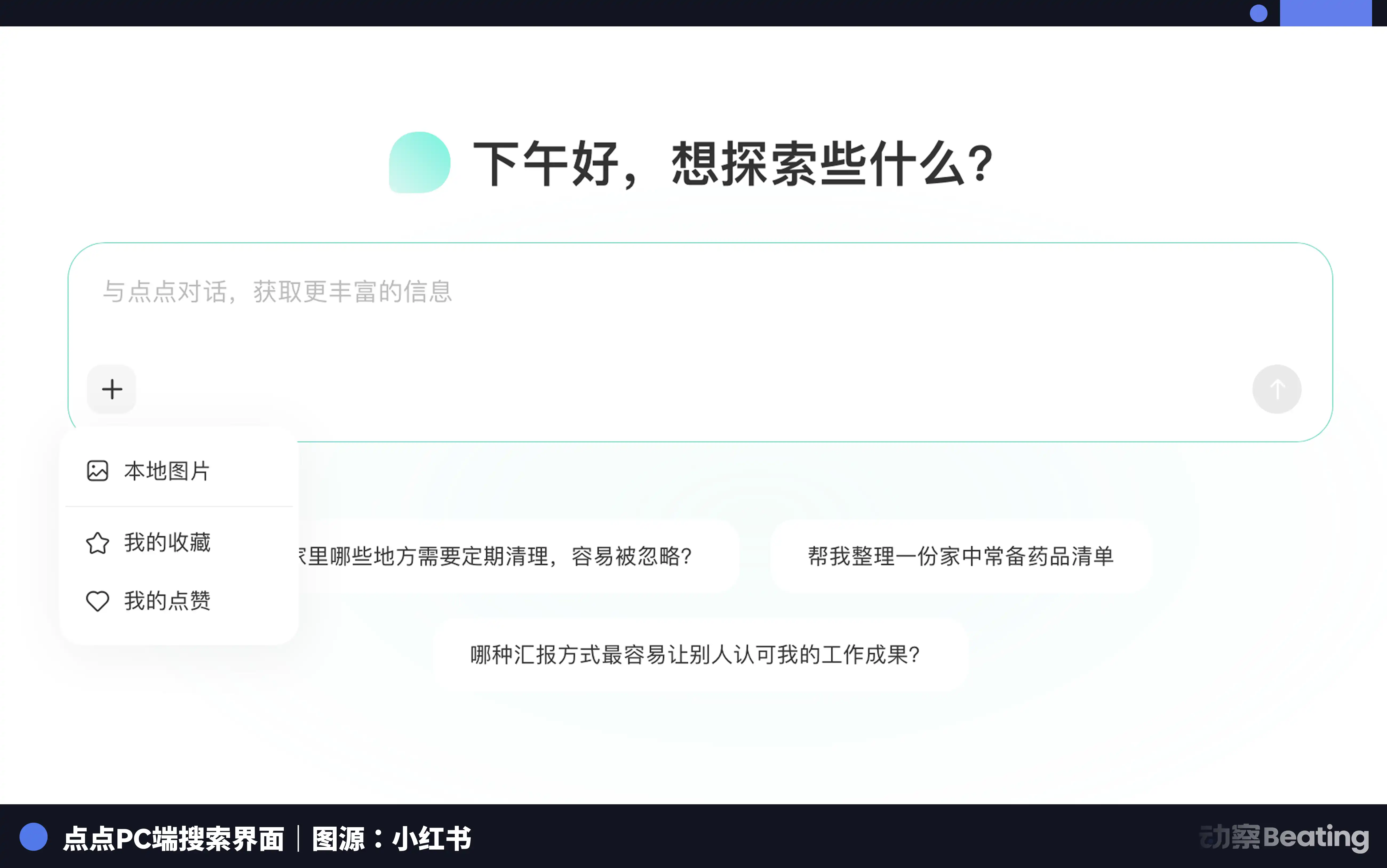
What truly pointed the way was Diandian. It focused on lifestyle search, combining in-app notes with web-wide information, supporting queries via text or voice. Later, Xiaohongshu simply acquired the company behind it. Diandian wasn't a hit, but a scout's mission isn't to conquer cities.
It discovered one thing: past searches started from keywords; users handed over a street address. Current queries start from situations; users hand over a whole set of troubles. People no longer just search "Okinawa family trip"; they ask how to arrange a five-day trip to Okinawa with a three-year-old, a budget of 15,000 yuan, wanting to stay close to the sea.
To solve these troubles, Xiaohongshu published research on multimodal retrieval and search understanding, open-sourced the image editing model FireRed and the search Agent framework REDSearcher. It has no intention of competing with tech giants for rankings on general models. Others compete on parameters and leaderboards; what it wants is to read, break down, and recombine the real human experiences scattered across images, text, videos, and comments into concrete, usable advice. With the establishment of Dots this year, this line moved from experimental periphery to core business.
Xiaohongshu wants to do the work of flipping through twenty notes to piece together an answer for the user. But one answer can only solve one problem. What it truly wants is to turn experience into a repeatedly callable ability.
Notes Grow Hands and Feet
RED Skill does exactly that. It turns experience from content into a tool.
After the feature launched, Xiaohongshu quickly pushed support activities and curated rankings. Three hundred thousand people began writing AI Skills. Guizang's PPT generation tool, which had garnered over ten thousand Stars on GitHub, was installed by several thousand people on Xiaohongshu within days.
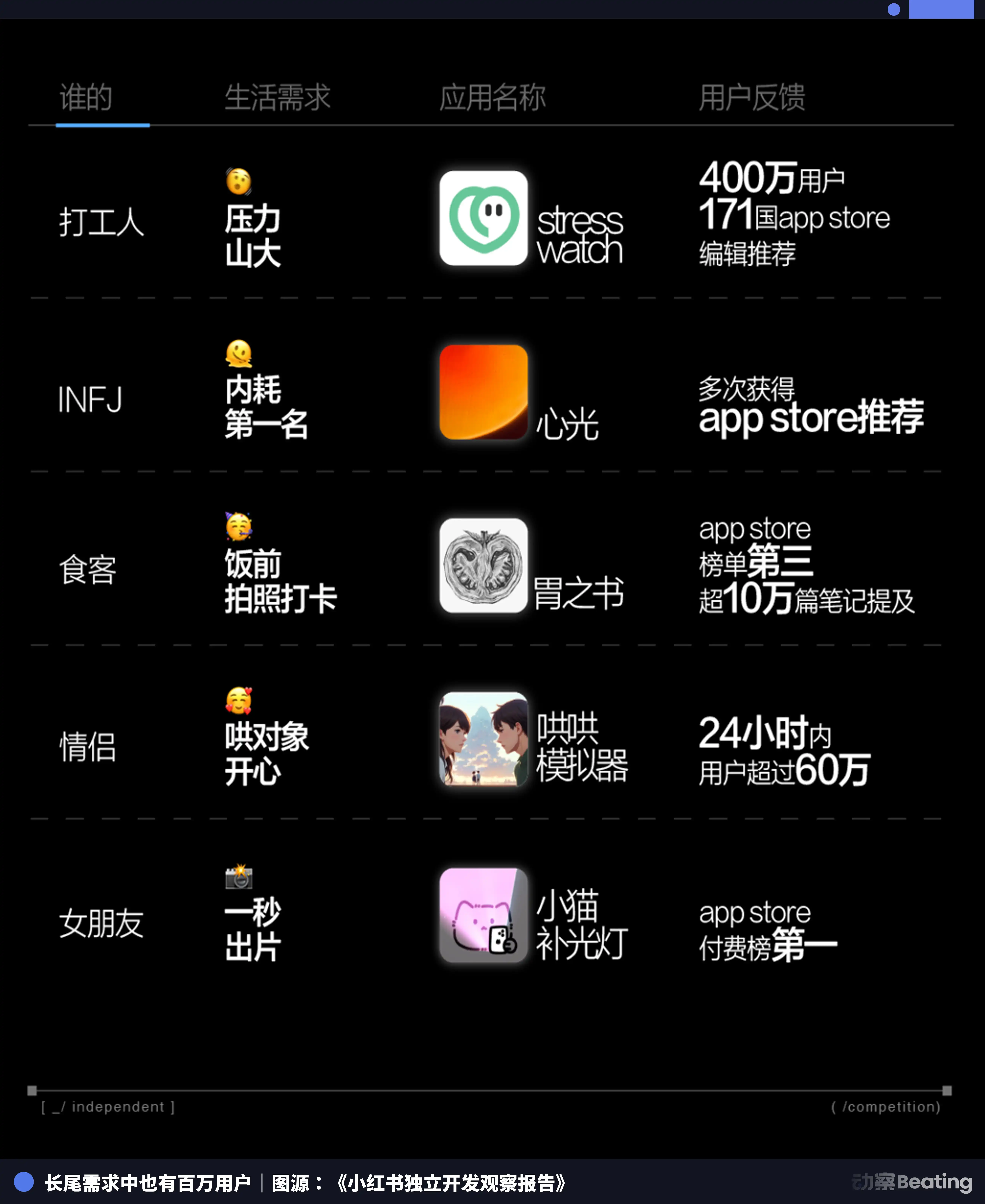
Looking further back, last year's indie developer contest received 1,355 submissions. This spring's first hackathon featured forty-eight hours of closed-door development, a 500,000 yuan prize pool, with sixty percent of participants being Gen Z, the youngest being twelve. Notes tagged with #BuildinPublic on the platform have exceeded 1.1 million.
These numbers, while not yet proof of a mature ecosystem, clearly show what Xiaohongshu wants to do.
In the past, developers wanting to cold-start a product would mostly go to GitHub or Product Hunt. There were more peers, more investors, but not necessarily more ordinary users. People might give you Stars, give you valuations, but not necessarily place orders.
Xiaohongshu is eyeing precisely this gap. Developers write about their progress here, users make requests in the comments, bloggers write notes about their usage experience, and the platform gathers initial attention through rankings. An AI tool is just the beginning after being written; it needs to be tried, discussed, and translated into something ordinary people understand and can use.
Xiaohongshu may not be the best at building tools. But it's very familiar with getting tools into people's lives.
Over the past thirteen years, Xiaohongshu's creators were more like storytellers. Vivid writing, trustworthy recommendations, influence accumulated bit by bit. Users were willing to listen primarily because they trusted you as a person. In the AI era, creators are beginning to turn into craftspeople. Changing from a connoisseur to a craftsman might sound like a demotion, but it's really just a change in metrics. How many installs a tool gets, how many times it's called, how many real tasks it helps users accomplish—these begin to determine a creator's weight.
For note writers, your experience could only be seen before; now it can also be called. Being callable creates the possibility of being priced.
To Before the Search Query Appears
In December 2024, Dai Lidan, a partner at Today Capital, joined Xiaohongshu as Head of Strategy, establishing a strategic investment team. A Peking University computer science graduate, she previously worked on Baidu Image Search and Baidu Maps, then went to Harvard for an MBA, returning to join Today Capital. Technology, product, capital—she has been through it all.
Before her arrival, Xiaohongshu invested mostly in consumer brands: M Stand coffee, Moody colored contacts, plus food, trendy toys, maternity and baby products. It invested in the lifestyles of young people, the business it knew best. After her arrival, financial investment and strategic investment were separated. The strategic investment team turned towards hard tech and AI. Xiaohongshu is on MiniMax's shareholder list, and also participated in Moonshot AI's financing round exceeding $1 billion.
It's betting on more than just on-screen AI.
Around the Nanshan Science Park in Shenzhen, with DJI headquarters as the center, a group of people working on AI hardware have gathered. In the second half of 2025, Xiaohongshu made nearly ten investments in startups here. The pace was fast—sometimes deals were closed in a day or two—and it was willing to offer higher valuations to secure shares.
Two of these deals were done via its subsidiary "Shu Neng Sheng Qiao." One investment went to Yunwang Innovation, a company that turned traditional foam rollers into AI massage robots, where the device senses where the body aches and adjusts pressure and path automatically. Another went to Skyris, making companion robots that float using helium, interacting with people via wings, LED eyes, and voice.
The industry loves calling Xiaohongshu the "entry point for life decisions." These eight words look good on a PowerPoint, but nice words always hover three feet off the ground.
Decision-making is a very late step. When someone starts searching "how to use a foam roller," it means the need has already been voiced. Before it becomes a search query, the need often doesn't have a name yet—maybe just shoulders feeling sore for a while, maybe someone sitting alone at home for three hours.
In the past, Xiaohongshu stayed downstream, waiting for people to write their life experiences into notes. Now, it wants to move upstream, actively finding those needs that haven't yet turned into search queries.
In 2024, Xiaohongshu's parent company also became an LP in a fund under GSR Ventures. GSR was an early investor, discovering the company at a startup competition in 2014 and investing the following year. Ten years later, the investee became the investor. Xiaohongshu used a fund share to secure a long-term channel to early-stage projects.
Of course, investing early doesn't mean seeing clearly. AI hardware hasn't yet proven it can achieve large-scale commercialization. Mass production, supply chain, after-sales service—each is a tough job, and none are businesses Xiaohongshu is familiar with. More troublesome is data. When your shoulders ache, the device knows; why they ache, the platform also wants to know. Understanding too little makes the product hard to use; understanding too much brings privacy risks.
But it still must invest. What it truly fears is not today, but a tomorrow where the person hesitating late at night won't open Xiaohongshu to flip through notes, but will instead hand the problem directly to another AI.
When Ads Live in Answers
Xiaohongshu's story cannot avoid commercialization.
On this platform, experience and business have always been intertwined. Skincare advice sits atop skincare products; renovation guides sit atop building materials. Users want to avoid detours, merchants want to be seen, the platform wants to make money. Each wish is reasonable on its own; put together, they require a set of rules.
In November 2025, Xiaohongshu obtained an Oriental Payment license through a subsidiary, completing the last piece. AI can recommend products and services for users, but after the recommendation, where is the order completed, where does the money flow? This decides where the business ultimately lands. Xiaohongshu doesn't want to just be responsible for giving advice; it also wants to keep the transaction within its own system.
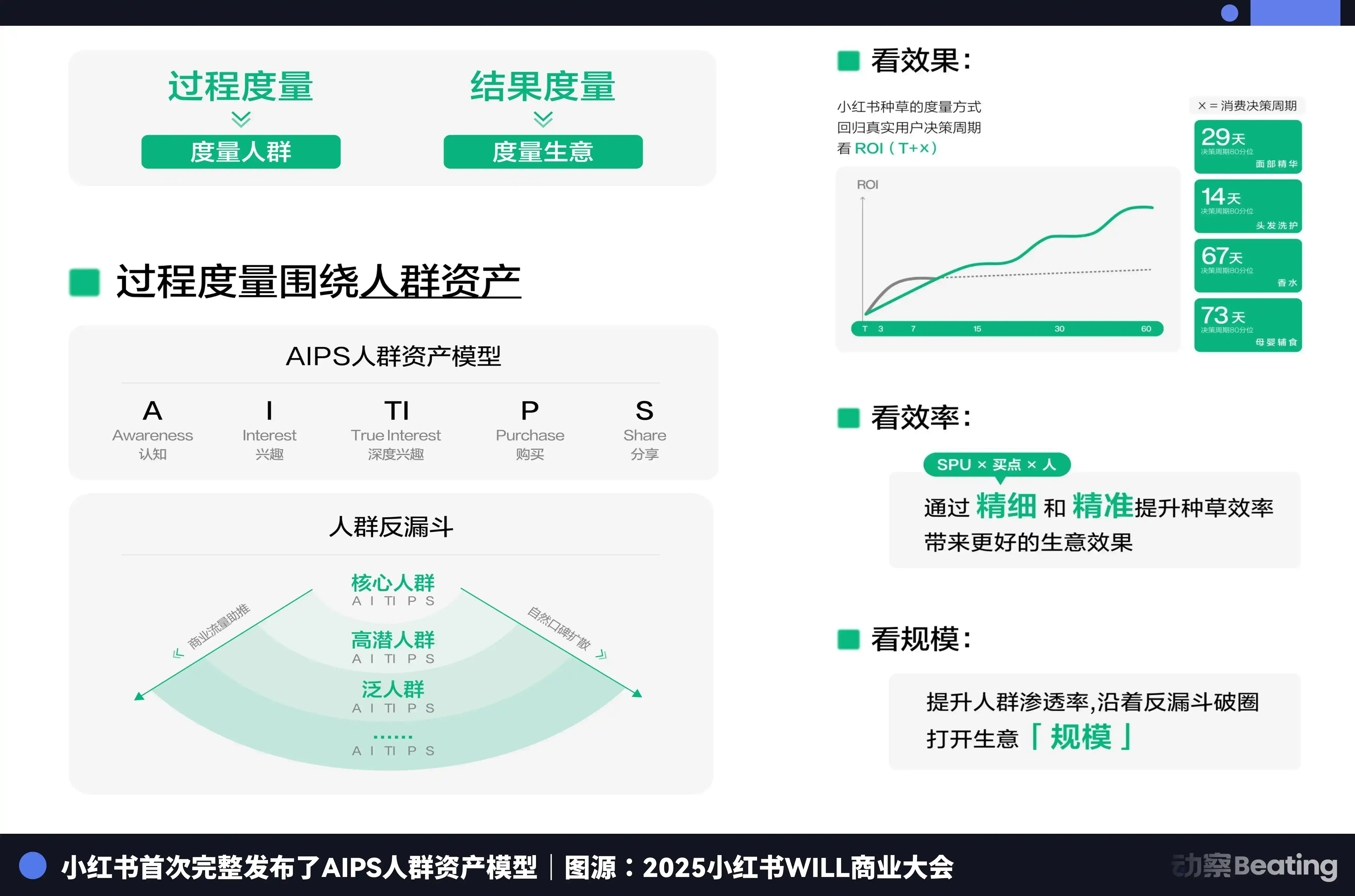
Xiaohongshu's commercial infrastructure was laid earlier. In December 2024, at the WILL Commercial Conference, Xiaohongshu launched the AIPS audience asset model, connecting data with Taobao, JD.com, and Vipshop through the Seeding Alliance, then reconciling it with brands' own data. Two numbers from the conference were particularly interesting. The decision cycle for facial serums was up to twenty-nine days; for baby food, over seventy days.
This is precisely the murkiest part of the seeding business. Someone watches a review today, searches ingredients ten days later, goes to another platform to place an order twenty days later, having also watched live streams and asked friends in between. Who ultimately brought in the money? Merchants want to know; Xiaohongshu couldn't clearly say before. AIPS aims to chart this fuzzy path.
What's truly valuable for Xiaohongshu isn't traffic. Someone scrolling short videos might just be killing time; someone searching for serums or baby food is usually close to making a purchase.
What's most valuable is knowing what people are hesitating about. AI will see this hesitation even more clearly. In the past, the platform only knew what you viewed; now it also knows what you want to solve. What you hand over is no longer just a keyword; it's a whole situation—budget, preferences, physical condition, and even those less openly stated concerns.
The advertising business has always been moving into people's decision-making process. Initially, it stood by the roadside as a signboard; one look and you knew it was an ad; if you didn't want to see it, you could walk around it. Later, it mixed into articles as soft ads and product placements; later still, it entered the information feed, looking more and more like content you would naturally see. With each step forward, ads became harder to detect and closer to people's decisions. In the AI era, it has found an even better position: living inside the answer.
The Machine Learned "I've Tried This"
In February 2026, following the national "Measures for Labeling AI-Generated Synthetic Content," Xiaohongshu required creators to label AI-generated images, text, and videos, limiting distribution of unlabeled content. In March, it began cleaning up AI-operated accounts, banning those entirely written and posted by machines. In April, it first fully announced its AI governance stance, encouraging AI to amplify creativity, opposing AI forging life. Cloning voices, fabricating personas, inventing experiences—all are prohibited.
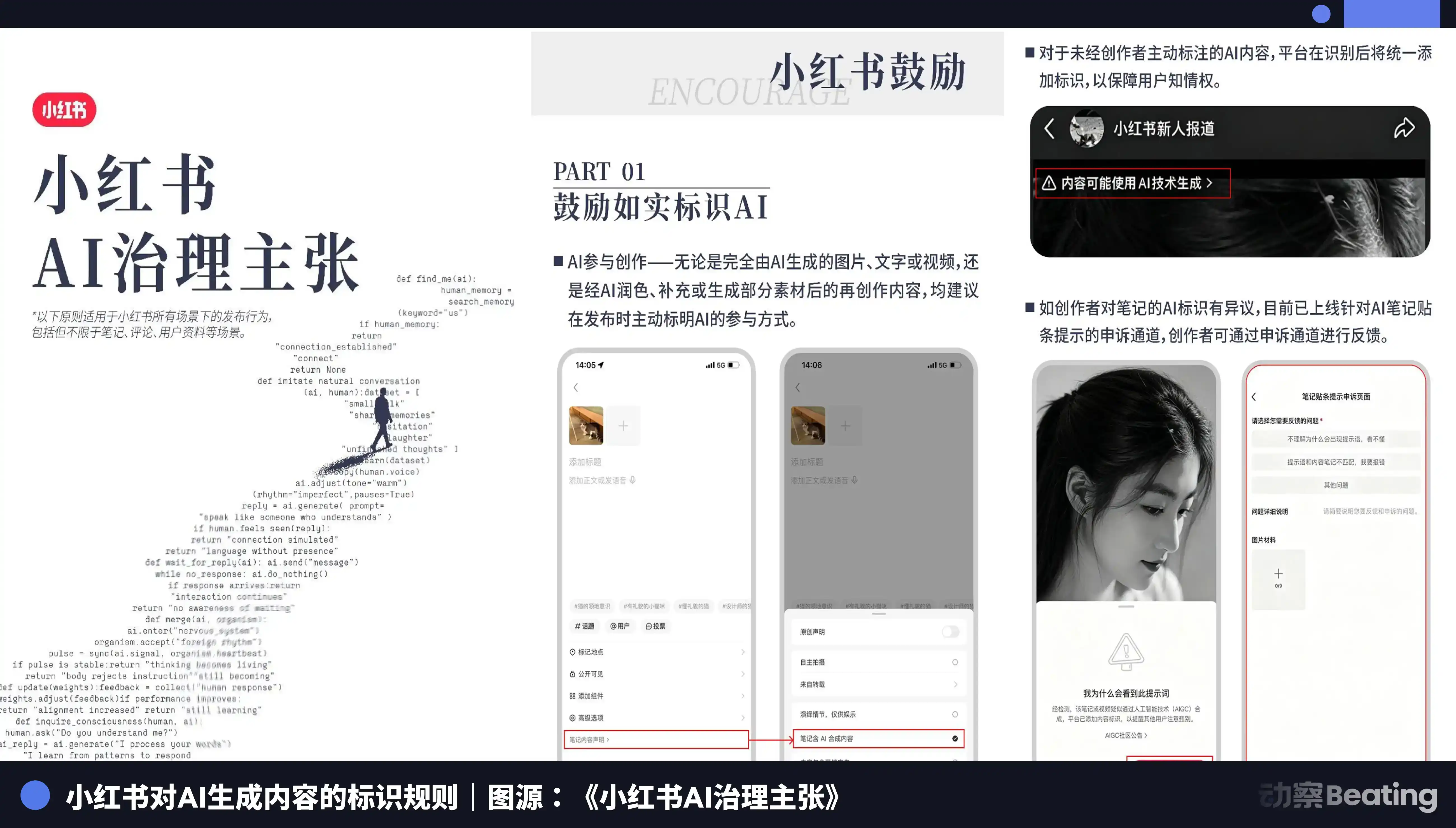
These statements sound like positioning, but they're actually about survival.
AI is best at imitating people. In the end, it even learned "I've tried this." This is what it learns fastest, and what it absolutely should not have learned. The trust Xiaohongshu built over thirteen years relies precisely on countless specific "I've tried this" moments. A machine can write ten thousand trial notes without ever having truly tried once. Its skin never gets allergic; its wallet never feels the pinch.
When such content reaches a certain volume, real human experience will also depreciate. Xiaohongshu would revert to what it once tried to replace: that pile of better-written, more human-like seller pitches.
What comes next remains uncertain. Whether RED Skill can grow a true ecosystem, whether Diandian can integrate into the main app, whether payment will be embedded in answers—all these must be left to time. But the nature of this endeavor is already clear: Xiaohongshu is acting as a translator. It translates real human experience into structures machines can process, turns judgments from life into tools, and connects hesitation to business.
Translation values faithfulness, expressiveness, and elegance. The machine has already learned expressiveness. What Xiaohongshu must guard is faithfulness.
Borges wrote about an empire obsessed with precision. There, cartography became increasingly advanced; a provincial map was as large as a city, the empire's map as large as a province. Cartographers still felt it insufficient, eventually drawing a map the same size as the empire's territory, where every city, every road, every patch of wilderness found a corresponding spot on the map. But once a map is as large as reality, it becomes useless. Later generations ignored it, letting it rot in the desert.
AI is drawing such a map for experience, drawing finer and faster, making it easier to forget that the map is ultimately not life itself.
Mao Wenchao wrote in his letter that this moat was, for the time being, not easily shaken by AI. He probably also understood that the real problem isn't the moat, but the city. Xiaohongshu must build an increasingly intelligent machine; otherwise, the experience accumulated over thirteen years will soon be organized, called upon, and repriced by others. But once the machine's voice drowns out human voices, the city will be empty, and a moat guarding an empty city, no matter how wide, is useless.
It must build the machine into the city, while ensuring what ultimately remains in the city isn't just the machine, but also those people hesitating late at night, and those willing to say to them, "I've tried this."
This is its true moat, and also its current, all-encompassing unease.
Epilogue
Before this article was finalized, Bloomberg reported that Xiaohongshu plans to submit a confidential IPO application in Hong Kong by the end of this month. Its valuation once reached $31 billion, with estimated full-year 2025 profit around $3 billion.
From a PDF to the Hong Kong Stock Exchange, thirteen years. It gathered the hesitations from the lives of hundreds of millions of people into something that can make money. Now it's the capital market's turn to reprice it.
Stock prices will always rise and fall. But those people hesitating late at night holding their phones, those willing to tell a stranger "I've tried this"—they won't disappear from the story because of stock price fluctuations. Money makes a company run fast, but running long is another matter.
What comes next, leave to time.