Morgan Stanley Research Report Analysis: S&P Equal-Weight Drops 5%, AI Concentration Risk Builds Up Before Year-End

marsbitPublished on 2026-10-12Last updated on 2026-10-12

Abstract

Morgan Stanley's research report highlights a divergence in the S&P 500: while the market-cap weighted index fell only 0.5% in September, the equal-weight version dropped 5%. This resilience masks broad market weakness, concentrated in the outperformance of the top six contributors (like Meta, Apple, Nvidia), which added about 190 basis points, while the rest dragged the index down by ~240 basis points. The report notes a "flight to quality," with AI and semiconductor stocks still supported by capex expansion and earnings revisions. However, their elevated valuations (median forward P/E ~32x vs. 10-year average of ~19x) and rising interest rates pose sustainability challenges, drawing parallels to the dot-com bubble in terms of price action and potential supply pressures from IPOs/secondary offerings. For Japanese markets, seasonal foreign capital inflows are expected to resume from October, potentially supporting AI-related stocks there. Morgan Stanley's strategy advises selectively maintaining AI/semiconductor exposure while gradually reducing theme concentration. It recommends tactically adding low-volatility stocks for downside protection and allocating to financially sound value stocks, which may benefit if the AI rally broadens out. The core message is to prepare for potential turning points by year-end/early 2027 by de-risking concentrated positions and adding defensive elements to portfolios.

Author: Rita

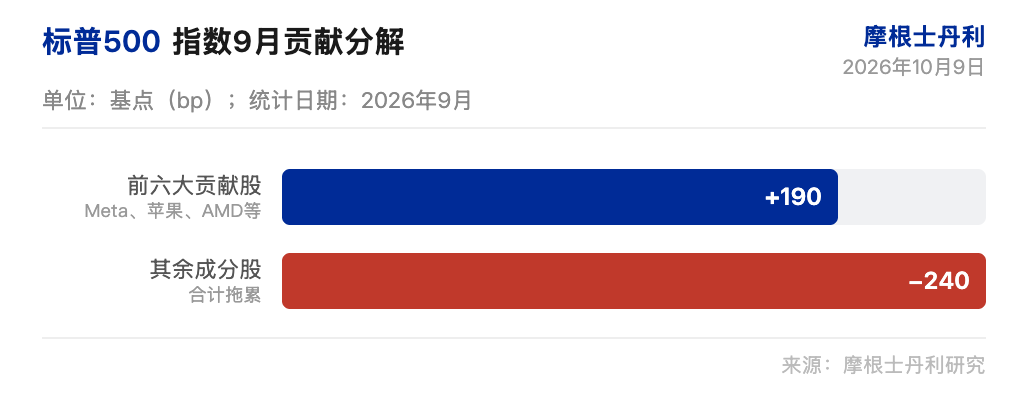
The S&P 500 Index fell 0.5% in September, while the equal-weight version declined 5%. The top six contributing stocks collectively contributed approximately 190 basis points, while the remaining constituents collectively dragged down about 240 basis points. The index's resilience masks broad weakness.

In a global strategy report released on October 9, 2026, Morgan Stanley pointed out that AI and semiconductor-related stocks remain supported by capital expenditure expansion and earnings revisions, but rising interest rates and elevated valuations pose challenges to the sustainability of the rally. The report suggests selectively maintaining AI positions, gradually reducing thematic concentration, tactically increasing holdings in low-volatility stocks, and allocating to financially robust value stocks.

The article begins by examining market structure, analyzing fund flows related to the quality factor, and then discusses allocation directions and potential turning point risks before year-end.

Index Resilience Masks Broad Weakness

In September, the global high-yield bond index fell sharply. The equal-weight S&P 500 dropped 5%, while the market-cap-weighted version declined only 0.5%. The index's resilience stems from support by a few strong individual stocks, indicating the overall market strength is not solid.

The divergence between market-cap-weighted and equal-weight indices illustrates that capital is concentrating towards high-quality assets. Morgan Stanley refers to this as a "flight to quality." The top six contributors were Meta, Apple, AMD, Nvidia, Intel, and Micron, collectively contributing about 190 basis points. The remaining constituents collectively dragged down about 240 basis points.
Returns for the quality factor in US equities have steadily risen, with low-volatility factor valuations at the 98th historical percentile. The quality factor in the Japanese market began to strengthen in late September, while the value factor weakened during the same period. In an environment of rising interest rates, investor concerns over financial fragility have outweighed preferences for valuation.

Capital expenditure from hyperscalers continues to expand, with earnings forecasts for AI and semiconductor stocks persistently revised upward. Morgan Stanley believes such companies possess thematic appeal in the current market, primarily stemming from earnings visibility and quality attributes. High return on equity and other profitability metrics align with definitions of quality stocks.

Foreign Inflows Support Japanese AI Stocks

Seasonal behavior of foreign capital in the Japanese stock market warrants attention. Data from 2011 to 2025 shows foreigners were typically net sellers in August and September, turning net buyers in October and beyond.

In the first half of 2026, foreign buying of Japanese AI-related stocks provided support. Morgan Stanley anticipates similar fund flows could reappear. Following net selling in August and September, the tendency for net buying starting in October will form a support base.

In a report on August 14 titled "The Second Half of the AI Rally," Morgan Stanley recommended holding AI and semiconductor stocks, citing strong earnings. The current view remains unchanged, but market recognition of entering the second half is strengthening. The report advises against further concentration in the theme, suggesting gradually reducing concentration and selectively investing in stocks with earnings support.

Risks for AI and semiconductor stocks also exist. In a May 14 report, "Are We Going Back to 1999?" Morgan Stanley noted multiple similarities between the AI-driven market and the internet bubble. A July 6 report further analyzed the causes of the internet bubble, with the overlap between the two periods increasing.

Elevated Valuations Coexist with Supply Pressure

The median forward price-to-earnings ratio for core AI and semiconductor stocks is around 32x, compared to about 38x three months ago. This level remains above the ten-year average of approximately 19x.

Earnings revisions remain positive but have retreated from recent peaks. A comparison of the SOX index trajectory with the internet bubble period shows high similarity in the patterns of sharp rises, sharp declines, and rebounds.

Supply-side pressure is accumulating. IPOs, new issuances, and secondary offerings could disperse investment capital, creating pressure on stock supply and demand. During the internet bubble, the number of shares available for sale after lock-up expirations increased leading up to the March 2000 peak. The current market harbors similar potential for supply expansion.

The interest rate environment also warrants attention. The internet bubble peaked in March 2000, in the middle of a Federal Reserve rate-hiking cycle. The recent Fed pivot towards tightening monetary policy could undermine market sustainability. Debates persist regarding overinvestment in data centers and the credit conditions of AI-related companies. While capital expenditure expansion supports near-term earnings, concerns over mid-term investment returns may rise.

Concentration Risk Calls for Defensive Allocation

Morgan Stanley recommends selectively maintaining AI and semiconductor exposure while gradually reducing thematic concentration. Tactically adding low-volatility stocks can enhance resilience against broader market pullbacks.

Low-volatility stocks are suitable as a defensive allocation to cope with overall market corrections. Morgan Stanley also believes investor positioning in these stocks is relatively light.

Financially robust value stocks represent another allocation avenue. The Japanese value factor has shown weakness since late September, primarily pressured by the rise of AI and quality stocks. Value stocks typically have weaker financial strength compared to growth and quality stocks, raising investor concerns about their financial fragility during rising rates. If the AI stock consolidation dissipates and preferences broaden, relative performance of value stocks may improve. The value factor has a seasonal tendency to rise towards year-end, and its medium-term allocation value remains.

Morgan Stanley maintains its judgment on earnings support for AI and semiconductor stocks but reminds investors to prepare for a potential turning point from December to early 2027. Concentration risk is accumulating. Reducing concentration and increasing allocations to low-volatility and financially sound value stocks are the core strategic directions at present. Foreign capital flows and changes in earnings forecasts are subsequent observation points.

Disclaimer

This article is a compilation and interpretation by Chao Xiang Research of a third-party brokerage research report (Morgan Stanley, October 9, 2026), combined with the organization of publicly available market information. The ratings, target prices, earnings forecasts, and related judgments cited herein are the views of the analyst(s) at the mentioned brokerage firm, representing only the stance of their affiliated institution. They do not represent the views of Chao Xiang Research nor constitute any investment advice.

Markets involve risks, and decisions require independence. This article should not serve as the basis for trading any securities.


Related Questions

QAccording to Morgan Stanley's report, what is the main contrast in performance between the S&P 500 capitalization-weighted index and the equal-weighted index in September, and what does this divergence indicate?

AIn September, the S&P 500 capitalization-weighted index fell only 0.5%, while the equal-weighted index fell 5%. This divergence indicates that the index's resilience is being supported by a handful of strong-performing stocks, masking broader market weakness and a concentration of capital into high-quality assets.

QWhat specific investment strategy does Morgan Stanley recommend regarding AI and semiconductor stocks in the current market environment?

AMorgan Stanley recommends selectively maintaining positions in AI and semiconductor stocks while gradually reducing thematic concentration. Additionally, they advise tactically increasing exposure to low-volatility stocks and allocating to financially sound value stocks to enhance defensive capabilities against a potential market downturn.

QWhat key risk parallels does the Morgan Stanley report draw between the current AI-driven market and the internet bubble of 1999-2000?

AThe report draws parallels in several areas: the sharp rise, correction, and rebound pattern of the SOX index compared to the internet bubble era; high valuations; and accumulating supply-side pressures from potential IPOs and secondary offerings, similar to the increase in lock-up expirations before the March 2000 peak.

QHow does Morgan Stanley analyze the role of foreign capital flows in the Japanese stock market, particularly concerning AI-related stocks?

AMorgan Stanley notes that foreign investors in Japanese stocks have a seasonal pattern of net selling in August and September, often turning to net buying from October onward. They expect similar supportive foreign capital inflows for Japanese AI-related stocks to potentially reoccur following this seasonal pattern.

QWhat are the two main defensive asset classes Morgan Stanley suggests adding to a portfolio to prepare for a potential market turning point around year-end?

AMorgan Stanley suggests two main defensive asset classes: 1) Low-volatility stocks, which are suitable for defending against a broad market pullback, and 2) Financially sound value stocks, which may see improved relative performance if the concentration in AI stocks dissipates and preferences broaden, especially given value factors' historical tendency for a seasonal rise toward year-end.

Related Reads

Are Alt-L1s over? Security, costs drive smaller chains to Ethereum

Running an independent blockchain promises control but comes with major costs, and smaller networks are increasingly finding it economically unsustainable. Zilliqa recently announced it is abandoning its nine-year-old Layer 1 architecture to become an Ethereum-based Layer 2, admitting usage never reached the level a standalone chain requires and that funding and liquidity for independent L1s have dried up. Gnosis is also transitioning its chain into an Ethereum-based network through its Ethereum Economic Zone initiative, and gaming-focused Ronin completed its move back to Ethereum as an L2 in May. According to Bitwise analyst Max Shannon, the decision comes down to profitability: L2s only need to maintain execution and don't necessarily need a token, making them more attractive financially and operationally. The largest networks generate tens of millions in annual fees with margins above 90%, while chains ranked 11th and below collectively earned less than $1 million in annual fees. However, becoming an L2 doesn't guarantee profitability—networks like Optimism, Katana and Linea still have expenses exceeding fee revenue, and Blast has shut down. Beyond cost savings, projects can tap into Ethereum's established ecosystem of applications, developers and liquidity rather than building network effects from scratch. Matter Labs CEO Alex Gluchowski expects more L1 teams to keep their own chains while using Ethereum for settlement, arguing sovereignty and Ethereum integration are not mutually exclusive. Still, Shannon cautions there is no clear conclusion to the L1 versus L2 debate, as some institutions continue launching independent chains like Circle's Arc, Stripe's Tempo and Hyperliquid.

cointelegraph3m ago

Are Alt-L1s over? Security, costs drive smaller chains to Ethereum

cointelegraph3m ago

GRAM Defies Market Downturn, Durov Claims It's Undervalued—Can Ecosystem Fundamentals Keep Up?

Despite a broad crypto market downturn driven by hawkish macro expectations, tech stock selloffs, ETF outflows, and geopolitical risks, GRAM (TON) has bucked the trend, drawing attention as one of the top gainers among the top 100 tokens by market cap with a 5.3% rise. Telegram CEO Pavel Durov publicly argued that GRAM is severely undervalued, claiming it deserves a top-three spot among cryptocurrencies given its unique integration with a large social ecosystem, and he updated his X bio to include "TON blockchain founder (2019)." TON was originally launched by Telegram but was abandoned after U.S. regulatory action; Durov rejoined the project in May, rebranded the token back to GRAM, and introduced a seven-step "Make TON Great Again" strategy. However, GRAM has fallen about 55.1% since hitting $2.7 in May and is down 85.3% from its all-time high. Durov also highlighted ecosystem growth: Telegram's self-custodial Gram wallet, launched in July 2026 and fully opened to global users on October 9, surpassed 3.53 million wallets by November 12, adding nearly 650,000 in 48 hours, aided by an auto-activation mechanism triggered by receiving even 0.1 GRAM. Yet real adoption lags—daily active addresses are only about 53,000 (roughly 1.5% of wallets), and only about 188,000 addresses hold GRAM, totaling around 1.683 million tokens worth about $2.05 million. TON's ecosystem also faces challenges: TVL is just $45.74 million versus a historical peak of $780 million, concentrated in Tonstakers and Stakee, with limited application diversity and high development barriers. Tokenomics add inflation pressure, with annual inflation rising from about 0.6% to about 4% after an April block-speed upgrade. While Telegram provides unmatched traffic, converting users into genuine on-chain activity and sustainable value remains unproven.

marsbit52m ago

GRAM Defies Market Downturn, Durov Claims It's Undervalued—Can Ecosystem Fundamentals Keep Up?

marsbit52m ago

Bernstein: Why You Absolutely Should Not Buy the Dip on Nvidia Right Now

Bernstein downgraded Nvidia from "Outperform" to "Market Perform," cutting its price target from $400 to $200, not due to deteriorating fundamentals but because of an ongoing management scandal at the highest levels of the company. Reports of CEO Jensen Huang's inappropriate relationships—first with Alice Huang, which Huang publicly acknowledged, and subsequently with a direct subordinate, reportedly Kimberly Powell, VP of healthcare—have prompted the board to launch an independent investigation, and The Wall Street Journal reports the company is preparing to dismiss him. Bernstein analyst Stacy A. Rasgon argues the board will almost certainly not retain Huang given the new allegations, and even if he stays, the risk of continued negative exposure remains significant. Despite Nvidia's stock now trading at what Bernstein calls "almost absurdly undervalued" levels, the firm strongly advises investors to stay on the sidelines. Fundamentals remain intact—Bernstein projects data center revenue of about $378.3 billion in FY2026, rising to $657.8 billion in FY2027 and over $918.2 billion in FY2028, with total revenue growing nearly 70% annually and non-GAAP EPS averaging $19.04 for FY28/29, supporting the $200 target at roughly 11x forward P/E, down from 21x. However, the succession question—internal promotion or external hire, and who could replace Huang—remains unanswered, and any resolution will introduce new variables. Bernstein uses a "cockroaches in the kitchen" analogy: finding two implies there are likely more. The analyst suspects the current scandal is just the tip of the iceberg, with more internal allegations, potential government investigations, and uncertainty over strategic supply-chain investments and guarantees possibly to come, while some competitors' shares have already risen on the news. Though Rasgon admits to being torn and understands the buy-the-dip logic, his instinct says the well's depth hasn't been fully plumbed—so Bernstein chooses to step aside and watch from the sidelines.

marsbit58m ago

Bernstein: Why You Absolutely Should Not Buy the Dip on Nvidia Right Now

marsbit58m ago

QQQ Reclaims Its 200-Day Moving Average: Ahead of the December Rate Hike, Who Should You Watch in This AI Rally?

QQQ has reclaimed its 200-day moving average, but the real AI story is just entering a differentiation phase. The index has completed its repair; individual stocks now face their exam. Under the same AI theme, the market's answers have diverged sharply: some stocks are back above the annual line with cash flow, while others have rallied 25% yet remain 30% below it. The key question after the index-level repair is who can pass this exam—depending on whether earnings delivery can outrun valuation pressure. QQQ closed at $690.38 on Nov 11, 1.27% above its 200-day line, recovering most of its losses within days. Two hurdles remain: Nvidia, the largest weight, is still 15% below its annual line and reports earnings on Nov 17, with board governance concerns unresolved; and the 10-year Treasury yield closed at 4.998%, pressing the 5% threshold that anchors valuation for long-duration growth stocks. AI names now fall into three tiers relative to their 200-day lines: AMD is 31.6% above (high expectations priced in), Micron 6.5% above (fundamentals delivering, up 11.89% in a day), QQQ 1.27% above, while Nvidia is 15.0% below and CoreWeave 32.1% below despite a 24.71% single-day jump. The takeaway: the index returning to its annual line may not mean a broad AI rally—capital may be rotating from "buying AI" to "buying delivery." Nvidia's Nov 17 earnings must address both results and governance, with consensus Q3 revenue near $108.8 billion. Micron trades at roughly 10.8x earnings after 379% revenue growth; whether that's undervaluation or cycle-top pricing hinges on HBM pricing and HBM4 supply from Samsung and SK Hynix. CoreWeave's rally prices relief over near-term solvency fears, not financing risk. AMD's challenge is converting revenue into cash, with free cash flow falling to $554 million from $1.56 billion. A December rate hike is already priced in (about 87% odds per CME FedWatch), making the 10-year Treasury the real valuation switch. If yields fall and QQQ holds above its annual line, AI assets could re-rate; if the 10-year breaks 5%, pressure returns. Five signals will determine which AI names keep running. QQQ back at its annual line does not mean AI is back to a broad rally—the index has finished repairing, and the stocks have begun their exam.

marsbit1h ago

QQQ Reclaims Its 200-Day Moving Average: Ahead of the December Rate Hike, Who Should You Watch in This AI Rally?

marsbit1h ago

Trading

Spot
活动图片