Lummis: The CLARITY Act mechanism "is not working" as the Senate drags its feet

cryptonews.ruPublicado a 2026-07-31Actualizado a 2026-07-31

Resumen

U.S. Senator Cynthia Lummis has argued that the current regulatory framework for digital assets is inadequate, harming industry, investors, and regulators alike. She is urgently pushing for the Senate to pass the Digital Asset Market Clarity Act (H.R. 3633/CLARITY Act) before the August recess, warning the current momentum for the bill is a unique opportunity this decade. The legislation aims to divide oversight between the SEC and CFTC. Time is running out, as the Senate must act before its August 8th recess. Delays would push the debate to September, further squeezing the legislative calendar before the midterm elections. Forecasting platforms now estimate only a 30% chance of the bill becoming law in 2026, a sharp drop from over 80% in February. Passage requires 60 votes, meaning at least seven Democrats must join Republicans, a task complicated by Democratic opposition. Key objections from figures like Senator Elizabeth Warren center on concerns the bill could weaken oversight of decentralized finance (DeFi) and consumer protection, potentially endangering the financial system. Over 200 crypto industry organizations, including Coinbase and Ripple, are lobbying for a vote, arguing continued uncertainty drives innovation and jobs overseas. Lummis contends the bill's custody and disclosure rules are precisely the consumer protections needed to close existing loopholes. The bill's fate now hinges on whether Senate Majority Leader John Thune schedules a vote this week or de...

Today, Lummis argued, stating that the existing set of rules regulating digital assets satisfies no one it affects, namely companies operating in this sphere, ordinary asset holders, and agencies tasked with combating fraud. In recent days, the senator has repeatedly spoken in the Senate to pressure colleagues regarding the bill and told journalists she plans to continue talking about it as the voting deadline approaches.
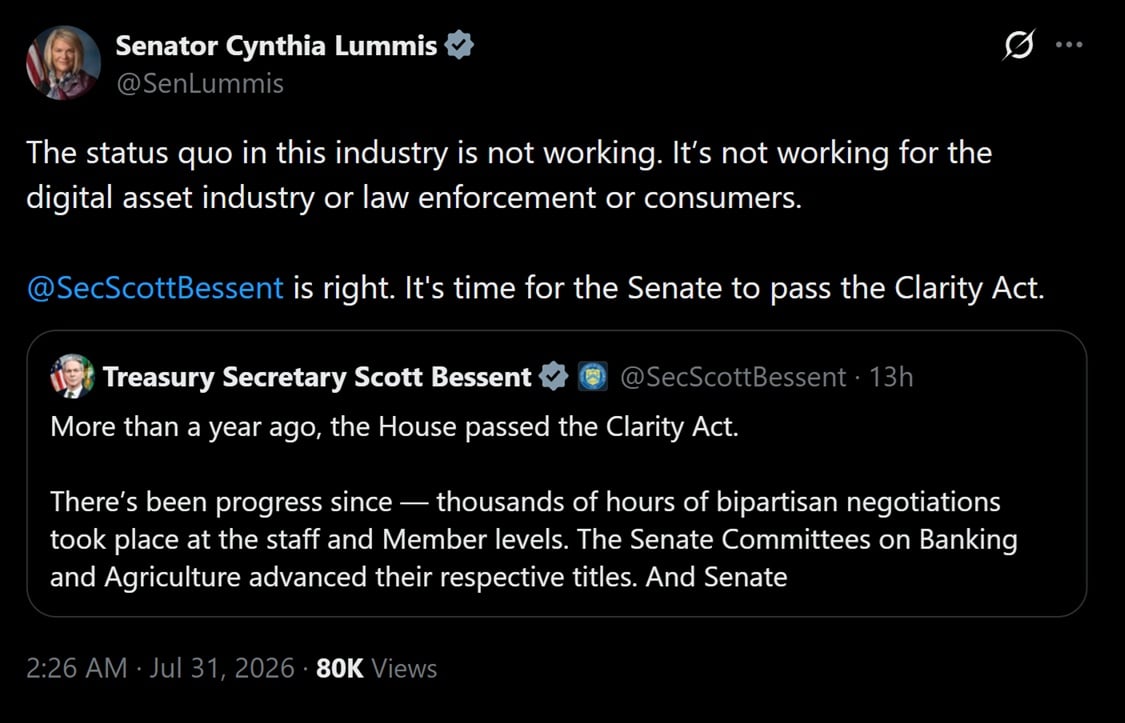
Image Source: X

The Digital Asset Market Clarity Act, officially designated as H.R. 3633, provides for the division of oversight over digital assets between the Securities and Exchange Commission (SEC) and the Commodity Futures Trading Commission (CFTC). Lummis separately warned that the current momentum with which the bill is advancing "will not be repeated again in this decade," noting that further delays will result in the bill not being passed this year.

She also framed the essence of the confrontation in more concrete terms, telling colleagues that prolonged debates could leave cryptocurrency custody rules unprotected just as the industry is increasingly penetrating the sphere of traditional finance.

Time is Running Out

The Senate is scheduled to begin its August recess on August 8th, and Majority Leader John Thune has not yet allocated time for the bill to be debated in the Senate. If lawmakers do not reach a decision by this deadline, discussion will only resume in September, further shrinking the already diminishing legislative window before the midterm elections.

This deadline pressure is reflected in prediction markets: forecasting platforms currently estimate the probability of CLARITY becoming law in 2026 at approximately 30%, significantly lower than the figure of over 80% recorded in February. Passing the bill in the Senate requires 60 votes. Republicans control 53 seats, meaning at least seven Democrats must vote for it for passage—a task that has proven difficult due to unresolved objections within the Democratic caucus.

What is Holding Up the Vote

Beyond the ethics provisions governing cryptocurrency ownership by federal officials, which Senate negotiators are working on separately, opponents have expressed concern about how the bill approaches decentralized finance (DeFi) protocols and whether its consumer protection provisions go far enough. Senator Elizabeth Warren argues that the bill would weaken oversight to the point of jeopardizing the financial system as a whole—a position she has reiterated since the committee vote in May.

Cryptocurrency industry associations have also strongly opposed the delay: over 200 organizations, including Coinbase, Ripple, Kraken, and Circle, are urging Senate leadership to bring the bill for a vote, arguing that the ongoing uncertainty is driving innovation and jobs overseas while leaving American consumers without clear protection.

Lummis directly linked the urgency of considering the bill to consumer protection measures, arguing that the bill's requirements for asset custody and disclosure are necessary precisely because existing legislation contains loopholes that bad actors could exploit.

However, with Senate floor time for the bill still not scheduled and only a few days remaining before the parliamentary recess ends, the bill's fate now hinges on whether Thune allocates time for its consideration this week or postpones it until the fall session. Reconvening in September would keep the CLARITY bill on the agenda but would push the final vote closer to the midterm election campaign season, when legislative activity typically slows down even further.


Preguntas relacionadas

QAccording to Senator Lummis, why is the CLARITY Act's mechanism 'not working'?

AAccording to Senator Lummis, the mechanism of the CLARITY Act is 'not working' because the Senate is delaying the legislative process, with Majority Leader John Thune not yet scheduling time for its floor consideration, leading to a high risk it won't pass this year.

QWhich two regulatory bodies would oversee digital assets under the proposed CLARITY Act (H.R. 3633)?

AUnder the proposed Digital Asset Market Clarity Act (H.R. 3633), oversight of digital assets would be divided between the Securities and Exchange Commission (SEC) and the Commodity Futures Trading Commission (CFTC).

QWhat is the estimated current probability of the CLARITY Act becoming law in 2026, according to betting platforms, and why has it dropped significantly?

ABetting platforms currently estimate the probability of the CLARITY Act becoming law in 2026 is about 30%, a significant drop from over 80% in February. The drop is due to the legislative delay and the shrinking window for action before the August recess and midterm elections.

QWhat are two key concerns raised by opponents, like Senator Elizabeth Warren, regarding the CLARITY bill?

AOpponents like Senator Elizabeth Warren have raised concerns that the bill's approach to decentralized finance (DeFi) protocols is problematic and that its consumer protection provisions are insufficient. Warren specifically argues it would weaken oversight enough to endanger the overall financial system.

QWhat consequence does Senator Lummis warn about if the CLARITY Act is further delayed?

ASenator Lummis warns that further delays will result in the bill not passing this year. She also cautions that prolonged debates could leave rules for cryptocurrency custody unprotected just as the industry increasingly integrates with traditional finance.

Lecturas Relacionadas

Has Bitcoin Bottomed, or Is a 'Shakeout' Approaching? What's the Situation with XRP?

Cryptocurrency analytics platform Santiment shared key insights on Bitcoin and altcoin markets, highlighting significant signals from on-chain data. Analysis shows Bitcoin's 365-day MVRV ratio has fallen to -26%, indicating substantial losses for long-term holders, a level historically associated with market bottom formations and long-term buying opportunities. While short-term MVRV is near breakeven, suggesting no clear directional signal, the annual perspective points to a bottom before bullish cycles. On-chain data reveals divergent behavior: large wallets (10-10,000 BTC) have been accumulating, adding ~18,500 BTC in 10 days, while smaller retail investors continue buying dips. Analysts caution that high retail demand can sometimes create a risk of a final market shakeout or correction. The altcoin market shows a mixed picture. Ethereum's 365-day MVRV is around -33%, but recent monthly gains combined with overly optimistic social sentiment pose a short-term correction risk. XRP is in oversold territory with 30-day and 365-day MVRVs at -57.5% and -45.5% respectively, signaling potential for a strong mid-to-long term rebound. Social activity and optimism are rising for Solana, while investor sentiment remains calmer towards Cardano. Future direction for Bitcoin and altcoins depends not only on on-chain metrics but also on macroeconomic and regulatory developments. The Federal Reserve's interest rate decision and upcoming policy rulings are increasing market volatility expectations, while uncertainty around the U.S. Congressional clarity process continues to pressure pricing. *This is not investment advice.

cryptonews.ruHace 16 min(s)

Has Bitcoin Bottomed, or Is a 'Shakeout' Approaching? What's the Situation with XRP?

cryptonews.ruHace 16 min(s)

Bank of Korea Reveals Results of Tokenized Deposit Testing

The Bank of Korea has announced the results of its pilot test for tokenized deposits. Involving 28 central banks and international financial organizations, the project saw participation from major South Korean banks including KB Kookmin Bank, NH NongHyup Bank, Shinhan Bank, Woori Bank, and Hana Bank. Transactions, from payment orders to final settlement, were completed in real time, averaging just 80 seconds. The test involved 30 transactions across 17 different scenarios—such as corporate and interbank transfers—and was conducted in six currencies, including the Korean won, US dollar, and euro, with a total transaction value reaching approximately $995,000. The central bank reported that the platform operated stably throughout, despite being only partially connected to the existing banking infrastructure. Settlements using tokenized deposits were executed seamlessly, quickly, and transparently. An internal transfer of 20 million won (about $13,890) between NH NongHyup Bank and Shinhan Bank was also successfully processed via the Project Agora platform, which involved connecting to the Bank of Korea's CBDC test platform, Project Hangang. Additionally, KB Kookmin Bank and Japan's MUFG Bank tested cross-border payments using these deposit tokens—digital certificates issued by commercial banks within the pilot, not directly by the central bank. The Bank of Korea plans to continue testing payments with tokenized deposits. This follows last year's pledge by South Korean authorities to tighten regulations for won-based stablecoins, which will require approval from both the central bank and the Financial Services Commission.

cryptonews.ruHace 2 hora(s)

Bank of Korea Reveals Results of Tokenized Deposit Testing

cryptonews.ruHace 2 hora(s)

Trading

Spot
活动图片