Edel Finance loses $403K as flash-loan oracle exploit hits xStock lending reserves

ambcryptoPublicado a 2026-07-01Actualizado a 2026-07-01

Resumen

Edel Finance, a programmable market layer for tokenized equities, suffered a $403,000 exploit. An attacker manipulated the wrapped xStocks (wGOOGLx) exchange rate via a flash loan, briefly inflating the collateral's value 78-fold to borrow far beyond its true worth. Although the protocol acted promptly to limit losses, the attack revealed critical oracle and collateral pricing vulnerabilities in tokenized lending markets. The exploit severely impacted liquidity, causing total value locked (TVL) to plummet from around $630,000 to roughly $947 as users withdrew funds. A net outflow of approximately $630,000 followed. Recovery hinges on restoring user confidence through deposit growth, stabilized TVL, and stronger oracle protections and risk management practices.

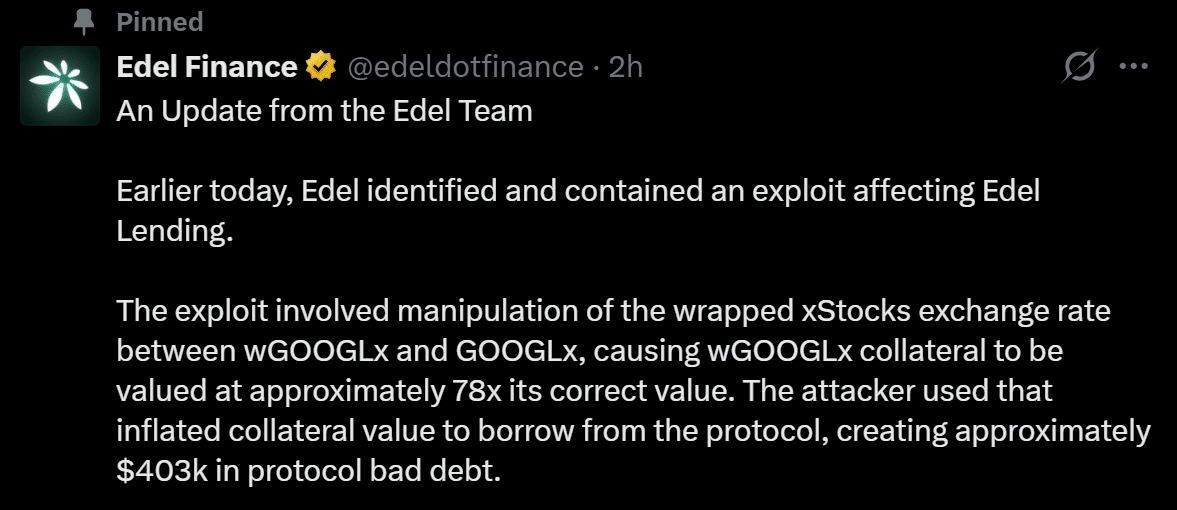
Edel Finance, a programmable market layer for tokenized equities, suffered a roughly $403,000 exploit. This was after an attacker manipulated the wrapped xStocks exchange rate through a flash loan.

The wGOOGLx collateral briefly gained in value about 78-fold over its true value. The inflated valuation allowed the attacker to borrow far more than the collateral’s true value, leaving the lender with significant bad debt.

Fortunately for the users of Edel Finance, they were able to act promptly to contain the issue before additional loss occurring.
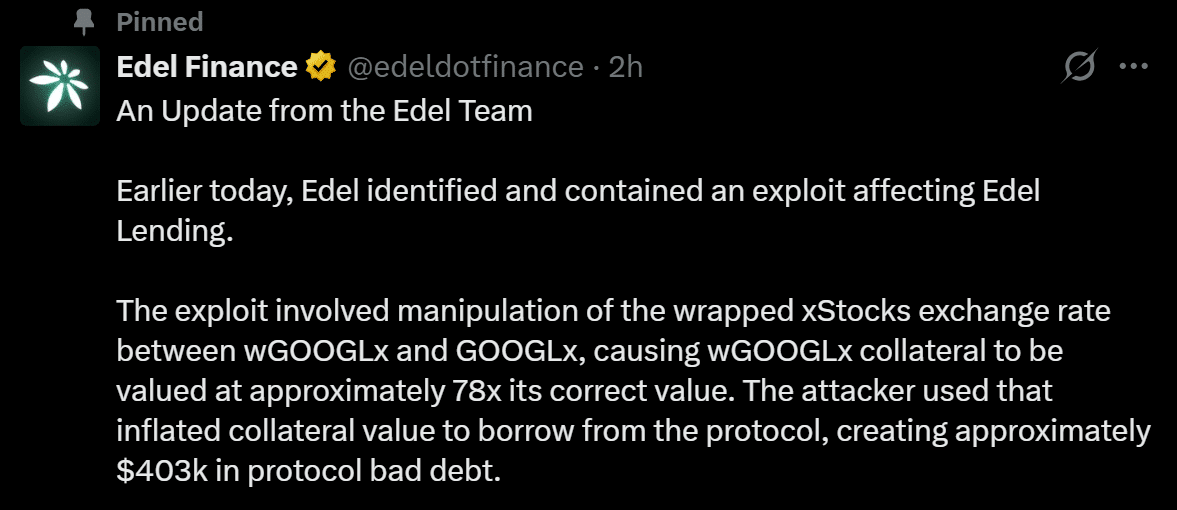
Source: X

In addition, a significant vulnerability was exposed by the attack despite the rapid response by Edel Finance. More importantly, the attack highlighted persistent weaknesses in oracle and collateral pricing across tokenized lending markets.

Conversely, unless the vulnerabilities are fully addressed, confidence remains fragile. Going forward, stronger oracle protections and collateral validation will likely determine how quickly trust returns.

Post-exploit withdrawals leave liquidity under pressure

The aftermath of the exploit quickly spilled into Edel Finance’s liquidity. As confidence deteriorated, total value locked (TVL) plunged from approximately $630,000 to roughly $947, reflecting a rapid wave of user withdrawals.
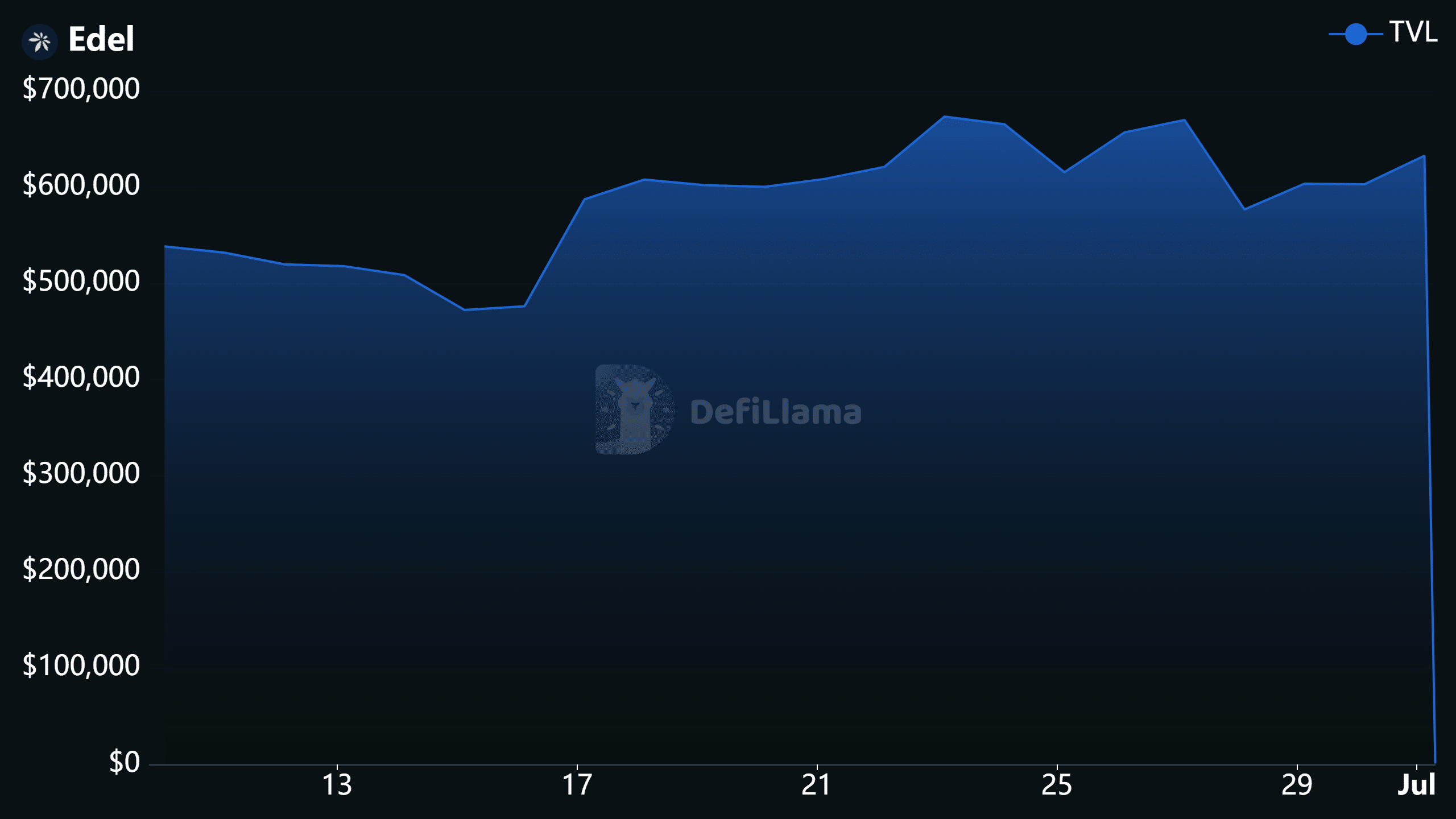
Source: DeFiLlama

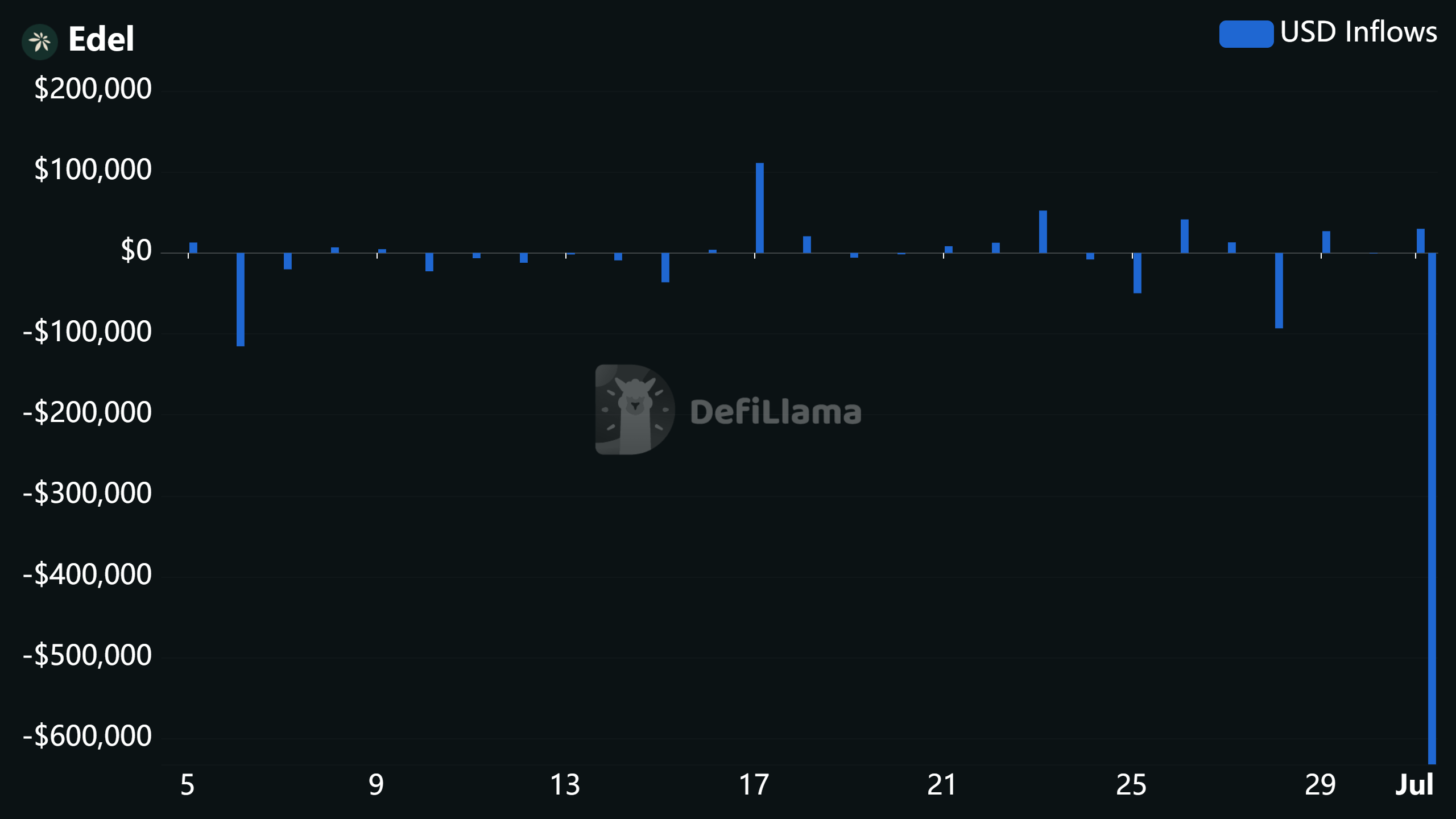
Capital flows reinforced the trend further. According to DeFiLlama data, Edel Finance recorded an estimated net outflow of $630,000, the largest on record. Earlier on, a $100,000 inflow had briefly supported liquidity. Even so, it failed to offset the accelerating withdrawals that followed the exploit.
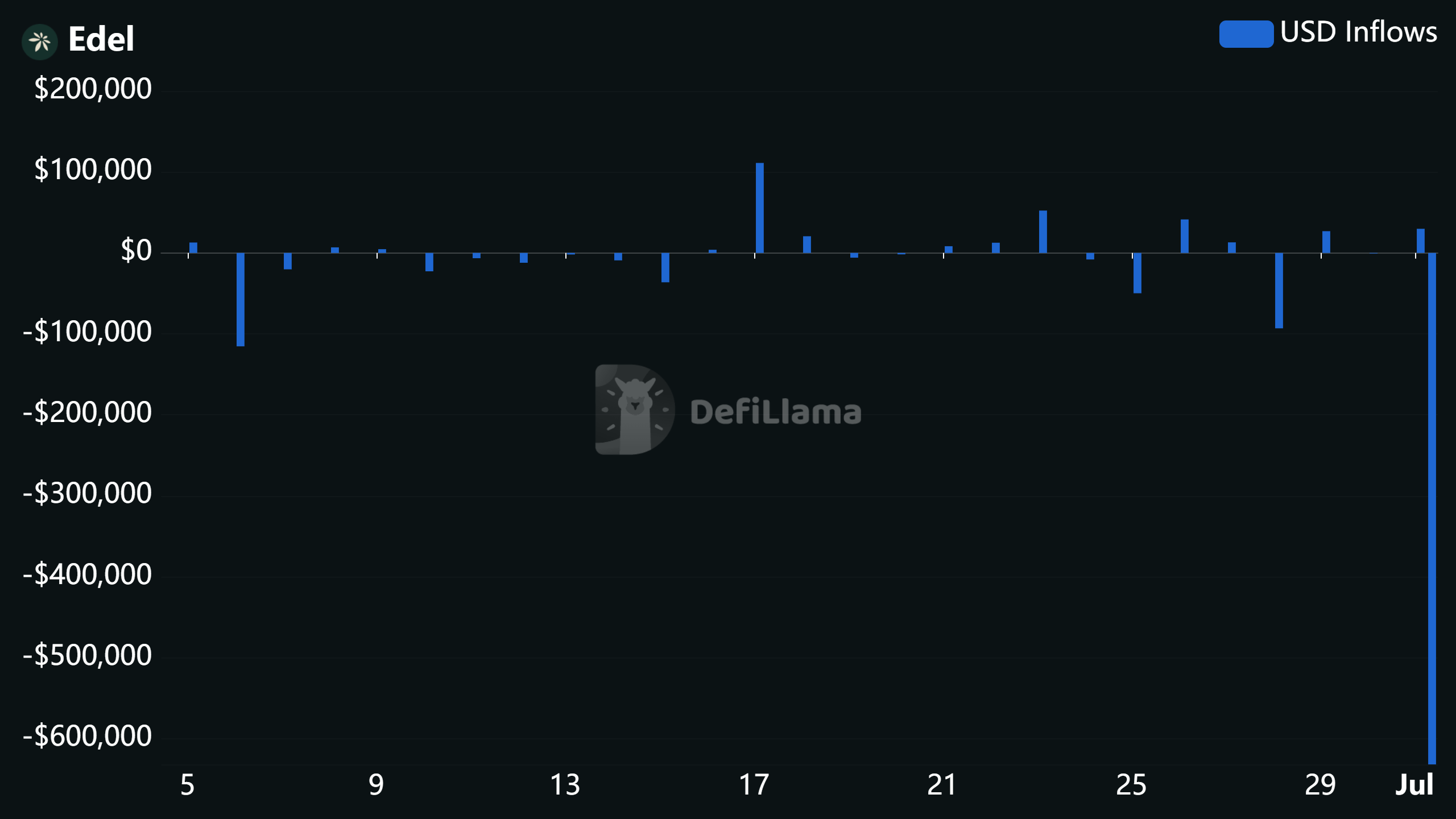
Source: DeFiLlama

These actions suggest that lenders are taking precedence over preserving capital versus supporting the protocol. Going forward, recovery depends on sustained deposit growth, stabilizing TVL, and shrinking daily outflows.

Without continued deposit growth, borrowing will continue to have limited capacity, ultimately limiting the ability of the lending platform to normalize its liquidity and delaying a return to normalcy within the lending markets.

It will take rebuilding confidence among users for meaningful capital to begin returning to Edel Finance through continued use of the lending platform and strengthened risk management practices.


Final Summary

  • Edel Finance’s xStock (wGOOGLx) exploit exposed critical oracle risks, highlighting persistent weaknesses in tokenized lending security.
  • Edel Finance’s recovery now depends on restoring liquidity, rebuilding TVL, and regaining user confidence.

Criptos en tendencia

Preguntas relacionadas

QWhat was the primary method used by the attacker to exploit Edel Finance?

AThe attacker manipulated the wrapped xStocks exchange rate through a flash loan, artificially inflating the value of wGOOGLx collateral.

QHow much financial loss did Edel Finance suffer due to this exploit?

AEdel Finance suffered a roughly $403,000 exploit.

QWhat specific vulnerability in the protocol did the attack highlight?

AThe attack highlighted persistent weaknesses in oracle and collateral pricing mechanisms across tokenized lending markets.

QWhat happened to Edel Finance's Total Value Locked (TVL) following the exploit?

AFollowing the exploit and user withdrawals, the TVL plunged from approximately $630,000 to roughly $947.

QWhat is identified as essential for Edel Finance's recovery and the return of user capital?

ARecovery depends on rebuilding user confidence, sustained deposit growth, stabilizing TVL, and implementing stronger oracle protections and risk management practices.

Lecturas Relacionadas

The Largest Upgrade Since The Merge? How Glamsterdam Will Affect Ethereum and Regular Users?

The upcoming Glamsterdam upgrade, scheduled for late 2026, is considered Ethereum's most significant change since The Merge. It focuses on fundamentally restructuring Ethereum's block production, transaction execution, and gas pricing to enable major scalability improvements while preserving decentralization. The upgrade centers on three key innovations: * **Enshrined PBS (ePBS)**: Moves the Proposer-Builder Separation mechanism into the protocol's core, eliminating reliance on external relays. This reorganizes the block pipeline, extending the time window for processing execution payloads, which is crucial for safely increasing block capacity. * **Block-Level Access Lists (BALs)**: Attaches a "map" to each block, declaring in advance which state data its transactions will access. This enables potential parallel transaction processing and faster node synchronization, breaking a key performance bottleneck. * **Gas Repricing**: Introduces a more accurate resource pricing model by separating computation costs from state storage costs. This discourages uncontrolled state growth by making operations that create permanent data (like new accounts) more accurately reflect their long-term network burden. Together, these changes aim to solve the core challenges of increasing Ethereum's throughput (e.g., raising the Gas Limit) without overburdening node hardware or increasing centralization risks. They prepare the infrastructure for higher capacity, targeting a credible post-upgrade capacity of up to 200 million Gas. For users, the impact will be nuanced: * General transaction fees may become lower and more stable as block space increases. * Simple transfers could see cost reductions, while state-intensive operations (like contract deployment) may become relatively more expensive due to the new gas model. * Gas fee estimations by wallets will become more accurate. * L2 networks could benefit long-term from increased data blob capacity. * Standardized logs for all ETH transfers (EIP-7708) will improve tracking for wallets and exchanges. Ultimately, Glamsterdam represents a foundational shift, not a simple block size increase. It seeks to expand Ethereum's capacity by re-engineering its underlying mechanics, maintaining its commitment to decentralization while enabling significant performance gains.

marsbitHace 2 hora(s)

The Largest Upgrade Since The Merge? How Glamsterdam Will Affect Ethereum and Regular Users?

marsbitHace 2 hora(s)

Circle CEO Responds to the OUSD Challenge: Stablecoin is a Winner-Takes-All Business, and We Won't Slow Down

In response to questions about the OUSD stablecoin initiative, Circle CEO Jeremy Allaire argues that the stablecoin market is a "winner-take-most" platform business driven by powerful network effects, and Circle has no plans to slow down. He outlines three key drivers behind USDC's dominant position: 1. **Protocol/Software Layer Network Effects**: The value of a stablecoin network grows as more developers and services integrate it, creating compounding utility and user preference. Circle has spent nearly a decade building this ecosystem with USDC, now accelerated by mainstream adoption and enhanced by software stacks like CCTP and Gateway for interoperability. 2. **Liquidity Network Effects**: Liquidity begets more liquidity. USDC has achieved top-tier global liquidity—ranking among the top three digital assets alongside BTC and USDT—through nearly a decade of building deep primary and secondary market access across regions and venues. 3. **Regulatory and Policy Integration**: Establishing a global stablecoin requires deep regulatory engagement, licensing, and compliance across key markets—a significant, long-term investment where Circle is a leader. Allaire cites Artemis data showing USDC facilitated 80% of all dollar stablecoin on-chain transaction volume in Q1 2026, with USDT at 20% and all others negligible. He addresses OUSD's purported advantages: "free" minting/burning is often not sustainable in practice; redistributing all revenue can starve essential infrastructure investment; and large consortium models historically struggle with inefficiency and slow execution, unlike focused strategic partnerships. He reaffirms Circle's strong ongoing partnership with Coinbase on USDC and notes Circle collaborates with dozens of other stablecoin issuers through its expanding platform (Arc, CCTP, CPN, etc.). While welcoming OUSD to the ecosystem, Allaire asserts that Circle's vast, trusted network and continued investment make USDC the foundational digital dollar infrastructure for the world.

链捕手Hace 2 hora(s)

Circle CEO Responds to the OUSD Challenge: Stablecoin is a Winner-Takes-All Business, and We Won't Slow Down

链捕手Hace 2 hora(s)

Q2 Crypto Market Review: Did Bitcoin Rise for 'Nothing'? Did Money Flow to AI and On-Chain?

Q2 2026 Crypto Market Recap: Bitcoin's Gains Erased Amid Shift to AI and On-Chain Activity The second quarter of 2026 saw a significant reversal for the cryptocurrency market. Bitcoin gave back all its April gains, ending Q2 down approximately 11%, while major stock indices posted strong gains. This divergence was driven by a hawkish shift in Fed rate expectations, capital rotation into AI stocks, and weakening liquidity channels into crypto. Key demand pillars deteriorated simultaneously. Spot Bitcoin ETFs recorded net outflows of $4.08 billion for the quarter, with outflows dominating June. Crypto treasury entity Strategy's bitcoin accumulation slowed markedly, and the total stablecoin market cap contracted by ~$4.2 billion. This created a tighter liquidity environment. Exchange data reflected the downturn. Spot trading volumes fell 28% quarter-over-quarter. The market underwent significant deleveraging, with $8.35 billion in long liquidations for BTC and ETH, primarily in late May/early June. Open interest and order book liquidity also declined. Despite the bearish price action, structural developments point to an expanding on-chain ecosystem. These include the rise of tokenized stocks with full legal rights, the growth of RWA (real-world asset) perpetual contracts for trading stocks and commodities 24/7, and the use of crypto markets for price discovery ahead of major events like the SpaceX IPO. On-chain vaults are also emerging as a core layer for institutional capital allocation.

Foresight NewsHace 2 hora(s)

Q2 Crypto Market Review: Did Bitcoin Rise for 'Nothing'? Did Money Flow to AI and On-Chain?

Foresight NewsHace 2 hora(s)

Trading

Spot

Artículos destacados

Cómo comprar LAYER

¡Bienvenido a HTX.com! Hemos hecho que comprar Solayer (LAYER) sea simple y conveniente. Sigue nuestra guía paso a paso para iniciar tu viaje de criptos.Paso 1: crea tu cuenta HTXUtiliza tu correo electrónico o número de teléfono para registrarte y obtener una cuenta gratuita en HTX. Experimenta un proceso de registro sin complicaciones y desbloquea todas las funciones.Obtener mi cuentaPaso 2: ve a Comprar cripto y elige tu método de pagoTarjeta de crédito/débito: usa tu Visa o Mastercard para comprar Solayer (LAYER) al instante.Saldo: utiliza fondos del saldo de tu cuenta HTX para tradear sin problemas.Terceros: hemos agregado métodos de pago populares como Google Pay y Apple Pay para mejorar la comodidad.P2P: tradear directamente con otros usuarios en HTX.Over-the-Counter (OTC): ofrecemos servicios personalizados y tipos de cambio competitivos para los traders.Paso 3: guarda tu Solayer (LAYER)Después de comprar tu Solayer (LAYER), guárdalo en tu cuenta HTX. Alternativamente, puedes enviarlo a otro lugar mediante transferencia blockchain o utilizarlo para tradear otras criptomonedas.Paso 4: tradear Solayer (LAYER)Tradear fácilmente con Solayer (LAYER) en HTX's mercado spot. Simplemente accede a tu cuenta, selecciona tu par de trading, ejecuta tus trades y monitorea en tiempo real. Ofrecemos una experiencia fácil de usar tanto para principiantes como para traders experimentados.

300 Vistas totalesPublicado en 2025.02.11Actualizado en 2026.06.02

Cómo comprar LAYER

Discusiones

Bienvenido a la comunidad de HTX. Aquí puedes mantenerte informado sobre los últimos desarrollos de la plataforma y acceder a análisis profesionales del mercado. A continuación se presentan las opiniones de los usuarios sobre el precio de LAYER (LAYER).

活动图片