GitHub Empire on the Brink of Collapse: Source Code Leak, 18-Year Veteran Leaves, Microsoft Loses 1.5 Billion Developers

marsbitPublicado a 2026-05-22Actualizado a 2026-05-22

Resumen

GitHub is facing an unprecedented crisis, marked by a massive exodus of developers and severe operational failures. The tipping point came when Mitchell Hashimoto, creator of Ghostty and an 18-year GitHub user, publicly severed ties, citing persistent platform outages that made serious work impossible. This departure highlights a broader pattern of user frustration. The platform's instability has drawn complaints from major corporate clients like Citibank and Intel, forcing Microsoft to issue substantial service credits. A critical incident last month saw an accidentally triggered, unreleased feature cause widespread repository rollbacks, erasing recent code changes and pushing enterprises to migrate. Security has catastrophically breached. In May 2026, hackers infiltrated over 3,800 of GitHub's internal repositories via a poisoned VS Code extension installed by a developer, leading to the attempted sale of core source code for $50,000. This follows the discovery of a critical zero-day vulnerability in March that threatened access to millions of repositories. Internally, GitHub's autonomy has collapsed. After the resignation of CEO Thomas Dohmke in mid-2025, Microsoft eliminated the CEO role, folding GitHub into its CoreAI division under the unpopular leadership of Jay Parikh. This triggered a talent drain, with key executives and engineers leaving. A disruptive migration of GitHub's infrastructure to Azure servers, pushed by CTO Vladimir Fedorov, is blamed for the recurri...

GitHub is experiencing an unprecedented major collapse.

Recently, the global open-source tech community witnessed a shocking rift.

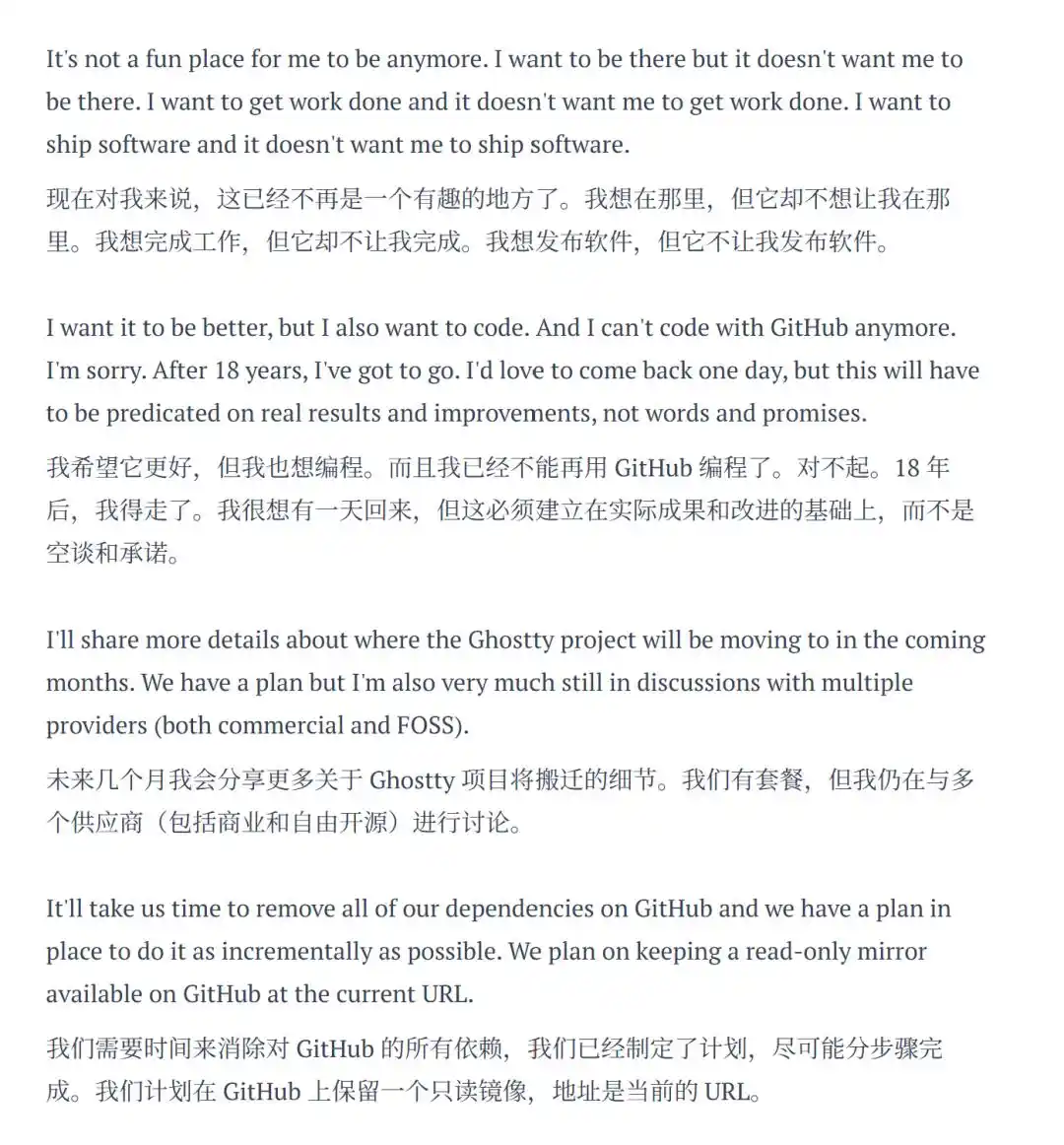
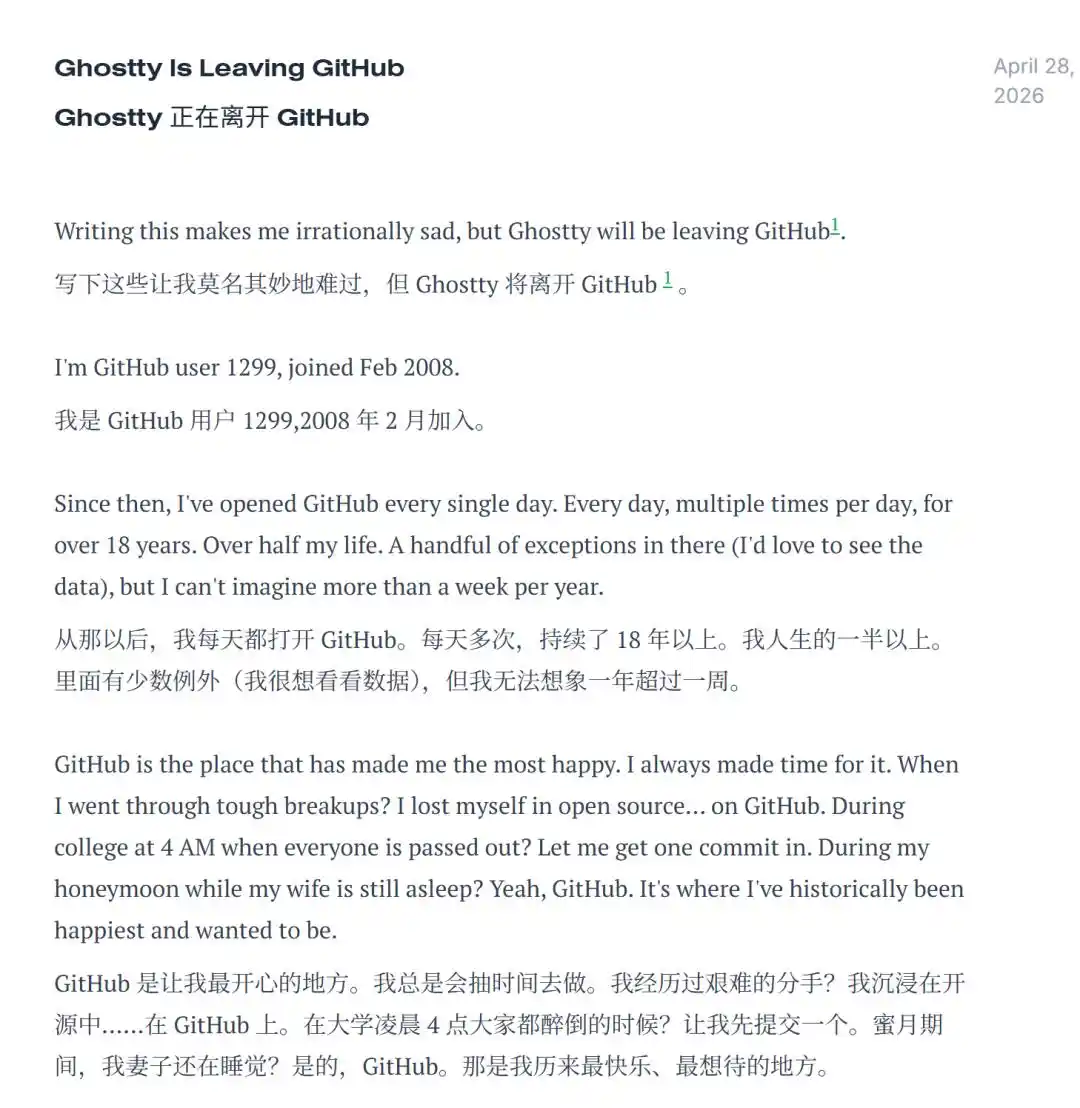
Mitchell Hashimoto, an 18-year veteran fan of GitHub and the famous developer of the Ghostty terminal, posted a sensational 'farewell letter' that went viral—every word bleeding with pain.

GitHub fails me every day.

I wish it were better, but I want to program more. I can no longer program using GitHub. I'm sorry, after 18 years, I have to go.

If a platform locks you out for hours every day, it is no longer suitable for serious work.

Subsequently, Ghostty packed up all its assets and decisively left.

His departure is just the tip of the iceberg in an avalanche.
GitHub's Life or Death

In recent months, giants like Citibank and Intel have expressed dissatisfaction to Microsoft over GitHub's ongoing failures. Even OpenAI has begun exploring self-built solutions.

To appease customers, Microsoft had to issue a large number of Credits to enterprise users as compensation for losses, leading directly to a bleeding of profits.

The most severe incident occurred last month: a mistakenly triggered, unreleased feature on GitHub caused numerous repositories to 'roll back,' with recent code modifications disappearing directly. Many enterprises have been forced to migrate.

Nearly eight years ago, when Microsoft acquired GitHub for $7.5 billion, global programmers were filled with concern.

As expected, after a brief golden period, this 'programmer's sanctuary'—hosting over 1.5 billion developers and 10 billion code repositories worldwide—now stands at a critical juncture of life or death in an extremely brutal manner.

3800+ Repositories 'Wiped Out' by Hackers

Even more serious, a recent security storm has completely stripped GitHub bare.

On May 21, 2026, a message instantly exploded on the hacker forum BreachForums: a hacker group openly offered GitHub's core source code for sale at a mere $50,000!
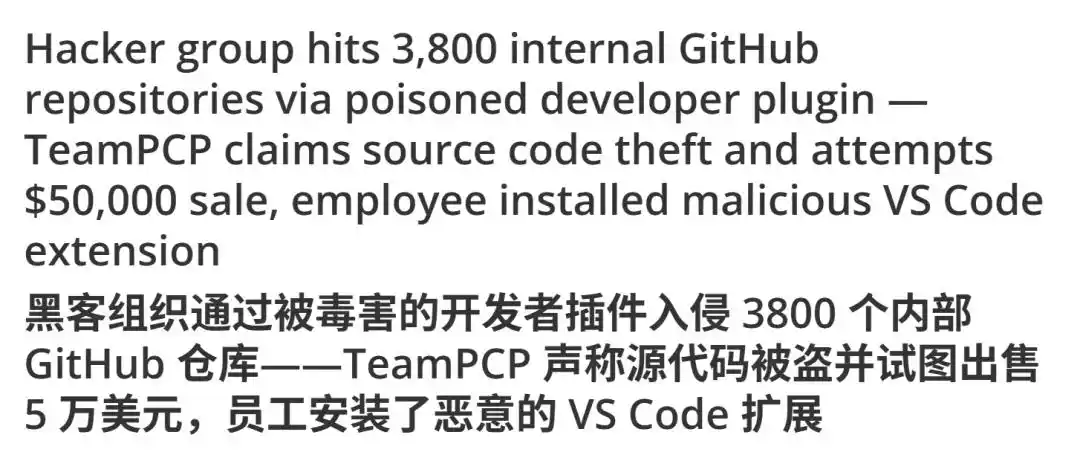
They arrogantly wrote:

Everything of the main platform is here. I would be happy to send samples to interested buyers for verification. This is not blackmail; we are too lazy to extort GitHub. If one person buys, we will completely destroy the data. If no buyer is found, we will soon make it public for free.
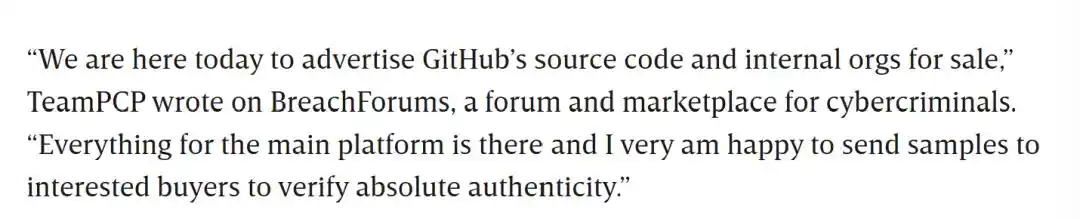
Subsequently, GitHub officially reluctantly confirmed: over 3,800 internal code repositories were indeed compromised.

The origin of this disaster is absurdly unbelievable: a GitHub internal developer installed a malicious, poisoned VS Code extension plugin on their work device. After credentials were leaked, over 3,800 repositories were breached.

VS Code and GitHub, both belonging to Microsoft, should have been a 'family ecosystem combination.' However, VS Code plugins lack high-intensity review mechanisms, making them the perfect entry point for hackers.

Because VS Code frequently prompts developers to install various plugins, these 'Trojan horses' can freely access local files, system terminals, etc.

When the GitHub engineer downloaded the malicious plugin, their long-term valid personal access token was instantly intercepted by the hackers!

For a platform built on 'code security and hosting,' having its source code publicly offered for sale is undoubtedly a resounding slap in the face.

This is just the tip of the iceberg.

In March of this year, security agencies discovered a 0-day-level critical vulnerability in GitHub's internal Git infrastructure.

If exploited, attackers could directly and unlimitedly access millions of public and private code repositories across the entire network, with consequences a hundred times more terrifying than this incident!

Management Shake-up: No More CEO, Reduced to a Microsoft Vassal

Behind the frequent security and technical incidents is GitHub's internal 'leaderless state' for nearly a year.

Last summer, the beloved former CEO Thomas Dohmke suddenly resigned. Microsoft then made a decision that shocked all employees: completely abolish the GitHub CEO position.

GitHub CEO Thomas Dohmke
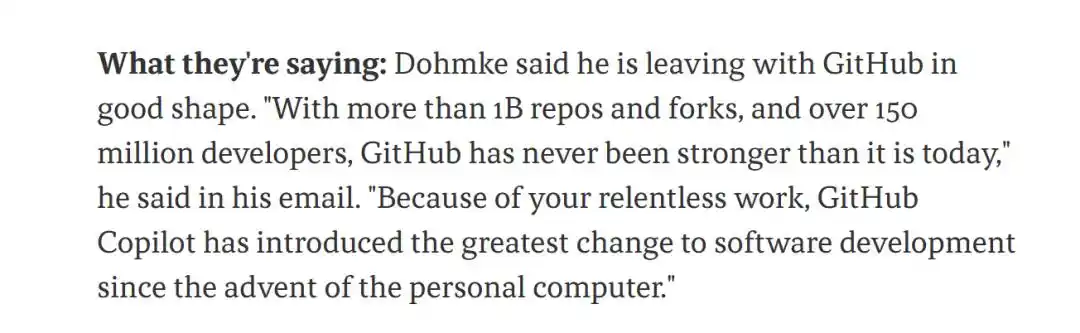
Dohmke thanked everyone: 'GitHub has never been stronger, with over 1 billion repositories and branches, and over 1.5 billion developers. It is thanks to your relentless efforts that GitHub Copilot has brought the biggest transformation in software development since the advent of the PC.'

For seven years, GitHub proudly maintained its status as an 'independent subsidiary.' But last summer, it was merged into the newly formed CoreAI team.

This drastic change directly pushed GitHub executives into an awkward position: they lost their direct line of communication with Microsoft's top leadership and were forced to report to Parikh, the head of the CoreAI team and former Meta executive.

However, Parikh is extremely unpopular internally. It was he who insisted on erasing the GitHub CEO position.

'There's basically no GitHub here anymore; it's now completely a department of Microsoft,' one senior employee angrily stated. 'Management and technical talent are fleeing madly.'

This was followed by a loss of top talent: former CEO Dohmke founded the next-generation developer platform Entire, poaching 11 people; 34-year veteran Julia Liuson resigned; Senior Vice President of Product Engineering Jared Palmer transferred to the Xbox team; the Chief Revenue Officer resigned.
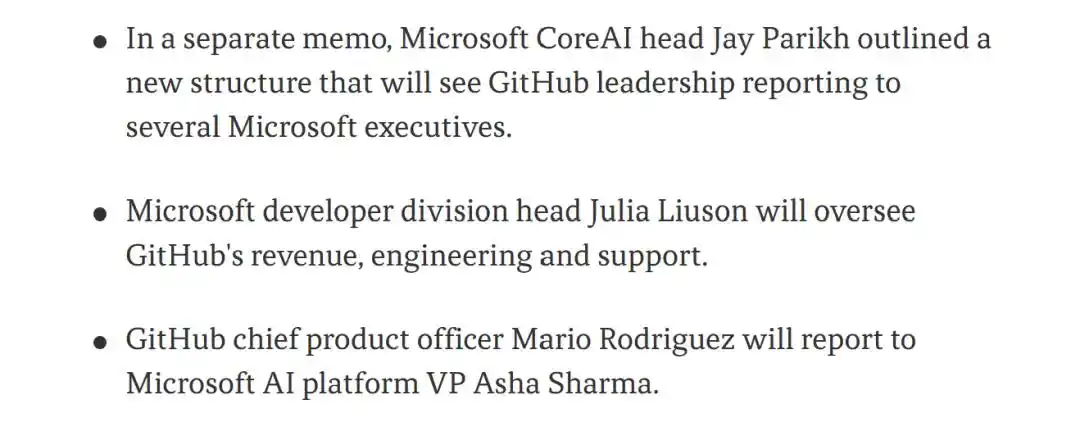
Current CTO Vladimir Fedorov aggressively promoted the project to migrate GitHub to Azure servers. This complex MySQL cluster relocation directly caused the chain of outages over the past year.

Thus, GitHub's R&D, finance, and marketing have been comprehensively strangled and devoured. Internally, there is division and discord, with the loss of technical backbone.

GitHub's once-proud 'pure developer culture' is being gnawed away by Microsoft's bureaucratic and powerful system!

Moat Breached: Cursor and Claude Code's Dimensional Reduction Strike

The external outages and internal turmoil have torn open huge cracks for predators.

Once, Copilot was almost synonymous with AI-assisted programming.

However, in 2024, Cursor emerged out of nowhere. While GitHub Copilot was still stuck in the 'you write a line, I guess the next line' code completion stage, Cursor could already understand the entire project context and generate entire modules with one click.

In 2025, Claude Code launched a dimensional reduction strike—it could not only write code but also automate complex debugging, testing, and multi-file collaborative modifications.

Microsoft was thrown into unprecedented panic internally. According to leaks, Jay Parikh warned with an ashen face in a meeting: GitHub is facing a 'death threat.'

Parikh's core fear is: once developers get used to completing all development in Cursor, they will no longer upload their code to GitHub.

To this end, Microsoft seriously evaluated acquiring Cursor but hesitated for a moment. In the blink of an eye, Cursor was snapped up by SpaceX.

What's even more amusing is that Claude Code is so incredibly good that tens of thousands of engineers in Microsoft's Windows and Office departments have all become die-hard fans of CC. Microsoft executives were completely broken!

Rajesh Jha issued a strict order to all staff, forcibly revoking all CC licenses by the end of June and forcing engineers to revert to using GitHub Copilot CLI.

Financial Avalanche: The 'Subsidy Black Hole' of Making More Money, Losing More Money

Moreover, GitHub's commercial operations are also deeply mired, even starting to backfire on Microsoft.

On the surface, GitHub's data still looks impressive. By the end of 2025, Copilot paid users surpassed 4.7 million, and GitHub's annual recurring revenue crossed the $3 billion threshold.
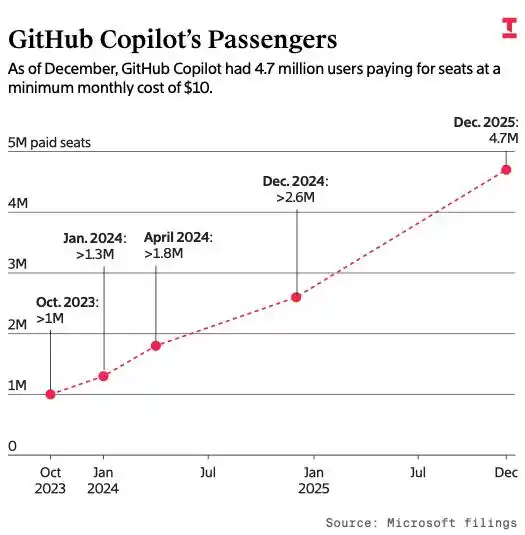
But behind the pretty numbers, it's all Microsoft's blood.

With the AI explosion, GitHub traffic surged 14 times. However, AI features for code hosting and open-source projects remain completely free.

Meanwhile, the inference costs for running AI models remain high. The computing power consumed by heavy users far exceeds the $10 monthly subscription fee—the more they sell, the more they lose.
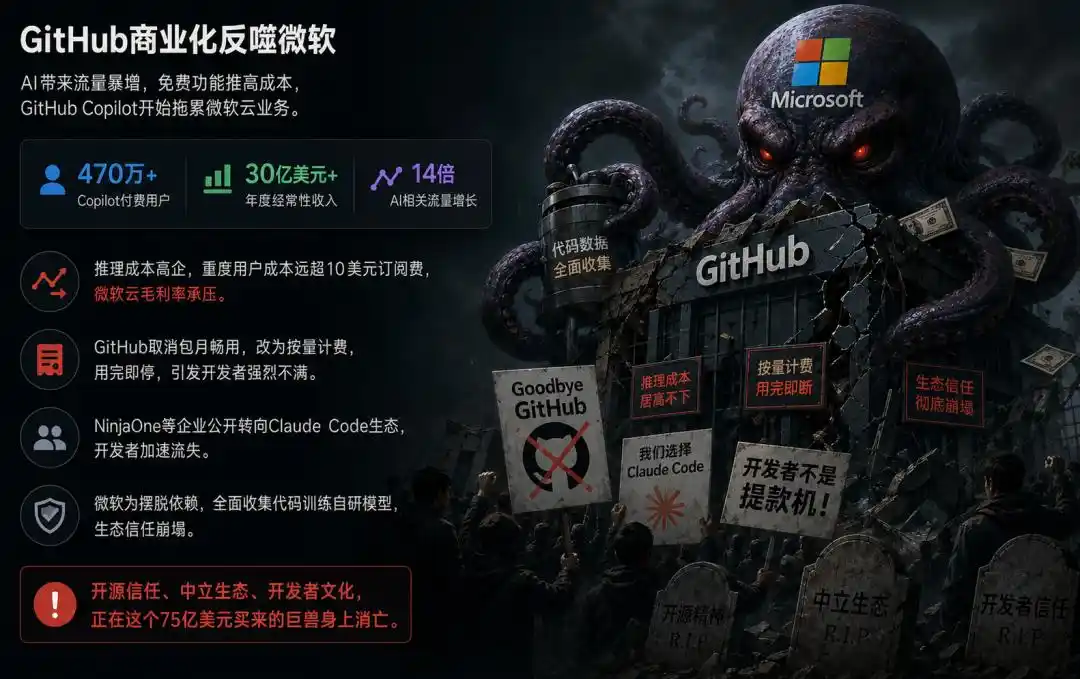
During Microsoft's earnings call in April this year, the CFO rarely admitted: the significant increase in GitHub Copilot usage directly lowered the gross margin of the entire core cloud business.

Under pressure from Wall Street, GitHub announced last month: abolish the unlimited monthly usage model and fully transition to 'pay-as-you-go.' Once credits are depleted, AI services are immediately cut off.

This move, perceived as greedy, completely infuriated developers!

The global IT services giant NinjaOne immediately publicly stated: they are comprehensively guiding engineers to abandon GitHub and turn to the Claude Code ecosystem.

Will GitHub Die?

This year, Microsoft's stock price has fallen by over 10%, performing the worst among the 'Magnificent Seven' tech stocks.

Its developer ecosystem cornerstone, GitHub, is pushing everything toward the abyss.

To break free from dependence on OpenAI and Anthropic, CoreAI has ordered the comprehensive collection of all code to train Microsoft's own native large model.

This practice of recklessly depleting the ecosystem for its own benefit has completely chilled developers worldwide.

The trust of the open-source community, the neutral ecological environment, and the free, pure developer culture are rapidly vanishing from this $7.5 billion behemoth.

Now, the most fatal question facing Satya Nadella is: In the era of AI agents, do global developers still need a central code repository platform like GitHub?

If Microsoft cannot provide a convincing answer, it will lose the soul it has cultivated around its ecosystem for decades—

'Developers, developers, developers!'

References:

https://www.theverge.com/tech/935250/microsoft-github-struggles-notepadhttps://mitchellh.com/writing/ghostty-leaving-githubhttps://www.wired.com/story/teampcp-software-supply-chain-attack-spree-github/?utm_source=chatgpt.com

This article comes from the WeChat public account "Xinzhiyuan," author: ASI Revelation.

Preguntas relacionadas

QWho is Mitchell Hashimoto and what significant action did he take regarding GitHub?

AMitchell Hashimoto is the developer of the Ghostty terminal and a long-time GitHub user. He recently announced his departure from the platform, citing frequent outages that prevented serious work, and moved the Ghostty project assets away from GitHub.

QWhat major security incident involving GitHub's source code is detailed in the article?

AA hacker group breached and stole the source code for over 3,800 of GitHub's internal repositories. The breach originated from a GitHub engineer installing a malicious VS Code extension, which compromised their credentials, allowing the hackers to access and later attempt to sell the code.

QHow has Microsoft's internal restructuring impacted GitHub's leadership?

AMicrosoft disbanded GitHub's independent subsidiary status and merged it into the CoreAI team. The CEO position was eliminated, and GitHub's leadership now reports to the CoreAI head, Jay Parikh, leading to a loss of autonomy, internal dissatisfaction, and a significant exodus of senior talent.

QWhat competitive threats to GitHub Copilot are mentioned, and what was Microsoft's internal reaction?

AThe article cites Cursor and Claude Code as major competitive threats, offering more advanced AI-assisted programming features. Microsoft was internally alarmed, with executives describing it as an 'existential threat.' Notably, many Microsoft engineers preferred using Claude Code, prompting management to forcibly revoke its licenses within the company.

QWhat financial and operational challenges is GitHub facing according to the article?

AGitHub is struggling with profitability despite high revenue. The massive computational costs of running free AI features like Copilot exceed subscription income, negatively impacting Microsoft's cloud margins. In response, GitHub shifted from a flat-rate subscription to a pay-as-you-go model, which angered many developers and prompted some companies to consider alternatives.

Lecturas Relacionadas

IOSG Founder: Web3 Is 'Losing Blood,' How Can Practitioners Survive Better?

IOSG Founder: Web3 Is "Bleeding Out" – How Can Practitioners Survive Better? In a candid reflection, the founder of IOSG Ventures voices deep concerns about the current state of Web3, describing an ecosystem experiencing severe "blood loss." Despite the recent MuShanghai event showcasing a successful pivot towards a more diverse, global community, a somber reality persists: many crypto-native attendees were there exploring exits or new labels in biotech, AI, and robotics. The core issue is identified as a breakdown in the ecosystem's positive feedback loop. Alarmingly, underestimated "low-probability bad events" are occurring simultaneously: a significant brain drain of Chinese developers to AI, a lack of breakout applications despite massive funding, and a widening credibility gap for practitioners globally, often stigmatized as scam artists. This has created a dire接班人 (successor) problem, with the next generation seeing little professional prestige or financial upside in crypto compared to fields like AI. A significant portion of the critique focuses on Ethereum and Vitalik Buterin. While not pessimistic about Ethereum's technology, the founder worries that critical development windows were missed by focusing on niche technical narratives like ZK and L2 instead of mass-market applications. A more urgent concern is that Vitalik may be isolated in an "information bubble," shielded from the grassroots community's hardships by layers of intermediaries, preventing crucial feedback from reaching him. The call is for Vitalik to return to a founder's mindset, re-engage directly with the community, and rally efforts for the next decade. The divergence between U.S. and Chinese OG (Original Gangster) ecosystems is stark. While many U.S. builders reinvest their wealth into the ecosystem, the Chinese scene suffers from a severe lack of "造血能力" (blood-making ability), with most market-driven funds struggling and many early success stories cashing out entirely. This threatens the entire Asian Web3 ecosystem's survival. For individual practitioners, survival advice is pragmatic: find your core "why," maintain life balance beyond token prices, continuously learn new skills (like AI), form small, trusted alliances for mutual support, and practice self-compassion. The industry's greatest need is not money or tech, but lighthouses—individuals at all levels who offer mentorship, grants, referrals, and honest reflection to guide others. The piece concludes with a direct appeal: OGs must pay forward the opportunities the industry gave them; founders must not struggle alone; and builders must continue their work, ensuring it remains a viable profession. The survival of Web3's "cathedral" depends not on any single leader but on the collective responsibility of everyone who remains.

marsbitHace 32 min(s)

IOSG Founder: Web3 Is 'Losing Blood,' How Can Practitioners Survive Better?

marsbitHace 32 min(s)

Deficits, Inflation, and the New Fed: The Deep Logic Behind US Bond Yields Breaking 5% and the Market Reset

In the week of May 15-19, 2026, U.S. long-term Treasury yields surged to multi-year highs, with the 30-year yield hitting 5.2%, a level unseen since 2007, and the 10-year yield climbing to 4.687%. Equity markets declined in response. Four primary factors are driving the rise in yields. First, stubborn inflation persists, with April wholesale prices rising 6% year-over-year, fueling expectations of potential future Fed rate hikes instead of cuts. Second, newly confirmed Fed Chair Kevin Warsh inherits a complex inflation battle, with markets closely awaiting his first FOMC meeting. Third, deteriorating U.S. fiscal health, marked by large deficits and rising debt servicing costs, is eroding the traditional "safe-haven" premium for Treasuries. Fourth, the "One Big Beautiful Bill" tax cuts are projected to add trillions to the national debt, contributing to Moody's recent credit rating downgrade. Rising yields pressure stocks through several channels: a higher discount rate reduces the present value of future earnings (especially for growth stocks); rising risk-free rates compress equity risk premiums, making bonds relatively more attractive; higher borrowing costs impact consumers and corporations; and a stronger dollar affects multinational earnings. For investors, the environment favors value and financial stocks over long-duration growth stocks. Bond investors find attractive yields in short to intermediate maturities, while income investors see the best fixed-income opportunities in over a decade. Key developments to watch include Chair Warsh's first FOMC meeting, upcoming inflation data, Treasury auction demand, and whether the 30-year yield approaches 6%, a level that could trigger a more sustained equity valuation reset. The bond market's message is clear: the era of cheap government borrowing is over, posing a central challenge for markets in late 2026.

marsbitHace 34 min(s)

Deficits, Inflation, and the New Fed: The Deep Logic Behind US Bond Yields Breaking 5% and the Market Reset

marsbitHace 34 min(s)

Is MicroStrategy Selling Bitcoin Not a Bearish Signal? Deconstructing the 5 Financial Logics Behind Corporate Bitcoin Divestment

The article "Is Strategy Selling Bitcoin Not a Bearish Signal? Decoding 5 Financial Logics Behind Corporate Bitcoin Divestment" analyzes why companies might sell their bitcoin holdings, arguing it's not necessarily negative. It begins by noting the market's surprise at Strategy's potential sale, contrasting its previous "never sell" stance. The core argument is that corporate decisions prioritize shareholder value, and selling bitcoin can be a rational strategic choice. The article outlines five key financial reasons for such sales: 1. **Increase Bitcoin Holdings Per Share:** Companies can use proceeds from bitcoin sales to repurchase shares when the stock price is undervalued relative to its bitcoin assets. This reduces the outstanding share count, potentially increasing the bitcoin amount backing each remaining share. 2. **Optimize Capital Structure & Reduce Financing Costs:** Building cash reserves through bitcoin sales can improve credit ratings (as favored by agencies like S&P), leading to lower future borrowing costs. Repaying debt with sale proceeds also reduces financial leverage. 3. **Legitimate Tax Planning:** In the absence of wash-sale rules for bitcoin in the US, companies can sell to realize capital losses, then repurchase, lowering the tax basis of their holdings and creating tax offsets. 4. **Counter Negative Market Narratives:** A controlled, non-disruptive sale could demonstrate market resilience and disprove fears that corporate selling would crash the market, thereby normalizing bitcoin as a corporate treasury asset. 5. **Repurchase Preferred Stock at a Discount:** If a company's preferred stock trades significantly below its face value, using bitcoin sale proceeds to repurchase it can retire expensive liabilities at a profit, saving on future dividend payments. The conclusion emphasizes that bitcoin's monetary properties offer flexibility. Strategic sales can protect corporate and shareholder interests, making asset utilization more important than rigid "hold" mandates.

marsbitHace 1 hora(s)

Is MicroStrategy Selling Bitcoin Not a Bearish Signal? Deconstructing the 5 Financial Logics Behind Corporate Bitcoin Divestment

marsbitHace 1 hora(s)

Why Did Zhipu Surge Nearly 30% in a Single Day?

"Global AI Model Unicorn" Zhipu's stock surged nearly 30% in a single day, reaching a new market cap high. The catalyst was the launch of its GLM-5.1-highspeed API, boasting a generation speed of **400 tokens per second**, setting a new global benchmark. This speed, roughly 3-5 times faster than industry leaders like OpenAI's GPT-4o and Anthropic's Claude, is achieved **without compromising the full-scale model's capabilities**. In the era of AI Agents requiring dozens of self-calls, such latency reduction is critical, transforming speed from a system metric into a determinant of intelligence limits. The breakthrough stems from a three-layer technical overhaul: 1. **TileRT Inference Engine**: Compiles the entire model into a continuous, always-on computation pipeline using "Warp Specialization," minimizing GPU idle time by having different processor groups handle data loading, computation, and communication in parallel. 2. **Heterogeneous Parallelism for MLA**: To efficiently run the GLM-5.1 model using the MLA attention mechanism, TileRT employs a heterogeneous strategy. One GPU handles sparse indexing/routing, while the others perform dense computation, optimizing for MLA's unique workflow. 3. **ZCube Network Architecture**: Replaces the standard Spine-Leaf (ROFT) network topology with a flat, dual-group interconnect. This design creates a single optimal path between any two GPUs, eliminating network congestion at scale and reducing latency. The business impact is significant: a 15% increase in cluster throughput (free extra capacity), a 40.6% reduction in tail latency (improved stability), and a one-third cut in networking hardware costs. Long-term, this innovation challenges the dominance of NVIDIA's integrated hardware-software stack (GPU+NVLink+InfiniBand), potentially benefiting manufacturers of high-density Leaf switches and optical modules while lowering the software barrier for domestic AI chips like Huawei's Ascend. The innovation proves that more can be achieved with the same compute, reshaping the infrastructure beyond just GPUs.

marsbitHace 2 hora(s)

Why Did Zhipu Surge Nearly 30% in a Single Day?

marsbitHace 2 hora(s)

Trading

Spot
Futuros

Artículos destacados

Cómo comprar OP

¡Bienvenido a HTX.com! Hemos hecho que comprar Optimism (OP) sea simple y conveniente. Sigue nuestra guía paso a paso para iniciar tu viaje de criptos.Paso 1: crea tu cuenta HTXUtiliza tu correo electrónico o número de teléfono para registrarte y obtener una cuenta gratuita en HTX. Experimenta un proceso de registro sin complicaciones y desbloquea todas las funciones.Obtener mi cuentaPaso 2: ve a Comprar cripto y elige tu método de pagoTarjeta de crédito/débito: usa tu Visa o Mastercard para comprar Optimism (OP) al instante.Saldo: utiliza fondos del saldo de tu cuenta HTX para tradear sin problemas.Terceros: hemos agregado métodos de pago populares como Google Pay y Apple Pay para mejorar la comodidad.P2P: tradear directamente con otros usuarios en HTX.Over-the-Counter (OTC): ofrecemos servicios personalizados y tipos de cambio competitivos para los traders.Paso 3: guarda tu Optimism (OP)Después de comprar tu Optimism (OP), guárdalo en tu cuenta HTX. Alternativamente, puedes enviarlo a otro lugar mediante transferencia blockchain o utilizarlo para tradear otras criptomonedas.Paso 4: tradear Optimism (OP)Tradear fácilmente con Optimism (OP) en HTX's mercado spot. Simplemente accede a tu cuenta, selecciona tu par de trading, ejecuta tus trades y monitorea en tiempo real. Ofrecemos una experiencia fácil de usar tanto para principiantes como para traders experimentados.

391 Vistas totalesPublicado en 2024.12.12Actualizado en 2025.03.21

Cómo comprar OP

Discusiones

Bienvenido a la comunidad de HTX. Aquí puedes mantenerte informado sobre los últimos desarrollos de la plataforma y acceder a análisis profesionales del mercado. A continuación se presentan las opiniones de los usuarios sobre el precio de OP (OP).

活动图片