Robinhood Chain Leads All Networks in Tokenized Stock Holders One Month After Launch

cryptonews.ruPublicado a 2026-07-28Actualizado a 2026-07-28

Resumen

A month after its mainnet launch on July 1, Robinhood Chain has become the leading blockchain network by number of tokenized stock holders, according to data from Token Terminal. The network now boasts 329,200 holders, surpassing Solana (281,400) and BNB Chain (214,600). Overall, the total number of tokenized stock holders across all networks grew by approximately 68.5% this month, reaching 934,800. This rapid growth is attributed not to superior technology, but to Robinhood's direct distribution to its existing user base of roughly 28 million brokerage app users, who can access tokenized stocks without dealing with crypto wallets or gas fees. However, while Robinhood Chain holds about 35% of all tokenized stock holders, the total value of assets on the network is only around $44 million, resulting in an average balance of just over $130 per wallet. In contrast, platforms like Ondo Finance manage significantly more capital ($857 million) with far fewer wallets, catering more to institutional investors. Currently, trading volume on Robinhood Chain is still heavily driven by meme coins, with tokenized stocks growing alongside, not replacing, this speculative activity. The network's future significance in the tokenized assets space will depend on whether the average wallet balances increase from their current retail-focused levels.

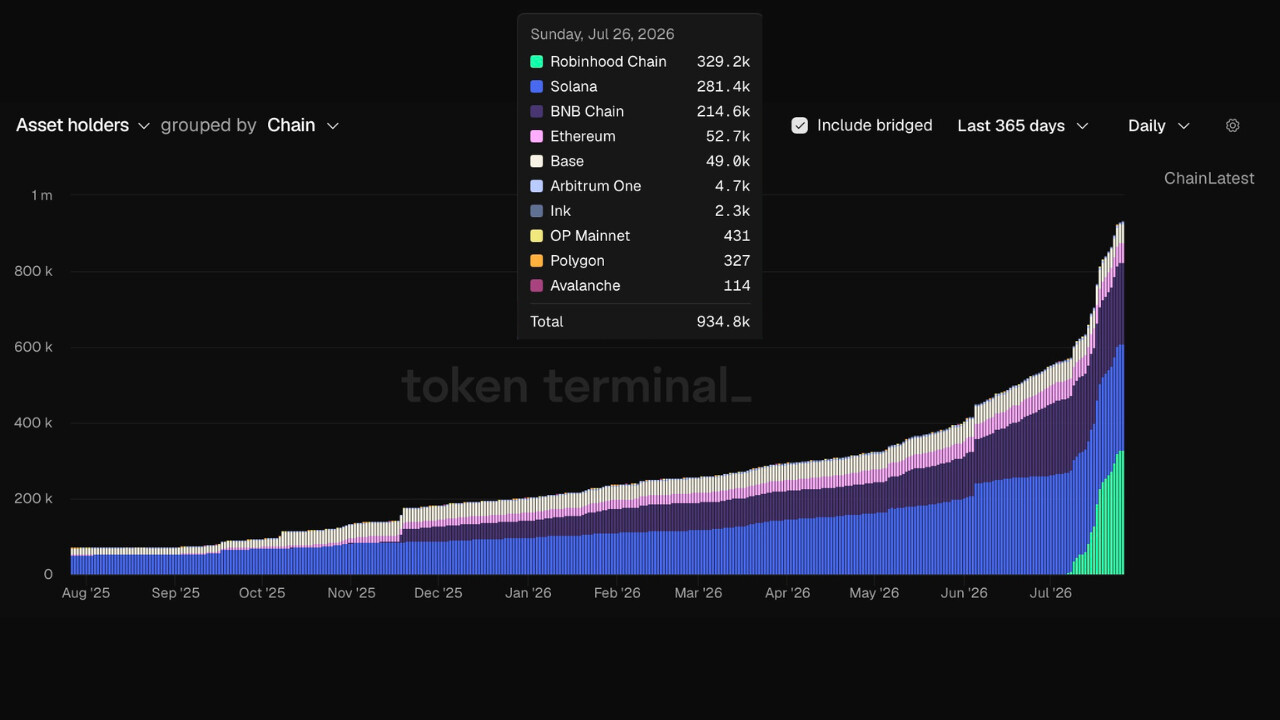
Since the beginning of the month, the number of tokenized stock holders has grown by approximately 68.5% — from 554.9 thousand to 934.8 thousand. The primary reason for this surge is the emergence of Robinhood Chain, which now has more tokenized stock holders than any other network. The latest data from Token Terminal shows that the network counts 329.2 thousand asset holders, surpassing long-time leaders in this category: Solana (281.4 thousand) and $BNB Chain (214.6 thousand). The main Robinhood Chain network launched on July 1st, and in less than four weeks it managed to overtake Solana, a network that held leading positions in this category for most of last year.
Source: Token Terminal

The chart above of token holders shows where the growth came from. Solana led the sector throughout last year and was the network, along with $BNB Chain and Ethereum, that gradually increased the base of tokenized stock holders. Then July arrives, and a green block appears almost vertically. Robinhood Chain now occupies almost a third of the entire sector in terms of token holders, starting from zero.

Victory Was Achieved by Distribution, Not the Network

Robinhood Chain's rapid growth did not occur because the company implemented more advanced infrastructure compared to other existing networks. It took the leading position by occupying the "front door." By "front door," we mean the huge existing user base under the Robinhood umbrella. Tokenized stocks were placed in the already existing brokerage app, which had about 28 million users, most of whom never had to think about a wallet, a bridge, or a transaction fee to ultimately receive a token.

Other networks in the tokenized stock market have to convince a large group of existing cryptocurrency users to buy stocks. Robinhood, on the contrary, only needed to convince stock users to click a button, and it would immediately be reflected on the blockchain as a holder number.

Owner of 35% of Shares, Holding $44 Million in Assets

The advantage is great, but at the same time, insignificant. Robinhood accounts for about 35% of tokenized stock holders, but according to DWF Labs, there are only about $44 million in assets. Ondo, for comparison, has about $857 million, with a significantly smaller number of wallets.

The calculations are not optimistic. The average asset volume per wallet on Robinhood Chain is just over $130. Retail investors opening small positions in tokenized assets of Tesla or Nvidia will show exactly this picture. Institutional and accredited investors, which Ondo aims for, show the opposite result. The number of holders is a distribution metric. It is not a capital metric, and at this stage, these two metrics rarely change together.

Meme Coins Still Lead in Trading Volume

At the beginning of this month, the main topic of discussion was meme coins and speculation, and this trend has not disappeared. Trading volume on Robinhood Chain is still largely focused on meme coins, and tokenized stocks are growing on this base, not replacing it. Both are true simultaneously. The speculative layer attracted initial liquidity and attention, and the stock layer gives the network a reason to exist beyond that.

The future of the cryptocurrency depends on whether average balances will grow. If holder balances remain at $130 per wallet, Robinhood will create a very large but very small user base, and asset metrics will still favor Ondo. However, if balances grow even slightly across 329,000 wallets, then the rating that matters will also start to change.

end-content
Criptos en tendencia

Preguntas relacionadas

QWhat network now has the most tokenized stock holders, and how many holders does it have according to the latest data from Token Terminal?

AAccording to the latest data from Token Terminal, Robinhood Chain now has the most tokenized stock holders, with 329.2 thousand holders.

QAccording to the article, what is the primary reason for Robinhood Chain's rapid growth in the number of tokenized stock holders?

AThe primary reason is distribution through its massive existing user base. Tokenized stocks were placed directly into the existing Robinhood broker app, which has about 28 million users, eliminating the need for them to think about wallets, bridges, or transaction fees.

QHow much in assets under management does Robinhood Chain currently have in its tokenized stock sector, and what is the average asset per wallet?

ARobinhood Chain currently has about $44 million in assets under management in its tokenized stock sector, with an average asset per wallet of just over $130.

QWhat is the main trading volume focus on the Robinhood Chain network, according to the article?

AAccording to the article, trading volume on the Robinhood Chain network is still largely focused on meme-coins.

QWhat does the article state needs to happen for Robinhood Chain's asset rankings to become more significant compared to a competitor like Ondo?

AThe article states that for Robinhood Chain's asset rankings to become more significant, the average balances in its 329,000 wallets need to grow. If balances remain at around $130 per wallet, its large user base will still hold a relatively small total value.

Lecturas Relacionadas

Miners Advised Not to Buy GPUs for AI and to Focus on Infrastructure

A founder at an energy investment forum advises bitcoin miners not to purchase GPUs for AI themselves, but to instead focus on infrastructure like power and data center space. Mike Alfred of Alpine Fox stated that while AI infrastructure demand is a long-term, 20-30 year trend, it presents a key choice for miners. The first, riskier model involves owning and operating GPUs, which requires financing expensive hardware that quickly becomes obsolete. The second, more conservative model is akin to real estate: providing colocation services where clients bring their own servers, and the miner sells space, power, cooling, and water. Alfred noted this model is easier to finance. Most existing bitcoin mining sites are difficult and expensive to convert for AI, as AI data centers require far higher construction costs, redundant fiber connections, backup power, complex cooling, and near 100% uptime. A hybrid model, where mining acts as a flexible load to use excess power during AI data center construction or from generation facilities, was discussed. However, participants concluded this is only viable with very cheap power; otherwise, developers are better off focusing solely on AI. Miners are increasingly being evaluated for their available power capacity and project portfolios rather than just bitcoin output. Panelists also warned of risks in the AI sector, predicting at least one major default or contract breach among AI tenants, lenders, or landlords before bitcoin's next halving in 2028.

cryptonews.ruHace 3 min(s)

Miners Advised Not to Buy GPUs for AI and to Focus on Infrastructure

cryptonews.ruHace 3 min(s)

Millisecond 'Pay-to-Cut': How Did Hyperliquid's Priority Fee Turn into a Multi-Million Dollar Business?

"Millisecond 'Paid Queue-Jumping': How Hyperliquid's Priority Fee Became a Multi-Million Dollar Annual Business" In traditional finance, high-frequency trading firms spend millions on infrastructure for millisecond advantages. Hyperliquid has translated this race onto the blockchain with its "Priority Fee" system, creating an open economic game for speed. This system auctions two types of priority: **Gossip Priority** for faster data feeds (via a Dutch auction every 3 minutes), and **Order Priority** for front-of-queue trade execution (users bid a fee for lower latency). This converts a hardware race into a transparent, market-priced mechanism. Since launch, this feature has generated over $5M in protocol revenue. Projected annualized buybacks from this income exceed $30M, accounting for ~7% of total protocol revenue. The demand stems from large traders and market makers on Hyperliquid, for whom milliseconds can mean the difference between profit/loss or avoiding liquidation. Market makers pay these fees as "protection" to ensure their orders execute first, which in turn improves liquidity for all users. Crucially, Hyperliquid internalizes Maximum Extractable Value (MEV) that typically leaks to external validators or searchers, creating a new revenue stream beyond trading fees. The mechanism also strengthens HYPE's tokenomics. While 97% of trading fees fund secondary market buybacks (via the Assistance Fund), Priority Fees are **directly burned**, adding a second deflationary engine. Furthermore, fees for order priority are deducted from users' undelegated HYPE balances, encouraging large traders to hold and lock up tokens, reducing circulating supply. However, a key challenge remains: balancing the speed needs of institutional players with fair market access for retail users, as those who cannot pay high fees may suffer worse slippage during volatility. In summary, Hyperliquid's Priority Fee is a novel model that monetizes latency, captures MEV for the protocol, and enhances its native token's value through burning and lock-ups.

marsbitHace 8 min(s)

Millisecond 'Pay-to-Cut': How Did Hyperliquid's Priority Fee Turn into a Multi-Million Dollar Business?

marsbitHace 8 min(s)

The Truth Behind Digital Banking: The Fragile Ecosystem Supporting 1.46 Billion Users

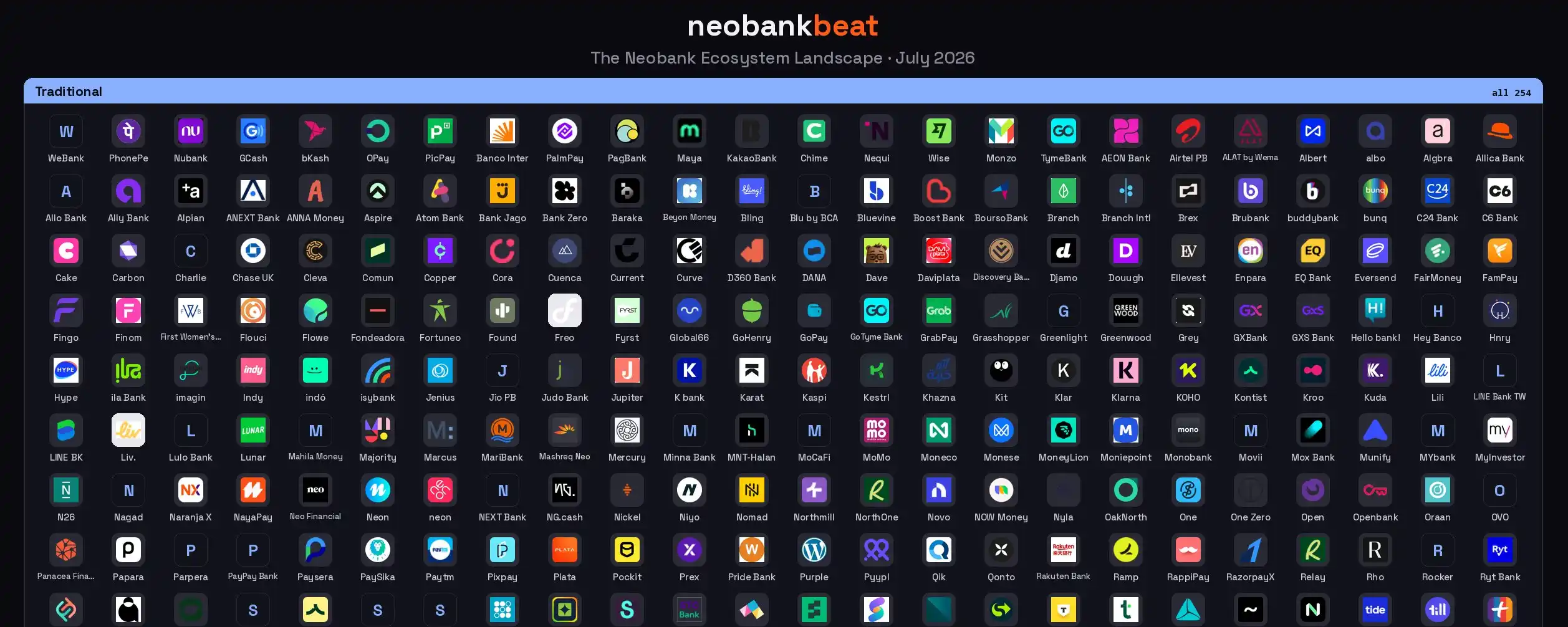
The article "The Truth About Digital Banks: The Fragile Ecosystem Behind 1.46 Billion Users" provides a data-driven analysis of the digital banking sector based on a verified list of 368 active neobanks as of July 2026. While these platforms collectively serve 1.46 billion users, with Asia (817 million users) and institutions like WeBank and Nubank dominating the landscape, the sector faces significant structural vulnerabilities. A key finding is that only 127 of the 368 neobanks hold full banking licenses. The majority operate atop third-party infrastructure providers like Banking-as-a-Service (BaaS) platforms, creating systemic risk where the failure of a single provider, as seen in past cases like Wirecard and Synapse, can jeopardize multiple consumer brands. Furthermore, the industry experiences a steady, quiet stream of failures, mergers, and shutdowns that often go unreported. The analysis also examines the adoption of artificial intelligence (AI), finding only 67 platforms (18%) have deployed AI at scale, with many innovators based in emerging markets like Nigeria and the Philippines. The infrastructure layer is highly concentrated, with 106 providers supporting the entire ecosystem of 368 consumer-facing brands. The article concludes with three predictions: the unlicensed gap will close through acquisitions or exits; an AI credit model is likely to fail in the next economic downturn; and a nascent but significant trend is the emergence of financial services designed for AI agents rather than humans.

marsbitHace 23 min(s)

The Truth Behind Digital Banking: The Fragile Ecosystem Supporting 1.46 Billion Users

marsbitHace 23 min(s)

Digital Asset Trading Platform Uphold Cuts 17% of Global Workforce Amid 'Crypto Winter'

Cryptocurrency trading platform Uphold has laid off approximately 17% of its global workforce, affecting 85 full-time employees and contractors. The cuts are part of a strategic shift to reallocate resources towards its rapidly growing corporate services business, as retail cryptocurrency trading activity has declined amid the ongoing market downturn. CEO Simon McLaughlin stated the company is restructuring after years of significant growth and remains confident in the long-term prospects of digital assets and blockchain technology. Founded in 2015, Uphold offers trading and custody services for cryptocurrencies, fiat, stocks, and precious metals. It has recently expanded to provide infrastructure for banks, fintech firms, and broker-dealers to integrate crypto services. The layoffs occur against a backdrop of a prolonged crypto market slump, with total market capitalization falling to around $2.1 trillion by Q2 2024. Factors include weakened trading volumes, reduced retail participation, interest rate hikes, geopolitical uncertainty, and net outflows from U.S. spot Bitcoin ETFs. Uphold clarified it is not shutting down its UK operations or any international offices. The company highlighted strong growth in its corporate platform and announced plans to evolve its consumer app into a broader blockchain-based financial assistant by 2026, offering U.S. stocks, tokenized securities, lending, credit cards, and DeFi yield opportunities.

cryptonews.ruHace 23 min(s)

Digital Asset Trading Platform Uphold Cuts 17% of Global Workforce Amid 'Crypto Winter'

cryptonews.ruHace 23 min(s)

Trading

Spot

Artículos destacados

Cómo comprar ONE

¡Bienvenido a HTX.com! Hemos hecho que comprar Harmony (ONE) sea simple y conveniente. Sigue nuestra guía paso a paso para iniciar tu viaje de criptos.Paso 1: crea tu cuenta HTXUtiliza tu correo electrónico o número de teléfono para registrarte y obtener una cuenta gratuita en HTX. Experimenta un proceso de registro sin complicaciones y desbloquea todas las funciones.Obtener mi cuentaPaso 2: ve a Comprar cripto y elige tu método de pagoTarjeta de crédito/débito: usa tu Visa o Mastercard para comprar Harmony (ONE) al instante.Saldo: utiliza fondos del saldo de tu cuenta HTX para tradear sin problemas.Terceros: hemos agregado métodos de pago populares como Google Pay y Apple Pay para mejorar la comodidad.P2P: tradear directamente con otros usuarios en HTX.Over-the-Counter (OTC): ofrecemos servicios personalizados y tipos de cambio competitivos para los traders.Paso 3: guarda tu Harmony (ONE)Después de comprar tu Harmony (ONE), guárdalo en tu cuenta HTX. Alternativamente, puedes enviarlo a otro lugar mediante transferencia blockchain o utilizarlo para tradear otras criptomonedas.Paso 4: tradear Harmony (ONE)Tradear fácilmente con Harmony (ONE) en HTX's mercado spot. Simplemente accede a tu cuenta, selecciona tu par de trading, ejecuta tus trades y monitorea en tiempo real. Ofrecemos una experiencia fácil de usar tanto para principiantes como para traders experimentados.

337 Vistas totalesPublicado en 2024.12.12Actualizado en 2026.06.02

Cómo comprar ONE

Discusiones

Bienvenido a la comunidad de HTX. Aquí puedes mantenerte informado sobre los últimos desarrollos de la plataforma y acceder a análisis profesionales del mercado. A continuación se presentan las opiniones de los usuarios sobre el precio de ONE (ONE).

活动图片