Top Korean Crypto Media TokenPost Integrates RootData and Launches Relationship Map Feature

链捕手Publicado a 2026-07-27Actualizado a 2026-07-27

Resumen

Korean leading crypto media TokenPost has integrated RootData's data and introduced a 'Relationship Map' feature on its crypto asset data platform, Token Watch. This new functionality visualizes the connections between projects, investors, and key personnel, specifically focusing on crypto assets listed on the Korean Won market. The map displays the top 30 investors by portfolio and key individuals active across multiple projects. Users can search or filter by type to view specific connections. Relationship lines are categorized into General Investment, Lead Investment, Current Affiliation, and Past Affiliation. This allows users to identify not only who invested but also who led investment rounds, as well as the current or past organizational ties of key figures. Key utilities of the tool include identifying co-investors, frequently co-investing VC combinations, overlapping investors among competing projects, and recurring key personnel. It serves as a reference for investors, a research tool for journalists, and a means for professionals to explore connection pathways. The underlying investor and personnel data is sourced from RootData, with TokenPost editorial verification for some details. The feature is available directly on the web with Korean and English language support. TokenPost emphasized that understanding a project requires insight into its backing network and stated plans to continue optimizing the map. All information is for reference only and not investment...

Author: Han Jae-ho

TokenPost's crypto asset data platform "Token Watch" has launched an "Interaction Relationship Map" feature that allows users to visually understand the connections between projects, investors, and key figures at a glance.

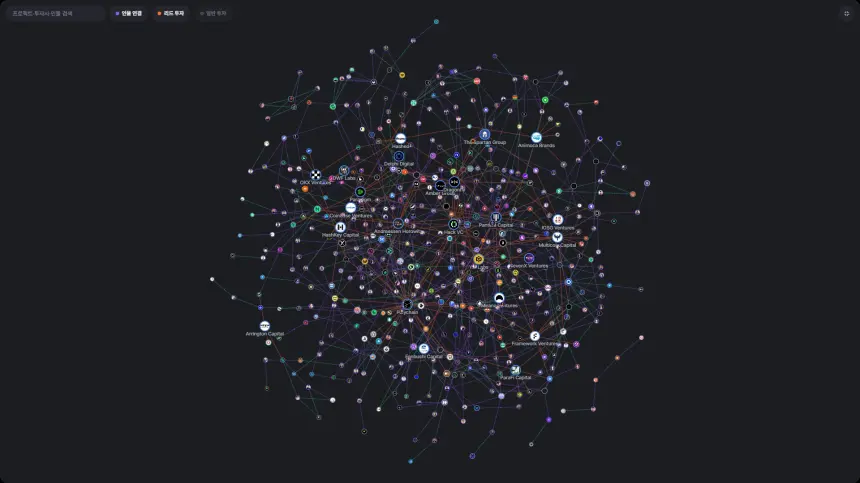
The newly added relationship map visualizes the connections between investors and key figures, centered on crypto asset projects listed on the Korean Won market. It allows users to not only view the investment background of individual projects but also explore other projects backed by the same investors, as well as past and present affiliations of individuals, all within the same screen.

The map currently displays the top 30 investors by portfolio and key figures identified across multiple projects. Users can directly search for projects, investors, or people, or filter by type to extract only the desired relationships.

The relationship lines are categorized into ▲General Investment ▲Lead Investment ▲Current Affiliation ▲Past Affiliation. This distinction allows users to confirm not only which investors participated in a specific project but also who led the investment round, and which organizations a key figure is currently or was previously associated with.
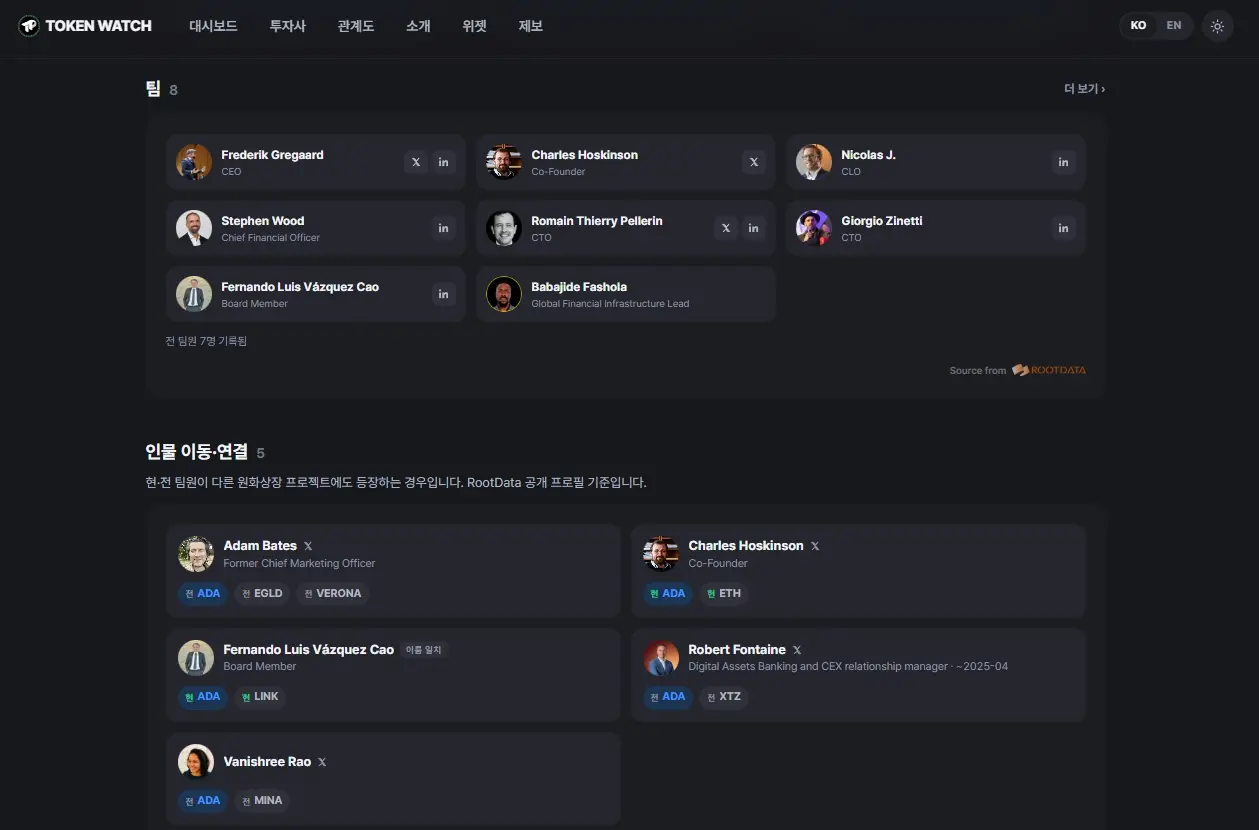
For example, selecting a specific project displays the investors in that project and related individuals. Conversely, focusing on an investor shows that investor's portfolio of Won-listed projects and co-investment relationships with other investors.

Clicking on a node and using the "View centered on this node" function retains only connections within two degrees of separation from the selected object. This allows users to quickly focus on a specific project or investor and narrow down the core relationships, even when the overall network appears complex. The feature also supports dragging nodes and zooming the view.

With this relationship map, Token Watch goes beyond simple investor lists, enabling users to explore the multi-dimensional networks of capital and talent in the crypto asset market.

This feature can be used to uncover information previously difficult to confirm from project-disclosed investor logos alone, such as:

  • Co-investors

  • Frequently co-investing VC combinations

  • Investor overlap between competing projects

  • Key individuals recurring across multiple projects

For investors, it can serve as a reference to verify the background of projects of interest. For journalists and researchers, it can be used as a tool for interviews and analysis to uncover hidden commonalities between projects. For industry professionals and business development personnel, it can be used to view connection paths between projects, investors, and key figures.
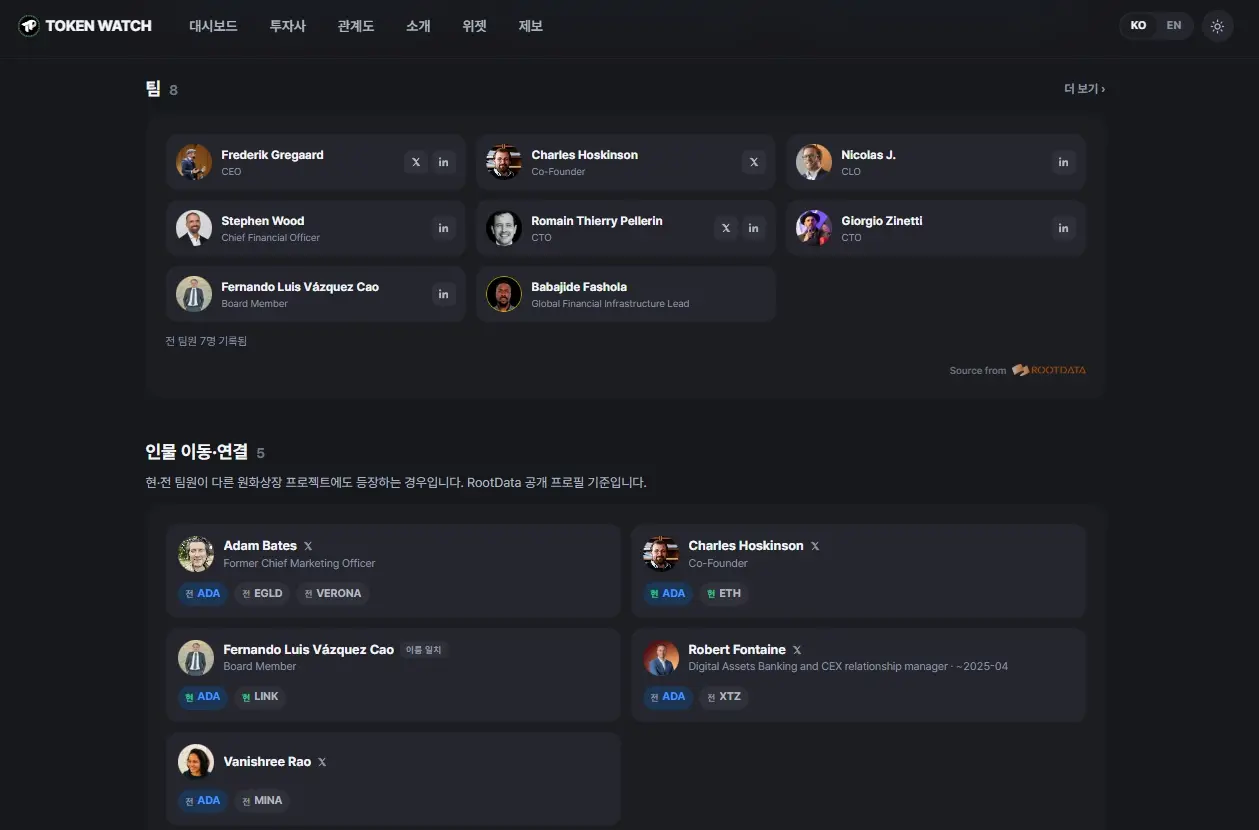
The investor and people data used in the relationship map is based on RootData, with some information (such as whether a project has responded) being based on TokenPost's editorial records. For personal relationships, to reduce false connections for the same individual, associations are made only when X (formerly Twitter) account handles match or when two or more full names are identical.

The Token Watch relationship map requires no additional installation and can be used directly on the web, supporting both Korean and English interfaces.

A TokenPost representative stated, "To understand crypto asset projects, one needs to not only look at prices and listing information but also understand the capital and individuals connected behind them. We will continue to optimize the relationship map to allow intuitive exploration of scattered investment and people information."

Token Watch also notes that the information displayed in the relationship map may differ from the latest actual status due to the timing of data collection and verification, and all data is for reference only, not constituting investment advice.


This article is based on market data and chart analysis and does not constitute investment advice for specific projects.

Criptos en tendencia

Preguntas relacionadas

QWhat new feature has the Korean crypto media TokenPost added to its data platform 'Token Watch'?

ATokenPost has added an 'Interaction Relationship Map' feature to its Token Watch platform. This function visually maps the connections between crypto projects, investors, and key personnel in a single, interactive graph.

QWhat is the primary data source for the investor and personnel information in Token Watch's relationship map?

AThe investor and personnel data used in the relationship map is primarily based on the database provided by RootData. Some additional information, such as whether a project has responded to inquiries, is based on records from TokenPost's editorial team.

QWhat are the four types of relationship lines shown in the relationship map, and what do they indicate?

AThe four types of relationship lines are: 1) General Investment, 2) Lead Investment, 3) Current Affiliation, and 4) Former Affiliation. These distinguish between types of investor participation (lead vs. general) and the current or past organizational ties of key individuals.

QWhat are two examples of insights that users can gain from the relationship map, according to the article?

AAccording to the article, the map helps reveal information that is difficult to confirm from simple project listings, such as: 1) Identifying co-investors and frequent VC co-investment partnerships. 2) Discovering investor overlap between competing projects. It also helps spot key individuals who appear across multiple projects.

QWho are the target users for this relationship map tool, and what are its stated use cases for them?

AThe tool is designed for: 1) Investors, to research the background of interesting projects. 2) Journalists and researchers, as a tool for interviews and analysis to uncover hidden commonalities. 3) Industry professionals and business developers, to trace connection paths between projects, investors, and key figures.

Lecturas Relacionadas

Crypto.com, Backed by Citadel Securities, Transfers XYO and XL1 into Regulated Custody

Crypto.com, with backing from Citadel Securities, has placed XYO and XL1 tokens into regulated custody. This move provides eligible institutions and high-net-worth clients with a regulated mechanism for storing, managing, and exchanging these tokens without first having to transfer assets onto an exchange. The custody structure utilizes segregated MPC wallets managed by a bankruptcy-remote entity, with private keys secured via multi-party computation. Clients benefit from cold storage, audit trails, and direct access to Crypto.com's institutional liquidity while their assets are custodied, removing the operational step of pre-trade transfers. Company leadership positioned this as a strategic step to provide "unmatched security and seamless liquidity" for digital asset organizations, and to protect and scale the XYO ecosystem. The partnership builds on an existing relationship since XYO's initial listing on the exchange. This development follows Citadel Securities' $400 million investment in Crypto.com and comes as the company expands its regulatory standing, having received conditional approval to establish a national trust bank. For institutional investors, this custody agreement addresses a key barrier by demonstrating that smaller market-cap assets like XYO and XL1 can be held under the same regulatory and security standards as larger tokens. XYO operates a large DePIN network generating real-world data for AI and robotics, with XL1 handling its blockchain transactions and infrastructure.

cryptonews.ruHace 16 min(s)

Crypto.com, Backed by Citadel Securities, Transfers XYO and XL1 into Regulated Custody

cryptonews.ruHace 16 min(s)

Less Than Two Weeks Left — Bitcoin's BIP-110 Countdown Begins as Miner Support Grows Ahead of Decisive Moment

The BIP-110 activation process for Bitcoin, which proposes a temporary soft fork to limit specific data-heavy transaction types (like Ordinals inscriptions), is entering its critical final phase. As of July 27, 2026, there are roughly 1,790 blocks remaining until the mandatory signaling window begins at block 961,632 (estimated for August 9). Starting then, nodes enforcing BIP-110 will reject blocks not signaling for the proposal. While support from miners has grown from below 1% to around 3% recently, it remains concentrated among smaller pools and independent miners, with major pools like Foundry, Antpool, ViaBTC, and F2Pool largely not signaling. Foundry's stance is particularly decisive, as it holds a large share of the network's hashrate and has tied its signaling to a client vote. Without a major pool's shift, widespread activation is unlikely. If the current low signaling levels persist after the window opens, nodes enforcing BIP-110 will follow a slower, minority chain, potentially creating a chain split from the majority chain followed by legacy (e.g., Bitcoin Core) nodes. This activation mechanism differs from past soft forks like SegWit, resembling the 2017 UASF BIP-148 more closely. Proponents argue BIP-110 is necessary to curb spam-like data transactions that increase node costs and distort fee markets, framing opposition as a contentious hard fork. Critics, however, view the activation method as a radical overreaction to a minor issue. The final outcome in the coming two weeks hinges on whether a major pool switches support, if major exchanges clarify their chain preference, and how miners actually behave once the mandatory window is open.

cryptonews.ruHace 18 min(s)

Less Than Two Weeks Left — Bitcoin's BIP-110 Countdown Begins as Miner Support Grows Ahead of Decisive Moment

cryptonews.ruHace 18 min(s)

Trading

Spot

Artículos destacados

Cómo comprar DATA

¡Bienvenido a HTX.com! Hemos hecho que comprar DATA Network (DATA) sea simple y conveniente. Sigue nuestra guía paso a paso para iniciar tu viaje de criptos.Paso 1: crea tu cuenta HTXUtiliza tu correo electrónico o número de teléfono para registrarte y obtener una cuenta gratuita en HTX. Experimenta un proceso de registro sin complicaciones y desbloquea todas las funciones.Obtener mi cuentaPaso 2: ve a Comprar cripto y elige tu método de pagoTarjeta de crédito/débito: usa tu Visa o Mastercard para comprar DATA Network (DATA) al instante.Saldo: utiliza fondos del saldo de tu cuenta HTX para tradear sin problemas.Terceros: hemos agregado métodos de pago populares como Google Pay y Apple Pay para mejorar la comodidad.P2P: tradear directamente con otros usuarios en HTX.Over-the-Counter (OTC): ofrecemos servicios personalizados y tipos de cambio competitivos para los traders.Paso 3: guarda tu DATA Network (DATA)Después de comprar tu DATA Network (DATA), guárdalo en tu cuenta HTX. Alternativamente, puedes enviarlo a otro lugar mediante transferencia blockchain o utilizarlo para tradear otras criptomonedas.Paso 4: tradear DATA Network (DATA)Tradear fácilmente con DATA Network (DATA) en HTX's mercado spot. Simplemente accede a tu cuenta, selecciona tu par de trading, ejecuta tus trades y monitorea en tiempo real. Ofrecemos una experiencia fácil de usar tanto para principiantes como para traders experimentados.

143 Vistas totalesPublicado en 2026.07.01Actualizado en 2026.07.01

Cómo comprar DATA

Discusiones

Bienvenido a la comunidad de HTX. Aquí puedes mantenerte informado sobre los últimos desarrollos de la plataforma y acceder a análisis profesionales del mercado. A continuación se presentan las opiniones de los usuarios sobre el precio de DATA (DATA).

活动图片