3B Small Model's Programming Scores Rival Opus 4.5, Mysterious Model Sparks Heated Discussion, Turns Out to be Domestic

marsbitPublicado a 2026-06-18Actualizado a 2026-06-18

Resumen

A 3B parameter dense reasoning model named VibeThinker-3B has gained significant attention for achieving performance comparable to leading models like Gemini 3 Pro, GPT-5 high, and Claude Opus 4.5 in verifiable reasoning tasks such as programming, mathematics, and STEM problem-solving, despite its significantly smaller size. Developed by Sina Weibo's team, the model is built upon Qwen2.5-Coder-3B. Its training employs an upgraded Spectrum-to-Signal pipeline, featuring a curriculum-based two-stage supervised fine-tuning (SFT), multi-domain reinforcement learning (RL) inspired by MGPO, offline self-distillation, and instruction RL to enhance controllability. A key innovation is the Claim-Level Reliability (CLR) assessment, a test-time scaling strategy that further boosts performance on math benchmarks. The model excels in specific, verifiable domains, scoring highly on tests like AIME26 (94.3/97.1 with CLR) and LiveCodeBench v6 (80.2 Pass@1). However, it performs less impressively in areas requiring broad general knowledge. The authors propose a "parameter compression coverage hypothesis," suggesting that verifiable reasoning abilities—reliant on multi-step logic and feedback—are highly compressible, while open-domain knowledge depends more on large-scale parameters. VibeThinker-3B demonstrates that small models, when specialized for tasks with clear verification signals, can reach frontier performance, offering a complementary research path to scaling model size. The model ...

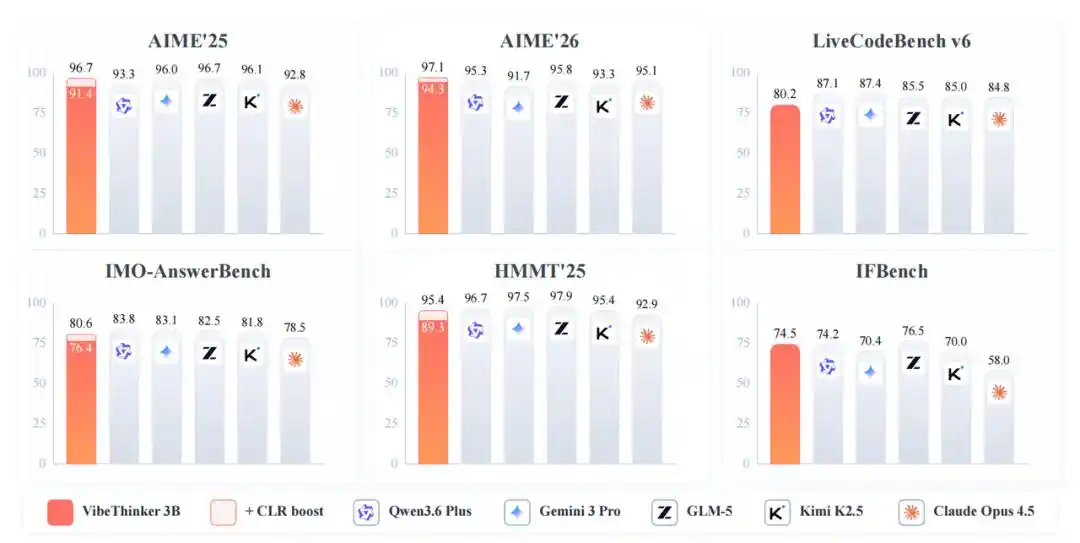
In recent days, a 3B small model has gained popularity on X because in some difficulty-verifiable reasoning tasks (like programming), it has entered the performance range of frontier models like Gemini 3 Pro, GPT-5 high, Claude Opus 4.5, GLM-5, and Kimi K2.5, while its size is far smaller than these models.

This model is named VibeThinker-3B, a dense reasoning model with 3 billion parameters, aiming to explore how far verifiable reasoning capability can be pushed under strictly small model scale constraints.

After the model's release, many were amazed by its results and expressed a desire to try it out.
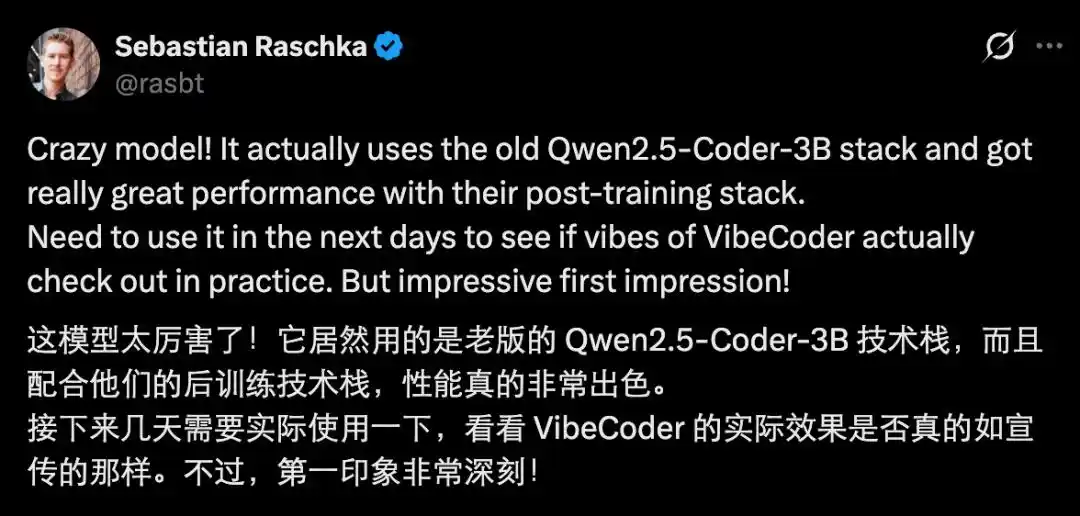
Notably, it is also a domestic model, coming from the Sina Weibo team.
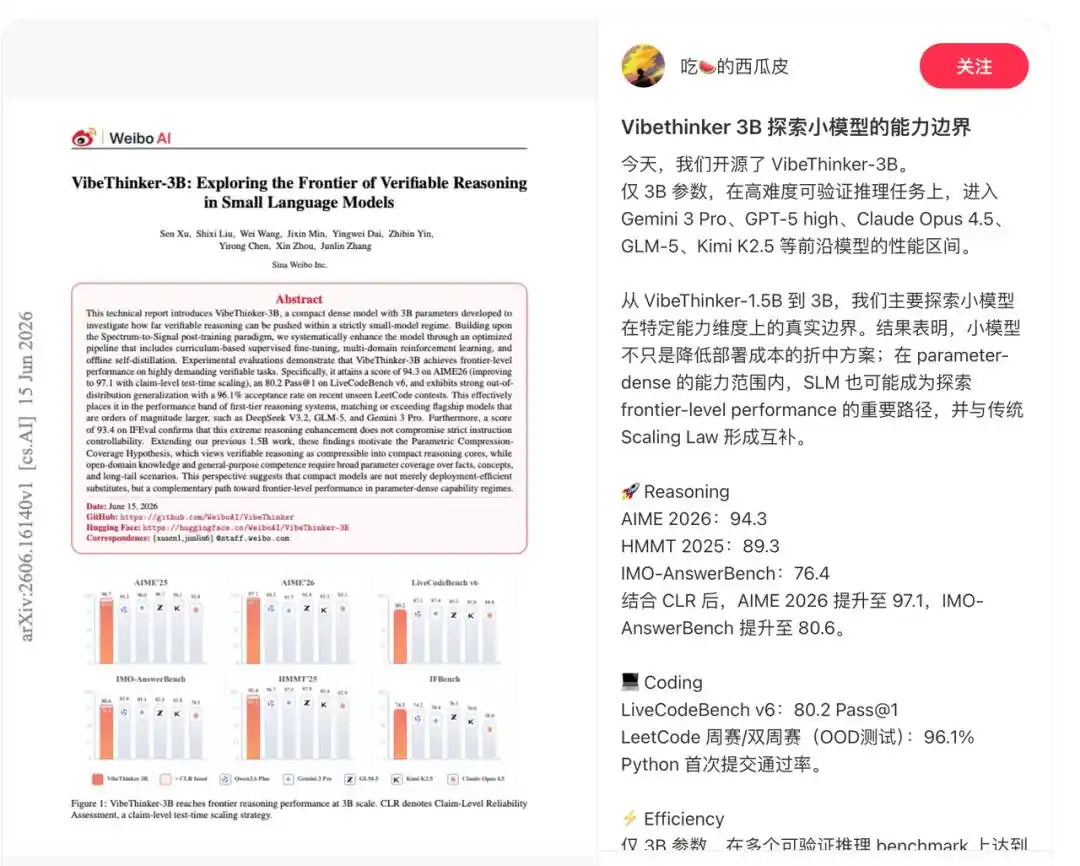
The technical report shows that this model is designed specifically for tasks with reliable verification signals, including mathematical reasoning, competitive programming, STEM reasoning, and instruction execution with clear constraints.

Therefore, it performs exceptionally well in various benchmark tests. It scored 94.3 on the AIME26 test, 89.3 on the HMMT25 test, 80.2 on the LiveCodeBench v6 test (Pass@1), and achieved a 96.1% pass rate in the latest unpublished weekly and biweekly LeetCode contests between April 25 and May 31, 2026.
How was this model trained? The technical report reveals some details.

First, it is built upon Qwen2.5-Coder-3B and undergoes post-training using an upgraded Spectrum-to-Signal process. This process strengthens data synthesis, quality filtering, and curriculum learning in Supervised Fine-Tuning (SFT), extends MGPO-style reinforcement learning to multiple verifiable domains, preserves complete long-context reasoning trajectories, and consolidates various capabilities through offline self-distillation and instruction reinforcement learning (Instruct RL).
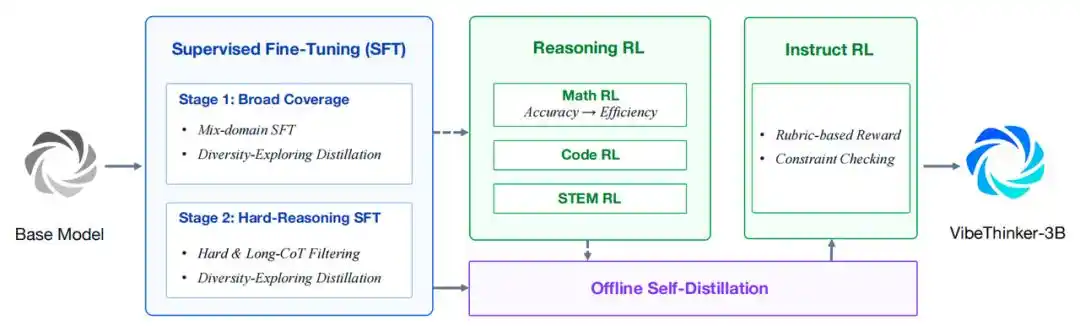
Overall training pipeline of VibeThinker-3B
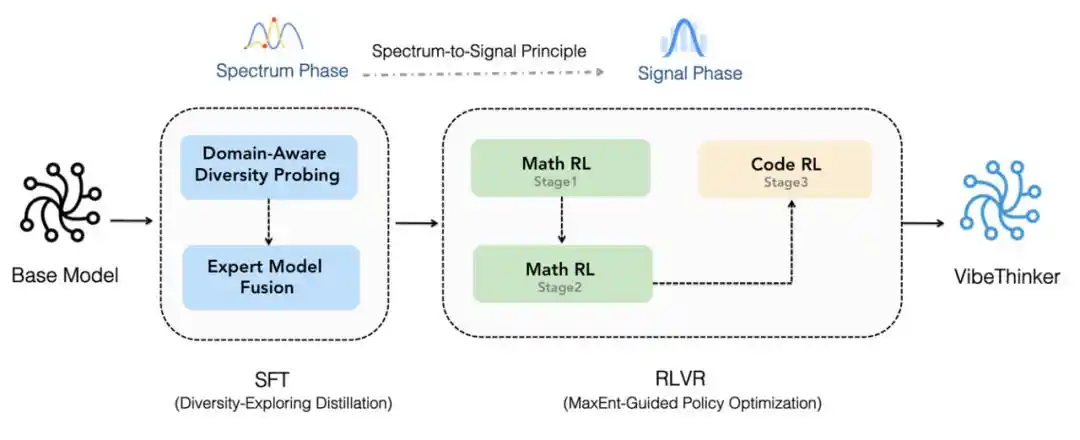
Spectrum-to-Signal pipeline.

Furthermore, VibeThinker-3B introduces Claim-Level Reliability (CLR) assessment, a test-time scaling strategy for answer-verifiable reasoning. CLR further improves performance on mathematical benchmarks, raising AIME26 from 94.3 to 97.1, HMMT25 from 89.3 to 95.4, and BruMO25 to 99.2.
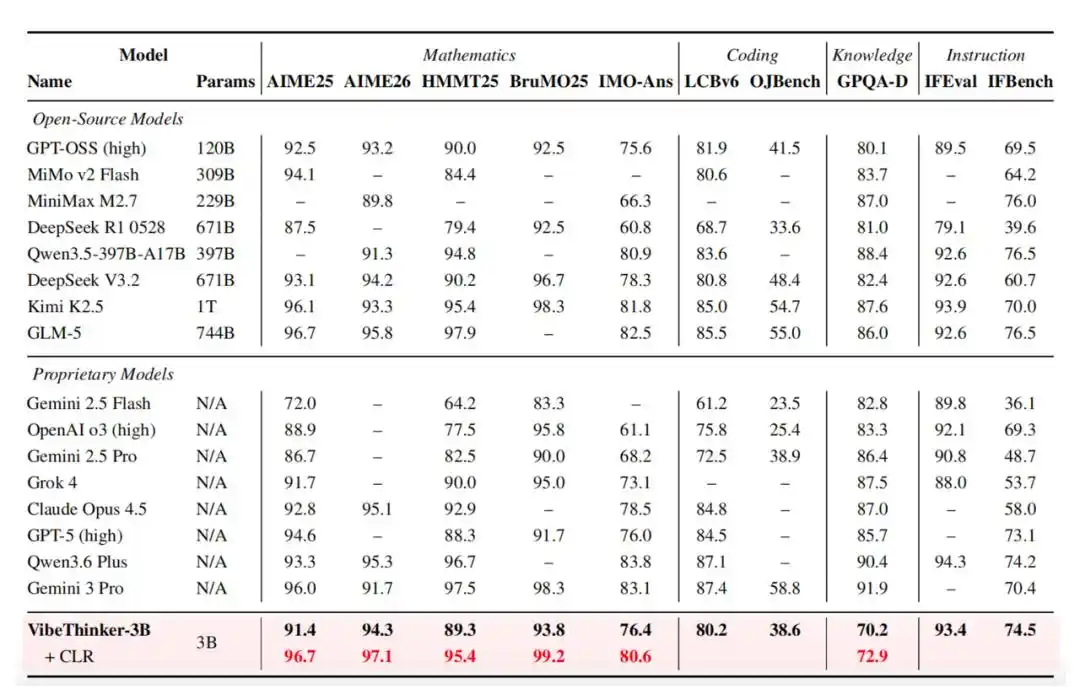
The specific training pipeline is as follows:

  • Curriculum-based two-stage SFT. The first stage focuses on broad capability coverage in mathematics, programming, STEM reasoning, general conversation, and instruction following. The second stage shifts to more difficult, broader-scope reasoning samples. Diversity-Exploring Distillation is used to preserve multiple valid solution paths.
  • Multi-domain reasoning reinforcement learning. VibeThinker-3B reuses MGPO. Reinforcement learning is applied sequentially to mathematical, programming, and STEM reasoning tasks. Training uses a single 64K long-context window to preserve complete long-horizon reasoning trajectories.
  • Offline self-distillation. High-quality trajectories are filtered and distilled from the mathematical, programming, and STEM RL checkpoints, ultimately forming a unified student model. Learning Potential Scoring is used to prioritize trajectories that are correct but not yet well imitated by the student.
  • Instruct RL. The final stage improves the controllability for user-facing prompts. For format-sensitive and open-ended instructional data, rule-based verifiers and rubric-based reward models are employed.

In a recent post, well-known AI researcher and blogger Sebastian Raschka systematically summarized key points disclosed in the VibeThinker-3B technical report, including the following:
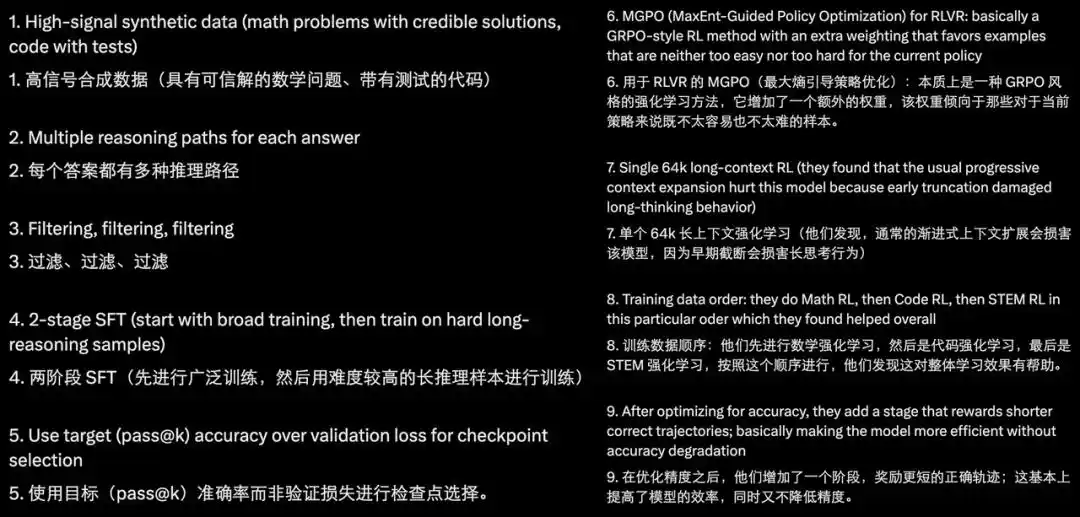
If you are interested in this content, you can delve into their technical report. Currently, the model is also publicly available for download.
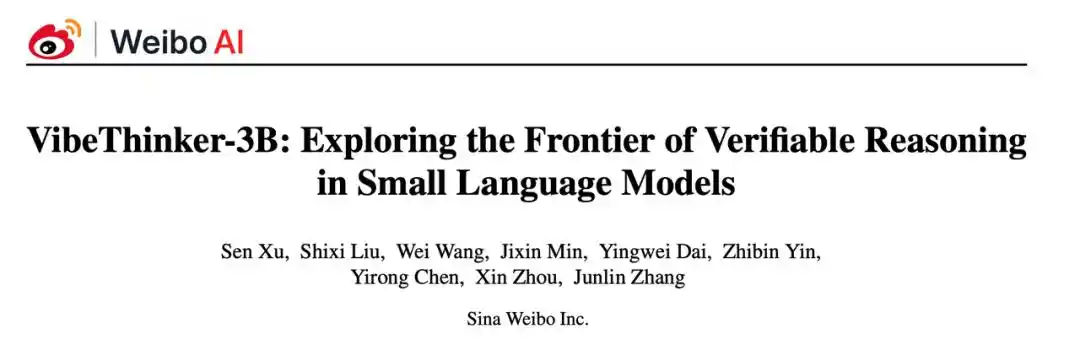
Report Title: VibeThinker-3B: Exploring the Frontier of Verifiable Reasoning in Small Language Models

Report Link: https://arxiv.org/pdf/2606.16140

HuggingFace Link: https://huggingface.co/WeiboAI/VibeThinker-3B

However, the model's applicable scope has clear limitations, as it does not perform well in domains requiring general knowledge.
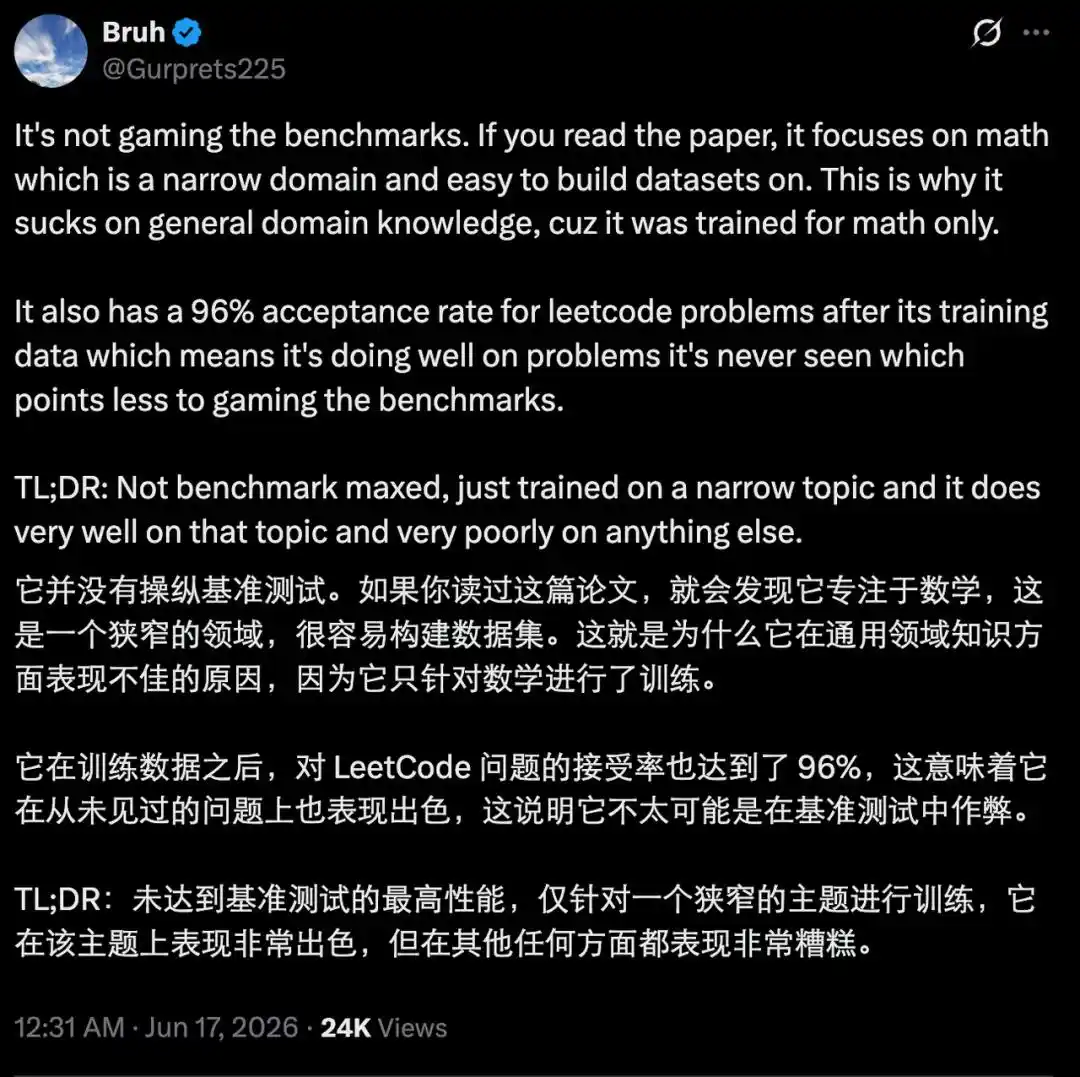
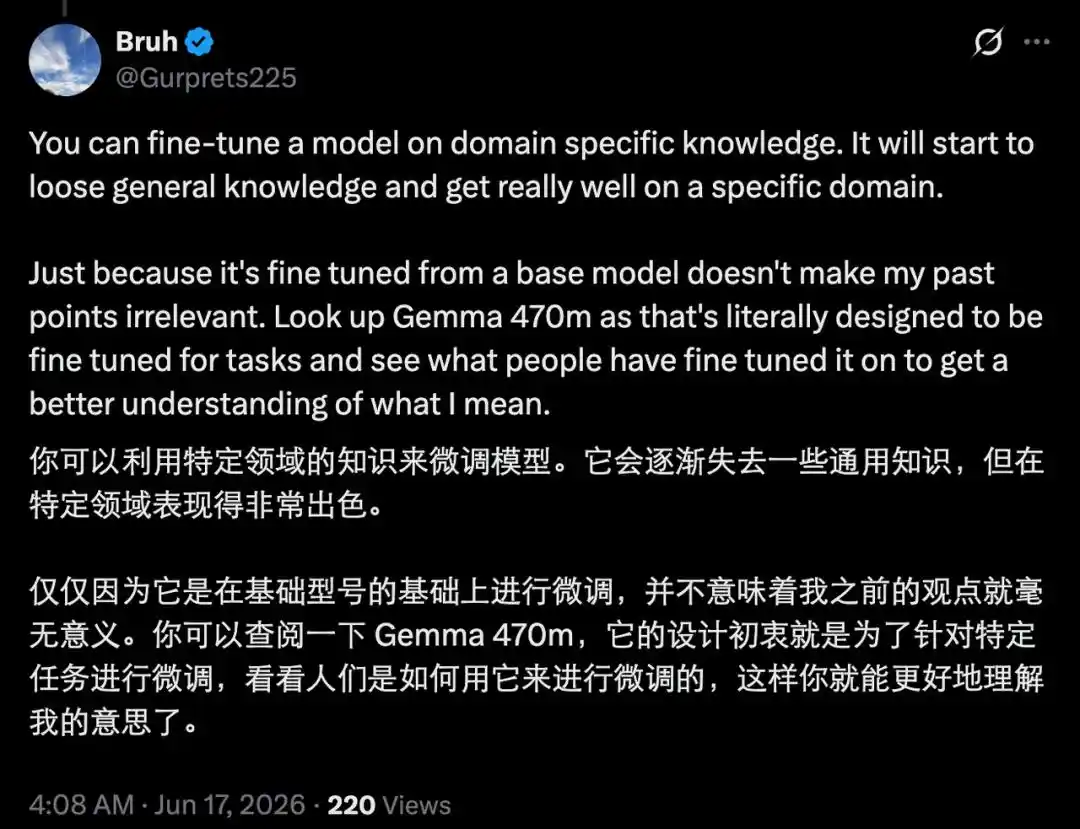
The developers also explicitly point this out and propose the "Parameter Compression Coverage Hypothesis": Different capabilities rely on model parameters in drastically different ways. Verifiable reasoning is closer to a highly compressible, parameter-dense ability whose core lies in multi-step reasoning, constraint satisfaction, self-correction, and answer verification. When the task space structure is clear enough and feedback signals are sufficiently reliable, compact models can also possess near-state-of-the-art reasoning capabilities. In contrast, open-domain knowledge, general conversation, and long-tail scenario understanding rely more on large-scale parameters to extensively cover facts, concepts, and world knowledge. This hypothesis is very insightful. VentureBeat wrote in its report: "It reveals a partial decoupling between reasoning capability and factual knowledge, and that the former can be compressed more efficiently than previously thought — an insight that has profound implications for how the industry thinks about model design, deployment costs, and the accessibility of advanced AI capabilities."
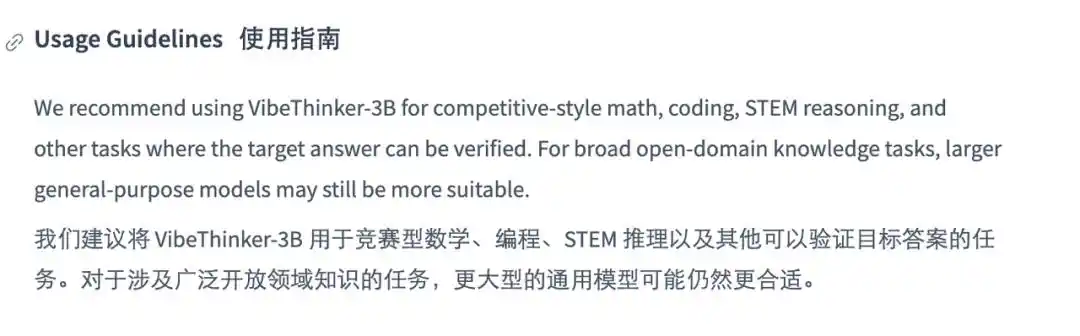

The authors state that their goal is not to create a small model to replace large-scale models, but to examine the true boundaries of small models along specific capability dimensions. With VibeThinker-3B, they hope to demonstrate that small models should not merely be seen as a compromise to reduce deployment costs. In capability domains with clear feedback and verification mechanisms, small language models are revealing a promising research path, potentially achieving frontier-level performance and forming a fundamentally complementary relationship with the traditional paradigm of parameter scaling.

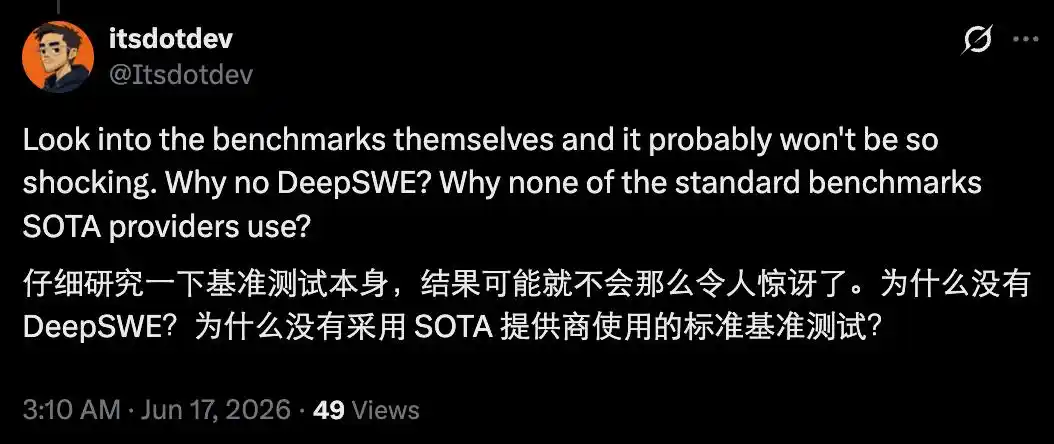
Currently, the model still faces some skepticism within the community. If you are interested in this model, you might want to try it out for yourself.
Reference Links:

https://x.com/orcus108/status/2066876960073281582

This article is from the WeChat public account "Machine Heart" (ID: almosthuman2014), author: Zhang Qian


Preguntas relacionadas

QWhat is the name and key characteristic of the small AI model discussed in the article?

AThe model is called VibeThinker-3B. Its key characteristic is that despite being a small model with only 3 billion parameters, it achieves reasoning performance on verifiable tasks like programming that is comparable to much larger frontier models.

QWhich company or team developed the VibeThinker-3B model?

AThe VibeThinker-3B model was developed by the Sina Weibo (microblog) team, making it a domestic Chinese model.

QWhat is the core hypothesis proposed by the creators of VibeThinker-3B regarding model capabilities?

AThe core hypothesis is the 'Parameter-Compression Coverage Hypothesis'. It suggests that different capabilities depend on model parameters in distinct ways. Verifiable reasoning (multi-step reasoning, constraint satisfaction) is highly compressible and parameter-dense. In contrast, open-domain knowledge and understanding rely more on large-scale parameters for broad factual coverage.

QOn which specific benchmark tasks did VibeThinker-3B demonstrate exceptional performance?

AVibeThinker-3B demonstrated exceptional performance on verifiable reasoning benchmarks such as AIME26 (97.1 with CLR), HMMT25 (95.4 with CLR), LiveCodeBench v6 (80.2 Pass@1), and recent private LeetCode contests (96.1% pass rate).

QWhat are the main limitations or scope of application for the VibeThinker-3B model as stated in the article?

AThe model's applicability is limited. It excels in domains with clear verification signals (math, programming, STEM) but does not perform well in areas requiring general world knowledge, open-domain dialogue, or understanding of long-tail scenarios, as these rely on broader parametric coverage.

Lecturas Relacionadas

Gate Research Institute: ETF Outflows Suppress Risk Appetite, Two-Way System Navigates Weak Market

Gate Institute Research Report: May 2026 Crypto Market Review & Strategy Analysis In May 2026, the crypto market shifted from an early-month rally to a mid-month correction, concluding with low-volatility consolidation. BTC, ETH, and SOL peaked in early May before declining. The primary market dynamic was a divergence between weakening spot ETF inflows and persistently high leverage-driven perpetual trading volume. A dual-direction moving average cluster breakout strategy outperformed, returning +2.11% for an equally-weighted BTC/ETH/SOL portfolio. This contrasted with a -6.09% return for buy-and-hold and -3.65% for a long-only version of the strategy. Profits were primarily generated from short positions on ETH and SOL during the mid-to-late May downtrend, demonstrating the month's suitability for two-way trend trading. Market structure evolved in three phases: an initial surge (May 1-6), a failure and reversal (starting May 7), and low-volatility compression (May 22 onward). While stablecoin supply remained stable, significant outflows from mainstream BTC and ETH ETFs created selling pressure. Concurrently, high correlation with the S&P 500 (~0.6) and stronger performance from AI equities like Nvidia highlighted crypto's position as a high-beta risk asset within a broader risk-budget framework, lacking independent momentum. The successful strategy employed a 4-hour chart system using a cluster of six moving averages (EMA6,12,24 & SMA6,12,24). A breakout signal was triggered after the cluster width compressed below 2.2%. Trades were managed with a 2.5% fixed stop-loss, a 3:1 Risk/Reward (7.5%) take-profit, and an EMA12-based exit rule to control losses from false breakouts. The strategy's low win rate but high payoff from a few large trend moves was effective in May's conditions. The report concludes that for June, a disciplined, bidirectional approach remains superior to subjective directional bets. The framework should adapt signal weighting based on BTC's position relative to key EMAs, ETF flow trends, and the relative strength of the Nasdaq, prioritizing risk management and trend preservation.

marsbitHace 2 min(s)

Gate Research Institute: ETF Outflows Suppress Risk Appetite, Two-Way System Navigates Weak Market

marsbitHace 2 min(s)

Anthropic CEO's Latest Interview: On Technological Explosion, Safety Red Lines, and the Civilization Contract

Interview with Anthropic CEO Dario Amodei covers the intense pressures and ethical dilemmas of leading AI development. He describes the experience as "exponential growth," feeling constant acceleration akin to relativistic time dilation. The discussion delves into his departure from OpenAI, rooted in a fundamental loss of trust and divergent values rather than mere technical disagreements. Amodei emphasizes Anthropic's enterprise-focused business model, arguing it aligns better with safety and responsible deployment than consumer-facing, ad-driven models. He addresses critical issues like AI's impact on employment, advocating for proactive macroeconomic policies and a shift towards "doing more with the same resources" to avoid widespread job displacement. On safety and governance, he details Anthropic's cautious approach, including delaying the release of the powerful "Mythos" model due to its advanced cyber capabilities. He stresses the need for "human-in-the-loop" principles in military applications, setting red lines against autonomous weapons and mass surveillance. Amodei calls for industry collaboration among trustworthy actors to establish standards and advocates for a balanced regulatory framework with checks and balances, such as Anthropic's Long-term Benefit Trust, rather than corporate or government monopoly over the technology. He expresses geopolitical concerns, particularly regarding China, and a belief that AI should bolster liberal democracies. While acknowledging a non-zero risk of civilizational catastrophe from advanced AI, he asserts Anthropic's actions are aimed at significantly reducing that probability. The interview concludes with Amodei arguing that trust must be earned through concrete actions, like sacrificing commercial gain for safety, to distinguish Anthropic in a Silicon Valley landscape he criticizes for eroded public trust.

marsbitHace 5 min(s)

Anthropic CEO's Latest Interview: On Technological Explosion, Safety Red Lines, and the Civilization Contract

marsbitHace 5 min(s)

The Brutal Truth Behind CARDS' $535M FDV: Only $43M in Net Revenue and Halved Profit Margins

The article titled "The Brutal Truth Behind CARDS' $535 Million FDV: Only $43 Million Net Revenue, Profit Margins Halved" provides a critical analysis of Collector Crypt (CC), a platform combining physical collectible cards with NFTs in a gacha-style system. Key findings include: * CC has generated $635 million in total user deposits. However, 90.6% ($576 million) is instantly returned to users via automatic card buybacks, resulting in only $43 million in net platform revenue (6.7% retention). * Activity is highly concentrated among dozens of high-frequency wallets, with an average of only ~420 daily active players. * There is minimal secondary market activity for the cards (under $5 million total), indicating the platform functions more as a gambling casino than a collector's marketplace. eBay sales as a percentage of gacha volume have declined for six consecutive quarters. * Despite a tripling in transaction volume, net profit margins have been halved from 11.2% to 5.8% as activity shifts to higher-priced card packs with lower margins. * Value captured by the CARDS token is minimal: only $140,000 (from burns and recent buybacks), representing just 3.4% of CC's cumulative net revenue. In contrast, wallets linked to operational infrastructure have off-ramped $45.7 million in USDC. * The token's ~$535 million Fully Diluted Valuation (FDV) represents a 7.3x multiple of annualized net revenue. Only 20.5% of the token supply is floating, with 72% allocated to insiders and locked until November 2027. The conclusion is that CC has found product-market fit as a high-speed gambling platform for a niche user base, not as a growing collector economy. The token currently captures a negligible share of the platform's revenue.

Foresight NewsHace 30 min(s)

The Brutal Truth Behind CARDS' $535M FDV: Only $43M in Net Revenue and Halved Profit Margins

Foresight NewsHace 30 min(s)

Trading

Spot
Futuros
活动图片