Bitcoin's hash rate has been declining for 287 consecutive days – one of the longest periods of falling computational power in the network's history. This is stated in a report by the analytical platform Bitcoin Magazine Pro.
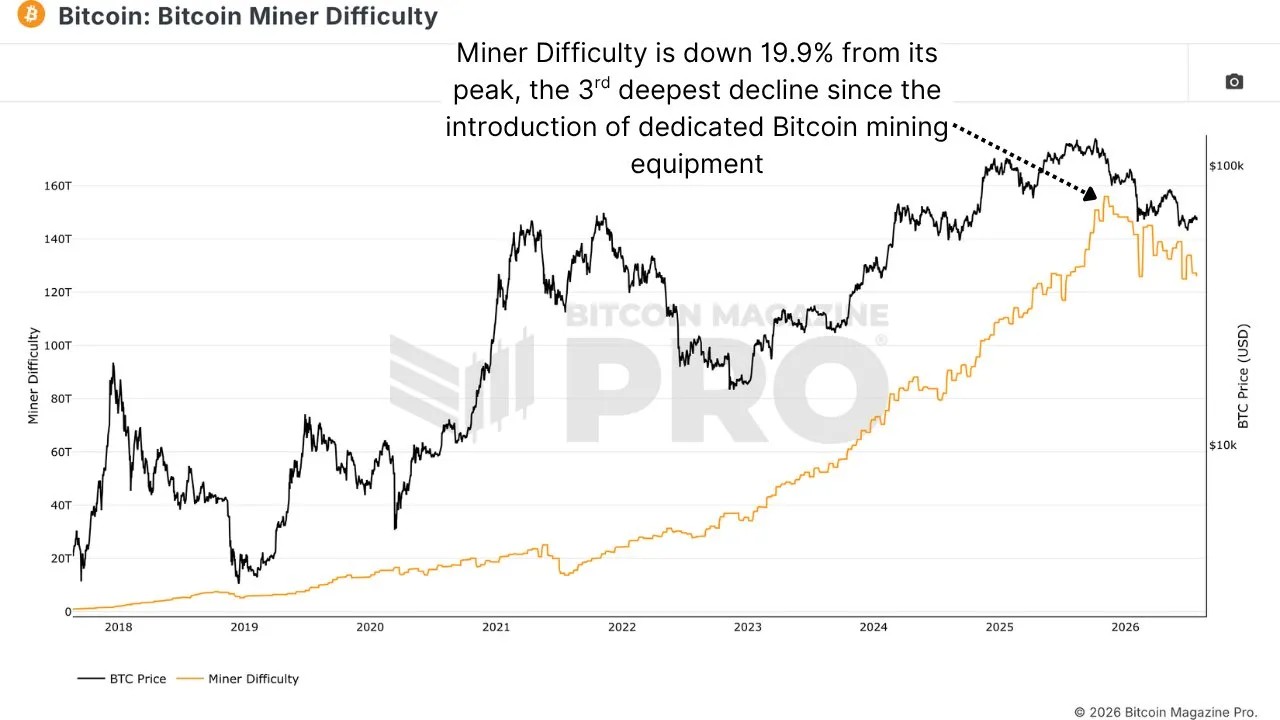
Following the hashrate, the mining difficulty has also dropped – it is currently 19.9% below its peak. Since the advent of specialized equipment for mining the first cryptocurrency, the indicator has fallen harder only twice, and both declines lasted about the same time. The sharpest of them coincided with the mining ban in China. Experts called that episode "extremely clear": the authorities turned off the equipment, so the hash rate collapsed. The current downturn does not offer such clarity, they noted.
Miner Stocks Rose Despite Price Decline
Over the past 12 months, bitcoin has lost about 46% of its value. Meanwhile, shares of public mining companies have mostly risen:
- Hut 8 — by 431%;
- Riot Platforms — by 62%;
- HIVE Digital — by 37%.
An exception was MARA Holdings, whose shares fell by 29%.
Specialists emphasized that such dynamics are uncharacteristic for this pair of assets. Historically, miner stocks traded with leverage relative to digital gold – they fell harder during corrections and rose at a faster pace during upward trends.
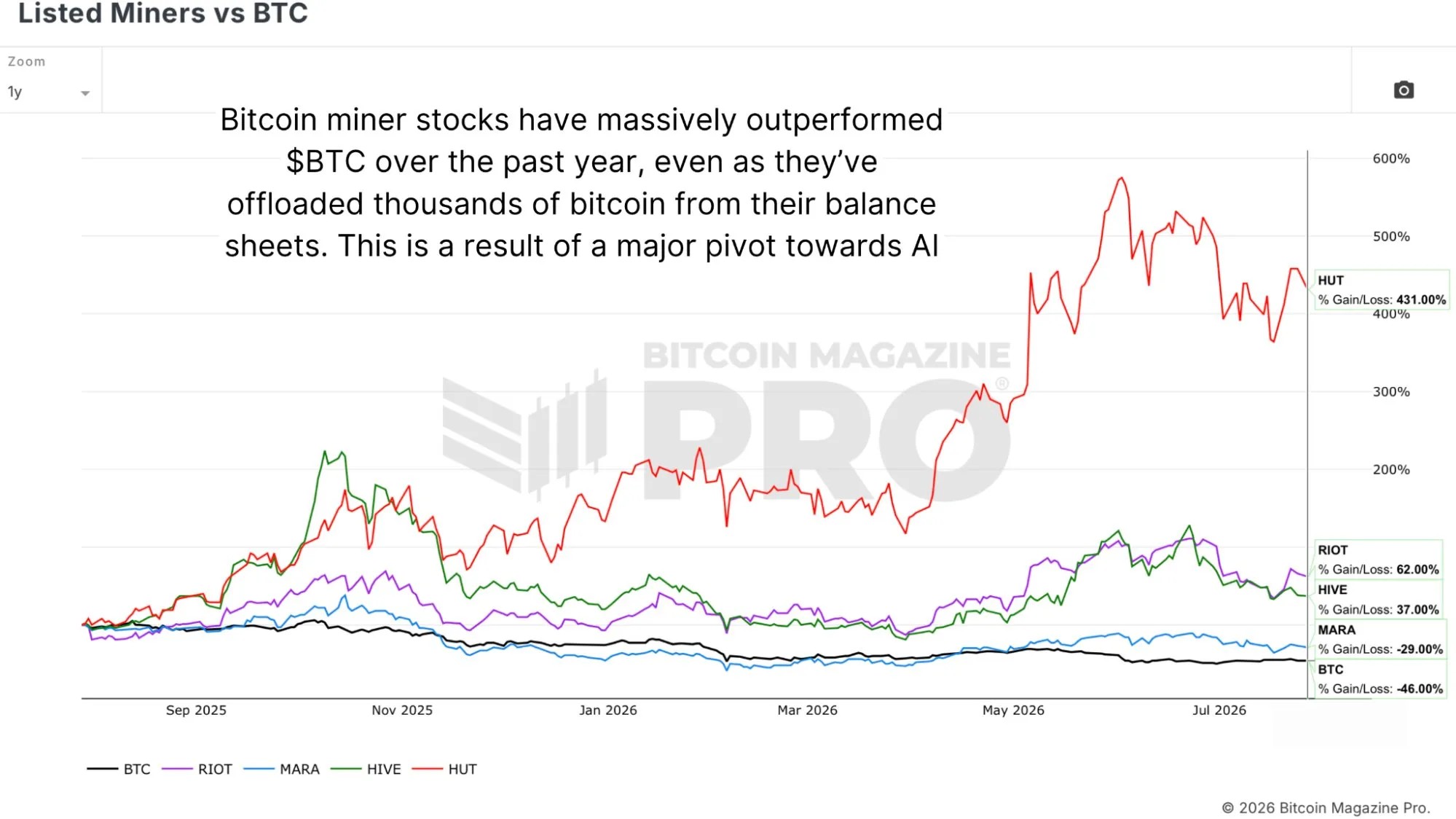
Bitcoin Magazine Pro explained the divergence by the industry's pivot to artificial intelligence. Investors are valuing miners not as a bet on bitcoin, but as providers of computational infrastructure. For many years, the first cryptocurrency moved together with AI-sector stocks, with correlation sometimes reaching 0.8-0.9. However, the trend then changed: technology company shares strengthened, while digital gold entered a sell-off phase.
Stocks are appreciating even though bitcoin miners sold thousands of bitcoins during this period. In the first quarter alone, they sold over 32,000 BTC to cover operating expenses – more than in all of 2025.
Transaction Fees Pay for Ten Minutes of Network Operation
Miner revenue comes from two sources – block rewards and transaction fees. Emission halves every four years and will eventually reach zero. After that, only fees will ensure the network's operation. If they are insufficient, the total revenue of miners will decrease, and with it – the cost required to attack the blockchain, noted Bitcoin Magazine Pro.
Daily revenue from block rewards has already hit a historical low. This is partly a consequence of the outflow of computing power: before the difficulty recalculation, the interval between blockchain units exceeds ten minutes. However, the main factor is the standard operation of the protocol, experts believe.
Since the first halving, the industry has used the same argument: the number of coins per block decreases, but their value increases, so dollar revenue remains stable. Until now, this mechanism has worked, analysts acknowledged.
However, now the bitcoin price is falling along with the emission volume. This is visible in the Puell Multiple indicator, which compares current miner revenue with the average over the previous year. The indicator has dropped to about 0.75, which in monetary terms is approximately $30 million per day against an average closer to $40 million.
The second revenue source remains insignificant. Of the same $30 million in daily revenue, only about $200,000 comes from fees. The reward for one block exceeds the entire daily fee collection: over the last 28 days, their average daily volume did not even cover one such payout. With 144 blocks per day, fees fund the network's operation for about ten minutes out of 24 hours.
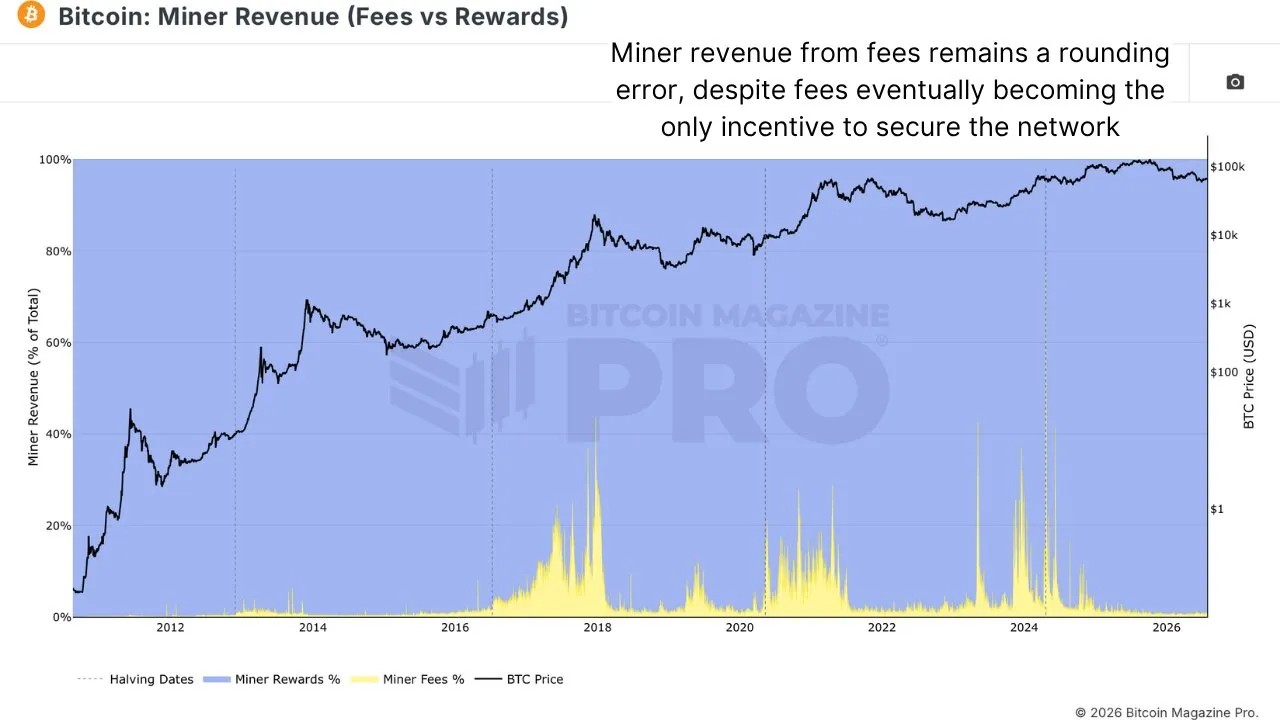
In previous cycles, the share of fees briefly reached tens of percent – notable spikes occurred in 2017, 2021, and 2023-2024. Currently, the indicator is near zero, and such spikes have stopped, analysts concluded.
Recall that on July 11th, the mining difficulty of the first cryptocurrency decreased by 5% – to 127.17 T. In mid-June, the indicator fell by 10.09% at once, but then recovered by 7.15%.
end-content