The recent rhythm in the AI circle is clearly a bit fragmented.
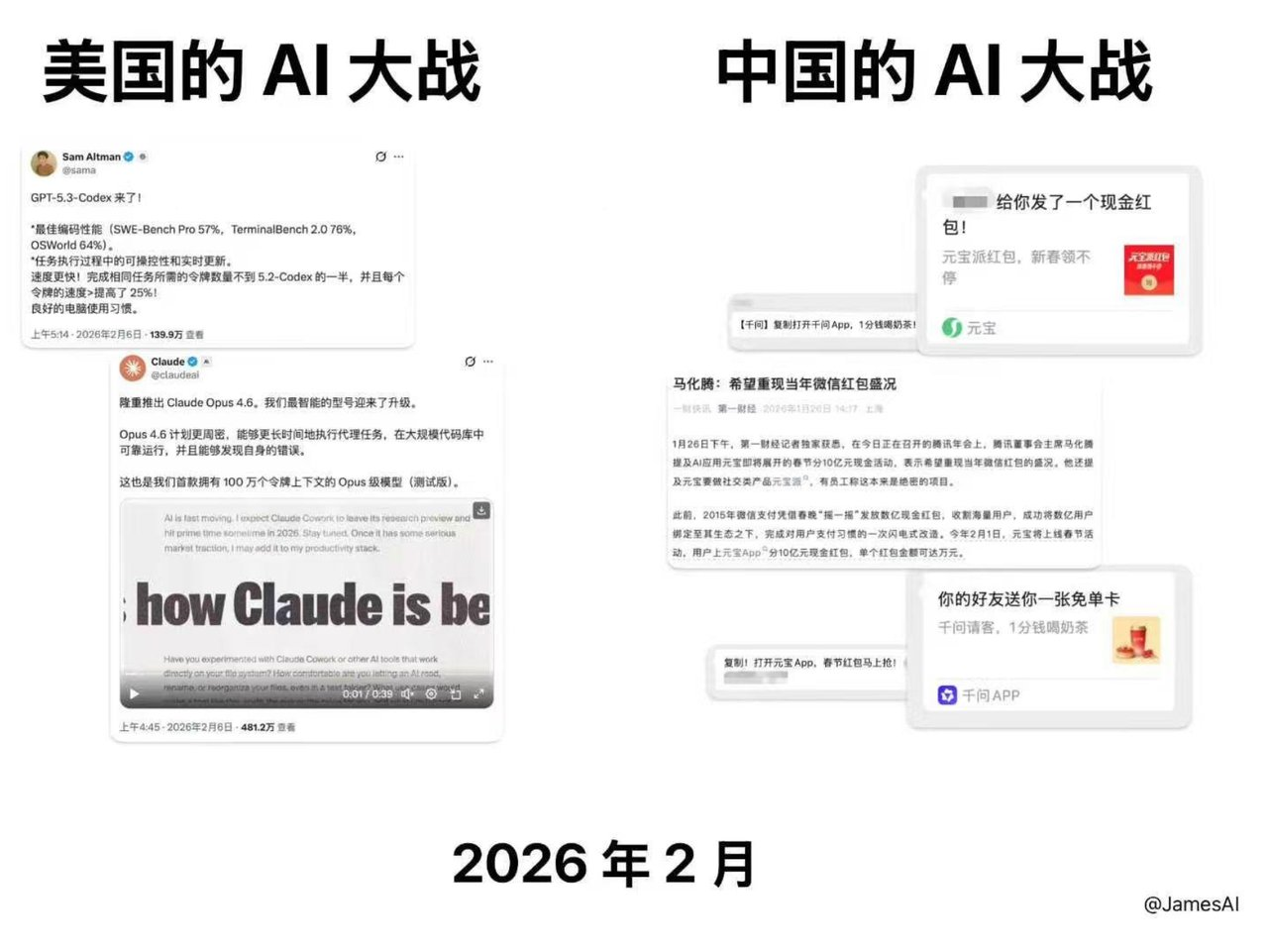
Image source: @JamesAI
On one side, overseas models are updating almost daily.
Before you can fully deploy OpenClaw, Moltbook and Codex are already pushed to new heights.
On the other side, domestic tech giants' AI products are疯狂“撒钱” (splashing cash) on holiday marketing during the Spring Festival.
The Spring Festival Remains the Most Competitive "Traffic Battlefield" for Big Tech
Looking just at the scale of investment:
Alibaba 30B > Tencent 10B ≈ ByteDance (undisclosed, but Spring Festival Gala sponsorship worth billions) > Baidu 5B
In fact, this national-level, trillion-traffic entry point is a must-compete battleground every year.
If we simply rank the AI marketing tactics of BBAT this year from "solid" to "lame" based on general user perception, it would roughly be:
- Qwen: Deeply integrated with Alibaba's consumer ecosystem, complex path, but the most solid long-term value.
- Doubao: Leveraged the Spring Festival Gala and Douyin ecosystem for mass exposure, strong brand awareness, weaker conversion.
- Wenxin: Steady progress with red packets + interactions, has presence, but lacks a breakthrough point.
- Yuanbao: Extremely aggressive裂变拉新 (viral user acquisition), but明显不足 (clearly insufficient) tool utility and user retention.
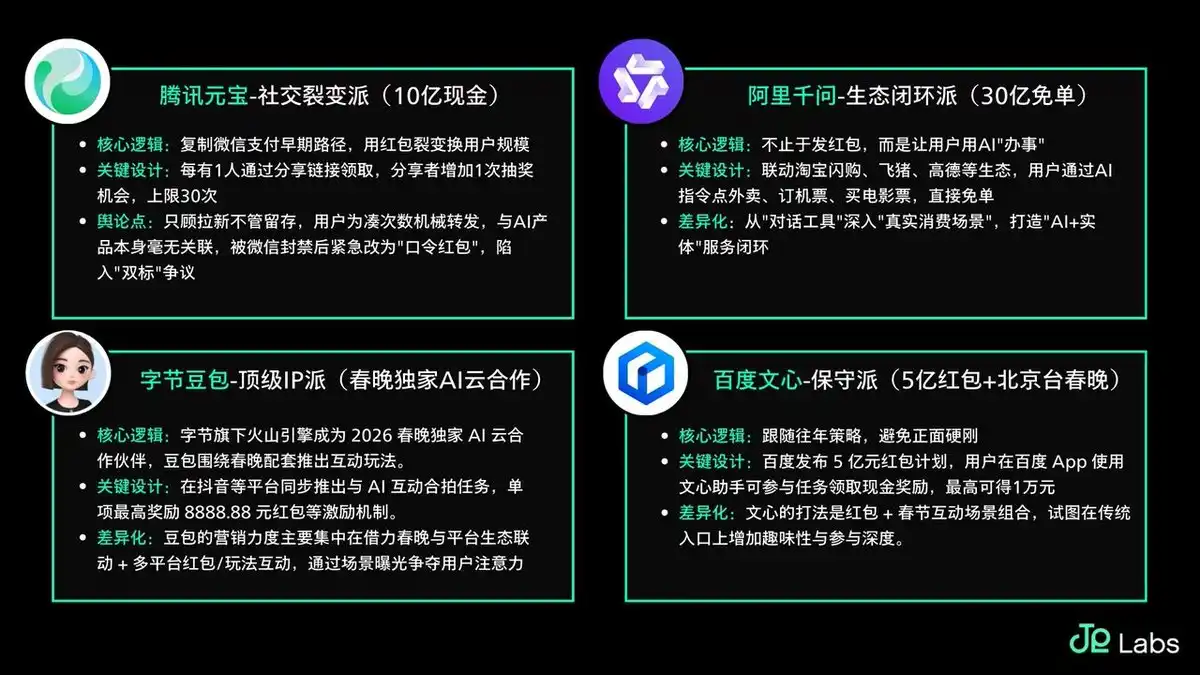
The usual tactics each year are mostly similar, but this year some are happy while others worry.
Yuanbao's Marketing Mishap: Essentially Using Web2 Traffic Era Methods for an AI Era Product
Tencent Yuanbao's 10 billion red packet plan encountered a dramatic scene just 3 days after launch—it was "banned" by its own WeChat.
On February 4th, the WeChat Security Center issued an announcement, pointing out that Yuanbao's Spring Festival marketing activities involved "inducing users to frequently share links to WeChat groups through 'completing tasks' and 'receiving red packets'," disrupting the platform ecology, and restricting its direct opening within WeChat. Tencent's stock price fell 3.53% that day.
The irony is that 11 years ago, it was WeChat's red packet "shake" miracle during the Spring Festival Gala that rewrote the mobile payment landscape. Now, Tencent originally hoped Yuanbao would重现 (recreate) this spectacle, but forgot the times have long changed.
On the surface, Yuanbao just touched the red line of WeChat's ecosystem rules. But looking deeper, this is a classic pitfall of AI product marketing:
1. Product and Growth Strategy Logic is Wrong
AI is a typical "task-driven tool"—users actively use it when they encounter problems and need efficiency improvements.
Red packet裂变 (viral裂变), however, is essentially a "method to pull emotions"—users don't act for the product's value, but are pushed by immediate benefits.
Red packet裂变 hasn't never succeeded before.
Pinduoduo made it work because its product and strategy are naturally aligned:
Almost no cognitive load, extremely short path, rewards are immediately visible and redeemable.
But AI products are恰恰相反 (precisely the opposite):
- Relatively high learning cost
- Complex scenario understanding
- Value is delayed
It's a misalignment between product attributes and growth strategy. It's like opening a top-tier brain surgery clinic, not promoting how skilled the surgeons are, but instead giving out eggs at the door every day to attract traffic.
2. Only Acquiring Users, Not Retaining Them: The Data Illusion
From a backend perspective, this round of裂变 might look "very successful":
Tiers are spreading, DAU is jumping, the sharing curve data looks beautiful.
But the reality is: users have already categorized Yuanbao as "trash"—close the App after getting the red packet, return to main groups to discuss tech, discuss DeepSeek.
This kind of traffic is a one-time "casual user base." After the Spring Festival, what remains is the认知 (cognition) of "that orange App that gives money," not value recognition for an AI assistant.
3. Designing Solutions for KPIs, Not for Users
From an industry perspective, this operation seems more like a stress response driven by chasing data.
Doubao's DAU broke 100 million, Qwen and Wenxin相继站上 (successively reached) the hundred-million scale, while Yuanbao remained at the twenty-million level.
In the "Big Tech AI Ranking," it indeed seems不够体面 (not respectable enough).
Under this pressure, growth goals became前置 (prioritized), "doing something" became more important than "doing the right thing."
It also reflects a common big tech problem: as long as the curve is rising, as long as the reports look good, short-term misalignments and long-term side effects can be temporarily ignored.
Qwen's Boom: Landing in Practical Application Scenarios, Offline Order-Grabbing Fuels Marketing
In contrast, what Qwen did well was directly tying AI capabilities to users' real needs and Spring Festival scenarios, rather than单纯拉新 (simply acquiring users) or刷流量 (brushing traffic). Through Qwen Agents, users could not only grab freebie coupons but also connect to Taobao Flash Sales, order from Hema, and have items delivered directly home, creating an immediate, tangible sense of value.
Core advantages include:
- Task-driven experience: Users use AI to complete actual consumption or life tasks, low learning cost, clear收获 (gains).
- Scenarios closely tied to festival pain points: Spring Festival shopping, gift-giving, preparing New Year goods, AI tools directly solve user刚需 (rigid demands), not just interactive games.
- Long-term心智建立 (mindset building): Users gain practical value while developing trust and reliance on the AI product, not just remembering the "App that gives red packets."
- Reusable mechanism: This set of场景化 (scenario-based)玩法 (playbook) can be migrated to other nodes like daily consumption, discount activities,延续 (extending) user stickiness and activity.
Overall, Qwen's Spring Festival marketing currently made AI "useful," not just "fun," forming a closed loop from short-term刺激 (stimulus) to long-term value. If capacity is increased and more practical application scenarios are added, running the entire Taobao ecosystem through Qwen agents could become very powerful.
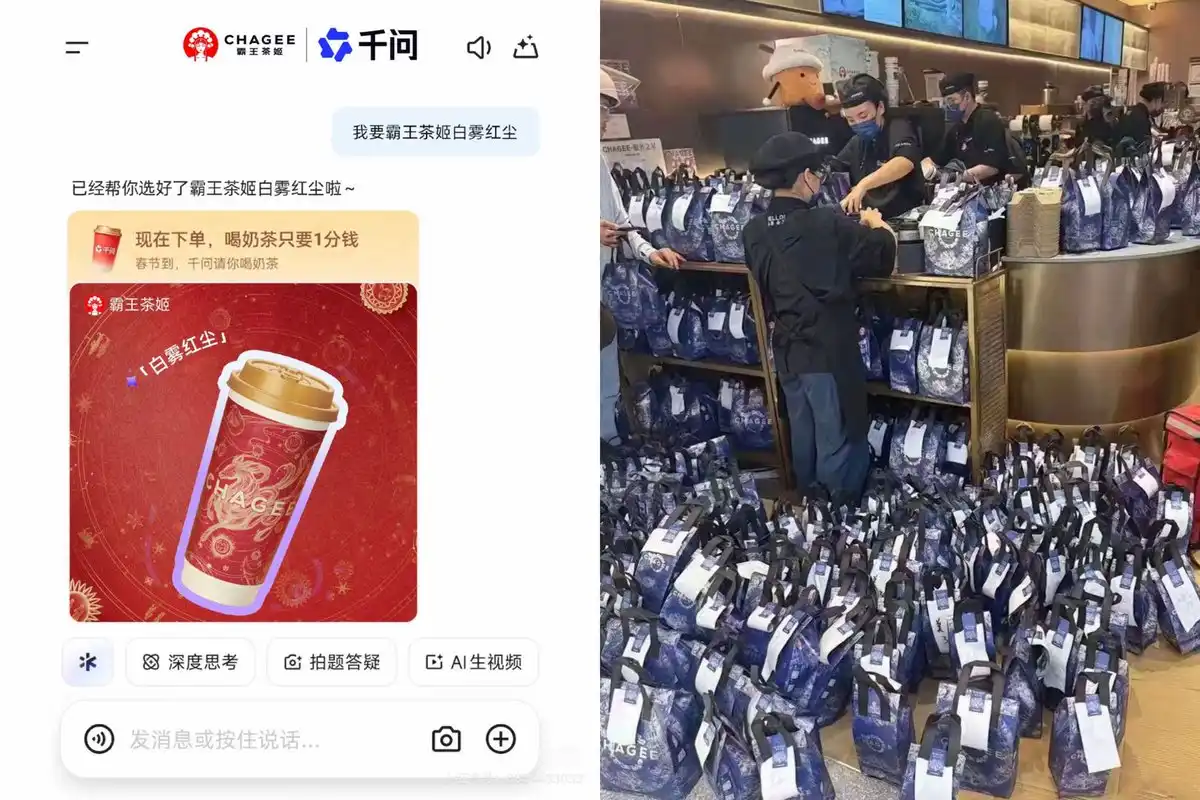
Image source from the internet
How Should AI Spring Festival Marketing Be Done?
The Spring Festival is indeed a must-compete place for AI marketing—it covers the widest user base, has the highest usage frequency, and is most suitable (最适合) for concentrated投放 (launches).
Grabbing red packets suits the national context, but AI tools doing this are easily criticized. The key is whether real pain points are solved with AI.
Based on big tech cases and industry trends, the right approach for AI Spring Festival marketing should be:
1. From "Giving Red Packets" to "Getting Things Done"
Bad example: Yuanbao's red packets were completely disconnected from AI functions, users left after getting money.
Good example: Alibaba's Qwen let users use AI to order takeout, book flights, buy movie tickets for direct freebies. This not only lowered the尝试门槛 (trial barrier) but also let users experience the value of "AI can get things done."
Spring Festival travel scene suggestions:
- Smart itinerary planning: Input departure, destination, budget, AI automatically plans the optimal route home (train/flight/carpool combination).
- Ticket-grabbing assistant: Real-time monitoring of ticket availability, smart recommendations for transfer options, providing more feasible cost-effective (性价比) plans, not just simple speed-up packs.
- Luggage list generation: Automatically generate a packing list based on destination weather, trip duration, personal habits.
- Local custom crash course: For users bringing partners/children back home, provide quick方言学习 (dialect learning),一键整理 (one-click organize) locally preferred gifts, making New Year greetings easier.
2. From "Spending Money to Acquire Users" to "Saving Money to Retain Users"
Big tech spending money to buy users has become an arms race, but users are getting smarter—you spend 10B, I take it and leave.
Cost-effective strategies:
- AI-generated personalized New Year greetings: Generate heartfelt messages + AI greeting cards based on relationship closeness and recipient preferences, solving the "awkward mass messaging" problem.
- Smart family photo organization: Upload yearly photos during Spring Festival, AI automatically categorizes, generates annual memory videos, solving the "phone storage explosion" pain point.
- Relative Q&A rehearsal: Input questions relatives might ask (salary, partner, children), AI generates tactful response scripts, solving "Spring Festival social anxiety".
3. From "Social裂变" to "Word-of-Mouth裂变"
WeChat banning Yuanbao was essentially protecting the social experience. AI marketing shouldn't damage relationship chains, it should enhance them.
Innovative plays:
- AI family group管家 bot: Automatically organize important info in family groups (gathering times, location changes), grab red packets promptly to avoid missing out.
- Cross-generational games: Design AI interactive games suitable for grandparents, parents, and children to play together (like AI lantern riddles, AI couplet writing), letting AI bridge the generation gap.
- New form of AI red packets: Not giving money, but giving "AI-generated exclusive blessing videos," "AI-customized family tree charts," making sharing有面子 (face-giving).
4. From "Spring Festival Blitz" to "Long-Termism"
All Spring Festival marketing faces the same problem: how to retain users after the hype recedes?
Retention mechanism suggestions:
- Continue Spring Festival tasks: AI tasks completed during the festival (e.g., generating New Year videos) automatically remind users to "use AI to create holiday content" during the Lantern Festival, Qingming Festival, etc.
- Habit-forming challenges: "7-day AI Life Challenge"—use AI to solve one practical problem daily (check weather, make攻略 (guides), write emails), earn points upon completion redeemable for perks (points can be used for WeChat/Alipay wallet withdrawal fee waivers).
- Personalized memory: AI remembers user needs during Spring Festival (e.g., "go back to Henan hometown every Spring Festival"), proactively provides related services the following year, planning travel early.
Making AI truly useful in "the matter of Spring Festival" is the best marketing.
A Single Flower Does Not Make Spring, A Hundred Flowers Blooming Fill the Spring Garden
Hopefully, while domestic tech giants actively market, they can also strive to catch up, optimize models—after all, a good product is king. Looking forward to the next国产 AI 之光 (shining light of domestic AI).